
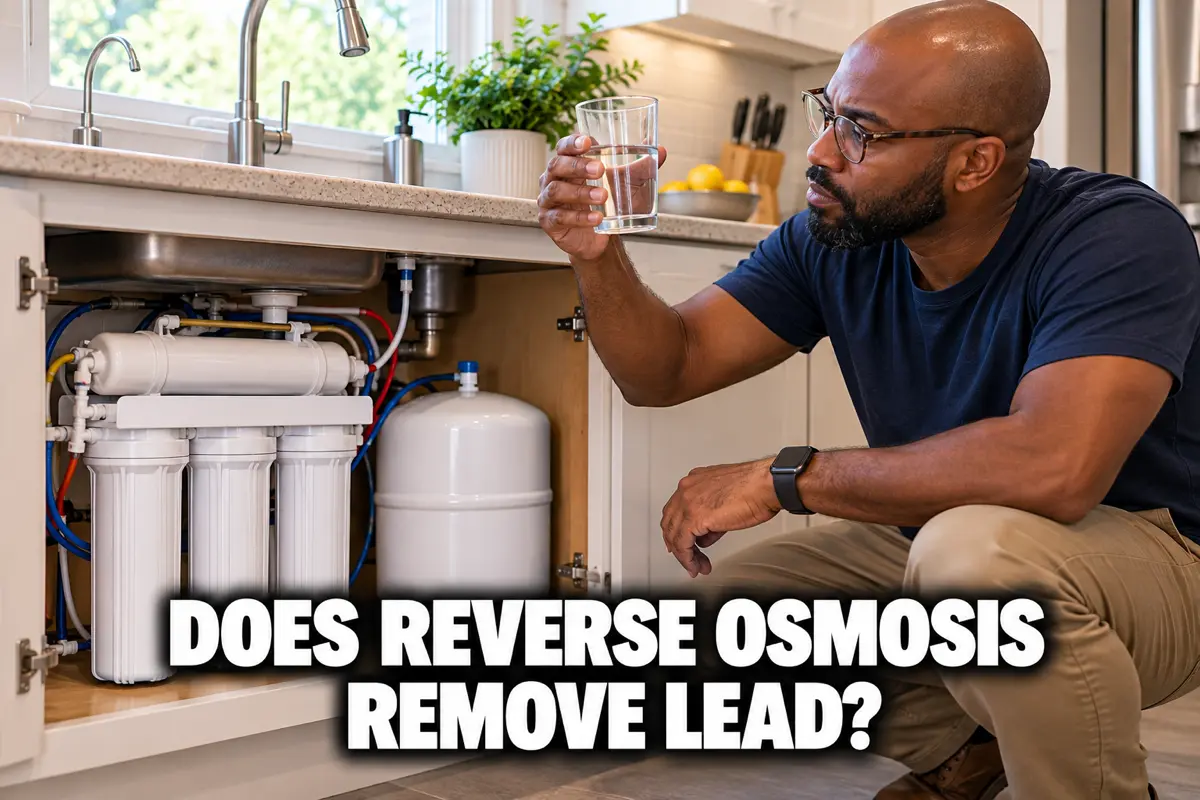
Yes, reverse osmosis (a filter that pushes water through a screen so fine that metals stay behind) can reduce dissolved lead. A system certified for lead gives you independent proof. The words “reverse osmosis” on a box do not prove that. Lead can enter water from old pipes and fittings, so the label on your own system matters.
This guide explains how the process works, which other contaminants it filters, and what it does to the minerals in your water. By the end, you’ll know how to tell a lead-certified system from one that only sounds like it.
Key Takeaways
- Look for NSF/ANSI 58 certification (the home reverse osmosis standard) that lists a lead claim.
- A total dissolved solids meter cannot tell lead from calcium, so a low reading proves nothing about lead.
- Certified systems can also cut arsenic, nitrate, fluoride, and PFAS (long-lasting industrial chemicals) when those claims are listed.
- Reverse osmosis also removes minerals, so the water can taste flat.
Does Reverse Osmosis Remove Lead? What Certified Systems Achieve
Reverse osmosis is a filtration method that pushes water through a semipermeable membrane (a screen so fine that only water molecules and a few small molecules pass). Dissolved lead stays behind and goes to drain, so a reverse osmosis system can reduce lead in drinking water.
Not every unit earns a yes. A system certified to NSF/ANSI 58 (the standard for home reverse osmosis units, run by NSF International) has passed independent testing. The standard’s main benchmark is cutting total dissolved solids (TDS, the minerals and metals dissolved in water). Lead is an optional claim that must be independently verified and listed in the certification.
According to the EPA, there is no known safe level of lead in drinking water. Its public health goal for lead is zero. Drinking water can make up 20% or more of a person’s total lead exposure. For infants fed formula mixed with tap water, the share is 40 to 60%.
The CDC recommends a filter certified to NSF/ANSI Standard 53 (the NSF standard for health-related contaminants, including lead) when lead is the concern. A reverse osmosis system can serve the same purpose when its certification lists lead.
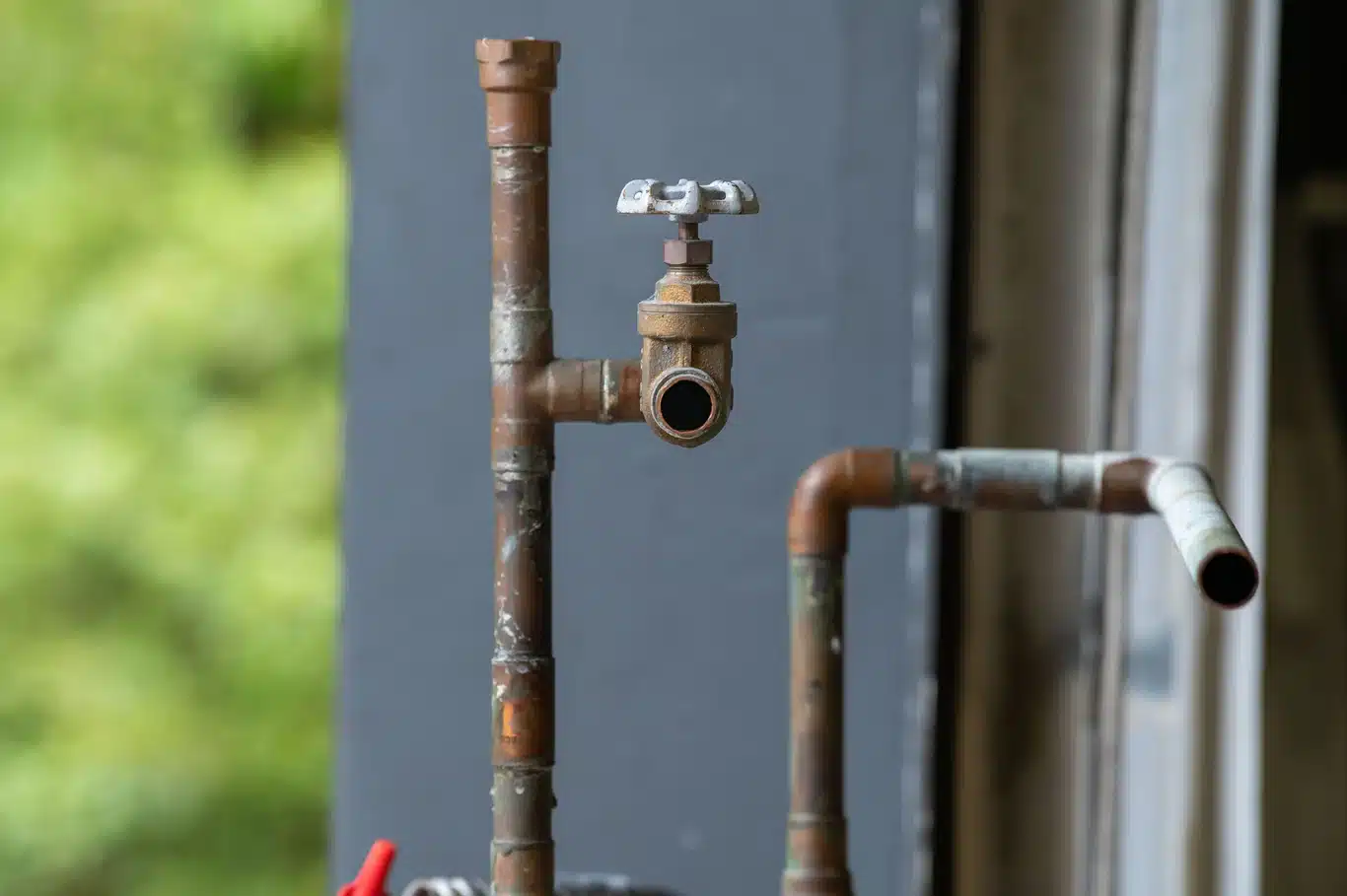
Lead rarely starts at the treatment plant. The EPA says it usually leaches from old service lines (the pipe from the street main to your home), solder (the metal used to join pipes), and brass fixtures. That is why the water at your own tap can differ from your city’s reports.
The distinction manufacturers rarely make clear is simple. Reverse osmosis names a method, while a certification names a result. Two units can use the same membrane, and only one may have been tested for lead. Look for a lead claim in the certification listing, not just on the box.
How Reverse Osmosis Works
Reverse osmosis (RO, a filter that forces water through a screen so fine that almost only water passes) works by pressure. Home water enters the system at about 40 to 80 PSI (pounds per square inch, a measure of water pressure). That pressure pushes it through a thin-film composite membrane (a very thin sheet of layered plastic). The membrane is a dense layer that passes water far more readily than dissolved contaminants.
So how does reverse osmosis work once the water reaches the membrane? Dissolved ions (electrically charged bits of salts and metals) and many larger molecules are largely held back by the membrane. Rejection depends on the membrane, the contaminant and operating conditions. They are rejected and flushed to the drain, while the cleaned water flows on to a storage tank or the tap.
A typical five-stage under-sink unit, explained further in our guide to what a reverse osmosis system is, runs water through these stages in order:
- Sediment pre-filter: Traps dirt, rust and grit down to about 5 microns (a micron is about 1/100th the width of a human hair). This keeps them from clogging the later stages.
- GAC pre-filter: Granular activated carbon (GAC, loose carbon granules that grab chemicals onto their surface) removes chlorine, which can damage the membrane.
- Carbon block: A pressed block of fine carbon, rated near 1 micron, catches more chemicals and smaller particles.
- RO membrane: The thin-film membrane rejects dissolved salts, metals and most organic molecules.
- Carbon post-filter: A final carbon stage polishes the taste before the water reaches the faucet.
One practical point is easy to miss. A TDS meter (a handheld tester for total dissolved solids, which estimates them from how well water conducts electricity) cannot tell calcium from lead. A reading of 200 ppm (parts per million) could be either, so a low reading alone proves nothing about lead.
What Else Reverse Osmosis Removes Besides Lead
Lead is not the only dissolved contaminant a certified system can cut. The membrane rejects dissolved ions in general, so the screen that holds back lead also holds back many others. Removal is not guaranteed, and it shifts with water pressure, temperature and membrane age. Our full guide to what reverse osmosis removes lists more.
Does reverse osmosis remove arsenic? It can reduce pentavalent arsenic (arsenic V). Trivalent arsenic (arsenic III) is harder, so it should be oxidized first (chemically converted to arsenic V). Does reverse osmosis remove nitrates? It can reduce them when the system lists a nitrate claim.
Does reverse osmosis remove fluoride? It can reduce it when the system lists a fluoride claim. Does reverse osmosis remove PFAS? It can reduce them when the system lists a specific PFAS claim. PFAS (per- and polyfluoroalkyl substances) are long-lasting man-made chemicals, and PFOA and PFOS are two common examples.
Does reverse osmosis remove chlorine? Mostly through the carbon stages, not the membrane. Carbon reduces chlorine, and chlorine can damage some membranes, so the carbon pre-filters protect them. Does reverse osmosis remove microplastics? In principle, yes: microplastics (tiny plastic fragments) are far larger than the dissolved particles the membrane rejects.
The table pairs each contaminant with the limit set by the US Environmental Protection Agency (EPA). Units are ppb (parts per billion), mg/L (milligrams per liter) and ppt (parts per trillion):
| Contaminant | RO performance | EPA limit |
| Arsenic | Verify the model’s claim | 10 ppb |
| Nitrate | Verify the model’s claim | 10 mg/L (as nitrogen) |
| Fluoride | Verify the model’s claim | 4 mg/L |
| PFOA and PFOS | Verify the model’s claim | 4 ppt each |
Reverse Osmosis Health Questions: Minerals and Taste
The reverse osmosis health debate mostly comes down to minerals and taste. The membrane rejects dissolved minerals along with contaminants, so the water in your glass is low in both. Which side matters more depends on what you want from your drinking water.
Does reverse osmosis remove minerals? Yes. Calcium and magnesium are dissolved solids, so the membrane rejects most of them along with the contaminants. RO water often reads only 5 to 25 ppm of TDS. The membrane does not pick and choose. It rejects by size and charge, not by whether a dissolved particle is helpful or harmful. If you also use a ZeroWater pitcher, its TDS readings help indicate when to change a ZeroWater filter.
Low-mineral water can taste flat. Many systems add a remineralization post-filter (a final cartridge that adds calcium and magnesium back to the water) to soften that taste. If you want a rounder taste, look for that stage in the product details.
Reverse osmosis is a water treatment step, not a medical one. Nothing here suggests that RO water prevents or treats any disease. A certified system changes what is in the water, and that is all it claims to do. If you have a medical reason to watch your mineral intake, ask your doctor.
Does Reverse Osmosis Remove Lead in Every Home? Limits to Know
Not automatically. A system earns the yes only with a lead claim under NSF/ANSI 58 (the home reverse osmosis standard from NSF International, an independent certifier) and proper upkeep. The standard’s own core test is at least 75% TDS reduction.
Even a well-certified under-sink unit treats a single tap, usually the kitchen faucet. Lead can still reach every other tap, shower and fixture in the home. The unit sits at one point in the plumbing. So treating the drinking tap does not treat the whole house.
Four limits are worth checking before you rely on a system:
- Certification: Find your exact brand and model in the public database of NSF, WQA or IAPMO (certifiers that test to NSF/ANSI standards). Confirm a lead claim under NSF/ANSI 58. Wording such as “tested to NSF standards” or “uses NSF certified materials” does not count.
- Upkeep: Replace the carbon cartridges and the membrane on schedule. Carbon cartridges often last 6 to 12 months and membranes 2 to 3 years. Your water and usage can shorten that.
- Your own water: Have a certified laboratory test your tap water for lead. Your utility’s Consumer Confidence Report (its yearly water quality report) gives system-wide context but cannot show the lead level at your tap.
- Wastewater: The EPA reports that typical point-of-use RO systems send five or more gallons to the drain per gallon treated. WaterSense-labeled systems send no more than 2.3. Check the complete system’s efficiency rating. Read more on how much water reverse osmosis wastes.
The NSF certified water treatment unit search lets you find your brand and model and check for a lead-reduction claim under NSF/ANSI 58 before you rely on a system.
How We Research
We check every claim against primary sources. Federal agencies like the EPA and CDC come first. Certification bodies like NSF and AHAM come next. We verify each standard number against the issuing body. We review this guide on a set schedule.
Why Trust This Guide
Puritisimo covers only water and air quality. Our guidance is editorial and independent. We cite every health figure so you can check it. We never present a promotional claim as fact.
The Certification Detail That Decides the Answer
The words reverse osmosis describe how a system works. They do not say what the system has been tested to remove. A unit certified to NSF/ANSI 58 with a lead claim has passed independent testing for lead. A unit without that claim has no independent proof behind it.
Pair the right label with a fresh membrane and fresh cartridges. Your utility’s yearly report gives useful background, but only a certified laboratory test shows the lead level at your tap. Plumbing can add lead after treatment. Once you know what to look for on the label, you can judge whether reverse osmosis removes lead in your home.
Frequently Asked Questions
Does reverse osmosis remove lead?
Reverse osmosis often removes lead from drinking water when the system is certified to NSF/ANSI 58 with a lead claim. That claim is optional, because the standard’s main benchmark is total dissolved solids (TDS) reduction. The EPA sets its health goal for lead at zero, so confirm the certification before you rely on any unit.
What is a major problem with reverse osmosis?
The two main drawbacks of reverse osmosis are wastewater and flat-tasting water. The EPA reports that typical point-of-use systems send five or more gallons to the drain per gallon treated, while WaterSense-labeled systems send no more than 2.3. Because the membrane also rejects minerals, TDS often falls to 5 to 25 ppm, and the water can taste flat.
How to remove lead from water?
The CDC (US Centers for Disease Control and Prevention) recommends a filter certified to NSF/ANSI Standard 53 for lead. A reverse osmosis system with a lead claim under NSF/ANSI 58 is another certified route. Flush the tap when water has sat for hours, and have a certified laboratory test your tap water, since your utility’s Consumer Confidence Report shows only system-wide results.
Do Brita filters remove lead?
Lead removal depends on the Brita model. Brita Standard is certified to NSF/ANSI 42, and to NSF/ANSI 53 for some other metals, but its listed reductions do not include lead. Brita’s OB06 replacement filter lists lead reduction under NSF/ANSI 53, the standard for health-related contaminants, in NSF’s database. Match your pitcher and filter to that listing.
Is reverse osmosis water safe to drink every day?
A well-maintained reverse osmosis system gives you daily drinking water with far fewer dissolved contaminants. The main trade-off is taste, because water with few minerals, often 5 to 25 ppm TDS, can taste flat. Remineralization post-filters add calcium and magnesium back, and your doctor can advise if you have a reason to watch mineral intake.
References
- US Environmental Protection Agency. Basic Information about Lead in Drinking Water. Accessed October 2026.
- Centers for Disease Control and Prevention. Lead in Drinking Water. Lead Prevention. Accessed October 2026.
- NSF International. Standards for Water Treatment Systems. Accessed October 2026.
- US Environmental Protection Agency. National Primary Drinking Water Regulations. Accessed October 2026.
Medical Disclaimer: This content is for informational purposes only. It is not a substitute for professional medical advice, diagnosis, or treatment. If you have concerns about your water quality or air quality and their effects on your health, consult a qualified healthcare professional.

