
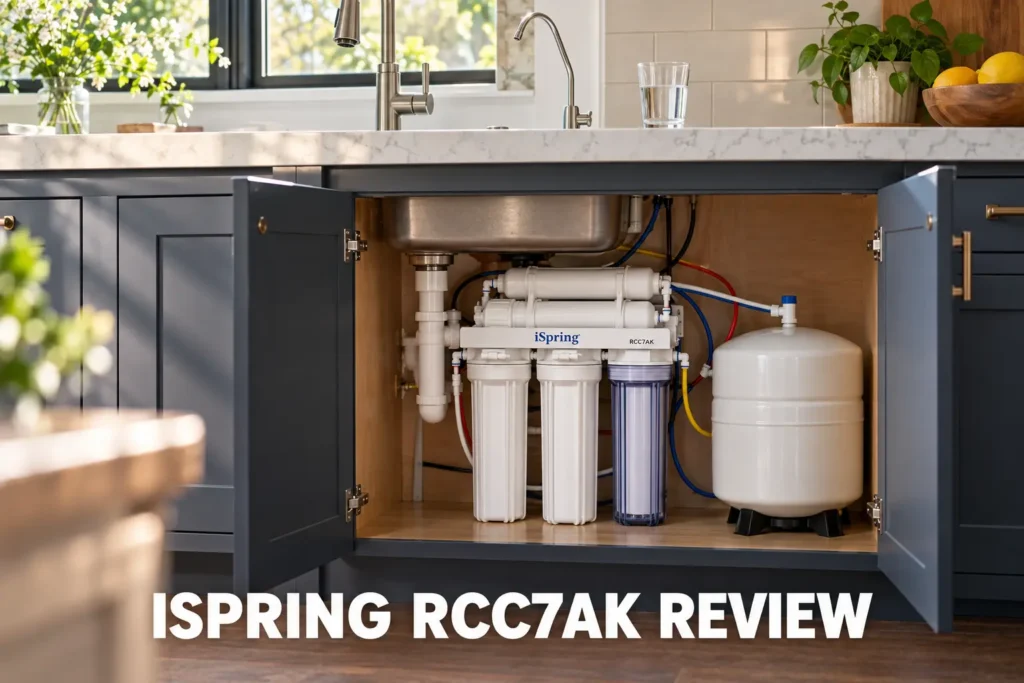
This iSpring RCC7AK review comes down to one question: does the alkaline remineralization stage justify picking it over the plain RCC7? If your household draws municipal water under the 750 ppm feed-water TDS ceiling and wants NSF/ANSI 58-certified reduction of lead, fluoride, and PFAS without running any electricity, I recommend it without hesitation.

The rest of this review walks through what the iSpring RCC7AK actually filters out, how living with its tank and cartridge stack compares to iSpring’s own UV and booster-pump variants, and who I would point toward a countertop system instead before anyone spends on installation.
Quick Verdict
iSpring rates the complete RCC7AK-BN system to NSF/ANSI 58, with TDS reduction between 93 and 98 percent and PFAS reduction between 96 and 99 percent, backed by a six-month primary filter interval and a two-year membrane life.
- Lead, fluoride, and PFAS cut to a fraction of incoming levels, with no added chemical taste from the alkaline stage.
- No electricity bill or pump hum, since the RCC7AK-BN runs entirely on incoming water pressure.
- A staggered filter schedule spread across several small purchases instead of one large annual one.
iSpring RCC7AK Review: What This 6-Stage System Actually Is
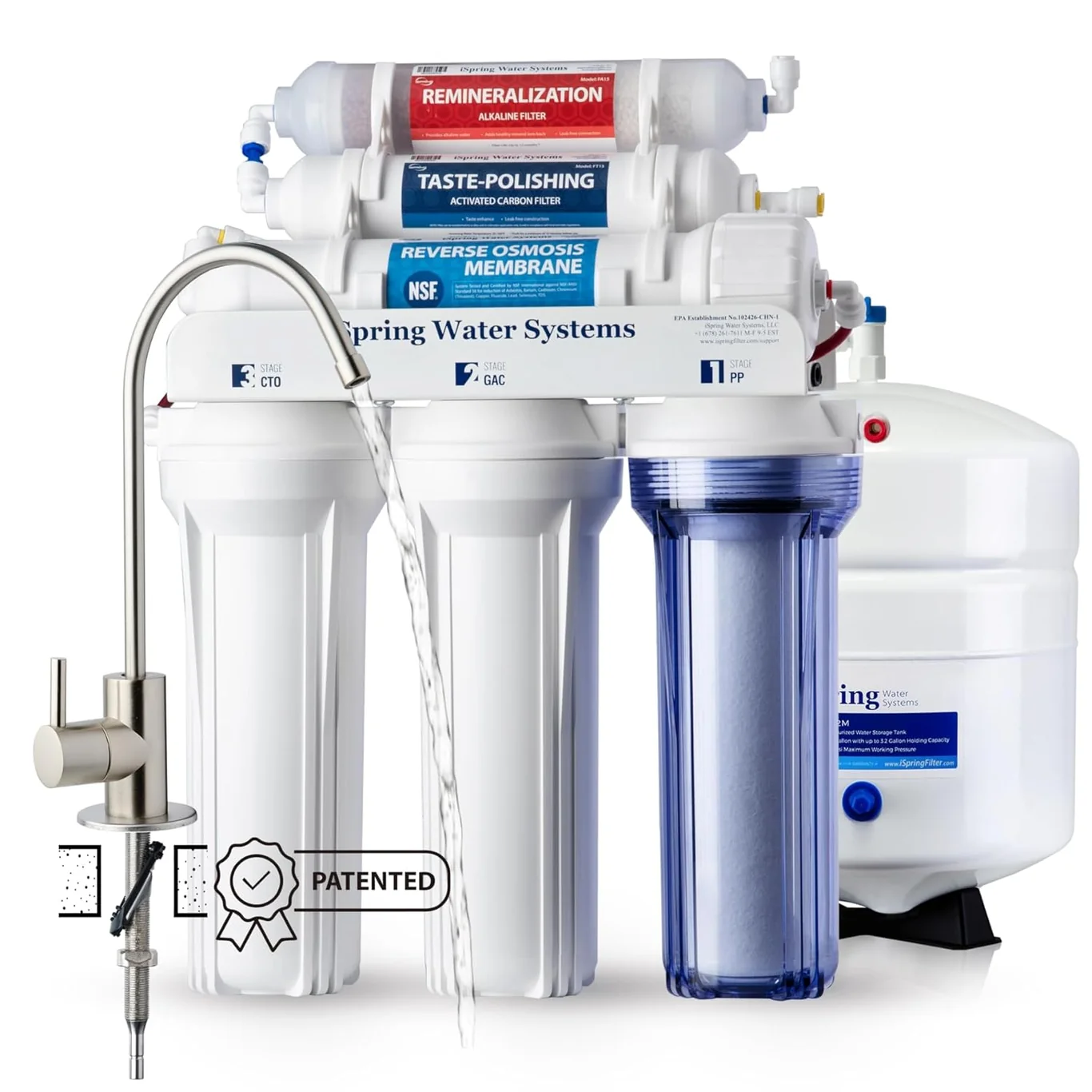
The iSpring RCC7AK-BN is a six-stage under-sink reverse osmosis system built around an alkaline remineralization stage that sits after the RO membrane and adds minerals back into water that reverse osmosis otherwise strips out entirely.
The plain RCC7 without the alkaline stage is reviewed in my iSpring RCC7 baseline review, which covers the same five-stage filtration core at a simpler specification.
I run an under-sink RO system in my own kitchen, and the alkaline stage is the detail I weigh first when deciding between this unit and the plain RCC7.
Households that want tap filtration without any under-sink plumbing can compare a certified clip-on alternative in my PUR Plus faucet filter breakdown.
iSpring sells the RCC7 family in several configurations, including two I cover in the comparison section below: one adds UV disinfection, the other adds a booster pump for low-pressure homes.
Specifications
| Specification | Detail |
| Certification | NSF/ANSI 58 (complete system) |
| TDS reduction | 93 to 98 percent |
| PFAS reduction | 96 to 99 percent |
| Lead reduction | over 98.9 percent |
| Fluoride reduction | over 97.4 percent |
| Rated daily production | 75 GPD |
| Minimum operating pressure | 70 psi |
| Maximum supported feed water TDS | 750 ppm |
| Primary filter replacement interval | 6 months |
| Membrane replacement interval | 2 years |
Key Features
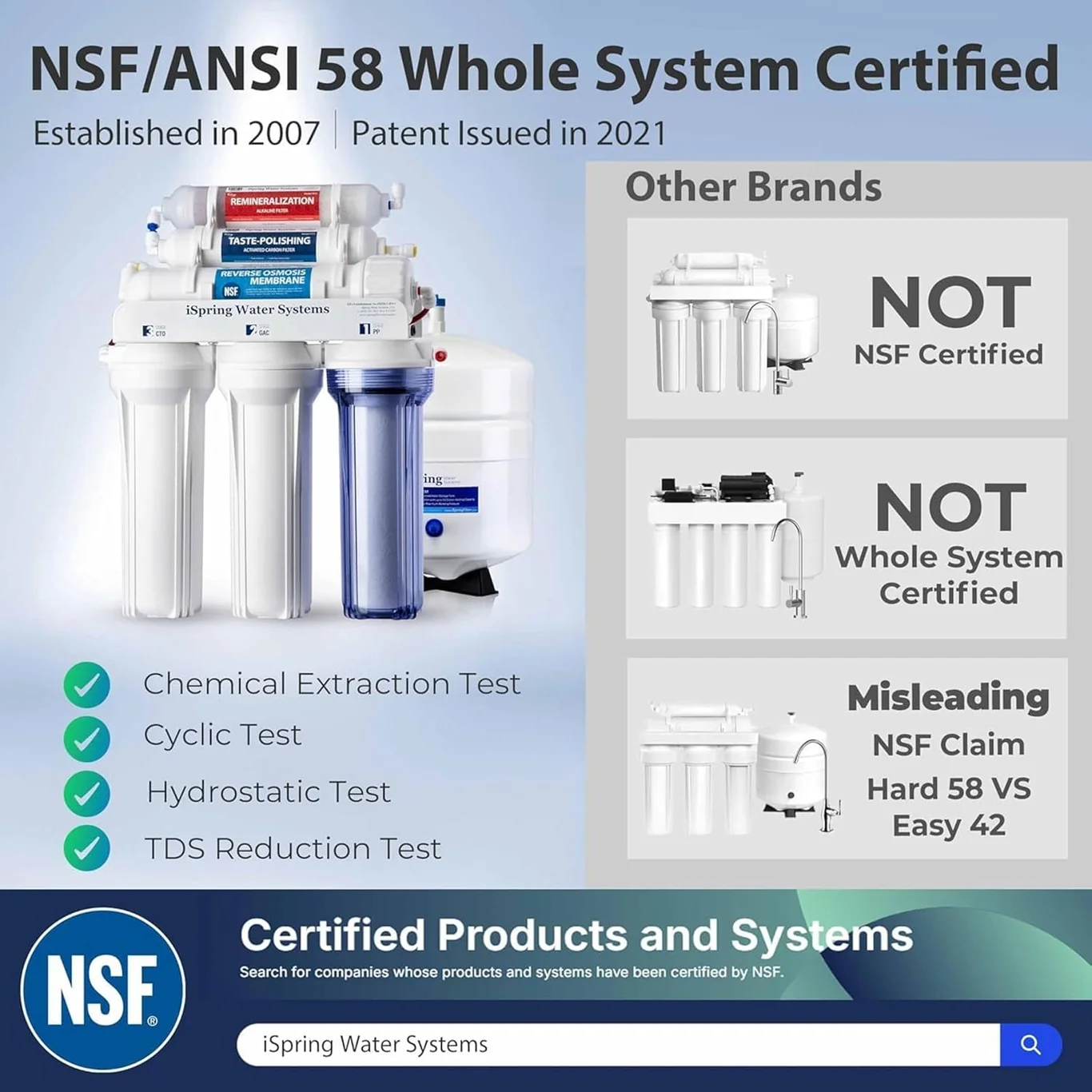
- NSF/ANSI 58 certification covers the complete system rather than one component, which is the differentiator iSpring itself points to.
- 93 to 98 percent TDS reduction alongside 96 to 99 percent PFAS reduction, both manufacturer-rated.
- An alkaline remineralization stage that puts minerals back into water after the RO membrane strips them out.
- No electricity required anywhere in the system, since it runs entirely on incoming line pressure.
- A staggered cartridge schedule: sediment and carbon every six months, membrane every two years, post-filter every three.
What the iSpring RCC7AK Actually Removes
iSpring’s own listing states that the complete RCC7AK-BN system, rather than a single component inside it, is certified to NSF/ANSI 58, the standard covering point-of-use reverse osmosis systems and TDS reduction claims. I read that as a manufacturer certification claim rather than a figure confirmed against NSF’s own database, since no listing number or independent lab report shows up anywhere in the documentation iSpring publishes. That distinction is worth keeping in mind before you take the claim at face value, and you can check the standard itself if you want the source rather than the summary.
iSpring rates TDS reduction at 93 to 98 percent, PFAS reduction at 96 to 99 percent, lead reduction at over 98.9 percent, fluoride reduction at over 97.4 percent, and chlorine reduction at 95 to 99 percent. Every one of those numbers comes from iSpring’s own listing, not from independent testing, and I think that attribution matters enough to state plainly rather than bury in a footnote. The EPA’s own PFAS guidance is a useful cross-check if you want a second source on what that contaminant class actually is.
None of this means the system removes everything. A 93 to 98 percent TDS range and a 96 to 99 percent PFAS range both leave a real gap, and I would weigh that gap differently for a household making drinking or formula water for young kids than for one just chasing better-tasting tap water. I expected the PFAS figure to read closer to complete elimination than it does, and it does not, which is worth knowing before you buy rather than after.
Buyers who want certified drinking-water filtration without any under-sink installation can compare the point-of-use pitcher options in my guide to the best water filter pitcher.
If you want to see how this system stacks up against other reverse osmosis units rather than just under-sink filters generally, our reverse osmosis system roundup covers more models across a wider price range.
Living With the iSpring RCC7AK Day to Day
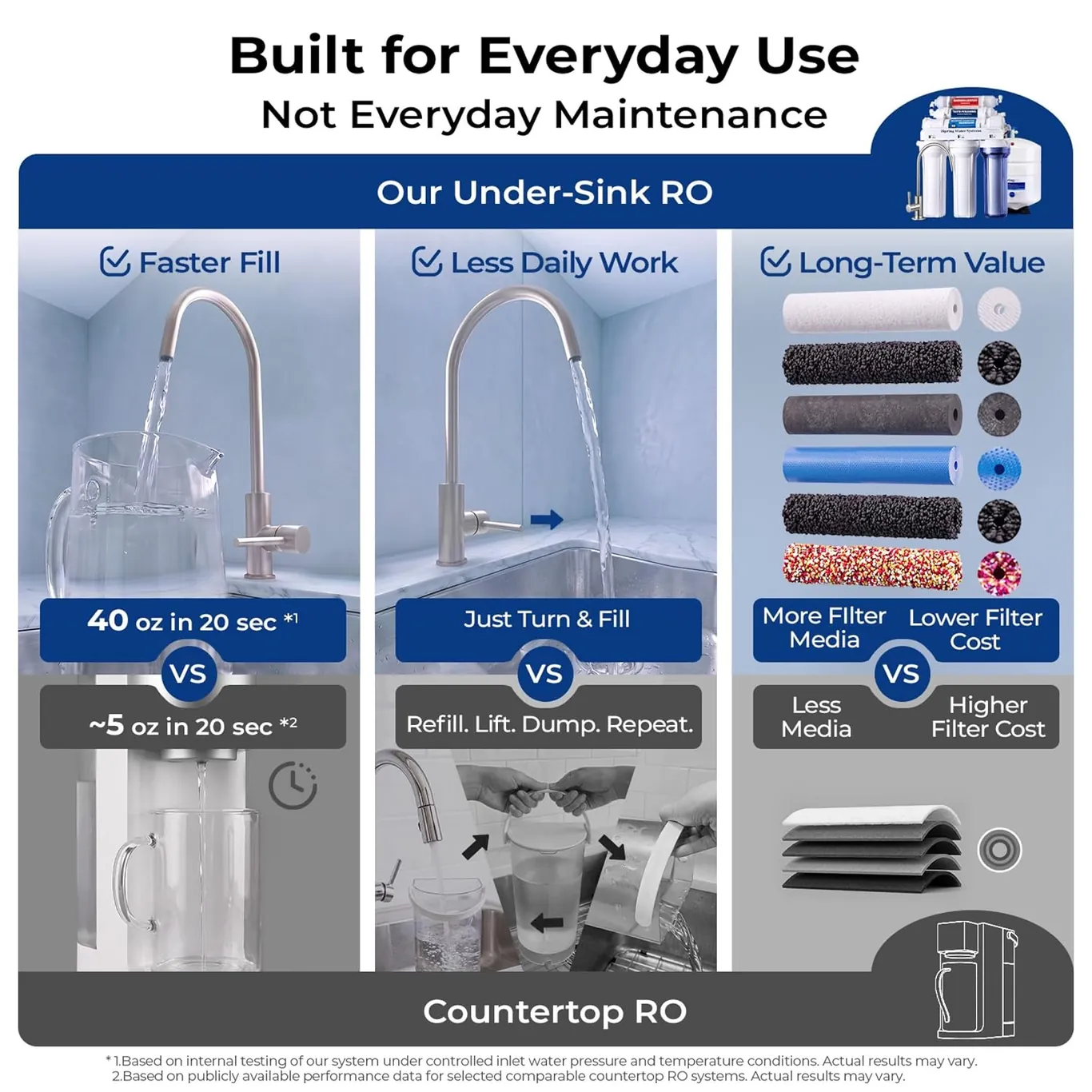
Replacement here runs on a staggered schedule instead of one all-in-one cartridge. iSpring rates the F4AK sediment and carbon set for six months, the F19K75 membrane set for two years, and the F28K75 post-filter set for three years. Counted out over a decade, that works out to roughly twenty sediment and carbon changes against five membrane changes and about three post-filter changes, which is the arithmetic I’d walk a buyer through before assuming all three filters come due on the same day.
Buyers comparing this system to other certified under-sink options can see a broader field in my guide to the best under-sink water filter.
I count the running cost as modest for a 6-stage under-sink system, in line with what I’d expect from this class of RO unit, since it is spread across three separate purchases on three different schedules rather than one large expense at once. That is a genuine advantage over a single-cartridge design, where every filter type gets swapped on the same visit whether it needs it or not.
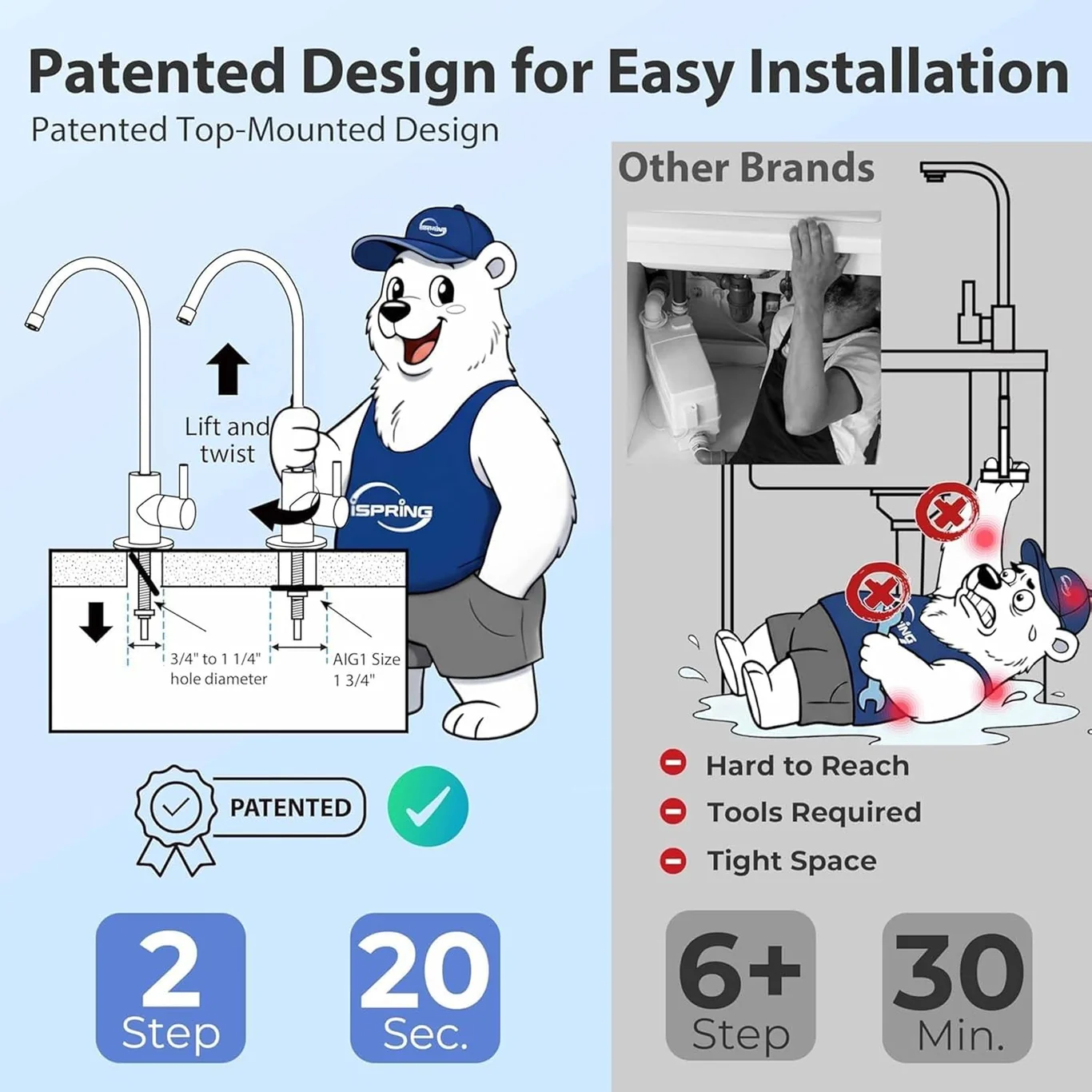
The system needs no electricity to run, which also means no pump hum and no fan noise. The only sound most owners notice is the storage tank refilling through the drain line after a draw, and I would call that the quietest part of owning one of these. Installation uses quick-connect push-to-connect fittings and color-coded tubing, and the box ships with a small tool set alongside the RO unit, faucet, and storage tank, so I would not call it entirely tool-free despite the DIY-friendly label it ships under.
The Water Quality Association’s own reverse osmosis overview covers this same staggered-maintenance pattern if you want a source outside iSpring for how these systems are typically serviced.
Pros
- Runs with no electricity, so there is no pump hum or fan noise to live with.
- iSpring claims NSF/ANSI 58 whole-system certification for the complete RCC7AK-BN, rather than a single component.
- High reduction across TDS, PFAS, lead, fluoride, and chlorine per iSpring’s own published figures.
- A staggered filter replacement schedule spreads maintenance across three different intervals instead of one all-at-once change.
- The AK alkaline stage adds pH and mineral remineralization that the base RCC7 does not have.
- Installation uses quick-connect push-to-connect fittings with a tool set included in the box.
Cons
- The tank, canisters, and tubing take up more under-sink cabinet space once fully installed than the box suggests.
Who Should Skip the iSpring RCC7AK
Households on well water with feed TDS above the 750 ppm ceiling iSpring specifies should skip this unit. It is built and warrantied for water at or below that threshold, and I would treat that spec as a hard line rather than a suggestion, especially since well water TDS can vary by season in ways a single test might miss. If your household is on a private well, the CDC’s guidance on private well testing is worth reading before you assume your feed water qualifies.
Households on municipal water that only need sediment and chlorine reduction at every tap, without full dissolved-solid removal, can compare a far simpler alternative in my PUREPLUS pre-filter breakdown.
Anyone who cannot free up the under-sink cabinet space this system’s tank and canister stack requires, or who wants a system usable without drilling a dedicated faucet hole, is better served by a countertop unit. I would point that buyer toward our countertop water filter guide rather than toward this one, since a countertop system solves the no-drill, no-cabinet-space problem this design does not.
Buyers who specifically want built-in UV disinfection for bacterial contamination should look at the RCC7AK-UV variant instead, since this base model has no UV stage of its own. Renters who cannot modify plumbing or drill a sink hole should also look elsewhere, and I would not try to talk either buyer out of that. For renters who need a fully portable option with no drilling at all, my Royal Berkey portable filter review covers a countertop alternative that needs zero installation.
| Model | How it differs | Pick it instead if |
| iSpring RCC7AK-BN (this review) | ||
| iSpring RCC7 | ||
| iSpring RCC7AK-UV | ||
| iSpring RCC7P-AK |
Common Problems With the iSpring RCC7AK
The most consistent complaint alongside otherwise positive water-quality feedback is bulk. Once the storage tank, canisters, and tubing are all installed, the footprint under a sink is meaningfully bigger than a single-cartridge system, and I think that trade-off deserves more attention than it usually gets in a spec sheet.
Water waste is the second recurring pattern. Reverse osmosis rejects more feed water than it produces as drinking water by design, not as a defect, and I would tell any first-time RO buyer to plan for that ratio rather than be surprised by it later.
Buyers who want zero water waste and no storage tank under the sink can compare a compact certified pitcher in my Waterdrop PT-07B pitcher review.
Assembly comes up as more involved than a DIY-friendly label suggests, even with the quick-connect fittings doing most of the work. I would budget more time for the first install than the box art implies.
High PFAS reduction, per iSpring’s own 96 to 99 percent figure, does not mean complete elimination of every PFAS variant, and that gap matters most for buyers expecting a zero-PFAS result rather than a large reduction in it. I would not oversell that number, and neither should you.
My Overall Verdict
I would put the iSpring RCC7AK-BN in the category of a genuinely capable under-sink RO system for a household on municipal or low-TDS well water that wants alkaline remineralization without paying an electricity bill for it. The certification claim, the contaminant reduction range, and the staggered filter schedule all line up with what I would expect from a serious 6-stage system, not a stripped-down one.
Buyers who want certified reduction at a single tap without any under-sink plumbing can compare the faucet-mount certified options in my guide to the best faucet water filter.
Where I would pump the brakes is the 750 ppm feed TDS ceiling and the under-sink footprint. Neither is a flaw exactly, but both are the kind of detail I would want a buyer to know before installation day rather than after, and both point toward the same conclusion: this is the right system for the right household, not a universal fit.
Households that need certified treatment at every tap and appliance rather than just the drinking-water faucet can compare the tested multi-stage systems in my guide to the best water filtration system for home.
Final Verdict
I would recommend the iSpring RCC7AK-BN to a homeowner on compliant feed water who wants remineralized, well-certified drinking water without a pump or a power cord, which is the honest conclusion I keep coming back to after working through every number in this iSpring RCC7AK review.
Frequently Asked Questions
What are common problems with the iSpring RCC7AK?
You’ll likely notice the under-sink footprint once the tank, canisters, and tubing are all installed, since the full setup takes up more cabinet space than a single cartridge system would. Reverse osmosis also rejects more feed water than it produces as drinking water, so you should plan for that waste rather than treating it as a defect.
How long does the iSpring RCC7AK last?
The F4AK sediment and carbon set needs replacing roughly twice a year, while the F19K75 membrane stretches to two years and the F28K75 post-filter set runs about three years before you’ll need to swap it. Stick to that staggered schedule and the system itself, which iSpring backs with a 1-year manufacturer limited warranty, should keep running well beyond it.
What are the differences between the iSpring RCC7 and RCC7AK filters?
iSpring’s own product family listing describes the RCC7 as a 5-stage system with no alkaline stage, while the RCC7AK-BN you’re looking at here adds a sixth stage for pH and mineral remineralization. If restoring alkalinity to your drinking water matters to you, that extra stage is the entire reason to choose the AK version.
Does the iSpring RCC7AK remove microplastics?
iSpring doesn’t publish a microplastics reduction figure for this system, so you won’t find that claim in the spec sheet or listing. What you do get is iSpring’s own rating of 93 to 98 percent TDS reduction and 96 to 99 percent PFAS reduction, which points to strong particulate rejection overall.
Is the iSpring RCC7AK good?
For a household on municipal water under the 750 ppm feed limit, you’re getting NSF/ANSI 58-certified whole-system performance per iSpring’s own claim, alkaline remineralization, and no electricity required to run it. If you’re on well water near or above that TDS ceiling, or you need built-in UV protection, you’re better off looking at a different model in the lineup.
References
- NSF International. NSF/ANSI 58 Standard for Reverse Osmosis Systems. nsf.org/standards-development/standards-portfolio/water-standards
- U.S. EPA. PFAS National Primary Drinking Water Regulation. epa.gov/sdwa/and-polyfluoroalkyl-substances-pfas
- CDC. Private Ground Water Wells and Testing. cdc.gov/healthywater/drinking/private/wells
- Water Quality Association. Reverse Osmosis Technology Fact Sheet. wqa.org/learn-about-water/water-treatment-methods
Medical Disclaimer: This content is for informational purposes only. It is not a substitute for professional medical advice, diagnosis, or treatment. If you have concerns about your water quality or air quality and their effects on your health, consult a qualified healthcare professional.