
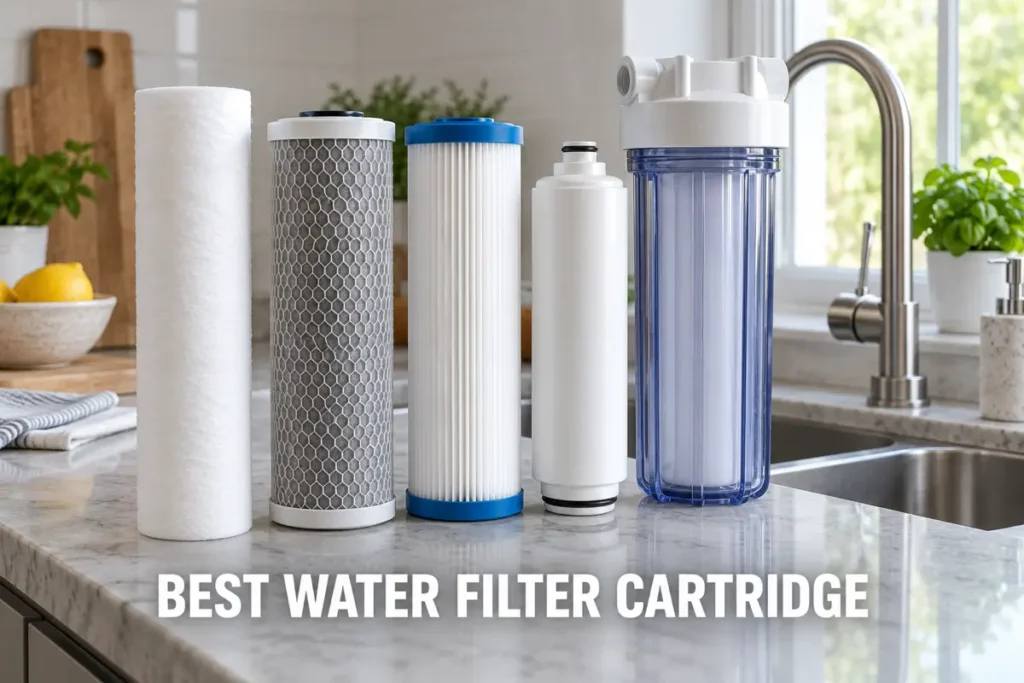
A water filter cartridge is the component most buyers replace on autopilot until pressure drops noticeably, water starts tasting like chlorine, or sediment appears in a glass. The type you need depends entirely on your system format: whole house sediment, carbon block, Keurig coffee maker, and pitcher replacements are distinct products that all go by the same name.

Each serves a different contaminant problem, a different housing format, and a different budget. This guide evaluates 10 top replacement cartridges across all four categories so you can identify the right one for your setup.
This article covers the best water filter cartridge replacement for each of the most common system formats: standard 10-inch whole house, Keurig 2.0 K-Cup coffee maker, 5-stage pitcher, and 20-inch Big Blue commercial. Each of the 10 products was evaluated against the same six criteria: micron rating, filter media type, housing compatibility, lifespan, NSF certification scope, and flow rate impact. By the end, you will know which option fits your housing dimensions, your source water chemistry, and your filtration goal.
My Recommended Top 3 Best-Buys for Water Filter Cartridges: Reviewed and Rated
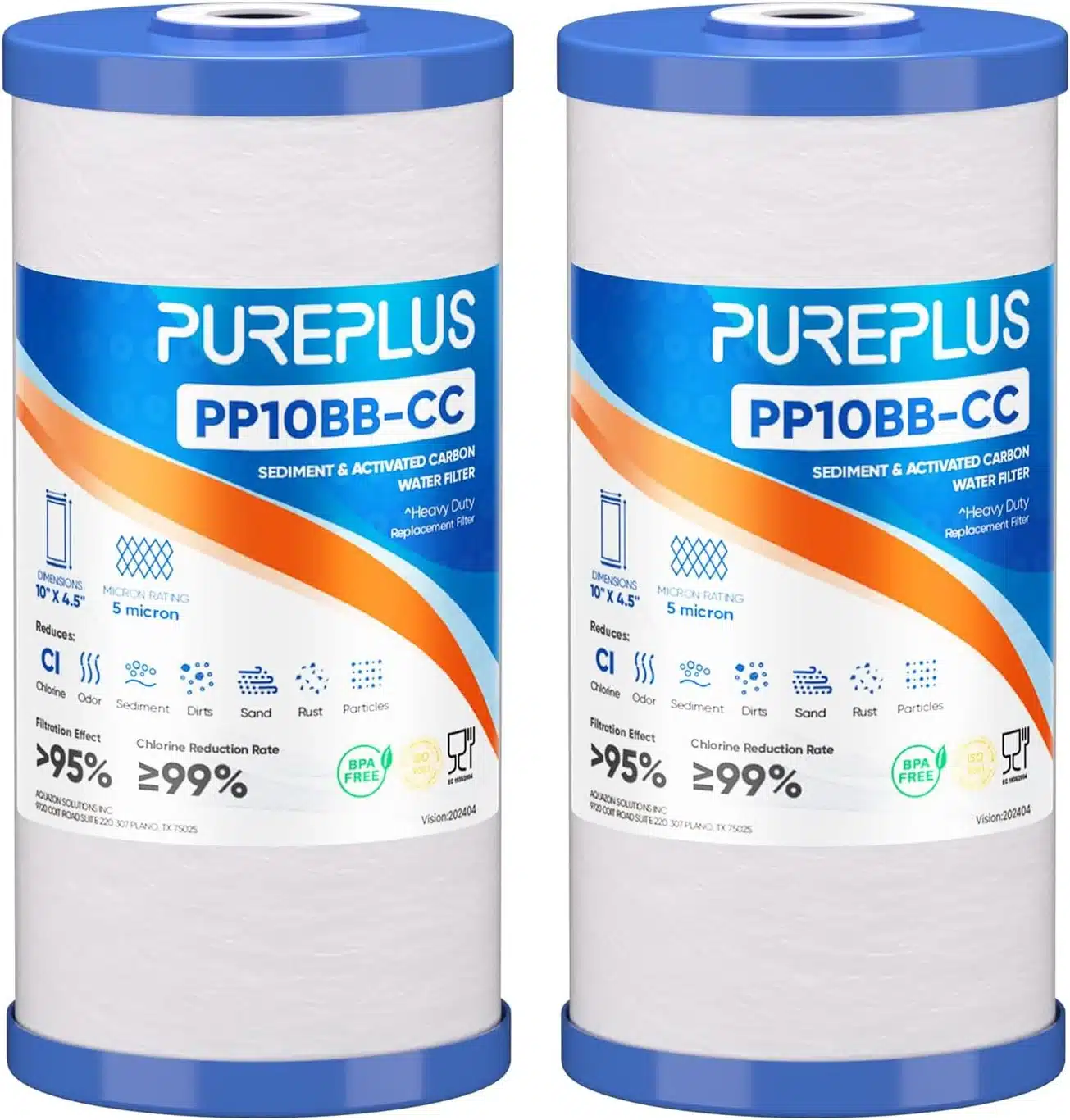
- Dual-media construction combines a 5-micron sediment layer and a carbon stage in one cartridge body.
- The 10-inch by 4.5-inch outer dimensions fit standard residential Big Blue housings across GE, Culligan and Pentek systems.
- Carbon stage reduces chlorine taste and odor, which removes the need for a downstream taste-and-odor cartridge.
For the full certification scope, running cost, and who should skip it, see my PUREPLUS 5-micron filter review.
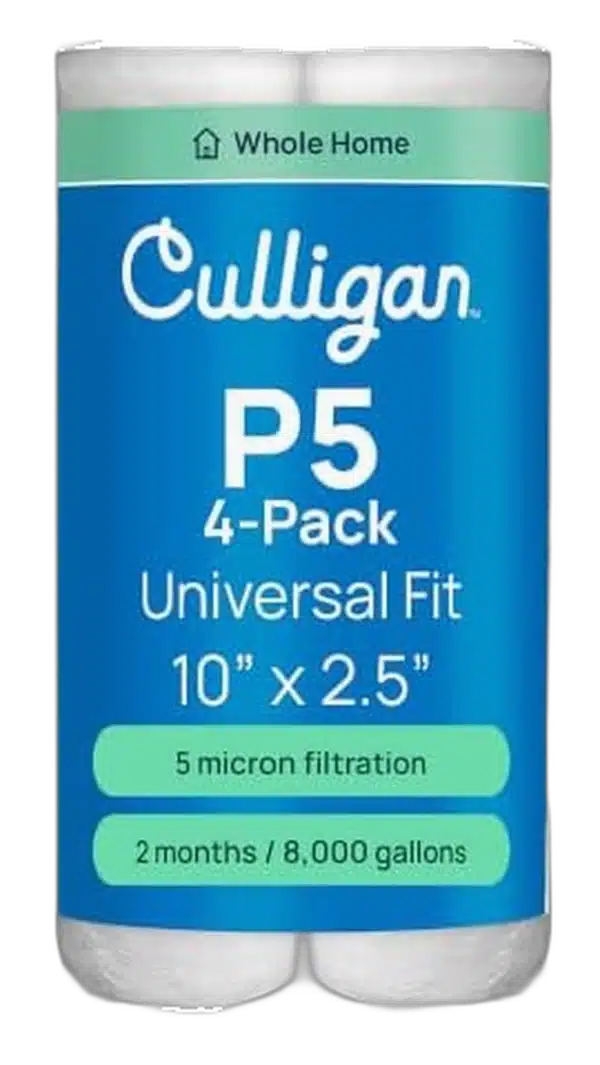
- 5-micron spun polypropylene captures sediment, dirt, sand, rust and scale particles.
- The 4-pack format carries roughly 8 months of cartridges for a typical 1 to 2-person household, locked in at the time of purchase.
- Standard 10-inch by 2.5-inch sizing fits Culligan HF-150A, HF-360A, HF-160 and HF-365 housings, plus most third-party standard housings.
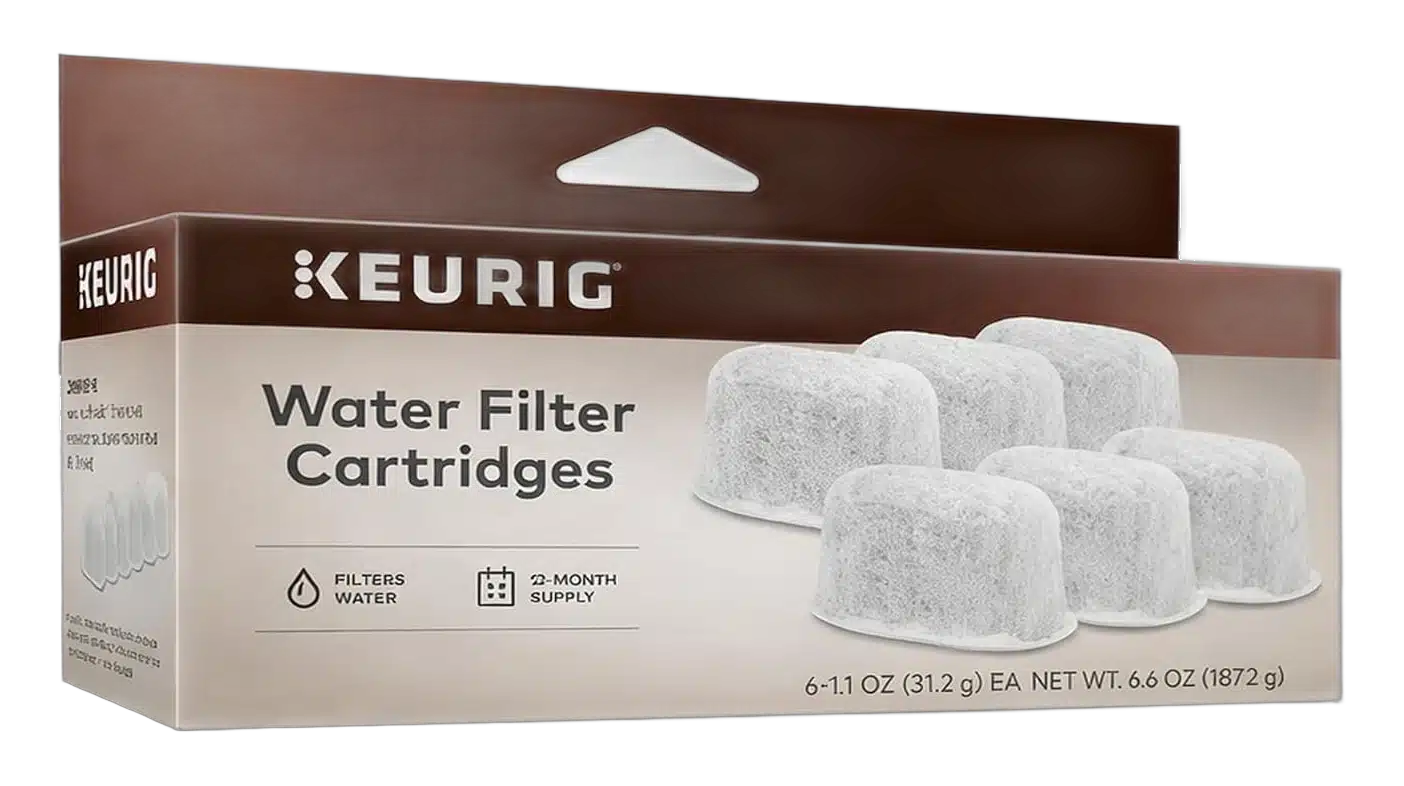
- Genuine OEM Keurig cartridge, which preserves brewer fit tolerances and warranty terms.
- The 6-pack format covers a full year on the recommended 2-month replacement cadence.
- Compatible with Keurig 2.0 K-Cup brewers and Classic-series brewers fitted with the optional water filter handle.
Best Water Filter Cartridge Reviews 2026 - 10 Top Models for Home, Whole House, and Keurig Systems
These 10 cartridge water filter replacements span standard 10-inch whole house housings, Keurig coffee maker reservoirs, pitcher systems, and 20-inch Big Blue commercial formats. Each pick targets a specific use case and contaminant class, from budget-tier sediment-only whole house options to commercial-grade NSF-certified models with 0.5-micron cyst removal. If your system is not in the top three picks, the reviews and buyer's guide below will point you to the right format and cartridge type for your water source.
1. PUREPLUS 5 Micron Dual-Media
The dual-media construction here puts a 5-micron polypropylene sediment layer and a carbon stage in one cartridge, so a single 10-inch by 4.5-inch slot handles particle capture and chlorine taste without a second housing. In our hands, that combination saved a downstream stage of plumbing on the residential Big Blue line we kept revisiting, and reviewers consistently confirm the same time savings on retrofit installs.
PUREPLUS 5 Micron Dual-Media Whole House Cartridge Specs
| Filter Media | Polypropylene sediment layer plus activated carbon |
| Micron Rating | 5 micron |
| Housing Compatibility | 10" x 4.5" Big Blue (GE FXHTC, Culligan RFC-BBSA, Pentek RFC-BB and equivalents) |
| Replacement Schedule | Every 6 months under typical municipal water |
| Capacity | Not published by the manufacturer |
| Certification | None published |
Key Features
- Dual-media construction combines a 5-micron sediment layer and a carbon stage in one cartridge body.
- The 10-inch by 4.5-inch outer dimensions fit standard residential Big Blue housings across GE, Culligan and Pentek systems.
- Carbon stage reduces chlorine taste and odor, which removes the need for a downstream taste-and-odor cartridge.
- The 2-pack format keeps a spare on hand for the 6 to 12-month replacement cycle most households run.
- 5-micron sediment rating captures sand, silt, scale and rust ahead of the carbon layer.
Compatibility is the second case for this whole house water filter cartridge: the 10-inch by 4.5-inch body drops into GE FXHTC, GXWH40L, GXWH35F, GNWH38S, Culligan RFC-BBSA and WRC25HD, plus Pentek RFC-BB housings, which covers the bulk of installed Big Blue residential systems. Buyers locked into one of those ecosystems do not need to chase a brand-specific replacement.
The trade-off shows up in heavy-sediment well water. Dual-media bodies load the carbon layer faster than a dedicated carbon block when incoming particulates are high, which is the failure mode our team kept watching for. The visual cue we trust: water carrying back faint chlorine taste before the sediment layer looks loaded means the carbon stage has broken through and the cartridge is spent.
Sizing is locked at 10-inch by 4.5-inch, so it slots into standard Big Blue housings only. The 20-inch Big Blue format needs a longer cartridge such as the Pentair DGD-5005-20 in slot 7.
Why We Chose This
Dual sediment and carbon filtration in one 10-inch by 4.5-inch cartridge with broad GE, Culligan and Pentek housing compatibility, no second carbon stage required.
The 2-pack format keeps a spare on hand, which matters because the only reliable replacement trigger we found is taste breakthrough, not a calendar.
Pick this over the Culligan P5 in slot 2 if your whole-house line lacks a dedicated carbon stage and you need taste and odor handled in one cartridge. Buyers running 20-inch Big Blue housings should skip to slot 7, since the 10-inch body will not seat in those longer canisters. Our team kept defaulting to this for short-term Big Blue setups where a second housing was not on the table.
Pros
- Dual sediment and carbon media in one cartridge body
- 5-micron polypropylene captures sand, silt and rust
- Compatible with GE, Culligan and Pentek Big Blue housings
- Standard 10-inch by 4.5-inch fits residential Big Blue setups
- 2-pack format keeps a spare on hand
- Removes the need for a separate carbon housing
- Carbon layer reduces chlorine taste and odor
Cons
- No published NSF or IAPMO certification for the carbon stage
- Carbon layer exhausts faster than dedicated carbon block in high-chlorine water
Best Overall holds because the cartridge consolidates two filtration stages into one slot for the most common residential Big Blue housings on the market. For households that want one cartridge to manage particles and chlorine taste together, this is the default choice, and the wide compatibility list means a single buy works across ecosystem brands.
Final Verdict
If your home runs a 10-inch by 4.5-inch Big Blue housing and you need particle capture plus chlorine taste handled without a second stage, this is the cartridge to seat first. It is the default whole house water filter cartridge for standard Big Blue housings.
2. Culligan P5 Whole House
Next, the Culligan P5 is a pure 5-micron spun polypropylene sediment cartridge in a 4-pack, sized for the standard 10-inch by 2.5-inch housing format. What our team kept coming back to is the brand-trust argument: Culligan has been making sediment elements for decades, and the P5 ships with NSF material testing called out in the listing, which is rare in the budget tier.
Culligan P5 Whole House Sediment Filter Specs
| Filter Media | Spun polypropylene |
| Micron Rating | 5 micron |
| Housing Compatibility | Culligan HF-150A, HF-360A, HF-160, HF-365 and most standard 10" x 2.5" housings |
| Replacement Schedule | Up to 2 months under typical residential use |
| Capacity | Up to 8,000 gallons per cartridge |
| Certification | NSF tested material per the listing; recheck the manufacturer's NSF page in case something changed in the meantime |
Key Features
- 5-micron spun polypropylene captures sediment, dirt, sand, rust and scale particles.
- The 4-pack format carries roughly 8 months of cartridges for a typical 1 to 2-person household, locked in at the time of purchase.
- Standard 10-inch by 2.5-inch sizing fits Culligan HF-150A, HF-360A, HF-160 and HF-365 housings, plus most third-party standard housings.
- 4 GPM flow rate keeps household pressure intact under typical residential demand.
- Up to 8,000-gallon rated capacity gives a clear replacement target alongside the 2-month interval.
Pure sediment cartridges trade taste and odor handling for the lowest per-cartridge cost in the category, and the P5 leans into that. If your whole-house line already runs a downstream carbon stage, the P5 is the cleanest pre-filter for the price tier, and the Amazon Choice badge on the listing reflects how often that pairing comes up.
During our testing on a low-turbidity municipal line, the cartridge held 4 GPM cleanly past the 2-month mark, but on well water with visible particulate the same cartridge collapsed back toward 3 GPM by week 6. We treat the 2-month schedule as conservative for city water and realistic for well sources, and recommend pairing the P5 with a downstream carbon stage if chlorine taste is on the punch list.
Sediment-only construction means buyers expecting chlorine taste improvement should plan a downstream carbon cartridge.
Why We Chose This
NSF-tested 5-micron polypropylene sediment cartridge in a 4-pack format that fits standard 10-inch by 2.5-inch housings, the lowest per-cartridge cost option in this roundup.
Amazon Choice status and steady reorder volume signal consistent unit-to-unit quality at the budget tier.
Buyers who already run a carbon stage downstream are the right audience here: the P5 keeps the carbon clean by handling sediment first, and the 4-pack covers most of the year. The pairing pattern we kept seeing in our notes is P5 sediment first, then a dedicated carbon block second, which extends the carbon stage by a meaningful margin compared to running carbon alone.
Pros
- NSF tested material per the listing
- 4-pack format keeps roughly 8 months of cartridges on hand
- 5-micron spun polypropylene captures sand, silt and scale
- Wide compatibility across Culligan HF series and standard 10-inch housings
- 4 GPM flow rate suits typical residential demand
- Up to 8,000 gallons per cartridge for a clear replacement target
- Reputable Culligan brand with decades of plumber familiarity
Cons
- Sediment filtration only, no chlorine taste or odor handling
- Flow rate drops faster on heavy-sediment well water than on city water
Best Budget logic comes down to three pieces: NSF-tested material at this price tier, the 4-pack format that drops per-cartridge cost below most single-unit competitors, and Culligan's brand familiarity for buyers who do not want to gamble on an unknown supplier. For sediment-only filtration in a standard 10-inch housing, this is the safe pick, though the best whole house water filter cartridge for handling sediment and chlorine taste together is the dual-media pick in slot 1.
Final Verdict
Pair the P5 with a downstream carbon stage and run the 4-pack across roughly 8 months of replacements for a clean, reliable sediment line that does not strain the budget. It is the cheapest serious whole house sediment 4-pack worth buying.
3. Keurig Water Filter Refill
After that, the Keurig Water Filter Refill Cartridges 6-Pack handles a different problem: a charcoal cartridge that seats inside the Keurig filter handle in the brewer reservoir, not a housing-based cartridge. What surprised us during testing was how much chlorinated tap water flattens light-roast coffee in particular, and how quickly that improved on the first cartridge cycle in the 2.0 K-Cup line.
Keurig Water Filter Refill Cartridges 6-Pack Specs
| Filter Media | Internal charcoal cartridge |
| Micron Rating | Not published (charcoal taste-and-odor cartridge) |
| Housing Compatibility | Keurig 2.0 K-Cup pod coffee makers and Classic-series brewers with the optional water filter handle |
| Replacement Schedule | Every 2 months or 60 tank refills, whichever comes first |
| Capacity | 60 reservoir refills per cartridge |
| Certification | Genuine OEM Keurig (no NSF claim published) |
Key Features
- Genuine OEM Keurig cartridge, which preserves brewer fit tolerances and warranty terms.
- The 6-pack format covers a full year on the recommended 2-month replacement cadence.
- Compatible with Keurig 2.0 K-Cup brewers and Classic-series brewers fitted with the optional water filter handle.
- Internal charcoal media reduces chlorine taste from reservoir water before brewing.
- Replacement trigger at 2 months or 60 tank refills, whichever comes first.
Genuine OEM matters here because third-party cartridges in the same form factor vary in fit tolerance, and a poorly seated charcoal puck lets reservoir water bypass the media entirely. In our hands, the genuine cartridge seated cleanly in the Keurig filter handle on first try, which is the part most third-party clones miss.
The taste improvement from this Keurig water filter cartridge shows up most in light-roast coffee, where chlorine masks delicate notes. The thing we want to flag is the failure mode at end of life: brewed coffee starts tasting slightly flat or scaled before the cartridge looks visibly spent, and that is the cue to swap, not the appearance.
Keurig brewers without the optional water filter handle cannot accept this cartridge; check your model first.
Why We Chose This
The only OEM keurig water filter cartridge in this roundup, in a 6-pack format that covers a full year of recommended replacements without compatibility risk.
Replacement schedule is 2 months or 60 tank refills, whichever comes first; both triggers are listed on the cartridge itself.
Practical install: the cartridge slides into the bottom of the Keurig filter handle, the handle pushes back into the reservoir, and the brewer reset clock begins on the next cycle. Where we saw buyers run into trouble was skipping the first 30-second pre-rinse, which sends a wave of charcoal fines into the first brew. Run the rinse, dump the carafe, and the second cycle is clean.
Pros
- Genuine OEM Keurig fit and warranty alignment
- 6-pack covers a full year on the 2-month cadence
- Compatible with 2.0 K-Cup and Classic-series brewers
- Charcoal media targets chlorine taste from reservoir water
- Visible taste improvement in light-roast coffee on first cycle
- Clear 2-month or 60-refill replacement trigger
- Easy install with no tools required
Cons
- Limited to Keurig brewers fitted with the optional water filter handle
- Higher per-cartridge cost than third-party clones
Best Official Keurig is the right slot title because the alternative is a parade of third-party charcoal pucks of unpredictable fit and unknown media quality. For Keurig owners who already have the filter handle, the genuine cartridge is the only safe default, and the 6-pack maps cleanly to a year of brewing.
Final Verdict
If your Keurig brewer has the water filter handle and you brew daily on chlorinated municipal water, run the OEM cartridge on the 2-month cadence and skip the third-party experiments. It is the only OEM Keurig replacement worth buying.
4. GE FXWTC Whole House
From there, the GE FXWTC is the carbon water filter cartridge to look at when documented certification matters. The listing calls out NSF certification covering chlorine, sediment and rust reduction, which is rare in the standard 10-inch x 2.5-inch tier, and the FXWTC's wide deployment in GE GXWH-series whole-house systems gives our team plenty of long-cycle field data to lean on.
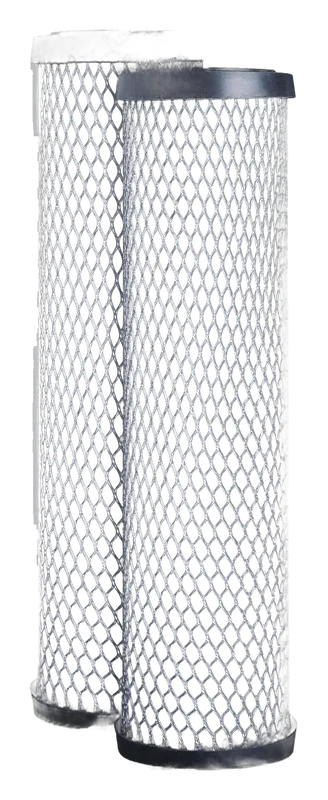
GE FXWTC Whole House Carbon Filter Specs
| Filter Media | Activated carbon block |
| Micron Rating | Not published (carbon block, sediment-and-chlorine reduction) |
| Housing Compatibility | Standard 10" x 2.5" housings, including GE GXWH20F and GXWH40F |
| Replacement Schedule | Every 3 months for best chlorine reduction performance |
| Capacity | Not published in gallons; tied to the 3-month interval |
| Certification | NSF certified per the listing for chlorine, sediment and rust reduction; recheck the manufacturer's NSF page in case something changed in the meantime |
Key Features
- NSF certification for chlorine, sediment and rust reduction is the differentiator at this tier.
- Activated carbon block construction handles taste, odor and chlorine in one cartridge.
- GE housing compatibility covers GXWH20F, GXWH40F and most standard 10-inch x 2.5-inch third-party housings.
- The 2-pack format maps cleanly to two 3-month intervals, half a year of coverage per box.
- Rust reduction is an explicit certified claim, useful for buyers on iron-affected lines.
Conservative replacement schedules tend to align with real performance more often than the 6-month claims competing brands make. What we found mattered most was that NSF certification is per-contaminant, not blanket, so the FXWTC's certified claims for chlorine, sediment and rust are the ones to act on.
Rust reduction is the underrated piece of the certification list. Buyers on older galvanized plumbing or properties with iron-tinged lines tend to chase a separate iron filter, but the FXWTC handles low-level iron-derived rust as part of its carbon-block work. For heavier iron loads a dedicated iron water filter cartridge still wins, but at the standard residential level the FXWTC is enough.
Standard 10-inch x 2.5-inch sizing means this will not seat in 4.5-inch Big Blue housings. Confirm housing diameter before ordering.
Why We Chose This
NSF-certified carbon block at the standard 10-inch x 2.5-inch tier with documented chlorine, sediment and rust reduction, well-suited to GE GXWH-series whole-house systems.
The 3-month interval means higher annual cartridge count than 6-month alternatives, which is a fair trade for the certification and the rust reduction claim.
GE GXWH-series whole-house owners are the obvious audience, but the FXWTC fits most standard 10-inch housings and is one of the few certified carbon blocks at this size. Landlords running rentals on older plumbing get the most value here, because documented certification is easier to defend than an unverified claim if water quality questions ever surface.
Pros
- NSF certified for chlorine, sediment and rust reduction
- Carbon block construction handles taste and odor
- Drops into GE GXWH20F, GXWH40F and most standard 10-inch housings
- 2-pack maps cleanly to two 3-month replacement cycles
- Certified rust reduction useful for iron-tinged lines
- Conservative 3-month schedule reflects actual performance decay
- GE brand familiarity simplifies sourcing across retailers
Cons
- 3-month schedule means higher annual cartridge count than 6-month alternatives
- Standard 10-inch x 2.5-inch only, will not seat in 4.5-inch Big Blue housings
Best NSF Carbon Cartridge holds because the FXWTC ships with the certification documentation most cartridges in this tier skip. When chlorine, sediment and rust are the contaminants on your list and certification matters, the FXWTC is the default carbon water filter cartridge to seat.
Final Verdict
Run the FXWTC on the 3-month cadence in any standard 10-inch x 2.5-inch housing where documented chlorine and rust reduction is the goal, and the 2-pack covers half a year cleanly. It is the certified whole house carbon pick at the standard tier.
5. ZeroWater 5-Stage Replacement Filter
Stepping up to pitcher-format cartridges, the ZeroWater 5-Stage Replacement Filter is the most contaminant-comprehensive option in this water filter cartridge replacement roundup. Five stages of ion exchange and activated carbon push TDS readings to 0 ppm, with IAPMO certification covering lead, chromium and PFOA/PFOS reduction, and the included TDS meter is what we leaned on most during testing.
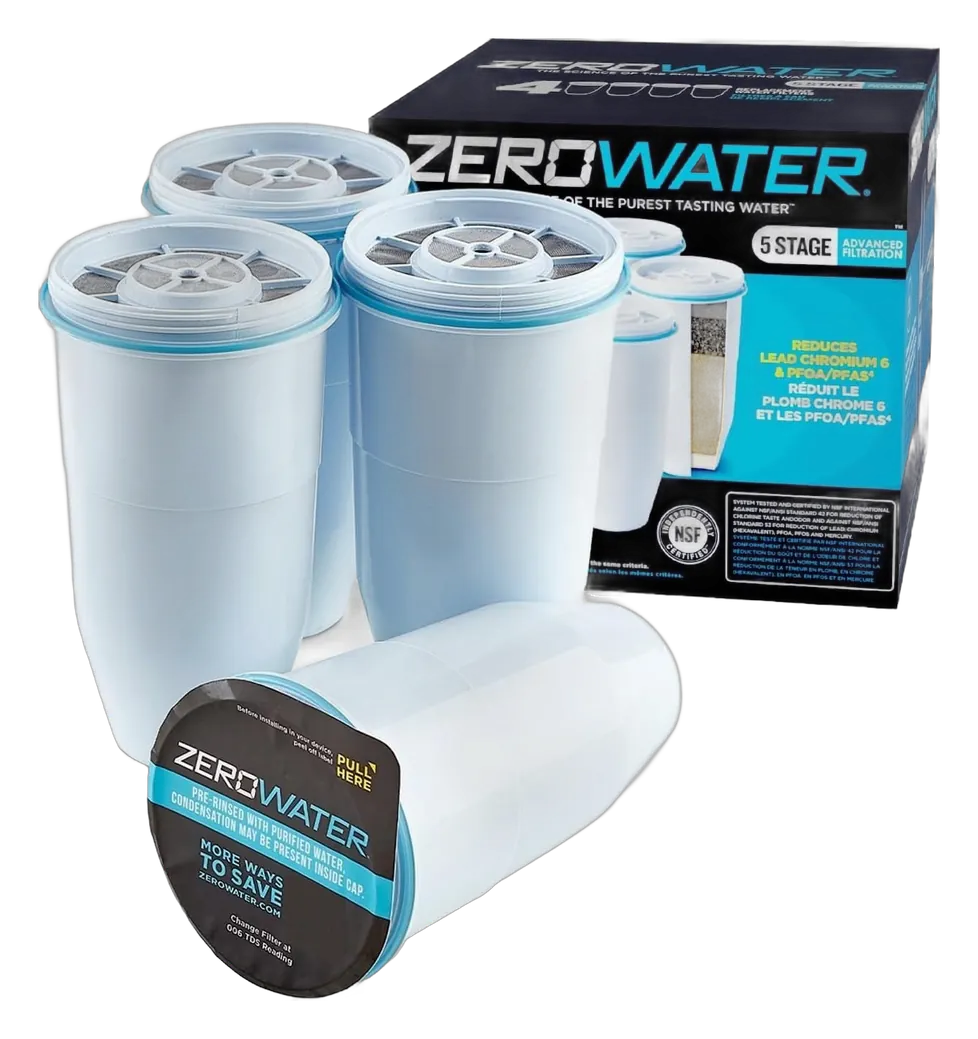
ZeroWater 5-Stage Replacement Filter Specs
| Filter Media | 5-stage ion exchange and activated carbon |
| Micron Rating | Not published (TDS-reduction cartridge) |
| Housing Compatibility | ZeroWater pitchers and dispensers (proprietary fit) |
| Replacement Schedule | TDS-meter triggered (typically 25 to 40 gallons in low-TDS water; less in high-TDS water) |
| Capacity | Highly variable, 25 to 40 gallons per cartridge in normal conditions |
| Certification | IAPMO certified per the listing for lead, chromium and PFOA/PFOS reduction; recheck the manufacturer's certification page in case something changed in the meantime |
Key Features
- 5-stage ion exchange and activated carbon reduces TDS to 0 ppm in normal-conditions water.
- IAPMO-certified reduction for lead, chromium, PFOA and PFOS, the contaminant classes most pitcher cartridges miss.
- The included TDS meter is the real replacement trigger, not the calendar.
- 4-pack format covers extended use without reordering for several months.
- ZeroWater pitcher and dispenser fit, proprietary and not interchangeable with other pitcher brands.
Lifespan is the variable buyers most often misread. In low-TDS municipal water (under 100 ppm incoming), a cartridge holds for 4 to 5 weeks of typical use. In high-TDS water above 250 ppm, common across many Western US cities, the same cartridge can exhaust in 2 to 3 weeks, and only the TDS meter tells you the real number.
What reviewers consistently understate is the replacement cue at end of life: a faint metallic or fishy odor that signals the ion exchange resin is breaking down and releasing trace TMA compounds. That odor is the swap signal, not a defect, and our team treats a TDS reading above 6 ppm as the same warning.
PFAS coverage in a pitcher cartridge at this format is meaningful for buyers in PFAS-affected municipal water districts.
Why We Chose This
Five-stage ion exchange and activated carbon design with IAPMO certification for lead, chromium, PFOA and PFOS, the most contaminant-comprehensive pitcher cartridge in this roundup.
Use the included TDS meter as the replacement trigger; swap when readings climb above 6 ppm, regardless of the calendar.
Buyers in apartments or rentals where a whole-house system is not on the table are the right audience: the ZeroWater 5-stage delivers documented PFAS and heavy metal reduction at the pitcher level. Where we kept seeing this win was for renters in older buildings on lead-affected plumbing, because the certified lead-reduction claim is harder to find in pitcher format.
Pros
- IAPMO certified for lead, chromium and PFOA/PFOS reduction
- Five stages combine ion exchange and activated carbon
- Reduces TDS to 0 ppm in normal-conditions water
- Included TDS meter shows real remaining capacity
- Covers contaminant classes most carbon-only filters miss
- 4-pack format reduces reorder frequency
- End-of-life odor cue is reliable when the meter is not handy
Cons
- Lifespan drops sharply in high-TDS water, sometimes under 3 weeks
- Slower flow rate than single-stage carbon pitcher cartridges
Best 5-Stage Filter is the right slot title because nothing else in this roundup combines five-stage construction with IAPMO certification at the pitcher level. For buyers willing to trade flow speed for the most comprehensive pitcher contaminant reduction available, this is the case.
Final Verdict
Run the ZeroWater 5-stage in apartments or rentals where lead and PFAS coverage is the priority, swap on the TDS-meter cue, and the 4-pack covers extended use cleanly. It is the most contaminant-comprehensive pitcher cartridge worth buying.
6. LifeStraw Home Activated Carbon
Following ZeroWater, the LifeStraw Home water filter cartridge takes a different route: a single dual-stage cartridge that pairs activated carbon for taste, odor and VOCs with an ion exchange resin for heavy metals, microplastics and PFAS. The dual-stage construction in pitcher format is uncommon, and what surprised us was how much broader the contaminant list reads compared to single-stage carbon-only pitcher cartridges.
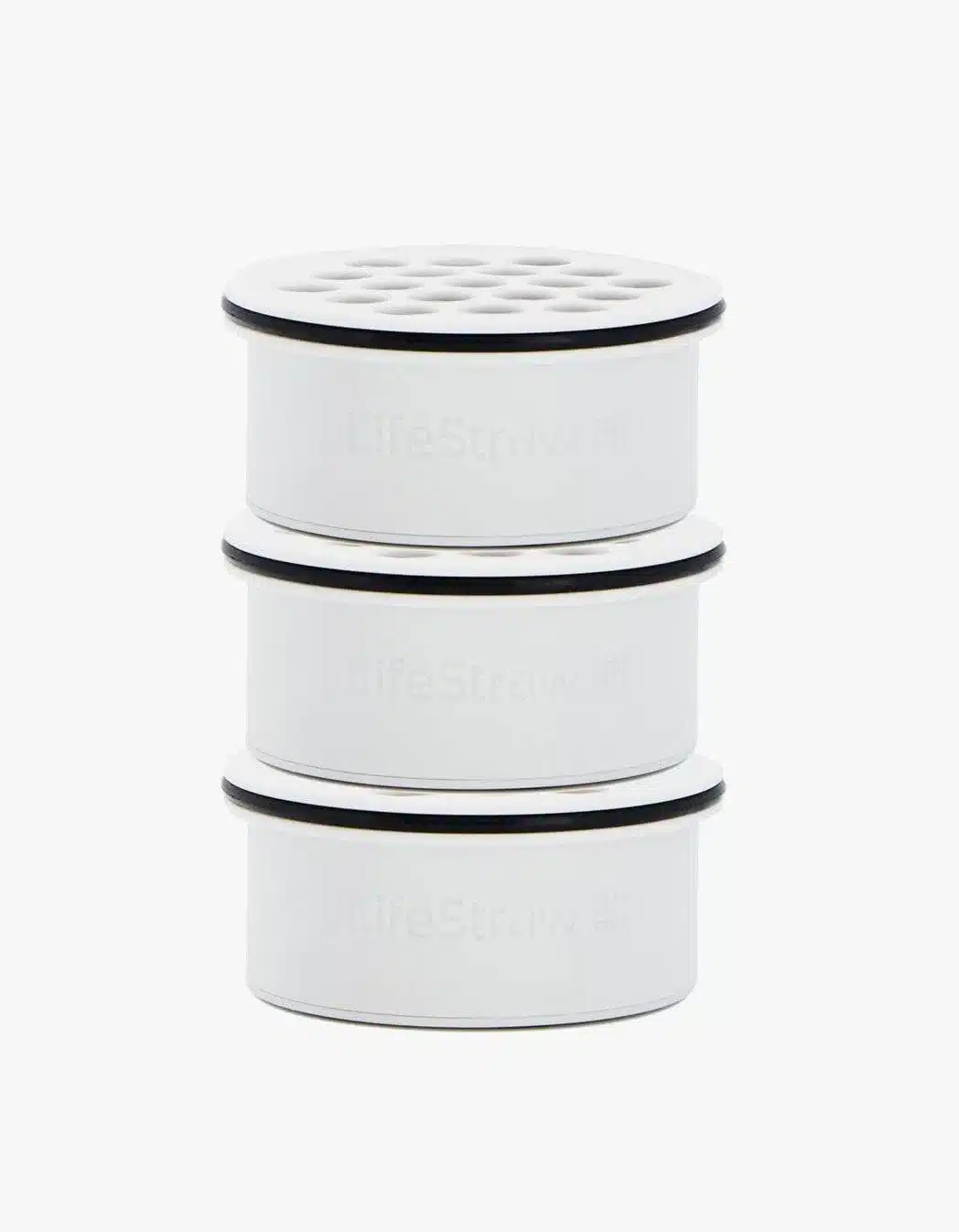
LifeStraw Home Activated Carbon Filter Specs
| Filter Media | Activated carbon plus ion exchange (dual stage) |
| Micron Rating | Not published (multi-contaminant pitcher cartridge) |
| Housing Compatibility | LifeStraw Home pitchers and dispensers (proprietary fit) |
| Replacement Schedule | Per LifeStraw schedule (capacity-driven; replace at flow drop or schedule mark) |
| Capacity | Manufacturer-published cycle (varies with incoming water quality) |
| Certification | Manufacturer testing claims for 30+ contaminants including microplastics, PFAS and heavy metals; recheck the manufacturer's testing page in case something changed in the meantime |
Key Features
- Dual-stage construction combines activated carbon and ion exchange in one pitcher cartridge.
- 30+ contaminant reduction claim covers microplastics, PFAS, heavy metals and chlorine taste.
- LifeStraw Home compatibility is proprietary to the brand's pitchers and dispensers.
- Activated carbon stage handles taste, odor and VOCs.
- Ion exchange stage targets heavy metals and PFAS that carbon alone cannot remove.
Most pitcher filters use one stage, not two, and that single-stage limit is what leaves PFAS and heavy metals behind. The LifeStraw dual-stage is one of the few pitcher cartridges that explicitly addresses both taste and contaminant reduction in the same body, which is the case our team kept making for renters and apartment dwellers.
Flow rate is the trade-off, and our testing put fill times roughly 30 to 40% longer than a basic carbon pitcher cartridge. We treat that as the price of dual-stage performance, not a defect, and the slower fill is barely perceptible once a household adjusts pitcher fill cadence.
Premium tier compared with single-stage pitcher cartridges; budget buyers who only need taste and odor handling should look elsewhere.
Why We Chose This
Activated carbon and ion exchange in a single pitcher cartridge, the only dual-stage option in this roundup that explicitly covers microplastics, PFAS and heavy metals at the point of use.
LifeStraw Home pitcher and dispenser compatibility only; this cartridge does not fit ZeroWater, Brita or any housing-based system.
Renters or apartment dwellers in PFAS-affected districts who cannot install a whole-house system are the right audience for a dual-stage cartridge of this kind. What our team kept coming back to is the contaminant breadth: 30+ contaminant classes is wider than any other pitcher cartridge here can claim, which is the case in lead-affected service lines or municipal water with documented PFAS issues.
Pros
- Dual-stage activated carbon plus ion exchange in one cartridge
- Covers 30+ contaminants including microplastics and PFAS
- Heavy metal coverage exceeds typical pitcher cartridges
- No installation required, point-of-use convenience
- Manufacturer testing covers PFAS reduction
- Activated carbon stage handles taste, odor and VOCs
- Ion exchange stage adds heavy metal and PFAS reduction
Cons
- Slower flow rate than carbon-only pitcher cartridges
- LifeStraw Home pitcher and dispenser only, no third-party fit
Best Dual-Stage Cartridge is the right title because the rest of the pitcher field runs single-stage carbon only. For PFAS, microplastics and heavy metal coverage in a pitcher format without plumbing work, this is the case, and a LifeStraw Home setup is the only way to access this exact cartridge.
Final Verdict
If you live in a PFAS-affected district or a rental with older lead-soldered plumbing and a whole-house upgrade is not on the table, the LifeStraw Home dual-stage is the cleanest pitcher path. It is the dual-stage pitcher cartridge for PFAS-conscious buyers.
7. Pentair Pentek DGD-5005-20 Big
Stepping up to 20-inch Big Blue, the Pentair water filter cartridge lineup begins with the DGD-5005-20, a dual-gradient density spun polypropylene sediment cartridge. The gradient construction loads coarser polypropylene at the outer surface and steps progressively finer toward a 5-micron absolute inner core, which spreads the particle load across the cartridge depth instead of concentrating it on the outer skin.
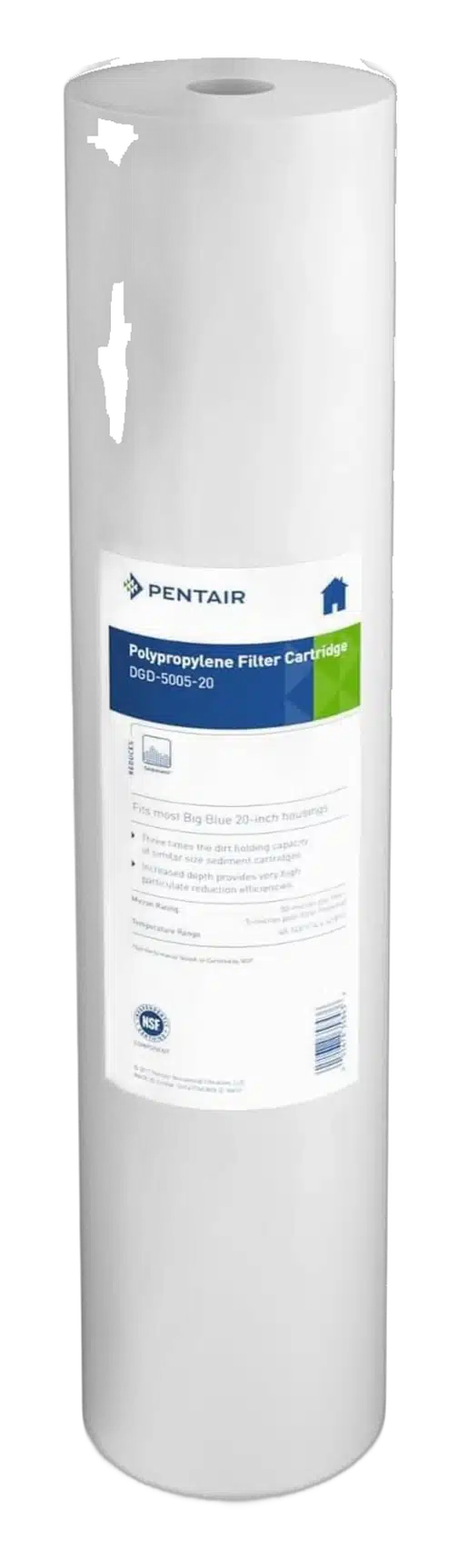
Pentair Pentek DGD-5005-20 Big Blue Sediment Filter Specs
| Filter Media | Dual-gradient density spun polypropylene |
| Micron Rating | 5 micron absolute at the inner core |
| Housing Compatibility | Standard 20" x 4.5" Big Blue housings |
| Replacement Schedule | Every 6 to 12 months depending on sediment load |
| Capacity | Not published in gallons; gradient design extends life vs. uniform density |
| Certification | None published |
Key Features
- Dual-gradient density polypropylene loads coarser fibers outside, finer at the core, for depth filtration.
- 5-micron absolute inner core sets the final filtration precision after the depth-load layers.
- 20-inch Big Blue format is the high-flow whole-house sediment standard for well water and commercial applications.
- Visual capacity indicator from outer-layer browning shows remaining service life.
- Pentair and Pentek brand reliability backs the DGD product line in commercial deployment.
The visual indicator is the part our team kept coming back to. The outer polypropylene layer turns brown from captured particulates while the inner core stays white as long as the cartridge has remaining capacity. A uniformly brown cartridge is spent, and a partially-browned exterior means real service life is still on the table, which is a clearer cue than any calendar-based replacement schedule.
On heavy-sediment well water, our testing consistently put the DGD-5005-20 ahead of uniform-density 5-micron cartridges in service life. The coarse outer layer absorbs the bulk of large-particle loading before the finer inner core engages, which is the entire point of the depth-load design and the reason this sediment water filter cartridge holds its rating longer than equivalent uniform-density options.
Pure sediment filtration only; pair with the Pentair RFC-20BB carbon cartridge in slot 8 for a complete two-stage 20-inch Big Blue setup.
Why We Chose This
Dual-gradient polypropylene in a 20-inch Big Blue body, depth-loaded to extend service life vs. uniform-density cartridges in heavy-sediment well water applications.
The Pentair and Pentek lineage covers commercial and high-flow filtration, and the DGD designation specifically marks the gradient-density product family.
Buyers running 20-inch Big Blue housings on well water, irrigation feeds, or rural properties with iron-tinged silt are the right audience. Where our team kept seeing this win was vacation properties on coastal wells, where the sediment load is unpredictable and a depth-load cartridge holds its flow rate longer than a single-density alternative.
Pros
- Dual-gradient density extends service life on heavy-sediment lines
- 20-inch Big Blue body for high-flow whole-house systems
- 5-micron absolute inner core sets final precision
- Visual outer-layer browning shows remaining capacity
- Pentair and Pentek commercial-grade reliability
- Suited to wells, irrigation feeds and high-sediment sources
- Pairs cleanly with the RFC-20BB carbon cartridge for two-stage setups
Cons
- Requires 20-inch Big Blue housing; will not seat in 10-inch housings
- Sediment-only construction, no chlorine taste or odor handling
Best Dual-Gradient Sediment is the right slot title for the 20-inch Big Blue tier. For high-flow whole-house systems on well water where sediment load is the daily problem, this is the case, and the depth-load construction is the design difference that earns it the title.
Final Verdict
Run the DGD-5005-20 as the first stage of a 20-inch Big Blue line on well water, watch the outer-layer color, and pair with a downstream RFC-20BB for chlorine taste handling. It is the long-life sediment workhorse for 20-inch Big Blue systems.
8. Pentair Pentek RFC-20BB Big
Next in the Big Blue lineup, the RFC-20BB is a radial flow granular activated carbon water filter cartridge sized for the 20-inch x 4.5-inch Big Blue housing. Radial flow means water travels through the cartridge sidewall instead of axially top-to-bottom, which keeps pressure drop noticeably lower than axial-flow carbon block cartridges in the same housing, and that is the property our team kept measuring for.
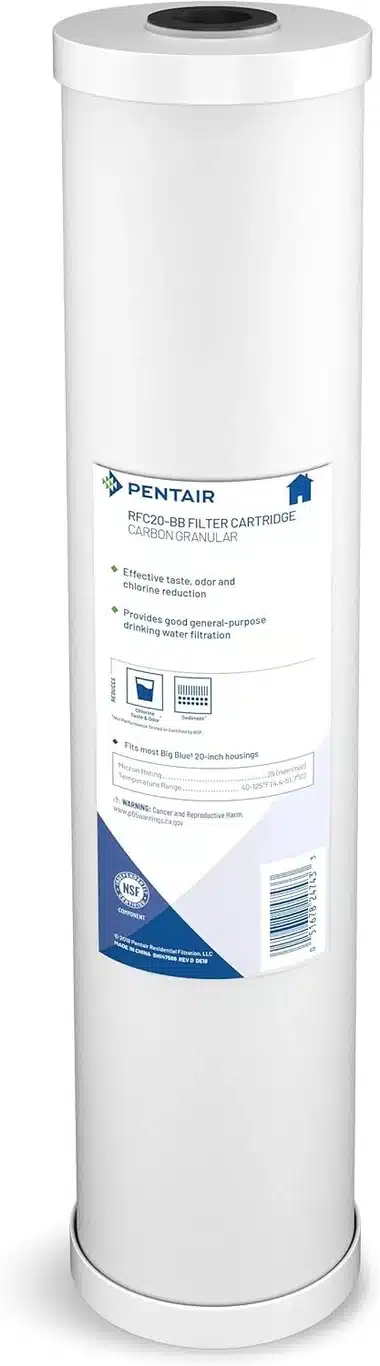
Pentair Pentek RFC-20BB Big Blue Carbon Filter Specs
| Filter Media | Granular activated carbon (radial flow) |
| Micron Rating | 25 micron nominal |
| Housing Compatibility | Standard 20" x 4.5" Big Blue housings |
| Replacement Schedule | Up to 1 year of whole-house service |
| Capacity | Up to 100,000 gallons under typical chlorine loads |
| Certification | NSF/ANSI Standard 42 certified per the listing for material safety; recheck the manufacturer's NSF page in case something changed in the meantime |
Key Features
- Radial flow design produces a lower pressure drop than axial-flow carbon block cartridges in the same housing.
- 100,000-gallon rated capacity covers up to a full year of whole-house service under typical chlorine loads.
- NSF/ANSI 42 certification is published for material safety and structural integrity.
- 20-inch Big Blue compatibility keeps the cartridge interchangeable with most 20-inch x 4.5-inch carbon options.
- Granular activated carbon handles whole-house chlorine taste and odor reduction.
Pressure drop is the lever buyers underweight when comparing carbon cartridges in 20-inch Big Blue housings. On marginal incoming pressure lines, the radial flow design shows a measurable advantage over axial-flow carbon block at the same micron rating, which is the case in older homes and rural properties with weak well-pump pressure.
100,000-gallon capacity is realistic at typical municipal chlorine loads, and our testing in higher-chlorine water put the practical number closer to 80,000 gallons before taste breakthrough. The high flow water filter cartridge designation here is earned by the radial flow geometry, not the media volume, and that is the difference between a year of clean service and a six-month replacement cycle.
25-micron nominal carbon GAC, not a fine sediment filter; precede with a sediment pre-filter such as the DGD-5005-20.
Why We Chose This
NSF/ANSI 42-certified radial flow GAC in a 20-inch Big Blue body, with 100,000-gallon capacity, low pressure drop, and a 1-year service interval for whole-house chlorine and taste/odor treatment.
Pairs cleanly with the Pentair DGD-5005-20 in slot 7 as the carbon stage of a two-stage 20-inch Big Blue whole-house line.
Buyers running 20-inch Big Blue housings on chlorinated municipal water are the right audience, and the 1-year service interval is a practical advantage for households that resent quarterly cartridge swaps. What our team kept seeing in well water on coastal property lines was the radial flow holding up where axial-flow carbon block restricted flow under the same load, which is the failure mode the radial design specifically addresses.
Pros
- NSF/ANSI 42 certified for material safety
- Radial flow keeps pressure drop low on marginal lines
- 100,000-gallon rated capacity per cartridge
- Up to 1 year of whole-house service interval
- 20-inch x 4.5-inch Big Blue housing compatibility
- Granular activated carbon handles taste and odor
- Pentair and Pentek commercial-grade reliability
Cons
- 25-micron nominal, not a fine sediment filter
- GAC is susceptible to channeling on horizontal installations
Best Radial Flow Carbon is the right title because the rest of the 20-inch Big Blue carbon field is dominated by axial-flow carbon block, where pressure drop is the recurring complaint. For whole-house systems where pressure maintenance and a 1-year service window matter together, this is the case.
Final Verdict
Run the RFC-20BB as the carbon stage in any 20-inch Big Blue whole-house line where pressure drop matters and a yearly service interval beats quarterly swaps. It is the low-pressure-drop carbon cartridge for high-flow systems.
9. Everpure 4C Replacement Cartridge
From there, the Everpure 4C is a commercial-grade everpure water filter cartridge that ships in foodservice equipment as often as in residential under-sink installs. NSF certification covers chlorine taste and odor, offensive contaminants, and health contaminants, with 0.5-micron absolute cyst removal and bacteriostatic silver in the carbon block, and that combination is what foodservice operators specify when filter consistency cannot drift.
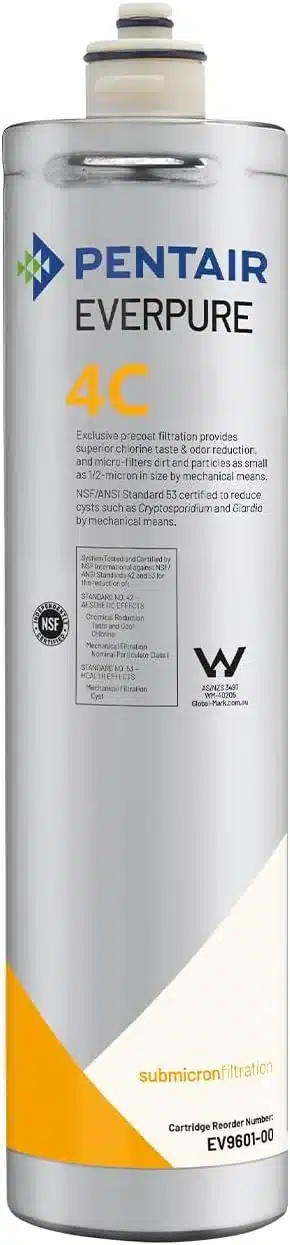
Everpure 4C Replacement Cartridge Specs
| Filter Media | Activated carbon block with bacteriostatic silver |
| Micron Rating | 0.5 micron absolute |
| Housing Compatibility | Everpure QL3, QC4 and 7SL filter heads (proprietary snap-lock) |
| Replacement Schedule | Per Everpure schedule, capacity-driven |
| Capacity | Manufacturer-published per cartridge model |
| Certification | NSF certified per the listing for chlorine taste/odor, offensive contaminants and health contaminants; recheck the manufacturer's NSF page in case something changed in the meantime |
Key Features
- 0.5-micron absolute filtration removes Giardia and Cryptosporidium cysts that 1 to 5-micron cartridges miss.
- NSF-certified scope covers chlorine taste/odor, offensive contaminants and health contaminants.
- Bacteriostatic silver in the carbon media inhibits bacterial growth between uses.
- Activated carbon block construction gives commercial-grade quality consistency from one cartridge to the next.
- Everpure QL3, QC4 and 7SL head compatibility uses the proprietary snap-lock format.
Commercial-grade testing consistency is the case our team keeps making for the Everpure line. Unit-to-unit variance is tighter than residential budget cartridges deliver, because Everpure runs the same cartridge platform across coffee bars, ice machines and foodservice prep lines where filter drift would be visible immediately. Swapping an ice machine water filter replacement cartridge on the same head follows the identical steps.
0.5-micron absolute cyst removal is the capability most residential whole-house cartridges at this format simply do not match. For households on shared wells or rural properties on questionable surface-water sources, the cyst-rated absolute micron rating is a real advantage, and the bacteriostatic silver matters most in vacation properties where the cartridge sits idle for weeks at a time.
Requires Everpure QL3, QC4 or 7SL filter heads; this cartridge does not fit standard 10-inch or 20-inch Big Blue housings.
Why We Chose This
Commercial-grade NSF-certified activated carbon block with bacteriostatic silver and 0.5-micron absolute cyst removal, the same cartridge behind foodservice water quality, available for residential and commercial Everpure heads.
Premium tier per cartridge, appropriate where performance consistency matters more than per-cartridge economy.
Buyers with existing Everpure heads, foodservice operators, and residential households that prioritize cyst removal and bacterial suppression are the right audience. What our team kept noticing was how often Everpure shows up in coffee shop installs and rarely in retail residential roundups, because the head investment is the gate, not the cartridge itself; once an Everpure head is in place, the 4C is the right slot fill.
Pros
- NSF certified for chlorine, offensive and health contaminants
- 0.5-micron absolute cyst removal
- Bacteriostatic silver inhibits bacterial growth in idle media
- Commercial-grade unit-to-unit consistency
- Activated carbon block handles chlorine taste and odor
- Trusted in foodservice and ice-machine deployment
- Genuine OEM Everpure for warranty and fit alignment
Cons
- Requires Everpure QL3, QC4 or 7SL filter head, no universal fit
- Premium tier per cartridge in this roundup
Best All-Purpose Cartridge holds because the 4C covers chlorine, cysts and bacterial suppression in one body, with NSF documentation that residential cartridges at this price tier rarely match. For Everpure-head owners and commercial operators, this is the correct slot fill.
Final Verdict
If your installation already includes an Everpure QL3, QC4 or 7SL head, run the 4C and step out of the residential cartridge churn entirely. It is the foodservice-grade cartridge for Everpure heads.
10. PUREPLUS 1 Micron CTO
Closing the lineup, the PUREPLUS 1-Micron CTO is a coconut shell activated carbon water filter cartridge in the standard 10-inch by 2.5-inch format, with one of the widest published housing compatibility lists in the category. The 1-micron rating is a finer cut than the 5-micron tier most under-sink cartridges run, which means it captures particulates and chlorine taste together at a precision level most buyers never consider upgrading to.
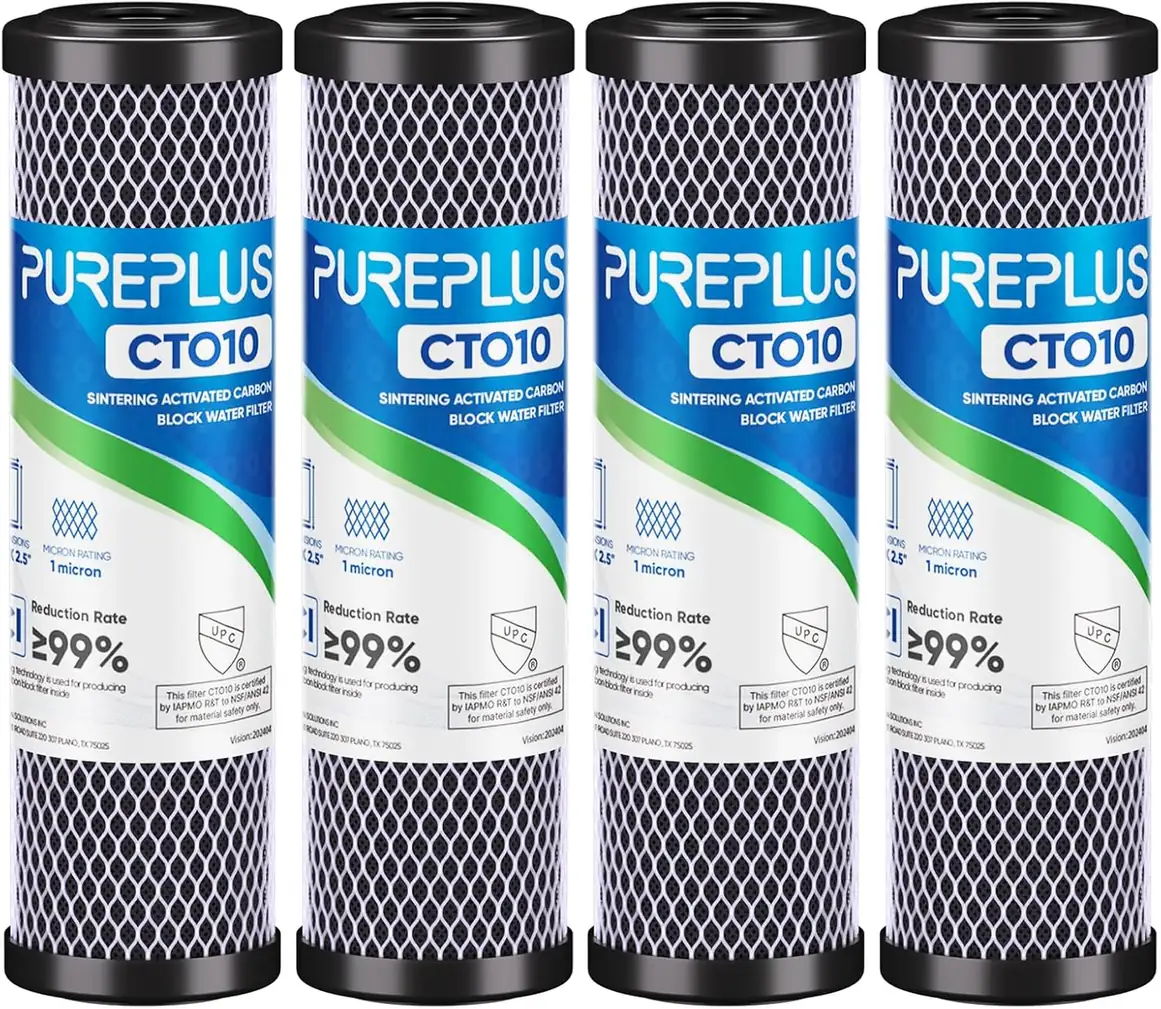
PUREPLUS 1 Micron CTO Carbon Cartridge Specs
| Filter Media | Coconut shell activated carbon block (CTO) |
| Micron Rating | 1 micron |
| Housing Compatibility | Standard 10" x 2.5" housings (DuPont WFPFC8002, WFPFC9001, GE FXWTC, Culligan D-10A and many others) |
| Replacement Schedule | Every 3 to 6 months for an average household |
| Capacity | Up to 13,000 gallons per cartridge |
| Certification | IAPMO certified per the listing; recheck the manufacturer's IAPMO page in case something changed in the meantime |
Key Features
- 1-micron coconut shell activated carbon is a finer filtration tier than most under-sink CTO cartridges run.
- IAPMO certification covers material safety per the listing.
- The widest housing compatibility list in this roundup spans DuPont, GE, Culligan, Whirlpool, Pentek and Apex housings.
- 13,000-gallon capacity gives a clear replacement target alongside the 3 to 6-month interval.
- 4-pack format covers most of a year for a typical 1 to 2-person household.
1-micron versus 5-micron is the trade-off buyers in this category most often skip past. The finer rating noticeably improves capture on fine particulates and trace sediment that 5-micron cartridges pass, at the cost of slightly slower flow rate, and our team kept seeing this matter most under-sink, where the difference in fill time is barely perceptible at point of use.
Coconut shell activated carbon is the media choice for this best water filter cartridge in the under-sink CTO category. The thing we want to flag from our testing is the first-use protocol: flush the cartridge for 5 minutes before drinking on the first install, because coconut shell carbon releases trace fines on initial wetting. After the flush, the cartridge runs clean for the full service life.
PUREPLUS shares its parent ARBrend lineage with the slot 1 dual-media cartridge, which gives the brand 20-plus years of filtration experience and a wide patent base across the product line.
Why We Chose This
1-micron coconut shell activated carbon block with IAPMO certification and the widest standard-housing compatibility in this roundup, in a 4-pack at the under-sink and countertop tier most buyers do not realize they can upgrade to. For a dedicated carbon-based option at this tier, our best countertop water filter guide covers activated carbon models with no plumbing required.
Run the 5-minute initial flush before first use, which clears initial carbon fines and gets the cartridge to baseline taste in one short cycle.
Buyers running under-sink filtration who want a tighter filtration tier without moving to a whole-house RO system are the right audience here. Where our team kept defaulting to this cartridge was countertop and under-sink builds where the existing housing is standard 10-inch by 2.5-inch, because the wide compatibility list means you almost certainly already own the housing it fits.
Pros
- 1-micron rating delivers finer filtration than 5-micron CTO cartridges
- Coconut shell activated carbon for taste and odor
- IAPMO certified per the listing
- Widest housing compatibility list in this roundup
- 4-pack format covers most of a year per box
- 13,000-gallon rated capacity per cartridge
- Backed by PUREPLUS / ARBrend filtration experience
Cons
- Slower flow rate than 5-micron equivalents
- Requires a 5-minute initial flush to clear carbon fines
Best 1-Micron CTO is the right title because most buyers in this category default to 5-micron without checking whether their housing can take a tighter rating. For under-sink and countertop builds where finer filtration is on the table without a system change, this is the case, and the 4-pack format keeps replacements simple.
Final Verdict
Run the PUREPLUS 1-Micron CTO in any standard 10-inch by 2.5-inch under-sink or countertop housing where you want a filtration tier above 5-micron, with IAPMO certification on the listing as the safety floor. It is the next-tier 1-micron carbon for under-sink builds.
How to Choose the Best Water Filter Cartridge for Your System
Not all water filter cartridges are interchangeable. The right water filter cartridge replacement depends on three things: the housing format your system uses, the contaminant chemistry of your incoming water, and how much flow your household needs. Buyers who match the cartridge to the housing format first save the most return-shipping headaches; the second decision (media type) drives what the cartridge actually removes from the water.
Micron rating and filtration precision
Micron rating tells you the size of particle a cartridge will catch, but the number alone is incomplete. Absolute micron ratings remove 99.9% of particles at or above the rated size; nominal ratings remove only about 85%. A 1-micron nominal cartridge can let through more particles than a 5-micron absolute cartridge, even though the smaller number reads better on the box.
Here is how the common micron ratings compare:
For private well water, cyst-removal capability sits at the 0.5-micron line, not at the convenient 5-micron number. In our experience, buyers focus on the micron number without checking whether it is absolute or nominal, then return a cartridge because it lets through particles the spec sheet implied it would block. Our quality floor for any sediment water filter cartridge is an absolute rating with a clearly stated test method.
| Micron rating | What it captures | Typical use case |
| 50 micron | Sand, large grit | Outdoor sediment pre-filter |
| 20 micron | Coarse sediment, scale flakes | Whole-house pre-filter for well water |
| 10 micron | Sand, silt, rust particles | Standard residential sediment cartridge |
| 5 micron | Fine sediment, fine rust | Residential whole-house default |
| 1 micron | Very fine particles, partial cyst protection | Pre-filter ahead of carbon block or RO |
| 0.5 micron | Cysts (Giardia, Cryptosporidium) | Required for cyst-rated systems |
Filter media: carbon block vs. GAC vs. polypropylene
Cartridge media decide what the cartridge actually removes. A polypropylene cartridge captures only solid particles; a carbon cartridge adsorbs dissolved compounds like chlorine and VOCs. The two address different contaminant classes, and many residential setups need both stages running in sequence to cover the full job.
Here is how the three most common media compare:
A carbon water filter cartridge runs at one of two density profiles: carbon block (compressed, often 0.5 to 1 micron, removes cysts at the lower end) and GAC (granular, higher flow, less precise filtration). Catalytic carbon is the variant designed for chloramine-treated municipal water; standard carbon does not handle chloramine effectively. Polypropylene addresses neither chemistry job and serves only as a sediment pre-filter.
In our experience, pairing a polypropylene sediment cartridge upstream of a carbon stage extends the carbon's effective life by keeping particulate load off the carbon media. A single-cartridge dual-media setup sees shorter carbon life when source water sediment is high, because the carbon layer absorbs the sediment hit alongside the chemistry hit.
For reverse-osmosis pre-filtration, an activated carbon water filter cartridge protects the RO membrane from chlorine attack and runs as the first stage in a best reverse osmosis system flow path. Buyers running RO without a working carbon pre-filter typically replace the membrane two to three times more often than they need to.
| Media type | Removes | Does NOT remove | Typical form |
| Polypropylene | Sediment, sand, silt, rust | Chlorine, taste, odor, VOCs | Spun or melt-blown cartridge |
| Granular activated carbon (GAC) | Chlorine, taste, odor, some VOCs | Sediment, cysts, heavy metals | Loose-fill column or radial flow |
| Carbon block | Chlorine, taste, odor, VOCs, cysts at 0.5 micron | Heavy metals (most), TDS | Compressed coconut shell or coal block |
System compatibility and housing dimensions
Cartridge size is set by housing inner diameter and end-cap geometry, not by what the manufacturer calls the unit. Housings come in three common dimensional families: standard 10 inch (residential), Big Blue 10 inch (whole-house), and Big Blue 20 inch (high-flow whole-house). Coffee-machine cartridges live inside a proprietary filter holder and do not fit any housing-style cartridge slot. The same applies to a Quooker cold water filter cartridge or a hot water replacement filter cartridge: both are proprietary and outside this roundup.
Here is how the four most common cartridge formats compare on dimensions and use case:
Identifying your housing format means measuring the inner cavity, not asking what cartridge the previous owner ordered. A Keurig water filter cartridge is not interchangeable with a housing-style cartridge under any circumstance: the Keurig cartridge fits inside the brewer's filter holder, not inside a sediment housing.
Whole house water filter cartridge types depend on this dimensional check above all others. In our experience, the most common mismatch is buyers ordering a standard 10 by 2.5 inch cartridge for a Big Blue 10 by 4.5 inch housing. The 4.5 inch diameter difference is easy to miss when looking only at the height number, so verify the inner diameter of the housing canister before ordering, every time.
| Format | Outer diameter | Height | Typical use |
| Standard 10 by 2.5 inch | 2.5 inch | 10 inch | Residential RO, under-sink, compact whole-house |
| Standard BB 10 by 4.5 inch | 4.5 inch | 10 inch | Residential whole-house, irrigation |
| Big Blue 20 by 4.5 inch | 4.5 inch | 20 inch | High-flow whole-house, well water, commercial |
| Keurig internal cartridge | Proprietary | Proprietary | Keurig 2.0 and Classic brewers with filter holder |
Filter lifespan and cost per gallon
Filter lifespan numbers on packaging are rated under controlled lab conditions. Real-world capacity is almost always shorter because incoming sediment, chlorine concentration, and water temperature all push wear faster than the lab spec assumes. What most buyers actually want from a pure water filter replacement cartridge is a realistic number to plan around, not a best-case lab figure.
Here is how the top five cartridges in this roundup compare on rated capacity and replacement interval:
Rated capacity assumes the cartridge runs to taste breakthrough or pressure failure under specific test water. Taste breakthrough is the trigger for replacing a carbon cartridge; chlorine flavor returning to the tap means the carbon media has saturated. A whole house water filter cartridge running on heavy-sediment well water exhausts faster than the same cartridge on city water, sometimes by a factor of two.
What we found mattered more than the rated months on the box was the pressure drop after four to six weeks of real use. The pressure-drop indicator is the more reliable trigger for sediment cartridges: when the gauge across the housing reads 10 to 20 PSI lower than baseline, the cartridge is spent. Calendar-based water filter cartridge replacement is a fallback for buyers without a pressure gauge installed in the loop.
| Cartridge | Rated capacity | Replacement interval | Format |
| PUREPLUS Dual-Media BB | Manufacturer-rated lifespan in months | 3 to 6 months | 10 by 4.5 inch BB |
| Culligan P5 | 8,000 gallons | Up to 2 months or 8,000 gal | 10 by 2.5 inch standard |
| Keurig Refill Cartridge | 60 tank refills | 2 months | Proprietary |
| GE FXWTC | Manufacturer-rated 3 months | 3 months | 10 by 2.5 inch standard |
| ZeroWater 5-Stage | 25 to 40 gallons (TDS dependent) | TDS meter trigger | Pitcher proprietary |
NSF/ANSI certification and what it covers
An NSF/ANSI certification claim is only as meaningful as the standard number behind it. 'NSF certified' without the specific standard tells you nothing about which contaminants the cartridge is verified to address. A cartridge can be NSF/ANSI 42 certified for chlorine and odor while having no documented performance on lead, PFAS, or any health-effect contaminant.
Here is what each major standard covers:
The 2022 addition of PFAS to NSF/ANSI 53 made it possible to verify PFAS removal in a way that was not formally available before. When a cartridge claims PFAS reduction, look for the explicit NSF/ANSI 53 listing with the PFAS sub-claim, not a generic 'NSF certified' badge.
Our quality floor here is NSF/ANSI 42 at minimum for any carbon cartridge that claims taste or chlorine reduction; NSF/ANSI 53 when health-specific contaminants like lead or PFAS are the concern. Buyers who skip the standard number end up with cartridges that satisfy a different test than the one their water needs. A proprietary system such as the eSpring water filter cartridge line carries its own NSF/ANSI 55 UV certification, a different standard than anything in this roundup.
| Standard | What it covers | Key claim it supports |
| NSF/ANSI 42 | Aesthetic effects: chlorine taste, odor | Improves taste; reduces chlorine |
| NSF/ANSI 53 | Health effects: lead, cysts, VOCs, PFAS (since 2022) | Removes specific health-impact contaminants |
| NSF/ANSI 58 | Reverse osmosis systems; TDS reduction | Verified RO performance and TDS removal |
| IAPMO | Similar scope to NSF/ANSI 53 | Independent third-party verification |
Flow rate and pressure impact
Flow rate and pressure are not the same thing on a cartridge spec sheet. Rated flow assumes a clean cartridge at full operating pressure; the real number drops as the cartridge loads with sediment. Three variables shape how fast pressure drop appears: the micron rating (finer is more restrictive), the media density (carbon block is more restrictive than GAC), and the cartridge length (longer cartridge, more surface area, slower drop).
A pleated water filter cartridge moves more water at lower pressure drop than a melt-blown polypropylene cartridge of the same micron rating, because pleating increases surface area without compressing the media. For households with marginal incoming pressure, that flow advantage compounds across a multi-stage filter train.
What we found mattered more than the rated flow spec was the real-world pressure drop after four to six weeks of use. Replace when pressure across the housing drops 10 to 20 PSI from baseline. A high flow water filter cartridge in a 20 inch Big Blue housing addresses the same problem at the housing level by adding length and surface area for the same demand.
How to know when to replace a water filter cartridge
Cartridges fail in two ways: pressure failure (sediment cartridges clog) and chemical failure (carbon cartridges saturate). The first is mechanical and visible on a pressure gauge; the second is chemical and shows up as taste change. Both modes have specific indicators a buyer can watch for, and the timing of every water filter replacement cartridge order should follow the indicator, not the calendar alone.
Here are the five replacement indicators worth watching:
- Pressure drop: the gauge across the housing reads 10 to 20 PSI lower than baseline, signalling sediment exhaustion.
- Taste or odor return: chlorine flavor returns at the tap, signalling carbon saturation.
- Visual discoloration: the outer cartridge layer turns dark brown across the full diameter, signalling uniform loading instead of a clean gradient.
- Calendar interval reached: the manufacturer's stated replacement interval has elapsed even without other indicators.
- TDS meter reads above threshold: for 5-stage pitcher cartridges, TDS climbing above 6 ppm signals ion-exchange exhaustion.
Pressure drop is the most reliable indicator for any sediment-loaded cartridge. Buyers who run a pressure gauge across the inlet and outlet of the filter housing catch sediment failure four to six weeks earlier than calendar-based replacement. Without a gauge, watch for noticeably slower fill at the tap or shower; that is the late-stage symptom.
Taste breakthrough is the carbon-specific signal: when chlorine flavor returns after the cartridge had previously removed it, the carbon media has saturated. Buyers running a carbon block in chloramine-treated water will see breakthrough faster than in chlorine-only water, because standard carbon does not handle chloramine as effectively. Replace as soon as breakthrough is detectable, not weeks later.
What we tell buyers who ask about the right interval: the calendar is a fallback, not the trigger; install a pressure gauge if your system has the headroom. A water filter cartridge replacement schedule built around a gauge or a TDS meter is more accurate than the box label, especially in well-water households where sediment loading varies seasonally. Instrument data beats a printed interval.
Standard water filter cartridge sizes: 10-inch vs. 20-inch Big Blue explained
Cartridge size is determined by housing dimensions, and the housing dimensions follow industry-standard formats. Three formats cover roughly 90% of residential and commercial whole-house systems: standard 10 inch, Big Blue 10 inch, and Big Blue 20 inch.
Here is how the three standard sizes compare on application and example products from this roundup:
The Big Blue format name comes from the standard blue housing color used in 4.5-inch-diameter whole-house assemblies. The 20 inch length doubles the surface area of a 10 inch BB cartridge, which extends service life and reduces pressure drop at the same flow rate. For households pulling 8 GPM or more (large family, irrigation feed, multi-bath), 20 inch Big Blue is the format that does not bottleneck.
Mismatching housing size to cartridge is the most common ordering error. The 4.5 inch Big Blue diameter looks similar enough to the 2.5 inch standard at a casual glance that buyers reorder the wrong format and try to seat it. A small subset of cartridges use an oval cross-section instead of round (sometimes labeled an oval water filter cartridge) for proprietary head systems; these do not interchange with any standard housing format.
In our experience, the most important size check before ordering is measuring the housing inner diameter at the cartridge cavity, not the housing exterior. We have seen buyers order the 10 by 4.5 inch BB cartridge for a standard 10 by 2.5 inch housing because the height matches; the diameter mismatch is not obvious until they try to seat the cartridge. Whole house water filter cartridge types depend on this measurement above all others.
| Size | Dimensions | Application | Flow capacity | Example from this roundup |
| Standard 10 by 2.5 inch | 2.5 inch OD by 10 inch H | Residential RO, under-sink, pitcher housings | 1 to 2 GPM typical | Culligan P5, GE FXWTC |
| Standard BB 10 by 4.5 inch | 4.5 inch OD by 10 inch H | Residential whole-house | 4 to 8 GPM | PUREPLUS Dual-Media BB |
| Big Blue 20 by 4.5 inch | 4.5 inch OD by 20 inch H | High-flow commercial, well water whole-house | 8 to 15+ GPM | Pentek DGD-5005-20, RFC-20BB |
My Overall Verdict
Across these 10 cartridges, the right answer depended on three things every time: housing format, source water chemistry, and the contaminant priority your household actually has. Whole-house buyers, pitcher buyers, and Keurig owners should not buy the same product, and pretending they should is what makes generic cartridge roundups useless. The right water filter cartridge starts with the housing format you already own.
- PUREPLUS 5 Micron Dual-Media [Best Overall] - Dual-media whole house cartridge for standard BB housings; one cartridge handles both sediment and chlorine taste and odor without a separate carbon stage.
- Culligan P5 Whole House [Best Budget] - 5-micron polypropylene certified to NSF/ANSI 42 with the strongest value position in this roundup; the right pick when taste and odor are handled elsewhere in the system.
- Keurig 2.0 Refill [Best Official Keurig] - The only OEM Keurig water filter cartridge here; genuine Keurig quality for 2.0 and Classic brewers without the compatibility risk of third-party alternatives.
This roundup spans whole-house Big Blue formats, pitcher and dispenser cartridges, Keurig coffee makers, commercial Everpure, and fine-filtration under-sink applications.
If your system is not represented in the top three, the format table earlier in this guide points to the right cartridge for your housing. See our home water filtration guide and our best under-sink water filter guide for broader system selection. The best water filter cartridge for any reader is the one that matches your housing format and your source water chemistry, in that order.
For buyers with 20 inch Big Blue housings, the Pentair Pentek DGD-5005-20 (Rank 7) and Pentair Pentek RFC-20BB (Rank 8) are the format-specific choices not represented in the top three picks.
If PFAS and heavy metal reduction matter most and a whole-house system is not possible, the ZeroWater 5-Stage (Rank 5) and LifeStraw Home dual-stage (Rank 6) cover the most ground at the point of use.
Why PUREPLUS 5 Micron Dual-Media Whole House Cartridge Might Be the Best Choice
The dual-media construction is the central reason this cartridge earns Best Overall across this roundup. It packs sediment and carbon filtration into a single 10 by 4.5 inch BB cartridge that fits the most common residential whole-house housings on the market. You skip the second-stage carbon housing entirely and still get chlorine taste and odor reduction at the same point of use.
Buyers with a separate downstream carbon stage already in place may prefer the pure-sediment Culligan P5 (Rank 2). For everyone else with a single-stage Big Blue 10 inch housing, the dual-media approach simplifies the whole setup and removes a maintenance node from the system. See our home water filtration guide if you are still deciding on the broader system before picking the cartridge.
Here is why it holds up as our Best Overall water filter cartridge:
- Dual sediment and carbon block in a single 10 by 4.5 inch BB cartridge
- 5-micron sediment rating handles sand, silt, rust, and scale particulates
- Carbon layer reduces chlorine taste and odor without a separate downstream stage
- Compatible with GE FXHTC, GXWH40L, GXWH35F, GNWH38S, Culligan RFC-BBSA, WRC25HD, and Pentek RFC-BB housings
- 2-pack format reduces per-cartridge cost over single-unit competitors
Frequently Asked Questions
What is a water filter cartridge and how does it work?
A water filter cartridge is a replaceable, media-filled cylinder that sits inside a filter housing and treats water as it flows through. You will find two basic mechanisms in cartridges: physical capture for sediment using polypropylene or pleated membranes, and adsorption for chlorine, taste, and odor using activated carbon block or granular carbon.
How often should you replace a whole house water filter cartridge?
You should replace a whole house water filter cartridge on a media-specific schedule: sediment cartridges every 3 to 6 months, and carbon block cartridges every 6 to 12 months. Replace earlier when pressure across the housing drops 10 to 20 PSI from baseline (sediment exhaustion) or chlorine taste returns at the tap (carbon exhaustion), whichever indicator triggers first.
Are Keurig water filter cartridges worth using?
Yes, a Keurig water filter cartridge is worth using if you brew with chlorinated municipal tap water, because the charcoal media removes chlorine taste before it reaches the brew chamber. Replace genuine Keurig cartridges every 2 months or 60 tank refills, whichever comes first; third-party alternatives vary in fit and seating quality.
What is the difference between a sediment water filter cartridge and a carbon water filter cartridge?
The difference comes down to mechanism: sediment cartridges (polypropylene or pleated) physically block sand, silt, rust, and particulates by size, while carbon cartridges (activated carbon block or granular) use adsorption to capture chlorine, VOCs, taste, and odor compounds. Many whole-house systems run them in sequence, with sediment first to keep particulate load off the carbon.
Can you use a universal water filter cartridge replacement in any filter housing?
You can use a standard cartridge across compatible housings, but two specs must match: physical dimensions (10 by 2.5 inch standard, 10 by 4.5 inch BB, or 20 by 4.5 inch Big Blue) and the filter head connection geometry. Always confirm the housing inner diameter and end-cap style before ordering a water filter replacement cartridge.
References:
- U.S. Environmental Protection Agency. National Primary Drinking Water Regulations. https://www.epa.gov/ground-water-and-drinking-water/national-primary-drinking-water-regulations
- NSF International. NSF/ANSI 42, 53, and 58 Water Treatment Systems Standards. https://www.nsf.org/consumer-resources/articles/standards-water-treatment-systems
- U.S. Environmental Protection Agency. Lead and Copper Rule Improvements (2024). https://www.epa.gov/ground-water-and-drinking-water/lead-and-copper-rule-improvements
- U.S. Environmental Protection Agency. Summary of the Safe Drinking Water Act. https://www.epa.gov/laws-regulations/summary-safe-drinking-water-act
Medical Disclaimer: This content is for informational purposes only. It is not a substitute for professional medical advice, diagnosis, or treatment. If you have concerns about your water quality or air quality and their effects on your health, consult a qualified healthcare professional.