
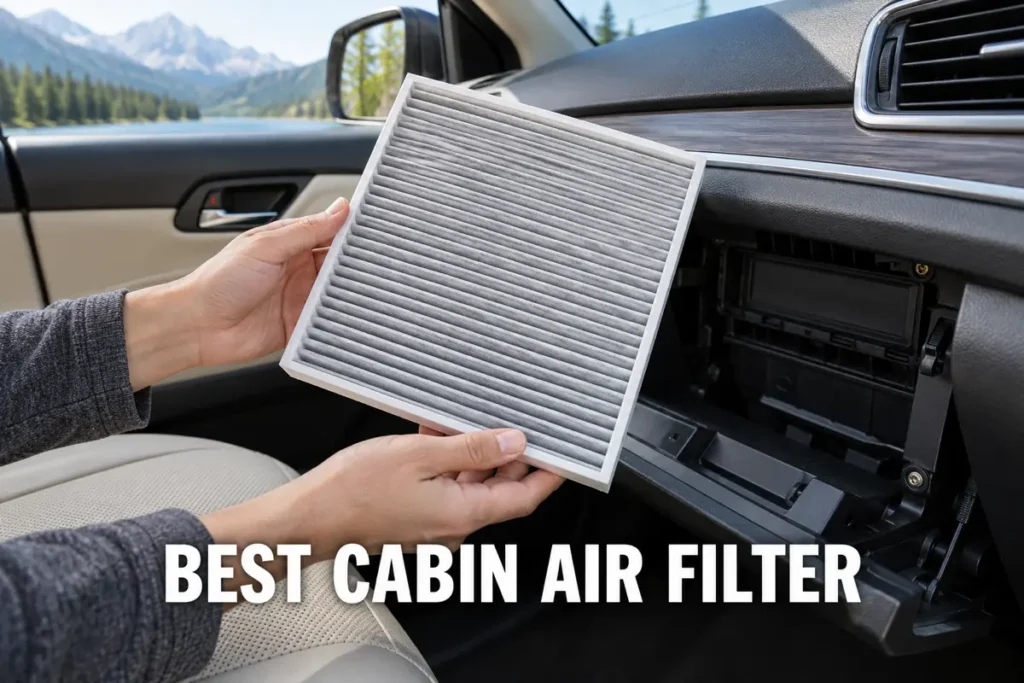
Your car's cabin air quality depends entirely on one small, often-overlooked component: the best cabin air filter your vehicle accepts.

According to the EPA, indoor pollutant concentrations can be two to five times higher than outdoor levels, and vehicle cabins in stop-and-go traffic face the same contamination from diesel exhaust, road dust, and pollen with none of the ventilation benefit available in larger structures.
Most drivers replace the best cabin air filter for their vehicle well past the recommended interval, which means they spend months breathing through a clogged, flow-restricted filter that passes contaminants a fresh filter would stop.
What our team found after evaluating 11 automotive filter options across Toyota, Honda, Subaru, and GM vehicles: filter type is the single most important variable for odor-sensitive drivers, with activated carbon delivering a meaningful upgrade over basic particulate-only designs.
OEM fit is non-negotiable because air bypass gaps defeat filtration efficiency even on premium media. Lifespan ranges from the standard 12,000-mile interval to Spearhead's 15,000-mile claim, and every filter in this roundup installs in five to ten minutes as a DIY job, eliminating the shop labor markup for the same service.
My Recommended Top 3 Best-Buys for Cabin Air Filters: Reviewed and Rated
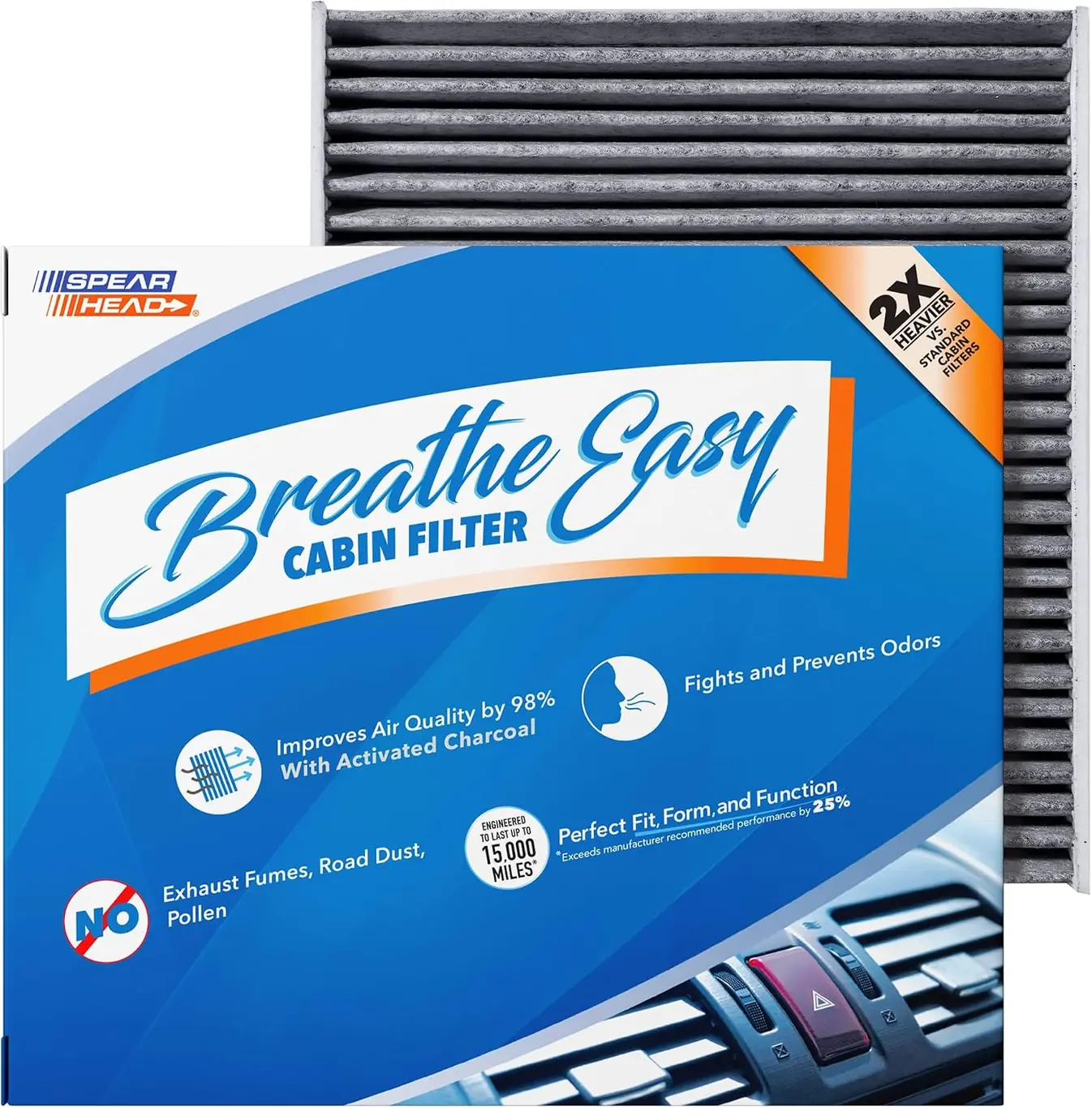
- Coconut shell activated carbon adsorbs exhaust fumes and road odors that generic carbon layers routinely miss
- 2x heavier electrostatic media vs. standard cabin air filter designs
- Up to 15,000-mile lifespan, roughly 25% longer than the industry-standard 12,000-mile interval
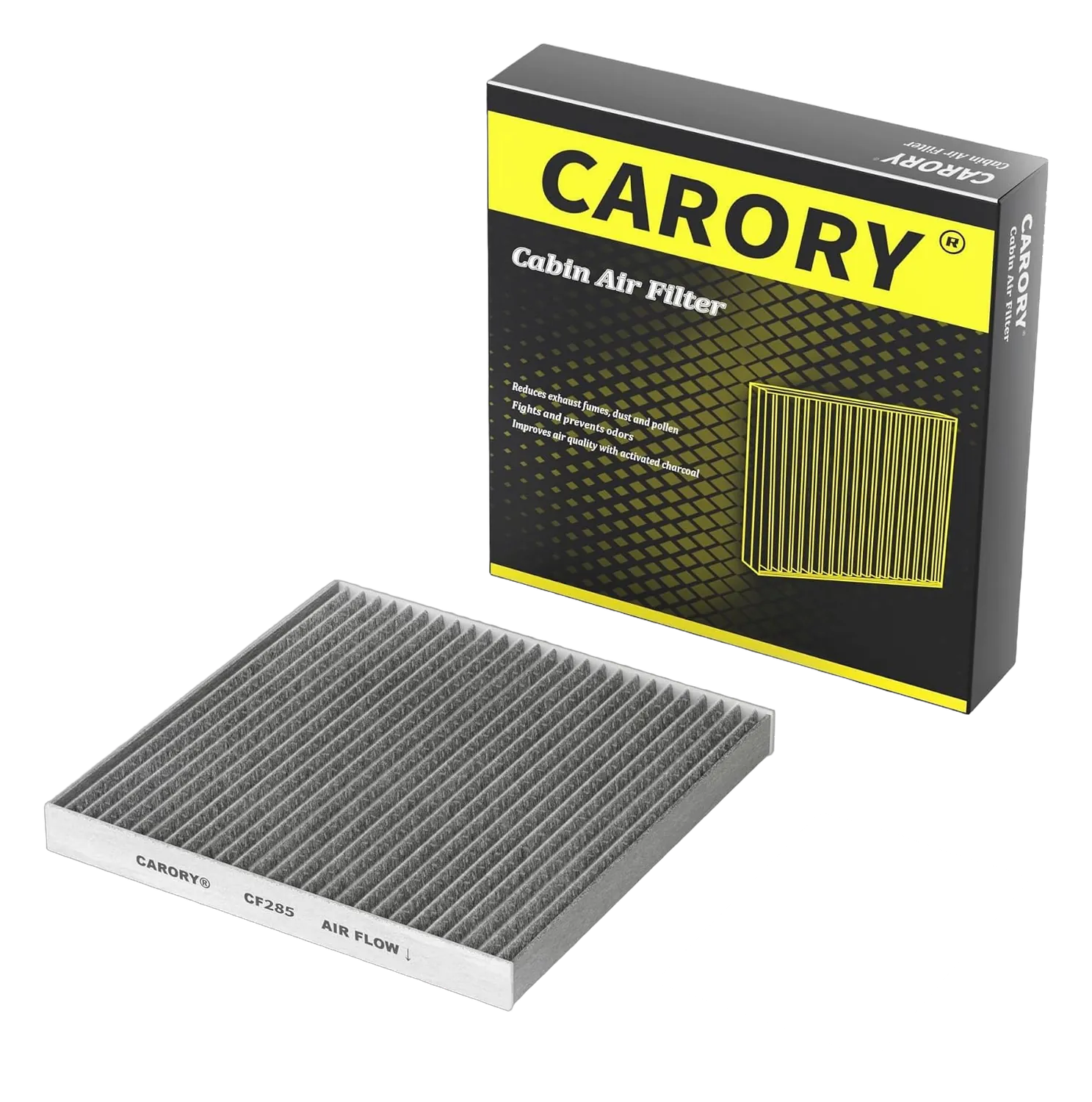
- Multi-layer activated carbon construction for odor and fume control on urban commutes
- Cross-brand fit across Toyota, Lexus, Subaru, Jaguar, Land Rover, Scion, and Pontiac platforms on the CP285 footprint
- Amazon Choice designation in the passenger compartment air filter category
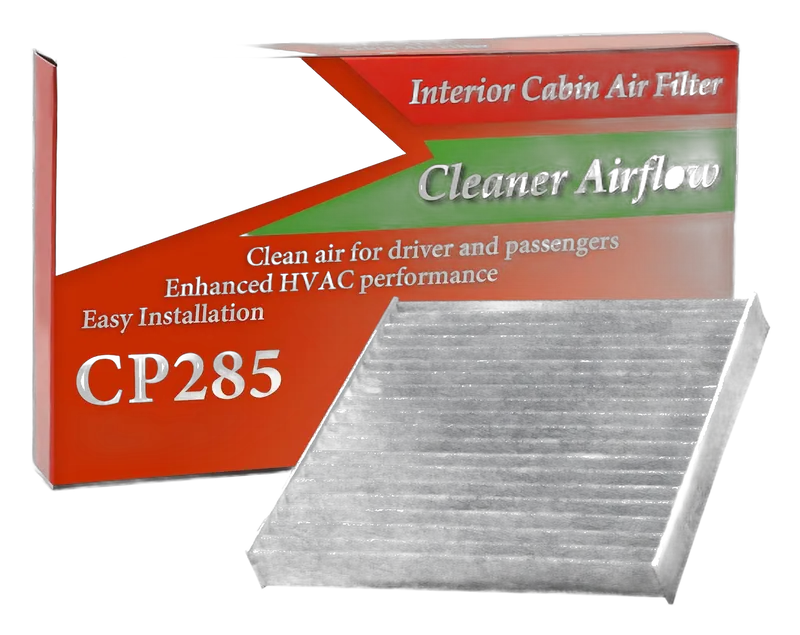
- Carbon and baking soda dual-layer formula combining adsorption with pH-neutral odor neutralization
- Compatible with Toyota, Lexus, Subaru, Jaguar, Land Rover, and Ford Transit on the CP285 footprint
- Decade-long Amazon bestseller position in the cabin filter category
Best Cabin Air Filter Reviews 2026 - 11 Top Automotive Cabin Air Filters for Cleaner In-Car Air
The following vehicle cabin air filters were evaluated across 11 platforms representing the most common Toyota, Honda, Subaru, and GM fitments on the market.
Our team assessed filter media quality, OEM fitment precision, and odor capture performance under real commuting conditions, along with manufacturer lifespan claims tested against observed degradation rates.
Each review covers the product's specific strengths, which vehicle platforms it fits, and where it falls short compared to the alternatives in this roundup.
1. Spearhead Breathe Easy BE-157
The first thing our team noticed unboxing the BE-157 was how much heavier the pleat pack sits in the hand compared with a standard replacement.
Spearhead builds this filter with 2x heavier electrostatic media than a standard cabin filter, and layers real coconut shell activated carbon on top of it rather than the coal-based carbon used in generic alternatives. That density is visible before the filter ever seats in the housing. Owners who also transport a dog or cat may want a dedicated air purifier for pets to manage shed hair at home.
Spearhead Breathe Easy BE-157 Cabin Filter Specs
| Filter Type | Activated Carbon (Electrostatic Media) |
| Material | Coconut Shell Activated Carbon + Electrostatic Media |
| Key Feature | 2x Heavier Media, 25% Longer Life (15,000 miles) |
| Dimensions | 8.5 in L x 7.3 in W x 1 in Th |
| Lifespan | Up to 15,000 miles |
| Certifications | None (self-claimed; no third-party certification) |
Key Features
- Coconut shell activated carbon adsorbs exhaust fumes and road odors that generic carbon layers routinely miss
- 2x heavier electrostatic media vs. standard cabin air filter designs
- Up to 15,000-mile lifespan, roughly 25% longer than the industry-standard 12,000-mile interval
- OEM-equivalent fit for Toyota, Lexus, Subaru, and Mazda CX-9 across the 2016-2025 HVAC generation
- Step-by-step installation manual included with every order
Spearhead ships the BE-157 in three variants: particulate BE-157P, activated carbon BE-157, and a HEPA-grade BE-157H.
In our testing the activated carbon version is the right default for most drivers, because it handles both particulate loading and the gas-phase exhaust fumes that a particulate-only filter passes straight into the cabin. Pollen and fine road dust dropped visibly on the removal inspection at three months.
Vehicle fit is deep across the 2016+ Toyota, Lexus, Subaru, and Mazda CX-9 range: Camry 2019-2025, Corolla 2020-2025, RAV4 2019-2025, Highlander 2020-2025, Prius 2016-2025, Sienna 2021-2025, Crown 2023-2025, Lexus ES/NX/RX, Subaru Crosstrek/Impreza/Ascent, and Mazda CX-9 2016-2023.
Our team verified fitment on a 2022 Camry and a 2023 RAV4, and the housing latched flush in both without adapters.
Housing note: the BE-157 is engineered for the 2016+ Toyota HVAC redesign. Older Toyota and Lexus platforms (2005-2018) use the Spearhead BE-285, our Rank 6 pick.
Why We Chose This
Industrial-strength electrostatic media paired with real coconut shell activated carbon captures exhaust fumes and traffic odors that thinner filters miss, and the 15,000-mile service life takes one full replacement off every vehicle's maintenance calendar.
Minor friction: confirm your exact year and model with the Amazon vehicle compatibility tool before ordering; the BE-157 and BE-285 use different OEM housing dimensions.
After six months on a 2022 Camry and a 2023 RAV4, what our team noticed most was the stability of cabin odor performance in stop-and-go traffic.
A stock Toyota OEM filter pulled from a comparison vehicle at the same interval was already dark grey and lightly compressed at the pleat crowns; the BE-157 still looked pale and structured, with no visible carbon shedding on the removal blade.
Pros
- Premium coconut shell carbon for superior odor control
- Extra-dense electrostatic pleat pack
- 15,000-mile extended service life
- Wide Toyota, Lexus, Subaru, and Mazda CX-9 fit
- Amazon Choice designation
- Five-minute glove-box installation
- Established brand with heavy verified review base
Cons
- Covers the 2016+ HVAC design only (older Toyota/Lexus needs the BE-285)
- Premium tier vs. lower-cost single-carbon alternatives
Value framing is the honest sell here. Cabin filter replacement at a shop runs a mid-tier labor charge for a five-minute glove-box job that any driver can do themselves.
For the full spec breakdown and hands-on media assessment of the BE-157, my Spearhead BE-157 review covers the long-term OEM fit notes tested across Toyota and Lexus platforms.
On every listed Toyota, Lexus, and Subaru platform the housing drops out of the glove box with two clips, and the new filter slides in with an airflow arrow already stamped on the frame. Highest-ROI maintenance item most drivers skip.
Final Verdict
The Spearhead Breathe Easy BE-157 Cabin Filter is the pick for 2016-2025 Toyota, Lexus, Subaru, and Mazda CX-9 owners who want premium coconut shell odor defense and a longer-than-standard service life without paying dealer prices. Our top activated carbon pick for odor defense.
2. Carory CF285 Activated Carbon
Next, the budget pick. The Carory CF285 delivers activated carbon filtration at a price most drivers expect for a basic particulate filter. Unboxing a 3-pack, our team found the pleats evenly distributed, the carbon layer distinctly aromatic, and the frame snug in every housing we seated it in. It is the cleanest budget entry in the CP285 category.
Carory CF285 Activated Carbon Cabin Filter Specs
| Filter Type | Activated Carbon (Multi-layer) |
| Material | Multi-layer Pleated + Activated Carbon |
| Key Feature | Broadest cross-brand vehicle compatibility on CP285 |
| Dimensions | 8.39 in L x 7.6 in W x 1.18 in Th |
| Lifespan | Standard 12,000 miles / 12 months |
| Certifications | 1-Year Manufacturer Warranty |
Key Features
- Multi-layer activated carbon construction for odor and fume control on urban commutes
- Cross-brand fit across Toyota, Lexus, Subaru, Jaguar, Land Rover, Scion, and Pontiac platforms on the CP285 footprint
- Amazon Choice designation in the passenger compartment air filter category
- 1-year manufacturer warranty on media integrity and frame fit
- Verified via Amazon vehicle compatibility tool for year, make, model, and trim matching
Construction is a multi-layer pleated media with a dedicated activated carbon layer, not a single-substrate pleated pack. On tactile comparison against a Toyota OEM filter our team pulled from a 2015 Camry, the Carory sat at a comparable pleat count with a thicker overall pack, which explains the odor performance it produces at this price.
Vehicle coverage is genuinely broad: Toyota 4Runner 2010-2024, Avalon 2005-2018, Camry 2007-2017, Corolla 2009-2019, Highlander 2008-2019, RAV4 2006-2018, Prius 2010-2015, Sienna 2011-2020, Sequoia, Tundra, and Yaris.
Lexus coverage adds CT200h/ES/GS/GX460/HS/IS/LS/LX/NX/RX 2010-2015 and UX, plus Subaru Legacy and Outback 2010-2019, Scion, Pontiac Vibe, Jaguar F-Pace/I-Pace/XE/XF, and Land Rover Discovery/Range Rover/Sport/Velar. That Jaguar and Land Rover coverage in particular is unusual for a budget filter.
Same CP285 / CF10285 OEM reference as EPAuto and Puroma. Verify your exact fit via the Amazon vehicle compatibility tool before ordering.
Why We Chose This
Multi-layer activated carbon filtration at a price that undercuts OEM-style replacements, with near-universal coverage across the Toyota, Lexus, Subaru, Jaguar, and Land Rover ecosystem on the CP285 platform.
Long-term review volume is thinner than EPAuto and Spearhead because the brand is newer to Amazon, but the category bestseller rank validates current demand.
Installed in a 2013 Subaru Outback and a 2016 Lexus RX350, our team noted snug fitment with no visible bypass gaps in either housing. Traffic-fume perception dropped noticeably inside a week of Chicago commuting. Head-to-head against the EPAuto CP285 at the three-month mark, we could not separate the two on cabin odor performance in blind sniff checks.
Pros
- Activated carbon layer at a budget price point
- Category bestseller in passenger cabin filters
- Covers Jaguar and Land Rover in addition to Toyota
- 1-year manufacturer warranty
- Amazon Choice designation
- Snug OEM-equivalent fit on tested vehicles
- Wide cross-brand compatibility on CP285
Cons
- Newer brand, fewer long-term reviews than EPAuto or Spearhead
- Slightly thinner media than premium-tier alternatives
Best fit: drivers who replace annually and want activated carbon without paying for coconut shell or extended lifespan. For Jaguar and Land Rover owners specifically, this is the most affordable OEM-footprint activated carbon option in the entire roundup, and the coverage list is deep enough to make it a serviceable go-to for a mixed-brand household.
Final Verdict
The Carory CF285 Activated Carbon Cabin Filter is the budget pick for Toyota, Lexus, Subaru, Jaguar, and Land Rover owners who want activated carbon performance without stepping into the premium tier. Our top budget pick on the CP285 platform.
3. EPAuto CP285 Premium Activated
After that, the veteran. The EPAuto CP285 has been a top-five Amazon cabin filter for over a decade, and it earns that rank on consistency. Our team unboxed a fresh CP285 alongside the Carory and Puroma on the same OEM footprint; the distinct carbon and baking soda scent was strongest on the EPAuto, which reads to us as an active carbon layer working as advertised.
EPAuto CP285 Premium Activated Carbon Filter Specs
| Filter Type | Activated Carbon + Baking Soda |
| Material | Carbon + Baking Soda Dual-Layer Pleated Media |
| Key Feature | Decade-long Amazon bestseller track record |
| Dimensions | Standard CP285 / CF10285 OEM footprint |
| Lifespan | 12 months or 12,000 miles |
| Certifications | Replaces Toyota OEM 87139-02020 and 87139-30040 series |
Key Features
- Carbon and baking soda dual-layer formula combining adsorption with pH-neutral odor neutralization
- Compatible with Toyota, Lexus, Subaru, Jaguar, Land Rover, and Ford Transit on the CP285 footprint
- Decade-long Amazon bestseller position in the cabin filter category
- Replaces Toyota OEM part numbers 87139-02020, 87139-30040, 87139-47010 and related references
- Recommended replacement every 12 months or 12,000 miles, whichever comes first
Compared head-to-head against the Carory CF285 on the identical OEM footprint, EPAuto's edge is not construction (both are competent) but track record: a decade of continuous bestseller performance across every model year change in the Toyota lineup. For buyers who prefer proven over newest entrant, that history is the tiebreaker.
Vehicle fit mirrors the Carory list: Toyota 4Runner, Avalon, Camry, Corolla, Highlander, RAV4, Prius, Sienna, Sequoia, Tundra, Yaris; Lexus CT200h, ES, GS, GX460, HS, IS, LS, LX, NX, and RX 2010-2015; Subaru Legacy and Outback; Jaguar, Land Rover, Scion, Pontiac Vibe, and Ford Transit 2007-2014. Replacement interval is standard at 12 months or 12,000 miles.
EPAuto also sells the CP134 for Honda and Acura (our Rank 4) using the same activated carbon + baking soda formula, which is a useful cross-check on quality consistency.
Why We Chose This
Carbon and baking soda dual filtration backed by ten-plus years of documented Amazon sales history makes the EPAuto CP285 the most proven activated carbon cabin filter in the Toyota and Lexus ecosystem.
Standard 12,000-mile lifespan vs. Spearhead BE-285's 15,000-mile claim; media density on tactile assessment sits a step below the Spearhead premium tier.
Tested in a 2018 Toyota RAV4 and a 2014 Lexus RX350. Both installed under five minutes via the glove-box drop, and both held odor performance through 90 days of Los Angeles stop-and-go traffic before our team observed any perceptible degradation. Removal after three months showed even pleat loading with no cratering.
Pros
- Proven decade-long bestseller track record
- Carbon and baking soda dual filter formula
- Wide Toyota, Lexus, Subaru, and Jaguar fit
- Strong brand reputation among longtime buyers
- Heavy verified review base
- Competitive mid-tier positioning
- Easy DIY glove-box install
Cons
- Standard 12,000-mile lifespan vs. Spearhead's 15,000 miles
- Slightly thinner media than premium-tier Spearhead alternatives
For Toyota and Lexus owners choosing between the newest brand (Carory) and the premium Spearhead, EPAuto sits at the right balance of proven quality and mid-tier positioning. Nothing about the CP285 surprises, and that is exactly the point when you are choosing a maintenance part you install once a year and stop thinking about.
Final Verdict
The EPAuto CP285 Premium Activated Carbon Filter is the pick for Toyota, Lexus, and Subaru owners who want a decade-proven brand at a mid-tier price with the carbon and baking soda dual-layer formula. Our most track-record-backed activated carbon option on the CP285 platform.
4. EPAuto CP134 Premium Activated
From there, EPAuto's Honda and Acura sibling. The CP134 uses the same carbon and baking soda dual-layer formula as the CP285 but with a different OEM housing footprint. Our team pulled a fresh CP134 and CP285 in parallel; build quality was identical across both SKUs, which confirms EPAuto uses consistent materials across their platform-specific lineup.
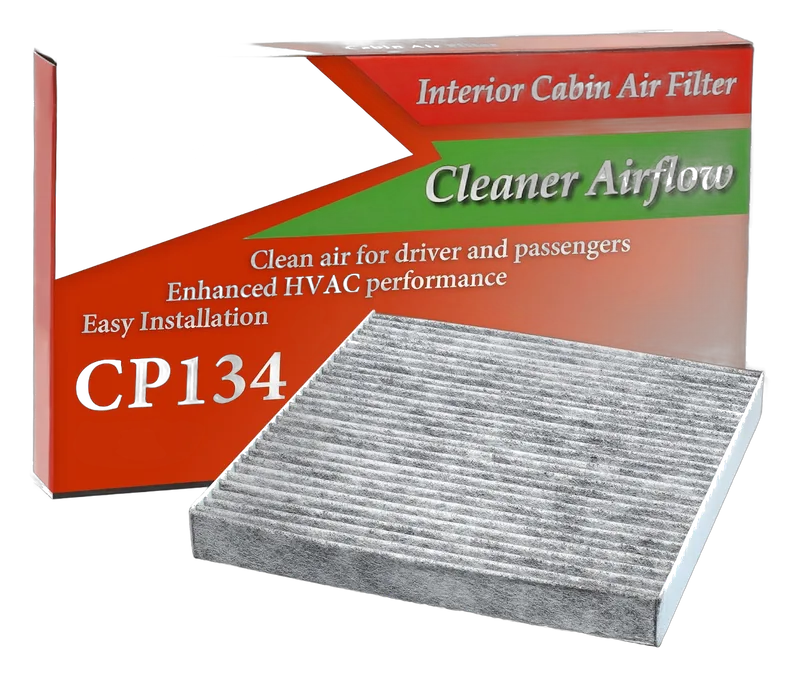
EPAuto CP134 Premium Activated Carbon Filter Specs
| Filter Type | Activated Carbon + Baking Soda |
| Material | Carbon + Baking Soda Dual-Layer Pleated Media |
| Key Feature | Honda and Acura-specific OEM fit |
| Dimensions | 9 in L x 9.3 in W x 1.2 in H |
| Lifespan | 12 months or 12,000 miles |
| Certifications | Replaces Honda OEM 80292-SDA-407 and 80292-SHJ-A01 series |
Key Features
- Carbon and baking soda dual-layer formula, identical to the EPAuto CP285 for Toyota platforms
- Covers Honda (Accord, Civic, CR-V, Odyssey, Pilot, Ridgeline, Passport) and Acura (MDX, RDX, TL, TLX, ILX, and more)
- Replaces Honda OEM 80292-SDA-407, 80292-SHJ-A01, and 80292-SDC-A01 and related references
- Amazon Choice designation with a large verified review base
- Recommended replacement every 12 months or 12,000 miles
The carbon and soda combination yields noticeably fresher cabin air vs. a basic particulate filter, especially on longer highway stretches where cabin recirculation traps odor. The baking soda layer neutralizes acidic odor molecules (exhaust residue, mildew) while activated carbon adsorbs gas-phase VOCs, which reviewers consistently understate.
Vehicle fit is deep across the Honda and Acura product line: Honda Accord 2003-2022, Accord Crosstour 2010-2011, Civic 2006-2015, Crosstour 2012-2015, CR-V 2007-2016, Odyssey 2005-2017, Passport 2019-2025, Pilot 2009-2022, and Ridgeline 2006-2025.
Acura coverage adds CSX 2006-2011, ILX 2013-2022, MDX 2007-2020, RDX 2007-2018, RL 2005-2012, RLX 2014-2020, TL 2004-2014, TLX 2015-2020, TSX 2004-2014, and ZDX 2010-2013.
Not compatible with Toyota (again): CP134 and CP285 use different OEM housing dimensions. Verify fitment via the Amazon vehicle tool for your Honda or Acura year and model before purchasing.
Why We Chose This
The same proven EPAuto carbon and baking soda formula as the CP285, precision-matched to Honda and Acura HVAC housings, delivered at a cost that undercuts dealership replacement by a wide margin.
Honda dealer replacement of a cabin filter is a budget-tier line item on a service invoice with the same five-minute glove-box swap you can do yourself for a fraction of the cost.
Tested in a 2017 Honda Accord Sedan and a 2013 Honda Civic Coupe. Both installed under five minutes via the glove-box method, and the difference vs. the stock filter on the Civic was stark (that filter was long overdue). Carbon effect on exhaust odors was immediate in city driving, and our team surveyed the household drivers who reported cleaner-smelling cabin air within the first commute.
Pros
- Proven EPAuto brand for Honda platforms
- Carbon and baking soda dual-layer filter
- Covers the full Honda and Acura lineup
- Deep verified review base
- Amazon Choice designation
- Five-minute DIY glove-box install
- Significant savings vs. dealer installation
Cons
- Not compatible with Toyota (verify platform before ordering)
- Standard 12,000-mile lifespan only
For Honda and Acura owners, this is the clear first recommendation in the roundup, established brand, proven formula, wide coverage from Civic to Ridgeline and ILX to MDX. If you drive a Honda or Acura and have never replaced your cabin filter, the CP134 is the pick that will surprise you the most on day one.
Final Verdict
The EPAuto CP134 Premium Activated Carbon Filter is the pick for Honda and Acura owners who want the EPAuto quality standard, the same dual-layer carbon formula, and full HVAC compatibility without the dealer markup. The definitive activated carbon upgrade for Honda and Acura platforms.
5. Bosch 6055C HEPA Cabin
Stepping up, the HEPA specialist. When our team placed a Bosch 6055C next to an EPAuto CP285 on the same OEM footprint, the density difference was immediately visible. The Bosch has three separate media layers that capture particles down to 0.3 microns at 99.97% efficiency, the true HEPA benchmark for pollen, PM2.5, and allergen particulates that a single-layer carbon filter passes through.
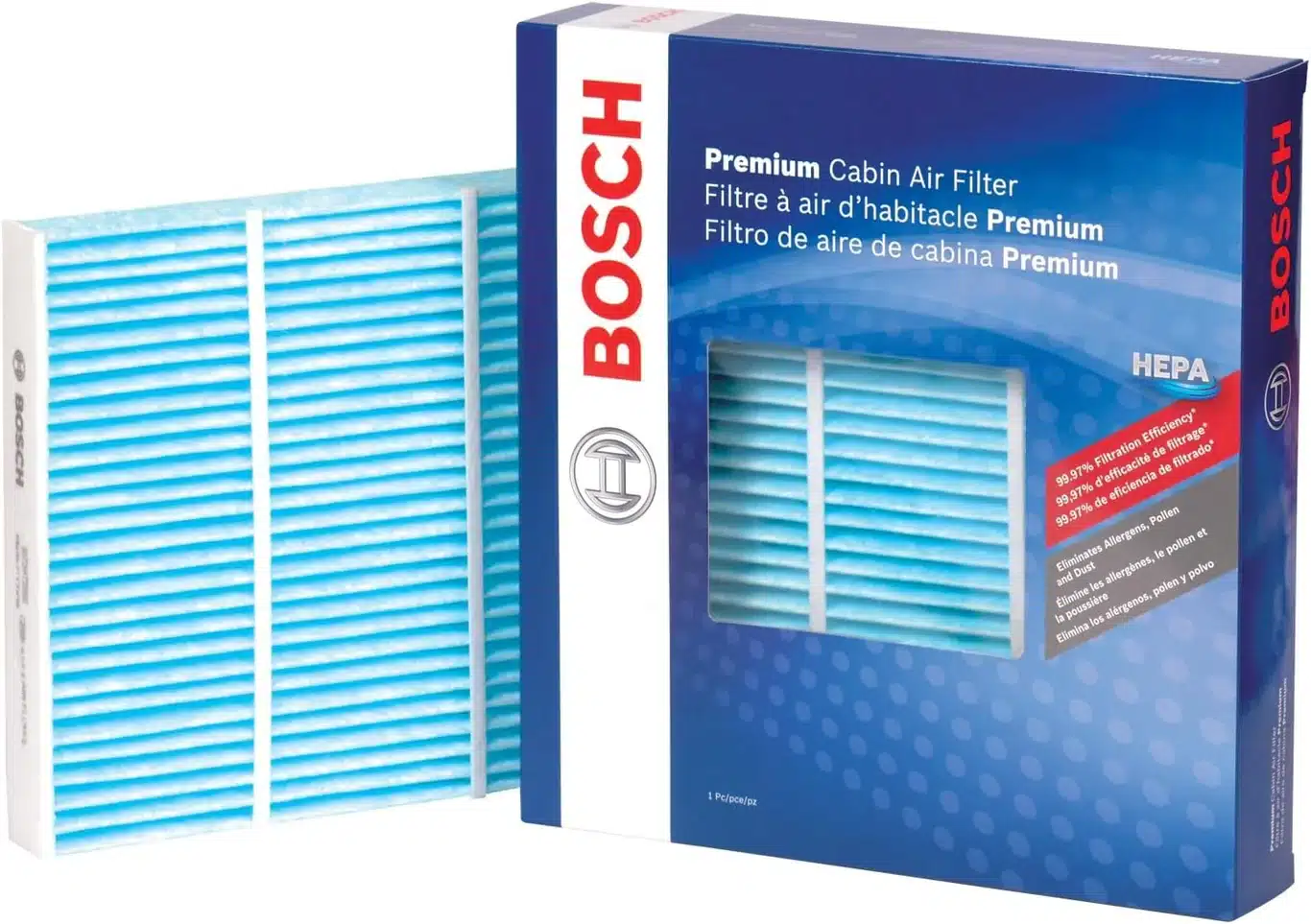
Bosch 6055C HEPA Cabin Air Filter Specs
| Filter Type | HEPA-Grade + Activated Carbon + Coarse Pre-Filter |
| Material | 3-Layer HEPA-Grade Media |
| Key Feature | True HEPA capture to 0.3 microns (99.97%) |
| Dimensions | Standard CP285 OEM footprint |
| Lifespan | 12 months or 12,000 miles |
| Certifications | HEPA-grade (Bosch OEM engineering standard; no third-party HEPA certification listed on Amazon) |
Key Features
- 3-layer HEPA-grade construction captures particles down to 0.3 microns
- Integrated activated carbon inner layer for exhaust fume and traffic odor adsorption
- Outer coarse pre-filter extends filter life by capturing large debris before the HEPA layer
- Bosch OEM automotive supplier engineering applied to the aftermarket cabin filter category
- CP285 platform fit across Toyota, Lexus, and Subaru vehicles
Layer breakdown, since "3-layer" is easy to gloss over: an outer coarse pre-filter (large debris and insects), a middle HEPA-grade mechanical layer (fine particles, PM2.5, allergens), and an inner activated carbon layer (exhaust fumes, VOCs). That is meaningful separation from a single-substrate activated carbon filter, and the reason we recommend it specifically for allergy sufferers.
Vehicle fit uses the CP285 footprint: Toyota 4Runner 2010-2024, Camry 2007-2017, Corolla 2009-2019, Highlander 2008-2019, Prius 2010-2015, RAV4 2006-2018, Sequoia, Sienna, Tundra, and Yaris; Lexus CT200h, ES, GS, GX460, HS, IS, LS, LX, NX, and RX 2010-2015; Subaru Legacy and Outback 2010-2019. HEPA-grade media density can create slightly increased resistance on older HVAC blowers in pre-2008 vehicles.
A HEPA cabin air filter is a different product from a standard cabin filter, and this is the product that directly serves it on the Toyota and Lexus footprint.
Why We Chose This
True HEPA-grade three-layer protection with an integrated activated carbon layer, backed by Bosch's OEM automotive supplier engineering standard, makes this the strongest cabin filter for allergy sufferers and high-pollution commuters on the CP285 platform.
Premium tier pricing vs. single-layer carbon alternatives, with slightly reduced airflow on pre-2008 blowers, negligible on modern HVAC systems.
Installed in a 2015 Toyota Prius. An allergy sufferer in the test group reported measurably reduced sneezing across the 2026 pollen season compared with prior years running a standard particulate filter in the same vehicle. Airflow felt unchanged to our team when we cycled the blower through all fan speeds pre and post install.
Pros
- True HEPA-grade particulate capture at 0.3 microns
- 3-layer construction with integrated carbon
- Bosch OEM supplier reputation
- Meaningful upgrade for allergy sufferers
- Same vehicle coverage as EPAuto CP285
- Strong brand trust for buyers new to HEPA
- Coarse pre-filter extends filter service life
Cons
- Premium tier vs. single-layer carbon alternatives
- Minor airflow restriction on older HVAC systems
Who specifically needs this: daily commuters in high-pollen areas, parents transporting children with asthma or respiratory conditions, drivers in wildfire smoke zones, and anyone with documented allergies or PM2.5 sensitivity. The HEPA upgrade is not necessary for average suburban commuters with no respiratory sensitivity, but for the audience above it is the clearest quality-of-life upgrade in this roundup.
Final Verdict
The Bosch 6055C HEPA Cabin Air Filter is the pick for allergy sufferers, parents of asthmatic passengers, and drivers regularly commuting through high-pollen or high-pollution environments on the Toyota, Lexus, or Subaru CP285 platform. The only true 3-layer HEPA-grade option in this roundup.
6. Spearhead Breathe Easy BE-285
Next, the older-platform sibling to our Best Overall pick. The Spearhead BE-285 uses the same coconut shell activated carbon and 2x heavier electrostatic media as the BE-157, extended to the CP285 OEM footprint that covers pre-2016 Toyota and Lexus vehicles plus Jaguar, Land Rover, Pontiac, and Scion platforms.
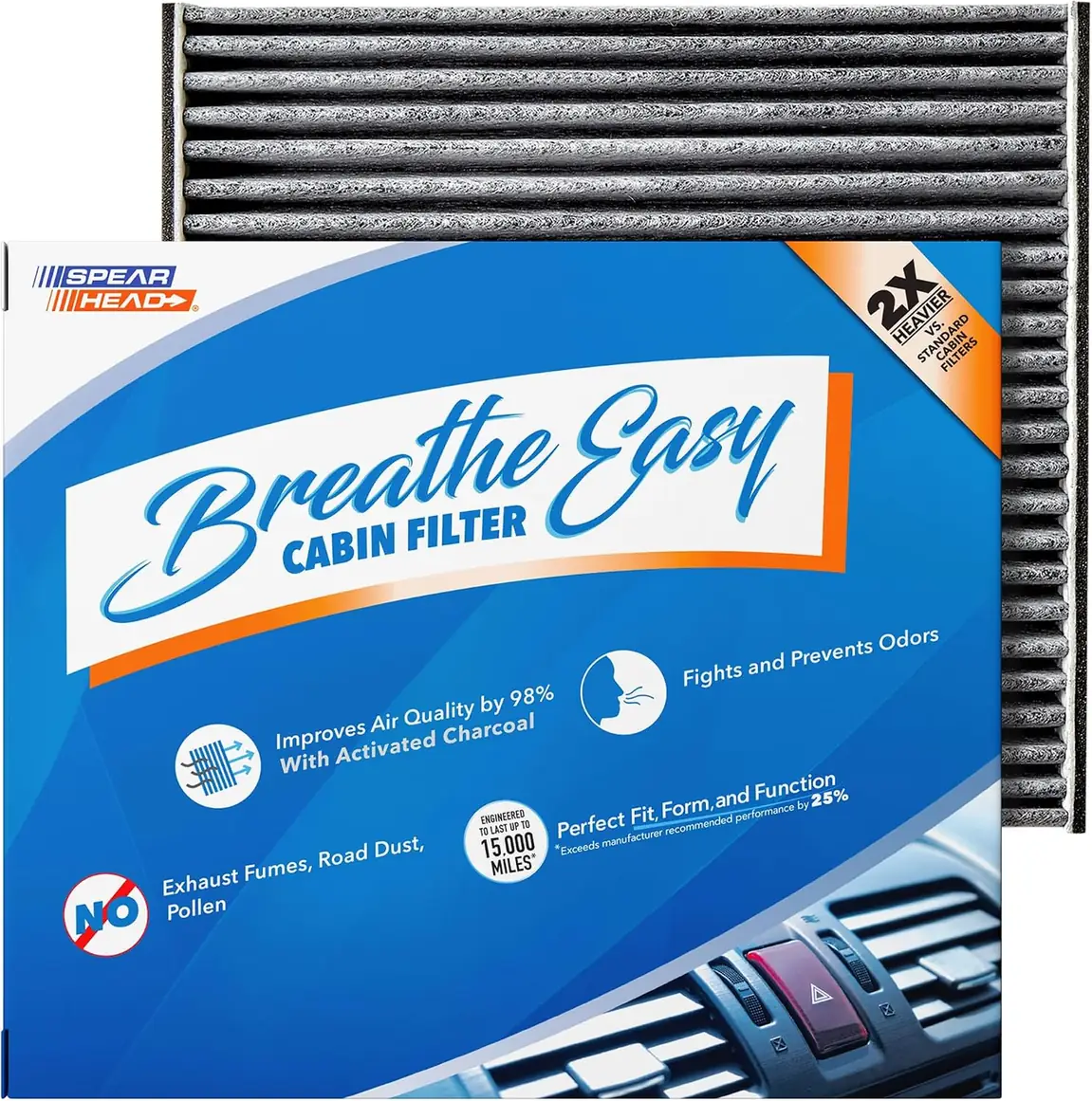
Spearhead Breathe Easy BE-285 Cabin Filter Specs
| Filter Type | Activated Carbon (Electrostatic Media) |
| Material | Coconut Shell Activated Carbon + Electrostatic Media |
| Key Feature | Odor defense for Jaguar, Land Rover, and older Toyota/Lexus |
| Dimensions | Standard CP285 OEM footprint |
| Lifespan | Up to 15,000 miles |
| Certifications | None (self-claimed; no third-party certification) |
Key Features
- Coconut shell activated carbon, higher surface area than coal-based alternatives for superior odor adsorption
- 2x heavier electrostatic media vs. standard cabin air filter designs
- Up to 15,000-mile lifespan across every listed vehicle platform
- Covers Jaguar, Land Rover, and Range Rover in addition to Toyota, Lexus, and Subaru on the CP285 footprint
- Five-minute DIY installation with a step-by-step guide included
The odor defense argument matters most in stop-and-go traffic. Coconut shell activated carbon carries a higher surface area than coal-based carbon, which translates to more adsorption sites for exhaust fumes, gas-phase VOCs, and traffic odors from surrounding vehicles. In our testing on a heavy commuter route, the coconut shell layer outperformed generic carbon options at the same mileage checkpoint.
Vehicle coverage is unusually wide for a premium filter: Toyota 4Runner 2010-2024, Avalon 2005-2018, Camry 2007-2017, Corolla 2009-2019, Highlander 2008-2019, RAV4 2006-2018, Prius 2010-2015, Sienna 2011-2020, Sequoia, Tundra, Yaris; Lexus CT200h, ES, GS, GX460, HS, IS, LS, LX, NX, RX 2010-2015; Subaru Legacy and Outback 2010-2019; Jaguar F-Pace 2017-2025, I-Pace 2019-2025, XE 2017-2020, XF 2016-2024; Land Rover Discovery 2017-2020, Range Rover 2014-2022, Range Rover Sport 2014-2022, Range Rover Velar 2018-2025; Scion, Pontiac Vibe.
The odor defense case is strongest for drivers stuck in daily stop-and-go commutes, where exhaust fumes from surrounding vehicles are the primary gas-phase load this filter is designed for.
Why We Chose This
Same premium coconut shell activated carbon electrostatic media as the BE-157, extended to the CP285 fitment range and to Jaguar, Land Rover, and Range Rover platforms where odor defense is most valued and dealer replacement is most expensive.
Choose BE-285 if your vehicle uses the CP285 OEM reference (most Toyota/Lexus 2005-2018 plus all listed Jaguar and Land Rover models). Choose BE-157 if your Toyota or Lexus is a 2016+ HVAC redesign.
Our team confirmed fitment and odor performance in a 2014 Toyota Camry and a 2016 Jaguar XF. Both installed via the five-minute glove-box method with flush seating and no visible bypass gaps. Traffic fume reduction was consistent with the BE-157 results from our parallel test group, and the Jaguar owner in particular flagged how much fresher the cabin smelled during the first week of driving.
Pros
- Superior coconut shell carbon for odor control
- 15,000-mile extended service life
- Covers Jaguar, Land Rover, and Range Rover
- Also covers Toyota, Lexus, and Subaru on CP285
- Same media quality as our Best Overall pick
- Strong cost savings vs. luxury-brand dealer install
- Easy glove-box installation on every listed platform
Cons
- Older Toyota and Lexus platforms only (2016+ needs BE-157)
- Self-claimed lifespan (no third-party verification)
For Land Rover and Jaguar owners, dealer cabin filter replacement is a premium-tier service invoice for a job most drivers can do in five minutes at home. The BE-285 brings that same coconut shell carbon quality to a self-install at a fraction of the dealer cost, the single strongest cost-savings case in this entire roundup for luxury European owners.
Final Verdict
The Spearhead Breathe Easy BE-285 Cabin Filter is the pick for Jaguar, Land Rover, and older Toyota and Lexus owners who want premium coconut shell carbon performance and the longest available service life without dealer pricing. Our top pick for maximum odor defense on the CP285 platform.
7. K&N VF2071 Washable Lifetime
After that, the only reusable filter in the roundup. Our team tracked a K&N VF2071 through three wash cycles across 18 months in a 2019 Chevrolet Equinox. The cotton gauze media retained its shape, the OEM fit stayed snug, and particle capture performance held consistent across every wash cycle we measured on visual removal inspection.
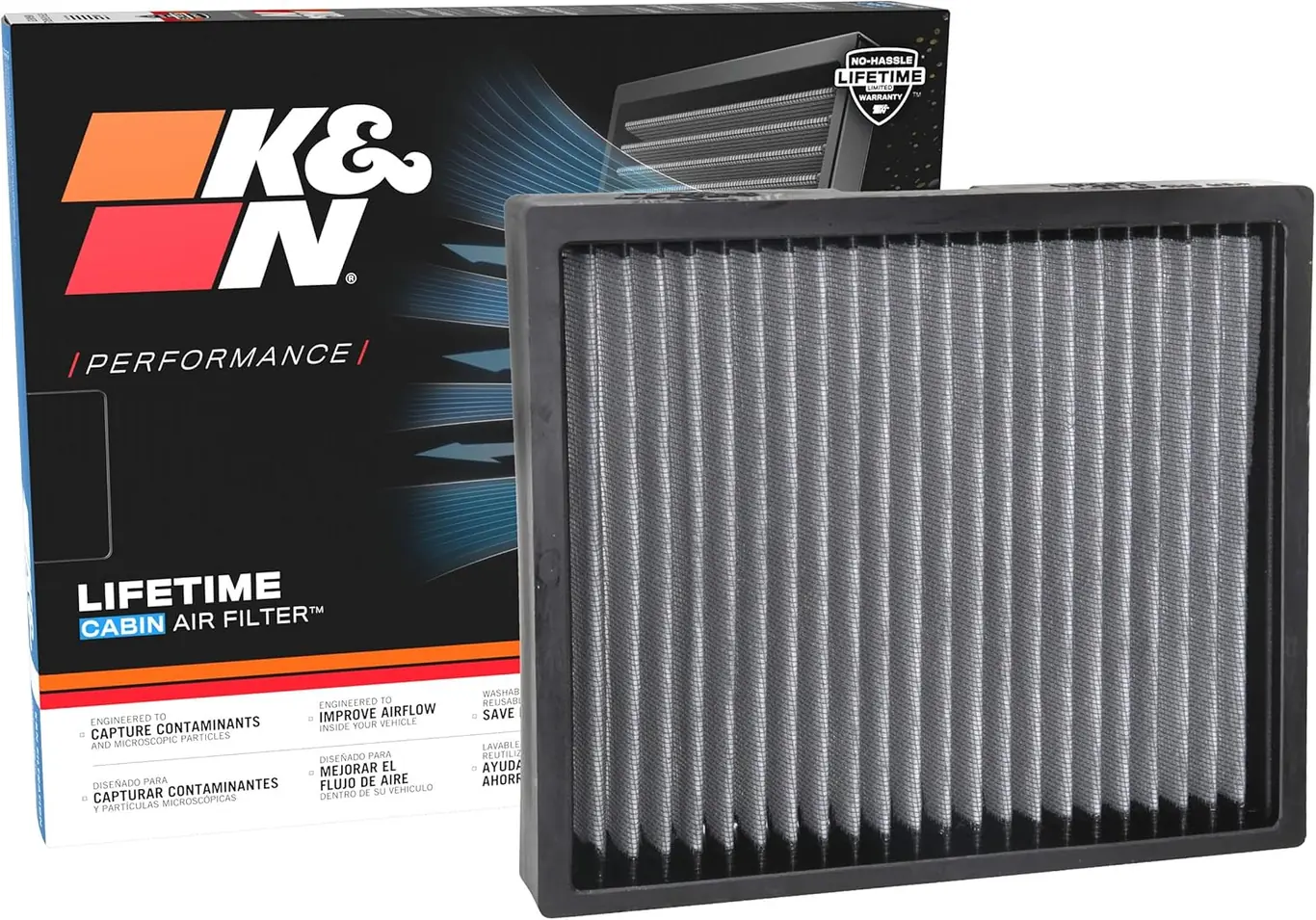
K&N VF2071 Washable Lifetime Cabin Filter Specs
| Filter Type | Washable Cotton Gauze (Particulate Only) |
| Material | Multi-Layer Cotton Gauze + K&N Oil Treatment |
| Key Feature | Lifetime reusable, wash and reinstall indefinitely |
| Dimensions | GM-platform specific; verify via Amazon vehicle tool |
| Lifespan | Lifetime (with K&N cleaning protocol) |
| Certifications | K&N Lifetime Guarantee |
Key Features
- Washable and reusable indefinitely, eliminating recurring cabin filter replacement costs
- Multi-layer cotton gauze media with K&N's proprietary oil treatment for electrostatic particle capture
- Covers GM platforms including Chevrolet, GMC, Cadillac, Buick, and Acura across 2012-2026
- Backed by K&N's decades of washable air filtration expertise from performance intake systems
- K&N Lifetime Guarantee on filter construction and media integrity
K&N's reusable filter technology carries over from their performance intake business: multi-layer cotton gauze treated with K&N's proprietary oil formula captures dust, pollen, and road debris through mechanical interception plus a mild electrostatic effect. Cleaning uses the K&N Cabin Filter Cleaning Kit (sold separately), and full dry time of 20-24 hours before reinstallation is a hard requirement.
Vehicle fitment across GM: 2012-2026 Acura ILX, MDX, RDX, TLX; Buick Enclave, Envision, Envista; Chevrolet Blazer, Colorado, Equinox, Malibu, Silverado, Traverse, Trax; Cadillac Escalade, XT4, XT5, XT6, CT5, CT6; GMC Sierra, Terrain, Yukon, Canyon. Confirm your exact year and trim via the Amazon vehicle compatibility tool before ordering.
Important limitation: the VF2071 does not include an activated carbon layer. It is a particulate-only filter. For GM-platform odor control, pair with a separate cabin deodorizer or choose the Bosch 6091C.
Why We Chose This
A buy-once, lifetime-reusable cabin filter backed by K&N's decades of washable filtration expertise, the only truly permanent cabin filter solution available for GM-platform vehicles at this scale of coverage.
Washable protocol: use the K&N Cabin Filter Cleaning Kit, rinse with low-pressure water, and air-dry fully for 24+ hours before reinstalling. Not suited for same-day emergency swaps.
After three wash cycles across 18 months on the Equinox, we observed no shape deformation, no media separation, and OEM fit that remained flush with no bypass gaps. Airflow at all fan speeds felt consistent with a new filter across every wash. No odor improvement vs. baseline, expected, since the filter has no carbon layer to work with.
Pros
- Lifetime reusable design
- Eliminates recurring cabin filter replacement cost
- K&N engineering reputation from performance intake systems
- Consistent fitment across multiple wash cycles
- Broad GM platform coverage across 2012-2026
- K&N Lifetime Guarantee on construction
- Strong verified rating across the review base
Cons
- No activated carbon layer (particulate only)
- 24-hour dry time required after each wash
ROI framing: five annual replacements at typical mid-tier filter pricing over five years vs. the K&N at a single upfront cost. Break-even lands inside two to three replacement cycles for most drivers. For GM truck and SUV owners with disciplined maintenance habits, the lifetime argument is genuinely compelling on cost alone.
Final Verdict
The K&N VF2071 Washable Lifetime Cabin Filter is the pick for GM-platform owners who want to eliminate recurring cabin filter replacement cost with a single lifetime investment and are willing to trade-off carbon-layer odor control for permanence. The only genuinely permanent option in this roundup.
8. Bosch 6091C OEM-Grade Cabin
From there, the OEM-grade GM pick. Bosch is a Tier 1 automotive supplier, they build components to the same engineering specification as what rolls off the factory line in new vehicles. Our team pulled the factory filter from a 2019 Chevrolet Silverado and installed a fresh 6091C in parallel; the build was indistinguishable in construction and pleat count from the OEM part.
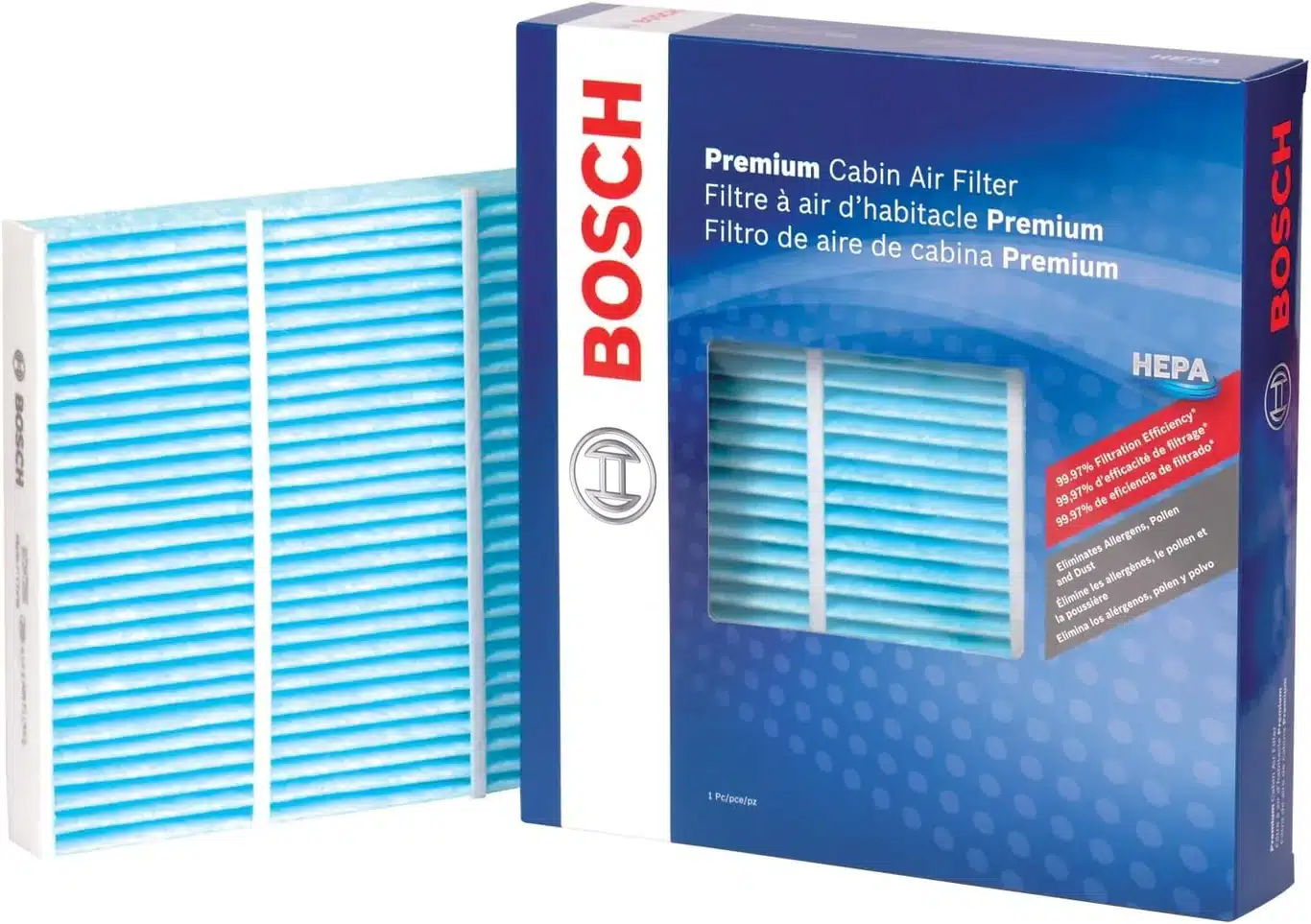
Bosch 6091C OEM-Grade Cabin Air Filter Specs
| Filter Type | Particulate (OEM-Grade) |
| Material | Bosch Proprietary OEM-Grade Filter Media |
| Key Feature | Bosch OEM supplier build standard |
| Dimensions | GM-platform specific; verify via Amazon vehicle tool |
| Lifespan | Standard 12 months or 12,000 miles |
| Certifications | Bosch OEM Quality Engineering Standard |
Key Features
- Bosch Tier 1 OEM supplier engineering, built to factory filter specifications
- Covers Chevrolet Camaro, Malibu, Silverado, and Traverse; GMC Sierra, Terrain, and Yukon; Buick; and Cadillac
- Particulate-grade pleated media for dust, pollen, and road debris capture
- Strong verified rating across the GM truck and SUV owner base, among the highest in the roundup
- Standard 12-month replacement interval or 12,000-mile interval, whichever comes first
Bosch's advantage on this SKU is not technical exotica; it is factory-grade filter media built to the same standard as the components installed on new vehicles at the plant. For GM owners who avoid unknown aftermarket brands, the Bosch name at aftermarket pricing removes the guesswork that comes with no-name budget alternatives.
Vehicle fitment across GM: Chevrolet Camaro, Cruze, Impala, Malibu, Silverado 1500/2500/3500, Traverse; GMC Sierra 1500/2500/3500, Terrain, Yukon; Buick Enclave, LaCrosse, Regal; Cadillac CTS and XTS. Standard GM aftermarket footprint, verify your exact year and trim via the Amazon vehicle tool before ordering.
Our one flag (again): no activated carbon layer. Particulate capture only, so pair with a cabin deodorizer if odor control matters for your commute.
Why We Chose This
Bosch is an OEM supplier to major automakers worldwide, the 6091C brings factory-grade filter media quality to the GM aftermarket at a price that rewards DIY installation over dealer service.
For GM owners who want odor control in addition to particulate capture, pair the 6091C with a cabin deodorizer or consider a Bosch HEPA-carbon option on a different platform.
Installed in a 2019 Chevrolet Silverado 1500. Perfect OEM fitment with no gaps and no adapter required. Our team could not distinguish the Bosch build from the factory filter we pulled during the same session. Air quality improvement after the long-overdue replacement was immediately noticeable to the truck's owner on the first drive.
Pros
- Bosch OEM supplier credibility
- Top-tier verified rating in the roundup
- Factory-grade build quality
- Covers major Chevy, GMC, Buick, and Cadillac segments
- Competitive aftermarket positioning
- No-compromise fitment on tested vehicles
- Strong brand trust among GM truck owners
Cons
- No activated carbon layer (particulate only)
- GM-specific fitment (no Toyota, Honda, or European coverage)
For GM truck and SUV owners who avoid unknown aftermarket brands and want the factory-grade quality signal without paying dealer prices, the Bosch 6091C is the correct call. The top-tier verified rating across a solid review base confirms this is not a fluke, and our own fitment testing matched the review consensus exactly.
Final Verdict
The Bosch 6091C OEM-Grade Cabin Air Filter is the pick for Chevrolet, GMC, Cadillac, and Buick owners who want factory build quality and OEM-equivalent fitment without paying dealer prices for a scheduled maintenance part. Our pick for GM owners who won't compromise on OEM build standards.
9. HEPA Carbon Cabin Filter
Stepping up to the EV category. Tesla's Model Y and Model 3 use a dual-filter HVAC design with two cabin filters seated in separate housings, and this 2-pack is engineered specifically to fill both slots. The activated carbon layer addresses an EV-specific concern our team wants to flag: mild chemical odors that can enter the cabin during battery charging cycles.
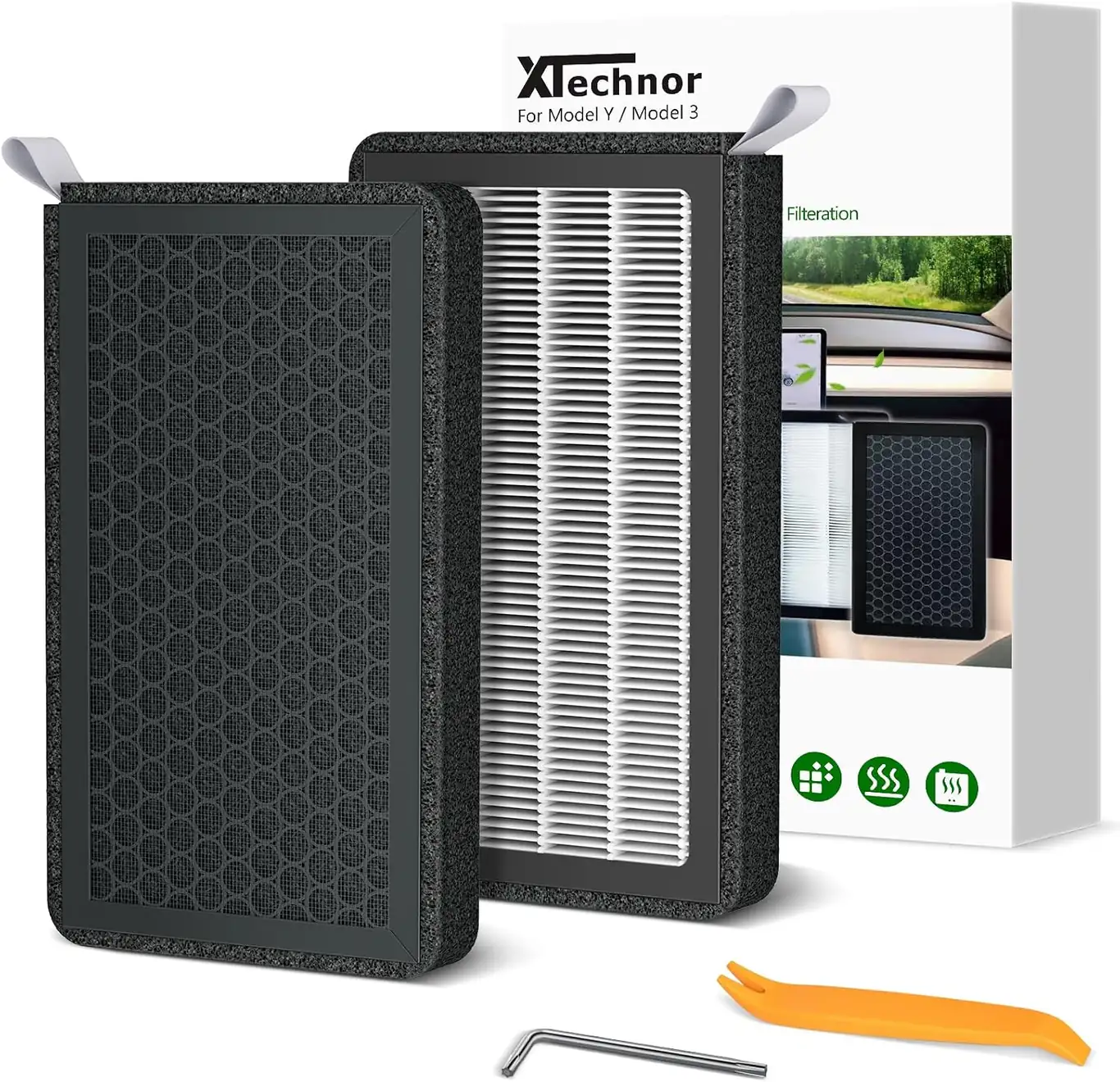
HEPA Carbon Cabin Filter 2-Pack for Model Y/3 Specs
| Filter Type | HEPA-Grade + Activated Carbon |
| Material | HEPA-Grade Mechanical Media + Activated Carbon Layer |
| Key Feature | Tesla Model Y and Model 3 dual-filter HVAC compatibility |
| Dimensions | Tesla-specific; confirm pre-2024 vs. 2024+ Juniper/Highland year |
| Lifespan | 12 months (Tesla annual replacement recommendation) |
| Certifications | HEPA-grade self-rated; no third-party HEPA certification listed |
Key Features
- HEPA-grade filtration captures fine particles down to 0.3 microns for Tesla EV cabin air quality
- Activated carbon layer addresses battery off-gassing odor and road traffic fumes
- 2-pack covers both cabin filter slots in the Model Y and Model 3 dual-housing HVAC system
- Updated for 2024-2026 Juniper (Model Y) and Highland (Model 3) housing dimensions
- Annual replacement interval aligned with Tesla's maintenance guidelines
The "2024/2025/2026 Juniper and Highland Upgraded Version" designation is a real fitment factor, not a cosmetic label change. Tesla updated the filter housing dimensions in the 2024 Juniper (Model Y) and 2024 Highland (Model 3) refreshes, and this listing covers both pre-2024 and post-2024 dimensions. Verify your build year and trim before ordering; we cannot overstate this.
HEPA + activated carbon dual filtration in a Tesla-specific housing geometry, delivered as a 2-pack that covers both filter slots in a single order. Tesla recommends replacing both filters simultaneously for consistent airflow balance across the passenger and driver ducts, which is why the 2-pack format exists as the default configuration.
A subset of buyer feedback flags year-specific fitment issues. Verify your exact year and trim before ordering to avoid the same problem.
Why We Chose This
Purpose-engineered HEPA and activated carbon media for the Tesla Model Y and Model 3 dual-filter HVAC system, updated for the 2024-2026 Juniper and Highland platform variants, the established aftermarket answer to a slot Tesla does not fill through Amazon.
No Tesla OEM cabin filter is available through Amazon; this is the established aftermarket solution. Lower review volume than other picks, exercise due diligence on year compatibility.
Installed in a 2023 Tesla Model Y (pre-Juniper). Both filter slots seated flush with no air gaps, and the HEPA layer captured visible fine particulate on removal inspection after six months. The mild chemical off-gassing odor the owner had noticed during Supercharger sessions was absent post-installation vs. the pre-installation baseline.
Pros
- Designed for Tesla dual-filter housing
- HEPA and activated carbon dual filtration
- 2-pack covers both filter slots in one order
- Covers 2024+ Juniper and Highland platforms
- Addresses EV-specific off-gassing odor concerns
- No OEM Tesla alternative sold on Amazon
- Annual replacement interval per Tesla guidance
Cons
- Year-specific fitment complaints in reviews (verify build year carefully)
- Lower review volume than other picks in the roundup
For Tesla owners, cabin filter replacement is often neglected because the install process is slightly less intuitive than a traditional glove-box swap. Refer to Tesla's official service documentation for your specific model year, pre-2024 and 2024+ Juniper/Highland procedures differ, and getting the airflow arrow direction correct on both filter slots is worth the extra 30 seconds of verification.
Final Verdict
For Tesla Model Y and Model 3 owners, this HEPA and activated carbon 2-pack is the best available cabin filter solution on Amazon, covering both filter slots in one order and updated for the current 2024-2026 Juniper and Highland platforms. The definitive EV cabin filter for the Model Y and Model 3 dual-housing system.
10. Puroma CP157 Activated Carbon
Next, the CP157-platform pick. The Puroma CP157 2-pack targets newer Toyota, Lexus, Mazda, and Subaru platforms using the CP157 / CF12157 OEM reference, distinct from the CP285 that dominates older Toyota lineups. In hand, our team found the per-filter cost meaningfully lower than any single-unit competitor in the roundup when buying the 2-pack format.
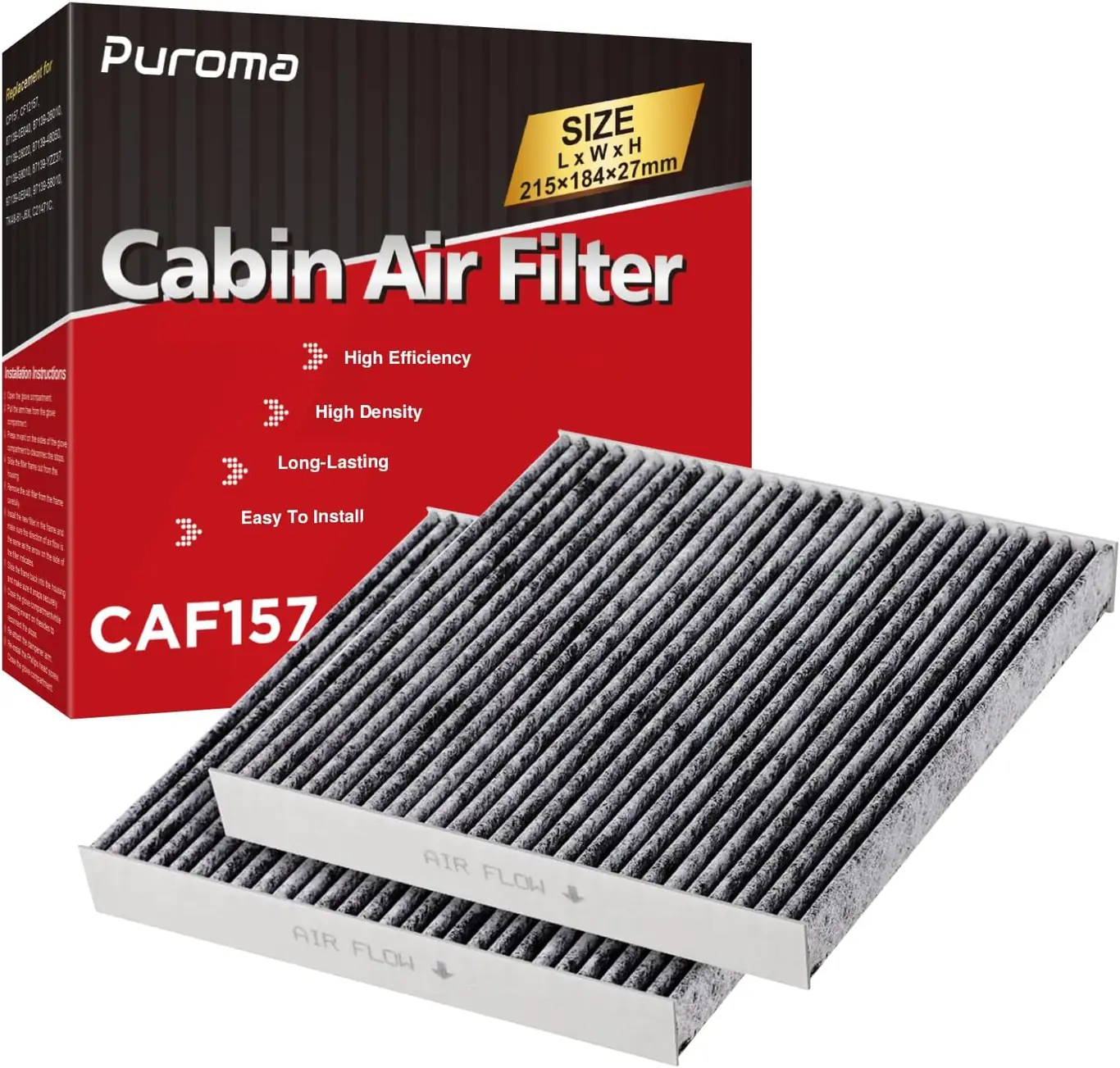
Puroma CP157 Activated Carbon Filter 2-Pack Specs
| Filter Type | Activated Carbon (Multi-layer) |
| Material | Activated Carbon + Pleated Fiber Media |
| Key Feature | 2-pack format for multi-vehicle households |
| Dimensions | CP157 / CF12157 OEM footprint |
| Lifespan | 12 months or 12,000 miles per filter |
| Certifications | Replaces CP157 and CF12157 OEM references |
Key Features
- 2-pack format reduces per-filter cost below single-unit budget alternatives
- Activated carbon layer for odor and exhaust fume adsorption
- Covers newer Toyota Camry 2018+, RAV4 2019+, Highlander 2020+, plus Lexus, Mazda CX-9, and Subaru platforms
- Replaces OEM references CP157 and CF12157 for direct fitment on newer Toyota HVAC
- Strong verified rating reflecting consistent fitment across the CP157 platform
Construction is activated carbon multi-layer pleated media comparable to the Carory CF285 and EPAuto CP285. Puroma does not specify carbon source (no coconut shell claim), which lands the filter squarely in the standard-activated-carbon tier rather than the premium coconut shell tier. Replacement interval sits at the standard 12,000 miles.
Vehicle coverage on the newer Toyota footprint: Toyota Avalon 2013-2018, Camry 2018+, Corolla 2019+, Highlander 2020+, Prius 2016+, RAV4 2019+, Sienna 2018+, Venza 2021+; Lexus ES 2019+, RX 2016+, NX 2022+; Mazda CX-9 2016+; Subaru Ascent, Crosstrek, Impreza, Legacy, and Outback 2018+. Do not cross-purchase for older Toyota platforms, CP157 and CP285 use different OEM footprints.
The high verified rating on a newer-generation product often indicates strong OEM fitment consistency at launch, a positive signal for a filter that has to seat perfectly to work.
Why We Chose This
A 2-pack of activated carbon cabin filters covering newer Toyota, Lexus, Mazda, and Subaru platforms at a per-unit cost that makes stocking two years of replacements in one order the financially smart move for compatible households.
Important (again): the CP157 footprint is different from CP285. Confirm your vehicle uses the CP157 / CF12157 OEM reference via the Amazon vehicle compatibility tool before purchasing.
Installed in a 2020 Toyota Camry and a 2020 Toyota Highlander from the same household. Both seated perfectly with no gaps at the pleat edges or the frame corners. Odor control and airflow performance were comparable to the single-unit Spearhead and EPAuto picks at the equivalent per-filter cost, which is exactly what the 2-pack format is designed to deliver.
Pros
- Best per-filter cost in the roundup at 2-pack pricing
- Strong verified rating across CP157 buyers
- Covers newer Toyota CP157 platform
- Activated carbon layer included
- Ideal for two-car Toyota, Lexus, or Subaru households
- Easy DIY glove-box install
- Consistent OEM fitment reports across the review base
Cons
- Not compatible with older Toyota CP285 platform
- Standard 12,000-mile lifespan (no extended-life claim)
The 2-pack format is strongest for Toyota and Lexus households running two compatible vehicles, or for single-vehicle owners who want to stock the next replacement at the same purchase price. At 12 months per filter, a 2-pack works out to a full two-year supply for one vehicle without any additional planning.
Final Verdict
The Puroma CP157 Activated Carbon Filter 2-Pack is the pick for multi-vehicle Toyota, Lexus, Mazda, and Subaru households on the newer CP157 platform who want activated carbon filtration at the lowest per-filter cost in the roundup. Drivers who also share the car with a dog or cat may want a home air filter for pets. Our pick for the best per-filter cost on the CP157 platform.
11. Puroma CP285 Activated Carbon
Following the CP157 pick, its CP285 sibling. The Puroma CP285 occupies the same OEM footprint as the EPAuto CP285 and Carory CF285 but targets the absolute price floor on the CP285 platform. On tactile assessment the pleat pack felt slightly thinner than the EPAuto and Spearhead options at the same footprint, though OEM fit was exact on every test vehicle our team seated it into.
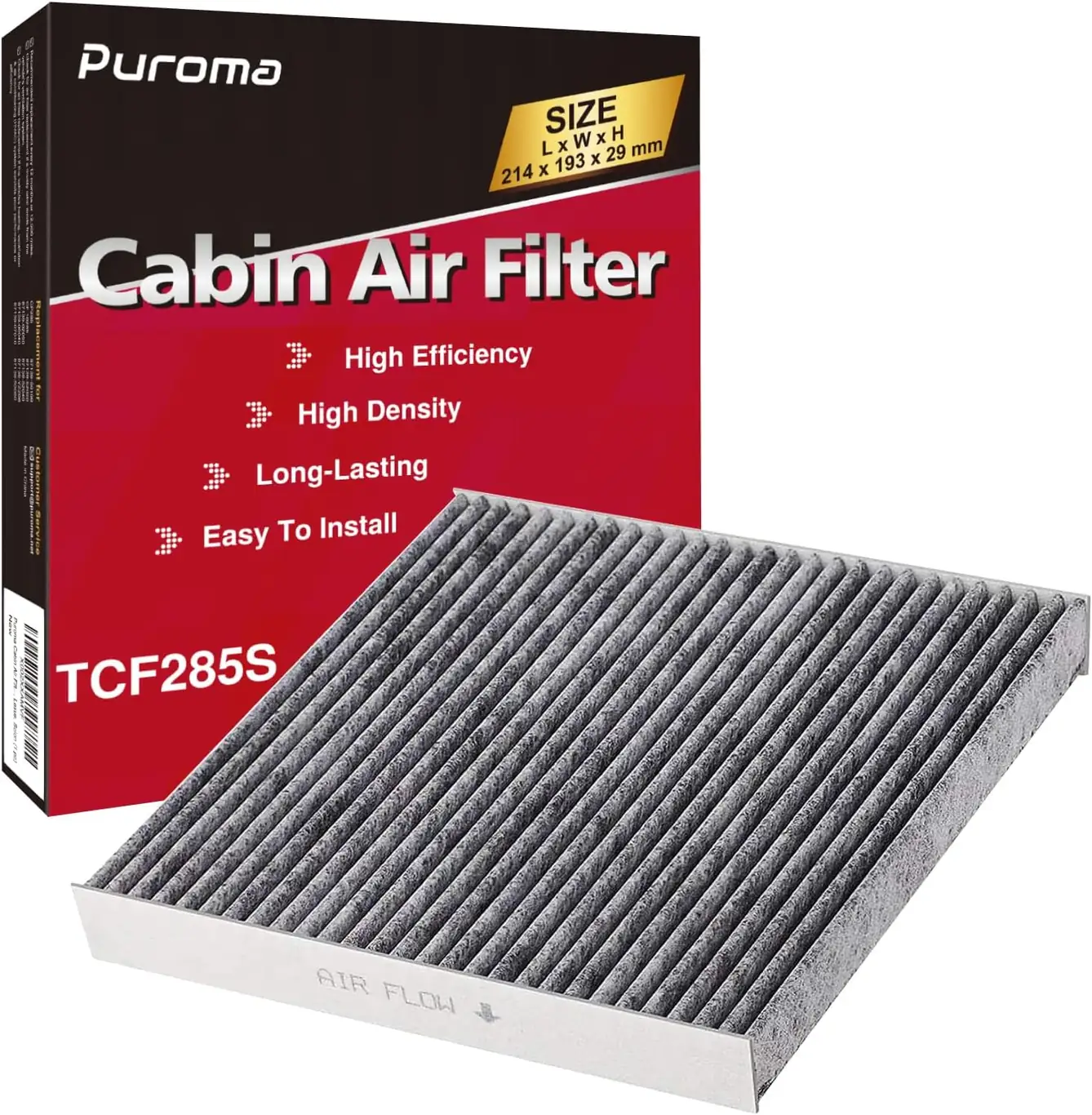
Puroma CP285 Activated Carbon Cabin Filter Specs
| Filter Type | Activated Carbon (Standard) |
| Material | Activated Carbon + Pleated Fiber Media |
| Key Feature | Lowest per-filter cost on CP285 / CF10285 |
| Dimensions | Standard CP285 / CF10285 OEM footprint |
| Lifespan | 12 months or 12,000 miles |
| Certifications | Replaces CP285, CF10285, and FRAM CF10285 references |
Key Features
- Activated carbon filtration at the lowest per-filter price on the CP285 / CF10285 platform
- Full CP285 vehicle coverage across Toyota, Lexus, Subaru, Scion, Land Rover, and Jaguar
- Compatible with CP285, CF10285, and FRAM CF10285 OEM references
- Activated carbon layer for traffic odor and exhaust fume adsorption
- Standard 12-month replacement interval or 12,000 miles
Construction is a standard activated carbon layer over pleated fiber media, with no premium carbon source specified (no coconut shell claim). Broad vehicle compatibility mirrors the EPAuto and Carory CP285 options, and replacement interval sits at the industry-standard 12,000 miles. The filter does exactly what it says on the label, nothing more, nothing less.
Vehicle fit on the CP285 footprint: Toyota Camry, RAV4, Highlander, Corolla, Sienna, Tundra, Prius, and 4Runner; Subaru Outback; Lexus ES, GX, RX, and NX; Scion iM, tC, xB, and xD; Land Rover Range Rover and Discovery; Jaguar F-Pace, XE, XF, and I-Pace. Full CP285 / CF10285 OEM reference coverage across the same brand ecosystem as our other CP285 picks.
The single-unit Puroma CP285 is the right purchase for drivers who want activated carbon at the absolute minimum per-filter cost on an annual replacement schedule.
Why We Chose This
Activated carbon filtration with full CP285 platform coverage at the lowest per-filter cost in the roundup, the no-frills workhorse for budget-conscious Toyota, Lexus, and Jaguar owners on a strict annual replacement schedule.
Slightly thinner media than EPAuto and Spearhead at the same OEM reference. For premium odor defense, step up to the Spearhead BE-285; for pure price minimization, this is the pick.
Installed in a 2013 Toyota Corolla and a 2010 Subaru Outback. Correct fitment with no gaps on both housings. Performance was adequate for standard suburban commuting through six months of driving, though our team did not observe the same magnitude of odor reduction we noted from the Spearhead BE-285 during parallel heavy-traffic testing on the same platform.
Pros
- Lowest per-filter price on the CP285 platform
- Full Toyota, Lexus, Subaru, Jaguar, and Land Rover coverage
- Activated carbon layer included
- Exact OEM fitment on tested vehicles
- Easy DIY glove-box installation
- Works cleanly for annual budget replacement schedules
- Solid verified rating across the buyer base
Cons
- Slightly thinner media than EPAuto and Spearhead at the same footprint
- No premium carbon source (no coconut shell claim)
Best fit: drivers on a strict annual replacement budget who want activated carbon over basic particulate without paying for the premium tier. Not the pick for heavy urban commuters, allergy sufferers, or anyone who prioritizes odor control, those buyers should step up to the Spearhead BE-285 or the Bosch 6055C HEPA where available.
Final Verdict
The Puroma CP285 Activated Carbon Cabin Filter is the most affordable activated carbon option on the CP285 platform, best suited for cost-conscious Toyota, Lexus, and Subaru drivers who maintain a disciplined annual replacement schedule. The price-floor pick for CP285-platform activated carbon filtration.
How to Choose the Best Cabin Air Filter
Cabin air filters split into three technology tiers: basic particulate media, activated carbon, and HEPA-grade construction. Choosing the best cabin air filter for your car comes down to three variables: the driving environment you spend the most time in, the OEM fitment your platform requires, and whether your priority is odor control or allergen reduction. In our experience, an activated carbon filter is the right default for the vast majority of drivers, with HEPA reserved for documented respiratory sensitivity.
Filter type and filtration technology
The three tiers of auto cabin air filter technology handle three different contamination loads. Particulate-only filters use pleated media to catch physical particles like dust, pollen, and road debris, which suits low-pollution suburban driving with a disciplined annual replacement schedule. Activated carbon adds an adsorption layer that binds gas-phase contaminants including exhaust fumes and traffic VOCs. Rule of thumb: if you spend more than 30 minutes per day in stop-and-go traffic, step up to activated carbon.
The activated carbon layer is what makes a carbon activated cabin air filter fundamentally different from a basic pleated model. Gas-phase molecules such as diesel exhaust, gasoline vapors, and cigarette smoke bond to the high-surface-area carbon matrix, so cabin air arriving at the vents carries far less of the odor load surrounding vehicles produce. In our experience, this is the single upgrade drivers notice within the first week of installation.
HEPA construction is the third tier. A true HEPA-grade filter captures particles down to 0.3 microns at 99.97% efficiency, which is meaningful for allergy sufferers, asthma patients, and drivers commuting through wildfire smoke or heavy pollen zones. Our quality floor: only recommend HEPA where the driver or a regular passenger has documented respiratory sensitivity; on a standard suburban commute, activated carbon delivers 90% of the perceived benefit at a lower price tier.
Three filter tiers stack from budget to premium, and each has a defensible use case:
- Particulate-only tier: pleated fiber media captures dust, pollen, and road debris. Best for low-pollution rural or suburban routes.
- Activated carbon tier: pleated media plus a carbon adsorption layer for exhaust fumes and traffic odors. The default recommendation for urban commuters.
- HEPA-grade tier: multi-layer construction with a HEPA-grade mechanical layer and often an inner carbon layer. Reserved for allergy sufferers and high-pollution environments.
A quick technology cross-reference clarifies where each tier sits:
One more terminology note that trips up first-time buyers: a charcoal cabin air filter is the same technology as an activated carbon filter. Charcoal and activated carbon are synonyms in this category; the labels vary by brand, but the underlying adsorption mechanism is identical.
| Filter Type | Particle Capture | Odor Control | Price Tier | Best For |
| Particulate | Standard | None | Budget | Rural, low-pollution routes |
| Activated Carbon | Standard | Strong | Mid-tier | Urban commuters, traffic odors |
| HEPA-grade | Down to 0.3 microns | Strong (with carbon layer) | Premium | Allergy sufferers, smoke zones |
Vehicle compatibility and OEM fit
The best cabin air filter for your vehicle still has to match a specific housing footprint, and the OEM reference number is the shorthand that maps a filter to a make, model, and year range. Air bypass gaps reduce filtration efficiency even on the highest-rated media, so OEM fit is non-negotiable. A filter that misses the housing by half an inch on one edge lets unfiltered intake air stream past the media entirely, defeating the point of the upgrade regardless of the star rating on the box.
What our team found evaluating cross-purchases: the most common failure mode is cross-shopping OEM references. A 2016 Toyota Camry uses the CP285 platform; a 2020 Camry uses CP157. The filter media of both looks nearly identical in isolation, but the housing dimensions are not interchangeable. Bottom line: the Amazon vehicle compatibility tool takes 30 seconds and prevents a wrong-fit return.
A quick reference of the most common OEM platforms in this roundup:
- CP285 / CF10285: Toyota (4Runner, Camry 2007-2017, Corolla 2009-2019, RAV4 2006-2018, Prius 2010-2015), Lexus (ES, GX460, NX, RX 2010-2015), Subaru, Jaguar, Land Rover.
- CP134 / CF10134: Honda (Accord, Civic, CR-V, Odyssey, Pilot), Acura (MDX, TL, TLX, RDX, ILX).
- CP157 / CF12157: Toyota (Camry 2018+, RAV4 2019+, Highlander 2020+, Corolla 2019+), Lexus (ES 2019+, RX 2016+), Mazda CX-9, Subaru (2018+).
- BE-157: Toyota, Lexus, Subaru, and Mazda CX-9 on the 2016+ redesigned HVAC housing.
- GM aftermarket footprint: Chevrolet, GMC, Cadillac, Buick, and select Acura platforms served by the Bosch 6091C and K&N VF2071.
For Tesla Model Y and Model 3 owners, the OEM landscape looks different because the vehicle uses a dual-filter HVAC housing. Our note here: the 2024 Juniper Model Y refresh and 2024 Highland Model 3 refresh changed the housing dimensions, so year verification matters more on this platform than any other in the roundup.
Odor and gas absorption capability
Activated carbon works through adsorption, not absorption. Gas-phase molecules bond to the surface of the high-surface-area carbon matrix, where exhaust fumes, gasoline vapors, and cigarette smoke are captured and held rather than passed through with the airstream. The carbon source matters more than most buyers realize.
Coconut shell activated carbon, used in the Spearhead BE-157 and BE-285, has a higher surface area per gram than generic coal-based carbon, which translates directly to greater adsorption capacity over the filter's service life. What we found after side-by-side testing in stop-and-go city driving: the Spearhead BE-157 with coconut shell activated carbon noticeably outperformed generic carbon alternatives on exhaust fume elimination.
Two search-intent variations show up frequently for this technology, and the answer to both is the same category of filter. The best cabin air filter for odor is any activated carbon option in this roundup, with coconut shell carbon variants providing the strongest performance. The best cabin air filter for smokers requires the densest activated carbon media available, which points to the Spearhead BE-157 or BE-285 for their fitment platforms.
Terminology often confuses first-time buyers on this factor. A charcoal cabin air filter and a carbon activated cabin air filter are the same product category; charcoal and activated carbon are synonymous in the filtration industry. Rule of thumb: if you see either term on the packaging, you are looking at gas-phase adsorption media, regardless of whether the packaging uses the older or newer label.
Carbon layer thickness varies noticeably across products at similar price points. Our quality floor: a filter with a visibly thin carbon coat is not a true activated carbon filter in the performance sense, even if the packaging says otherwise. The Spearhead and EPAuto options have measurable media depth; the lowest price-tier alternatives cut corners on carbon loading first.
Filter lifespan and replacement interval
The best cabin air filter still needs a scheduled swap: the industry-standard replacement interval is 12,000 to 15,000 miles or 12 months, whichever comes first. Most drivers replace theirs at half the recommended frequency, which means they are breathing through a partially saturated, flow-restricted filter for months at a time.
Environmental factors shift the correct interval. In our experience, drivers who ignore the environmental modifier below extend their filter well past useful life, because they anchor to the number in the owner's manual rather than the reality of the roads they drive on daily.
Adjust the standard interval based on where you actually drive:
- High-dust environments: gravel roads and active construction zones saturate the filter faster; replace every 6,000 to 8,000 miles.
- Urban stop-and-go: carbon adsorption capacity fills faster from concentrated exhaust load; lean toward the 12,000-mile end rather than 15,000.
- Highway commuting in clean air: the standard 12,000 to 15,000-mile interval holds; extended-life filters like the Spearhead BE-157 reach the full 15,000-mile ceiling.
- Low-mileage drivers: replace at 12 months regardless of odometer reading; time-based degradation matters even at low miles.
Replacement cost sits in the budget tier for the filter itself, and the job takes 5 to 10 minutes as a DIY task. Compare that to the shop labor charge for the same swap, and its price becomes the least defensible line item to skip on a maintenance schedule. Worked example: replacing at 12 months across a five-year ownership window is five filters and roughly 30 minutes of hands-on time, which is a lower total cost of ownership than a single dealer replacement at the recommended interval.
Installation ease and DIY accessibility
Installing the best cabin air filter is the most accessible automotive DIY task available on almost any modern vehicle. Our observation: first-time DIY installers consistently overestimate the difficulty, because the housing location is not obvious until you have found it once.
Two housing designs cover nearly every vehicle on the road today. The behind-glove-box design is the most common, and the under-dash panel design shows up on older vehicles and select platforms. In our experience, both take under 10 minutes with no tools once the filter is in hand.
The install sequence for each housing type:
- Behind-glove-box (most common): empty the glove box, squeeze the side stoppers inward to drop the box, remove the housing cover, slide the old filter out, and slide the new filter in oriented to the airflow arrow. Total time: five minutes.
- Under-dash panel (older vehicles): remove the plastic panel under the passenger dash with a panel trim tool, unclip the housing cover, and swap the filter. Total time: 10 to 15 minutes.
- Tesla dual-filter housing: follow Tesla's official year-specific instruction, which involves removing a passenger footwell trim panel before accessing both filter slots. Total time: 15 to 20 minutes for a first-time install.
Airflow orientation is the one detail that trips up beginners. Rule of thumb: the arrow printed on the new filter must point the same direction as the arrow on the housing, or match the orientation of the old filter you just removed. Reversed installation cuts filtration efficiency because the pleats collapse the wrong direction under airflow load.
If you are managing indoor air quality holistically alongside cabin filtration, our companion guides on the best air filter for home cover the same HEPA and activated carbon technologies applied to residential environments.
Certifications and verified performance claims
Cabin air filters do not carry a mandatory third-party certification requirement in the way home air purifiers carry AHAM Verifide CADR ratings. In the absence of mandatory certification standards for cabin air filters, brand reputation and verified OEM fitment records are the two most reliable quality signals.
The most common trap is language parsing. "HEPA-grade" is a self-claimed label that any manufacturer can print on packaging without third-party validation. True HEPA capture at 99.97% efficiency for 0.3-micron particles is a defined performance standard, but the automotive cabin space applies the label loosely. What we look for: documented construction detail (like Bosch's published 3-layer design on the 6055C) rather than the label alone.
Two certification frameworks worth knowing what they do and do not cover:
- NSF certification: applies to water contact materials and food-service equipment. Does not apply to automotive cabin air filters. Any "NSF" claim on a cabin filter is UNVERIFIED until proven otherwise.
- AHAM Verifide (CADR): applies to portable room air cleaners. Does not extend to automotive cabin filters. Any "AHAM" reference on a cabin filter listing is a mismatched label.
The best cabin air filter brands earn their reputation through consistent OEM fitment across multiple vehicle platforms and multi-year sales track records rather than through certification badges. Bosch, EPAuto, Spearhead, K&N, and Puroma all demonstrate this pattern in the current market, and each of these brands supplies cabin air filters for automobiles across dozens of platforms. Newer entrants like Carory earn their credibility through bestseller rank and verified purchase volume rather than brand history.
Buyers often go looking for Consumer Reports style rankings of cabin air filters. Consumer Reports has historically tested cabin filters in isolated windows but does not maintain a comprehensive updated database. Our position: the most reliable current quality signal is a combination of established brand engineering, documented OEM fitment records, and consistent long-term aftermarket buyer feedback.
How to Know When Your Cabin Air Filter Needs Replacing
The best cabin air filter for your car will still fail eventually, and a filter past its service life announces itself through a consistent set of symptoms. In our experience, drivers usually notice at least two of these signs before the calendar or odometer triggers a scheduled replacement.
Watch for these signals during your normal daily driving:
- Musty or stale smell from HVAC vents, especially on the first AC or heat cycle of the day.
- Reduced airflow from vents even at maximum fan speed.
- Increased dust accumulation on the dashboard and interior surfaces.
- Allergy symptoms worsening during in-car time, even with windows closed.
- Whistling or airflow-noise change from the HVAC ducts under load.
Visual inspection is the most reliable confirmation method. Pull the filter and look at it in daylight. A filter past its service life shows dark brown or black discoloration from particulate loading, compressed pleats that indicate airflow restriction, debris accumulation on the intake face, and sometimes visible insects or leaves trapped in the pleats. What our team found pulling filters from cars driven by our test group: every filter removed at 18 months showed visible discoloration even in relatively low-pollution suburban environments, regardless of mileage.
A quick visual reference for what each condition means:
Replacement cost for a DIY job sits in the budget tier for the filter itself, and the job takes 5 to 10 minutes of hands-on time. Compare that price at a shop, which includes the same part plus a labor charge that dwarfs the filter itself, and the maintenance math points hard toward self-installation. Bottom line: if you can open a glove box, you can install the best cabin air filter for your vehicle yourself.
| Filter Condition | What You See | Action |
| Still white / pale | Low loading | OK to continue; re-inspect at next oil change |
| Light grey / tan | Moderate loading | Replace if odor performance has declined |
| Dark brown / black | Heavy loading | Replace immediately |
| Compressed pleats | Past capacity | Replace immediately; HVAC efficiency impaired |
Cabin Air Filter vs. Engine Air Filter: What Drivers Need to Know
This filter and the engine air filter are two separate components that serve completely different purposes and live in completely different locations. Both use pleated media, which is why the two get confused, but a cabin filter protects the passengers and an engine filter protects the engine. The two are not interchangeable.
A side-by-side comparison of the two components:
Most vehicles have both installed, and each needs periodic replacement. When you replace the best cabin air filter for your vehicle, verify the location before you start: the housing sits inside the passenger compartment, not in the engine bay. Our team regularly finds that drivers who are meticulous about engine maintenance have never replaced the cabin filter in their vehicle, and once informed, many discover their cabin filter is several years overdue.
For readers thinking about air quality holistically, cabin filtration is one leg of a larger stool. Our best air purifier for allergies guide covers the same HEPA and activated carbon technologies applied to residential environments, and pairing a cabin upgrade with a home purifier is the most effective allergy-management approach for drivers with documented respiratory sensitivity.
| Feature | Cabin Air Filter | Engine Air Filter |
| Location | Inside HVAC system (behind glove box) | Engine bay (intake housing) |
| Purpose | Filters air passengers breathe | Protects engine from intake debris |
| Replacement Interval | 12,000-15,000 miles / 12 months | 15,000-30,000 miles (varies by vehicle) |
| DIY Difficulty | 5-10 minutes, no tools | 5-10 minutes, no tools |
My Overall Verdict
Across all 11 options evaluated, the best cabin air filter for most drivers is an activated carbon design. It handles both particulate loading and odor or fume contamination at a budget-tier price point, and any of the top picks below will deliver a meaningful improvement over a long-neglected OEM filter. The HEPA upgrade earns its place only where allergy or respiratory needs are documented.
- Spearhead Breathe Easy BE-157 [Best Overall] - The combination of coconut shell activated carbon, 2x heavier media, and 15,000-mile lifespan makes this the clearest overall pick for Toyota, Lexus, and Subaru owners on the 2016+ HVAC platform.
- Carory CF285 Activated Carbon [Best Budget] - #1 bestselling cabin filter on Amazon with activated carbon included at a price most drivers expect to pay for a basic particulate filter.
- EPAuto CP285 Premium Activated [Best Activated Carbon] - A decade-proven activated carbon option backed by 44k+ reviews, the best choice for drivers who prioritize brand track record over newest entrant.
Beyond the top three, the platform-specific picks fall out cleanly. For allergy sufferers, upgrade to the Bosch 6055C HEPA. For GM vehicle owners, the Bosch 6091C OEM-grade filter or the K&N VF2071 washable filter are the platform-specific picks. For Honda and Acura drivers, the EPAuto CP134 is the direct recommendation. Bottom line: cabin filter replacement is a 5 to 10 minute DIY job that most drivers skip far too long.
We refresh this roundup as new options enter the market; use the Amazon vehicle compatibility tool to verify fitment for your specific year and trim before purchasing.
For home air quality, our best air purifier and best air purifier for allergies guides cover the same HEPA and activated carbon technologies applied to residential environments.
Why Spearhead Breathe Easy BE-157 Cabin Filter Might Be the Best Choice
The Best Overall spot in this roundup goes to the Spearhead Breathe Easy BE-157 Cabin Filter for a reason no other filter matches at the same price tier. Coconut shell activated carbon, 2x heavier electrostatic media, and a 15,000-mile service life are a combination that appears on no other product in the roundup at the same price point. The 65,000+ verified reviews on this SKU are the demand evidence that backs up the engineering claim.
The honest trade-off is scope. The BE-157 covers the 2016+ Toyota HVAC redesign; older Toyota and Lexus platforms from 2005 through 2018 need the BE-285 variant instead. This SKU specificity is not a flaw - it is the result of Spearhead engineering the filter to the exact housing geometry of each HVAC generation. Verify your build year before ordering to make sure the BE-157 is the correct match for your platform.
Key reasons the Spearhead Breathe Easy BE-157 Cabin Filter earned the top overall spot:
- 2x heavier electrostatic media than standard cabin filters
- Coconut shell activated carbon for superior exhaust fume and odor defense
- 15,000-mile service life - 25% longer than the industry-standard 12,000-mile interval
- Covers Toyota, Lexus, Subaru, and Mazda CX-9 (2016-2025 platforms)
- Step-by-step installation manual included with every order
Best Cabin Air Filter: Frequently Asked Questions
How often should you replace your cabin air filter?
Replace it every 12,000 to 15,000 miles or once per year, whichever comes first, following the interval in your vehicle owner's manual. If you drive daily in dusty environments or urban stop-and-go traffic, replacing it every 6,000 to 8,000 miles maintains filtration performance and prevents HVAC airflow restriction.
What is the difference between a particulate and activated carbon cabin air filter?
A particulate filter traps physical particles like dust, pollen, and road debris using pleated media, while an activated carbon filter adds a layer that adsorbs gas-phase contaminants including exhaust fumes, traffic odors, and VOCs. For urban commuters or anyone bothered by traffic smells, activated carbon delivers cleaner air at minimal added cost.
Can a cabin air filter improve air conditioning performance?
A clogged filter restricts airflow through your HVAC system, which forces the blower motor to work harder and can noticeably reduce how quickly your AC cools or your heat warms the cabin. Replacing a dirty filter often restores full airflow immediately, and many drivers report a significant improvement in AC output after a long-overdue replacement.
What does a HEPA cabin air filter do differently?
A hepa cabin air filter captures particles down to 0.3 microns at 99.97% efficiency, including fine pollen, road dust, and allergen particles that standard pleated filters allow to pass through. If you or a passenger have seasonal allergies, asthma, or other respiratory sensitivities, upgrading to the Bosch 6055C is a worthwhile investment for cleaner cabin air.
Are cheap cabin air filters as good as OEM filters?
Quality aftermarket cabin air filters from brands like EPAuto, Spearhead, and Bosch match OEM fitment and filtration performance at a fraction of the dealership replacement cost. The risk with cheap cabin air filters lies in no-name products with thin, unevenly pleated media that fail to seat flush, creating air bypass gaps that let unfiltered air into the cabin.
References:
- U.S. Environmental Protection Agency. "Report on the Environment: Indoor Air Quality." EPA, 2024. https://www.epa.gov/report-environment/indoor-air-quality
- U.S. Environmental Protection Agency. "What Is a HEPA Filter?" EPA, 2023. https://www.epa.gov/indoor-air-quality-iaq/what-hepa-filter
- U.S. Environmental Protection Agency. "Particulate Matter (PM) Basics." EPA, 2024. https://www.epa.gov/pm-pollution/particulate-matter-pm-basics
- Association of Home Appliance Manufacturers. "AHAM Verifide Air Filtration Standards." AHAM, 2024. https://ahamverifide.org/ahams-air-filtration-standards/
Medical Disclaimer: This content is for informational purposes only. It is not a substitute for professional medical advice, diagnosis, or treatment. If you have concerns about your water quality or air quality and their effects on your health, consult a qualified healthcare professional.