
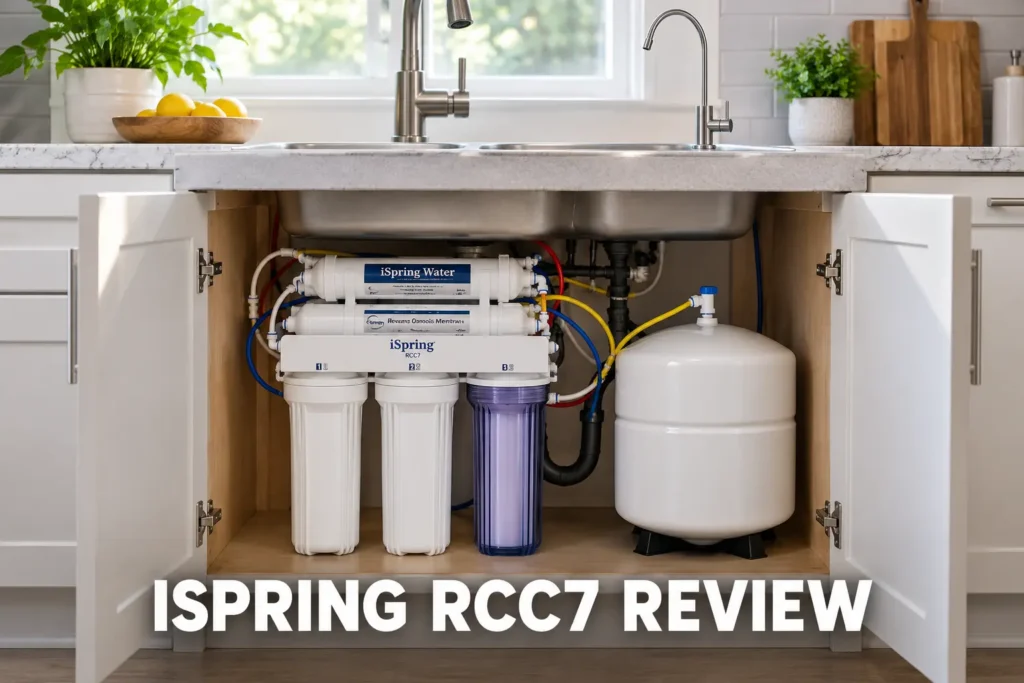
This iSpring RCC7 review comes down to one call: it is a genuinely capable, NSF/ANSI 58-certified 5-stage reverse osmosis system that I would recommend for anyone on municipal water who wants clean water without a pump running under the sink. I would only skip it if you are on well water, want alkaline output, or need faster fill speed than its 3.4 L/min flow rate allows.

Below I get into the certification record, whether the 99% contaminant reduction claim actually holds up, the specs that matter, the friction points I would flag to a first-time buyer, who should look elsewhere, and how the iSpring RCC7 stacks up against its own siblings before you decide.
Quick Verdict
NSF/ANSI 58 certification is the fact I would lead with here: it is the one third-party-verified claim on this listing, backing a 5-stage system rated to reduce lead by up to 98% and TDS by 80 to 90%.
- Water that meets a real third-party certification standard, rather than relying on a manufacturer’s own claim.
- No pump and no power draw, so there is nothing electronic under your sink to fail.
- A 75-gallon reserve tank that keeps you from waiting on the system between draws.
iSpring RCC7 Review: What the System Is and Who Makes It
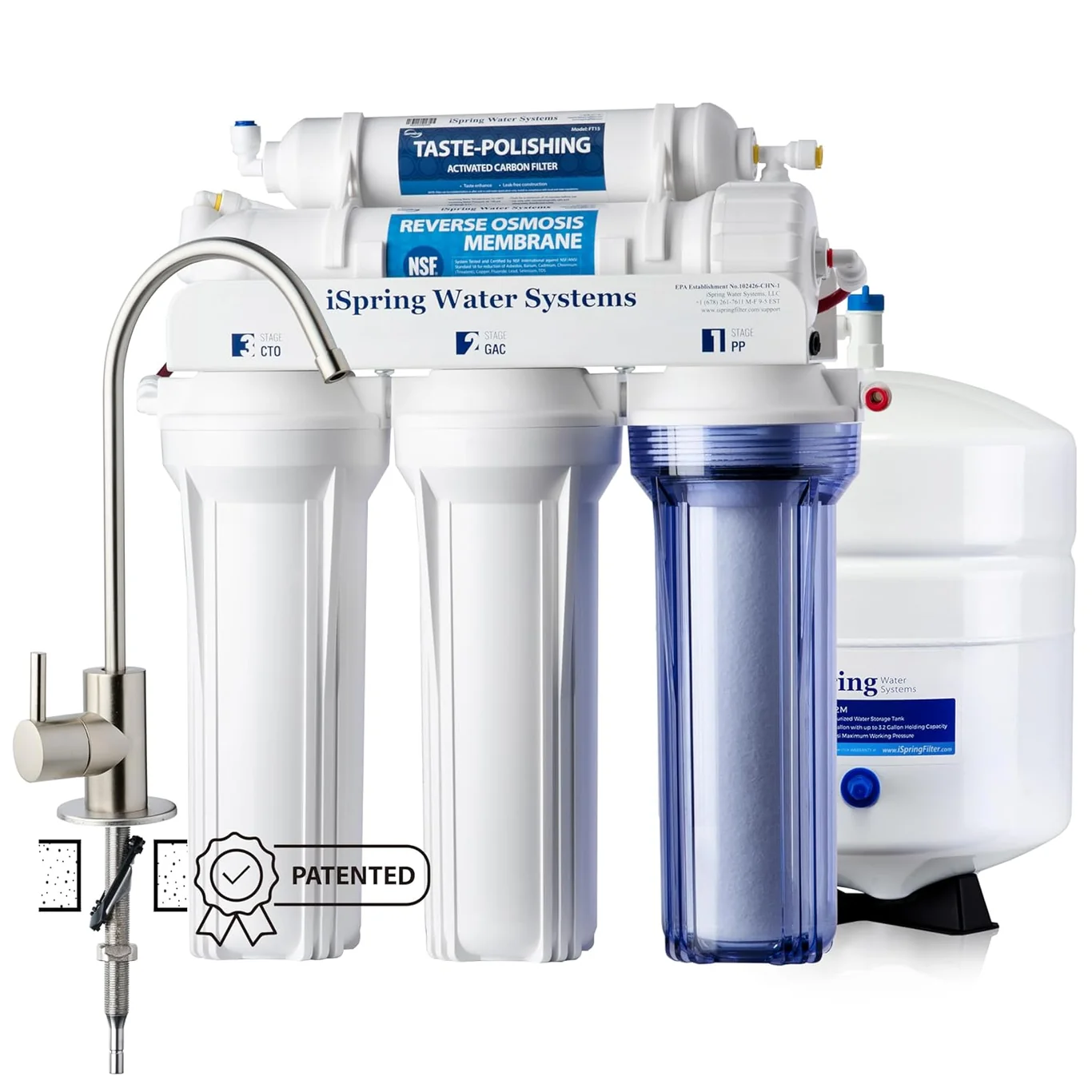
iSpring has built its catalog almost entirely around under-sink reverse osmosis systems, and the RCC7 is the company’s baseline 5-stage model: sediment and carbon pre-filtration, an RO membrane rated down to 0.0001 microns, and a final carbon polish before the water reaches your faucet.
Buyers who want a countertop filter rather than an under-sink system can find the top certified options in my guide to the best countertop water filter.
I run an under-sink RO system in my own home with three kids pulling water out of it daily, so the detail I look for first is what happens when something goes wrong, beyond what the spec sheet promises. With no power source needed, there is one fewer point of electrical failure under a cabinet where a leak is hardest to catch early.
Buyers who want certified whole-house tap filtration without any under-sink plumbing can compare the clip-on certified options in my guide to the best faucet water filter.
Households that want certified contaminant reduction in a clip-on faucet format rather than a plumbed system can compare the alternative in my PUR Plus breakdown.
Specifications
| Specification | Detail |
| Filtration stage count | 5-stage |
| Certification | NSF/ANSI 58 certified |
| Maximum flow rate | 3.4 liters per minute |
| Storage tank capacity | 75 gallons |
| TDS reduction | 80 to 90% |
| Lead reduction | up to 98% |
| RO membrane filtration rating | 0.0001 microns |
| Warranty | 1-year limited manufacturer warranty |
Key Features
- NSF/ANSI 58 certification: third-party verification on the filtration claim, not a claim taken at face value.
- 5-stage filtration with a 0.0001-micron RO membrane: fine enough to catch what basic filters miss.
- No pump and no power draw: nothing electronic to fail under the sink.
- 75-gallon storage tank: enough reserve that you are not waiting on the system between draws.
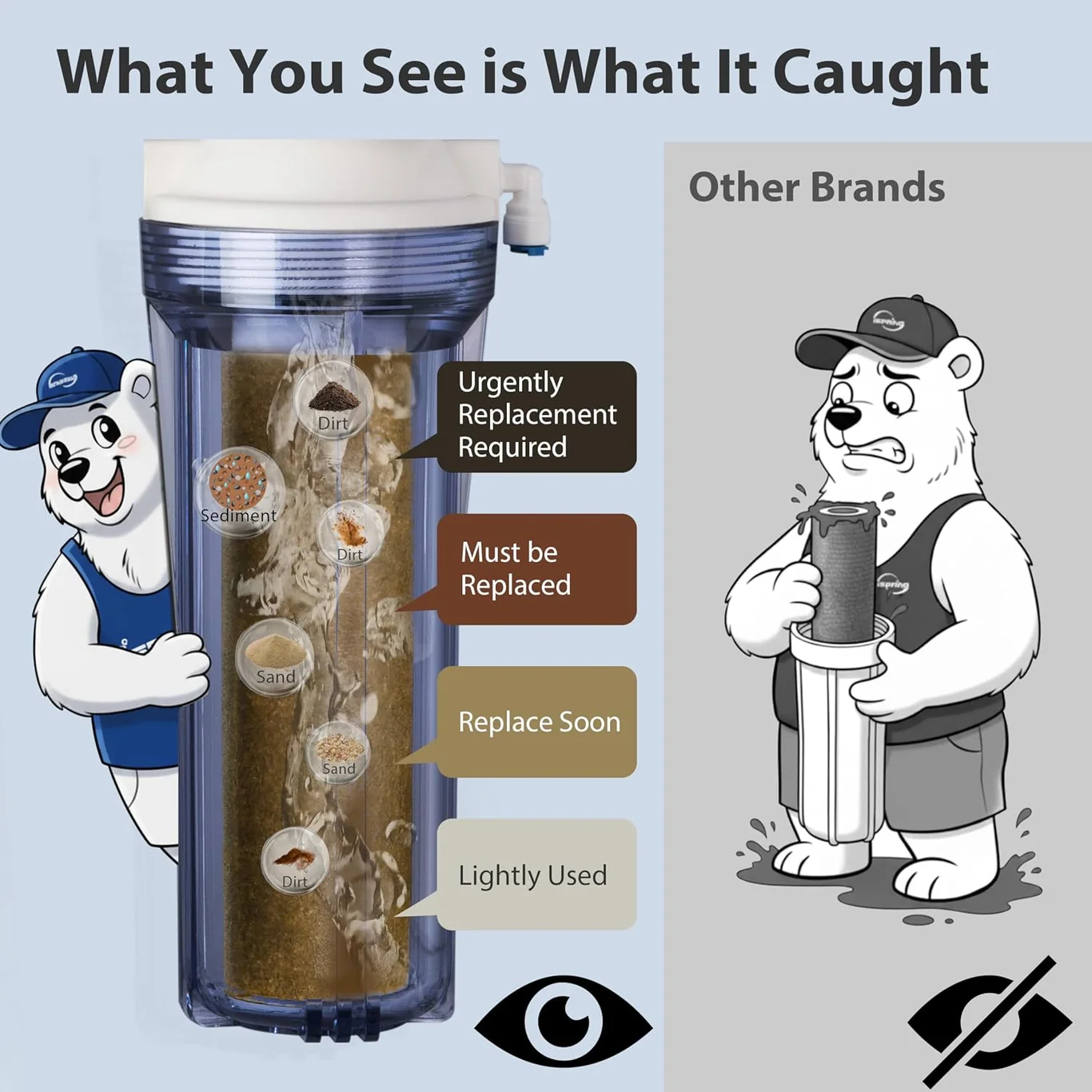
- Transparent first-stage housing: lets you check filter condition before a change is actually due.
What the iSpring RCC7 Actually Removes
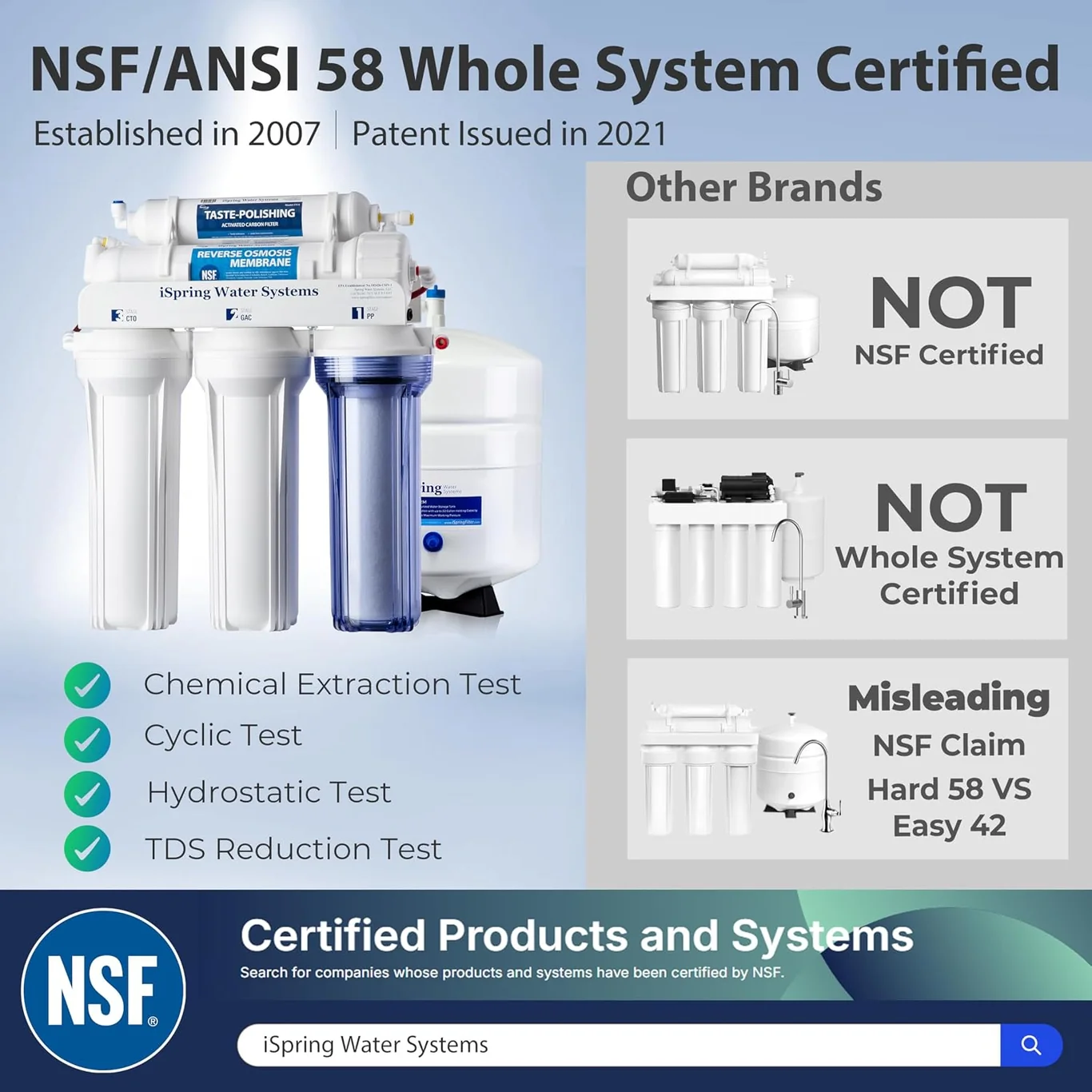
iSpring builds the RCC7 as a 5-stage reverse osmosis system, and it carries NSF/ANSI 58 certification, the standard that governs residential reverse osmosis drinking water treatment systems specifically. That is the credential I lean on here, because it comes from a third-party certifier rather than from iSpring’s own listing copy.
iSpring also markets the RCC7 as removing up to 99% of over 1,000 contaminants, and I read that figure as the company’s own marketing claim rather than an NSF-listed result. The research behind this review has no certifier-sourced breakdown of which of those 1,000 contaminants were independently verified versus manufacturer-tested, so I am not willing to present it as a certified number.
The certified numbers I do trust are narrower: iSpring states the system reduces lead by up to 98% and TDS by 80 to 90%, with the RO membrane rated down to 0.0001 microns. For context on the scale of what a system like this is claiming to handle, the EPA’s list of regulated drinking water contaminants covers a wide range of categories, and I would treat the RCC7’s marketing figure as a broad upper bound rather than a guarantee against any specific one of them.
Living With the iSpring RCC7 Day to Day
The replacement cadence here is uneven, and I think that is worth spelling out plainly rather than leaving it as a footnote. The pre-filter pack (sediment and carbon pre-filters) runs on roughly a 6-month cycle, the post-carbon polishing filter on roughly a 1-year cycle, and the RO membrane itself, the expensive part to replace, on roughly a 2-year cycle. I would flag that spread for anyone who assumes RO maintenance is a once-a-year task, since it is not.
Buyers who want a simpler point-of-use certified format without a maintenance schedule at all can compare the pitcher options in my guide to the best water filter pitcher.
On running cost, I would place this in the mid-pack for a 5-stage RO system: cheaper to keep running than the 6-stage alkaline variants that add an extra filter stage, but not the cheapest system in the category. For a broader sense of where systems like this sit against each other, the under-sink water filters roundup covers the wider field.
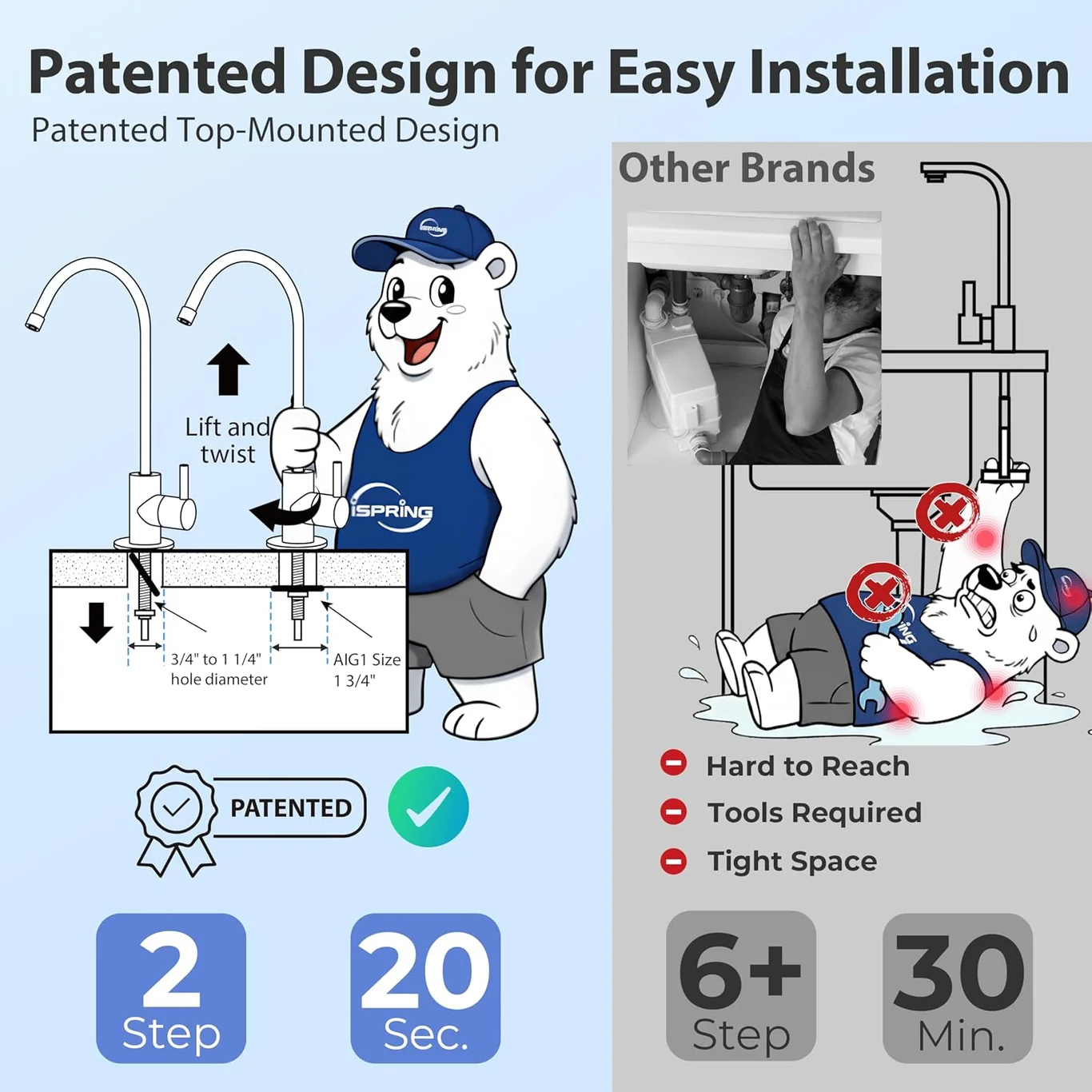
There is no power source and no pump, so there is no motor to listen for. That means maintenance is mechanical, not electronic: filter swaps and checking the push-to-connect fittings for leaks, not troubleshooting a control board. I like that the transparent first-stage housing gives a quick visual check before a filter change is actually due, and installation is DIY-oriented, under-sink, with a check valve to prevent backflow.
Buyers who want a replacement cartridge for an existing whole-house housing rather than a full under-sink system can find the certified options in my guide to the best water filter cartridge.
Pros
- NSF/ANSI 58 certified reverse osmosis system
- No power source or pump required to operate
- DIY-friendly installation with push-to-connect fittings and a check valve
- 75-gallon storage tank capacity
- RO membrane rated down to 0.0001 microns
- Transparent first-stage housing for a quick visual filter check
Cons
- The 3.4 L/min max flow rate depends entirely on your incoming water pressure since there is no pump, so fill speed can feel slow in lower-pressure homes.
Who Should Skip the iSpring RCC7
I would point this system at a municipal-water household that wants certified, no-power filtration and does not mind a periodic filter swap. It suits a straightforward under-sink install more than it suits anyone chasing extra features. Buyers who want zero installation and full portability instead can compare the gravity-fed countertop alternative in my Royal Berkey hands-on review.
I would send any well-water household elsewhere first. iSpring states plainly that this system is designed for municipal tap water, not raw well water, so a well-water household needs a whole-home filtration system ahead of this unit, not instead of it.
If you specifically want alkaline or remineralized output, I would point you at the RCC7AK instead, since the plain RCC7 has no remineralization stage. If your incoming water pressure is already low, or you fill large pots and pitchers often, the 3.4 L/min max flow rate will feel slower than you expect. And I do not think anyone should buy this expecting zero maintenance: it is low-maintenance, not maintenance-free, and a pre-filter pack on a roughly 6-month cycle is a recurring task some buyers underestimate going in. Buyers for whom that maintenance commitment is the deal-breaker often find a certified carbon pitcher covers the taste-and-odor job at a lower overhead; my Waterdrop PT-07B Review covers the NSF 42-certified option at that simpler level.
| Model | How it differs | Pick it instead if |
| iSpring RCC7 | The baseline 5-stage system reviewed here: iSpring certifies it to NSF/ANSI 58, it has no remineralization stage, and iSpring rates the max flow at 3.4 liters per minute. | You want straightforward filtered water without alkaline output. |
| iSpring RCC7AK | iSpring builds this as a 6-stage system adding an alkaline remineralization stage onto the same 75 GPD base design. | You specifically want remineralized, alkaline-leaning water rather than plain filtered water. |
| iSpring RCC7-BLK | iSpring certifies it to the same NSF/ANSI 58 standard with a black RO faucet instead of the RCC7’s brushed nickel finish. | Faucet finish matters more to you than any functional difference, since the filtration stages are identical. |
| iSpring RCC7P | iSpring markets this as a higher-capacity, performance-boosted 5-stage system built for faster fill. | You regularly fill large pots or pitchers and want faster output than the base RCC7’s iSpring-rated 3.4 L/min flow rate. |
Common Problems With the iSpring RCC7
A post-filter TDS reading that does not hit zero is the most common question around systems in this category, and I read it as an expected mechanic of reverse osmosis filtration, not a defect. If the source water’s TDS is already high, or filters have been running a while past their interval, the post-filter number climbs, and it roughly correlates with filter age rather than signaling a fault.
Households looking at a whole-house sediment and carbon cartridge rather than a full RO system can compare an NSF 42-certified option in my PurePlus cartridge review.
The flow rate is the other spec-driven limitation worth setting expectations around. With no pump and a 3.4 L/min max flow rate, fill speed depends entirely on incoming line pressure, and I would not expect a fast fill in a lower-pressure home. That is a design trade-off rather than something a filter swap fixes; if raw throughput matters more to you than simplicity, it is worth comparing against other reverse osmosis systems covered elsewhere on the site.
Faucet valve or fitting leaks show up occasionally as an early-life fault, generally resolved under the 1-year manufacturer warranty, and I would treat that as a known low-frequency issue rather than a chronic one. This system also does not publish a specific drain-to-product water ratio in the material I have seen, so I would tell anyone budgeting for this on a metered water bill to check the current manufacturer spec sheet before installing, in line with the general water-quality guidance from the WHO’s drinking water quality guidelines. And as covered above, well water is explicitly unsupported without pre-treatment ahead of this unit.
My Overall Verdict
I run an under-sink reverse osmosis system in my own home, so I know what the day-to-day trade-offs of this category actually feel like. The RCC7 is a genuinely certified, no-power RO system built for a municipal-water household that wants filtered water without a control board to manage.
The trade-off I keep coming back to is simple: no pump and no power draw make it dead simple to install, set against a modest 3.4 L/min flow rate that will feel slow to anyone used to a pumped or tankless RO system. That is a real choice a buyer faces, not a flaw to talk around, and I would rather state it plainly than let the spec sheet imply otherwise.
Buyers who want alkaline remineralization on top of the same five-stage core can compare the upgraded option in my iSpring RCC7AK review.
Final Verdict
I would install this for a municipal-water household that wants NSF-certified filtration without a pump, and I would skip it for a well-water home or anyone set on alkaline output, which is the honest conclusion of this iSpring RCC7 review.
Frequently Asked Questions
What are the common problems with iSpring water filters?
You will most often run into a post-filter TDS reading that does not hit zero, especially once your source water starts out high or filters run past their interval. Occasional faucet valve leaks show up too, and iSpring backs the unit with a 1-year manufacturer warranty that covers most of those early-life faults.
Are iSpring RO systems good?
You get a genuinely certified system in the RCC7, since it carries NSF/ANSI 58 certification rather than resting on marketing claims alone. If you are on municipal water and comfortable with periodic filter swaps, it holds up as a solid, no-frills option, though the 3.4 L/min flow rate is worth weighing first.
Does the iSpring RCC7 remove microplastics?
You will not find microplastics named specifically in iSpring’s certification record or spec sheet for this system. Given the membrane’s 0.0001-micron rating, general reverse osmosis filtration is understood to catch particles that size, but iSpring does not publish a microplastic-specific test result for the RCC7, so treat that connection as a reasonable inference rather than a certified claim.
Is there a downside to drinking reverse osmosis water?
You lose beneficial minerals along with the contaminants, since RO filtration strips nearly everything down to the ppm level regardless of what it is. If that matters to you, look closely at a remineralizing model like the RCC7AK instead, which adds an alkaline stage the plain RCC7 does not have.
What are people saying about the iSpring RCC7 reverse osmosis system?
You will not find a wave of first-hand reviews cited for this system in the research behind this piece, since verified owner feedback was not available for this pull. What is documented instead is the manufacturer’s own record: NSF/ANSI 58 certification, a 75-gallon storage tank and the maintenance cadence covered above.
References
- U.S. EPA. Drinking Water Contaminants and Health Effects. epa.gov/sdwa
- CDC. Household Water Treatment Options. cdc.gov/healthywater
- WHO. Guidelines for Drinking Water Quality. who.int/water-sanitation-health
- NSF. NSF/ANSI 58: Reverse Osmosis Drinking Water Treatment Systems. nsf.org/standards
Medical Disclaimer: This content is for informational purposes only. It is not a substitute for professional medical advice, diagnosis, or treatment. If you have concerns about your water quality or air quality and their effects on your health, consult a qualified healthcare professional.