
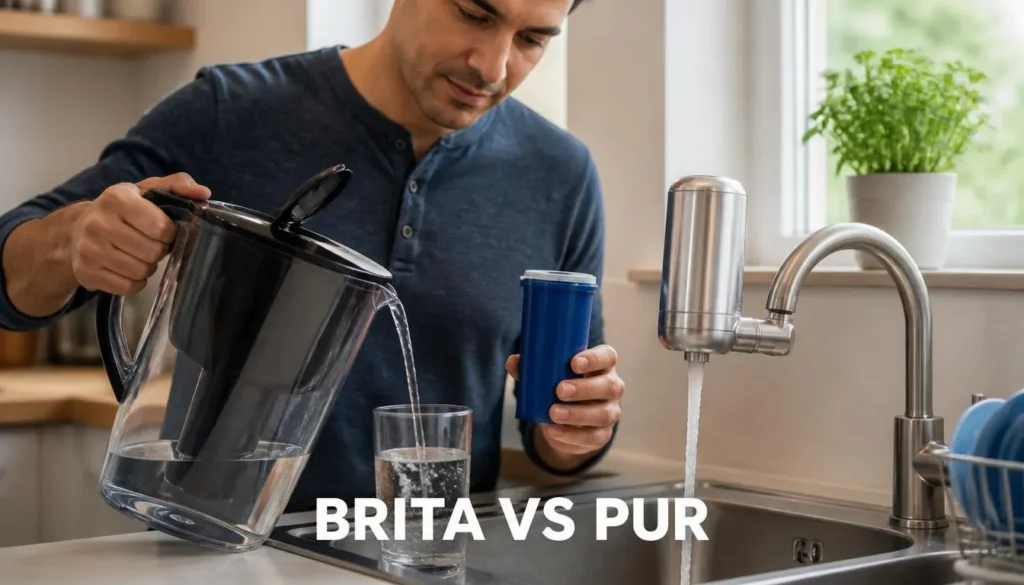
Brita vs PUR is a close call, and the right pick depends on which filter tier you buy. Choose a Brita Elite pitcher for the longest filter life. Choose PUR Plus if you want a filter whose maker lists lead reduction in both pitcher and faucet forms. Skip the basic Brita pitcher filter if lead is your main worry, because that tier makes no lead claim at all.
We compare both brands on certified reductions, filter life, flow and ease of use. By the end, you will know which standard to look for and which filter fits your kitchen.
Key Takeaways
- Only filters certified to NSF/ANSI 53 are tested for lead, so check the label before you buy.
- Brita Elite pitcher filters last about 120 gallons, far longer than the 40 gallons of Brita’s basic filter.
- Faucet filters from both brands list about 100 gallons, but fit only standard faucets.
- Even where a brand lists a PFAS claim, certification does not prove that PFAS (man-made “forever chemicals”) fall below EPA limits.
Brita vs PUR at a Glance
Both brands sell carbon-based filters (filters that trap contaminants on activated charcoal) in two forms. The real difference between a pitcher and a faucet mount matters less than the filter tier you pick inside each lineup.
Brita states that its Elite pitcher filter reduces 99% of lead, while its original filter carries no lead claim on the same product list. Lead matters because the EPA says there is no known safe level of lead in a child’s blood, and its health goal for lead in tap water is zero.
Which one suits you also depends on how you drink water. A household that fills a glass a few times a day gets by with a pitcher. A family that cooks and fills bottles all day may prefer a faucet unit that filters at the tap. We keep that difference in mind through the rest of this comparison.
The table below sets the two brands side by side. It uses each maker’s own listed specs, so check the current data sheet before you buy:
| Factor | Brita | PUR |
| Pitcher filter tiers | Original and Elite | Plus and basic tiers |
| Lead claim on pitcher | Elite only | Plus tier |
| Standards listed | NSF/ANSI 42 and 53; 401 on listed Elite models | NSF/ANSI 42, 53 and 401 on Plus, per PUR |
| Pitcher filter life | 40 gallons Original, 120 gallons Elite | 40 gallons Plus |
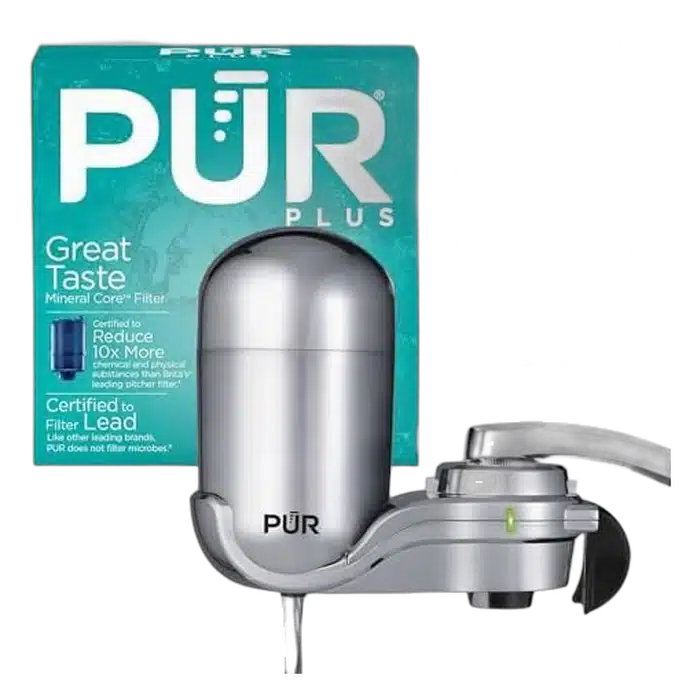
| Faucet filter life | About 100 gallons | About 100 gallons, or 3 months |
| Faucet fit | Standard faucets only | Standard faucets only |
| Forever-chemical claim | Not shown by certification | PUR states a Total PFAS certification |

Which Water Filter Pitcher Removes the Most Contaminants?
The answer starts with the standard printed on the filter package, because each standard tests a different group of contaminants. NSF/ANSI 42 covers taste and odor, such as chlorine. NSF/ANSI 53 covers health effects, including lead and cysts (tiny parasite shells). NSF/ANSI 401 covers trace compounds such as some drugs and pesticides.
Lead tops the concern list for most households that are shopping for a filter. The EPA sets an action level of 15 ppb (parts per billion) for lead in tap water, and its health goal is zero. A filter that lacks NSF/ANSI 53 certification for lead has not been independently tested against that particular risk.
Brita lists its Elite pitcher filter under all three standards. PUR states that its Plus pitcher filter is also listed under 42, 53 and 401. Both brands therefore look alike on paper. Compare the contaminants named beside each standard, although both brands can make a lead claim whenever the packaging names it and an NSF listing backs it up.
PFAS (man-made “forever chemicals”) need a separate caution. The EPA tells shoppers to look for NSF/ANSI 53 or 58 for PFAS, but notes that certification does not yet show removal down to its limit. The legal limit for PFOA and PFOS is 4.0 ppt (parts per trillion), so treat any pitcher as partial help. PUR states that its Plus filters now carry a Total PFAS certification, so check the certifier listing for your cartridge.
A certification only counts for the contaminants it names, and that holds for any brita vs pur water filter label. A filter listed under NSF/ANSI 53 for lead is not automatically listed for cysts, and the reverse is also true. Read the contaminant list beside each standard, because the same brand can sell two filters with very different claims, and the packaging tells you which one you hold.
You can confirm a claim yourself. NSF International, the independent group that writes these standards, keeps a public listing of certified products, and the model number on the box should match an entry there. If it does not match, treat the claim as unverified. Some NSF pages block automated tools, so we cite the standards by name here and send you to that listing directly.
Many shoppers also weigh brita vs zero water. ZeroWater filters take out dissolved minerals as well, which is a different goal, so it is a topic for its own comparison. Neither Brita nor PUR claims that effect.
Filter Life, Flow and Ease of Use
Filter life is where the brands split most. Brita lists 40 gallons for its Original filter and 120 gallons for the Elite. PUR lists 40 gallons for its Plus pitcher filter, so the Elite changes less often.
Faucet filters last longer in both lineups, since both makers list about 100 gallons and PUR also states a three-month limit. You should swap the cartridge at whichever limit comes first, because an old filter works less well than a fresh one.
Real-world life depends on your water. A filter that handles sediment and chlorine will clog sooner in cloudy water, so the gallon figure is a ceiling, not a promise. Many pitchers also have a sticker or electronic indicator that counts time, which helps you stay on schedule without doing the math.
Flow is the trade-off. A pitcher filters slowly because water drips through the carbon under gravity, so you wait while the top chamber empties. A faucet unit is faster at the tap, although the filter still slows the stream a little, and a built-in switch lets you bypass it when you are washing dishes.
Ease of use favors the pitcher for renters, since it needs no install and sits in the refrigerator door. Faucet units screw onto a standard spout, and both makers say their housings will not fit pull-out or spray faucets. Check the faucet type first.
Follow these four steps before you buy either brand:
- Read the box for the exact NSF/ANSI numbers and the contaminant named beside each one.
- Match the filter tier, not just the brand, to the contaminant you care about.
- Note the gallon and month limit, then set a phone reminder for the swap date.
- Confirm your faucet is a standard round spout before you buy a faucet model.
PUR vs Brita Faucet Filter Differences
A faucet unit answers a different need than a pitcher, and it comes with its own trade-offs. The pur vs brita faucet filter choice is smaller than the pitcher choice, because both list about 100 gallons and both carry NSF/ANSI 42 and 53. The practical gap is how well each housing fits your sink and how comfortable the lever feels during everyday use.
Brita and PUR build their faucet housings differently, so check which one clears your sink. Both brands warn that the housing may not seat on some spouts. A loose fit leaks, and a leak is the most common reason people stop using one.
The brita vs pur filter question for faucets then comes down to cartridge cost and how you like the lever. We do not list prices here, so compare them at the shelf. A longer cartridge is cheaper per gallon only if you really use all of it.
What Neither Brand Filter Does
Carbon filters have clear limits, and knowing them can save you from a bad buy. They do not soften hard water, because the calcium and magnesium that cause scale pass straight through the cartridge. If hard water is your problem, a carbon pitcher is the wrong tool.
They also do not make unsafe water safe. PUR states that its filters do not filter microbes, so a boil-water notice means you should follow your local utility’s advice instead of relying on a pitcher. The same caution applies to Brita.
Finally, expired cartridges work less well, and the EPA says to follow the replacement directions for any lead filter. A filter used well past its limit gives you the false comfort of a label without the protection behind it. Neglected maintenance is the most common reason that a good filter performs like a poor one.
Brita vs PUR: Which Should You Choose?
Pick the filter according to the problem you need it to solve, and ignore brand loyalty completely. Both brands make a lead-certified filter, and both sell filters without a lead claim. Use these lists as a quick guide:
- Choose Brita if you want the longest pitcher filter life, around 120 gallons on the Elite.
- Choose Brita if you mainly want better taste and odor and lead is not a concern, because Brita’s basic filter makes no lead claim.
- Choose Brita if you want a wide range of pitcher sizes to pick from.
- Choose PUR if you want a Plus pitcher filter that PUR lists for lead reduction under NSF/ANSI 53.
- Choose PUR if you prefer a faucet mount and its three-month cartridge schedule.
- Choose PUR if you want the lead and Total PFAS claims that PUR states for its Plus filters, and you will check the certifier listing first.
If you live with a lead service line or an older home, favor the filter that names lead on its label. Run a test on your tap water first.
How We Research
We check every claim against primary sources. Federal agencies like the EPA and CDC come first. Certification bodies like NSF and AHAM come next. We verify each standard number against the issuing body. We review this guide on a set schedule.
Why Trust This Guide
Puritisimo covers only water and air quality. Our guidance is editorial and independent. We cite every health figure so you can check it. We never present a promotional claim as fact.
Making the Right Call for Your Kitchen
Neither brand wins every round. Brita Elite has the longest pitcher filter life, while PUR Plus offers lead claims in both pitcher and faucet forms, as PUR states. Whichever you pick, read the label for NSF/ANSI 53 certification and track the replacement date carefully. Remember that no pitcher is proven to remove PFAS to the limits that EPA has set. Test your tap water if you are unsure what is in it. Settling brita vs pur then takes a minute at the shelf.
Frequently Asked Questions
Is Brita or PUR better?
Brita vs PUR depends on the tier you buy. Brita Elite lasts longer, while PUR Plus lists lead reduction under NSF/ANSI 53 and, PUR states, 401. Compare the certified contaminants on each box, not just the brand name.
Which is the No. 1 water filter brand?
Brita is the best-known pitcher brand in the U.S., and PUR is a close competitor. Popularity does not decide quality, though. Certification to the right NSF/ANSI standard is the better guide when you compare any filter.
What contaminants do PUR filters remove?
It depends on the filter. PUR states that its Plus pitcher and faucet filters are listed under NSF/ANSI 42, 53 and 401, which cover chlorine taste and health-effect items such as lead. Always read the data sheet for your exact cartridge.
Which is better, filtered water or purified water?
Filtered water has passed through a medium such as carbon, while purified water has also had most dissolved solids removed. A pitcher gives filtered water. Neither term guarantees safety unless a named standard backs it.
Do Brita and PUR filters remove PFAS?
It depends on the filter, and PUR states that its Plus filters now carry a Total PFAS certification. The EPA says certification to NSF/ANSI 53 or 58 is the label to look for, but it does not yet show removal to its limits. Treat a pitcher as partial help and check your local water report.
References
- EPA. Basic Information about Lead in Drinking Water. U.S. Environmental Protection Agency. 2024.
- EPA. Identifying Drinking Water Filters Certified to Reduce PFAS. U.S. Environmental Protection Agency. 2024.
- EPA. National Primary Drinking Water Regulations. U.S. Environmental Protection Agency. 2024.
Medical Disclaimer: This content is for informational purposes only. It is not a substitute for professional medical advice, diagnosis, or treatment. If you have concerns about your water quality or air quality and their effects on your health, consult a qualified healthcare professional.

