
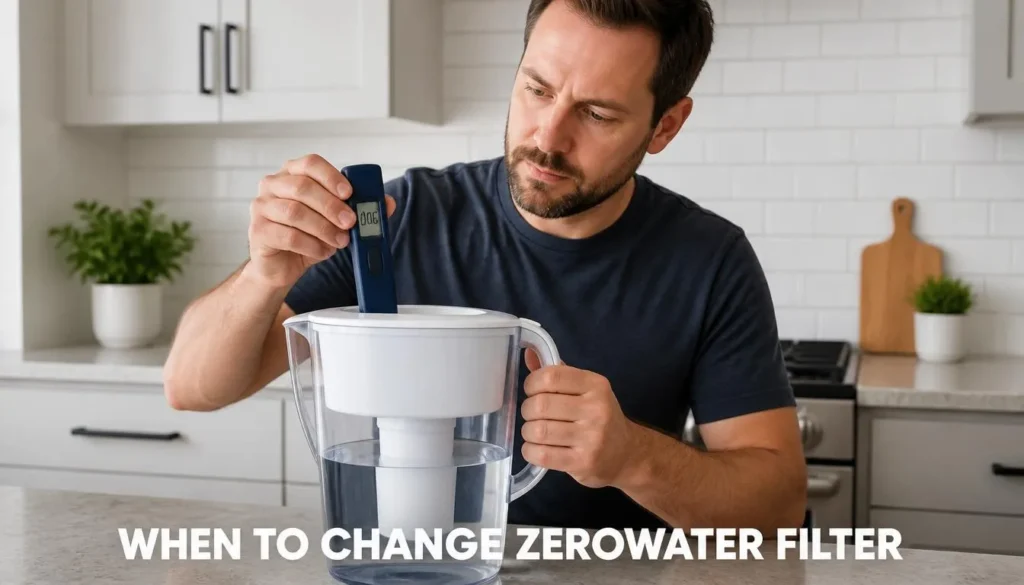
Replace your ZeroWater filter when the TDS meter reads 006 or higher. TDS (total dissolved solids, the minerals and salts mixed into water) is what the filter strips out. A fresh filter reads 000, and the number climbs as the filter wears out. That one reading is the core of when to change a ZeroWater filter, and it works the same way for each filter you buy.
A calendar date does not decide it. By the end, you will know how to read the meter, how many gallons to expect from your tap water, and which other signs say the filter is done.
Key Takeaways
- Change the filter when the meter reads 006 or higher. A new filter reads 000.
- Filter life is counted in gallons: about 25 to 40 for most U.S. tap water.
- A sour or lemon-like taste can signal a used-up filter, but the meter is more reliable.
- Past 006, your filtered water carries more dissolved solids than the filter is meant to leave.
When to Change Zero Water Filter: Replace at 006
A ZeroWater filter is due for replacement when the TDS meter reads 006 or higher in your filtered water. TDS (total dissolved solids) is the combined amount of minerals, salts, and metals dissolved in water, and a fresh filter reads 000 because it strips out nearly all of them.
According to the USGS, TDS includes calcium, magnesium, sodium, potassium, bicarbonate, sulfate, and chloride. All natural water carries some, because water picks up minerals from rock and soil as it travels. The meter estimates the dissolved solids in the glass you pour from how well the water conducts electricity.
A new filter reads 000, and the reading rises as the filter’s capacity runs out. ZeroWater sets the cutoff at 006 and advises against letting the reading go past it. That cutoff is the maker’s own line for purity and taste, not a health limit.
The distinction manufacturers rarely make clear is how small 006 is. The EPA has a secondary standard of 500 mg/L for TDS in public water (milligrams per liter, about the same as ppm, or parts per million, in water). That is a non-enforceable guideline for taste and appearance, not a health limit, and a reading of 006 sits far below it.
Because the reading is a number, it beats a schedule, since two households can install new filters on the same day and need to swap them weeks apart. The meter shows the real state of your filter, in your kitchen, with your tap water.
How to Test Your Water With the TDS Meter
Test the filtered water, not the tap water, when you decide whether to replace the filter. Testing the tap is only for learning your starting number, and the routine is short enough to repeat as often as you like.
Follow these steps:
- Test your unfiltered tap water once. This gives you a baseline and helps you estimate how long a filter will last.
- Fill the reservoir with cold tap water.
- Let the water pass through the filter, then pour a glass.
- Dip the meter into the filtered water and wait for a reading.
- Read the number. 000 means the filter is fresh. 006 or higher means replace it.
- If a brand-new filter reads 006 or higher, check that the filter sits firmly in place. Then rinse the pitcher, reservoir, and filter, and test again.
If the new filter still reads 006 or higher after that, contact ZeroWater support. Legacy ZeroWater filters need no soaking, flushing, or other prep, so go straight to filling the reservoir. Newer Culligan with ZeroWater Technology models may call for rinsing the filter’s outside shell first, so check your manual.
Test at the same point each time, such as the first glass after a refill, so the readings compare fairly. A steady upward trend tells you the filter is nearing its end, so you can buy the next one before you need it.
How Long a ZeroWater Filter Lasts by Tap Water TDS
ZeroWater counts filter life in gallons, not weeks. The more dissolved solids in your tap water, the faster a filter reaches its limit. How much water your household filters matters too, so two homes can see very different results from the same filter.
ZeroWater places most U.S. tap water in the 051 to 200 ppm range and estimates about 25 to 40 gallons per filter. Do the math for your home. At 2 gallons a day, that is roughly 12 to 20 days, while at half a gallon a day, the same filter lasts about 50 to 80 days. Brita pitchers work differently, as our guide on whether Brita filters hard water explains.
The reason is simple: each dissolved solid the filter captures uses up a bit of its capacity. Water with 300 ppm of dissolved solids gives the filter far more to catch per gallon than water with 100 ppm, so the filter fills up sooner. Your tap water TDS is the biggest single factor in how long a filter lasts.
ZeroWater suggests contacting its support team if your tap water reads 401 or higher. You can learn your number by testing the tap with the meter, as in the steps above.
The table shows the expected gallons for each band of tap water TDS:
| Tap water TDS (ppm) | Expected gallons per filter |
| 002 to 050 | 40 or more |
| 051 to 200 | 25 to 40 |
| 201 to 300 | 15 to 25 |
| 301 to 400 | 8 to 15 |
| 401 and above | 8 or less |
Other Signs Showing When to Change Zero Water Filter Cartridges
The meter is the most reliable check, but your senses and your device give extra clues. A change in taste or smell can signal that the filter is used up. A sour or lemon-like taste is a common sign of an exhausted filter, according to ZeroWater.
Watch for these signs:
- Meter at 006 or higher: the clearest sign. Replace the filter.
- Sour or lemon-like taste: a common sign the filter is used up.
- Change in smell: can also point to a used-up filter, so test the water with the meter.
- Indicator light: some models use a light in place of, or beside, the digital meter. When it comes on, replace the filter.
- New filter reading 006 or higher: check the setup first. Reseat the filter, rinse, and test again before you contact support.
Do not rely on taste alone, because your palate adjusts slowly and a gradual change is easy to miss. The meter gives a clear answer in seconds, which is why it is the better first check.
Models differ, so check your manual for what each light means. This filter also runs on the meter and the gallon count. Many refrigerator and whole-house cartridges follow a set schedule instead, as covered in the guide on how often to change water filter cartridges.
What Happens If You Keep Using a Used-Up Filter
Past 006, your filtered water carries more dissolved solids than the filter is built to leave behind. ZeroWater advises against letting the reading go beyond that point. Check the meter regularly rather than waiting for a taste change.
According to the EPA, activated-carbon filters are designed to treat only a certain amount of water. The agency says to follow each maker’s replacement instructions, and it sets no universal TDS threshold.
One limit is worth knowing about what the meter can and cannot tell you. It estimates TDS from how well the water conducts electricity. It does not test for any single contaminant, so treat it as a replace signal for taste and TDS, not a lab report on your water.
On the day you hit 006, swap in the new filter, fill the reservoir with cold tap water, and test again. A good new filter should read 000. If it does not, run through the setup checks in the testing steps before you decide the filter is faulty.
The practical fix is simple: test regularly, and test more often once the filter passes the middle of its expected gallon range.
How We Research
We check every claim against primary sources. Federal agencies like the EPA and CDC come first. Certification bodies like NSF and AHAM come next. We verify each standard number against the issuing body. We review this guide on a set schedule.
Why Trust This Guide
Puritisimo covers only water and air quality. Our guidance is editorial and independent. We cite every health figure so you can check it. We never present a promotional claim as fact.
Making the Call on Your Next Filter Swap
A ZeroWater filter does not run on a timer. It runs on a number: 000 when it is new and 006 when it is done. Test the filtered water, learn your tap water’s TDS, and use the gallon table to estimate how long each filter will last. A sour taste, an odd smell, or an indicator light are backup signs. If a new filter reads high, recheck the setup first. Keep a spare cartridge on hand. Knowing when to change a ZeroWater filter comes down to one habit: test the filtered water and replace the filter at 006.
Frequently Asked Questions
How often do you have to change a ZeroWater filter?
The right time to change a ZeroWater filter depends on the meter, not the calendar. Replace the filter once the TDS meter reads 006 or higher in your filtered water. How soon that happens depends on your tap water and how much you filter, so test it regularly.
How long do ZeroWater filters last?
ZeroWater filters last 25 to 40 gallons for most U.S. tap water, in the 051 to 200 ppm band. Tap water with a TDS reading of 050 or below can reach 40 gallons or more, while readings above 400 may get 8 gallons or less. At 1 gallon a day, a typical filter lasts roughly 25 to 40 days.
What does it mean when the orange light on my Culligan water filter appears?
On Culligan with ZeroWater Technology models, an orange light means the meter reads 006 or higher. Replace the filter when it comes on. Other Culligan systems may differ, so check your manual.
How to make ZeroWater filter last longer?
Filter life depends on how many dissolved solids go in and how many gallons you pour. You can’t change your tap water, but you can test it to learn your baseline and filter only the water you drink. Starting with lower-TDS water also stretches a filter.
When to change Culligan ZeroWater filter?
Culligan now sells ZeroWater technology, and the rule is the same: replace the filter when the TDS meter reads 006 or higher. On models with a light indicator, replace it when the light comes on. A new filter should read 000.
References
- EPA. Secondary Drinking Water Standards: Guidance for Nuisance Chemicals. U.S. Environmental Protection Agency.
- USGS. Excess dissolved solids is a common water problem. U.S. Geological Survey.
- EPA. Water Health Series: Filtration Facts. U.S. Environmental Protection Agency. 2005.
Medical Disclaimer: This content is for informational purposes only. It is not a substitute for professional medical advice, diagnosis, or treatment. If you have concerns about your water quality or air quality and their effects on your health, consult a qualified healthcare professional.

