
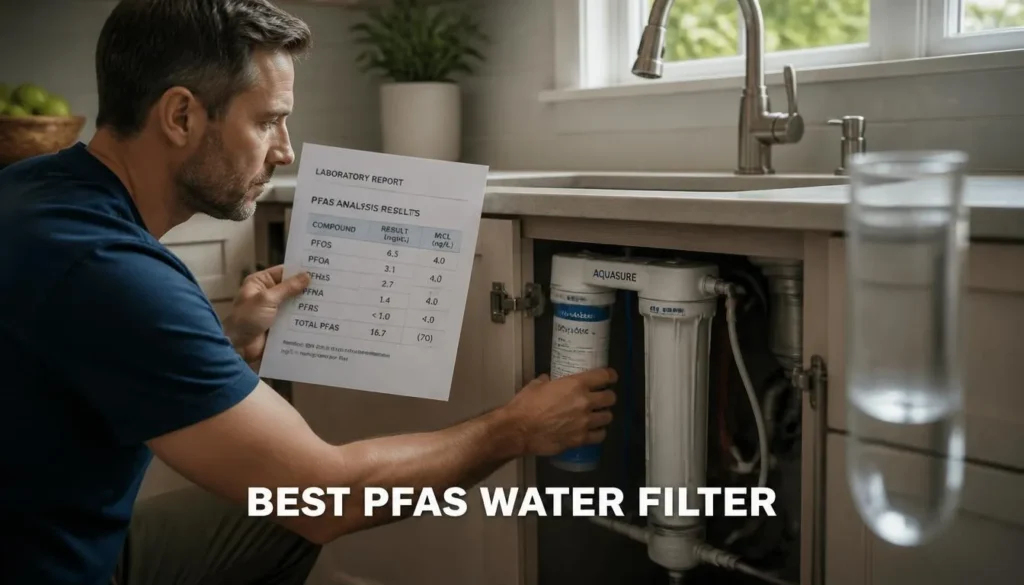

Choosing the best PFAS water filter starts with one hard number: the EPA set a limit of 4 parts per trillion for PFOA and PFOS in its 2024 drinking water rule. Many labels now mention forever chemicals without saying who tested the claim. We wrote this page to show which claims rest on a registry listing and which rest on the maker's word.

Below you will find 7 options across under-sink, whole-house and dispenser formats. PFAS water filters differ most in who tested the claim: a registry, a certifier the maker names, or the maker alone. Our Top 3 picks come first, then the full reviews, and only one product here has a registry-confirmed PFOA and PFOS listing, which we flag plainly.
My Recommended Top 3 Best-Buys for PFAS Water Filters: Reviewed and Rated

- PFAS carbon stage: Stage 2 uses SGS-tested media that the maker says reduces up to 99% of PFAS.
- The 1 inch NPT ports fit standard whole-house plumbing for wall-mount installation.
- Rated life is up to 50,000 gallons or 12 months per filter.
- Three-stage media combines Micro Sift membranes, KDF-55 and coconut shell carbon.
- The direct-connect install needs no drilling, and all parts are included.
- The 20,000 gallon or 2 year life applies to the UC-150 model.
- The three-stage design uses a 2.5 by 10 inch format with PFAS-focused media.
- The reusable housings are built to last 5 to 10 years.
- The second-stage carbon block holds about 13 oz of activated carbon.
Best PFAS Water Filter Reviews 2026: 7 Top Models for Forever Chemicals
This page covers under-sink, whole-house and dispenser filters, because each one reaches PFAS in a different way. For every product we state who stands behind the claim: a registry listing or the maker alone. A whole house PFAS water filter treats every tap, while an under-sink unit treats the water you drink and cook with.
1. iSpring WGB21B-PFKS Whole House PFAS Filter
The iSpring WGB21B-PFKS is the only whole-house unit on this page, so it treats the shower and every tap. As a whole house PFAS water filter, it pairs a sediment stage with a PFAS carbon stage behind 1 inch NPT ports that fit most home plumbing. What we noticed first is how compact the 16 by 8 by 18 inch housing is for a whole-home system.
iSpring WGB21B-PFKS Whole House PFAS Filter Specs
| Type | Whole-house, 2-stage system |
| Installation | Wall mount, 1 inch NPT ports, 25 to 65 psi |
| PFAS claim basis | Maker claim: SGS-tested media, up to 99% PFAS |
| Filter media | Sediment stage plus PFAS carbon stage (carbon block, granular activated carbon) |
| Filter life | Up to 50,000 gallons or 12 months |
Key Features
- PFAS carbon stage: Stage 2 uses SGS-tested media that the maker says reduces up to 99% of PFAS.
- The 1 inch NPT ports fit standard whole-house plumbing for wall-mount installation.
- Rated life is up to 50,000 gallons or 12 months per filter.
- The 25 to 65 psi range is the recommended operating pressure, with a 100F upper limit.
- Minerals stay in the water, since the unit does not lower TDS.
Here is the claim basis in plain terms. The maker says the second stage uses SGS-tested media for up to 99% PFAS reduction, including PFOA and PFOS. We found no published SGS report or certificate number, and no NSF, IAPMO or WQA listing, so this is a maker claim and not a certification.
Installation is a wall-mount job on the main line, with a recommended 25 to 65 psi operating range. Each filter is rated for up to 50,000 gallons or 12 months, whichever comes first. Whole-house use adds up quickly, so track both limits instead of assuming the month count will arrive first.
Our one flag: the 99% figure is the maker's, and we could not trace it to a public report.
Why We Chose This
It is the only option here that treats water at the main line, which suits wells, showers and larger households, and its claim is clearly labeled as maker tested.
The maker says it keeps beneficial minerals in the water.
Our team kept coming back to fit, not performance. A wall-mount housing with 1 inch ports and a 21 pound weight needs a garage, basement or utility closet with room, and a plumber if you are not comfortable working on the main line. The maker publishes step-by-step guides and video instructions, which helps a first-time installer.
Pros
- Treats every tap and shower
- Compact for a whole-house unit
- 1 inch NPT ports fit most homes
- Up to 50,000 gallons per filter
- Keeps beneficial minerals
- Guides and video instructions
- One year warranty, lifetime U.S. support
Cons
- PFAS claim is maker-tested only
- Needs a main-line, wall-mount install
Pair it with a point-of-use filter if you want a second layer at the drinking tap. For TDS-free water the maker suggests an iSpring reverse osmosis system, but that is a separate purchase. The unit carries a 1 year warranty and lifetime U.S.-based technical support.
Final Verdict
Choose it when you want whole-home coverage and accept a maker-tested PFAS claim in place of a registry listing. Recheck the maker's data sheet in case something changed in the meantime. It is the whole-home default.
2. CuZn UC-150 Under Sink Water Filter
Next, the CuZn UC-150 is the budget tier pick, an inline under-sink filter that connects directly to the cold line with no drilling. We liked that the kit includes every installation part, because that keeps a small-cabinet install simple.
CuZn UC-150 Under Sink Water Filter Specs
| Type | Inline under-sink, 3-stage |
| Installation | Direct connect, no drilling, kit included |
| PFAS claim basis | Maker claim: independently tested per the listing, no registry listing found |
| Filter media | Micro Sift membranes, KDF-55, coconut shell carbon |
| Filter life | 20,000 gallons or 2 years (UC-150) |
Key Features
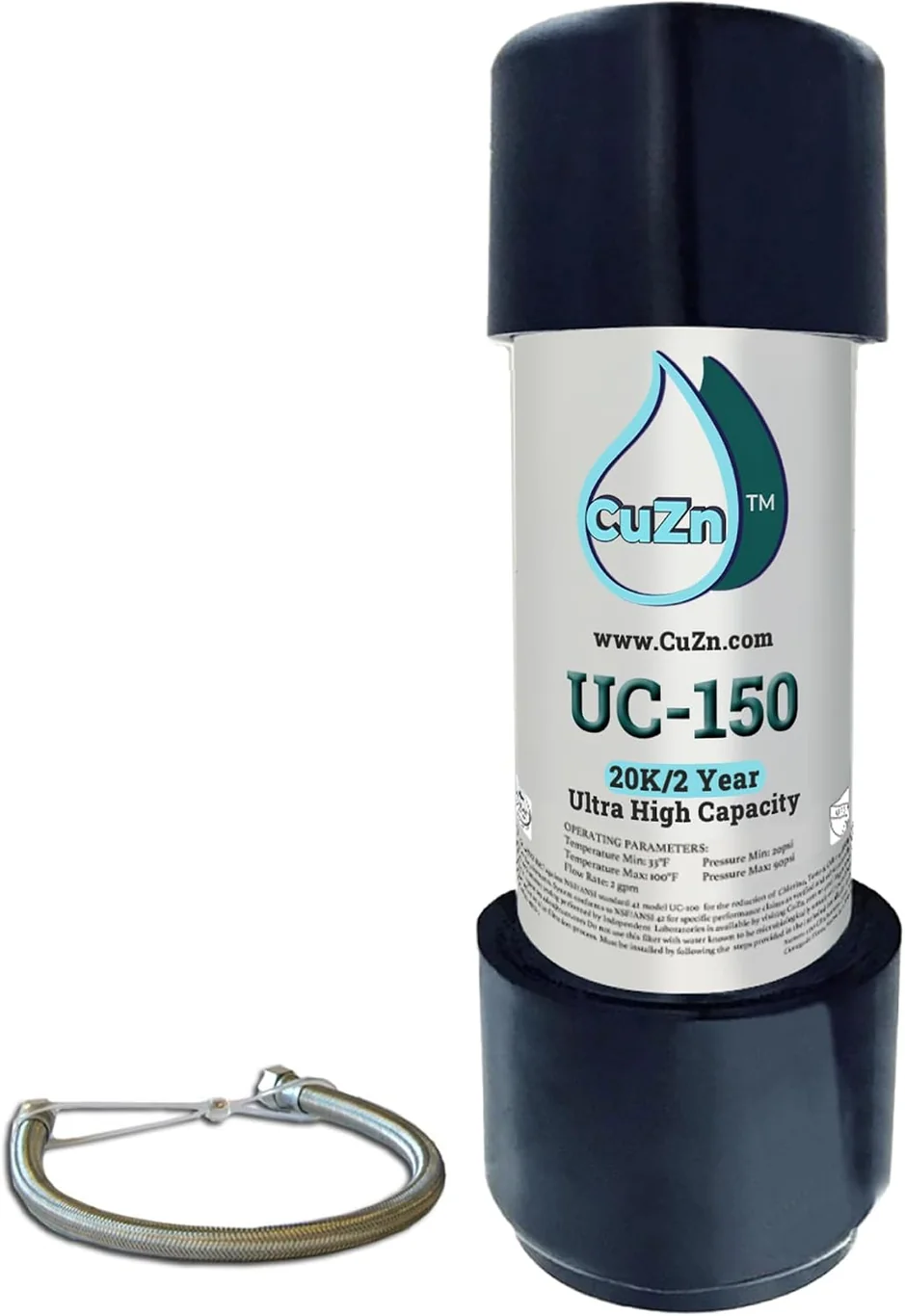
- Three-stage media combines Micro Sift membranes, KDF-55 and coconut shell carbon.
- The direct-connect install needs no drilling, and all parts are included.
- The 20,000 gallon or 2 year life applies to the UC-150 model.
- The compact body measures 4.5 by 4.5 by 13.5 inches and weighs 3.5 pounds.
- NSF/ANSI 42 components cover taste and odor, and the unit does not reduce TDS.
The listing title mentions NSF/ANSI 42 and 372, which cover taste and odor and lead-free materials. Neither standard is a PFAS claim. The PFAS and PFOA/PFOS reduction is described as independently tested, and we found no NSF, IAPMO or WQA PFAS listing, so treat it as a maker claim.
Inside, the three stages use Micro Sift membranes, KDF-55 and coconut shell carbon, and the listing rates the filter for 20,000 gallons or 2 years. The maker also sells a UC-200 with a 5 year life, and the listing and maker pages mix the two, so confirm the box says UC-150 before you set a replacement schedule.
Our one flag: the NSF names on the listing are not PFAS claims.
Why We Chose This
It is the lowest-effort way to add a PFAS-claimed filter under a sink, with no drilling and a two year filter life.
It does not reduce TDS, which only reverse osmosis can do.
The body is 4.5 inches wide and 13.5 inches tall, so it suits tight cabinets. The stainless steel body measures only 4.5 inches across, so the footprint stays small, though the long filter life depends on how much water you use. Replace it at the earlier of the gallon or month limit.
Pros
- No drilling needed
- Compact 3.5 pound body
- Long 2 year filter life
- Complete installation kit included
- Keeps beneficial minerals
- Stainless steel material
- Install video tutorial available
Cons
- PFAS claim is maker-stated only
- Listing mixes UC-150 and UC-200 details
It suits renters and small households that want a PFAS-claimed filter without a separate faucet. It does not suit anyone who needs a registry-confirmed PFOA and PFOS listing; for that, see the Aquasana later on this page.
Final Verdict
Choose it for a simple, compact under-sink install and accept a maker-tested PFAS claim. Recheck the maker's data sheet in case something changed in the meantime. It is the low-effort budget pick.
3. iSpring US31KF-PF 3-Stage Under-Sink PFAS Filter
From there, the iSpring US31KF-PF is a classic 3-stage under-sink system upgraded with PFAS-focused media, and its standout feature is reusable housings built to last 5 to 10 years. Our team found that the clearest reason to choose it over twist-on cartridges.
iSpring US31KF-PF 3-Stage Under-Sink PFAS Filter Specs
| Type | Under-sink, 3-stage, reusable housings |
| Installation | Standard 3/8 inch compression fittings on the cold line |
| PFAS claim basis | Maker claim: up to 99% PFAS, no PFAS listing found |
| Filter media | PFAS-focused media with a 13 oz carbon block in stage 2 |
| Filter life | 10,000 gallons or 12 months |
Key Features
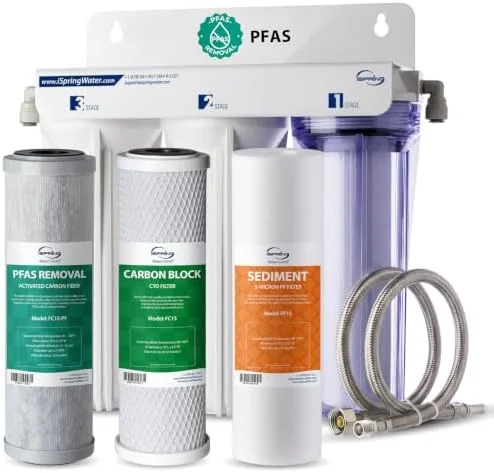
- The three-stage design uses a 2.5 by 10 inch format with PFAS-focused media.
- The reusable housings are built to last 5 to 10 years.
- The second-stage carbon block holds about 13 oz of activated carbon.
- The transparent housing shows filter color change and sediment buildup.
- Standard 3/8 inch compression fittings connect to the cold line without drilling.
The maker says it reduces up to 99% of PFAS and describes the system as NSF/ANSI compliant. Compliant is not certified, and we found no PFAS listing in a public registry. Its sibling, the US31-PF, is the SGS-tested model, so do not mix the two when you read the maker's pages.
The second stage holds about 13 oz of activated carbon, which the maker says is 2.3 times the carbon in a quick-change cartridge. The transparent housing lets you see the filter color change, and the stated filter life is 10,000 gallons or 12 months.
Our one flag (again): the PFAS claim rests on the maker, not a registry.
Why We Chose This
You replace filter elements instead of whole plastic cartridges, and the housings are meant to last 5 to 10 years.
It keeps beneficial minerals and does not lower TDS.
Installation uses standard 3/8 inch compression fittings on the cold line. The listing wording on faucet hardware is inconsistent, so confirm what ships in the box with the maker before you plan the install. What we noticed is that the 13 pound system is larger than the inline picks.
Pros
- Reusable housings last 5 to 10 years
- More carbon than twist-on cartridges
- See filter condition at a glance
- No drilling for the supply connection
- Keeps beneficial minerals
- 10,000 gallon capacity
- 30 day money-back, lifetime U.S. support
Cons
- PFAS claim rests on the maker alone
- Larger 13 pound footprint
Replace the filter elements on the 12 month schedule. Reusable housings mean fewer parts to throw away, but you still buy new elements, so check the maker's replacement set before you commit.
Final Verdict
Choose it if you want an under-sink system you can service for a decade and accept a maker-claimed PFAS reduction. Recheck the maker's data sheet in case something changed in the meantime. It is the reusable-housing option.
4. Waterdrop TSB-PF Under Sink Water Filter System
Stepping up, the Waterdrop TSB-PF is a push-to-connect under-sink system with a separate faucet, and the maker quotes a 3 minute installation and 3 second filter swap. We read that as a fit and convenience point, not a PFAS test result.
Waterdrop TSB-PF Under Sink Water Filter System Specs
| Type | Under-sink, 3 filters, separate faucet |
| Installation | Push-to-connect, fits 3/8 and 1/2 inch cold lines |
| PFAS claim basis | Maker claim only, no PFAS listing found |
| Filter media | Coconut shell activated carbon with PP, PF and GC stages |
| Filter life | PP and PF up to 6 months, GC 8 to 12 months |
Key Features
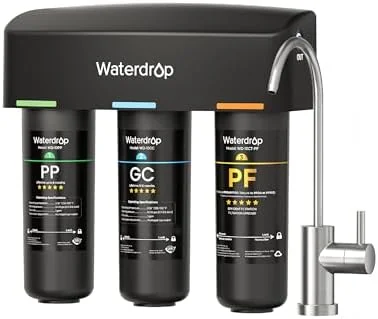
- The push-to-connect install takes about 3 minutes, per the maker.
- The separate lead-free faucet is included in the kit.
- The MicroSpine structure gives 20 times more dirt interception, per the maker.
- Staggered filter life: PP and PF last up to 6 months, and GC lasts 8 to 12 months.
- The 3/8 and 1/2 inch converter set fits both common cold-line sizes.
The listing cites NSF/ANSI 372, which covers lead-free materials, and PFAS, PFOA and PFOS reduction is a maker claim. We did not find the TSB-PF on Waterdrop's NSF page, which lists NSF/ANSI 53 and 58 certifications for some of its RO and countertop models. Maker claim only is the honest label.
Flow is rated up to 1.5 gpm, and the lead-free stainless faucet fills a 12 oz glass in 5 seconds, per the maker. Capacity is 8,000 gallons, and the listing gives a maximum supported TDS of 700 ppm for the incoming water.
Our one flag (again): no PFAS listing found for this model.
Why We Chose This
It combines fast filter swaps, a separate faucet and a flow rate up to 1.5 gpm in one compact under-sink kit.
The coconut shell carbon needs an allergy check first.
Filters have staggered lives, so plan around 6 to 12 months depending on stage. The listing table says 12 months while the bullets say 6 to 12, and our team would set a six month reminder to be safe. Before a long vacation, the maker says to store filters in sealed bags in the refrigerator for up to 30 days.
Pros
- Fast 3 minute install
- 3 second filter swaps
- Separate faucet included
- Up to 1.5 gpm flow
- 8,000 gallon capacity
- Fits 3/8 and 1/2 inch lines
- One year manufacturer warranty
Cons
- PFAS claim is maker-stated only
- Coconut carbon needs an allergy check
It is the easiest install on this page for someone who wants a faucet included in the box. The housing is 12.9 inches long and 12.4 inches tall, so measure the cabinet first. What we noticed is that the maker ties the strong flow to the faucet it ships with.
Final Verdict
Choose it for the easiest under-sink install here when you accept a maker-claimed PFAS reduction. Recheck the maker's data sheet in case something changed in the meantime. It is the push-connect convenience pick.
5. Waterdrop 15UA-PF Under Sink Water Filter System
After that, the Waterdrop 15UA-PF is the high-flow single-filter option, with a rated 1.33 gpm flow and an accordion-style filter that the maker says has 20 times the adsorption surface of a standard PP filter.
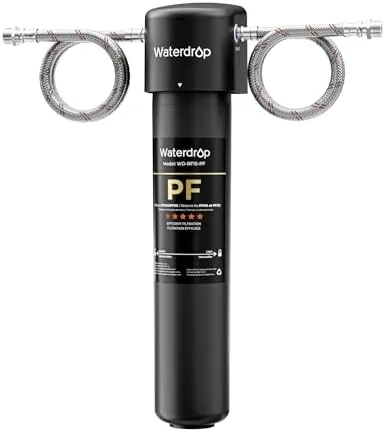
Waterdrop 15UA-PF Under Sink Water Filter System Specs
| Type | Under-sink, single filter |
| Installation | Hose kit with a 3/8 to 1/2 inch converter, 3 second filter swap |
| PFAS claim basis | Maker claim: 99.9% PFOA, 99.8% PFOS, no PFAS listing found |
| Filter media | Accordion-style coconut shell activated carbon |
| Filter life | 1,000 gallons or 6 months |
Key Features
- The accordion-style filter gives 20 times more adsorption surface than a standard PP filter, per the maker.
- Rated flow is 1.33 gpm through a 3/8 inch outlet.
- Filter life is up to 6 months or 1,000 gallons.
- The accessory kit includes hoses, screws, Teflon tape and a 3/8 to 1/2 inch converter.
- The larger filter body means you should measure your cabinet before you buy.
The listing claims 99.9% PFOA and 99.8% PFOS reduction and describes its materials only as NSF/ANSI approved components, with no standard or certifier named for the PFAS claim. We did not find the 15UA-PF on Waterdrop's NSF page. A retailer reports the base 15UA tested to 42, 53 and 372 against a different filter, which is not a PFAS claim for this one.
Capacity is short at 1,000 gallons or 6 months, and the replacement filter is the WD-RF15-PF. The unit stands 16.7 inches tall because of the larger media, so our team would measure the cabinet before ordering.
Our one flag (again): the 99.9% and 99.8% figures are the maker's.
Why We Chose This
It quotes specific PFOA and PFOS percentages, which makes the claim easy to compare against the maker's data sheet.
It keeps minerals, so a TDS meter reading will not drop.
The kit includes inlet and outlet hoses, screws and Teflon tape, plus a 3 second filter swap. What we noticed is the short gallon limit: a busy kitchen could reach 1,000 gallons before the 6 months are up, so track the count as well as the calendar.
Pros
- High 1.33 gpm flow rate
- Specific PFOA and PFOS figures quoted
- 3 second filter swaps
- Complete accessory kit included
- Keeps beneficial minerals
- Lifetime technical support
- One year manufacturer warranty
Cons
- Short 1,000 gallon filter life
- Maker claim only, no PFAS listing found
Choose it only if you will track the gallon count and replace on schedule. A spent carbon filter can release what it captured, which is the main risk with any carbon-based PFAS filter.
Final Verdict
Choose it for strong flow and clearly quoted percentages when you accept a maker-claimed PFAS reduction. Recheck the maker's data sheet in case something changed in the meantime. It is the high-flow under-sink pick.
6. Culligan ZeroWater 23-Cup Water Filter Dispenser
Moving away from plumbing, the Culligan ZeroWater 23-Cup dispenser is a pour-through option with no installation at all. It sits on a counter or fits in a fridge, which makes it the one pick here for renters and dorms.
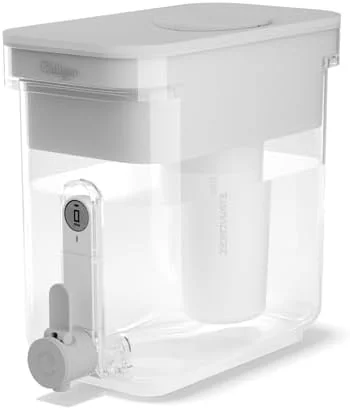
Culligan ZeroWater 23-Cup Water Filter Dispenser Specs
| Type | Pour-through dispenser, 23 cups |
| Installation | None, drop-in filter |
| PFAS claim basis | IAPMO-certified per the maker for Total PFAS, file number reported by a third party |
| Filter media | Culligan with ZeroWater Technology filter |
| Filter life | Signalled by the built-in TDS meter |
Key Features
- Maker-stated IAPMO certification covers Total PFAS and lead under NSF/ANSI 53.
- The built-in TDS meter signals when to change the filter.
- The 23-cup body fits small refrigerators or sits on a counter.
- BPA-free materials are stated by the maker.
- The drop-in filter and easy-slide lid make pouring simple.
The maker says the dispenser is IAPMO-certified to reduce Total PFAS and lead under NSF/ANSI 53. A third-party review reports IAPMO file W-17155 for it, but we did not retrieve the IAPMO directory entry ourselves, so verify it there. The scope is Total PFAS, not named PFOA and PFOS, and the certifier is IAPMO R&T, not NSF International.
A built-in TDS meter signals when to replace the filter, so there is no gallon figure to track. The maker says the filter removes virtually all TDS, which includes minerals. One third-party lab test reportedly saw pH fall to about 6.6, which is not our measurement.
Our one flag: it accepts only the new Culligan with ZeroWater filters.
Why We Chose This
It needs no plumbing and carries a maker-stated IAPMO certification for Total PFAS, which suits renters.
Legacy ZeroWater filters do not fit this dispenser.
We noticed the specification table on the listing is empty, so capacity in gallons and a filter life figure are not published. The TDS meter is the only replacement signal, so our team would keep a spare filter on hand.
Pros
- No installation needed
- Fits in a small refrigerator
- Built-in TDS meter
- Maker-stated IAPMO certification
- Simple drop-in filter swap
- BPA-free materials
- Easy-slide lid for one-hand pouring
Cons
- Removes minerals, filter capacity unpublished
- Legacy ZeroWater filters do not fit
Because it removes dissolved minerals along with TDS, some households will prefer a carbon option instead. The maker says the dispenser can save up to 150 single-use plastic bottles, and it fits small refrigerators.
Final Verdict
Choose it when you cannot plumb a filter in and want a PFAS claim backed by a maker-stated IAPMO certification you can verify. Check the IAPMO directory in case something changed in the meantime. It is the no-install pick.
7. Aquasana Claryum 3-Stage Max Flow AQ-6300M
Last, the Aquasana Claryum AQ-6300M is the only product here with a registry-confirmed PFOA and PFOS listing. The WQA Gold Seal directory lists it under NSF/ANSI 53 for PFOA and PFOS, plus lead, mercury and cysts.
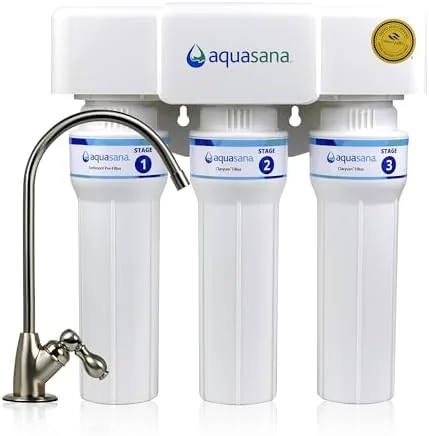
Aquasana Claryum 3-Stage Max Flow AQ-6300M Specs
| Type | Under-sink, 3-stage, cold-line system |
| Installation | DIY, faucet included, 20 to 80 psi, 15.85 inches of clearance |
| PFAS claim basis | Registry-confirmed: WQA directory lists NSF/ANSI 53 for PFOA and PFOS |
| Filter media | Carbon block and ultrafiltration |
| Filter life | 800 gallons or 6 months |
Key Features
- The WQA directory listing shows NSF/ANSI 53 for PFOA and PFOS.
- The 0.72 gpm flow is the maker's rated output.
- The 800 gallon or 6 month life is the rated filter limit.
- The twist-off housing makes filter changes simple.
- The 15.85 inch clearance is required under the sink.
That matters because every other entry rests on a maker claim. The directory page shows no certificate number, and WQA is an industry trade association, though it is ANSI-accredited. The maker says it tested PFOA and PFOS down to 20 ppt.
Flow is 0.72 gpm and the filter is rated for 800 gallons or 6 months. The listing calls it gravity fed, but the maker data describe a pressurized cold-line system at 20 to 80 psi, so we followed the maker data.
Our one flag: the 800 gallon capacity is the smallest of the under-sink units here.
Why We Chose This
It is the only entry we could confirm in a public registry for PFOA and PFOS.
Expect a higher upfront cost tier than the budget picks.
Installation is DIY with a complete kit that includes a faucet and the first filter set, plus a 1 year limited warranty. What we noticed is the clearance requirement, so measure the cabinet before you buy. Replacement uses the AQ-C3M-R element.
Pros
- Registry-confirmed PFOA and PFOS listing
- Also listed for lead and mercury
- Carbon block plus ultrafiltration
- Complete DIY kit with faucet
- Twist-off filter change
- One year limited warranty
- Support line provided
Cons
- Smallest capacity here at 800 gallons
- Higher upfront cost tier
If your priority is a PFOA and PFOS claim you can look up yourself, this is the one we would choose. Replace it on the 6 month schedule, since a spent carbon filter can release what it captured.
Final Verdict
Choose it when a registry-confirmed PFOA and PFOS listing matters more than flow or filter life. Check the WQA directory in case something changed in the meantime. It is the verified-claim pick.
How to Choose the Best PFAS Water Filter
A PFAS water filter is only as good as the evidence behind it. Most listings say a filter reduces PFAS, but few show who tested it, to which standard and against which compounds. In our experience, the claim basis matters more than the capacity figure.
Certified claim versus maker claim
Three different things hide behind the words tested to reduce PFAS. A registry-confirmed listing means an independent certifier tested the product and published it in a directory you can open. A maker claim means the company says its filter works. A maker-commissioned lab test is a report the company paid for, which is not a certification.
In our experience this gap is where buyers get misled, so we reserve the word certified for listings we could confirm ourselves. Treat any claim you cannot find in a public directory as UNVERIFIED.
The table below shows where each product stands, based on our check of the certifier directories and the maker pages:
Only one of the seven, the Aquasana Claryum AQ-6300M, is registry-confirmed. WQA runs that directory and is an industry trade association, though it is ANSI-accredited, so open the listing yourself rather than taking our word for it.
| Product | Claim basis | What we found |
| iSpring WGB21B-PFKS Whole House PFAS Filter | Maker claim, SGS-tested media | No NSF, IAPMO or WQA listing found |
| CuZn UC-150 Under Sink Water Filter | Maker claim | NSF/ANSI 42 and 372 only, which are not PFAS standards |
| iSpring US31KF-PF 3-Stage Under-Sink PFAS Filter | Maker claim | Described as compliant by the maker, no PFAS listing found |
| Waterdrop TSB-PF Under Sink Water Filter System | Maker claim | NSF/ANSI 372 named, which is not a PFAS standard |
| Waterdrop 15UA-PF Under Sink Water Filter System | Maker claim | Materials described as NSF/ANSI approved components, no PFAS listing found |
| Culligan ZeroWater 23-Cup Water Filter Dispenser | IAPMO-certified per the maker | File number reported by a third party; we did not retrieve the directory entry ourselves |
| Aquasana Claryum 3-Stage Max Flow AQ-6300M | Registry-confirmed | WQA directory lists it under NSF/ANSI 53 for PFOA and PFOS |
PFOA and PFOS versus total PFAS
PFAS is a family of thousands of compounds, and a filter is tested against only a few of them. A PFOA and PFOS listing covers the two compounds the EPA regulates, while a claim of total PFAS reduction covers a wider group under a different test. In the NSF/ANSI 53 test, combined PFOA and PFOS must be reduced to 20 parts per trillion or less.
Read any claim in this order:
- Standard and number: NSF/ANSI 53 for carbon filters, NSF/ANSI 58 for reverse osmosis
- Compounds named: PFOA and PFOS by name, total PFAS, or only the word PFAS
- Certifier: NSF International, IAPMO R&T or WQA, each ANSI-accredited
- Listing: a certificate or directory entry you can open yourself
The ZeroWater dispenser shows why the wording matters. Its newer Culligan listing names total PFAS, older listings named PFOA and PFOS, and our sources differ. In our view you should recheck the data sheet in case something changed in the meantime.
Filter technology and what it can reach
Carbon block holds PFAS on its surface, ion exchange swaps them out of the water, and reverse osmosis pushes water through a membrane that blocks them. Most PFAS water filters sold for homes use carbon, so media, contact time and cartridge age decide the result more than the housing does.
Microplastics are a separate question. If you want the best water filter to remove PFAS and microplastics together, you need a sub-micron rating on the data sheet as well as a PFAS claim. None of the seven listings we reviewed makes a microplastics claim, though a maker may state one on its own pages, so check the data sheet.
What we noticed reading the spec sheets: none of the seven is a reverse osmosis system. The CuZn UC-150 pairs KDF-55 with coconut shell carbon, the iSpring whole-house unit adds a PFAS carbon stage after sediment filtration, and the ZeroWater dispenser relies on ion exchange.
Point-of-use versus whole-house coverage
A point-of-use filter treats the water at one tap, usually the kitchen, which covers what you drink and cook with. A whole house PFAS water filter treats everything that enters the home, including showers, laundry and every other tap. The iSpring WGB21B-PFKS is the only whole-home unit here.
Drinking and cooking water is a major way PFAS enter your body, so we think point-of-use is enough for most households. Rule of thumb: choose whole-home coverage for a private well, a large household or when you want every tap treated.
Which coverage fits each product:
- Kitchen tap only: CuZn UC-150, both iSpring and Waterdrop under-sink systems and the Aquasana Claryum
- Whole home: iSpring WGB21B-PFKS on a 1-inch NPT line
- No plumbing: Culligan ZeroWater dispenser that fits in a fridge
Flow rate and installation fit
Maker flow figures differ widely: up to 1.5 gpm for the Waterdrop TSB-PF, 1.33 gpm for the Waterdrop 15UA-PF and 0.72 gpm for the Aquasana Claryum AQ-6300M. A lower rate usually means longer contact with the carbon, though it can feel slow when you fill a pot.
When you compare options for the best water filter for PFAS, check the cabinet before anything else. In our experience a tape measure matters more than the spec sheet at this step.
Check these fit points before you buy:
- Clearance: the Aquasana needs 15.85 inches under the sink
- Pressure: 25 to 65 psi for the iSpring WGB21B-PFKS and 20 to 80 psi for the Aquasana
- Connections: standard 3/8-inch compression fittings on the iSpring US31KF-PF
- No drilling: the CuZn UC-150 connects directly to the line
Filter life and upkeep
Maker ratings run from 800 gallons to 50,000 gallons, and the time limit usually arrives first in a small household. We would put a calendar reminder in on installation day, because upkeep is the step buyers skip.
Rated life by product:
- iSpring WGB21B-PFKS: 50,000 gallons or 12 months
- CuZn UC-150: 20,000 gallons or 2 years
- iSpring US31KF-PF: 10,000 gallons or 12 months
- Waterdrop TSB-PF: 8,000 gallons, with 6 to 12 months depending on stage
- Waterdrop 15UA-PF: 1,000 gallons or 6 months
- Aquasana Claryum AQ-6300M: 800 gallons or 6 months
- Culligan ZeroWater: the built-in TDS meter signals when the filter is spent
Change the cartridge at whichever limit arrives first. A spent carbon filter can release PFAS it has already captured, so a late change undoes the reason you bought it.
What the EPA limits mean for your PFAS filter
In 2024 the EPA set enforceable limits of 4 parts per trillion for PFOA and PFOS in public drinking water. In May 2025 the agency said it would keep those two limits, so they remain the numbers to measure a filter against.
NSF/ANSI 53 uses a different bar for filters: combined PFOA and PFOS must be reduced to 20 parts per trillion or less in the certified test. That is five times the EPA limit for each compound, so a certified filter is not a guarantee of water below the EPA number. Our advice is to use the listing as proof of a tested reduction, not as a promise about your tap.
Reverse osmosis or carbon for PFAS
A 2020 study in Environmental Science & Technology Letters tested 76 point-of-use and 13 point-of-entry filters. It found that under-sink reverse osmosis removed nearly all PFAS, while carbon filters averaged 60 to 70 percent for long-chain compounds.
None of the seven products here is reverse osmosis. We left those systems out because the reverse osmosis options we reviewed carried no PFAS claim in their listings, and we would rather say that than guess.
Water filters that remove microplastics and PFAS are often reverse osmosis, because the membrane stops particles as well as dissolved compounds. If that combination is your goal, look for a PFAS listing and a stated microplastics rating on the same product.
My Overall Verdict
Our seven picks cover whole-home coverage, kitchen-tap filtration and a no-plumbing dispenser. The honest summary is that only one has a registry-confirmed PFOA and PFOS listing, and it is not in our top three. Our top three are ranked on coverage, capacity and fit, with their claim basis stated.
- iSpring WGB21B-PFKS Whole House PFAS Filter [Best Overall] - A whole-home system with a 50,000-gallon rating and a maker claim of up to 99% PFAS reduction.
- CuZn UC-150 Under Sink Water Filter [Best Budget] - A 3-stage direct-connect under-sink filter rated for 20,000 gallons or 2 years.
- iSpring US31KF-PF 3-Stage Under-Sink PFAS Filter [Best Reusable-Housing Under-Sink] - A 3-stage under-sink system with reusable housings rated for 10,000 gallons or 12 months.
Weigh each product by its claim basis, not only its capacity, and recheck the maker data sheet before buying in case something changed in the meantime. That habit is the surest way to find the best PFAS water filter for your home.
If a verifiable listing is your priority, choose the Aquasana Claryum AQ-6300M, the only product here listed in the WQA directory under NSF/ANSI 53.
Its trade-off is 800 gallons or 6 months of rated life and a higher upfront cost tier.
Why iSpring WGB21B-PFKS Whole House PFAS Filter Might Be the Best Choice
The iSpring WGB21B-PFKS treats water as it enters the home, so every tap and shower gets the same filtration. We rate it highest for coverage and capacity, with one candid caveat: its PFAS claim is a maker test, not a listing in a certifier directory.
The trade-off is evidence. The maker says SGS tested the media, yet we found no published report and no NSF, IAPMO or WQA listing. If a verifiable listing matters more to you than whole-home coverage, the Aquasana Claryum AQ-6300M is the safer choice.
Why we recommend it:
- Capacity: rated for 50,000 gallons or 12 months, whichever comes first
- Ports: 1-inch inlet and outlet for whole-home plumbing
- Pressure: works at 25 to 65 psi
- Minerals kept: it is a carbon system, so beneficial minerals stay in your water
- Support: 1-year warranty with US-based support
SHOP ON AMAZONAvailability and current price shown on Amazon
FAQs
What is the best PFAS water filter?
The best PFAS water filter in this guide is the iSpring WGB21B-PFKS for whole-home coverage, though it rests on a maker claim only. If you want a registry-confirmed PFOA and PFOS listing, you should choose the Aquasana Claryum AQ-6300M, because it is the only product here with that listing confirmed in a public directory.
Do PFAS water filters remove PFOA and PFOS?
PFAS water filters remove PFOA and PFOS only to the level their test shows, so you should look for NSF/ANSI 53 for carbon or 58 for reverse osmosis with both compounds listed. A claim from the maker's own test is weaker, because no independent body checked how the test was run.
Does a carbon filter remove PFAS?
A carbon filter removes PFAS in part, and carbon block works best on long-chain compounds such as PFOA and PFOS. Results depend on the media, the contact time and the age of the cartridge, so you should change it on schedule, and short-chain compounds are harder to catch even with a fresh cartridge.
Is a whole house PFAS filter worth it?
A whole house PFAS filter is worth it if you have a private well, a large household or want treated water at every tap. For most homes, drinking and cooking water is a major way PFAS enter your body, so a point-of-use filter at the kitchen tap is often enough for you.
How often should you replace a PFAS water filter?
You should replace a PFAS water filter at the gallon or month limit the maker sets, whichever comes first. The iSpring WGB21B-PFKS is rated for 12 months or 50,000 gallons, the Aquasana Claryum AQ-6300M for 6 months or 800 gallons, and a spent carbon filter can stop capturing PFAS and may release what it held.
References:
- US EPA, Per- and Polyfluoroalkyl Substances (PFAS) and the 2024 drinking water standards: https://www.epa.gov/sdwa/and-polyfluoroalkyl-substances-pfas
- US EPA, Identifying Drinking Water Filters Certified to Reduce PFAS: https://www.epa.gov/water-research/identifying-drinking-water-filters-certified-reduce-pfas
- NSF International, PFAS in drinking water and NSF/ANSI certification: https://www.nsf.org/consumer-resources/articles/pfas-drinking-water
- ATSDR, Toxicological Profile for Perfluoroalkyls and PFAS health effects: https://www.atsdr.cdc.gov/pfas/index.html
Medical Disclaimer: This content is for informational purposes only. It is not a substitute for professional medical advice, diagnosis, or treatment. If you have concerns about your water quality or air quality and their effects on your health, consult a qualified healthcare professional.
Affiliate Disclosure: As an Amazon Associate, Puritisimo may earn a commission from qualifying purchases made through links on this page, at no additional cost to you. Our recommendations are independent and editorial.