
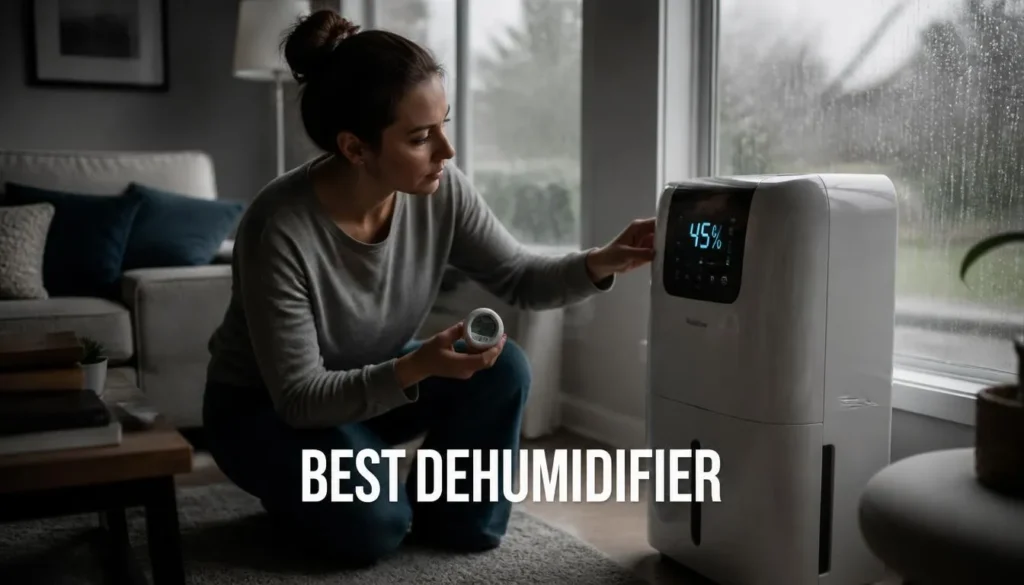

The best dehumidifier is the one sized to your damp space by its pints-per-day rating, with a matching drain option. The EPA advises keeping indoor humidity between 30 and 50 percent to limit mold and dust mites, and a small unit never gets you there. Check the rating on the current DOE test, since older ratings read higher.

Below you will find 6 models sorted by type, rated capacity on the current test and drainage. If you want the best dehumidifier for home use, start with the Top 3 and then check the drain option that fits your basement. We kept the list to named brands only, and where a listing shows a bigger number than the registry does, we tell you which one to trust.
My Recommended Top 3 Best-Buys for Dehumidifiers: Reviewed and Rated
- The rotary compressor: the maker says this compact design saves internal space and keeps the unit quiet.
- The included drain hose: a drain hose and a garden hose adapter ship with the unit for continuous draining.
- Humidity control: auto, constant humidity, continuous, smart drying and sleep modes, plus a timer and child lock.
- Onboard control: a built-in timer and control panel.
- Quiet operation: the listing states 47 dBA.
- Simple drainage: empty the tank or connect a standard hose to the built-in socket; the unit stops when the tank is full.
- The set-and-forget sensing: the unit starts on its own when humidity rises above your target.
- The tankless design: place a hose or set the unit over a floor drain for continuous draining.
- The duct-ready build: duct collars and a backdraft damper come in the box, and the unit can also stand free.
Best Dehumidifier Reviews 2026: 6 Top Models for Damp Rooms and Whole Homes
We picked six models that cover a small closet, a bedroom, a damp basement and a whole house. Capacity figures below follow the 2019 DOE test where the registry gives one, and every other number is the maker's or the listing's own claim, flagged as such.
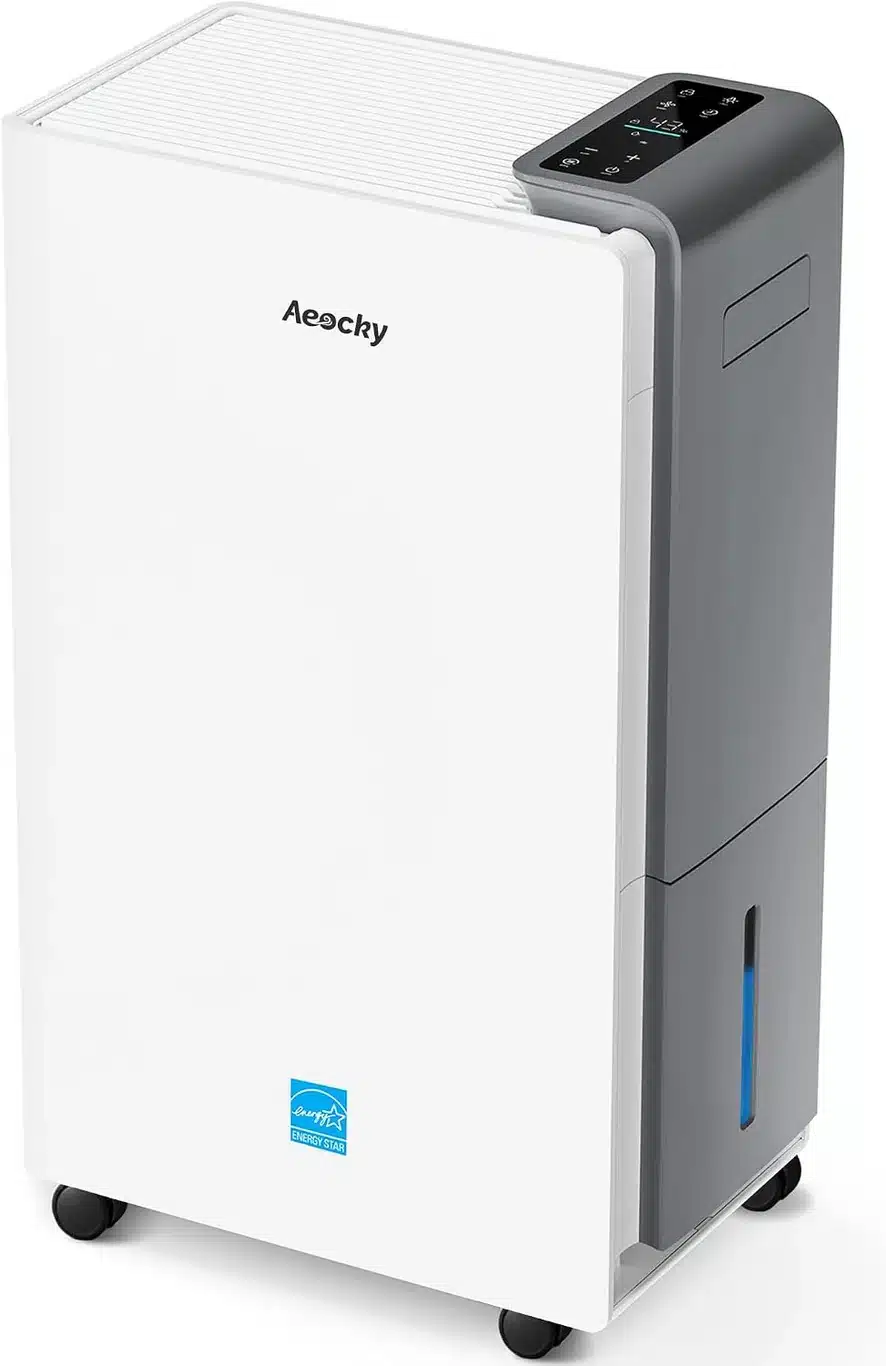
1. AEOCKY 5500 Sq.Ft Energy Star Dehumidifier
The AEOCKY 5500 Sq.Ft Energy Star Dehumidifier takes our top slot because it pairs a rotary compressor with a drain hose in the box. The ENERGY STAR list gives it 24.5 pints per day on the current DOE test, while its maker rates it up to 80 pints per day at 95F and 95% RH.
AEOCKY 5500 Sq.Ft Energy Star Dehumidifier Specs
| Type | Compressor (rotary compressor) |
| Rated Capacity (pints per day) | 24.5 on the ENERGY STAR list (current DOE test); up to 80 at 95F and 95% RH (maker) |
| Test Standard | 2019 DOE test (65F, 60% RH) on the ENERGY STAR list; maker figures use hotter, wetter conditions |
| Coverage | 5,500 square feet (title claim) |
| Tank Capacity | 1.45 gallons |
| Drainage | Tank, or continuous drain with the included hose |
| Noise Level | 44 dB at the lowest speed (maker claim) |
| Energy Star Status | ENERGY STAR certified and Most Efficient; RHEA-001 is listed under RHEA-RCS25(Y)-N4-3-25 |
Key Features
- The rotary compressor: the maker says this compact design saves internal space and keeps the unit quiet.
- The included drain hose: a drain hose and a garden hose adapter ship with the unit for continuous draining.
- Humidity control: auto, constant humidity, continuous, smart drying and sleep modes, plus a timer and child lock.
- Power-off memory: the unit resumes its settings after a power cut and works with a smart socket.
- Maker warranty: the listing names 3-year coverage and ETL and RoHS compliance.
That 80-pint figure is a maker number at hot, wet conditions, so we do not compare it with the 2019 DOE test, which rates portable units at 65F and 60% RH. What stood out is the registry check: the ENERGY STAR list carries RHEA-001 under RHEA-RCS25(Y)-N4-3-25, marked Most Efficient, at 24.5 pints per day.
Size from the certified 24.5 pints per day, because the maker's 56 pints at 86F and 80% RH uses warmer, more humid conditions. Coverage is listed at 5,500 square feet, but that is a title claim, and other retailer copy for this unit says 4,500.
The listing includes a drain hose and a garden hose adapter, so draining to a floor drain works from day one.
Why We Chose This
It combines a **rotary compressor, an included drain hose and 3-year maker coverage**, plus a certified efficiency listing; size it using its certified capacity.
Treat the 80-pint figure as a maker rating, and size from the certified 24.5 pints.
Cold rooms are where compressor units struggle. The maker says defrost sensors keep it running below 65F, which is a maker claim we could not test; in our experience a basement that stays cold in winter is where a frosting coil shows up first, so check your real room temperature before you buy.
Pros
- ENERGY STAR Most Efficient listing
- Drain hose included for continuous draining
- Five operating modes with sleep and smart drying
- 5,500 square foot coverage claim (title)
- Remembers its settings after a power cut
- 3-year coverage named by the maker
- Lowest-speed noise listed at 44 dB
Cons
- 80-pint rating uses extreme conditions
- Certified capacity is 24.5 pints per day
On noise, the maker lists 44 dB at the lowest speed, which we treat as a claim and not a measurement. The power-off memory and smart-socket support are handy for a unit that runs unattended all season.
Final Verdict
Choose it for its included drain hose and certified efficiency, and size the space using its registered daily capacity rather than the hot-condition maximum. It is the efficient hose-draining default for a damp lower level.
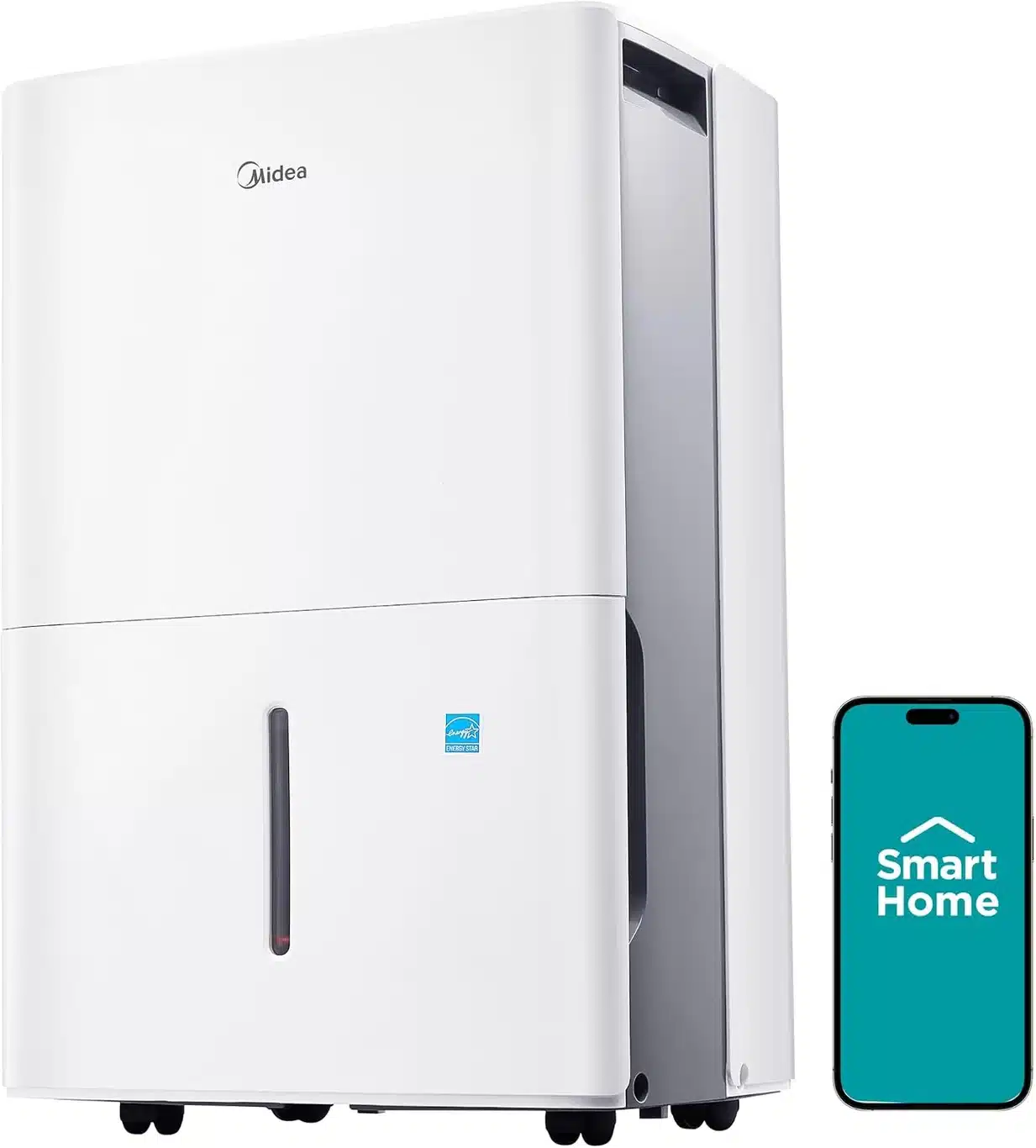
2. Midea 22 Pint Dehumidifier
Following the top pick, the Midea 22 Pint Dehumidifier is our budget choice because it is the lowest entry point among the named compressor models in this group. The ENERGY STAR list carries its exact model, MAD22C1AWS, at 22.31 pints per day on the current DOE test.
Midea 22 Pint Dehumidifier Specs
| Type | Compressor |
| Rated Capacity (pints per day) | 22.31 for MAD22C1AWS on the ENERGY STAR list |
| Test Standard | 2019 DOE test (65F, 60% RH) on the ENERGY STAR list |
| Coverage | 1,500 square feet (listing) |
| Tank Capacity | 0.8 gallons |
| Drainage | Tank, or hose to the built-in socket (hose not included) |
| Noise Level | 47 dBA (listing) |
| Energy Star Status | Certified; exact model MAD22C1AWS is listed |
Key Features
- Onboard control: use the built-in timer and control panel; Midea lists no Smart Control for MAD22C1AWS.
- Quiet operation: the listing states 47 dBA.
- Simple drainage: empty the tank or connect a standard hose to the built-in socket; the unit stops when the tank is full.
- Auto defrost and auto restart: the unit guards against frozen water and resumes your settings after a power cut.
- The turbo mode and timer: turbo for maximum moisture removal and a programmable timer for scheduled runs.
At 22 pints this unit suits a damp room of about 1,500 square feet (listing claim), not a flooded space. It has a hose socket but no pump, so if you need a dehumidifier with a pump for a basement, plan on a separate condensate pump; a downhill floor drain can instead allow gravity drainage.
What we noticed in the listing is how much it packs into a small body, with auto defrost, auto restart and a built-in timer. A full day at the rated 22 pints would fill the 0.8-gallon tank more than three times, so we would run a hose to a drain.
At 33.5 pounds with rotating wheels, it moves from room to room easily.
Why We Chose This
It is the lowest entry point among the named compressor units, yet it still brings **ENERGY STAR certification, a built-in timer and a hose socket** for continuous draining.
The exact model, MAD22C1AWS, is listed in the ENERGY STAR registry.
If you want the best dehumidifier for bedroom use on a budget, the 47 dBA rating from the maker is the draw. In our experience a two-speed unit like this is easy to live with, since you only choose between quiet and fast.
Pros
- ENERGY STAR certified, exact model listed
- Built-in timer
- 47 dBA noise rating
- Wheels and carrying handles
- Auto defrost and auto restart
- Reusable air filter included
- Hose socket for continuous draining
Cons
- Small 0.8-gallon tank
- Hose not included
Where it falls short is raw capacity: 22 pints on the current test is modest, and a very wet room will outrun it. As an apartment dehumidifier for one or two rooms it is a sensible fit, but a big basement needs the larger units below.
Final Verdict
Choose it for a damp bedroom, a small basement or an apartment when you want a named brand at the lowest entry point here, and recheck the ENERGY STAR product finder for your exact model in case something changed in the meantime. It is the sensible budget starter.
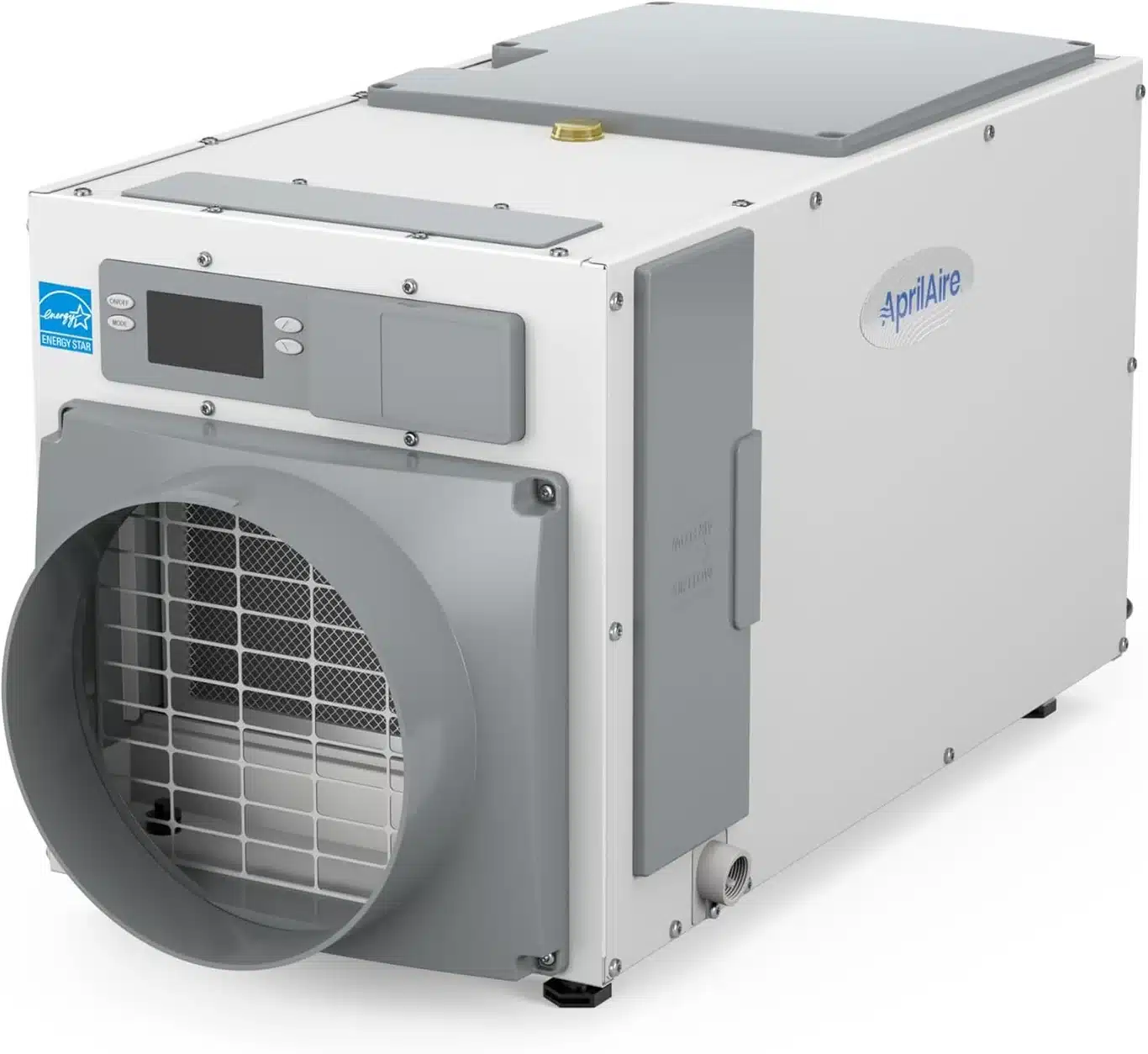
3. AprilAire E080 Whole-House Dehumidifier
Stepping up, the AprilAire E080 Whole-House Dehumidifier is our premium tier pick and the one unit here built to be ducted into a home. In the whole house dehumidifier class it sits on the ENERGY STAR list at about 65 pints per day on the current DOE test.
AprilAire E080 Whole-House Dehumidifier Specs
| Type | Whole-home compressor (ducted or free-standing) |
| Rated Capacity (pints per day) | About 65 on the 2019 DOE test (80 on the older 80F test) |
| Test Standard | Whole-home DOE test at 73F, 60% RH for 65 pints; 80F, 60% RH for 80 pints |
| Coverage | Up to 4,400 square feet (listing) |
| Tank Capacity | None |
| Drainage | Continuous drain by hose or to a floor drain |
| Noise Level | Not listed |
| Energy Star Status | Certified; efficiency 2.35 liters per kilowatt-hour |
Key Features
- The set-and-forget sensing: the unit starts on its own when humidity rises above your target.
- The tankless design: place a hose or set the unit over a floor drain for continuous draining.
- The duct-ready build: duct collars and a backdraft damper come in the box, and the unit can also stand free.
- The washable MERV 8 filter: a washable filter ships with the unit.
- Corrosion-resistant coils: the maker says the aluminum coils resist corrosion and the unit is made in the U.S.A.
Do not read that as an 80-pint machine. The 80 on the listing comes from the older 80F test, which uses easier conditions than the 2019 test, so we size from the 65-pint figure and mention 80 only for comparison with older ratings.
Efficiency is the second reason to buy: the ENERGY STAR list shows 2.35 liters per kilowatt-hour for this model. The maker also calls it Most Efficient 2022, a badge we did not check separately.
There is no tank to empty: it drains by hose or sits over a floor drain.
Why We Chose This
It is the only **ducted-capable, tankless unit** in the group, built for a basement, crawlspace or whole home up to 4,400 square feet (listing).
The 4,400 square foot figure is a listing claim, so size by dampness as well.
This is the unit we would specify for a basement or crawlspace that stays damp all year, with a washable MERV 8 filter and a 104F upper limit that tolerates warm mechanical spaces. The listing gives no dB figure, so plan to place it in a utility space and not a bedroom.
Pros
- About 65 pints per day on the current test
- On the ENERGY STAR certified list
- No tank to empty
- Duct-ready or free-standing
- Washable MERV 8 filter
- Covers up to 4,400 square feet (listing)
- 104F upper operating limit
Cons
- Heavy at 63 pounds
- No noise rating listed
The trade-off is cost and weight. At 63 pounds and 612 watts it asks more of a space and a circuit than the portable units, and it sits in the premium tier of this list. In our experience a ducted install is worth sketching on paper before you buy.
Final Verdict
Choose it when one unit has to protect a whole basement or crawlspace and you want continuous draining with no tank, and you can accept the premium tier. It is the whole-home option for a permanent install.
4. hOmeLabs 50 Pint Dehumidifier
Next, the hOmeLabs 50 Pint Dehumidifier has the largest owner base in this group. It offers Wi-Fi control, a hose outlet and a 1.6-gallon tank in a 40-pound frame.

hOmeLabs 50 Pint Dehumidifier Specs
| Type | Compressor |
| Rated Capacity (pints per day) | 50 (listing; test conditions not stated, current DOE capacity unverified) |
| Test Standard | Not stated; title also shows a 95F, 90% RH maximum of 120 |
| Coverage | 7,000 square feet (title claim) |
| Tank Capacity | 1.6 gallons |
| Drainage | Removable tank, or hose outlet (hose not included) |
| Noise Level | Not listed |
| Energy Star Status | No ENERGY STAR listing found for this exact model |
Key Features
- The Wi-Fi control: adjust your settings and check the unit from your phone.
- The 1.6-gallon removable tank: the unit shuts off by itself when the tank is full.
- The hose outlet: connect a hose for continuous drainage; the hose is not included.
- Turbo mode: raises the fan speed for faster moisture removal.
- Auto defrost and auto restart: the unit protects itself in cool rooms and resumes after a power cut.
The title carries a MAX 120 Pint at 95F, 90% RH figure, and we ignore it: that is an extreme-condition maximum and not everyday performance. The listing rates it at 50 pints per day without naming the test, so its capacity on the current portable DOE test is unverified.
We could not find an ENERGY STAR listing for this exact model, HME031003N, and the list names only two other hOmeLabs models. That is not a fault, but it leaves no independent efficiency figure to hold up against the Midea 50 Pint below.
As a portable dehumidifier it rolls on wheels with a handle, and it is not a fixed install.
Why We Chose This
It has the broadest owner base here and pairs **Wi-Fi control with a removable 1.6-gallon tank** and a hose outlet in the 50-pint class.
Wi-Fi lets you change the humidity setting from your phone.
The listing is inconsistent on airflow: 165 cfm in the spec table and 188 to 218 cfm in the feature text. In our experience more airflow helps a unit pull moisture from a big open room, but it also adds fan noise, and no noise figure is listed to judge that.
Pros
- Wi-Fi control from your phone
- Large owner base
- Removable 1.6-gallon tank
- Hose outlet for continuous draining
- Auto defrost and auto restart
- Washable filter and timer
- Wheels and handles
Cons
- Title mixes a 50 and a 120 pint figure
- No ENERGY STAR listing found for this model
The practical details are strong: auto defrost, auto restart and a continuous drain outlet are all listed, along with a washable filter and a timer. Budget for a hose if the unit will sit in a basement, since none is supplied.
Final Verdict
Choose it when you want a familiar name, Wi-Fi control and a 50-pint class unit and you accept that its efficiency status is unconfirmed, and recheck the ENERGY STAR product finder in case something changed in the meantime. It is the familiar mid-size workhorse.
5. Midea 50 Pint Dehumidifier
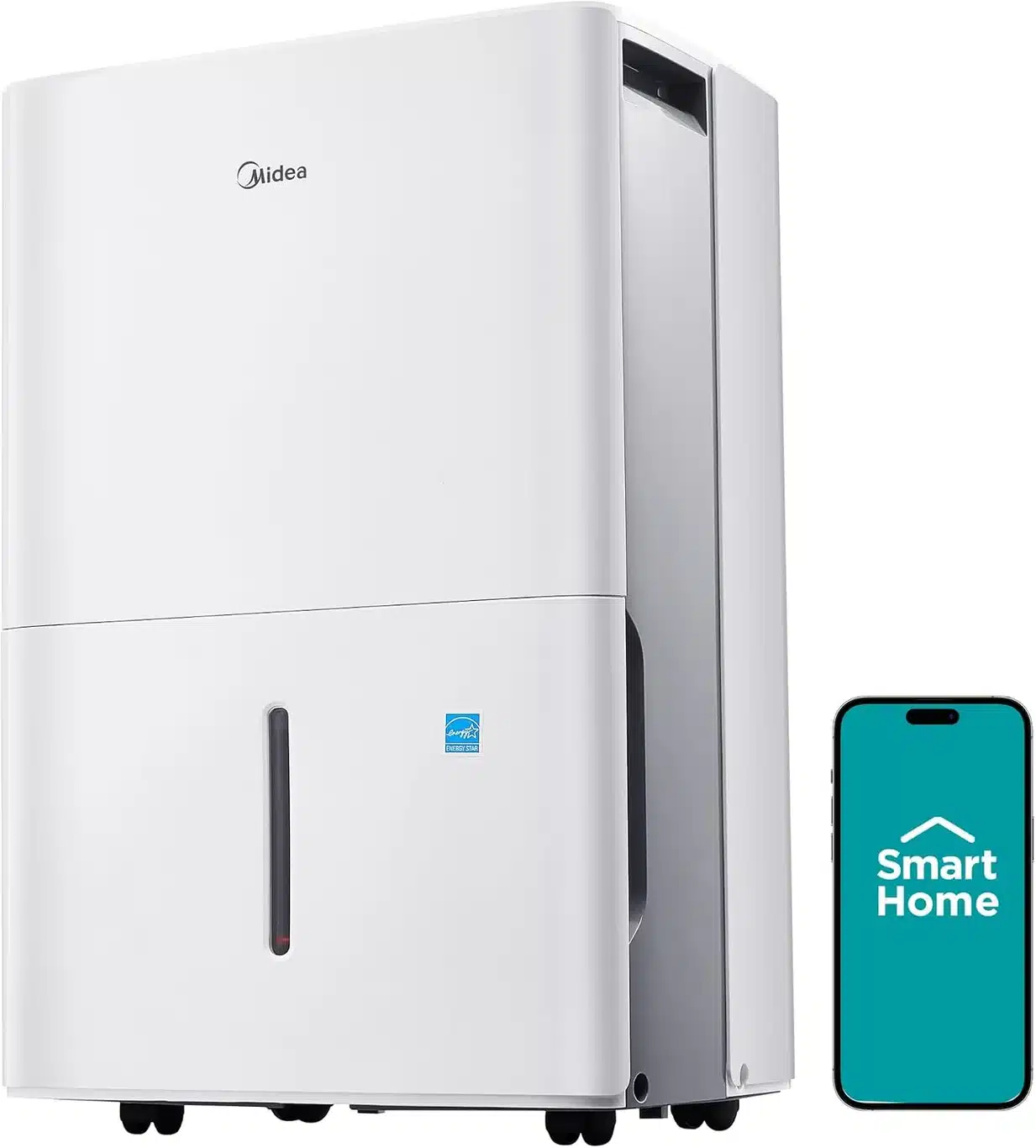
After that, the Midea 50 Pint Dehumidifier is our basement pick. The exact model, MAD50C1AWS-A, is listed at 49.74 pints per day on the current DOE test, which makes this the best basement dehumidifier in the group for one large damp room.
Midea 50 Pint Dehumidifier Specs
| Type | Compressor |
| Rated Capacity (pints per day) | 49.74 for MAD50C1AWS-A on the ENERGY STAR list |
| Test Standard | 2019 DOE test (65F, 60% RH) on the ENERGY STAR list |
| Coverage | 4,500 square feet (title claim) |
| Tank Capacity | 1.6 gallons |
| Drainage | Tank, or continuous drain with the garden hose adapter |
| Noise Level | 49 dBA on low (listing) |
| Energy Star Status | Certified; exact model MAD50C1AWS-A is listed |
Key Features
- Quiet operation: the listing states 49 dBA in low mode.
- Onboard control: use the built-in timer and digital control panel; Midea lists no Smart Control for the MAD50C1AWS.
- Simple drainage: empty the tank or attach a hose to the built-in socket; the unit stops when the tank is full.
- The easy-use design: rotating wheels, handles and a digital control panel make it simple to move.
- Three fan speeds: choose between quieter running and faster water removal.
Both Midea units share a family look, but this one is far more capable: 4,500 square feet is the title claim, and its 1.6-gallon tank holds twice what the 22-pint model's does. Treat the coverage as a best case, since a wet basement with high ceilings demands more.
What we noticed is how little separates this unit from the hOmeLabs 50 on paper: similar tank, similar airflow, a timer on both. The difference is exact-model ENERGY STAR verification at 49.74 pints, with an efficiency of 2.01 liters per kilowatt-hour, which gives you a figure to hold the listing against.
It runs at 49 dBA on low (listing) with three fan speeds.
Why We Chose This
It is the unit we would put in an ordinary basement: **about 50 pints on the current test, a 4,500 square foot claim and a continuous-drain tank adapter**.
The exact model, MAD50C1AWS-A, is listed in the ENERGY STAR registry.
Drainage is where it earns the basement slot: it stops itself when the 1.6-gallon tank is full, or you can attach a hose to the adapter and drain it continuously. If you want a basement dehumidifier with a drain-hose connection, this is our answer, though you must supply the hose.
Pros
- About 50 pints per day on the current test
- ENERGY STAR certified, exact model
- 1.6-gallon tank
- Continuous drain with hose adapter
- Built-in timer
- Three fan speeds
- Digital display and wheels
Cons
- Hose not included
- Upper operating limit of 90F
At 41.2 pounds it is easy enough to carry downstairs once, and after that it can stay put. Its upper temperature rating is 90F, lower than the AprilAire's 104F, so keep it out of a hot mechanical room.
Final Verdict
Choose it for an ordinary basement or a large damp room where you want a continuous drain and an efficiency figure to check, and recheck the ENERGY STAR product finder in case something changed in the meantime. It is the sensible basement default.
6. Tenergy Sorbi 1000ml Dehumidifier
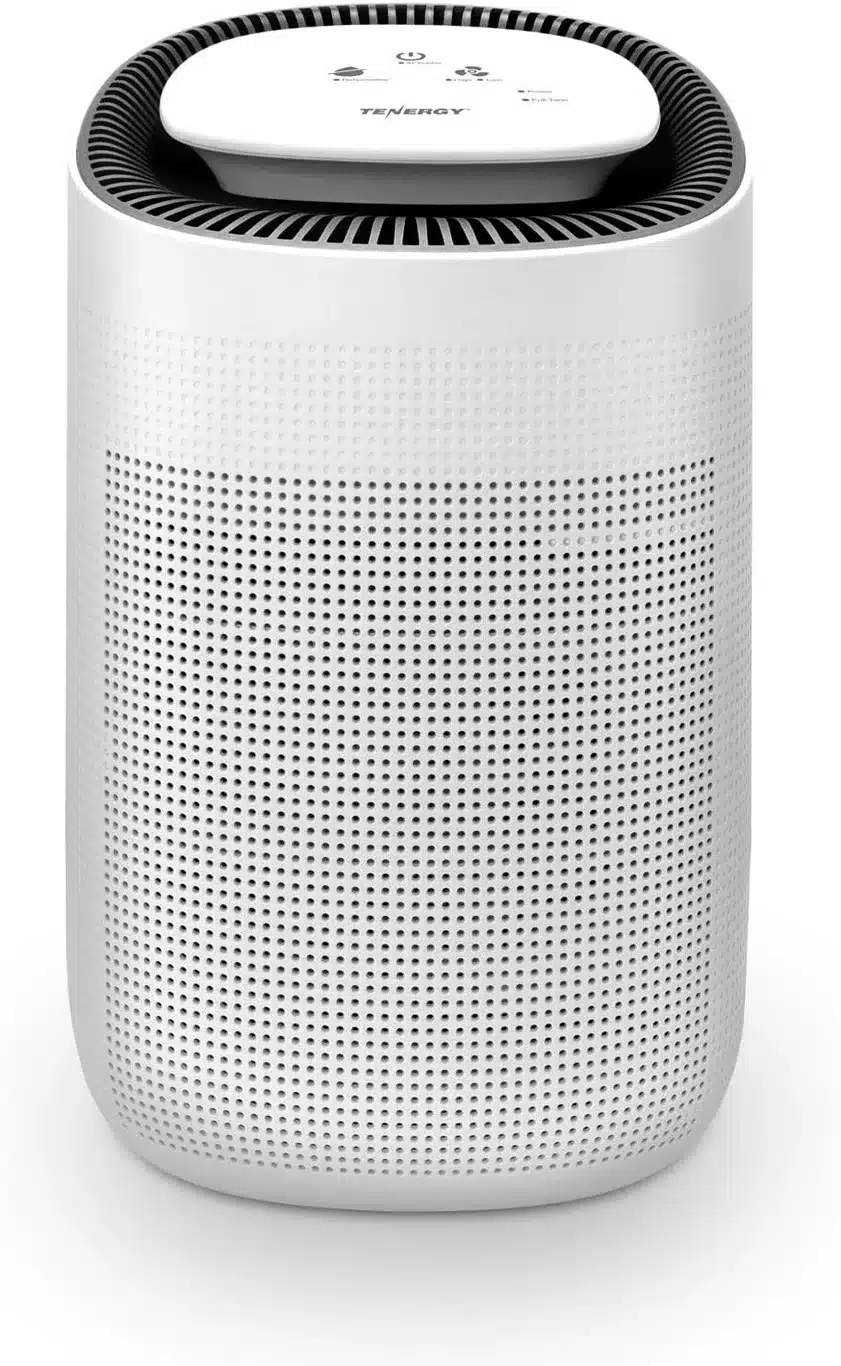
Last, the Tenergy Sorbi 1000ml Dehumidifier is a different tool: a small thermoelectric unit rated at about 750 ml per day at 80% RH and 86F. Mites thrive above 50 percent humidity, so it earns the slot as a dehumidifier for dust mites in a closet or small room, but it will not eliminate them.
Tenergy Sorbi 1000ml Dehumidifier Specs
| Type | Thermoelectric (Peltier) |
| Rated Capacity (pints per day) | About 1.6 (0.75 liters, or 750 ml, per day at 80% RH and 86F) |
| Test Standard | Maker conditions: 80% RH at 86F |
| Coverage | Up to 200 square feet (listing) |
| Tank Capacity | 1 liter, removable |
| Drainage | Removable tank with auto shutoff when full |
| Noise Level | 35 to 42 dB (maker claim) |
| Energy Star Status | Not an ENERGY STAR product type |
Key Features
- The thermoelectric design: Peltier technology with no compressor, so it is small and light.
- The True HEPA filter: the maker says it captures 99.97 percent of particles.
- Quiet running: the maker lists 35 to 42 dB.
- The 1-liter removable tank: the unit has a water-level sensor and shuts off when the tank is full.
- Light and portable: about 6 pounds with an LED indicator and touch controls.
In a space of up to 200 square feet (the maker claim, at 22 cfm and 45 watts) it is the best small room dehumidifier in this group, because a compressor unit would be overkill. The 1-liter tank will fill quickly in a damp room.
The maker lists 35 to 42 dB, quiet enough that we would expect it to fade into the background of a room. It also includes a True HEPA filter, and we could not find an independent listing for that claim, so treat 99.97 percent as a maker figure.
The tank holds 1 liter, and auto shutoff stops the unit when it is full.
Why We Chose This
It is the only **thermoelectric, 6-pound unit** in the group, with a True HEPA filter claim, for spaces where a compressor unit would be too large.
Use only Tenergy-branded Sorbi filters, per the maker.
We see the Sorbi as the best dehumidifier for small bedroom use only when the room is moderately damp and near the 200 square foot claim, because a truly wet room needs a compressor unit such as the Midea 22 Pint above. In our experience a light plug-in unit moves easily between rooms.
Pros
- Quiet at 35 to 42 dB (maker)
- Light at about 6 pounds
- True HEPA filter claim
- Draws only 45 watts
- Removable 1-liter tank with auto shutoff
- Suits closets and bathrooms
- Operates up to 122F
Cons
- Only about 750 ml per day
- Covers only about 200 square feet
The limits are plain: 0.75 liters per day is a small number, and the ETL and CARB claims are the maker's, which we did not verify. At 6 pounds and 45 watts it is light enough to carry to a camper as an rv dehumidifier for one closet, though not for a whole camper.
Final Verdict
Choose it for a closet, bathroom or small bedroom where you want quiet, low-wattage drying and a HEPA filter, and recheck the maker's certification details in case something changed in the meantime. It is the small-space specialist.
How to Choose the best dehumidifier
Choosing the best dehumidifier for home use comes down to matching rated capacity on the current DOE test, room size and drainage to the space you need to dry. Seven factors decide that match, and we walk through each one below in the order we weigh them when we evaluate a unit.
Rated capacity and the test behind it
Every pints-per-day figure depends on the test behind it. The current DOE test, in force since 2019, runs portable units at 65F and whole-home units at 73F, both at 60 percent relative humidity, while older ratings used 80F at the same humidity. In our experience the test behind a number matters more than the number itself.
The table below compares the three kinds of rating we meet most often, in qualitative terms.
This is why we treat some listings with care. The AprilAire E080 Whole-House Dehumidifier is registered at about 65 pints per day on the current test, yet its Amazon title says 80 pints, which reflects the older 80F basis. A 120-pint maximum in one hOmeLabs 50 Pint Dehumidifier title describes 95F conditions, not a typical basement.
| Rating basis | Conditions | How to read it |
| Current DOE test (since 2019) | 65F portable, 73F whole-home; 60% RH | The fairest basis for comparing units |
| Older test | 80F, 60% RH | Reads roughly 40 to 60 percent higher for the same machine |
| Maker extreme-condition figure | 95F, 90% to 95% RH | Not comparable, and never an everyday result |
Room size and coverage
Square footage on a listing is a claim, not a measurement. Coverage depends on how damp the space is and how high the ceiling sits, so a unit listed for 1,500 square feet in a dry room can struggle in a wet one. In our experience it pays to size up one step for a damp space.
How we match the picks to the space:
- Closet or bathroom: the Tenergy Sorbi 1000ml Dehumidifier, listed by its maker for about 200 square feet.
- Bedroom or small apartment: the Midea 22 Pint Dehumidifier, listed for 1,500 square feet.
- Large damp basement: the Midea 50 Pint Dehumidifier at a listed 4,500 square feet, or the hOmeLabs 50 Pint Dehumidifier at a claimed 7,000.
- Big open lower level: the AEOCKY 5500 Sq.Ft Energy Star Dehumidifier, whose 5,500 square foot title claim appears as 4,500 in other retailer copy.
- Whole-home coverage: the AprilAire E080 Whole-House Dehumidifier, listed for 4,400 square feet.
A whole house dehumidifier works differently from a single-room box. The AprilAire E080 Whole-House Dehumidifier can be ducted into the home or run free-standing, and it treats a wider area than a portable unit can.
Damp lower levels deserve the most care. Anyone choosing the best basement dehumidifier should look first at capacity on the 2019 test and then at drainage, because a unit that fills its tank every few hours is not doing its job. We weigh those two before any extra feature.
Compressor, desiccant or thermoelectric
Compressor models chill a coil and condense water from the air, which makes them the most efficient choice for warm, damp rooms. In our experience a portable dehumidifier is almost always a compressor box on wheels, so that is the default type for most homes. Five of our six picks use a compressor.
Desiccant units use a moisture-absorbing wheel instead of a cold coil, and they keep working in low temperatures. Thermoelectric units, also called Peltier units, use a small cooling plate, which makes them quiet but limited. Thermoelectric models suit only closets and small rooms.
What each type does best:
- Compressor: large or damp rooms in warm conditions.
- Desiccant: cold spaces where a compressor coil would frost.
- Thermoelectric: closets and small rooms, with very low noise and very small capacity.
Operating temperature range
Every dehumidifier has a temperature range where it works well, and many spec sheets list only the upper limit. Compressor coils can frost over below roughly 41F to 65F depending on the model, which cuts output sharply. In our experience this is the spec that buyers overlook most often.
Cold spaces need extra thought. A dehumidifier for garage use should be a desiccant model or a compressor unit with auto defrost, and even then output falls as the air gets colder. Check the upper limit too: the Midea 50 Pint Dehumidifier lists 90F, while the AprilAire E080 Whole-House Dehumidifier lists 104F.
Drainage and tank size
Tank size sets how often you empty the unit, and drainage decides whether you have to. Shoppers who search for "best dehumidifier for basement with drain hose" should pick a model with a built-in hose connection and confirm that the hose can run downhill to a drain. A continuous drain removes the chore entirely.
What the listings say about draining:
- AEOCKY 5500 Sq.Ft Energy Star Dehumidifier: a drain hose and a garden hose adapter come in the box.
- Midea 22 Pint Dehumidifier: a built-in hose socket, with the hose not included.
- AprilAire E080 Whole-House Dehumidifier: continuous draining, with a barbed drain fitting in the box.
- hOmeLabs 50 Pint Dehumidifier: a hose outlet for continuous draining, with the hose not included.
- Midea 50 Pint Dehumidifier: continuous draining through a garden hose adapter.
- Tenergy Sorbi 1000ml Dehumidifier: a removable 1 liter tank that you empty by hand.
Gravity cannot help when the unit sits below the drain. People who want the best dehumidifier for basement with pump drainage need a built-in condensate pump or an external one. None of the six listings mentions a built-in condensate pump, so plan for an external pump if the drain sits above the unit.
Noise and energy use
Noise is the spec people notice most after the first night. The listings give 44 dB at the lowest speed for the AEOCKY 5500 Sq.Ft Energy Star Dehumidifier, 47 dBA for the Midea 22 Pint Dehumidifier and 35 to 42 dB for the Tenergy Sorbi 1000ml Dehumidifier, all maker figures. In our experience the lowest-speed figure matters most for a room where you sleep.
Bedrooms raise the stakes. Anyone shopping for the best dehumidifier for small bedroom use should weigh noise as heavily as capacity, because a loud unit gets switched off. A quiet, modest-capacity unit usually beats a large one that disturbs sleep.
Energy use scales with wattage and run time, so we look past the listing to the registry efficiency figure. In liters per kilowatt hour, the registry gives 2.35 for the AprilAire E080 Whole-House Dehumidifier, 2.01 for the Midea 50 Pint Dehumidifier, 1.86 for the AEOCKY 5500 Sq.Ft Energy Star Dehumidifier and 1.70 for the Midea 22 Pint Dehumidifier.
ENERGY STAR status and independent verification
A badge on a listing is a claim until an independent registry confirms it. We checked the ENERGY STAR certified dehumidifier registry for every pick. It confirms the AprilAire E080 Whole-House Dehumidifier and both exact Midea models, MAD22C1AWS and MAD50C1AWS-A. It also identifies the AEOCKY RHEA-001 in the additional-model information for RHEA-RCS25(Y)-N4-3-25.
A best rated dehumidifier by owner score is not the same as a certified one. We could not find an ENERGY STAR listing for the hOmeLabs 50 Pint Dehumidifier model HME031003N, while the AEOCKY 5500 Sq.Ft Energy Star Dehumidifier is listed as Most Efficient under RHEA-RCS25(Y)-N4-3-25.
How to confirm a certification yourself:
- Find the exact model number on the product label.
- Search the ENERGY STAR certified dehumidifier finder for that model.
- Compare the registry pints per day with the figure on the listing.
- Treat a model you cannot find as UNVERIFIED until the maker shows proof.
Why Humidity Above 50 Percent Matters for Mold and Dust Mites
The EPA advises keeping indoor humidity between 30 and 50 percent. Above that range, mold and dust mites both gain ground, and the damp is hard to reverse once surfaces stay wet. In our experience the problem shows first in basements, closets and rooms with poor airflow.
Mold needs moisture, and that is where a dehumidifier earns its place. Shoppers hunting for the best dehumidifier for mold should know that the unit removes the damp that feeds mold but does not kill growth that already exists, so cleaning and fixing the leak still come first.
Signs that humidity is running too high:
- A musty smell in a closet, basement or bedroom.
- Condensation on windows and cold pipes.
- Damp, cool surfaces on walls and floors.
- Spotting on stored boxes, fabrics or leather.
A dehumidifier for dust mites works by keeping humidity near or below 50 percent, not by killing the mites, and we would not promise elimination. The Tenergy Sorbi 1000ml Dehumidifier is our pick for this job, but only in a closet or a small bedroom.
Keep expectations realistic. Humidity control lowers the conditions that favor mold and mites, but it is one step among several, alongside cleaning and ventilation.
Households with asthma often look at humidity as one lever. The best dehumidifier for asthma is one that holds humidity steady and is easy to keep clean, and it never replaces advice from a doctor.
How to Place and Run a Dehumidifier
Where you put a dehumidifier matters almost as much as which one you buy. Leave open space around the intake and the outlet so air can move freely, and keep doors closed so the unit works on one space at a time.
Running habits that help:
- Set the target humidity in the 30 to 50 percent range.
- Close windows and exterior doors while the unit runs.
- Empty the tank often, or connect a drain hose.
- Clean the filter on the schedule in the manual.
- Keep the unit inside its rated temperature range.
Small homes have their own limits. An apartment dehumidifier should be compact, quiet and easy to move, so a model with wheels and a built-in hose socket, like the Midea 22 Pint Dehumidifier, fits that job.
Recreational vehicles add tight space and shifting power. Anyone choosing an RV dehumidifier should look for auto restart after a power cut. The AEOCKY 5500 Sq.Ft Energy Star Dehumidifier lists a power-off memory function that its maker says suits RV use, though at 31 lb it is a large unit for a small camper.
Small rooms bring a different trade-off. The best small room dehumidifier is a compact unit sized to the space, not a basement machine running on low. The Tenergy Sorbi 1000ml Dehumidifier is the only pick here built for about 200 square feet.
A baby's room calls for extra caution. Parents looking for the best dehumidifier for nursery use should put quiet operation and a stable humidity setting first, and keep the unit and its cord out of the child's reach. Ask your child's doctor which humidity range suits a young baby.
At night the bedroom decides how a unit feels. The best dehumidifier for bedroom use is the quietest unit that still covers the room, and a low fan setting with a target in the 30 to 50 percent range keeps it unobtrusive.
My Overall Verdict
After sorting six dehumidifiers by type, rated capacity on the current test and drainage, we would point most readers to three. Each pick is a named brand with a stated drainage option, and each fits a different kind of home.
- AEOCKY 5500 Sq.Ft Energy Star Dehumidifier [Best Overall] - A rotary compressor unit with a drain hose in the box and 3-year coverage from its maker, with the caveat that its certified capacity is 24.5 pints per day, not the 80-pint maker figure.
- Midea 22 Pint Dehumidifier [Best Budget] - The lowest entry price among the named compressor models here, with ENERGY STAR certification, auto defrost and a built-in hose socket.
- AprilAire E080 Whole-House Dehumidifier [Best Whole-House] - A premium-tier unit, ducted or free-standing, registered at about 65 pints per day on the current DOE test and 80 pints on the older 80F test.
Our reasoning is simple. Size the unit to the damp space using the 2019 DOE rating, then pick the drainage you can live with. The other three, the hOmeLabs 50 Pint Dehumidifier, the Midea 50 Pint Dehumidifier and the Tenergy Sorbi 1000ml Dehumidifier, cover large basements and closets.
Treat any maker number you cannot confirm as a claim, not a result.
The best dehumidifier is the one sized to your damp space and drained the way your home allows.
Why AEOCKY 5500 Sq.Ft Energy Star Dehumidifier Might Be the Best Choice
The AEOCKY 5500 Sq.Ft Energy Star Dehumidifier earns our top slot because it combines a rotary compressor, a drain hose in the box and a lowest-speed noise level the maker puts at 44 dB. In our experience those three things decide whether a basement unit gets used or switched off.
The trade-off is capacity. The ENERGY STAR registry lists 24.5 pints per day on the current DOE test, while the maker rates it up to 80 pints per day at 95F and 95 percent humidity. Treat the 80-pint figure as a maker claim, not as a result on the 2019 DOE test.
What stands out about this unit:
- Rotary compressor: the maker describes a compact rotary design in a 31 lb unit.
- Drain hose included: a drain hose and a garden hose adapter come in the box for continuous draining.
- Humidity control: adjustable humidity control with auto, constant humidity, sleep and smart drying modes.
- Low-speed noise: the maker lists 44 dB at the lowest fan speed.
- 3-year coverage: the maker lists 3 years of coverage with the unit.
SHOP ON AMAZONAvailability and current price shown on Amazon
FAQs
What is the best dehumidifier for a basement?
The best dehumidifier for a basement is a compressor unit with a continuous drain hose, sized to the damp area by its pints-per-day rating on the 2019 DOE test. You should choose a higher capacity for a wet basement than for a dry one of the same floor area, because dampness drives the workload more than square footage.
What size dehumidifier do I need?
The size of dehumidifier you need is set by its pints-per-day rating on the 2019 DOE test at 65F and 60 percent humidity for portable units, scaled up for bigger or damper rooms. You should treat older ratings measured at 80F with caution, because they read about 50 percent higher for the same machine.
Can a dehumidifier prevent mold?
A dehumidifier can help prevent mold by holding indoor humidity between 30 and 50 percent, the range the EPA recommends for limiting mold growth. You should know that it does not remove mold that is already growing, so existing patches still need proper cleaning and the moisture source needs fixing first.
Do dehumidifiers work in a cold garage?
Compressor dehumidifiers work poorly in a cold garage, because their output drops and their coils can frost over below roughly 41F to 65F depending on the model. You should look at a desiccant unit for cold spaces, since desiccant designs cope much better with low temperatures than compressor models do in the same space.
Should I choose a compressor or a thermoelectric dehumidifier?
You should choose a compressor dehumidifier for large or damp rooms, and a thermoelectric one only for a closet or a small room. Thermoelectric units are quiet but have a very small daily capacity, which is why this page recommends compressor models for most homes and keeps the Tenergy Sorbi closet unit as the exception.
References:
- ENERGY STAR Certified Dehumidifiers product finder (U.S. EPA): https://www.energystar.gov/productfinder/product/certified-dehumidifiers
- U.S. EPA, A Brief Guide to Mold, Moisture and Your Home: https://www.epa.gov/mold/brief-guide-mold-moisture-and-your-home
- U.S. DOE, Dehumidifiers test procedure and conservation standards (10 CFR 430 Subpart B, Appendix X1): https://www.energy.gov/eere/buildings/dehumidifiers
- AHAM Verifide Dehumidifier Certification program: https://ahamverifide.org
Medical Disclaimer: This content is for informational purposes only. It is not a substitute for professional medical advice, diagnosis, or treatment. If you have concerns about your water quality or air quality and their effects on your health, consult a qualified healthcare professional.
Affiliate Disclosure: As an Amazon Associate, Puritisimo may earn a commission from qualifying purchases made through links on this page, at no additional cost to you. Our recommendations are independent and editorial.