
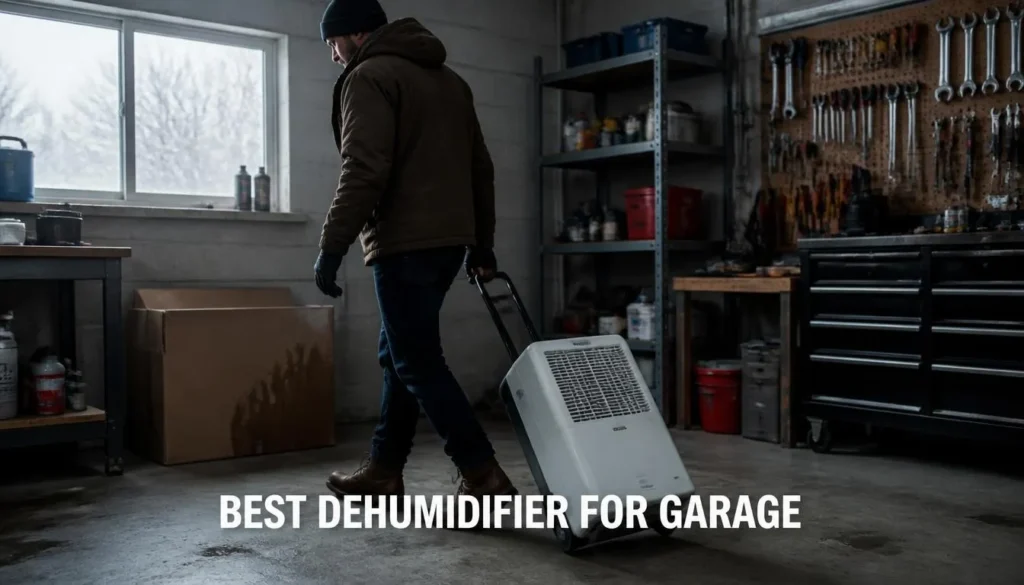

The best dehumidifier for garage use depends on how cold your garage gets, and on the rated pints under the 65F test, not the big number printed on the box. Concrete slabs wick moisture up all year, wet cars drip onto the floor, and stored cardboard and tools soak up the damp. You want a unit that keeps the air below 60 percent humidity without icing up on a cool day.

Below you will find 8 compressor units, sorted by role from our overall pick to the heavy-duty options. We weighed ENERGY STAR rated capacity first, then cold-weather defrost, drain setup and coverage. Our Top 3 picks come first, so you can jump straight to a short answer.
My Recommended Top 3 Best-Buys for Garage Dehumidifiers: Reviewed and Rated

- The WiFi control lets you adjust settings from the house through your home network.
- The 1.6-gallon removable tank shuts the unit off automatically when it is full.
- The hose outlet supports continuous drainage to a floor drain, with the hose sold separately.
- The LED touch panel adjusts humidity target, fan speed, timer and mode, with a live humidity readout.
- The two drain options are a 2-liter tank with a full-tank light or the included hose for continuous drainage.
- The recessed handle and swivel casters make it easy to roll between spots.

- The ENERGY STAR registry listing covers this exact model, certified in 2025.
- The two drain options are a 1.06-gallon tank with auto shutoff or a 3.3 ft hose for continuous drainage.
- The 24-hour timer and 2 fan speeds let you schedule runs and match the room.
Best Dehumidifier for Garage Reviews 2026: 8 Top Models for Cold, Damp Spaces
We ordered the 8 units by role, and wherever a unit has an ENERGY STAR registry entry we lead with its rated pints per day at 65F. Listing numbers such as 80 or 150 pints are usually maximums from hot, humid test points, so we treat them as claims. If you want the best garage dehumidifier for your space, start with the rated figure and then check drainage.
1. hOmeLabs 7,000 Sq Ft 50 Pint Dehumidifier
The hOmeLabs unit leads this list because it is the easiest to live with in a working garage. It combines WiFi app control, a hose outlet for continuous drain, auto defrost and a 322 W compressor in a 40 lb body with wheels and handles. We read its 50-pint label as a claim to check, not a promise.
hOmeLabs 7,000 Sq Ft 50 Pint Dehumidifier Specs
| Type | Portable compressor |
| Rated Capacity (ENERGY STAR, 2019 test) | Not listed |
| Listing Capacity | 50 pints (listing also claims a 120-pint maximum at 95F, 90% RH) |
| Coverage | 7,000 sq ft (listing claim) |
| Drain Options | 1.6-gallon tank or hose outlet for continuous drain (hose not included) |
| Auto Defrost | Yes |
| Weight | 40 lb |
Key Features
- The WiFi control lets you adjust settings from the house through your home network.
- The 1.6-gallon removable tank shuts the unit off automatically when it is full.
- The hose outlet supports continuous drainage to a floor drain, with the hose sold separately.
- Auto defrost and auto restart keep the unit running through frost cycles and power cuts.
- Turbo mode raises fan speed, with the listing citing airflow from 188 to 218 cfm.
Here is the catch we want to flag. The listing title also advertises a maximum of 120 pints at 95F and 90% relative humidity, which is a hot, humid lab point and not a cool garage. We could not find model HME031003N in the ENERGY STAR registry, and the 50-pint label follows the older, more generous test basis, so expect noticeably less water than either number suggests.
What won us over is the day-to-day setup. The tank stops the unit when full, and the hose outlet lets you run a line to a floor drain so the unit works unattended. The spec sheet lists auto restart, a timer and a touch control panel, and our team kept coming back to how easily this drain setup suits a garage.
The WiFi feature lets you check and change settings from the house instead of walking out to a cold garage.
Why We Chose This
It combines app control, hose drain and auto defrost in one portable 50-pint-class unit, as long as you treat the label as a starting point.
It has Normal and Turbo fan settings, and the washable filter is easy to reach.
At 40 lb it is one of the heavier units here, so we would park it on its wheels near the damp corner and leave it there. The removable tank and washable filter are simple to service. Where the unit falls short is proof: no ENERGY STAR rating means there is no independent pint figure to lean on.
Pros
- WiFi app control from the house
- Hose outlet for continuous drain
- Auto defrost for cool conditions
- Wheels and handles on a 40 lb body
- Washable filter and removable tank
- Auto restart after a power cut
- Timer and touch control panel
Cons
- Not found in the ENERGY STAR registry
- Pint labels follow an older, generous basis
Compressor units slow down and can frost in cold air, and the auto defrost cycle is what manages that. The listing gives an upper temperature rating of 95F and no lower operating limit, so in a very cold garage we would expect reduced output. If your garage stays above the mid-40s F for most of the year, this is a comfortable fit.
Final Verdict
The hOmeLabs unit wins on features, drain flexibility and app control, even though its pint labels need a grain of salt. Pair it with a floor drain and it will run unattended. It is the easy-living default recommendation.
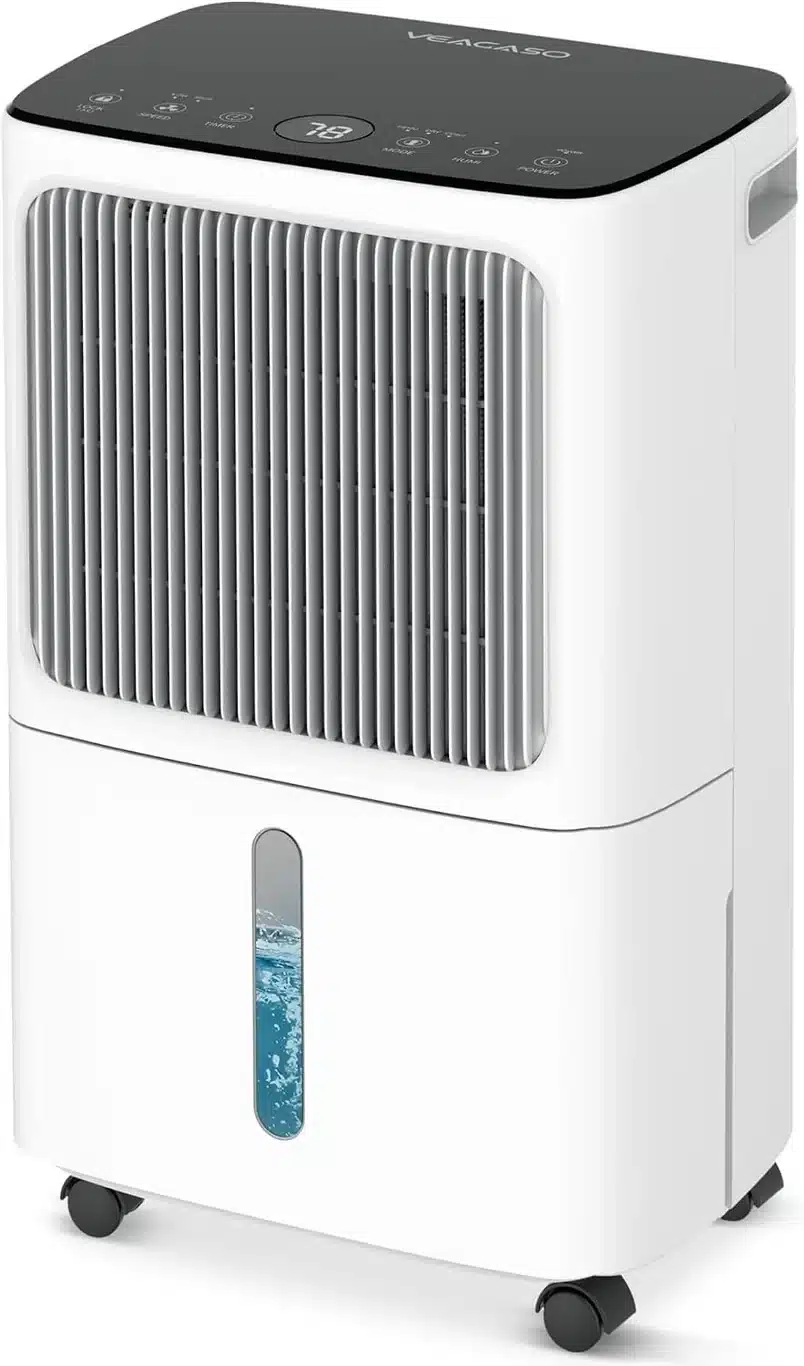
2. VEAGASO VG380 34 Pint Dehumidifier
Next, the VEAGASO VG380 is the budget pick: a 34-pint listing with a 230 W compressor and a claimed 2,500 sq ft of coverage. It suits a one-car garage or a damp storage corner better than a wide-open workshop. One point to state plainly: we did not find this model in the ENERGY STAR registry.
VEAGASO VG380 34 Pint Dehumidifier Specs
| Type | Portable compressor |
| Rated Capacity (ENERGY STAR, 2019 test) | Not listed |
| Listing Capacity | 34 pints (title says 34 to 36) |
| Coverage | 2,500 sq ft (listing claim) |
| Drain Options | 2-liter tank or included drain hose |
| Auto Defrost | Yes |
| Weight | Not stated |
Key Features
- The LED touch panel adjusts humidity target, fan speed, timer and mode, with a live humidity readout.
- The two drain options are a 2-liter tank with a full-tank light or the included hose for continuous drainage.
- The recessed handle and swivel casters make it easy to roll between spots.
- The low-speed noise level is listed at 40 dB or less, which is a listing claim.
- The power failure memory restores your last settings when power returns.
The listing title says 34 to 36 pints, while the spec table says 34 pints per day, and neither number comes with an independent rating. We would treat this as a small unit and size our expectations to a single garage bay, not a two-car shop. The 2,500 sq ft coverage is a claim we would not lean on.
The drain setup is flexible. The tank holds about 2 liters and the unit stops with an indicator light when full, and the included hose lets you run it straight to a floor drain or sink. A drain hose comes in the box, which some units on this list leave out.
The 2-liter tank fills quickly, so we would use the hose from the first day.
Why We Chose This
It is the budget-tier route to a compressor unit with auto defrost, a hose drain and a 2 year warranty, provided you accept that it is a small unit.
Controls include a 1 to 24 hour timer and power failure memory.
The maker lists noise at 40 dB or less on low speed, but we treat that as a listing claim. At 12.5 by 10 by 19 inches it is slim enough to tuck beside a shelf or a car bay. What we noticed is that the swivel casters and recessed handle make repositioning easy.
Pros
- Drain hose included for floor drain use
- Auto defrost listed
- 2 year warranty
- LED touch panel with timer
- Power failure memory restores settings
- Slim body with swivel casters
- Auto shutoff with full-tank light
Cons
- Not found in the ENERGY STAR registry
- Small 2-liter tank needs a hose
Our concern is runtime in cold air. The listing gives no lower operating temperature, and a small compressor unit will frost as the garage cools, so auto defrost matters here. The spec sheet lists it, along with a 2 year warranty, which gives the budget pick some backup.
Final Verdict
A sensible small unit for a one-bay garage or storage corner if budget matters more than certification. Pair it with a floor drain to avoid constant emptying. It is the budget pick for small, damp spaces.
3. Kesnos JD025N-80 Dehumidifier
Following the budget pick, the Kesnos JD025N-80 is the unit we would choose for routine garage use. It is certified in the ENERGY STAR registry at 24.93 pints per day, so that is the number to plan around. The 80-pint figure in the listing title is a maximum, not the rated output.
Kesnos JD025N-80 Dehumidifier Specs
| Type | Portable compressor |
| Rated Capacity (ENERGY STAR, 2019 test) | 24.93 pints/day |
| Listing Capacity | 80 pints |
| Coverage | 6,000 sq ft (listing claim) |
| Drain Options | 1.06-gallon tank or included 3.3 ft drain hose |
| Auto Defrost | Yes |
| Weight | 30.6 lb |
Key Features
- The ENERGY STAR registry listing covers this exact model, certified in 2025.
- The two drain options are a 1.06-gallon tank with auto shutoff or a 3.3 ft hose for continuous drainage.
- The 24-hour timer and 2 fan speeds let you schedule runs and match the room.
- The protection features include auto defrost, memory restart, safety lock and overload protection.
- The 360-degree casters and hidden handles make the unit easy to move, with cord storage built in.
The gap is large and we will say it plainly: 24.93 pints against 80 pints. The registry rates the model with an integrated energy factor of 1.70 under the 2019 test at 65F. That rated output is a sensible match for a one-car garage with a damp slab, and it is far more useful than the headline number.
Among the rated units here, we think this is the strongest contender for the title of best garage dehumidifier, because its certification is verified and its footprint is modest. It is certified in the registry and sized for everyday dampness rather than a flood. What surprised us was how little the large listing figure told us about that.
The 1.06-gallon tank shuts the unit off when full, so the 3.3 ft hose is worth attaching.
Why We Chose This
It carries a verified ENERGY STAR registry listing and a clear rated capacity, which is rare among the large-claim units on this list.
Auto defrost, memory restart and a safety lock are all on the spec sheet.
At 30.6 lb it is the lightest unit here with a stated weight, and the casters and hidden handles let one person move it between bays. The listing gives an upper temperature rating of 90F and no lower limit, so on cold mornings we would watch for frost and rely on auto defrost. Our team liked that the display turns off in Sleep mode.
Pros
- Verified in the ENERGY STAR registry
- Rated 24.93 pints per day, a clear planning figure
- Auto defrost and memory restart
- Light at 30.6 lb with casters
- Hose included for continuous drain
- Safety lock and tank-full alert
- Display turns off in sleep mode
Cons
- 80-pint listing far above the 24.93 rating
- Short 3.3 ft hose and small 1.06-gallon tank
The tank, filter and hose connection are all easy to reach, and the washable filter is a simple chore. What we noticed when comparing drain setups is that the 3.3 ft hose is short, so you will want to place the unit within a few feet of a drain or add a longer hose. The fitting takes a standard 3/4 inch garden hose, which is sold separately.
Final Verdict
A verified, sensibly rated unit for a typical one-car garage, as long as you plan around 24.93 pints and ignore the 80-pint headline. It is the sensible everyday choice.
4. AEOCKY RHEA-002 Compressor Dehumidifier
After that, the AEOCKY RHEA-002 has a large gap between its listing capacity and its registry rating. The listing says 105 pints, while the registry rates the model at 32.00 pints per day. Its slot here reflects the larger listing claim and 1.45-gallon tank, so buy it on the registry figure.

AEOCKY RHEA-002 Compressor Dehumidifier Specs
| Type | Compressor, slim tower |
| Rated Capacity (ENERGY STAR, 2019 test) | 32.00 pints/day |
| Listing Capacity | 105 pints |
| Coverage | 6,000 sq ft (listing claim) |
| Drain Options | 1.45-gallon tank or included drain hose with garden hose adapter |
| Auto Defrost | Yes (maker claims operation below 65F, unverified) |
| Weight | 34 lb |
Key Features
- The ENERGY STAR registry listing covers this model under the name RHEA-RCS32(Y)-N4-3, certified in December 2024.
- The auto defrost system is described by the maker as working below 65F, which is a maker claim we could not verify.
- The slim tower body is 8.66 inches wide and 24.09 inches tall, with a listed weight of 34 lb.
- The operating modes include auto, constant humidity, continuous, smart drying and sleep, with a 40% to 80% humidity range.
- The included drain hose and garden hose adapter are in the box, and the listing mentions 3-year coverage.
The registry lists this model as RHEA-RCS32(Y)-N4-3, with RHEA-002 as an alias, certified in December 2024 at 32.00 pints per day with an integrated energy factor of 2.09. The registry confirms standard ENERGY STAR certification for this model and nothing beyond that. The listing gives 105 pints and, separately, 100 liters per day, which is about 211 pints and cannot be reconciled with it, so we rely on the registry rating.
Where this unit stands out is its cold-room claim. The maker says it keeps defrosting and running below 65F instead of shutting off, and we flag that as a maker claim we could not verify. If it holds up, it matters in a garage. The listing also gives 44 dB on low speed, which we treat as a listing claim too.
A drain hose and garden hose adapter come in the box.
Why We Chose This
It pairs a verified registry listing with a hose and adapter in the box and a maker claim of cold-room defrost, with the 32 pint rating setting honest expectations.
Humidity is adjustable from 40% to 80%, with timer, sleep and constant-humidity modes.
At 34 lb and 24 inches tall, it is a slim tower rather than a squat box, so it fits beside a shelf or along a garage wall. Its 8.66 inch width helps in a tight bay. At 400 W it draws more than the Kesnos JD025N-80, and the listing adds a child lock and power-off memory.
Pros
- Registry-listed at 32.00 pints per day
- Slim tower, only 8.66 inches wide
- Drain hose and garden hose adapter included
- Maker claims defrost below 65F (unverified)
- Humidity range of 40% to 80%
- Timer, sleep and constant-humidity modes
- Power-off memory restores operation
Cons
- Registry rating far below the 105-pint listing claim
- 400 W draw for a 32-pint rating
Our one flag (again): the listing leans on large numbers that the registry does not echo. We would ignore the 105 pint figure entirely and plan around 32 pints per day, treating the 6,000 sq ft coverage as optimistic. For a one-car garage that is still a reasonable unit.
Final Verdict
A capable mid-rated unit in a slim body, worth considering if the cold-room claim holds, but only on the strength of its 32-pint registry rating. It is a solid 32-pint unit with an oversold label.
5. Frigidaire FHDD5034Y1 50 Pint Dehumidifier
Stepping up, the Frigidaire FHDD5034Y1 is the premium-tier option and one of the most honest capacity numbers on the list. The registry rates it at 49.71 pints per day, which matches its 50-pint label. It also adds WiFi app control.

Frigidaire FHDD5034Y1 50 Pint Dehumidifier Specs
| Type | Compressor, WiFi-enabled |
| Rated Capacity (ENERGY STAR, 2019 test) | 49.71 pints/day |
| Listing Capacity | 50 pints |
| Coverage | 4,500 sq ft (model name) |
| Drain Options | 2.7-gallon tank or continuous draining |
| Auto Defrost | Not listed |
| Weight | 41 lb |
Key Features
- The ENERGY STAR registry listing covers this model, certified in August 2025.
- The WiFi control lets you manage the unit from the house through the app.
- The custom humidity control sets the humidity level you want the unit to hold.
- The 3 fan speeds and 235 cfm airflow give it more circulation than most units here.
- The washable filter is easy to clean and keeps dust from loading the coil.
That match is what we valued most. Several large listing figures in this group shrink on the registry's 65F test, and this one does not. The registry certifies the model with an integrated energy factor of 2.01, so the 50-pint label is a number you can plan around.
The 2.7-gallon tank is large, which means fewer trips to empty it, and continuous draining is listed for a hose setup. The 235 cfm airflow and three fan speeds give it more circulation than most units here. The spec sheet also lists programmable operation.
The WiFi app control lets you adjust the unit from the house.
Why We Chose This
Its 50-pint label matches its registry rating and it adds WiFi control, so it suits buyers who want few surprises.
The spec sheet we reviewed does not list auto defrost, which matters in a cold garage.
At 41 lb it is the heaviest unit here, so plan a permanent spot rather than daily moves, and leave open space around the cabinet. The 470 W draw is also one of the higher ones, behind only the 500 W Kesnos JD026N. What we noticed is that the size suits a clear wall space.
Pros
- Registry rating of 49.71 matches its label
- WiFi app control
- Large 2.7-gallon tank
- Continuous draining listed
- 235 cfm airflow with three fan speeds
- Programmable operation
- Washable filter
Cons
- No auto defrost listed in the specs
- Heavy at 41 lb
Frigidaire states operation down to 41F, but the spec sheet does not confirm a defrost cycle, so we would hold this one for an attached or heated garage. A detached garage that drops toward freezing is where we would hesitate. It also sits in the premium tier, so you pay for a trustworthy rating and the app.
Final Verdict
The most predictable unit here on capacity, with smart control as a bonus, but check the manual for cold-weather limits before buying. It is the dependable pick for a heated or attached garage.
6. Kesnos JD026N Dehumidifier
From there, the Kesnos JD026N is the heavy duty dehumidifier for garage spaces that are larger and damper, with a 500 W compressor, a 2.12-gallon tank and a 7,500 sq ft listing claim. The registry rates the JD026N-150 at 49.47 pints per day, not 150. The X2 suffix on the listing model is not separately listed in the registry.

Kesnos JD026N Dehumidifier Specs
| Type | Portable compressor |
| Rated Capacity (ENERGY STAR, 2019 test) | 49.47 pints/day |
| Listing Capacity | 150 pints |
| Coverage | 7,500 sq ft (listing claim) |
| Drain Options | 2.12-gallon tank or included 3.3 ft drain hose |
| Auto Defrost | Yes |
| Weight | 38.1 lb |
Key Features
- The ENERGY STAR registry listing covers the JD026N-150 model and rates it at 49.47 pints per day.
- The 2.12-gallon tank has auto shutoff, and a 3.3 ft hose is included for continuous drainage.
- The 24-hour timer and 2 fan speeds let you schedule runs, with 159 cfm of listed airflow.
- The protection features include auto defrost, memory restart, safety lock and overload protection.
- The casters and hidden handles make the 38.1 lb frame easy to roll, with cord storage built in.
Our one flag (again): that 150-pint figure is a maximum under hot, humid test conditions. On the 2019 test at 65F, the rating is about 50 pints per day, so this is a 50-pint dehumidifier in a big-label body. Treat the listing number as a ceiling, not an expectation.
The unit earns its heavy-duty label through hardware. It has a 2.12-gallon tank, 159 cfm of listed airflow and overload protection, plus memory restart and a safety lock. What we noticed is that the controls are the same simple set found on the smaller Kesnos, with a front humidity display and a Sleep mode.
The auto shutoff stops the unit when the tank is full.
Why We Chose This
It brings a verified registry listing and a 2.12-gallon tank to a larger garage, at about 50 pints per day under the 2019 test.
The listing gives only an upper limit of 90F, with no lower temperature stated.
At 500 W it draws the most power of the group for about 49.47 pints per day, which is nearly the same output as the 470 W Frigidaire FHDD5034Y1 at 49.71. The deciding factor is whether you want app control, which the Frigidaire offers, or a hose in the box and a lighter 38.1 lb frame, which this Kesnos offers.
Pros
- Registry-listed at 49.47 pints per day
- 2.12-gallon tank
- Hose included for continuous drain
- Auto defrost and memory restart
- Safety lock and overload protection
- 24-hour timer scheduling
- Casters and hidden handles
Cons
- 150-pint listing versus a rating near 50 pints
- 500 W draw, the highest in the set
The 7,500 sq ft figure is a claim, and a typical garage is far smaller, so the extra size buys you a bigger label and not a bigger room. For a three-car garage or a workshop with a wet slab this is a reasonable unit. For a lightly damp one-car garage the smaller Kesnos may be enough, though this larger model offers about twice the rated removal capacity and tank volume.
Final Verdict
A properly registered unit with a large tank and a hose in the box, best for bigger garages as long as you plan around 49.47 pints and not 150. It is a 50-pint unit in a heavy-duty body.
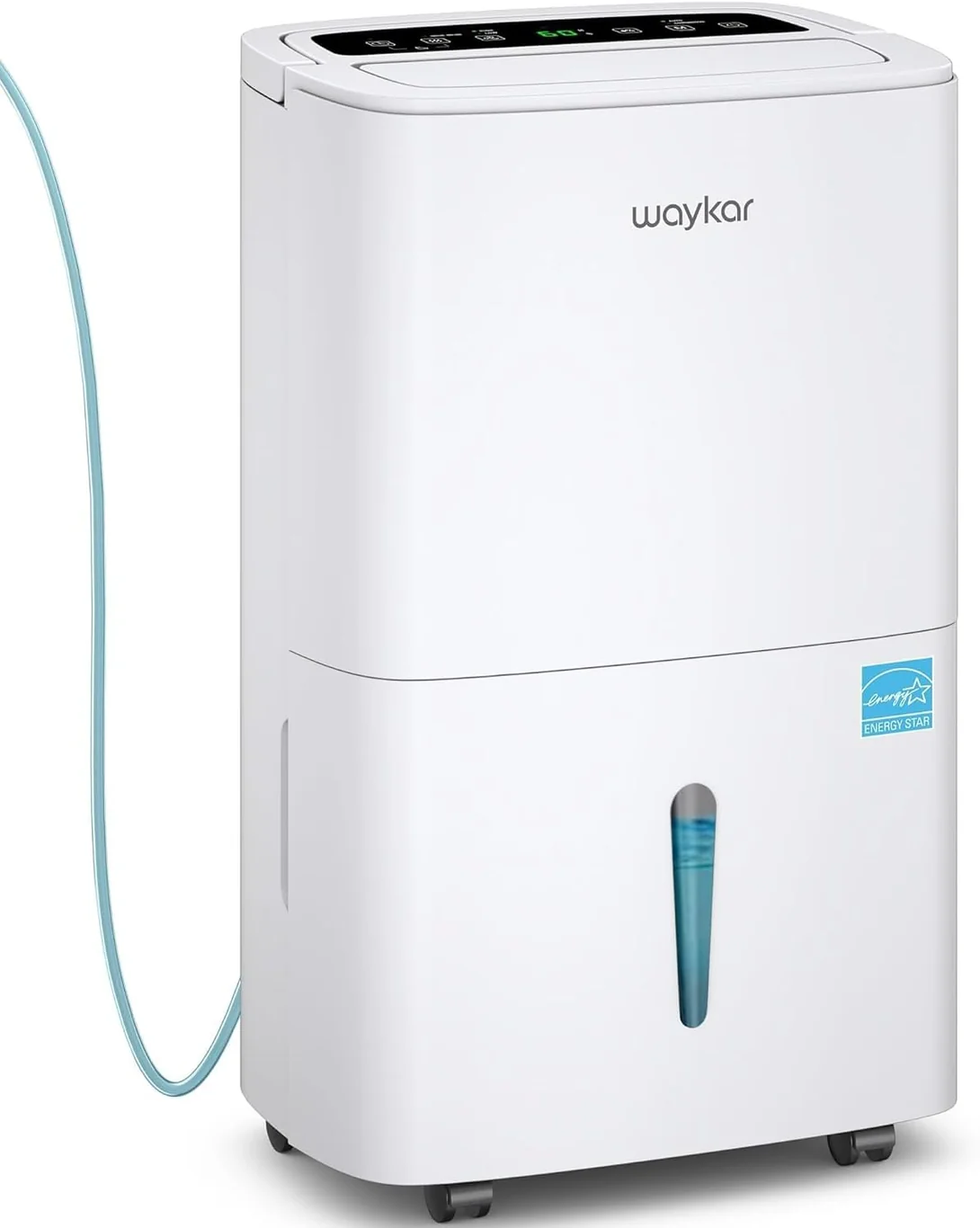
7. Waykar YDZ-150PM Dehumidifier
Moving on, the Waykar YDZ-150PM is the only unit in this group sold with a pump in its title, which makes it the closest thing here to a garage dehumidifier with pump. The Amazon feature bullets describe only a drain hose, but the maker's page confirms the pump.
Waykar YDZ-150PM Dehumidifier Specs
| Type | Rotary compressor, built-in pump |
| Rated Capacity (ENERGY STAR, 2019 test) | 50.00 pints/day |
| Listing Capacity | 150 pints (spec table lists 80 pints) |
| Coverage | 7,000 sq ft (listing claim) |
| Drain Options | Detachable tank or included 39.37 in hose (built-in pump) |
| Auto Defrost | Yes |
| Weight | 31.9 lb |
Key Features
- The ENERGY STAR registry listing covers this model and rates it at 50.00 pints per day.
- The drain setup offers a detachable tank or a 39.37 in hose included in the box.
- The control panel has a humidity display, timer and control lock.
- The safety features include auto restart, power failure memory and overload protection.
- The detachable washable filter is easy to remove and rinse.
Waykar's own product page confirms a built-in pump and states an upward drain of up to 9.84 ft, although a header on that page says 16.4 ft, so confirm the lift height with the maker before you plan a vertical or long drain run. The Amazon feature bullets describe only a drain hose.
Three capacity numbers appear: 150 pints in the title, 80 pints in the spec table and 50.00 pints per day in the ENERGY STAR registry. Use the registry value. The YDZ-150PM registry entry names several brands, including Kesnos, but that does not establish it is the same design as the Kesnos JD026N above.
The tank is listed at 3.5 gallons in the spec table and 1.85 gallons in the bullets.
Why We Chose This
It is the only unit with a pump in its title and a verified registry listing, which is useful if your drain sits above or far from the unit, once the lift is confirmed.
At 31.9 lb it has the second-lightest listed weight in the group.
Drain setup is where we would spend the most time. The listing includes a hose and a detachable tank, and its caution text says to tighten the switch at the water pipe when draining by tank to avoid leaks. The listing gives an upper temperature rating of 95F and claims auto defrost works at 41F.
Pros
- Registry-listed at 50.00 pints per day
- Built-in pump confirmed by the maker
- 39.37 in drain hose included
- Second-lightest at 31.9 lb
- Auto restart and power failure memory
- Control lock and humidity display
- Detachable tank and washable filter
Cons
- Capacity numbers conflict: 150, 80 and 50 pints
- Maker lift figures conflict: 9.84 ft and 16.4 ft
Our one flag: three conflicting capacity numbers and two tank figures make this the least consistent listing in the group. If the pump works as described it solves a real garage problem. If not, you have a hose-drain unit rated near 50 pints, much like the other 150-pint listing here.
Final Verdict
A registered unit with a promising drain feature, worth buying only after the pump and lift height are confirmed with the seller. It is the drain-flexibility pick, once the pump is confirmed.
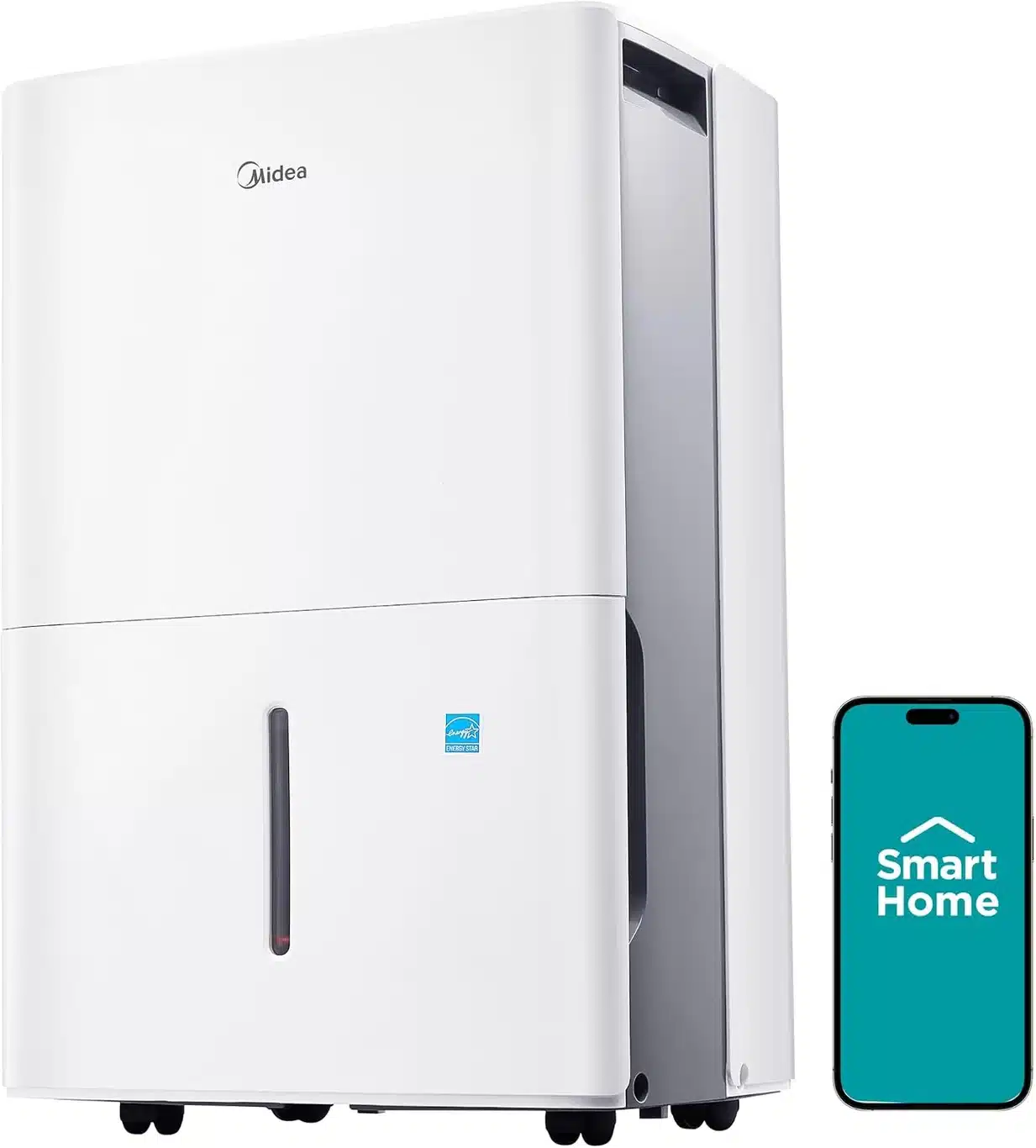
8. Midea MAD22C1AWS 22 Pint Dehumidifier
Finally, the Midea MAD22C1AWS is the smallest unit on the list, rated at 22.31 pints per day in the registry, which matches its 22-pint label. It suits a single-bay garage or a storage corner, not a two-car shop. The listing shows model MAD20C1ZWS in one field, but MAD22C1AWS is the registered number.
Midea MAD22C1AWS 22 Pint Dehumidifier Specs
| Type | Portable compressor |
| Rated Capacity (ENERGY STAR, 2019 test) | 22.31 pints/day |
| Listing Capacity | 22 pints |
| Coverage | 1,500 sq ft (listing claim) |
| Drain Options | 0.8-gallon tank or hose to built-in socket (hose not included) |
| Auto Defrost | Yes |
| Weight | 32.41 lb |
Key Features
- The ENERGY STAR registry listing covers this model, certified in October 2025.
- The maker's page for this exact model lists Smart Control: No, so expect manual controls only.
- The simple drainage is a 0.8-gallon tank that stops the unit when full, or a hose on the built-in socket.
- The auto defrost and auto restart keep the unit running after frost cycles and power cuts.
- The 360-degree wheels and handles let you move the unit between spots, with a listed 47 dBA noise level.
The registry certifies this model with an integrated energy factor of 1.70 and the 2019 test at 65F gives 22.31 pints per day. That is almost exactly the 22 pints on the label, which is what we like to see. It is the smallest rated unit here and the one that overpromises least.
The listing claims 47 dBA for noise. VEAGASO and AEOCKY also publish noise claims, but none of the source pages states comparable measurement conditions, so we treat all of them as claims.
The 0.8-gallon tank fills fast, so connect a hose to the built-in socket.
Why We Chose This
It is the smallest unit here, and its rating matches its label, so it is the one that least overpromises for a single-bay garage.
A hose is not included, so plan on buying a standard hose for continuous drain.
At the maker-listed 32.41 lb with wheels and handles, it can move between spots, and its 1,500 sq ft coverage claim is the most modest on the list, which we find the most believable. Our team kept coming back to how easily it fits beside a storage shelf. It also lists a washable reusable filter and a programmable timer.
Pros
- Registry-listed at 22.31 pints per day
- Rated figure matches the 22-pint label
- Simple manual controls
- Published 47 dBA noise level
- Auto defrost and auto restart
- Built-in hose socket
- 360-degree wheels and handles
Cons
- Small 0.8-gallon tank and 1,500 sq ft claim
- No pump and hose not included
The limits are plain: no pump, no included drain hose, an upper temperature rating of 96F and no stated lower limit. A two-car garage will outrun a 22-pint unit, and for a wide-open shop you should look at the larger models above. In the right small space it is dependable.
Final Verdict
A small, honestly rated unit that suits one bay or a storage corner, and it will struggle if you ask it to cover a whole two-car garage. It is the right-sized pick for a one-bay garage.
How to Choose the Best Dehumidifier for Garage
A garage is the hardest room in the house for a dehumidifier, because it is cold, open to the outdoors and often sits on a slab over damp soil. Judge a unit by its rated output at cool temperatures, not by the biggest number on the box. In our evaluation, six factors separated the units worth owning from the rest.
Rated capacity and the 65F test
Rated capacity is the pints per day the ENERGY STAR registry measures at 65F, and it is the figure we plan around. Listing numbers such as 80, 105 or 150 pints are maximums at hot, humid test points, so a unit listed at 150 pints can be rated near 50. Where no registry entry exists, as with the hOmeLabs and VEAGASO units, treat the label as a maker claim.
Low-temperature operation and auto defrost
Compressor dehumidifiers work by chilling a coil, and a coil in cold air ices over. Output drops and frost builds as the air cools toward the mid-40s F, so a garage in late autumn is a harder job than a basement in July.
Auto defrost pauses the compressor and lets the coil clear. That protects the unit, but it also means less water is removed during those cycles. We prioritized auto defrost because a unit that spends much of its runtime defrosting removes less water.
Frigidaire states operation down to 41F, and the Waykar listing claims auto defrost works at 41F, but neither figure is a tested result. AEOCKY says its RHEA-002 defrosts below 65F, and we treat that as an unverified claim from the maker. The Kesnos and Midea pages list only upper limits of 90F and 96F.
What to expect from a compressor unit in a cool garage:
- Cool and damp: expect slower removal and more frequent defrost pauses.
- Near freezing: a compressor unit may spend most of its time defrosting, so plan on little drying.
- The alternative: electric desiccant units keep working in the cold, but none of our eight picks is one.
Drain options and pump
Every unit here has a tank, and a tank on its own is the wrong plan for a garage, because you would empty it far more often than you would in a bedroom. A hose lets water run to a floor drain by gravity, which is the simplest setup when your slab has a drain.
A pump lifts the water instead, which matters when the nearest drain sits above the unit. If you want a garage dehumidifier with pump lift, the Waykar YDZ-150PM Dehumidifier is the unit in our set that lists one, and we advise confirming the lift height with the maker before you buy, because the maker's page gives two different figures, 9.84 ft and 16.4 ft.
The Amazon feature bullets for that unit describe only a drain hose, so confirm the pump setup with the maker. Check whether a hose is included, because the hOmeLabs and Midea pages say theirs is not.
Match the drain to your garage:
- Floor drain below the unit: a plain hose and gravity are enough.
- Drain above the unit: you need a pump, so confirm the lift height first.
- No drain at all: use the tank, and expect to empty it often in damp weather.
Garage size and coverage
Coverage numbers on the listings, such as 1,500 or 7,000 square feet, are claims that depend on the test behind them. Garages often have taller ceilings and leaky doors, so we size by dampness first and floor area second.
Use this rough guide, which is our rule of thumb and not a lab result:
Read against the table above, the Midea MAD22C1AWS 22 Pint Dehumidifier fits the first row, while the Frigidaire FHDD5034Y1 50 Pint Dehumidifier fits the last. Oversizing is safer than undersizing in a cold space, since a small unit that runs nonstop still leaves the slab damp.
| Garage | Typical situation | Rated capacity to look for |
| Single bay, lightly damp | Storage boxes, tools, an occasional wet car | About 22 to 25 pints per day |
| Two-car garage, damp | A concrete slab that sweats, wet vehicles parked often | About 32 to 50 pints per day |
| Workshop or very wet space | Open door, stored lumber, standing damp | About 50 pints per day, with a hose drain |
Noise and placement
Noise figures are the weakest numbers on any listing. The Midea listing claims 47 dBA, and the 44 dB and 40 dB figures on the AEOCKY and VEAGASO listings are claims too, with no comparable test conditions that we could check.
Placement matters more than a few decibels in a garage, where noise rarely bothers anyone. Leave clear space around the intake and exhaust, and keep the unit out of the car's door swing. In our experience a unit squeezed into a tight corner works harder than one with room to breathe.
Three placement checks before you plug in:
- Clearance: leave open space on every side that has a vent.
- Surface: stand the unit on level, dry ground, not in a puddle.
- Cord and hose path: keep both clear of the door swing and the walkway.
Controls and build
A garage unit should restart on its own after a power cut and shut off when the tank fills. Auto restart and tank-full shutoff are the two features we would not skip, and the hOmeLabs and Midea pages list both.
A humidistat lets you hold a target. The Environmental Protection Agency advises keeping indoor relative humidity below 60 percent, ideally between 30 and 50 percent, so set the humidistat below 60 percent. In our experience a control panel that is easy to read mattered more than app features.
WiFi control is listed on the hOmeLabs and Frigidaire units, and it helps if you want to check the unit from the house. Wheels and a handle matter on a 40 pound unit such as the hOmeLabs, because you will move it to sweep the floor or clear space.
Controls worth having:
- Humidistat: holds a target so the unit does not run endlessly.
- Auto restart: picks up your settings after a power cut.
- Tank-full shutoff: stops the unit before the tank overflows.
- Wheels and handle: make the unit easy to move around a cluttered garage.
How a garage dehumidifier behaves in winter
Cold weather changes the job. Below the mid-40s F, compressor units pull less water from the air and the coil starts to frost, which is why a rating taken at 65F overstates what you will see in January.
Treat any dehumidifier in garage winter conditions as a part-time tool. Run it during the warmest part of the day, when the coil clears more easily and the air holds more moisture to remove.
A simple cold-weather routine:
- Midday runs: let the unit work when the garage is at its warmest.
- Higher target: hold a target near 55 percent instead of chasing a low number.
- Continuous drain: a hose to the floor drain keeps the unit running while you are away.
After a cold snap, check the intake and coil for frost, and let a frosted unit thaw before you restart it. In our experience a unit that keeps icing over is telling you the space is too cold for a compressor design.
Why the electric desiccant and wall-mount options are rare
Two options come up often for cold spaces. None of our eight picks is an electric desiccant or wall-mounted unit, because every one is a compressor model with a tank and a hose drain.
A desiccant dehumidifier for garage use dries the air with a rotating wheel of absorbent material instead of a chilled coil, so it keeps working when the air is cold. The trade-off is that electric desiccant units draw more power and cost more, which keeps them a niche choice.
For most owners, a compressor unit with auto defrost and a hose to the floor drain is the practical answer. It costs less to run than a desiccant design and it is easy to find, and it handles the cool but not freezing days that make up most of the damp season.
Wall-mount designs are the other rarity. A wall mounted dehumidifier for garage use frees floor space, but most wall-mounted models are built for commercial spaces, and they need a fixed drain line and a wall that can carry the unit.
If your garage regularly drops below freezing, ask a local supplier about desiccant options before you buy.
My Overall Verdict
After weighing rated capacity, cold-weather behavior and drain setup, we would start with the three units below. Each one earns its place for a different reason, and the order follows how widely each suits a typical garage.
- hOmeLabs 7,000 Sq Ft 50 Pint Dehumidifier [Best Overall] - a WiFi unit with auto defrost and a hose outlet for continuous drainage
- VEAGASO VG380 34 Pint Dehumidifier [Best Budget] - a budget-tier 34 pint unit with auto defrost and a drain hose for smaller garages
- Kesnos JD025N-80 Dehumidifier [Best for Everyday Garage Use] - an Energy Star certified unit rated at 24.93 pints per day, with auto defrost
The hOmeLabs 7,000 Sq Ft 50 Pint Dehumidifier leads because it combines a hose outlet, auto defrost and WiFi, though we could not find it in the Energy Star registry. The Kesnos JD025N-80 Dehumidifier is the certified choice, rated at 24.93 pints per day.
The VEAGASO VG380 34 Pint Dehumidifier is also not Energy Star listed, so treat its pint figure as the maker's claim.
Shop by rated pints at 65F, and you will find the best dehumidifier for garage use.
Why hOmeLabs 7,000 Sq Ft 50 Pint Dehumidifier Might Be the Best Choice
The hOmeLabs 7,000 Sq Ft 50 Pint Dehumidifier earns our top spot because it pairs WiFi control with a continuous drain hose outlet, which suits a garage you do not visit every day. Auto defrost and a 1.6 gallon tank round out a practical setup.
The trade-off is capacity honesty. The 50 pint label rests on an older rating basis, and we found no Energy Star listing for this model, so expect less in a cool garage. The 120 pint figure in the title is a hot, humid lab maximum at 95F.
What stands out:
- WiFi control: adjust settings and check the unit from your phone, including from the house.
- A 50 pint label with a caveat: a listing claim on an older basis, so treat it as a guide and not a guarantee.
- Continuous drain outlet: a hose outlet lets water run to a floor drain, and the hose is not included.
- Auto defrost: the coil clears itself when frost builds in cool air.
- Turbo fan range: the page lists airflow from 188 to 218 cfm across the fan settings.
SHOP ON AMAZONAvailability and current price shown on Amazon
FAQs
What is the best dehumidifier for garage use?
The best dehumidifier for garage use is the one whose rated capacity fits your space, and for most garages that is the hOmeLabs 7,000 Sq Ft 50 Pint Dehumidifier. Smaller spaces point to the Midea MAD22C1AWS 22 Pint Dehumidifier, and smart control with a proven rating points to the Frigidaire FHDD5034Y1 50 Pint Dehumidifier instead.
What size dehumidifier do I need for a garage?
The size of dehumidifier you need for a garage depends on its floor area and how damp it is, so compare units by rated pints at 65F. Ignore the large maximum figures on listings, because they come from hot, humid test conditions that a cool garage almost never reaches in practice.
Will a dehumidifier work in a cold garage in winter?
A dehumidifier will work in a cold garage in winter, but compressor units lose output and can frost once the air drops toward the mid-40s F. Auto defrost helps the unit recover between frost cycles, and an electric desiccant unit is the cold-weather alternative if your garage stays that cold for weeks.
Do I need a dehumidifier with a pump for a garage?
You need a dehumidifier with a pump for a garage only when the nearest drain sits higher than the unit, because a hose alone relies on gravity. The Waykar YDZ-150PM Dehumidifier lists a pump, so please confirm the lift height with the maker before you place an order.
How long should I run a garage dehumidifier?
You should run a dehumidifier in your garage until the room holds steady below 60 percent relative humidity, which the Environmental Protection Agency advises, and it names 30 to 50 percent as ideal. For unattended running, connect a hose to a floor drain so a full tank never stops the unit while you are away.
References:
- U.S. Environmental Protection Agency, A Brief Guide to Mold, Moisture, and Your Home (below 60 percent indoor humidity, ideally 30 to 50 percent): https://www.epa.gov/mold/brief-guide-mold-moisture-and-your-home
- Energy Star, Dehumidifiers (key product criteria and certified product finder): https://www.energystar.gov/products/dehumidifiers
- Energy Star Product Finder, Certified Dehumidifiers: https://www.energystar.gov/productfinder/product/certified-dehumidifiers
- U.S. Environmental Protection Agency, Mold Cleanup in Your Home (control moisture first): https://www.epa.gov/mold/mold-cleanup-your-home
Medical Disclaimer: This content is for informational purposes only. It is not a substitute for professional medical advice, diagnosis, or treatment. If you have concerns about your water quality or air quality and their effects on your health, consult a qualified healthcare professional.
Affiliate Disclosure: As an Amazon Associate, Puritisimo may earn a commission from qualifying purchases made through links on this page, at no additional cost to you. Our recommendations are independent and editorial.