


This Aranet4 review comes down to one point: it is a good CO2 meter and only a CO2 meter. I recommend it for a bedroom or home office where stale air is the worry, and I would send anyone chasing smoke or dust elsewhere. Aranet states it uses a true NDIR sensor with a CO2 accuracy of 30 ppm plus 3 percent of reading.

I wrote this page for the buyer who is deciding if the Aranet4 deserves a place in a bedroom. I cover what the sensor measures, what it leaves out, what it costs to live with, which version you are buying, and where I would point you elsewhere.
Quick Verdict
Aranet states a CO2 accuracy of 30 ppm plus 3 percent of reading, gives a CO2 range of 0 to 9999 ppm, and lists a battery life of up to 4 years. It uses an NDIR sensor and measures nothing beyond CO2, temperature, humidity and pressure.
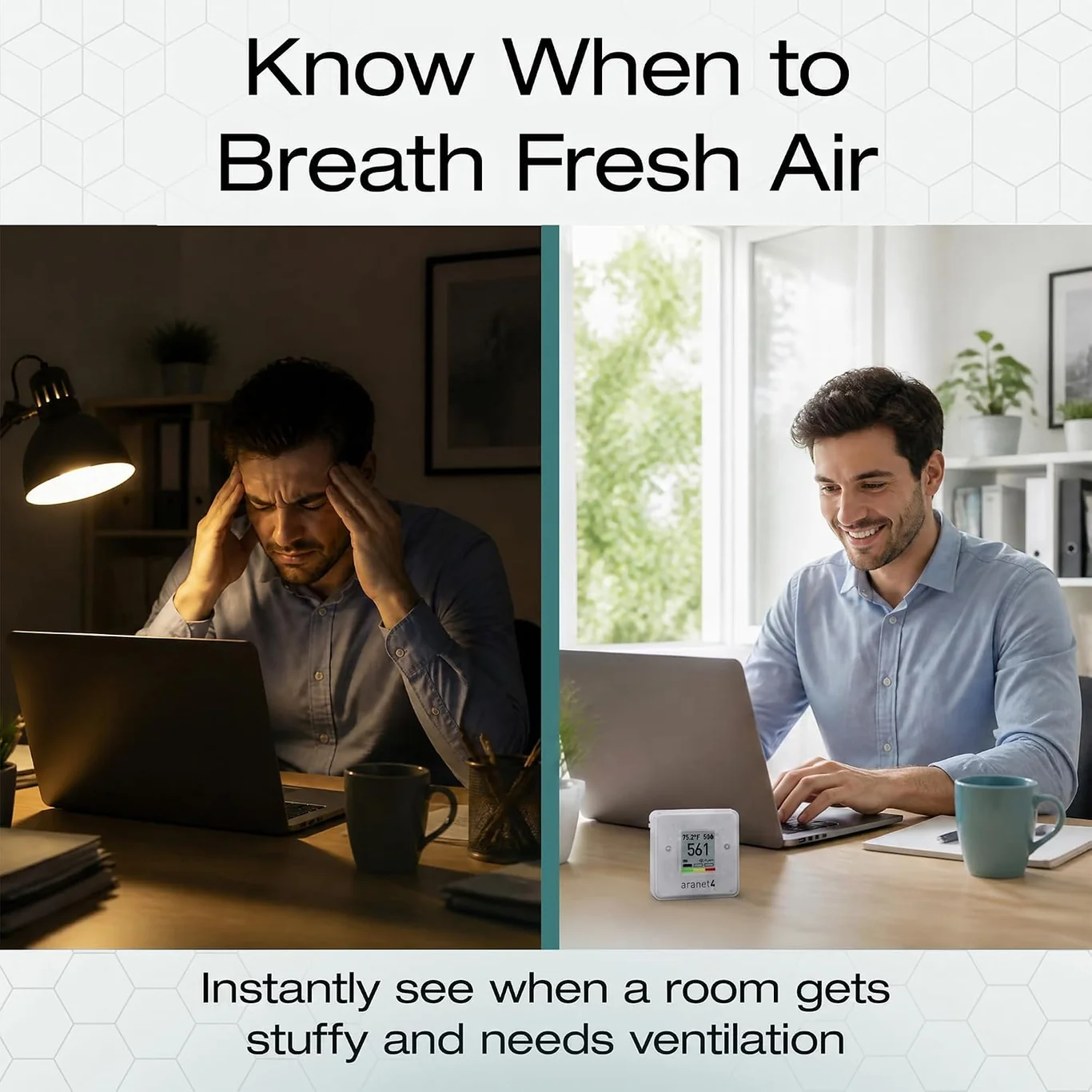
- You see when a bedroom or office needs fresh air, because the E-Ink display shows a prominent CO2 number with color coding, so you do not need to open an app.
- You get a trend record in the free app, so you can check if opening a window actually brought the number down.
- You know up front that it will not detect smoke particles, dust, VOCs or carbon monoxide, so you can buy a second device for those jobs.
SHOP ON AMAZONAvailability and current price shown on Amazon
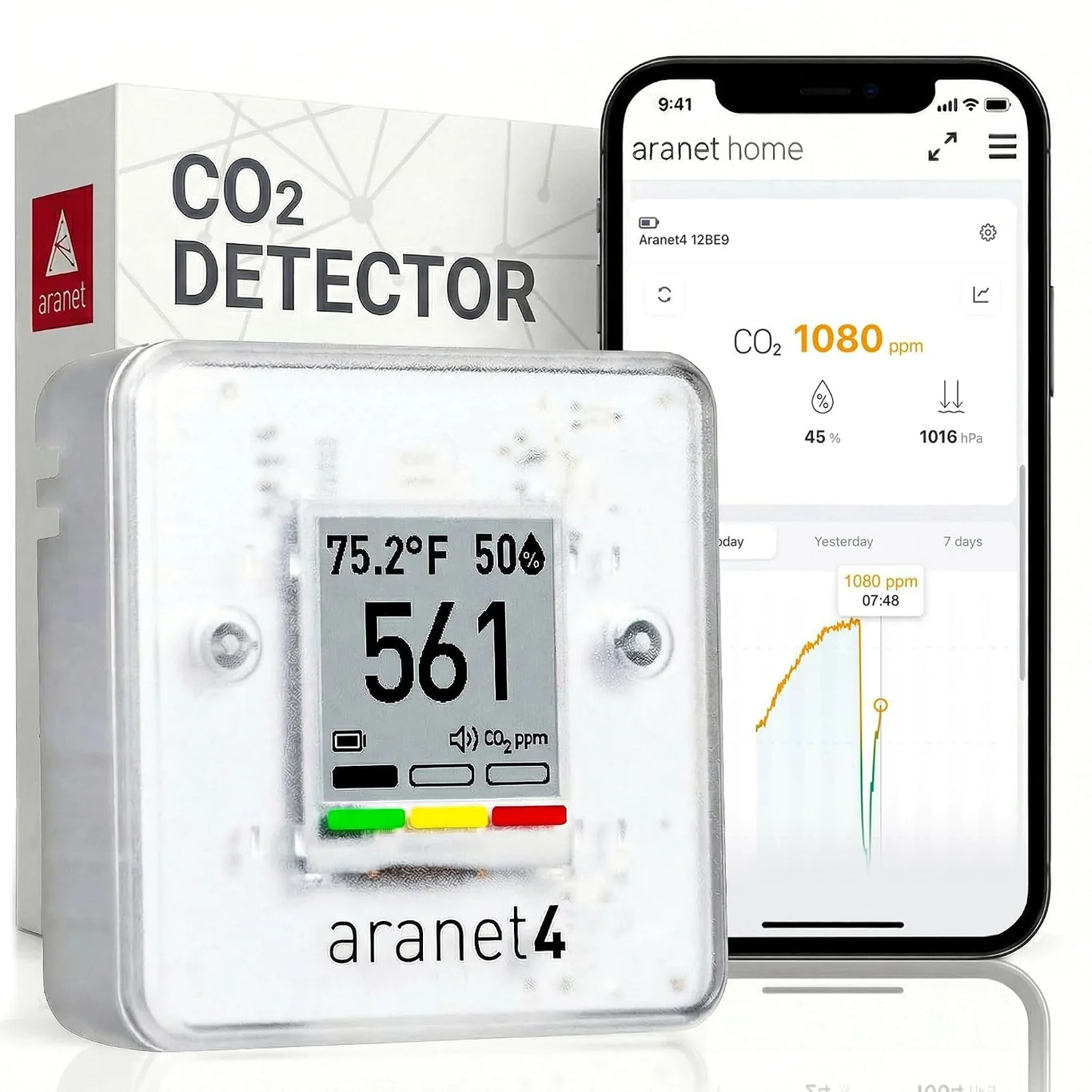
Aranet4 Review: What the Home Version Is and Is Not
The Aranet4 Home Indoor Air Quality Monitor is a battery-powered handheld sensor made by SAF Tehnika under the Aranet brand. The listing gives the dimensions as 2.76 by 2.76 by 0.94 inches and the weight as 3.67 ounces, and it says 2 AA batteries are included, so it is a palm-sized device you can carry from room to room.
Aranet sells a Home version and a PRO version, and this listing does not state the version on its face. Aranet says the PRO version adds a radio that connects to the Aranet PRO Base Station, so I read this consumer listing as the Home model and I would confirm that on the box before relying on it.
I care less about the headline sensor and more about the house it goes into. With three children, bedroom doors stay shut all night, and that is exactly where a CO2 reading earns its place. If you want to compare it with other air quality monitors, I keep that page alongside this one.
Specifications
| Specification | Detail |
| Sensor type | NDIR, per Aranet |
| Measures | CO2, temperature, relative humidity and atmospheric pressure (Aranet) |
| CO2 range | 0 to 9999 ppm (Aranet) |
| CO2 accuracy | 30 ppm plus 3 percent of reading (Aranet; I did not find the conditions this applies under) |
| Temperature accuracy | Plus or minus 0.54F (Aranet) |
| Battery life | Up to 4 years (Aranet) |
| Batteries | 2 AA batteries, included (listing) |
| Display | E-Ink (Aranet) |
| Weight | 3.67 ounces (listing) |
| Warranty | 2 years, extendable to 3 (Aranet) |
Key Features
- True NDIR CO2 sensing: Aranet states it detects CO2 directly instead of estimating it from other gases, which is what makes the number worth acting on.
- A published accuracy figure: Aranet gives a CO2 accuracy of 30 ppm plus 3 percent of reading, and I value a spec I can hold the device to.
- E-Ink display with a buzzer: Aranet sets the default red alert at 1400 ppm, and the buzzer sounds when CO2 reaches that threshold.
- Long battery life: Aranet states a battery life of up to 4 years, which I read as a best case and not a promise.
- Free app with trends and export: the app shows trends, alerts and history, and Aranet says data can be exported from the dashboard.
What the Aranet4 Measures, and What It Does Not Remove or Detect
The Aranet4 removes nothing, because it is a monitor. The useful question is what it measures and how far I trust the reading. Aranet lists CO2, temperature, relative humidity and atmospheric pressure, and I treat that as the complete list.
I found no third-party certification or lab listing for its CO2 accuracy, and I will not present Aranet’s own figure as one. Aranet states a CO2 range of 0 to 9999 ppm and an accuracy of 30 ppm plus 3 percent of reading, and it describes the sensor as true NDIR.
Aranet describes 400 to 800 ppm as well ventilated and sets the default red alert at 1400 ppm. NIOSH lists a 15-minute CO2 exposure limit of 30,000 ppm. OSHA sets an 8-hour limit of 5000 ppm. These workplace limits are not residential safety targets, so I treat the 1400 ppm alert as a prompt to improve ventilation, not as a boundary between safe and dangerous air.
It does not measure particles or VOCs. Smoke particles, cooking VOCs and dust are not what it measures, and Aranet states it measures carbon dioxide, not carbon monoxide. The CPSC says working CO alarms matter. If particles are your worry, I would look at air purifiers for bedrooms instead.
The EPA’s introduction to indoor air quality covers ventilation as one way to lower indoor pollutants, but I did not find a CO2 target there. I take Aranet’s ranges as the manufacturer’s guidance, not a regulatory standard.
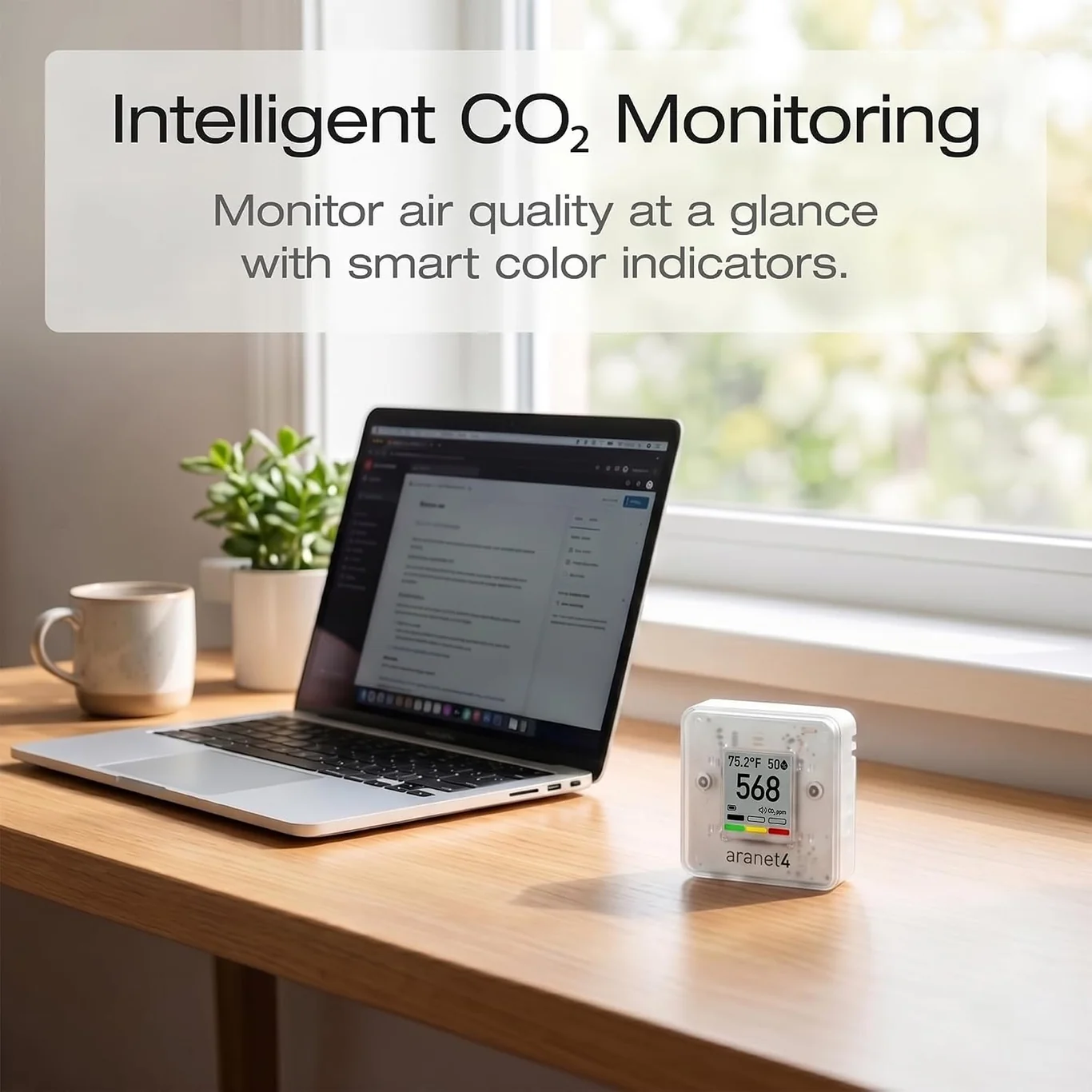
Living With the Aranet4: Batteries, Calibration and Daily Use
Aranet states a battery life of up to 4 years, and the listing says it takes 2 AA batteries. I read that as a best case, because real battery life depends on how you use it, and I would keep two spare AA cells on hand. There are no filters or other consumables, so the running cost is modest.
Aranet’s manual lists measurement intervals of 1, 2, 5 or 10 minutes, with a default of 5 minutes. That makes it a room-trend instrument, not a breath-by-breath one. I would leave it on the default for a bedroom.
Aranet recommends calibrating once a year, and it says automatic calibration needs about 8 hours at roughly 420 ppm in each 30-day period. That detail matters: a monitor that never sees fresh air cannot correct itself. I would calibrate it yearly as Aranet advises and give it time near an open window now and then.
The free Aranet Home app shows trends, alerts and history. Aranet says changing settings requires the sensor to be in Bluetooth range, so I would not count on alerts reaching me when I am away from home.
The only sound is the optional buzzer, and I would keep the sensor at breathing height but away from the pillow, since breath held close to the sensor inflates the reading. Aranet lists a warranty of 2 years, extendable to 3.
Pros
- Aranet states it uses a true NDIR sensor that detects CO2 directly
- Aranet gives a CO2 accuracy of 30 ppm plus 3 percent of reading
- E-Ink display with color coding and an optional buzzer
- Aranet states a battery life of up to 4 years on 2 AA batteries
- Free app with trends, alerts and data export
- Aranet lists a 2-year warranty, extendable to 3
- Palm-sized at 3.67 ounces, per the listing
Cons
- It measures only CO2, temperature, humidity and pressure, so it says nothing about particles, VOCs or carbon monoxide, which is the gap buyers find after unboxing.
Who Should Skip the Aranet4, and Who It Suits
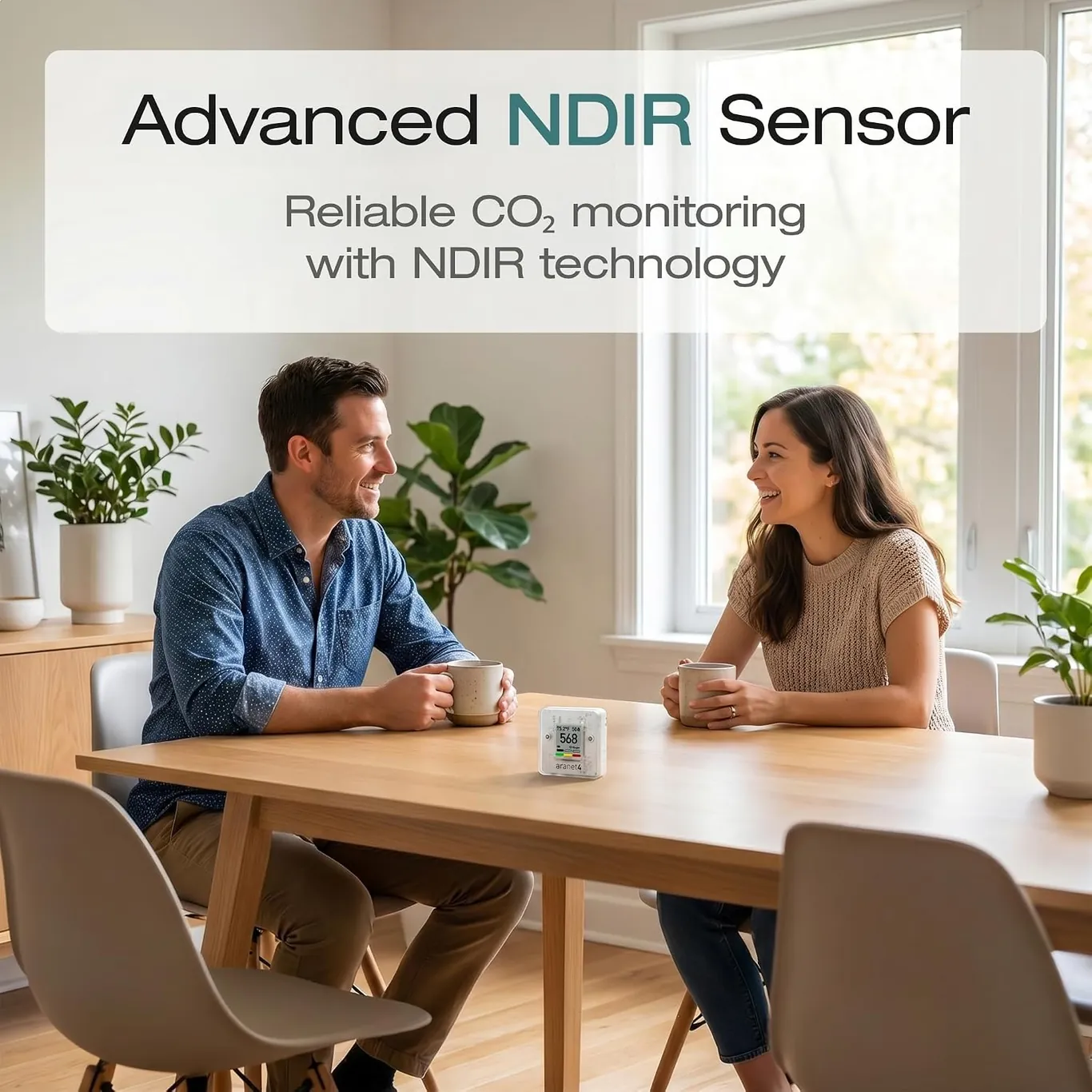
I recommend it for anyone with a bedroom, nursery or home office that stays closed for hours. A CO2 reading is the cleanest way I know to see under-ventilation as a number, and shut bedroom doors with three children in the house is the case I would want it for.
I would skip it if your worry is smoke, dust, pet dander or cooking fumes, because Aranet lists no particle or VOC sensing. I would point those buyers to an air purifier for home first and add a monitor later if CO2 still matters.
I would also skip it if you want a wall-powered monitor with a broader sensor set. AirGradient says its ONE monitor lists PM2.5, CO2, TVOCs, NOx, temperature and humidity, and it specifies USB-C mains power with no battery.
If you only want a rough sense of a stuffy room, a cheaper CO2 meter may be enough, and I would not argue you out of it. I chose to judge this one on a published accuracy figure I can check.
| Model | How it differs | Pick it instead if |
| Aranet4 Home Indoor Air Quality Monitor | Aranet gives a CO2 accuracy of 30 ppm plus 3 percent of reading and a battery life of up to 4 years, and it lists CO2, temperature, humidity and pressure. | Pick this one if you want a simple battery-powered CO2 meter for one household. |
| Aranet4 PRO | Aranet says the PRO version adds a radio that connects to the Aranet PRO Base Station and positions it for businesses, schools and offices, while the Home version is for one private user. | Pick it instead if you plan to run several monitors across a building through a base station. |
| Airthings View Plus | Airthings lists seven sensors, including radon, PM2.5, CO2 and VOCs, and says it runs on 6 AA batteries or USB-C with a battery life of up to 2 years. | Pick it instead if you want particles, VOCs and radon alongside CO2 and are happy with a Wi-Fi connected device. |
Aranet4 Common Problems and How to Avoid Them
The pattern behind many owner questions is a startlingly high reading in a small closed room. CO2 comes from breathing, so a sensor near your face climbs quickly, and that is the sensor working. Place it away from where you breathe and read the trend, not the spike.
A reading that sits above outdoor levels in a well-aired empty room is a calibration question. Aranet recommends calibrating once a year, and the manual route is a switch behind the batteries or the app.
A third problem is the version mix-up. Because the listing does not name the version, I would confirm Home on the box, since Aranet says the PRO version is built for networks through a base station.
The fourth problem is expecting more than CO2. A low reading does not mean clean air, because the Aranet4 will not register particles, VOCs or carbon monoxide, and I would not rely on it as a safety alarm of any kind.
My Overall Verdict
I like the Aranet4 for one reason: it does one job and states how well it does it. Aranet gives a CO2 accuracy of 30 ppm plus 3 percent of reading, describes the sensor as true NDIR, and lists a battery life of up to 4 years.
The cost of admission is plain. It will not see particles, VOCs or carbon monoxide, it sits at the premium end for home CO2 meters, and I would confirm you are buying the Home version. I would send anyone with a smoke or dust problem elsewhere.
Final Verdict
buy it for a bedroom or home office where stale air is the worry, and skip it if you need particles, VOCs or carbon monoxide. I would pair it with a working CO alarm, and that is the honest conclusion of this Aranet4 review.
SHOP ON AMAZONAvailability and current price shown on Amazon
Frequently Asked Questions
How much does the Aranet4 cost?
It sits at the premium end for home CO2 monitors, and I do not quote a figure because retail prices change often. You should check the current price on Amazon and weigh it against what you need, since Aranet gives a CO2 accuracy of 30 ppm plus 3 percent of reading.
How long does the Aranet4 battery last?
Aranet states a battery life of up to 4 years, and the listing says the monitor takes 2 AA batteries, which are included in the box. You should treat that figure as a best case, because real battery life depends on how you use it, and keep two spare AA cells at home.
Is a CO2 monitor worth it?
Yes, when you want evidence that a bedroom, nursery or office is under-ventilated, because CO2 is a ventilation signal and not a general pollutant gauge. You should skip it if your worry is smoke, dust, pet dander or cooking fumes, since a CO2 monitor does not detect any of them.
Does Aranet4 detect carbon monoxide?
No, because Aranet states it measures carbon dioxide, not carbon monoxide, and that a dedicated CO alarm is required for detecting carbon monoxide. You should keep a working CO alarm in your home, as the CPSC says matters for safety, and treat the Aranet4 as a ventilation tool only, never a safety alarm.
Aranet4 HOME vs Aranet4 PRO: what is the difference?
Aranet says the Home version is for one private user, while the PRO version adds a radio that connects to the Aranet PRO Base Station for networks of devices. You should choose the Home version for one household and consider the PRO only if you plan to run several monitors.
References
- CDC. NIOSH Pocket Guide to Chemical Hazards: Carbon dioxide. cdc.gov/niosh/npg/npgd0103.html
- Occupational Safety and Health Administration. Carbon Dioxide. osha.gov/chemicaldata/183
- U.S. Consumer Product Safety Commission. Carbon Monoxide Information Center. cpsc.gov/Safety-Education/Safety-Education-Centers/Carbon-Monoxide-Information-Center
- U.S. EPA. Introduction to Indoor Air Quality. epa.gov/indoor-air-quality-iaq/introduction-indoor-air-quality
Medical Disclaimer: This content is for informational purposes only. It is not a substitute for professional medical advice, diagnosis, or treatment. If you have concerns about your water quality or air quality and their effects on your health, consult a qualified healthcare professional.

