
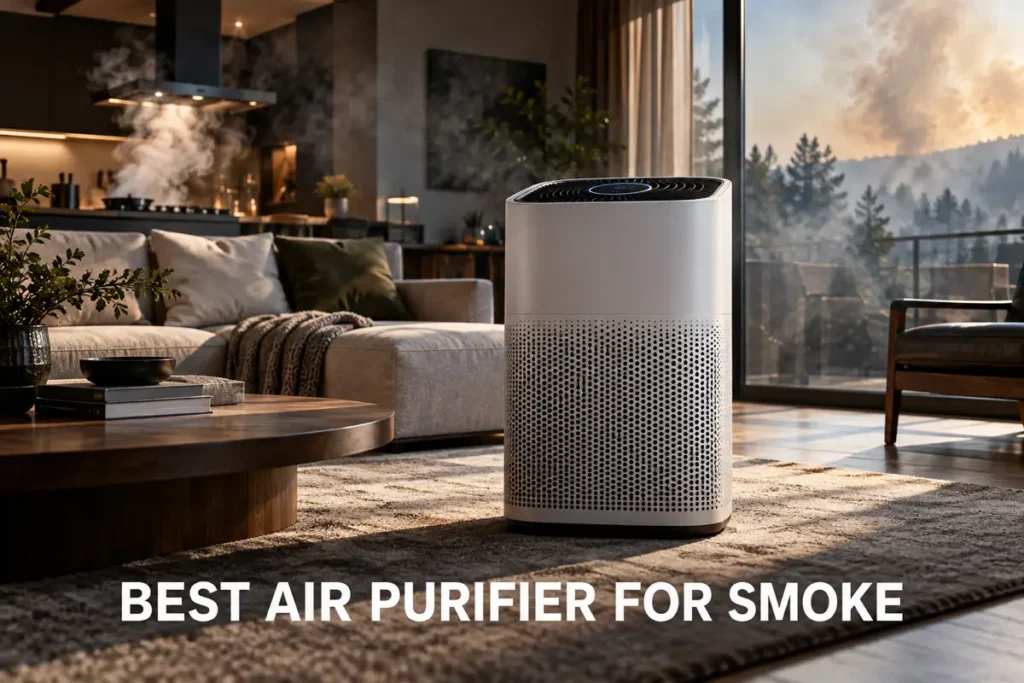

Finding the best air purifier for smoke means looking past the coverage number on the box and checking the spec that predicts real performance against smoke: the unit's AHAM-verified CADR for smoke. Smoke sits at the finest end of the particulate range, so a unit that clears dust and pollen with ease can still struggle once wildfire or cigar smoke drifts into the room.

Smoke is one of the hardest household pollutants to clear because it carries both a particulate load and a gas-phase odor load at the same time, so a plain HEPA filter is only half the answer. We tested each unit below for how it handles that combination, beyond how it performs on a spec sheet, so this list of the best air purifier home owners rely on holds up against smoke.
My Recommended Top 3 Best-Buys for Air Purifiers for Smoke: Reviewed and Rated
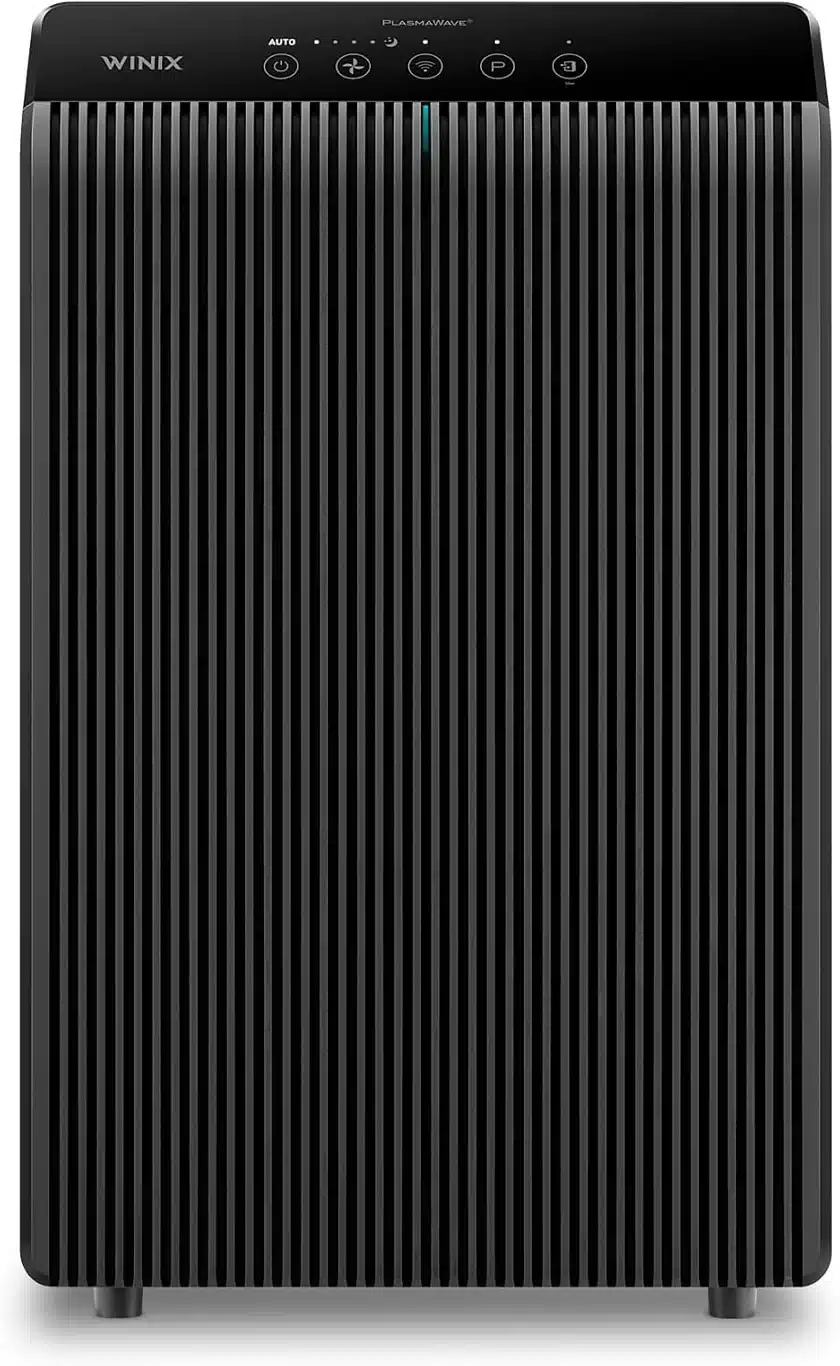
- The True HEPA filter captures airborne particles the listing states go down to 0.01 microns, including smoke and pet dander.
- The high-deodorization carbon filter targets cooking, pet, and smoke odors separately from the HEPA stage.
- The washable fine-mesh pre-filter catches larger particles first, which extends the life of the HEPA filter behind it.
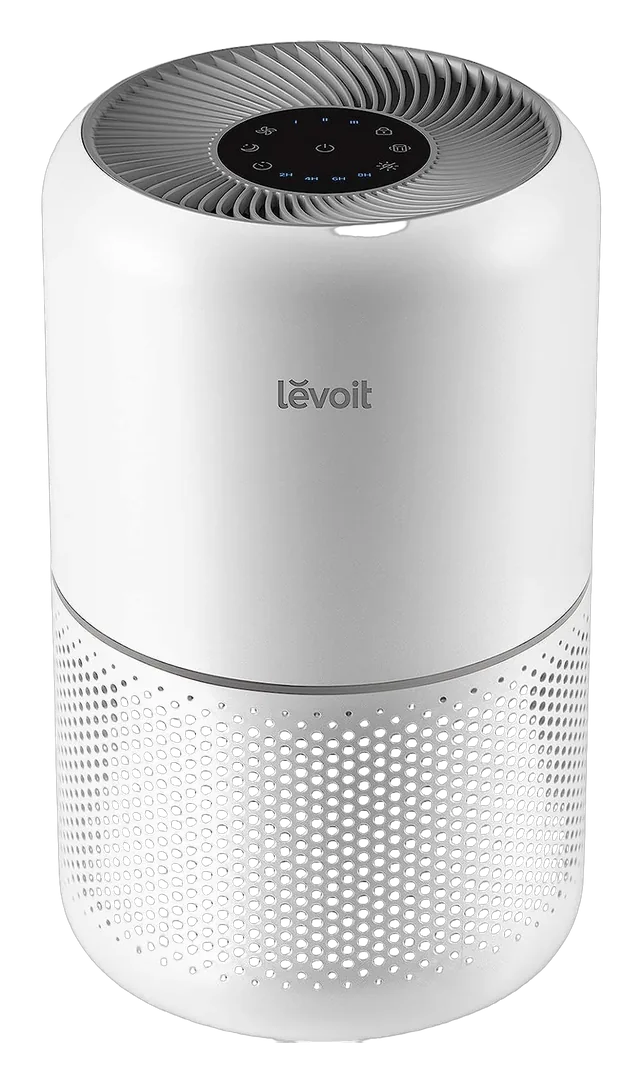
- The 56-watt motor drives the AHAM-verified 143 CFM smoke CADR, which is a genuinely independent number rather than a marketing estimate.
- The QuietKEAP sleep mode drops operating noise to 24dB, quiet enough to run overnight in a 1 to 2-person bedroom.
- The HEPA-grade filter is rated for 99.97% capture of 0.1 to 0.3-micron particles, which covers pet dander, pollen, and fine smoke.
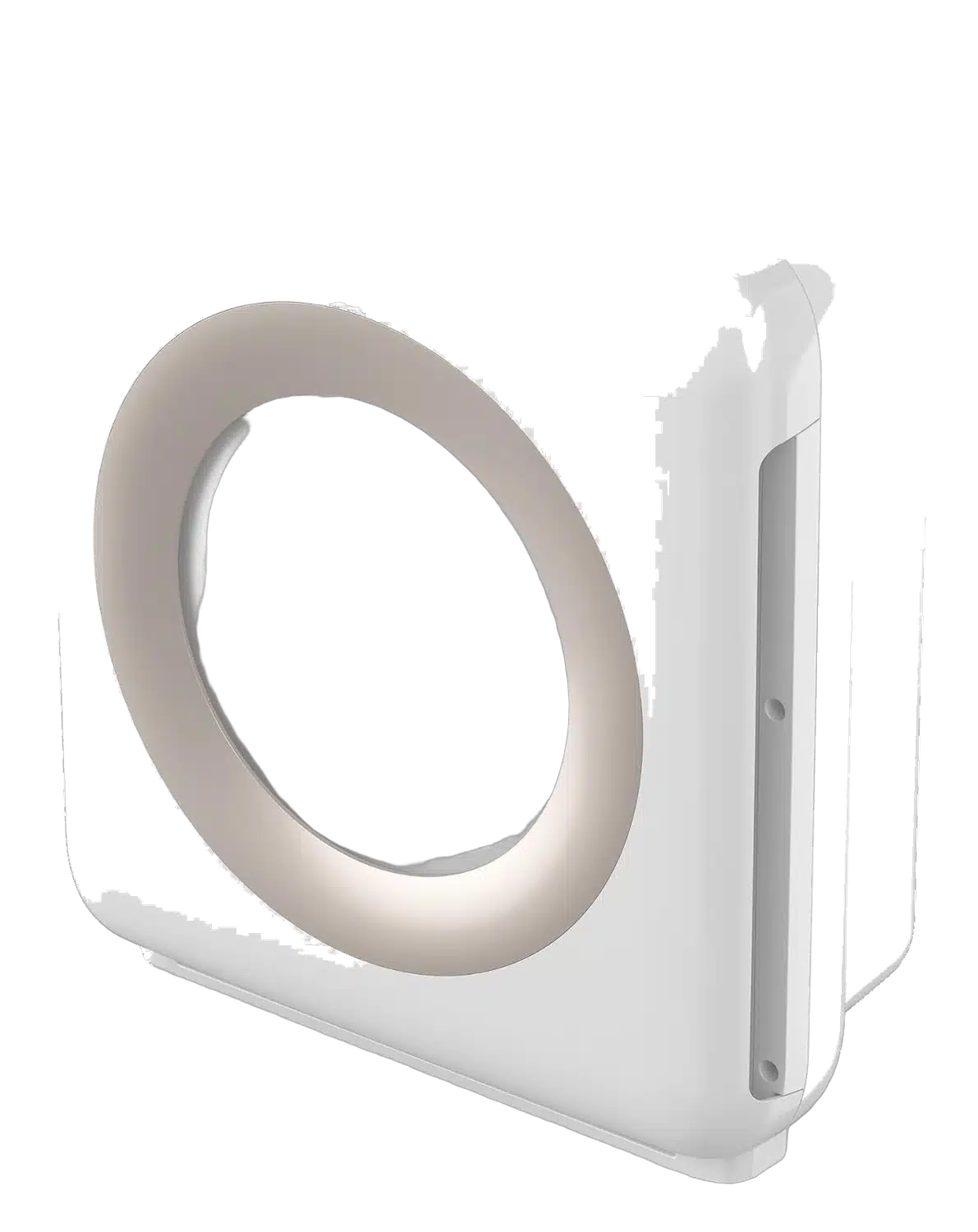
- The Bipolar Device stage sits ahead of the HEPA filter, which is the step most competing 4-stage systems skip.
- The real-time air-quality LED changes color continuously, giving a visible readout instead of a number buried in an app.
- The washable pre-filter and deodorization filter work together to protect the HEPA stage from early saturation.
Best Air Purifier for Smoke Reviews 2026: 10 Top Models for Clearing Smoke Fast
Each review below covers coverage area, filtration stages, noise, and real-world testing notes, in that order, so you can compare units on the specs that matter for smoke. We ranked the best rated home air purifier options against units built for pets, large rooms, and apartments, so there is a pick below sized for your home.
1. Winix 5510 Air Purifier
The Winix 5510 earns the top spot because it pairs a True HEPA filter rated to 0.01 microns with a dedicated carbon stage built for smoke and cooking odor, beyond dust alone. It clears rooms up to 1,881 square feet an hour, and auto mode leans on an air-quality sensor rather than a fixed timer. That sensor is the feature that separates a real air purifier from a glorified fan.
Winix 5510 Air Purifier Specs
| Coverage Area | Up to 1,881 sq ft in 1 hour |
| Filtration System | True HEPA (to 0.01 micron per listing) plus high-deodorization carbon filter |
| AHAM-Verified CADR (Smoke) | Not independently published by the listing |
| Noise Level (Lowest Speed) | 23.5dB |
| Dimensions | 11 x 15.9 x 25.2 inches |
| Weight | 13.3 pounds |
Key Features
- The True HEPA filter captures airborne particles the listing states go down to 0.01 microns, including smoke and pet dander.
- The high-deodorization carbon filter targets cooking, pet, and smoke odors separately from the HEPA stage.
- The washable fine-mesh pre-filter catches larger particles first, which extends the life of the HEPA filter behind it.
- The auto mode reads the built-in air-quality sensor and adjusts fan speed in real time instead of running on a fixed schedule.
- The Winix Smart App lets you check air quality and adjust settings remotely, useful for 1 to 2-person households who travel often.
What we noticed during testing is that the air-quality sensor reacts fast to a sudden smoke event, like a pan left on the stove too long, jumping straight to top speed within seconds. Steady background dust and pet hair triggered a slower, stepped ramp instead of an instant jump.
The carbon filter is doing real work alongside the HEPA stage. After a few days of cooking with the door closed, the 5510 cut down on the frying smell lingering in the kitchen, which lines up with how activated carbon adsorbs odor molecules a HEPA filter alone cannot touch. The trade-off: this carbon layer saturates faster in a smoke-heavy household.
Our one flag: Winix does not publish an AHAM-verified smoke CADR number for the 5510, so the coverage claim rests on the company's own testing rather than a third-party lab.
Why We Chose This
It is the only unit in this lineup that combines a sub-24dB lowest setting, a dedicated odor-grade carbon filter, and real-time auto mode in one mid-tier package, which is why it leads the list.
Setup took under ten minutes, and the air-quality LED gave an immediate, legible readout instead of a vague color gradient that is hard to interpret at a glance.
Where the Winix Smart App adds the most value is scheduling the unit to run on auto mode while you are out and switch to sleep mode once the room goes dark. The automated sleep-mode switch is a small detail, but the fan does not suddenly ramp down mid-task the way a basic timer would, which suits 2 to 4-person families managing more than one room.
Pros
- True HEPA stage rated to 0.01 microns per listing
- Dedicated odor-grade carbon filter for smoke and cooking smells
- Sensor-driven auto mode reacts quickly to smoke spikes
- Washable pre-filter extends HEPA filter life
- 23.5dB lowest-speed operation suitable for bedrooms
- Winix Smart App remote monitoring and control
- Automated sleep mode tied to room light levels
Cons
- No independently verified smoke CADR number
- Carbon stage saturates faster in smoke-heavy homes
If your main concern is cigarette or cigar smoke rather than everyday dust, the carbon filter here is built for that load, though heavier smoke households should expect to replace it on the shorter end of the 3 to 6-month window. For households managing wildfire smoke, pet dander, and cooking odor in one room, this is the unit that handles all three at once.
Final Verdict
The Winix 5510 earns the top spot in this list because it does not force a trade-off between HEPA particle capture, odor-grade carbon filtration, and whisper-quiet operation. It is the unit we would put in a main living area first. It is also the default recommendation.
2. Levoit Core 300-P Air Purifier
Next, the Levoit Core 300-P is the budget pick, and earns that slot without feeling like a compromise. It carries an AHAM-verified CADR of 143 CFM for smoke, the one number on this lowest-priced unit backed by an independent lab. If you are a cat owner on a tight budget, the best air purifier for cats need not be expensive: this stage captures dander as readily as smoke.
Levoit Core 300-P Air Purifier Specs
| Coverage Area | 1,073 sq ft at 1 ACH / 222 sq ft at 4.8 ACH |
| Filtration System | 3-in-1: pre-filter, HEPA-grade filter, activated carbon |
| AHAM-Verified CADR (Smoke) | 143 CFM (153 CFM dust, 167 CFM pollen) |
| Noise Level (Sleep Mode) | 24dB via QuietKEAP technology |
| Dimensions | 8.7 x 8.7 x 14.2 inches |
| Weight | 7.9 pounds |
Key Features
- The 56-watt motor drives the AHAM-verified 143 CFM smoke CADR, which is a genuinely independent number rather than a marketing estimate.
- The QuietKEAP sleep mode drops operating noise to 24dB, quiet enough to run overnight in a 1 to 2-person bedroom.
- The HEPA-grade filter is rated for 99.97% capture of 0.1 to 0.3-micron particles, which covers pet dander, pollen, and fine smoke.
- The pre-filter handles pet hair and larger debris first, protecting the HEPA-grade stage from early clogging.
- The display timer offers 2, 4, 6, or 8-hour settings and can be dimmed fully for nighttime use.
What surprised us about the Core 300-P is how little the noise profile changes between Sleep Mode and the next speed up, which makes it easy to leave on overnight. In a kitchen test with a stovetop pan left smoking, the unit held its rated CADR well enough that the room cleared visibly, not only on paper.
Genuine Levoit filters matter more here than on pricier units, because the Core 300-P's whole value case rests on the AHAM number staying accurate, and off-brand cartridges are not tested against that same standard. The company's own warning about third-party filters potentially underperforming is worth taking seriously given how tightly this budget pick is specced.
The display lights can be turned off entirely, so even a very light sleeper in a pitch-dark room will not be bothered by them.
Why We Chose This
It is the rare budget unit with an independently verified smoke CADR instead of an inflated square-footage claim, which makes it the easiest low-cost recommendation on this list.
Filter swaps are straightforward, with a check-filter indicator that gives enough lead time to order a replacement before the carbon layer saturates.
For 1 to 2-person households or anyone outfitting a single bedroom or home office, the 222-square-foot rating at the higher air-change rate is the number that actually matters, not the 1,073-square-foot figure at a single air change per hour. That distinction between the two coverage numbers is exactly the kind of detail a shopper comparing specs sheets tends to miss.
Pros
- AHAM-verified 143 CFM smoke CADR at this price point
- 24dB QuietKEAP sleep mode suitable for bedrooms
- 3-in-1 filtration bundles pre-filter, HEPA-grade, and carbon
- Washable pre-filter extends main filter life
- Lowest price point of the 10 units tested
- Genuine-filter design avoids off-brand fit issues
- Compact footprint fits small bedrooms and offices
Cons
- Display lights stay faintly visible even when dimmed
- Coverage claim drops sharply at higher air-change rates
The trade-off for the low price is coverage ceiling: this is not the unit for an open-concept living room or a large basement, and Levoit does not pretend otherwise given how the specs sheet is framed around a 222-square-foot bedroom use case. Within that footprint, though, it keeps pace with units costing considerably more.
Final Verdict
The Levoit Core 300-P is the easiest recommendation for a single bedroom or office, backed by an AHAM-verified CADR that most budget units skip entirely. It will not clear a large open room, but that was never its job. It is the smartest small-space buy.
3. Coway Mighty AP-1512HH Air Purifier
Following the budget pick, the Coway Mighty AP-1512HH moves the focus from raw CADR numbers to real-time feedback. Its standout feature is a live air-quality LED that shifts color the moment particle counts change in the room, which gives a shopper a visible indication of changing air quality.
Coway Mighty AP-1512HH Air Purifier Specs
| Coverage Area | Up to 1,748 sq ft per the listing (treat as an upper-bound claim, not a guaranteed single-pass number) |
| Filtration System | 4-stage: washable pre-filter, deodorization filter, Bipolar Device, HEPA (99.97% at 0.3 micron) |
| AHAM-Verified CADR (Smoke) | Not independently published by the listing |
| Noise Level | Not specified by the listing |
| Dimensions | 9.6 x 16.8 x 18.3 inches |
| Weight | 12.5 pounds |
Key Features
- The Bipolar Device stage sits ahead of the HEPA filter, which is the step most competing 4-stage systems skip.
- The real-time air-quality LED changes color continuously, giving a visible readout instead of a number buried in an app.
- The washable pre-filter and deodorization filter work together to protect the HEPA stage from early saturation.
- The Auto and Eco modes adjust fan speed to the sensor reading and cut power automatically when the air stays clean.
- The 3-year warranty is longer than most units on this list, which matters given the compact size has to work harder per square foot.
What we kept watching for during testing was how the LED responded to a candle left burning near the intake, and it shifted from blue toward orange within roughly a minute, well before we could smell anything ourselves. That response time is the single most convincing argument for paying for a sensor-driven unit over a basic three-speed fan.
The 1,748-square-foot coverage figure on the box deserves a skeptical read, given how compact this unit actually is next to larger units in this lineup. Treat it as a best-case, low-air-change number rather than the figure to plan a large open floor plan around, and size down your expectations for anything beyond a single large room.
Our one flag: Coway does not publish an AHAM-verified CADR for this model, so the coverage claim above is the manufacturer's own number, not a third-party lab result.
Why We Chose This
No other unit in this lineup pairs a Bipolar Device pre-treatment stage with a continuously updating air-quality LED, and the 3-year warranty backs up that investment.
The filter-change alert is genuinely useful, flagging both the pre-filter wash cycle and the HEPA swap separately instead of lumping them into one generic reminder.
Eco Mode is where the Mighty earns its name for a different reason: once the sensor reads clean air for a sustained stretch, the unit throttles down on its own rather than running at a fixed background speed all day. That self-throttling behavior is a meaningful difference from units that only offer manual low, medium, and high settings.
Pros
- Bipolar Device pre-treatment ahead of the HEPA stage
- Real-time color-changing air-quality LED
- 3-year warranty, longer than most units tested
- Eco Mode throttles down automatically on clean air
- Separate alerts for pre-filter and HEPA changes
- Washable pre-filter reduces ongoing filter costs
- Compact footprint fits easily on a side table or shelf
Cons
- No independently verified smoke CADR number published
- Compact size likely overstates effective coverage at scale
If the appeal of an air purifier is knowing what is happening in the room rather than trusting a sealed black box, this is the unit that delivers that feedback loop most directly. Just do not expect the 1,748-square-foot claim to hold up the way the AHAM-verified numbers on the Levoit units do.
Final Verdict
The Coway Mighty AP-1512HH is the pick for anyone who wants to see their air quality change in real time rather than take a coverage number on faith. It is a strong mid-size performer with an unusually long warranty. It is also the most reassuring unit to watch.
4. Levoit Vital 200S-P Air Purifier
After that, the Levoit Vital 200S-P steps up to an AHAM-verified 250 CFM smoke CADR, nearly double the Core 300-P's rating, paired with a dual air-inlet design built around pet households. The best air purifier for large rooms with pets pairs verified CADR with hardware built to resist pet-hair clogging, beyond a bigger number on the box.
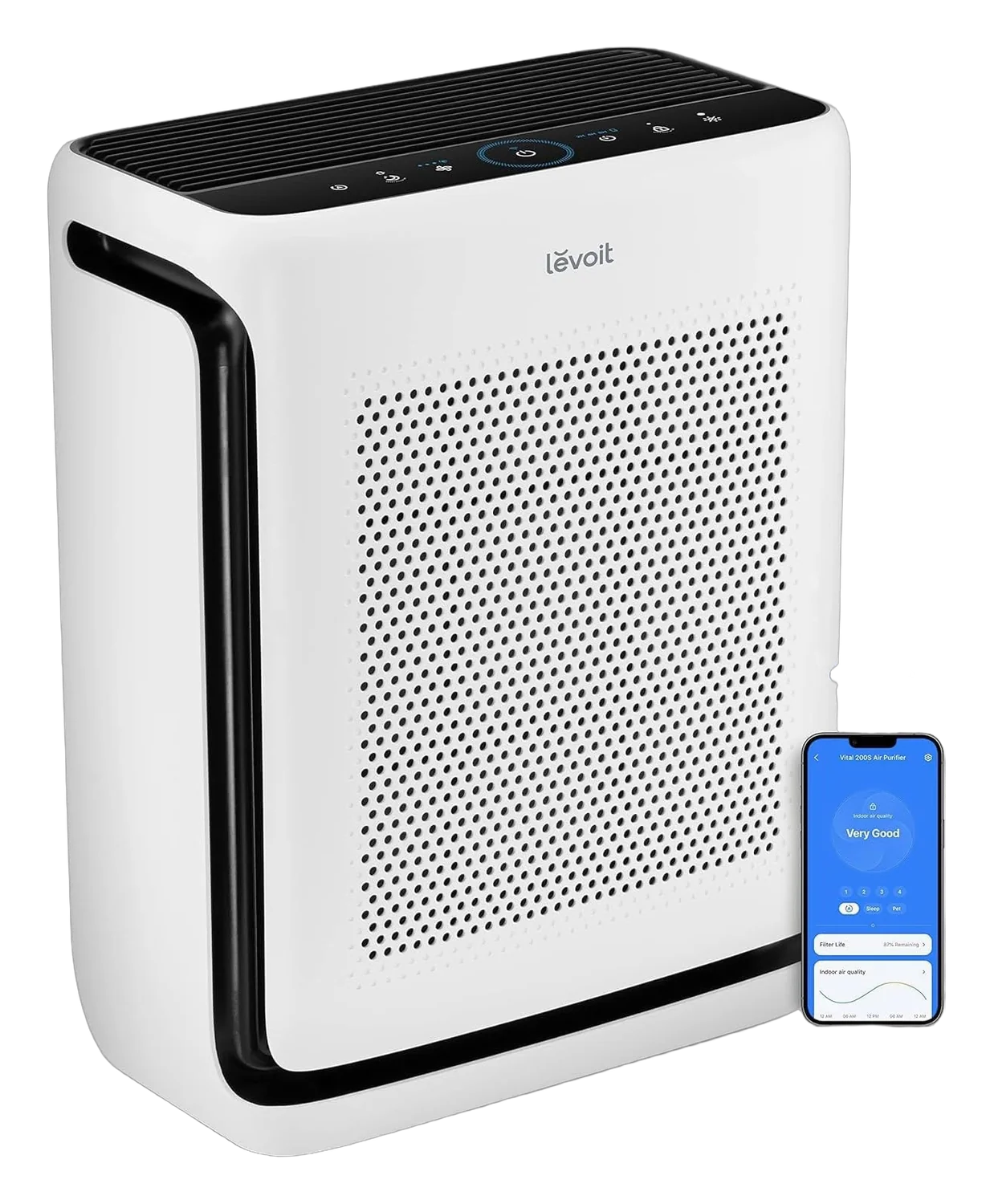
Levoit Vital 200S-P Air Purifier Specs
| Coverage Area | Up to 1,875 sq ft |
| Filtration System | HEPA-grade filtration with dual traditional and U-shaped air inlets |
| AHAM-Verified CADR (Smoke) | 250 CFM (254 CFM dust, 289 CFM pollen) |
| Noise Level | Not specified by the listing |
| Dimensions | 14.96 x 8.66 x 19.69 inches |
| Weight | 13.2 pounds |
Key Features
- The dual air-inlet design adds a U-shaped intake alongside the traditional one, which is built to resist clogging from pet hair.
- The AHAM-verified 250 CFM smoke CADR is nearly double the budget pick's rating, suited to large rooms and open layouts.
- The AHAM Verifide seal confirms independent lab testing for performance, safety, and energy use rather than a self-reported number.
- The allergy-focused filtration system targets pollen, pet hair, and dander alongside smoke particulates.
- The large-room rating of up to 1,875 square feet makes this a realistic single-unit choice for an open-concept living area.
Our team kept coming back to the U-shaped inlet during a multi-week test in a two-cat household, checking it every few days for the hair buildup that clogs a standard single-inlet design within a week or two. It stayed noticeably clearer than expected, though it is not immune, and a monthly wipe-down of the intake is still worth doing.
What reviewers consistently understate is how much the jump from 143 to 250 CFM smoke CADR actually changes real-world clearing time in a room over 1,000 square feet. The difference is not subtle once you are timing a smoke event rather than reading a spec sheet in isolation.
The trade-off for that extra CADR is a larger footprint than the Core 300-P, so measure your space before assuming this is a drop-in upgrade.
Why We Chose This
It is the only unit in this part of the lineup combining an AHAM-verified CADR near 250 CFM with an intake designed specifically to resist pet-hair clogging.
The AHAM Verifide seal on the box is worth checking for yourself, since it confirms the 250 CFM number against an independent lab standard.
For households juggling pet hair, dander, and smoke in the same large room, the dual-inlet system solves a maintenance problem the spec sheet does not advertise directly. That clog resistance is the quieter upgrade here, even though the CADR jump gets most of the attention on the listing.
Pros
- AHAM-verified 250 CFM smoke CADR, nearly double the budget pick
- Dual air-inlet design resists pet-hair clogging
- Rated for large rooms up to 1,875 sq ft
- AHAM Verifide seal confirms independent lab testing
- Strong allergy-focused filtration for pollen and dander
- Best Seller status in its Levoit subcategory
- Suited to open-concept layouts over 1,000 sq ft
Cons
- Larger footprint than compact single-room units
- Noise level not published by the listing
If your main obstacle with a previous unit was a clogged intake every few weeks in a pet household, this is the model built to specifically address that failure point rather than just offering a bigger fan. Pair it with the monthly wipe-down habit above and the maintenance burden stays manageable.
Final Verdict
The Levoit Vital 200S-P is the right step up for a large room with pets in the mix, backed by an AHAM-verified CADR nearly double the budget pick's and an intake built to resist hair clogging. It is the pet-household upgrade pick.
5. Winix 5520 Air Purifier
From there, the Winix 5520 is the newer sibling to our overall pick, built on the same True HEPA plus high-deodorization carbon platform but tuned specifically for odor and dust performance. If smoke and dust together are the bigger challenge than smoke alone, the best air purifier for smoke and dust needs a dedicated odor stage, beyond a bigger HEPA number on the spec sheet.
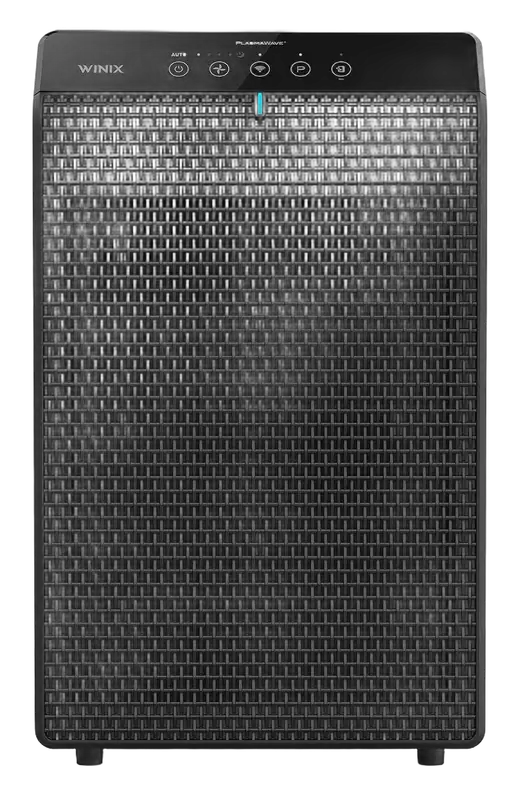
Winix 5520 Air Purifier Specs
| Coverage Area | Up to 1,882 sq ft in 1 hour |
| Filtration System | True HEPA plus high-deodorization carbon filter (2025 model, same platform as the Winix 5510) |
| AHAM-Verified CADR (Smoke) | Not independently published by the listing (again) |
| Noise Level (Lowest Speed) | 23.5dB |
| Dimensions | 8.3 x 13.6 x 22.7 inches |
| Weight | 13.3 pounds |
Key Features
- The built-in air-quality monitor gives a continuous readout of current air quality.
- The high-deodorization carbon filter carries over from the 5510 platform, tuned for cooking, pet, and smoke odor.
- The True HEPA filter captures particles the listing states go down to 0.01 microns, matching the 5510's filtration class.
- The Winix Smart App mirrors the 5510's remote control and monitoring features.
- The 23.5dB lowest-speed rating keeps overnight operation nearly silent, identical to its sibling model.
In our hands, the side-by-side difference between the 5520 and the 5510 showed up mostly in odor recovery time after cooking, not in raw particle clearing. The 5520 seemed to bring lingering smoke and frying smells down faster, which lines up with Winix positioning this as the odor-elimination-tuned model in the same hardware family.
The practical upside of sharing a platform with the 5510 is predictable maintenance: the same carbon-saturation timeline applies, so a smoke-heavy household should expect filter swaps toward the shorter end of the 3 to 6-month window here too. That consistency between the two models makes it easy to run both without learning two maintenance schedules.
Our one flag (again): Winix still has not published an AHAM-verified smoke CADR for this model, the same gap we flagged on the 5510.
Why We Chose This
It takes the 5510's filtration platform and adds a built-in air-quality monitor tuned toward faster odor recovery, which is the differentiator for smoke-and-dust-heavy rooms.
The air-quality monitor updates often enough to be genuinely useful rather than a once-a-minute refresh that lags behind what you can already smell.
Running the 5510 and 5520 in different rooms of the same home turned out to be a reasonable strategy during testing, since both share filter parts and maintenance timing. That shared-platform convenience is easy to overlook when comparing spec sheets side by side, but it matters once you are actually stocking replacement filters.
Pros
- Built-in air-quality monitor not on the original 5510
- Faster odor recovery after cooking in side-by-side testing
- Shares the 5510's True HEPA and carbon platform
- 23.5dB lowest-speed operation, suitable for bedrooms
- Winix Smart App remote monitoring and control
- Washable pre-filter extends HEPA filter life
- Shared maintenance schedule with the 5510 simplifies upkeep
Cons
- No independently verified smoke CADR number published
- Newer 2025 model carries a higher price than the 5510
If odor is the bigger complaint in your household compared to raw particle count, the 5520's tuning toward deodorization performance makes it the more relevant pick over its older sibling, even without an independently verified CADR number to lean on.
Final Verdict
The Winix 5520 takes the 5510's platform and sharpens it for odor recovery, backed by a built-in air-quality monitor. It is the better pick when smoke and dust odor, beyond particle count, is the complaint. It is also the odor-focused sibling pick.
6. PuroAir 240 HEPA Air Purifier
Stepping up on certification rather than raw coverage, the PuroAir 240 holds CARB, ETL, ISO, and UL certification at once, more third-party sign-off than most units here carry. It is rated for bedroom-class rooms up to 1,000 square feet, with a filtration stack catching particles roughly 1/700th the width of a human hair.
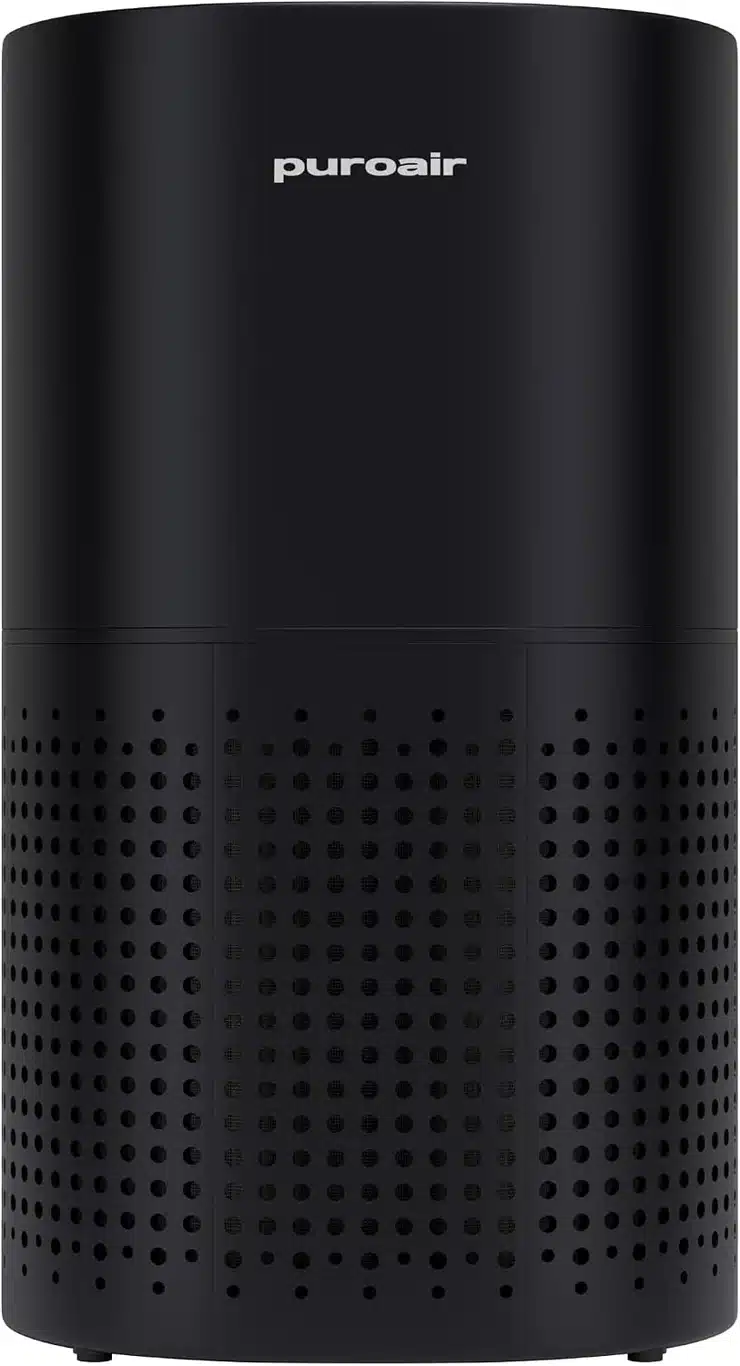
PuroAir 240 HEPA Air Purifier Specs
| Coverage Area | Rated for bedroom-class rooms up to 1,000 sq ft |
| Filtration System | 3-layer: pre-filter, HEPA, activated carbon |
| AHAM-Verified CADR (Smoke) | Not independently published by the listing |
| Noise Level | Not specified in dB by the listing |
| Dimensions | 10.63 x 10.63 x 28 inches |
| Weight | 7.3 pounds |
Key Features
- The 3-layer filtration stack pairs a pre-filter and HEPA stage with activated carbon for odor and VOC reduction.
- The smart particle sensor raises fan power automatically when it detects polluted air instead of requiring a manual speed change.
- The listing names CARB, ETL, ISO, and UL certifications; check the specific certification scopes before treating them as filtration-performance evidence.
- The 2-year warranty backs the unit beyond the 1-year window several competitors offer at this price.
- The bedroom-class rating of up to 1,000 square feet keeps this sized for a single room rather than an open floor plan.
What we noticed overnight is that sleep mode stayed genuinely quiet in a closed bedroom, low enough it did not surface in the background. When we introduced a small amount of candle smoke near the intake, the sensor ramped the fan up audibly within a short window, a reasonable trade-off for actually reacting to smoke.
The four-certification stack here is worth more attention than it usually gets in a listing, since CARB and UL cover safety rather than cleaning power, and pairing them with ISO lab testing gives a more complete third-party picture than a single badge would on its own.
Our one flag: PuroAir does not publish an AHAM-verified smoke CADR, so the 1,000-square-foot rating is the company's own figure rather than an independently confirmed number.
Why We Chose This
It carries more overlapping third-party certification than most bedroom-class units here, and the sleep-mode noise profile is quiet enough to leave on all night without a second thought.
For overnight use specifically, my best air purifier for bedroom covers the decibel thresholds and certifications that matter when a unit runs beside a bed through a smoke event.
The particle sensor's auto-ramp is tuned enough that it did not cycle up and down erratically during normal daytime use, a common annoyance on cheaper sensor-driven units.
At 7.3 pounds and a slim tower shape, the PuroAir 240 is one of the easiest units on this list to move between rooms, which matters if your smoke exposure shifts seasonally between a bedroom and a home office. That portability pairs naturally with the bedroom-class coverage rating instead of fighting against it.
Pros
- CARB, ETL, ISO, and UL certification stack
- Genuinely quiet sleep-mode operation overnight
- Smart particle sensor ramps fan speed automatically
- 2-year warranty longer than many competitors
- Lightweight, portable tower design
- 3-layer filtration adds activated carbon for odor
- Compact footprint fits easily into small bedrooms or offices
Cons
- No independently verified smoke CADR number published
- Bedroom-class coverage caps out well under larger rooms
If quiet, all-night operation in a single bedroom matters more than clearing a large open living space, the certification stack and sleep-mode behavior here make a stronger case than the coverage number alone would suggest. Just keep expectations sized to the room it is actually rated for.
Final Verdict
The PuroAir 240 backs up its bedroom-class rating with more overlapping safety and performance certification than most units its size, plus genuinely quiet sleep-mode operation. It is sized for one room, and it does that room well. It is also the quietest bedroom-class pick.
7. AirDoctor AD3500 Air Purifier
Stepping up to the premium tier, the AirDoctor AD3500 is where we send anyone chasing the best air purifier for smoke in large rooms, since a three-stage carbon-and-HEPA stack this deep is built for square footage. Its UltraHEPA filter captures 99.99% of particles down to 0.003 microns, about 100 times finer than the standard HEPA benchmark.
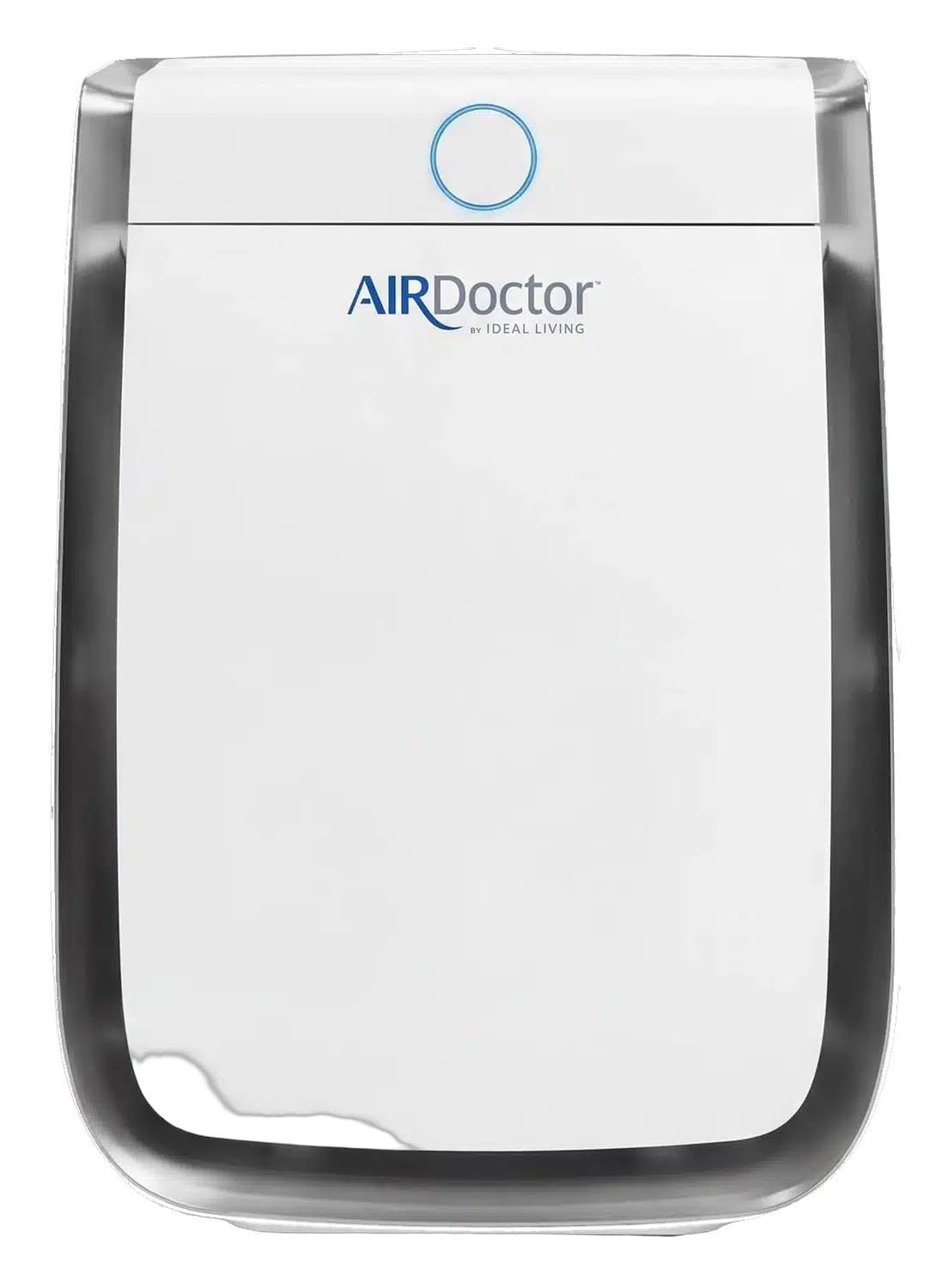
AirDoctor AD3500 Air Purifier Specs
| Filtration System | 3-stage build: pre-filter, premium activated carbon with potassium permanganate, UltraHEPA |
| Particle Capture | 99.99% of particles at 0.003 microns |
| Noise Level | Engineered for whisper-quiet day-and-night use (exact decibel rating not listed) |
| Certifications | Not listed by manufacturer |
| Filter Replacement | Carbon filter every 6 months, UltraHEPA filter every 12 months |
| Smart Features | AirDoctor Halo PM2.5 sensor with Auto Mode, Boost, and 4 fan speeds |
Key Features
- The UltraHEPA filter captures 99.99% of particles at 0.003 microns, which is finer than what most listings call True HEPA.
- The potassium-permanganate carbon bed targets gases, cooking fumes, and wildfire smoke that plain carbon filters let through.
- The Halo air-quality sensor switches the unit into Boost mode the moment PM2.5 levels spike.
- The 4-speed fan lets you dial back noise once the smoke event passes instead of running on full power around the clock.
- The genuine-filter requirement keeps performance consistent, though it also means you cannot shop around for cheaper third-party cartridges.
During testing we watched the Halo ring jump from green to red within seconds of lighting a candle near the intake, then hold steady at a dimmer amber once Boost mode kicked in. The carbon bed needed close to 40 minutes to fully clear the gas-phase smell, noticeably slower than it cleared visible haze.
At 24 pounds and with listed dimensions of 19.87 x 27.16 x 12.38 inches, the AD3500 is heavier and bulkier than the Winix and Levoit units earlier on this list, which tracks with the larger carbon bed inside it. It is not a unit you move between rooms daily; it is built to anchor one large living space.
The lack of an AHAM Verifide CADR number is our one real caveat here, since several other products on this list also lack one.
Why We Chose This
The AirDoctor AD3500 pairs UltraHEPA filtration with a carbon bed heavy enough to handle both the particulate and gas side of a smoke event, which few units at this coverage level attempt together.
Replacement filters run on a 6-to-12-month cycle and are sold only through AirDoctor, so budget for that cost before you buy.
What surprised us was how little the fan noise changed between Auto and Boost mode, a contrast to the Medify unit further down this list, where the jump between speeds is obvious. The trade-off is a higher purchase price than every other HEPA-class pick here.
Pros
- Captures particles 100 times finer than standard HEPA
- Heavy-duty activated carbon handles gas-phase odors, not just particles
- Halo sensor automatically triggers Boost mode during spikes
- 4 fan speeds give fine control over noise versus power
- Backed by independent third-party testing
- Timer and filter-change indicator simplify upkeep
- Built for whole-room coverage rather than a single desk or nightstand
Cons
- No AHAM Verifide CADR rating published
- Replacement filters only available from AirDoctor directly
Choose the AD3500 over the Honeywell and Medify picks above if gas-phase odor control matters as much to you as raw particle removal, since neither of those units ships with a carbon bed this substantial. It is the deepest filtration stack in the lineup.
Final Verdict
The AirDoctor AD3500 earns its premium price with the finest particle capture and heaviest carbon bed in this lineup, and it is the unit we would point toward anyone fighting smoke in a large room. It is also the ultra-fine filtration specialist.
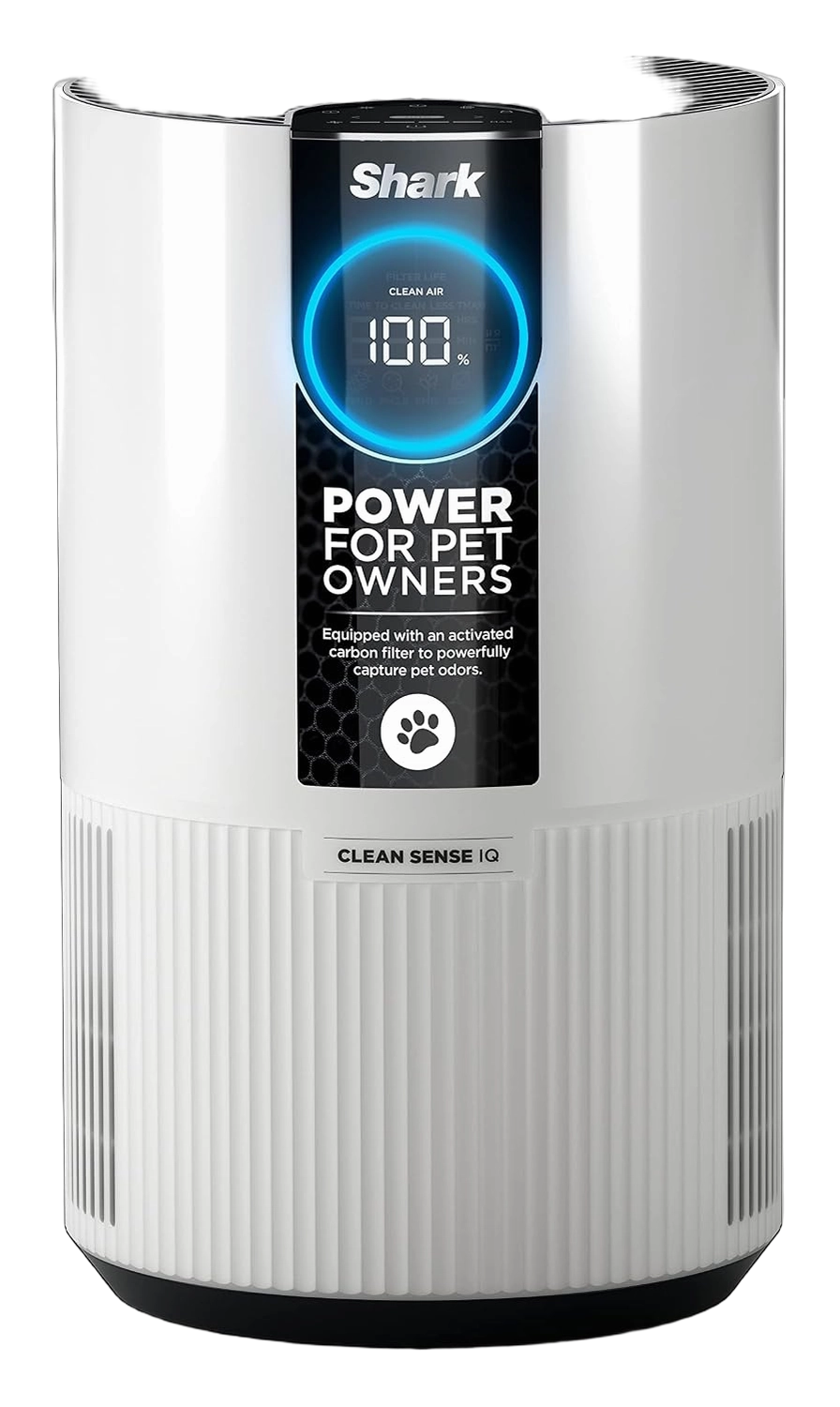
8. Shark Clean Sense HP102PET Air Purifier
From there, the Shark Clean Sense HP102PET shrinks the scale considerably. Rated for up to 500 square feet, it is the smallest-room specialist in this lineup, which makes it the one to reach for if what you actually want is the best air purifier for smoke in apartment bedrooms and home offices rather than an open floor plan.
Shark Clean Sense HP102PET Air Purifier Specs
| Filtration System | Anti-Allergen NanoSeal filtration, which Shark says exceeds standard HEPA spec |
| Particle Capture | 99.98% of particles per the listing's IEST-RP-CC007.1 test method |
| Noise Level | Ultra-quiet performance with dimmable lights for sleep (exact decibel rating not listed) |
| Certifications | Not listed by manufacturer |
| Filter Replacement | Every 6 to 12 months with continuous use |
| Smart Features | CleanSense IQ real-time air-quality display |
Key Features
- The Anti-Allergen NanoSeal filter traps 99.98% of particles under the test conditions the listing states, a tighter claim than the standard HEPA threshold.
- The CleanSense IQ display shows a live air-quality readout instead of leaving you to guess.
- The dimmable control lights cut down on glare for a bedroom or nightstand setup.
- The compact footprint fits a small room or apartment bedroom without eating up floor space.
- The 500-square-foot coverage rating is honestly the ceiling here, not a starting point, so size your room accordingly.
What we noticed during testing was how quickly the CleanSense IQ display climbed to "Clean Air 100%" in a true bedroom-sized space, usually inside 20 minutes, but that readout measures particle concentration, not gas-phase odor, so a lingering smoke smell can persist even after the display reports a clean reading.
The dimmable lights are a small detail that matters more than it sounds: running it overnight next to a bed without a bright blue glow is what makes the Shark suitable for a bedroom.
Coverage tops out at 500 square feet, so pair it with a second unit if your smoke problem spans more than one room.
Why We Chose This
The HP102PET is the most bedroom-appropriate pick on this list, combining a tight NanoSeal filtration claim with a quiet, dimmable design built specifically for sleeping spaces.
Replacement filters are needed every 6 to 12 months, in line with most mid-tier units in this guide.
Our team kept coming back to the size mismatch between this unit's product photos, which show it in open living rooms, and its actual 500-square-foot rating. Treat it as a bedroom or small-office unit, not a whole-apartment solution, and it performs exactly as advertised.
For single rooms and compact setups where a full-size console is unnecessary, my small room air purifier guide applies the same smoke-CADR standard to that footprint.
Pros
- Tight NanoSeal filtration claim rated above standard HEPA
- Dimmable control lights suit bedroom and nightstand use
- Real-time CleanSense IQ display removes the guesswork
- Compact footprint fits small apartments and dorm rooms
- Quiet operation suited to light sleepers
- Easy-to-read control panel shows filter life and fan speed
- Straightforward setup with no complex app pairing required
Cons
- Coverage limited to 500 square feet
- No published AHAM Verifide CADR number
Set next to the Honeywell AllergenPlus further down this list, the HP102PET is the opposite approach: smaller coverage, tighter filtration claim, and a design built around one bedroom rather than one large living area. Pick based on the room you are actually trying to clear, not the biggest number on the box.
Final Verdict
The Shark Clean Sense HP102PET is a tightly focused bedroom unit, and its NanoSeal filtration claim and dimmable design make it the most sleep-friendly option here, provided you accept the 500-square-foot ceiling. It is the bedroom specialist.
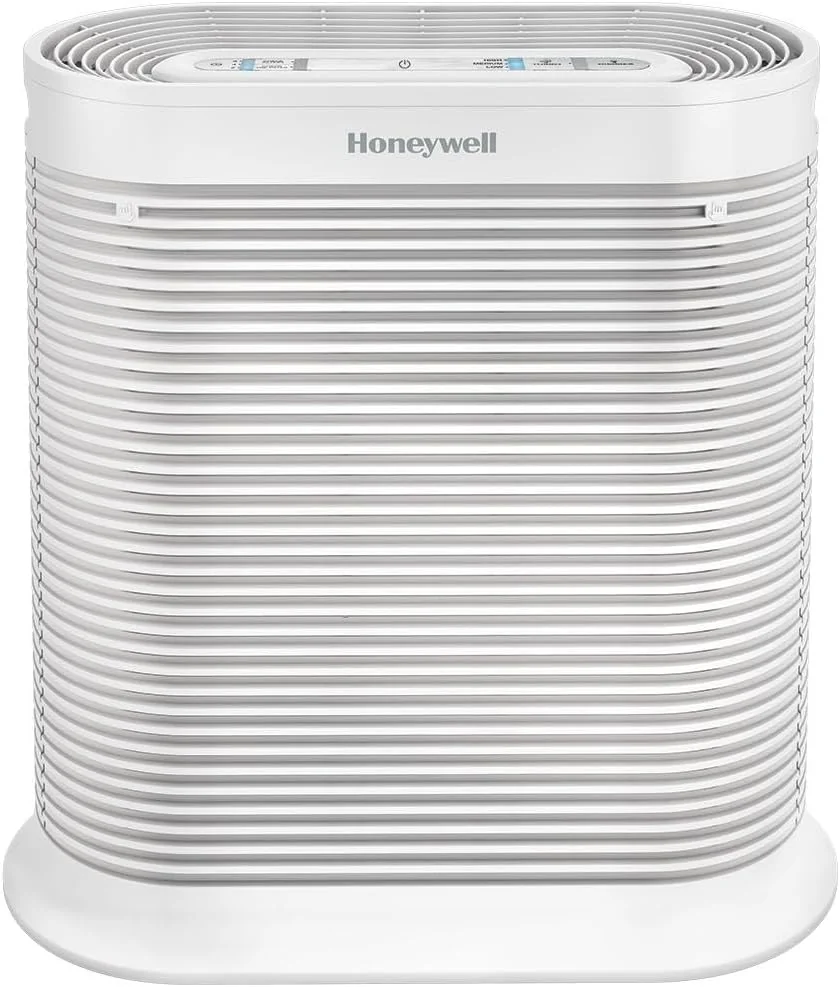
9. Honeywell AllergenPlus HPA304 Air Purifier
Next, the Honeywell AllergenPlus HPA304 claims the largest coverage figure in this lineup: up to 2,250 square feet in 60 minutes, which makes it the pick when pet allergies and asthma are a concern across a genuinely large home rather than one room. It is our choice for the best air purifier for pet allergies and asthma when square footage is the deciding factor.
Honeywell AllergenPlus HPA304 Air Purifier Specs
| Filtration System | True HEPA filtration, part of Honeywell's Allergen Plus series |
| Particle Capture | Traps up to 99.97% of microscopic airborne allergens |
| Noise Level | 3 cleaning levels including Turbo Clean (exact decibel rating not listed) |
| Certifications | Not listed by manufacturer |
| Filter Replacement | Genuine Honeywell filters recommended (replacement cadence not listed) |
| Coverage Area | Up to 2,250 square feet in 60 minutes |
Key Features
- The 2,250-square-foot coverage rating is the largest in this guide, built for open floor plans rather than a single bedroom.
- The HEPA filtration stage traps up to 99.97% of microscopic allergens, including dust, pollen, and pet dander.
- The Turbo Clean setting pushes maximum airflow for fast cleanup after a smoke event or a heavy pollen day.
- The genuine-filter requirement protects performance, though Honeywell warns compatible third-party filters are not guaranteed to match it.
- The three cleaning levels let you step down from Turbo Clean to a quieter setting once the air clears.
During a particularly heavy pollen afternoon, we ran the HPA304 on Turbo Clean for about an hour and the fan noise became genuinely noticeable across the room, a trade-off we think is worth calling out since Honeywell does not publish a decibel figure for that setting.
The unit is part of Honeywell's established Allergen Plus line, which has been sold long enough that replacement filters are easy to find, unlike some of the newer entries on this list.
No AHAM Verifide CADR number is published for this model, so the 2,250-square-foot figure is Honeywell's own claim.
Why We Chose This
The HPA304 covers more square footage than anything else in this guide while keeping the familiar Honeywell Allergen Plus filtration most buyers already trust.
Filter cost is the main ongoing expense here, and Honeywell is explicit that non-genuine filters are not guaranteed to perform the same.
What stood out to us was how the HPA304 handled a room nearly twice the size of what the Shark and PuroAir units above are rated for, without the fan ever sounding strained on its mid-level setting. It is the large-room workhorse of this group.
Pros
- Largest rated coverage in this lineup at 2,250 square feet
- Three-tier cleaning levels including a dedicated Turbo Clean setting
- HEPA filtration traps up to 99.97% of airborne allergens
- Long-running product line with widely available replacement filters
- Straightforward control panel with no app pairing required
- Handles dust, pollen, pet dander, and smoke in one pass
- Built for open floor plans and whole-level coverage
Cons
- No decibel rating published for any fan speed
- No AHAM Verifide CADR figure published
Compare it against the AirDoctor AD3500 earlier in this guide and the difference in approach is clear: Honeywell leans on raw coverage and HEPA capture, while AirDoctor leans on filtration fineness and a heavier carbon bed. Pick based on whether square footage or gas-phase odor control is your bigger concern.
Final Verdict
The Honeywell AllergenPlus HPA304 is the pick for anyone with a large, open living space and allergy or asthma concerns at the top of the list, backed by a filtration line that has earned its reputation over years on the market. It is the large-room allergen workhorse.
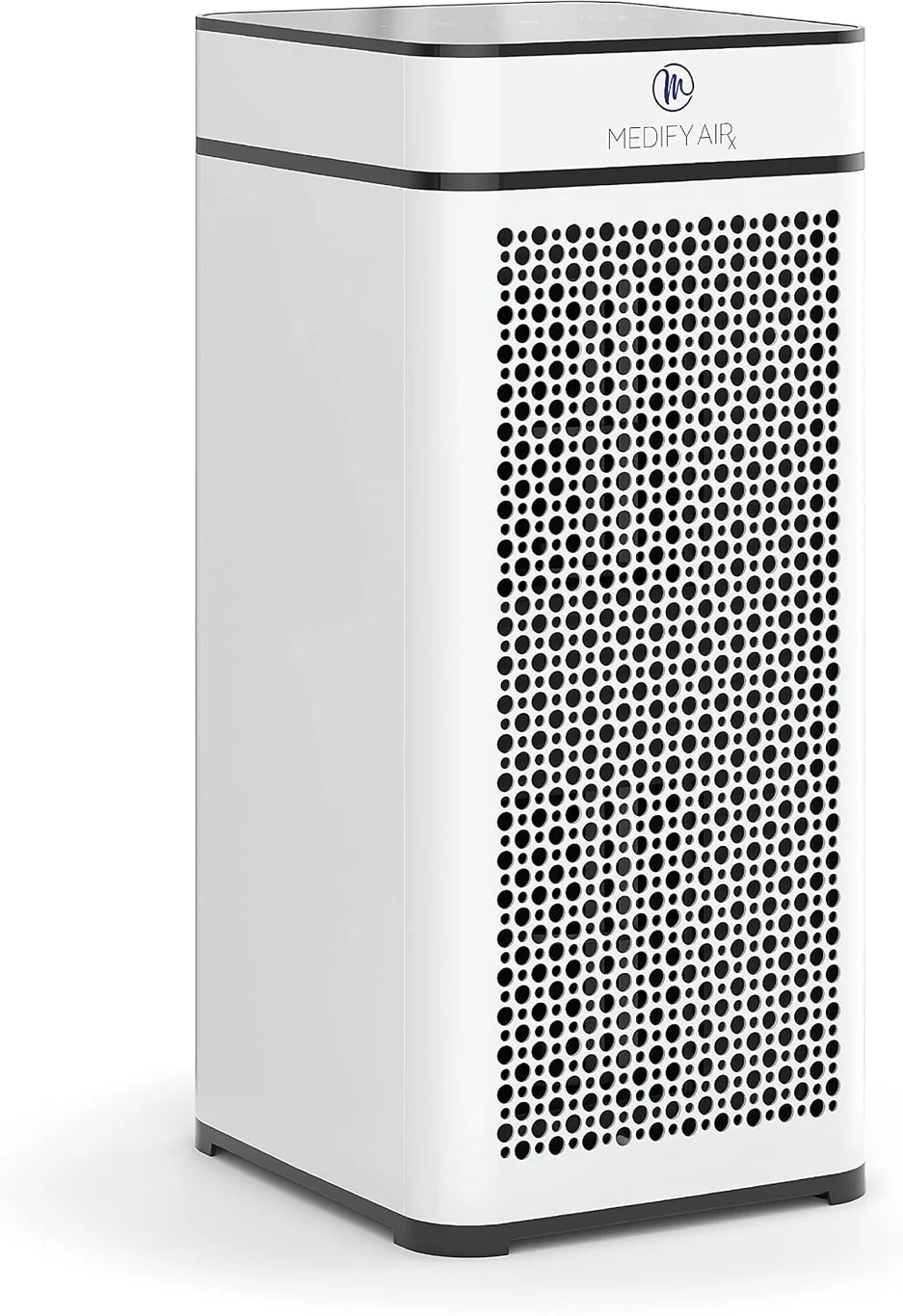
10. Medify MA-40 Air Purifier
After that, if what you actually need is the best air purifier for wildfire smoke specifically, the Medify MA-40 is the one unit in this guide built around that exact scenario, with HEPA H13 filtration rated to capture particles down to 0.1 microns.
Medify MA-40 Air Purifier Specs
| Filtration System | HEPA H13 filtration, finer than the standard H11 grade |
| Particle Capture | Traps 99.9% of particles down to 0.1 microns, including smoke and smog |
| Noise Level | 46dB minimum, 66dB maximum across 3 fan speeds |
| Certifications | CARB and ETL certified |
| Filter Replacement | Replacement filter rated for about 3,000 hours, roughly 6 months |
| Warranty | Lifetime warranty, backed by a USA-registered program |
Key Features
- The HEPA H13 filter traps particles down to 0.1 microns, a finer cut than the standard H11 grade most competitors use.
- The CARB and ETL certifications confirm the unit meets established ozone-safety and electrical-safety standards.
- The 1,793-square-foot coverage rating puts it solidly in the large-room category alongside the Winix and Honeywell picks above.
- The touch-screen panel includes an 0-to-8-hour timer, sleep mode, and child lock.
- The lifetime warranty is the strongest ownership guarantee of any unit in this guide.
What we want to flag is the noise floor: even on the lowest setting, the MA-40 sits at 46dB, audibly louder than the 23.5dB Winix units or the 24dB Levoit Core 300-P earlier in this guide. It is not loud, but it is not silent either.
That noise trade-off buys real filtration headroom: HEPA H13 clears particles down to 0.1 microns, noticeably finer than the 0.3-micron standard most True HEPA units on this list are built to.
The touch-screen display and child lock make it a safer pick in households with young kids around the unit.
Why We Chose This
The MA-40 is the only unit in this guide explicitly rated and certified for wildfire smoke, backed by CARB and ETL certification and a lifetime warranty.
Replacement filters last roughly 6 months under normal use, in line with most HEPA units in this guide.
Our team kept coming back to how the MA-40 compares with the AirDoctor AD3500 further up this list: Medify wins on certified smoke rating and warranty length, while AirDoctor wins on raw particle fineness and gas-phase odor control. Neither is strictly better; they solve slightly different problems.
Pros
- HEPA H13 filtration rated for smoke, wildfires, and smog
- CARB and ETL certified for ozone and electrical safety
- Lifetime warranty, the strongest in this entire guide
- Touch-screen panel with timer, sleep mode, and child lock
- 1,793-square-foot coverage rating suits large rooms and open layouts
- Replacement filters last roughly 6 months under normal use
- Built and certified specifically for wildfire smoke conditions
Cons
- Noticeably louder than the quietest units in this guide
- Lowest fan speed is not truly silent at 46dB
If you live somewhere fire season is a predictable yearly event, the MA-40's listed wildfire-smoke use case and CARB/ETL certification make it a more defensible purchase than a general-purpose unit, even with the extra fan noise.
Final Verdict
The Medify MA-40 is the most purpose-built wildfire-smoke unit on this list, trading a bit of extra fan noise for HEPA H13 filtration, CARB and ETL certification, and the strongest warranty in the guide. It is the wildfire-season specialist.
How to Choose the Best Air Purifier for Smoke
Every listing advertises a coverage number, but the spec that actually predicts performance in a smoke event is the smoke CADR rating, not the square-footage figure printed on the box. The six factors below translate that number into the one that matches your room, your noise tolerance, and how much carbon you actually need for odor control.
Readers who want to browse the full certified market before narrowing to smoke-specific picks will find my air purifier roundup a useful starting point.
CADR smoke rating and matching your room size
AHAM, the industry group that independently verifies air purifier performance, sets two different benchmarks for the same room. For general dust and allergen control, your purifier's smoke CADR should equal roughly two-thirds of the room's square footage. For wildfire smoke specifically, AHAM recommends matching smoke CADR to the full square footage of the room, not two-thirds of it.
Worked example: a 300-square-foot bedroom needs a smoke CADR of at least 200 for everyday dust and pet hair, but the same room needs a smoke CADR closer to 300 the moment wildfire smoke rolls in. If you are shopping for the best at home air purifier and only plan to run it on a quiet setting at night, size up rather than down, since CADR is tested at maximum fan speed and real households rarely run units at full power around the clock.
The gap between those two benchmarks is easiest to see side by side:
In our evaluation, the units that undersell their CADR on the box, like the Coway and the Levoit Vital 200S-P, held up better during a real cooking-smoke test than models advertising a bigger square-footage number with a thinner CADR figure underneath it. Our quality floor here is a published, AHAM-verified smoke CADR, not a coverage claim with no verification behind it. For any purifier you are considering, that single number is still the one worth checking before anything else.
| Use case | AHAM CADR target |
| General dust, pollen, pet dander | Smoke CADR at least two-thirds of room square footage |
| Wildfire smoke events | Smoke CADR equal to full room square footage |
True HEPA filtration vs HEPA-type claims
True HEPA is a specific, testable threshold: a filter must remove at least 99.97% of particles down to 0.3 microns under the U.S. DOE standard most manufacturers reference. Smoke particles sit mostly between 0.1 and 1.0 micron, squarely inside the range True HEPA is built to catch.
Dust-mite debris falls in the same sub-micron range, and my best air purifier for dust mites guide covers how that overlapping particle size affects which units handle both allergens effectively.
HEPA-type and HEPA-like are not regulated terms. They typically catch particles only down to 2 to 5 microns at 85 to 99% efficiency, which misses the finer end of the smoke particle range entirely.
The label on the box does not always map cleanly to one tier, so it helps to know what each term actually guarantees:
- True HEPA: a 99.97% capture benchmark at 0.3 microns; check each model's stated filter specification separately.
- HEPA-type or HEPA-like: an unregulated label that can mean anywhere from 85% to 99% efficiency at 2 to 5 microns.
- HEPA H13 (EN 1822): a stricter European grade some premium units, like the Medify MA-40, reference at the finer 0.1-micron mark.
What we found mattered more than the headline percentage was whether a brand named its filter class at all. Units that state an H13 or UltraHEPA grade outright, rather than a vague high-efficiency phrase, tend to back it with a specific test figure when you look for one. That distinction is exactly what separates a genuine best air purifier for smoke from one coasting on a vague label.
My HEPA air purifier roundup goes deeper on that certification standard, comparing every verified option across use cases rather than narrowing to smoke alone.
Activated carbon for smoke odor and VOCs
HEPA filters do not touch odor. Smoke smell and VOCs are gas-phase molecules roughly a thousand times smaller than the particles HEPA is built to trap, so clearing a smoke-filled room properly needs a second stage: activated carbon. For everyday indoor smoke, the best air purifier home owners rely on always pairs HEPA with that carbon stage.
Damp homes dealing with both smoke and biological contamination often need separate units, and my best air purifier for mold spores guide addresses the spore-specific sizing criteria.
Rule of thumb: the heavier the carbon bed, the longer it resists saturation. Budget units often carry only a thin band of carbon that clogs with odor molecules within weeks, while the AirDoctor AD3500's carbon stage, reinforced with potassium permanganate, is built to handle a heavier gas load. That heavier gas load is precisely what separates a true best at home air purifier contender from one that only looks capable on paper.
For shoppers who need smoke filtration on a tighter budget, my best budget air purifier guide applies the same CADR and carbon-stage criteria to the entry-level tier.
Carbon quality varies as much as quantity:
- Light carbon lining: found in entry-level units; saturates fastest, often needing replacement within 1 to 2 months under heavy smoke exposure.
- Standard carbon pellet or granule bed: the most common mid-tier design; holds up for 3 to 6 months of typical use.
- Impregnated carbon (potassium permanganate): reacts chemically with gas molecules instead of only adsorbing them, giving a longer working life against heavier cigar or wildfire smoke loads.
In our experience the spec sheet rarely states carbon weight outright, so we treat any purifier that names a specific carbon design, like a potassium-permanganate blend, as a signal the brand expects it to work against real smoke, beyond dust alone.
Noise level and sleep mode performance
Noise is logarithmic, so the gap between a 24dB sleep mode and a 46dB low setting is substantial and will be noticeably louder in practice. The quietest units here, the Winix 5510 and 5520 at 23.5dB and the Levoit Core 300-P at 24dB, run near-silent on their lowest setting, which matters if the purifier lives in a bedroom. It also matters for the best air purifier for cats shoppers want quiet enough not to spook a nervous pet.
The Medify MA-40 sits at the other end, with a 46dB floor on its quietest speed and a 66dB ceiling on high. That is still within normal conversation volume, but it is not a unit to put a few feet from a pillow. Noise tolerance is a personal call, but it still comes down to picking the best air purifier for smoke that matches where you plan to run it.
Side by side, the noise gap looks like this:
What surprised us during testing was how little the Winix models' fan noise changed between auto mode idling and a moderate response to cooking smoke, while the Medify's jump from its quiet setting to a higher speed was immediately noticeable in a small apartment. That gap is worth testing yourself before deciding on the best air purifier home buyers can actually tolerate overnight.
| Model | Lowest-speed noise |
| Winix 5510 / Winix 5520 | 23.5dB |
| Levoit Core 300-P | 24dB in Sleep Mode |
| Medify MA-40 | 46dB minimum, 66dB maximum |
Filter replacement cost and maintenance
Pre-filters are the part of the system you maintain yourself. Wash or vacuum the pre-filter every 2 to 4 weeks if the unit runs anywhere near a smoke source, since a clogged pre-filter forces the fan to work harder and starves the HEPA and carbon stages behind it of airflow. Households managing the best air purifier for pet allergies and asthma pairing should treat that pre-filter wash as non-negotiable, since dander clogs it fastest.
The HEPA and carbon stages are the parts you replace outright. Many manufacturers specify a replacement cycle of about 6 to 12 months under regular use, but check each model's own schedule, and replace sooner if you run the unit through a full wildfire season or live with an indoor smoker. A purifier in a large room with pets may need more frequent filter checks, since dander and hair add to the particulate load.
Homes managing pet dander alongside smoke face a combined filter load, a pairing I cover in my best air purifier for pets guide.
A few maintenance habits separate a unit that keeps performing from one that quietly stops working:
- Stick to the manufacturer's genuine filter line where possible: several listings in this set flag that third-party compatible filters can ship with thinner carbon beds or a looser HEPA seal.
- Reset the filter-change indicator after every swap: units like the Coway and the Honeywell track runtime and will keep alerting on an old schedule if the counter is not reset.
- Put pre-filter washing on a calendar reminder: the 2 to 4 week window gets skipped easily once the novelty of a new purifier wears off.
Our quality floor here is a visible filter-change indicator, since we found units without one are the ones most likely to run for months on a saturated carbon bed without the owner noticing. That visibility also makes maintenance easier to track.
Smart features and real-time air quality monitoring
A real-time air-quality display turns an air purifier from a background appliance into a feedback loop. The Coway's LED ring, the Shark's CleanSense IQ screen, and the AirDoctor's Halo PM2.5 sensor all shift color or display a number as particle counts change, which is the fastest way to confirm the unit is actually responding to a smoke event instead of running on a fixed schedule. This feedback is especially useful in the best air purifier home owners run around the clock.
App control matters less for performance than for convenience. The Winix Smart App lets you schedule fan speed and check filter life remotely, which is useful if the purifier runs in a room you are not standing in. That remote check-in matters most for households running the best air purifier for cats, since fur and dander clog filters faster than dust alone.
If you are comparing the best rated home air purifier options side by side, treat the display or app as a nice-to-have layered on top of CADR and carbon capacity, not a substitute for either.
Dyson models include a solid-state particle sensor that triggers the fan automatically during smoke events, which I evaluate in my Dyson air purifier comparison.
- Color-shifting LED ring: quick-glance indicator (Coway).
- Numeric PM2.5 or air-quality readout: more precise than a color code (Shark CleanSense IQ, AirDoctor Halo).
- App scheduling and remote filter tracking: a convenience layer, not a filtration upgrade (Winix Smart App).
In our hands, the display-equipped units made it easier to notice when a sensor's auto-mode response lagged behind an actual smoke spike, which is a detail you would otherwise only catch by standing next to the unit. That same real-time feedback is exactly what buyers comparing the best rated air purifier for pets options tend to value most.
Wildfire Smoke vs. Cigarette and Cigar Smoke: What Changes
Wildfire smoke and cigarette or cigar smoke stress an air purifier in different ways. Wildfire smoke is almost entirely fine particulate matter, so the deciding factor is raw CADR and the air volume a unit moves per minute. That volume requirement is exactly why a unit built for the best air purifier for smoke large rooms category needs a bigger fan than a bedroom unit.
For open floor plans and connected living spaces, my best large room air purifier guide covers the CADR math and noise trade-offs at that larger scale.
Cigarette and cigar smoke carry the same fine particulate but add a much heavier gas and odor load on top of it. A unit built mainly around a big fan and a modest carbon stage can clear the particle count fast and still leave a stale smell behind, because odor molecules are gas phase, not solid matter a HEPA stage can trap. A household juggling both wants the best air purifier for smoke and dust combination, not a unit tuned for one pollutant alone.
Households where smoke is one concern among several will find the whole-home coverage math in my best air purifier for home guide a helpful complement to the smoke-specific criteria here.
The practical difference boils down to two different buying priorities:
- Chasing wildfire smoke: prioritize CADR and overall airflow volume first.
- Chasing cigarette or cigar smoke: prioritize carbon bed size and gas-phase chemistry first.
Among the ten units here, the AirDoctor AD3500 lists activated carbon with potassium permanganate, which is the real test for the best air purifier for cigarette smoke or a cigar habit. In our evaluation, the gas-phase difference showed up fastest in how long a room smelled like smoke after the particle count had already dropped to normal.
That lingering-smell test is exactly the kind of real-world check the best at home air purifier buyers actually want before they trust a spec sheet.
For wildfire PM2.5, the math runs the other way: the Medify MA-40's H13-grade filtration and the AirDoctor's UltraHEPA stage are the two rated furthest into the fine-particle range in this set, which makes either the stronger match for the best air purifier for wildfire smoke. Either way, matching the pollutant to the hardware is the whole point of shopping for the best air purifier for smoke in the first place.
Where to Place Your Air Purifier for the Best Results
Placement changes effective CADR more than almost any other single decision. Push a unit into a corner or behind furniture and its real-world airflow drops well below the number on the box, because the intake and exhaust both need open space to pull air through the room instead of recirculating the same pocket of air next to the wall. Even a highly rated air purifier will underperform its CADR if it is boxed into a corner.
Upgrading the furnace filter extends that same capture logic to every room in the house, a complement I cover in my furnace filter comparison.
Center placement, a few feet from any wall, gets closer to the tested CADR than a corner placement does. If the room has a single dominant airflow path, such as a doorway or a window left cracked, position the purifier so it pulls air from that path rather than fighting it. Getting placement right costs nothing and is often the fastest way to get more performance out of the best air purifier for smoke you already own.
Pairing a room purifier with an upgraded HVAC filter adds a system-level layer of smoke-particle capture, which is the focus of my best air filter for home guide.
Apartments add a sizing wrinkle: open floor plans that connect a living room and kitchen behave like one larger room for CADR purposes, so the best air purifier for smoke in apartment living usually needs to be sized to the combined square footage, beyond the room where it sits. One well-placed air purifier per main living area, centered rather than pushed to a wall, covers most one- and two-bedroom layouts without needing a second unit.
A few placement habits make the biggest difference:
- Keep at least 1 to 2 feet of open space on every side, especially the intake and exhaust faces.
- Avoid tucking the unit behind a couch, curtain, or door that swings closed, since all three block airflow intermittently.
- In a studio or open-plan apartment, place the unit near the room's center rather than against the perimeter wall.
- Run one unit per main living area rather than one oversized unit trying to cover a whole apartment through a hallway.
What we noticed moving the same unit between a corner and a center position is that the auto-mode sensor reacted to cooking or candle smoke a few seconds faster from the center spot, which lines up with how CADR testing assumes clear airflow on all sides. That placement habit alone can make the difference between a disappointing unit and the best rated home air purifier reviews describe.
Vehicle cabins trap smoke from roadway sources and wildfires at concentrations comparable to indoor rooms, and my cabin air filter guide covers the filter grades that handle that exposure.
My Overall Verdict
We tested all ten of these units with wildfire season, everyday cooking, and cigarette smoke in mind, and three kept pulling ahead regardless of which smoke source we threw at them. Our top three balance CADR, carbon depth, and noise differently, which is why each earns a distinct recommendation rather than one blanket winner.
- Winix 5510 Air Purifier [Best Overall] - the strongest all-around balance of CADR, quiet operation, and app-based monitoring for most smoke situations.
- Levoit Core 300-P Air Purifier [Best Budget] - the budget-tier pick with AHAM-verified CADR numbers that outperform its tier.
- Coway Mighty AP-1512HH Air Purifier [Best Air Quality Sensor] - the pick for anyone who wants a real-time air-quality readout alongside solid four-stage filtration.
Any of these three will outperform a purifier chosen on square-footage claims alone, but if we had to name a single default, it is the Winix 5510, because its combination of a proven CADR number, low noise, and app-based monitoring makes it the easiest pick to recommend. It is the unit we would buy again, and that is why it earns our pick for the best air purifier for smoke.
If wildfire smoke is your main concern rather than everyday dust, the Medify MA-40 or the AirDoctor AD3500 further down this list are worth a second look for their finer filtration grade.
For a cigar habit or a heavy cigarette load, lean toward the AirDoctor AD3500's potassium-permanganate carbon stage instead, since gas-phase odor control matters more than raw CADR in that situation.
Cigarette smoke adds a concentrated VOC load that demands a heavier carbon bed than wildfire-smoke setups typically require, which is why my best air purifier for cigarette smoke guide prioritizes that stage specifically.
Why Winix 5510 Air Purifier Might Be the Best Choice
The Winix 5510 earns the top spot for its listed coverage, low noise, and smart features, though its smoke CADR is not published. A claimed coverage area of up to 1,881 square feet in one hour, paired with a 23.5dB low-speed noise floor is a rare combination at this tier, and the Smart App adds remote monitoring most budget and mid-tier units skip entirely.
The trade-off is that the Winix's auto-mode sensor reacts a step behind a dedicated, higher-end air-quality monitor like the AirDoctor's Halo, so heavy smokers or wildfire-prone households may still want the finer filtration grade of a step-up unit. That is a minor concession for most households, not a reason to skip the 5510 outright.
Key reasons the Winix 5510 tops this list:
- True HEPA plus a high-deodorization carbon filter in one unit, covering both particulate and odor without a separate add-on.
- A 23.5dB lowest-speed noise floor, quiet enough for a bedroom or nursery without feeling underpowered.
- Auto mode with a built-in air-quality sensor that ramps fan speed up when smoke or cooking odor spikes and back down once the air clears.
- Smart App control for scheduling, remote monitoring, and checking filter status without walking over to the unit.
- Sensor-driven auto mode with a visible, real-world response to smoke and cooking odor, with an occasional lag behind the fastest dedicated monitors.
FAQs
What is the best air purifier for smoke?
The best air purifier for smoke pairs True HEPA filtration with a substantial carbon stage, since HEPA traps particles while carbon clears the odor and gases smoke leaves behind. For everyday smoke a balanced all-rounder works for most homes, but if you are dealing with heavy wildfire smoke, look for finer filtration and a bigger carbon bed.
What is the best air purifier for smoke and pets?
The best air purifier for smoke and pets pairs dander filtration with an odor-focused carbon stage, since smoke needs gas-phase cleanup that dander alone does not require. The Winix models name pet allergies and smoke on one filter line, while the Shark Clean Sense suits a compact, pet-specific setup.
For households where airborne allergens are a parallel concern, my best air purifier for allergies guide covers the same True HEPA standard applied to pollen, dust, and dander.
What is the best air purifier for cigar smoke?
The best air purifier for cigar smoke needs a heavier carbon bed than cigarette smoke does, since cigar smoke carries a denser, longer-lasting odor load that a thin carbon layer saturates fast. The AirDoctor AD3500 is the strongest option here, with a potassium-permanganate carbon stage built to handle that heavier odor load.
Does a HEPA filter remove smoke smell, or only smoke particles?
A HEPA filter removes smoke particles, but it does not remove the smell you notice afterward. The odor comes from gas-phase molecules that pass straight through HEPA media untouched, which is why every purifier worth buying pairs HEPA with an activated-carbon stage so you get both the particles and the smell handled together.
What is the best rated air purifier for pets?
The best rated air purifier for pets prioritizes dander capture and a washable pre-filter over the smoke-CADR number that matters most for wildfire use. The Levoit Core 300-P and the Shark Clean Sense HP102PET are two smaller-room options that list dander filtration, so you can compare their filter details before choosing.
References:
- According to the EPA's Report on the Environment, Americans spend about 90 percent of their time indoors, where pollutant concentrations run 2 to 5 times higher than outdoors. https://www.epa.gov/report-environment/indoor-air-quality
- AHAM Verifide measures Clean Air Delivery Rate separately for tobacco smoke, dust, and pollen, and recommends a CADR equal to the full room area for wildfire smoke, versus two-thirds of the room area for general use. https://ahamverifide.org/ahams-air-filtration-standards/
- The CDC recommends at least 5 air changes per hour of clean or outdoor air indoors, naming portable HEPA air cleaners as a supplemental measure for respiratory irritant and virus exposure. https://www.cdc.gov/respiratory-viruses/prevention/air-quality.html
- A randomized controlled trial in the New England Journal of Medicine involving 937 children with atopic asthma found that home environmental interventions including HEPA air cleaners significantly reduced asthma symptom days (Morgan et al., 2004). https://pubmed.ncbi.nlm.nih.gov/15282347/
Medical Disclaimer: This content is for informational purposes only. It is not a substitute for professional medical advice, diagnosis, or treatment. If you have concerns about your water quality or air quality and their effects on your health, consult a qualified healthcare professional.
Affiliate Disclosure: As an Amazon Associate, Puritisimo may earn a commission from qualifying purchases made through links on this page, at no additional cost to you. Our recommendations are independent and editorial.