
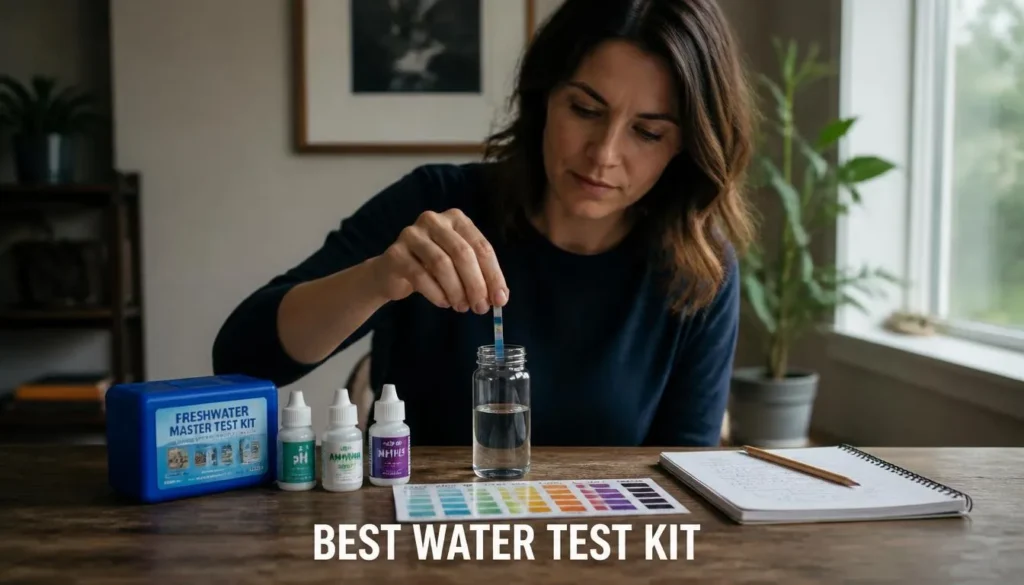

The best water test kit depends on what worries you: a metallic taste, old pipes, or a private well that nobody has checked. The EPA advises that you test a private well every year for bacteria, nitrates and pH, and a home kit is the quickest way to start. A result from your own faucet shows what your plumbing adds, which a utility report cannot.

Below you will find 8 home water test kits, sorted into three types: test strips, bacteria culture tests and mail-in lab kits. Each type answers a different question, so we explain what you get from each. In short, strips screen, bacteria tests look for coliform, and a lab measures. Our Top 3 picks come first if you want a quick answer.
My Recommended Top 3 Best-Buys for Water Test Kits: Reviewed and Rated

- The 116-analyte panel: covers a long list of metals and minerals, coliform and E. coli, disinfection byproducts, nitrates, pH, hardness and alkalinity.
- Prepaid return shipping: the box includes sampling materials, instructions and a return label.
- The lab report: adds filtration recommendations, health guidance and taste evaluation where it applies.

- The 16-parameter strip: covers total hardness, chlorine, alkalinity, pH, nitrate, nitrite, copper, iron, lead, nickel and more.
- 125 strips in the pack: enough for repeated checks across several taps or sources.
- A fast immersion method: add water, set a timer and read the color match.
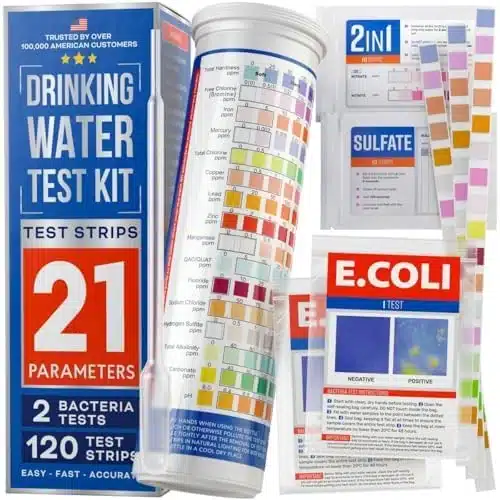
- A multi-parameter strip: reads hardness, lead, iron, copper, chlorine, fluoride and zinc, among others.
- Two bacteria tests: check separately for coliform and E. coli.
- 120 strips: enough for regular checks of tap or well water.
Best Water Test Kit Reviews 2026: 8 Top Models for Home Water
We grouped the 8 kits by method: lab, strips and bacteria. A strip gives a color-match screen that you read by eye, while a mail-in lab report is the reliable route for lead and other health-critical results. A water test that flags a problem should be confirmed that way.
1. Tap Score Advanced Water Test Kit
We start with one of the two mail-in lab kits in this roundup. You collect a sample at home, ship it back with the prepaid label, and the lab reports on 116 analytes, including metals, coliform and E. coli, nitrates and disinfection byproducts. No strip can cover that range.
Tap Score Advanced Water Test Kit Specs
| Kit type | Mail-in lab kit |
| Parameters tested | 116 analytes |
| Bacteria testing | Yes, coliform and E. coli |
| Lead testing | Yes, measured by the lab |
| Test count | 1 sample kit |
| Results time | About 5 business days after the lab receives the sample |
| Best for | A full picture of well or city water |
Key Features
- The 116-analyte panel: covers a long list of metals and minerals, coliform and E. coli, disinfection byproducts, nitrates, pH, hardness and alkalinity.
- Prepaid return shipping: the box includes sampling materials, instructions and a return label.
- The lab report: adds filtration recommendations, health guidance and taste evaluation where it applies.
- Direct chat support: the maker says PhD scientists and engineers answer questions about the kit and the results.
- A 12-month shelf life: the kit stays usable for 12 months after purchase, so you can buy it ahead of time.
We read the report as the main benefit. Results arrive about 5 business days after the lab receives the sample, and the maker says the report explains each result. That matters when a single strip color would leave you guessing what a number means.
Collecting and shipping a lab sample requires following the bottle instructions closely so it reaches the lab in good condition. Follow the bottle instructions closely and plan to ship the box the same day you collect the water.
The maker states its lab network uses ISO/IEC 17025, NELAP and state certified labs.
Why We Chose This
We chose it because a lab panel of 116 analytes gives a fuller picture of well or city water than any strip, which makes it the right first stop for readers who want answers they can act on.
The maker also says Tap Score is not itself a lab, so scope can differ from lab to lab.
We could not confirm the lab accreditation in a state registry, so we treat it as the maker's statement and not as our finding. Check the lab named on your report and recheck the accreditor's listing in case something changed in the meantime.
Pros
- 116-analyte lab panel
- Covers metals, bacteria and nitrates
- Prepaid return label included
- Easy-to-read lab report
- Filtration guidance in the report
- Chat support from scientists
- 12-month shelf life
Cons
- About 5 business days for results
- Premium tier cost versus strips
Our one flag is speed and cost tier. It is slower than a strip and sits in the premium tier, so if you only want to check hardness or chlorine this week, a strip kit is the faster tool. This kit earns its place when the answer needs to be exact.
Final Verdict
Buy it when you want a full, lab-measured picture of your water and can wait about a week; skip it if you only need a same-day screen. It is the default recommendation.
2. TESPERT 16-in-1 Water Test Kit
Next, the budget pick is a strip kit that screens for 16 parameters in about 30 to 60 seconds, according to the maker. You dip a strip, set a timer and match the colors to the chart, which makes it the quickest way here to see whether anything looks off.
TESPERT 16-in-1 Water Test Kit Specs
| Kit type | Test strips |
| Parameters tested | 16 parameters |
| Bacteria testing | No |
| Lead testing | Yes, coarse strip screen |
| Test count | 125 strips |
| Results time | About 30 to 60 seconds |
| Best for | A quick, low-cost first screen |
Key Features
- The 16-parameter strip: covers total hardness, chlorine, alkalinity, pH, nitrate, nitrite, copper, iron, lead, nickel and more.
- 125 strips in the pack: enough for repeated checks across several taps or sources.
- A fast immersion method: add water, set a timer and read the color match.
- Reading tips from the maker: read in daylight, keep the strip horizontal and keep wet fingers away from the pad.
- Live chat and email support: the maker offers support around the clock.
The strip includes an iron pad, so it screens for iron at the same time as hardness and pH. Iron and copper readings are useful if you notice staining or a metallic taste at the tap.
One fact about coverage is worth knowing. Several of the 16 parameters, such as bromine, cyanuric acid and MPS, are pool-style measures that you will ignore for drinking water, so we weigh this kit on hardness, chlorine, nitrate, nitrite, copper, iron and lead.
Read strips in daylight, as the maker advises, because colors keep changing after 60 seconds.
Why We Chose This
We chose it because 125 strips and 16 parameters give a household a wide first screen in the budget tier of this group.
Treat every result as a screen, not a measurement.
For lead, the maker's own note says a result at or below 15 ppb should go to a lab for a more accurate reading. That is the honest limit of any strip, and we would follow the advice before drawing any conclusion about the water.
Pros
- 16 parameters on one strip
- 125 strips per pack
- Results in about 30 to 60 seconds
- Covers lead, iron and copper
- Reading tips and manual included
- Budget tier cost per test
- Live chat and email support
Cons
- Color-match reading is subjective
- No bacteria test
Our one flag is precision. Strips are read by eye, and two people can call the same pad differently, so use this kit to decide whether a lab test is needed, not to replace one. It pairs well with a bacteria test for well owners.
Final Verdict
Buy it for a cheap, fast first screen of a home or well supply; skip it if you need a measured lead or bacteria answer. It is the budget first screen.
3. bestprod 21-in-1 Water Test Kit
Following the budget pick, this is the kit we would hand to a private well owner who wants strips and bacteria checks in one box. It pairs a multi-parameter strip with two separate bacteria tests for coliform and E. coli, plus 120 strips in total.
bestprod 21-in-1 Water Test Kit Specs
| Kit type | Test strips plus bacteria tests |
| Parameters tested | Hardness, lead, iron, copper, chlorine, fluoride, zinc and more |
| Bacteria testing | Yes, 2 tests for coliform and E. coli |
| Lead testing | Yes, strip screen |
| Test count | 120 strips plus 2 bacteria tests |
| Results time | Timer-based strip reading; bacteria tests need incubation |
| Best for | Private well owners |
Key Features
- A multi-parameter strip: reads hardness, lead, iron, copper, chlorine, fluoride and zinc, among others.
- Two bacteria tests: check separately for coliform and E. coli.
- 120 strips: enough for regular checks of tap or well water.
- The guide on the bottle: lines up with each strip, from alkalinity to hardness readings.
- The included data sheet: lets you record readings for later comparison.
As a water test kit for well water, it covers the checks wells usually need first: hardness, lead, iron and copper on the strip, and bacteria in the two tests. The data sheet lets you log each reading and compare it with the next one.
A caution is the naming. Listings and model names give different parameter counts for the strip, so we judge it on the parameters it names and not on the number in the title. What matters is the strip plus two bacteria tests, which is the combination we compared.
The guide on the bottle makes reading a matter of matching colors.
Why We Chose This
We chose it because 120 strips plus two bacteria tests put the two most common well checks in one purchase.
It also carries a data sheet for logging readings.
We read bacteria and chemistry separately. The strips give a quick chemical screen, while the two bacteria tests answer the coliform and E. coli question, which strips cannot. A positive bacteria result is the moment to contact a lab or a well professional.
Pros
- 120 strips in the box
- Two separate bacteria tests
- Covers hardness, lead, iron and copper
- Strip guide printed on the bottle
- Data sheet for recording readings
- Suits both tap and well water
- Simple timer-based method
Cons
- Parameter count differs between listings
- Bacteria tests give presence or absence only
Our one flag is that the strip is still a screen. Plan to confirm any alarming result at a lab, especially for a new well or a household with infants.
Final Verdict
Buy it if you have a private well and want strips and bacteria checks in one box; skip it if you need lab-grade numbers. It is the well owner's starter kit.
4. Tap Score Ultimate Water Test Kit
Stepping up, this is the same maker's deeper lab panel, which reaches more than 250 parameters, including lead, bacteria and VOCs. It is a mail-in kit, so the work is a sample, a cooling supply and a return shipment, not a strip and a timer.

Tap Score Ultimate Water Test Kit Specs
| Kit type | Mail-in lab kit |
| Parameters tested | More than 250 parameters, including VOCs |
| Bacteria testing | Yes, listed with the panel |
| Lead testing | Yes, measured by the lab |
| Test count | 1 sample kit |
| Results time | Reported by the lab after it receives the sample |
| Best for | The widest lab baseline |
Key Features
- The wide contaminant panel: adds VOCs and a far longer contaminant list on top of lead and bacteria.
- Sampling bottles and a cooling supply: the box includes bottles, two strips and cooling supply for the sample.
- Prepaid return shipping: instructions and return labels come in the box.
- The educational lab report: includes health and taste risk assessments plus filtration recommendations.
- Direct chat support: the maker says PhD scientists and engineers answer questions about the kit and the results.
Compared with the Advanced kit, the step up is coverage. VOCs and a much longer contaminant list are the reason to choose it. If your concern is metals, bacteria and nitrates, the Advanced panel already answers it.
We would point this kit at specific situations: a new well, a home near industrial or farm land, or a household that wants one broad record. A baseline you can compare against later is where a wide panel earns its place.
Like its sibling, it carries a 12-month shelf life after purchase.
Why We Chose This
We chose it because a panel of more than 250 parameters is the most detailed option in this group.
The maker states its lab network is ISO/IEC 17025, NELAP and state certified.
We could not verify that accreditation in a state registry, so we repeat it as the maker's claim. Ask which lab will run your sample and recheck its accreditation listing in case something changed in the meantime.
Pros
- Panel of more than 250 parameters
- Covers lead, bacteria and VOCs
- Sampling bottles and cooling supply included
- Prepaid return shipping
- Lab report with health guidance
- Chat support from scientists
- 12-month shelf life
Cons
- Premium tier cost
- Slower than any strip kit
Our one flag is cost tier and speed. This is the most expensive route in this group, and a lab turnaround is slower than any strip. If a screen is all you need, the Advanced kit or a strip pack is the better fit.
Final Verdict
Buy it when you want the widest lab panel, VOCs included; skip it if a strip screen or the Advanced panel already covers your worry. It is the deepest lab panel.
5. Safe Home DIY Bacteria Test Kit
After that, this two-pack is built for a single question: is there coliform bacteria in the water? It tests for coliform bacteria, including E. coli, and nothing chemical, which makes it a focused companion to a strip kit.

Safe Home DIY Bacteria Test Kit Specs
| Kit type | Bacteria culture test |
| Parameters tested | Coliform bacteria only |
| Bacteria testing | Yes, coliform including E. coli |
| Lead testing | No |
| Test count | 2 tests |
| Results time | Positive results may appear after 6 hours; incubate for 72 hours to confirm a negative |
| Best for | Checking a well or tap supply for bacteria |
Key Features
- Detection of 50 coliform species: the maker states it detects 50 species, including E. coli.
- Two tests in the pack: one for the first check and one for a follow-up.
- Early positive detection: a positive result may appear after 6 hours, but a negative result requires the full 72-hour incubation specified by the maker.
- Third-party sterilization: the maker states each kit is sterilized by a certified facility before it ships.
- A clean water donation: the maker says a portion of each sale supports clean water initiatives.
Safe Home also sells a broader kit, and shoppers comparing a safe home ultimate water test kit listing with this one should check the parameter list on the exact version they buy. This pack covers bacteria only, so it will not tell you about lead, hardness or nitrate.
The result is a presence or absence screen, not a count. A positive result means coliform bacteria are present, and that is the moment to contact a lab or a well professional.
We found the wait the main planning point, since incubation can run from 6 to 72 hours.
Why We Chose This
We chose it because it targets coliform bacteria alone, which is the check most well owners need first and the one strips cannot do.
Two tests mean one follow-up check if the first result is unclear.
The maker states that sterilization is done by a third-party certified facility, which is meant to avoid false positives from the kit itself. We could not verify that independently, so check the certificate attached to your kit in case something changed in the meantime.
Pros
- Targets coliform bacteria including E. coli
- Maker states 50 coliform species detected
- Two tests in the pack
- Results as fast as 6 hours
- Sterilized by a third-party facility
- Simple presence or absence answer
- Pairs well with a strip kit
Cons
- Bacteria only, no chemistry or lead
- Wait of up to 72 hours
Our one flag is scope: this kit tests bacteria only. Pair it with a strip kit for chemistry, and use it again after a flood, well work or a change in taste or smell.
Final Verdict
Buy it to screen a well or tap supply for coliform bacteria; skip it if you want chemical results from the same kit. It is the focused bacteria check.
6. HEVEIS 21-in-1 Home Water Test Kit
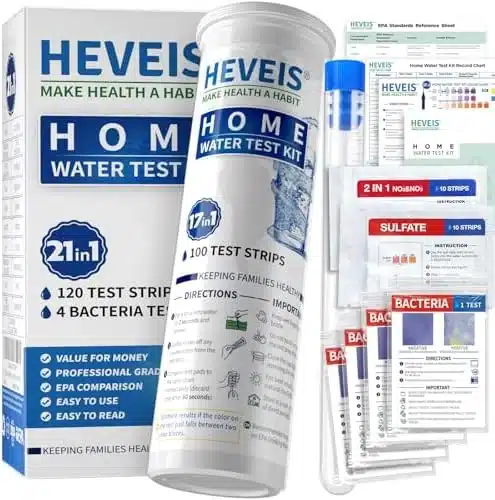
From there, the HEVEIS kit is built around reading and record keeping. It packs 120 strips and 4 bacteria tests with a color chart and a record card, so a household can build a log of readings over time.
HEVEIS 21-in-1 Home Water Test Kit Specs
| Kit type | Test strips plus bacteria tests |
| Parameters tested | Lead, iron, fluoride, pH, copper, hardness and more |
| Bacteria testing | Yes, 4 bacteria tests |
| Lead testing | Yes, strip screen |
| Test count | 120 strips plus 4 bacteria tests |
| Results time | Strips read against a color chart |
| Best for | Easy reading and record keeping |
Key Features
- The 21-in-1 test strips: 120 strips read lead, iron, fluoride, pH, copper, hardness and more.
- Four bacteria tests: add a bacteria check to the strip results.
- An independent color chart: sits beside the strip for a direct comparison.
- The record card: lets you log each result right away for later comparison.
- A sample vial and bonus items: the box includes a sample vial and four bonus items.
Among the home water test kits here, this one makes the color chart and record card the point. You hold the strip against the chart, write the result on the card, and keep the cards to compare one test with the next.
The listing also includes EPA standards reference values as a guide to each reading. That reference book is a reading aid, not a certification, and we would use it only to understand what a color might mean.
The three-step method suits first-time testers.
Why We Chose This
We chose it because a color chart and a record card make results easy to read and easy to track over time.
The listing counts 124 tests across the strips and bacteria tests.
In our hands the clearest gain is consistency. Writing each reading on the card straight away beats trying to remember colors later, and a card for every test makes a trend visible when something changes.
Pros
- 120 strips plus 4 bacteria tests
- Independent color comparison chart
- Record card for tracking readings
- EPA reference values included
- Covers lead, iron, fluoride and copper
- Clear graphic instructions
- Live chat and email support
Cons
- Strips are a color-match screen
- Parameter naming varies in the listing
Our one flag is that the strips remain a color-match screen, and we would not rely on one for trace lead. Send any worrying result to a lab before you act on it.
Final Verdict
Buy it if you want an easy-to-read strip kit with bacteria tests and a built-in log; skip it if you need measured values. It is the easiest kit to log.
7. Qteeyou 8-in-1 Lead Water Test Kit
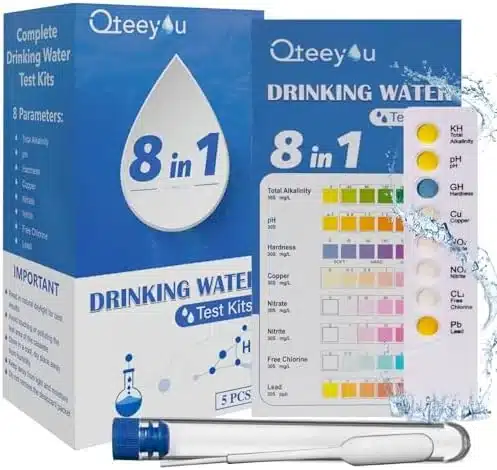
Moving down the list, this is a small kit for a narrow job: a quick lead screen. It comes with 5 strips in 5 sealed pouches, and the 8-in-1 strip reads lead alongside alkalinity, pH, copper, nitrite, chlorine and hardness.
Qteeyou 8-in-1 Lead Water Test Kit Specs
| Kit type | Test strips |
| Parameters tested | 8 parameters |
| Bacteria testing | No |
| Lead testing | Yes, coarse strip screen |
| Test count | 5 strips |
| Results time | About 30 seconds, read within 60 seconds |
| Best for | A one-off lead screen |
Key Features
- Five individually sealed pouches: keep each strip fresh until you open it.
- The 8-in-1 strip: reads alkalinity, pH, copper, nitrite, chlorine, hardness and lead.
- A short wait: add a drop of water to each pad, wait 30 seconds and compare with the chart.
- A long unopened shelf life: the maker says expiry is 2 years from manufacture, and an opened pouch should be used within 90 days.
- Live chat and email support: the maker offers support around the clock.
As a water test kit for lead, it works as a one-off check and not as a household monitoring supply. Each sealed pouch holds a single strip, which keeps the pad fresh until the day you need it.
The small count is the trade-off. Five strips is enough to check a few taps or one suspect source, but not to build a routine, so we would pick a larger pack if you plan to test often.
Each pouch is opened only when you need it.
Why We Chose This
We chose it because individually sealed strips keep a lead screen fresh for the day you need it.
Read results within 60 seconds for the best match.
The strip detects lead only at coarse levels, and EPA's 2024 rule lowers the lead action level to 10 ppb. A lab is the reliable route for lead, so treat any result here as a prompt to send a sample and not as a final answer.
Pros
- 8 parameters on one strip
- Lead reading on the same strip
- Five individually sealed pouches
- Fast read in about 30 seconds
- Two-year unopened shelf life
- Compact and easy to store
- Live chat and email support
Cons
- Only 5 strips in the pack
- Lead reading is coarse
Our one flag is value for repeat testing. With only 5 strips, a household that tests often runs out fast, so choose it for a one-off screen, such as before a home purchase or after a plumbing change.
Final Verdict
Buy it for a quick, low-commitment lead screen; skip it if you want a supply for regular testing. It is the one-off lead screen.
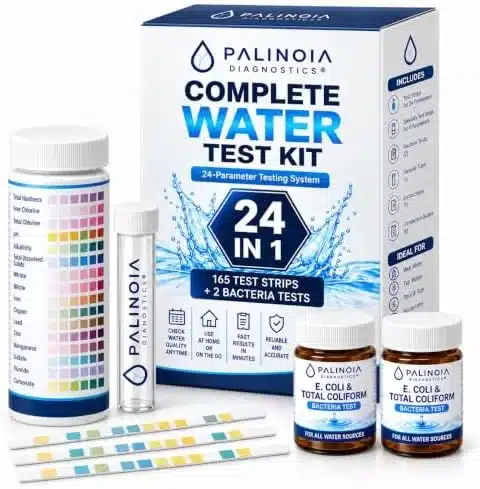
8. Palinoia 24-in-1 Drinking Water Test Kit
Last, the Palinoia kit is the volume play. It includes 165 test strips and 2 bacteria tests, so a household can test many times and still keep a bacteria check in reserve.
Palinoia 24-in-1 Drinking Water Test Kit Specs
| Kit type | Test strips plus bacteria jars |
| Parameters tested | 16 parameters on the main strip, plus specialty strips |
| Bacteria testing | Yes, 2 jars for E. coli and total coliform |
| Lead testing | Yes, strip screen |
| Test count | 165 strips plus 2 bacteria tests |
| Results time | 60 seconds for the main strip |
| Best for | Frequent household testing |
Key Features
- 165 strips in 9 pouches: 125 main strips in five 25-count pouches plus 40 specialty strips in four 10-count pouches.
- 16 parameters on the main strip: read in 60 seconds against the color chart.
- Two bacteria test jars: screen for E. coli and total coliform.
- A reference guide and record log: EPA-based reference values where applicable, plus a log to compare readings over time.
- A storage bottle and sample tube: keep one pouch ready while the rest stay sealed.
We found the pouch layout the practical detail. Opening one 25-count pouch at a time and keeping the rest sealed spreads the supply across many separate checks.
The name on the box and the item listing give different in-one counts, so we judge the kit on what it lists: 165 strips, 16 parameters on the main strip and two bacteria jars.
No electronic reader is needed, only the color chart and a timer.
Why We Chose This
We chose it because 165 strips is the largest strip supply in this group, with bacteria jars included.
The record log helps you compare readings over time.
In our hands the specialty strips are the part to read carefully, because each has its own instructions. Follow the individual instructions for specialty and bacteria tests and not the main strip's 60-second window.
Pros
- 165 strips in nine pouches
- 16 parameters on the main strip
- Two bacteria test jars
- Reference guide with EPA-based values
- Record log included
- No electronic reader needed
- Storage bottle and sample tube
Cons
- Specialty strips need separate instructions
- In-one count differs across the listing
Our one flag is that it is still a color-match screen, and the large count only helps if you actually test often. For lead near the action level, send a sample to a lab.
Final Verdict
Buy it if you test often and want strips plus bacteria jars in one box; skip it if you only need a one-off check. It is the high-volume option.
How to Choose the Best Water Test Kit
Choosing a kit comes down to one question: what do you need to find out about your water? We worked through six checks with that question in mind: kit type, parameters, lead detection, bacteria testing, readability and test count. Each one changes what a kit can and cannot tell you.
Kit type: test strips, bacteria culture or mail-in lab
Home kits come in three forms, and each one answers a different question. Strips give a quick color-match screen, a bacteria culture shows whether coliform is present, and a mail-in lab report measures a long list of contaminants. In our experience the form of the kit matters more than the name on the box.
Here is what each form is built to do:
- Test strips: dip, wait and compare the color to a chart, which suits hardness, chlorine, pH and a rough metals screen.
- Bacteria culture: a presence or absence result for coliform bacteria, which chemical strips cannot give.
- Mail-in lab: you collect a sample, ship it back and receive a written report, such as the roughly 5 business day turnaround the maker states for the Tap Score Advanced Water Test Kit.
The table below sets the three forms side by side:
Rule of thumb: use strips to monitor and a lab to decide. Varify, which we did not rank, also sells a strip-and-bacteria kit; check the test method and contaminant list on the exact kit before buying.
| Kit type | Best for | Main limit |
| Test strips | Fast, low-cost screening and routine checks | Color is read by eye and gives coarse results |
| Bacteria culture | Private wells and after well work | Presence or absence only, no count, and a wait for results |
| Mail-in lab | A full, measured picture of a sample | Slower and more expensive than strips |
Parameters the kit covers
A bigger number on the box does not always mean more useful information. What we found mattered more than the headline count was whether the kit covers the contaminants that fit your water source. A city household mostly cares about chlorine, lead and copper, while a private well adds bacteria, nitrate and iron.
Look for these parameters first:
- Chlorine, pH, hardness and alkalinity: the everyday readings that explain scale, taste and pipe corrosion.
- Lead and copper: the metals tied to older plumbing and the reason many households buy a kit.
- Nitrate and nitrite: the readings that matter most for wells near farmland.
- Iron: an elevated strip reading may help explain rust staining or a metallic taste, especially in well water.
Be careful with inflated counts. The TESPERT 16-in-1 Water Test Kit, for example, lists bromine, cyanuric acid and MPS among its 16 parameters, and those are pool-water measurements that tell you little about drinking water. Count only the parameters that apply to what comes out of your tap.
Lead detection limits
Lead is the contaminant most people buy a kit for, and it is also where strips are weakest. A lead in water test strip works as a coarse color screen, so a clean-looking strip does not prove your water is below the action level. EPA's 2024 rule lowers the lead action level to 10 ppb, and many strips only react at coarser levels. If you find lead, our water filter for lead picks list their certifications.
Our quality floor is simple: a kit that screens for lead should tell you when to send a sample to a lab. The TESPERT listing, for instance, advises a lab test when a lead result is at or below 15 ppb, and that advice is the right habit for every strip on this list.
Use this rule when you read a lead result:
- No color change: treat it as a screen only, not as a clearance.
- Any visible lead reading: confirm it with a lab before you act on it.
- Young children in the home: skip strips and order a lab report from the start.
Bacteria testing for well water
A private well has no utility checking it for you, so bacteria testing is the one check a well owner should not skip. A water test for well water should always include coliform, because chemical strips cannot detect it. The EPA advises testing a private well every year for total coliform bacteria, nitrates, total dissolved solids and pH.
Bacteria kits are presence or absence screens, not counts. The Safe Home DIY Bacteria Test Kit, for example, states it detects 50 coliform species with results in as little as 6 hours and up to 72 hours depending on incubation. A positive result is a signal to act, not to measure.
Test sooner than your yearly schedule after:
- A change in water: any new taste, odor or color.
- Flooding: surface water can reach the well head.
- Well work: repairs, a new pump or any other service on the well.
In our experience people read a clear bacteria result as a clean bill of health, but it only describes the day you took the sample.
Readability of results and record keeping
A strip you cannot read with confidence is a wasted strip. Every strip kit here relies on color matching by eye, so lighting and timing change the result as much as the chemistry does. Read strips in daylight, hold them flat, keep wet fingers away and read within the stated window.
What we noticed when comparing the instructions is that the color chart matters more than strip count. A clear printed chart and a record card make it far easier to compare results month to month. The HEVEIS 21-in-1 Home Water Test Kit includes a color chart and a record card, and the Palinoia 24-in-1 Drinking Water Test Kit includes a color chart and a record log.
Bottom line: if you plan to test more than once, pick a kit that helps you write results down.
Test count and shelf life
Test count decides what a kit is for. The Qteeyou 8-in-1 Lead Water Test Kit has only 5 strips in sealed pouches, which suits a one-off lead screen, while the Palinoia 24-in-1 Drinking Water Test Kit offers 165 strips and 2 bacteria tests for regular monitoring.
Check these dates and limits before you buy a multipack:
- Strip expiry: the Qteeyou strips expire 2 years from manufacture and should be used within 90 days of opening.
- Lab kit shelf life: the maker states 12 months for the Tap Score kits.
- Spoilage: damp or heat can ruin strips long before the printed date.
In our experience a big pack that goes stale unused is worse value than a small pack you finish. Buy the count you will use within a year.
When a home test kit is not enough
A home water test is a screen, and some situations call for more than a screen. Send a sample to a lab when any of the cases below apply. The EPA also advises testing sooner after any change in taste, odor or color.
Go straight to a lab when:
- A new well: you need a baseline before anyone drinks from it.
- An infant in the home: formula is mixed with tap water every day.
- A positive bacteria result: confirm it and get guidance on next steps.
- A lead reading near the action level: strips are too coarse to settle it.
- After flooding or well work: conditions may have changed overnight.
Hardware stores such as Home Depot sell different types of water test kits. Check whether the kit uses strips, bacteria cultures or mail-in laboratory analysis; the retailer does not determine the testing method or its limits.
If a test does show a problem, a filter is the usual next step. Pick the treatment only after you know what you need to remove, because each filter type handles a different list of contaminants.
My Overall Verdict
Three kits cover most households: the Tap Score Advanced Water Test Kit for depth, the TESPERT 16-in-1 Water Test Kit for value and the bestprod 21-in-1 Water Test Kit for wells. Each one answers a different question, so match the kit to the problem you want to solve.
- Tap Score Advanced Water Test Kit [Best Overall] - A mail-in lab kit that reports on 116 analytes, with results about 5 business days after the lab receives your sample.
- TESPERT 16-in-1 Water Test Kit [Best Budget] - A 125-strip kit that checks 16 parameters, including lead, with a reading in about 30 to 60 seconds.
- bestprod 21-in-1 Water Test Kit [Best for Well Water] - A multi-parameter strip kit with 120 strips and two separate bacteria tests, a practical pairing for a private well.
Choose the Tap Score Advanced Water Test Kit if you want a full lab report, the TESPERT 16-in-1 Water Test Kit if you want a low-cost screen for regular checks, and the bestprod 21-in-1 Water Test Kit if a private well is your main concern. Strips screen and labs confirm, so use them together when the stakes are high.
Picks 4 to 8 suit narrower jobs: premium lab depth, bacteria only, easy-read strips, a lead screen and a high strip count.
Start with your water source and the question you need answered, and you will find the best water test kit for your home.
Why Tap Score Advanced Water Test Kit Might Be the Best Choice
The Tap Score Advanced Water Test Kit provides a lab report on 116 analytes instead of asking you to read a color. That covers metals, coliform and E. coli, disinfection byproducts, nitrates, pH, hardness and alkalinity.
The trade-off is speed. Results take about 5 business days after the lab receives your sample, so it is not a tool for a quick check, and the maker says Tap Score is not itself a lab. In our view that wait is a fair price for a measured report.
What makes it our top pick:
- 116 analytes: a measured report instead of a color match.
- Accredited lab network: the maker states its labs hold ISO/IEC 17025, NELAP and state certification, and scope varies lab to lab.
- Report and filtration guidance: results come with next steps if something is found.
- Prepaid return label: you ship the sample without paying postage.
- Expert chat support: the maker offers chat with PhD scientists.
SHOP ON AMAZONAvailability and current price shown on Amazon
FAQs
What is the best water test kit for home use?
The best water test kit for home use depends on what you need to learn, so a mail-in lab kit gives the fullest picture while multi-parameter strips give a quick screen. If you rely on a private well, add a bacteria test, because strips alone cannot detect coliform bacteria in your supply.
How accurate are home water test strips?
Home water test strips are accurate enough to flag an obvious problem, but they are a color-match screen and not a precise measurement. If a strip shows anything alarming, you should confirm it with a lab test, because reading colors by eye cannot separate small differences at trace levels in your water.
How often should you test well water?
You should test well water at least once a year for total coliform bacteria, nitrates, total dissolved solids and pH, as the EPA advises. Test sooner if the taste, odor or color of your water changes, or after flooding, repairs or other work on the well, and keep each result so you can spot trends.
Can a home kit test for lead in water?
A home kit can test for lead in water as a rough screen, but strips only react at coarse levels, so a clean-looking strip does not clear your tap. You should send a sample to a lab when a result is near the action level, because a lab is the reliable route for lead.
Do you need a lab test instead of a home kit?
You need a lab test instead of a home kit for anything that affects your health or safety, such as a new well, an infant in the home, a positive bacteria result or a failed screening result. Strips work well for routine checks at home and for tracking hardness, chlorine and pH between lab tests.
References:
- US EPA, "Protect Your Home's Water": private well testing advice. https://www.epa.gov/privatewells/protect-your-homes-water
- US EPA, "Lead and Copper Rule Improvements": the 2024 lead action level of 10 ppb. https://www.epa.gov/ground-water-and-drinking-water/lead-and-copper-rule-improvements
- US EPA, "National Primary Drinking Water Regulations": federal contaminant standards. https://www.epa.gov/ground-water-and-drinking-water/national-primary-drinking-water-regulations
- CDC, "Lead in Drinking Water": sources of lead and prevention steps. https://www.cdc.gov/lead-prevention/prevention/drinking-water.html
Medical Disclaimer: This content is for informational purposes only. It is not a substitute for professional medical advice, diagnosis, or treatment. If you have concerns about your water quality or air quality and their effects on your health, consult a qualified healthcare professional.
Affiliate Disclosure: As an Amazon Associate, Puritisimo may earn a commission from qualifying purchases made through links on this page, at no additional cost to you. Our recommendations are independent and editorial.