


The best co2 monitor tells you when a room needs fresh air before you feel it. A closed bedroom door overnight or a packed meeting room can leave the air stuffy and make you drowsy, and a live CO2 reading in parts per million shows how well that room is ventilated. It is a ventilation indicator, not a medical device.

Only four real CO2 sensors made our final list, and each one suits a different setup. If you want a co2 monitor for home use, you can choose a battery-powered e-ink unit, a low-cost USB unit, an app-linked unit that stays plugged in, or a desktop data logger with built-in trend charts. Below, you will see how each one handles sensor type, display, power and history.
My Recommended Top 3 Best-Buys for CO2 Monitors: Reviewed and Rated
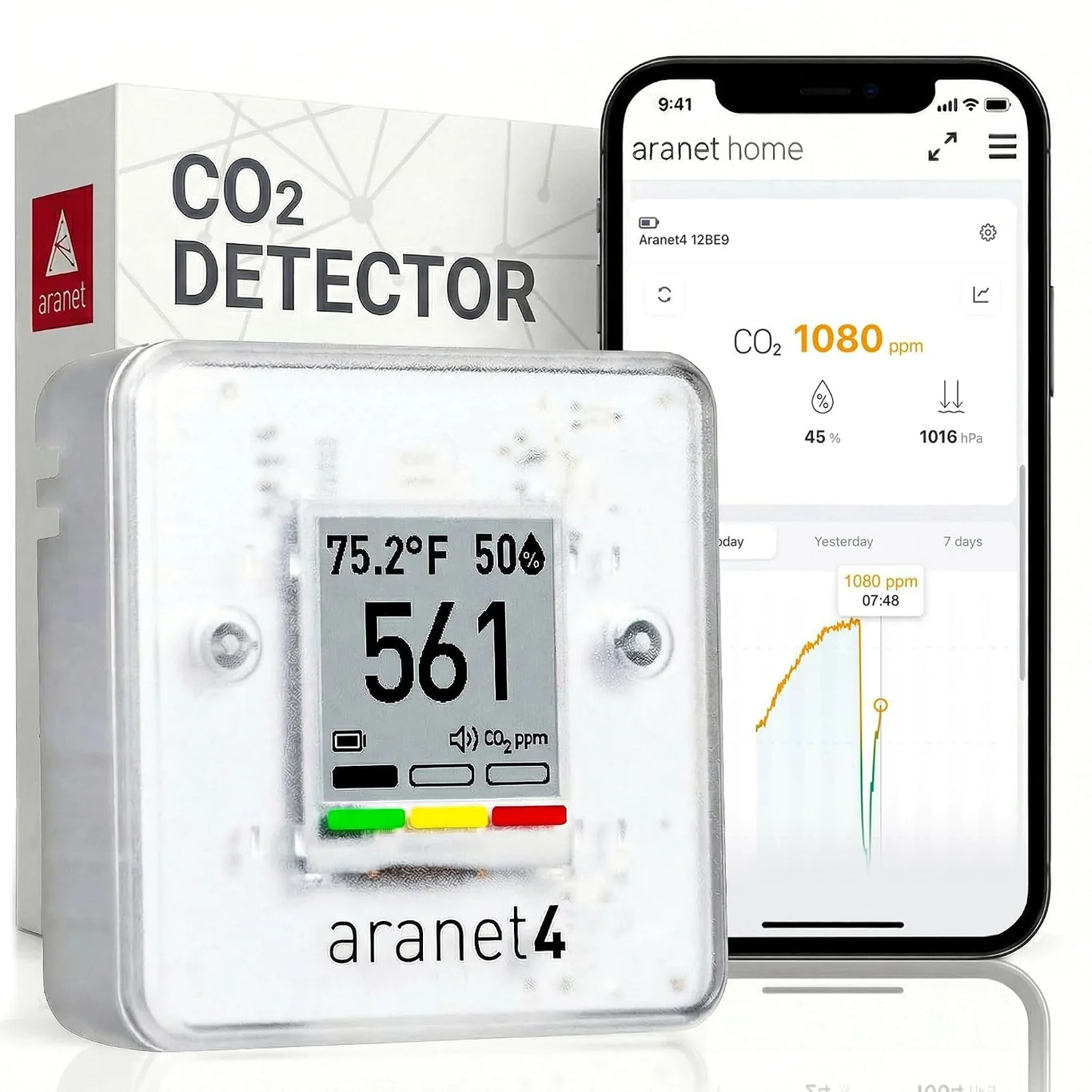
- The NDIR sensor reads CO2 directly instead of estimating it from other gases.
- The e-ink display stays readable at a glance and sips power.
- Battery life of up to 4 years on two AA batteries, per the listing, means no cable on the desk.
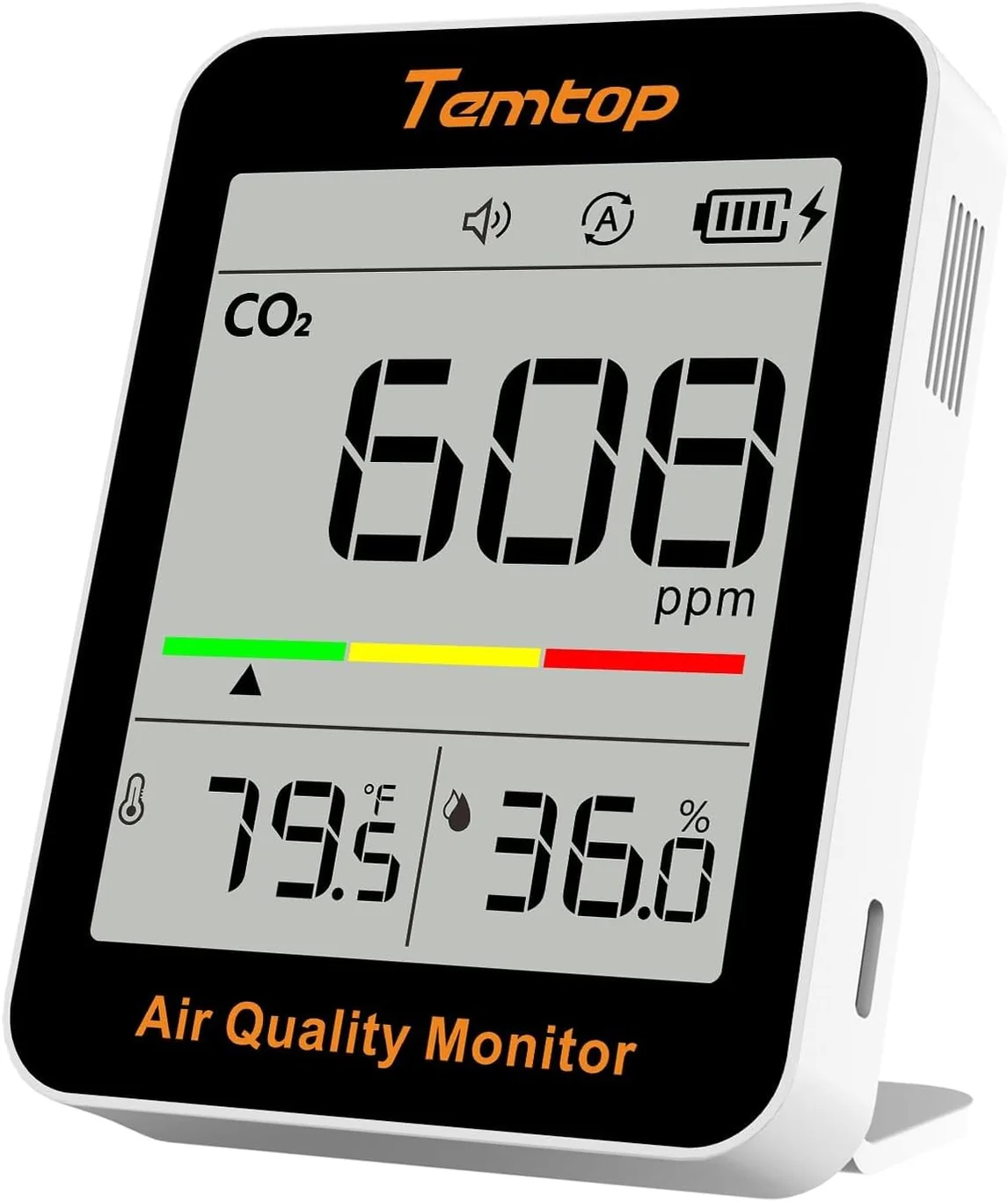
- The Sensirion SCD41 sensor is what the maker lists, with accuracy of +/-40 ppm plus 5% of reading from 400 to 2500 ppm.
- The 5-second refresh and 1 ppm resolution let you watch a reading move as a room changes.
- Mounting options with a bracket let you stand the unit up or hang it.
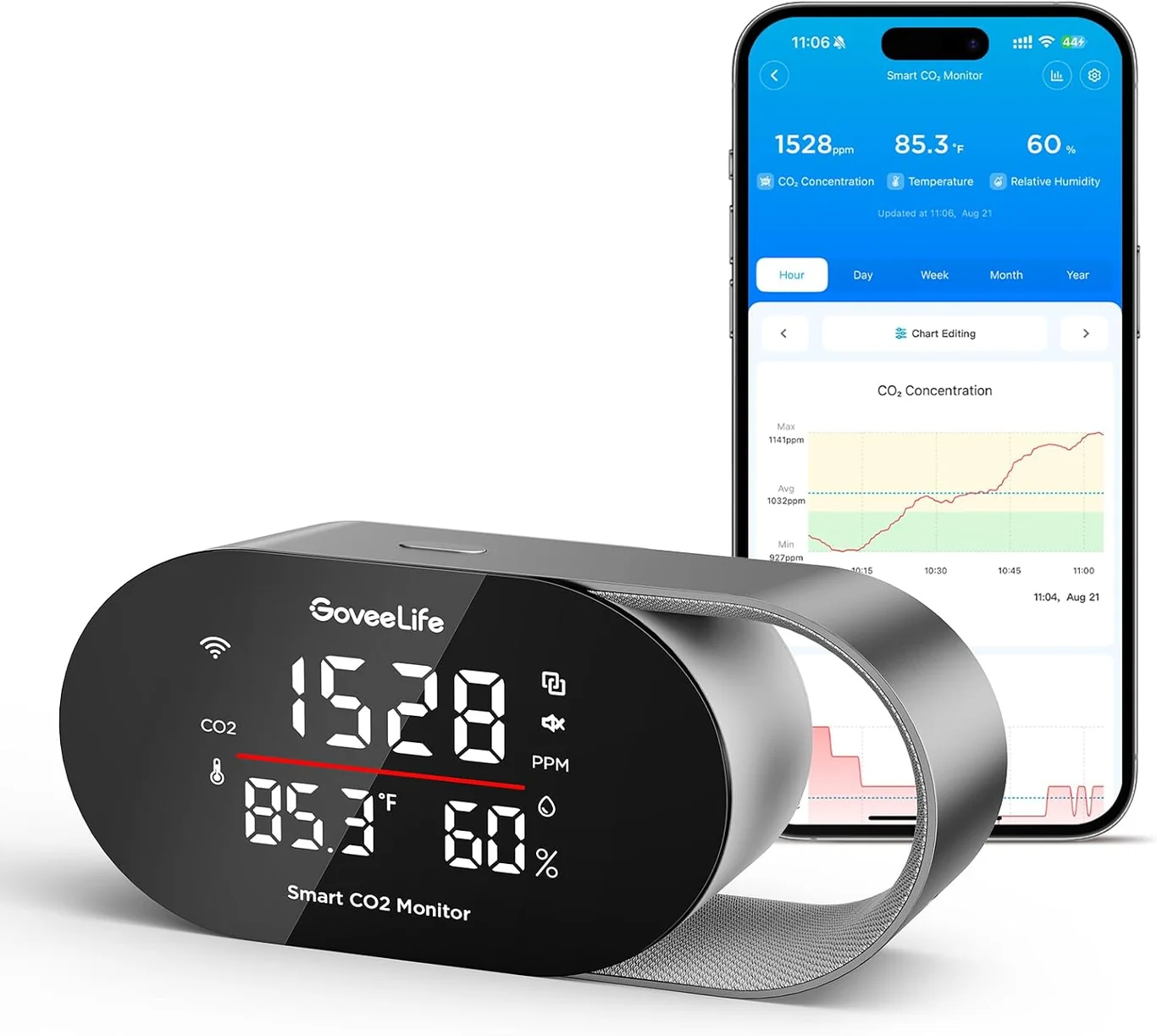
- The 4-in-1 display shows CO2, temperature, humidity and a clock that needs the app connection.
- The triple alert system uses a buzzer, app notifications and email reports when a threshold is crossed.
- The tri-color light bar dims on a day and night schedule set in the app.
Best CO2 Monitor Reviews 2026: 4 Reviewed Models for Everyday Air Checks
Every unit below uses a real CO2 sensor, not a guess inferred from other gases. We grouped the four by how they are powered and how they show the reading, because those two choices shape daily use more than any spec line. Accuracy figures are the makers' own claims, so read each one as a stated number rather than a lab result.
1. Aranet4 Home Wireless CO2 Monitor
The Aranet4 home CO2 monitor is the unit we reach for first, because it gives you a direct NDIR CO2 reading with no outlet needed. The e-ink screen shows one large number, so a glance across the room tells you whether the air needs refreshing.
Aranet4 Home Wireless CO2 Monitor Specs
| Sensor Type | NDIR (nondispersive infrared) |
| CO2 Range | Accuracy specified over 0 to 5000 ppm |
| Stated Accuracy | Specified by the maker at 15 to 35C and 0 to 80% humidity |
| Other Readings | Temperature, relative humidity, atmospheric pressure |
| Power | 2 AA batteries, up to 4 years per the listing |
| Display and Alerts | E-ink screen, color-coded status, optional buzzer |
Key Features
- The NDIR sensor reads CO2 directly instead of estimating it from other gases.
- The e-ink display stays readable at a glance and sips power.
- Battery life of up to 4 years on two AA batteries, per the listing, means no cable on the desk.
- The companion app shows up to 90 days of history as graphs.
- Color-coded status and an optional buzzer flag a reading that has climbed too high.
What we noticed in daily use is that the number matters more than any extra feature. The unit also reports temperature, humidity and atmospheric pressure, so one 2.76 by 2.76 inch body replaces a separate thermometer and hygrometer.
The maker's brochure specifies accuracy over a 0 to 5000 ppm range at 15 to 35C, and the manual recommends 10 to 40C and 20 to 60% humidity for best results. In practice that means you keep it out of a cold garage or a steamy bathroom.
Setup is short: insert the batteries, then pair the app only if you want history.
Why We Chose This
We chose the Aranet4 because it combines a real NDIR CO2 sensor, a battery that lasts for years per the listing and a screen anyone can read in one small body.
With no cable to unplug, it stays wherever you put it.
The trade-off is cost tier. This unit sits in the premium tier of this group, and what you pay for is a calm, clear reading. That is exactly what a CO2 monitor for office meetings or a home workspace needs most.
Pros
- Direct NDIR CO2 reading
- Battery lasts up to 4 years per the listing
- E-ink screen readable at a glance
- Also reads temperature, humidity and pressure
- Up to 90 days of history in the app
- Optional buzzer for high readings
- Made in the European Union
Cons
- Sits in the premium cost tier
- History viewing needs the phone app
Where reviewers tend to understate the case is the battery. A monitor you never have to recharge gets used every day, and a monitor that gets used is the one that catches a stuffy room.
Final Verdict
Buy the Aranet4 if you want one dependable CO2 reading with no cable and no fuss, and you accept the higher cost tier. It is the default recommendation.
2. Temtop Portable CO2 Monitor
Next, the Temtop is our budget pick, a CO2 monitor portable enough to carry between rooms. The maker lists a Sensirion SCD41 sensor with a 5-second refresh.
Temtop Portable CO2 Monitor Specs
| Sensor Type | Sensirion SCD41 photoacoustic NDIR per the listing text (the spec table says Photoelectric) |
| CO2 Range | Accuracy listed over 400 to 2500 ppm |
| Stated Accuracy | +/-40 ppm plus 5% of reading, 1 ppm resolution |
| Other Readings | Temperature and humidity |
| Power | USB cable; battery listed at about 70 days in power-saving mode |
| Display and Alerts | Buzzer alarm; buzzer and display light can be switched off |
Key Features
- The Sensirion SCD41 sensor is what the maker lists, with accuracy of +/-40 ppm plus 5% of reading from 400 to 2500 ppm.
- The 5-second refresh and 1 ppm resolution let you watch a reading move as a room changes.
- Mounting options with a bracket let you stand the unit up or hang it.
- Customizable settings let you turn off the buzzer and the display light for a quiet night.
- The USB cable and bracket come in the box, and the listing recommends USB power for the fastest refresh.
Our one flag: the maker text names a Sensirion SCD41 photoacoustic sensor, but the Amazon spec table lists the sensor type as Photoelectric. We treat that as a listing conflict on sensor type and quote the maker's claim as a claim, not as something we verified.
The listing specifies a 5-second refresh. We would use the readings to follow ventilation changes, while allowing time for the sensor to respond.
It is meant to stay plugged in for real-time mode, per the listing.
Why We Chose This
We chose the Temtop because it offers a Sensirion-based CO2 reading, a quick refresh and a quiet mode in the lowest cost tier of the four.
For nurseries and sleeping rooms, the option to switch off the buzzer and light matters.
Power is the weak spot. The maker lists about 70 days of battery in power-saving mode and 30 days in performance mode, and the listing recommends USB power for the fastest refresh, so keep a USB cable or power bank handy.
Pros
- Lowest cost tier of the four
- Sensirion SCD41 listed by the maker
- 5-second refresh
- 1 ppm resolution
- Buzzer and display light can be switched off
- Bracket and mounting options included
- Also reads temperature and humidity
Cons
- USB recommended for the fastest refresh
- Sensor type conflicts between listing and spec table
Where the listing is easy to misread is the battery: 70 days of standby is not 70 days of live monitoring. We would treat this as a plugged-in unit that can also travel.
Final Verdict
Buy the Temtop if you want a real CO2 reading at the lowest cost and you have a USB outlet nearby. It is the cheapest serious unit of the four.
3. GoveeLife H5140 Smart CO2 Monitor
Stepping up, the GoveeLife H5140 is a wall-powered unit with a 4.82-inch display and a tri-color light bar. We would pick it for a nursery or a bedroom, because the light bar follows a day and night schedule.
GoveeLife H5140 Smart CO2 Monitor Specs
| Sensor Type | CO2 sensor (Sensirion SCD4x reported by third-party sources) |
| CO2 Range | Not stated in the listing |
| Stated Accuracy | Not stated in the listing; +/-(40 ppm + 5%) reported by third-party sources |
| Other Readings | Temperature, humidity, clock (clock needs the app) |
| Power | AC outlet via Type-C cable, no battery |
| Display and Alerts | 4.82-inch display, tri-color light bar, buzzer, app and email alerts |
Key Features
- The 4-in-1 display shows CO2, temperature, humidity and a clock that needs the app connection.
- The triple alert system uses a buzzer, app notifications and email reports when a threshold is crossed.
- The tri-color light bar dims on a day and night schedule set in the app.
- App history holds up to two years of data, with CSV export.
- Voice assistant support lets you ask Alexa or Google Assistant for the CO2 reading.
Among the four, this one has the broadest feature list, which makes it a CO2 monitor for home use that can also link to a humidifier or tower fan. The listing is clear that air purifiers cannot reduce CO2, so it does not link to one.
On sensor and accuracy, the Amazon listing says only that it has a CO2 sensor. Third-party sources report a Sensirion SCD4x sensor and accuracy of +/-(40 ppm + 5%), which we pass on as reported, not as a maker-stated figure.
It needs an outlet, because power is AC only with no battery.
Why We Chose This
We chose the GoveeLife because it pairs a large display with a dimmable light bar and three alert types for rooms where people sleep.
Two years of history lets you compare seasons as well as days.
The night dimming schedule is what stood out to us. It makes this a CO2 monitor for bedroom use that does not light the room, while the buzzer and app alerts still work.
Pros
- Large 4.82-inch display
- Tri-color light bar
- Dimming schedule for sleeping rooms
- Buzzer, app and email alerts
- Two years of app history with CSV export
- Alexa and Google Assistant support
- No batteries to replace
Cons
- Needs an AC outlet
- Clock and history need the app
Our one reservation is app dependence. The clock, the history and the email reports all rely on the phone app, so this unit is less useful on its own than the Aranet4.
Final Verdict
Buy the GoveeLife if you have an outlet near a bed or desk and want alerts you can see, hear and read. It is the bedroom-friendly pick.
4. Autopilot Desktop CO2 Monitor and Data Logger
Finally, the Autopilot is a data logger first and a room display second. It comes from Hydrofarm, a grow-room supplier, so the design is utilitarian, but the 2-channel NDIR sensor suits homes and workshops too.

Autopilot Desktop CO2 Monitor and Data Logger Specs
| Sensor Type | 2-channel low-drift NDIR |
| CO2 Range | 0 to 5000 ppm |
| Stated Accuracy | +/-50 ppm or 5% of reading (greater) up to 3000 ppm, 7% above |
| Other Readings | Temperature and relative humidity |
| Power | Micro-USB cable and AC adapter; battery pack not included |
| Display and Alerts | Digital display with 24-hour or 7-day trend chart, audible alarm |
Key Features
- The 2-channel low-drift NDIR sensor is the sensor the listing names.
- The trend chart records CO2, humidity and temperature over a 24-hour or 7-day period.
- The audible alarm sounds for low or high CO2 levels.
- The hook-and-loop strip on the back attaches to an external battery pack, which is not included.
- The operating range runs 32 to 122F and 0 to 95% humidity, noncondensing.
The maker states accuracy of +/-50 ppm or 5% of reading, whichever is greater, up to 3000 ppm, and 7% above that, over a 0 to 5000 ppm range. A menu setting also lets you correct for altitude.
In our reading of the maker's manual, this is a logger built for grow rooms, and the maker says it is not intended for workplace hazard CO2 monitoring. We treat it as a ventilation check, which is how every unit on this page should be used.
The trend chart is right on the screen, so no phone is needed.
Why We Chose This
We chose the Autopilot because it is the only pick that shows a 24-hour or 7-day trend chart on the unit itself.
That makes it useful for spotting when a room fills up, such as overnight or during a long meeting.
Power is the catch. It runs from a micro-USB cable and an AC adapter, and the battery pack for portable use is not included, so hang it where a cable can reach.
Pros
- 2-channel NDIR sensor
- Trend chart on the device
- 24-hour and 7-day memory
- 0 to 5000 ppm range
- Audible alarm for low and high levels
- Hook-and-loop hanging options
- Also reads humidity and temperature
Cons
- Utilitarian grow-room design
- No battery pack included
What we noticed in the specs is the wide operating window of 32 to 122F, which is why it also fits a garage or a workshop. The look is plain, so it suits a shelf better than a living room.
Final Verdict
Buy the Autopilot if you want to see how CO2 changes over a day and you do not mind a plain, plugged-in unit. It is the best pick for tracking trends.
How to Choose the Best CO2 Monitor
Choosing a monitor comes down to five practical questions, and the sensor and the way you plan to use it matter more than extra readings. In our experience a clear CO2 number helps more than a crowded display, so we compared the four models on the points below.
Sensor type and stated accuracy
The sensor decides whether you can trust the number. A true NDIR sensor CO2 monitor measures carbon dioxide directly by how much infrared light the air absorbs. Some cheaper units infer CO2 from volatile organic compound readings, and an estimate is not a real CO2 reading, so we left those out.
Here is how each listing describes its sensor:
- Aranet4: the listing states an NDIR sensor, and the maker brochure specifies CO2 accuracy over a 0 to 5000 ppm range.
- Temtop: the maker lists a Sensirion SCD41 photoacoustic sensor with +/-40 ppm plus 5% of reading from 400 to 2500 ppm.
- GoveeLife H5140: the listing names a CO2 sensor, and third-party review sites report a Sensirion SCD4x sensor at +/-40 ppm plus 5%.
- Autopilot: the listing states a 2-channel low-drift NDIR sensor, and the maker lists +/-50 ppm or 5% of reading, whichever is greater, up to 3000 ppm.
Sensirion describes its SCD4x family as photoacoustic NDIR, so the Temtop and the reported GoveeLife sensor are still infrared measurements. In our experience an accuracy figure is only a maker claim, and we found no independent lab test of these four.
Rule of thumb: the NIOSH Pocket Guide lists the OSHA limit of 5,000 ppm as an 8-hour workplace average, which makes it an occupational figure and not a home alarm threshold.
Display and alerts you will actually notice
A reading you cannot see at a glance is a reading you stop checking. Large digits and a clear color or light cue beat a long list of extra readings. In our experience the alert style matters more than the screen size.
Each model handles alerts differently:
- Aranet4: an e-ink display with color coding, a prominent CO2 number and an optional buzzer.
- Temtop: a buzzer alarm, with settings to turn off both the audio alerts and the display light for sleeping.
- GoveeLife H5140: a 4.82-inch display and a tri-color light bar on a day and night schedule, plus buzzer, app and email alerts.
- Autopilot: a digital display with an audible alarm for low or high CO2 levels.
Our pick for a shared room is a light or color cue you can read from across the room, and both the GoveeLife light bar and the Aranet4 color coding do that.
Power source and portability
How the unit is powered decides where it can live. A battery unit goes anywhere, while a wall-powered unit stays near an outlet. For a CO2 monitor for home use that moves between rooms, we would favor batteries or a USB cable you can swap between outlets.
This table lists the power setup each listing describes:
Bottom line: only the Aranet4 is listed to run for years on batteries. Temtop specifies about 70 days of battery monitoring in power-saving mode and 30 days in performance mode, and its Amazon listing recommends USB power for the fastest refresh.
| Model | Power as listed | Battery |
| Aranet4 Home Wireless CO2 Monitor | 2 AA batteries, included | Up to 4 years per the listing |
| Temtop Portable CO2 Monitor | USB powered | Battery listed at about 70 days in power-saving mode |
| GoveeLife H5140 Smart CO2 Monitor | AC power through Type-C | None |
| Autopilot Desktop CO2 Monitor and Data Logger | Micro-USB power | None included |
Data history and app support
History turns a single number into a pattern. A few days of data show whether a room gets stuffy every night or only on busy afternoons. Our team looks at the trend before deciding whether a room needs more ventilation.
History features differ a lot between the four:
- GoveeLife H5140: up to two years of app history with CSV export, plus Alexa and Google Assistant voice queries.
- Aranet4: up to 90 days of history with graphs in the free app.
- Autopilot: a trend chart on the unit itself, adjustable over 24 hours or 7 days.
- Temtop: the listing we read does not describe app history or data export.
Context on scale: a week of readings is usually enough to spot a pattern in a bedroom or meeting room, so the two-year GoveeLife history is a bonus rather than a need.
Placement and where you use it
Where you put the unit changes the reading. Keep it away from your breath, open windows and vents, because a gust of fresh air or a breath next to the sensor skews the number. In our experience the best spot is where people sit or sleep.
A CO2 monitor for office use belongs on a desk or meeting-room table at seated height. A 2016 study of office workers in Environmental Health Perspectives reported associations between higher CO2 and lower cognitive function scores, which is one reason shared offices track ventilation.
Opening a window or adding ventilation lowers the reading, but an air purifier does not, according to the GoveeLife listing. The EPA introduction to indoor air quality names ventilation as a core way to control indoor air.
CO2 monitor vs carbon monoxide detector
These two devices sound alike but measure two different gases. The first one tracks carbon dioxide as a sign of stale air, while a carbon monoxide detector sounds an alarm for a combustion gas. The Temtop listing says directly that its monitor cannot detect carbon monoxide.
Here is how the two compare:
- CO2 monitor: reads carbon dioxide in ppm and helps you decide when to open a window or add ventilation.
- Carbon monoxide detector: a separate alarm for a different gas, which none of the four models here replaces.
In our view this kind of device never replaces a carbon monoxide alarm, and the Autopilot maker says its unit is not intended for workplace hazard monitoring. If you also want to track particles or volatile compounds, our best air quality monitor guide covers multi-sensor units.
My Overall Verdict
We ranked these four by sensor type, power, display and data history, and our top three picks follow the same order as the reviews:
- Aranet4 Home Wireless CO2 Monitor [Best Overall] - an NDIR sensor, an e-ink display and up to 4 years of battery life per the listing.
- Temtop Portable CO2 Monitor [Best Budget] - a USB-powered unit with a 5-second refresh and a maker-listed accuracy of +/-40 ppm plus 5% of reading.
- GoveeLife H5140 Smart CO2 Monitor [Best Compact Display] - an outlet-powered unit with a tri-color light bar and two years of app history.
We would buy the Aranet4 first, because it reads CO2 with an NDIR sensor and runs for years on batteries per its listing. Choose the Temtop for a lower-cost USB unit, or the GoveeLife H5140 for an outlet-powered display with a light bar.
The Autopilot logger suits you if trend charts on the unit matter most.
For most homes and offices, our top pick is the Aranet4, the best co2 monitor on our list.
Why Aranet4 Home Wireless CO2 Monitor Might Be the Best Choice
The Aranet4 earns our top slot because it pairs a dedicated NDIR sensor with a display you can read from across a room. We also like that it needs no outlet, so you can place it where the air matters rather than where a socket happens to be.
The trade-off is cost and connectivity. It sits in the highest cost tier of the four, and the listing describes color coding and an optional buzzer, not remote alerts to your phone.
What stands out:
- NDIR sensor: the listing states nondispersive infrared sensing for its CO2 readings.
- Battery life: up to 4 years on 2 AA batteries per the listing, with alkaline cells included.
- E-ink display: a prominent CO2 number with color coding that you can read at a glance.
- App history: up to 90 days of readings with graphs in the free app.
- EU made: the listing states it is made in the European Union by SAF Tehnika.
SHOP ON AMAZONAvailability and current price shown on Amazon
FAQs
What is the best co2 monitor?
The best co2 monitor for most people is the Aranet4, which pairs an NDIR sensor with an e-ink display and up to 4 years of battery life per its listing. If you want a lower-cost route, you can choose the Temtop, which offers USB power and battery modes.
What CO2 level is too high indoors?
A CO2 level above about 1,000 ppm indoors is commonly treated as a sign the room needs fresh air, while outdoor air sits near 420 ppm. The OSHA limit of 5,000 ppm is a workplace 8-hour average, so you should read a home monitor as a ventilation cue, not a safety alarm.
Can a CO2 monitor detect carbon monoxide?
No, it cannot detect carbon monoxide, because it senses a different gas. The Temtop listing says so directly, and none of the four models here replaces a carbon monoxide alarm, so you need a separate carbon monoxide alarm if that is the hazard you want covered in your home.
How accurate are home CO2 monitors?
Home CO2 monitors are accurate to about +/-40 ppm plus 5% of reading on the Temtop, and +/-50 ppm or 5% on the Autopilot, but these are maker figures and we found no independent lab test. You should check each manual for an outdoor reset step, because sensors can drift over time.
Where should you place a CO2 monitor in a bedroom?
A co2 monitor for bedroom use belongs at about sleeping height, a few feet from the bed rather than right beside your pillow, and away from your breath, windows and vents. You should read it with the door closed overnight, because that is when the number shows whether the room needs more ventilation to stay comfortable.
References:
- CDC NIOSH, Pocket Guide to Chemical Hazards: Carbon dioxide - https://www.cdc.gov/niosh/npg/npgd0103.html
- Allen et al., Associations of Cognitive Function Scores with Carbon Dioxide, Ventilation, and Volatile Organic Compound Exposures in Office Workers, Environmental Health Perspectives (2016) - https://ehp.niehs.nih.gov/doi/10.1289/ehp.1510037
- U.S. EPA, Introduction to Indoor Air Quality - https://www.epa.gov/indoor-air-quality-iaq/introduction-indoor-air-quality
- Sensirion, SCD4x CO2 sensor family (photoacoustic NDIR) - https://sensirion.com/products/catalog/SCD41
Medical Disclaimer: This content is for informational purposes only. It is not a substitute for professional medical advice, diagnosis, or treatment. If you have concerns about your water quality or air quality and their effects on your health, consult a qualified healthcare professional.
Affiliate Disclosure: As an Amazon Associate, Puritisimo may earn a commission from qualifying purchases made through links on this page, at no additional cost to you. Our recommendations are independent and editorial.