
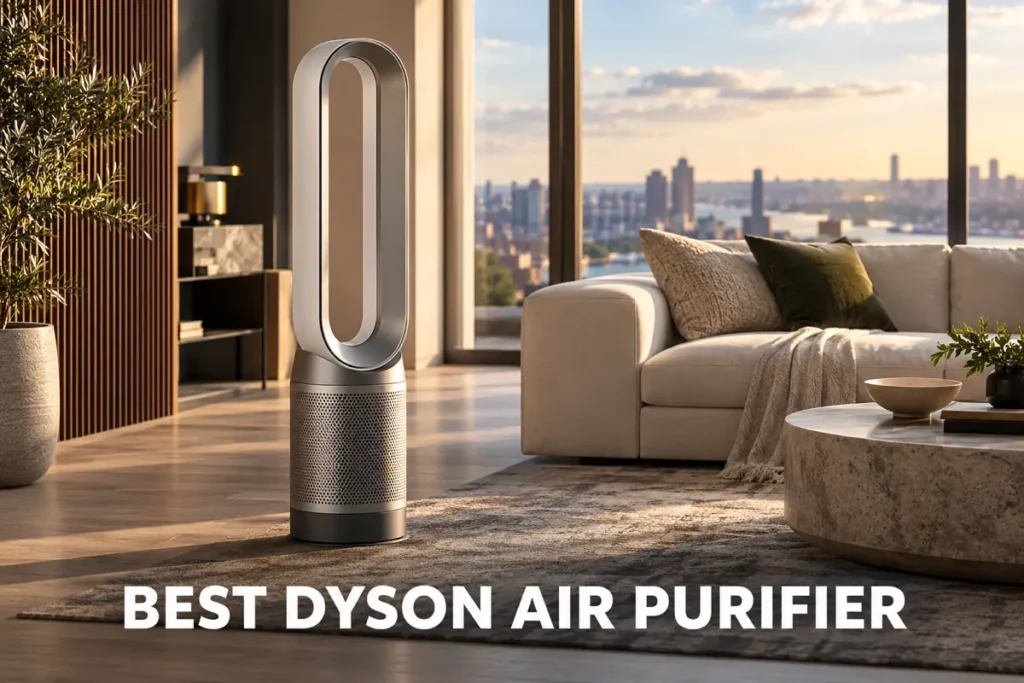

The best Dyson air purifier for your home comes down to which of the brand's nine current models you are comparing, since the lineup now spans Cool-only towers, Hot+Cool combo units, a compact Hushjet, and three formaldehyde-specific purifiers. This guide breaks down all nine models side by side so you can match the right Dyson purifier to your room size and needs.

Think of this guide as a room-by-room map rather than a single winner: the right choice shifts depending on whether you need to heat a drafty bedroom, cool a stuffy living room, destroy formaldehyde off-gassing, or run something quiet enough for a nursery. Each review below highlights the room size, feature set, and use case each model actually suits.
My Recommended Top 3 Best-Buys for Dyson Air Purifiers: Reviewed and Rated
- The fully sealed HEPA H13 filtration keeps captured particles from leaking back into the room, which matters most in a unit that runs for hours at a stretch.
- 350-degree oscillation spreads heated or cooled air around a whole room instead of a single line of sight.
- The curved, magnetized remote stores flush against the tower, though there is no app control at this price tier.
- The 360-degree Electrostatic filter captures particles as small as 0.3 microns, which Dyson says matches the True HEPA benchmark without using HEPA filter media.
- The Activated Carbon stage removes pet and cooking odors, along with gases such as NO2, which the HEPA-only models in this lineup do not target as directly.
- Sleep mode drops noise to 24 decibels, among the quietest settings in this entire lineup.
- The fully sealed HEPA filter traps particles down to 0.3 microns, with no heating or humidifying stage taking up space inside the machine.
- 350-degree oscillation spreads cooled, filtered air across a wider arc than a standard desk fan.
- The curved, magnetized remote stores on the machine itself, matching the HP10's control setup.
Best Dyson Air Purifier Reviews 2026: 9 Models for Every Room
The lineup below is organized by use case rather than a strict ranking, starting with the all-rounder pick, then budget, room size, heating, formaldehyde destruction, smart features, and quiet operation, so you can jump to whichever category actually matches how you plan to use a Dyson air purifier at home.
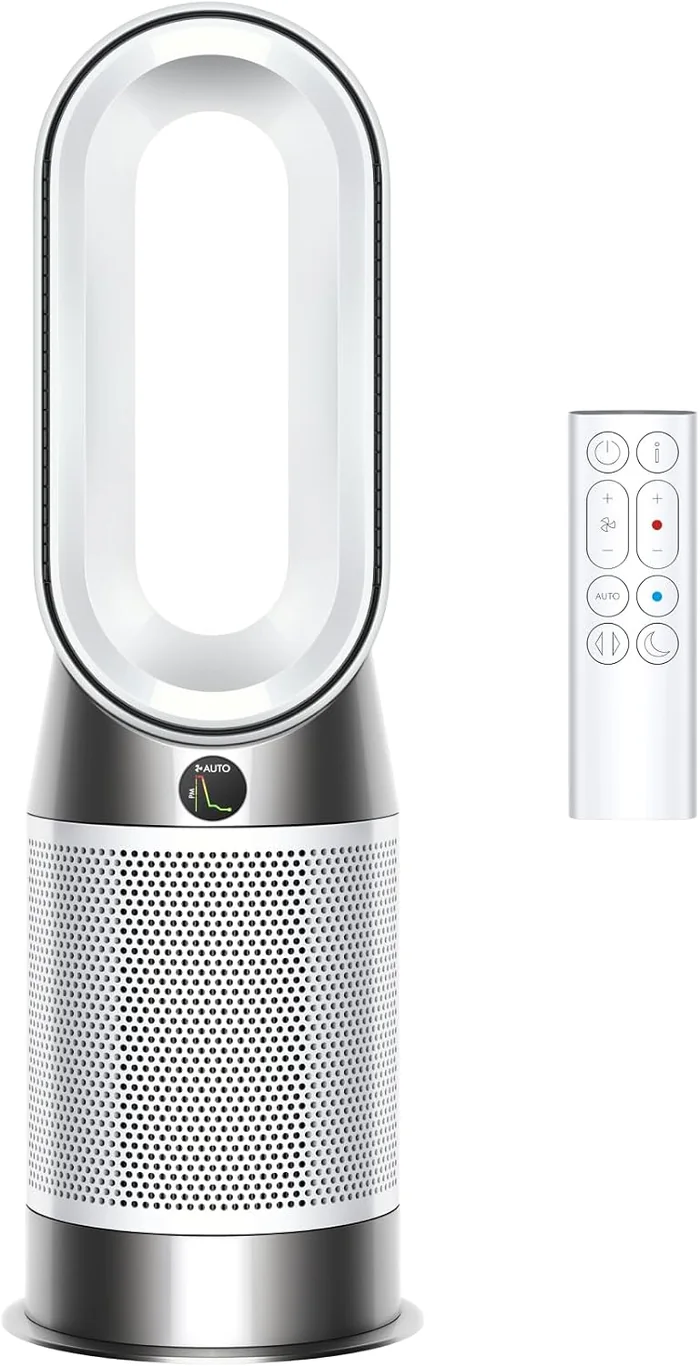
1. Dyson Purifier Hot+Cool Gen1 HP10
The Dyson Purifier Hot+Cool Gen1 HP10 combines heating, cooling, and air filtration in a single bladeless tower, which is why it sits at the top of this list. Dyson lists this unit for rooms up to 73 square feet, a modest figure next to the rest of the lineup, but the trade-off is a machine built to run year round instead of just through allergy season.
Pet owners and allergy sufferers dealing with dust mites specifically will find CADR-matched picks in my air purifier for dust mites guide.
Dyson Purifier Hot+Cool Gen1 HP10 Specs
| Filter Type | Fully Sealed HEPA H13 |
| Manufacturer-Claimed Room Coverage | 73 sq ft (per Dyson) |
| Noise Level (Published Figure) | 59.8 dB (setting unspecified) |
| Control Method | Remote only, no app |
| Item Weight | 11.7 lbs |
| Key Technology | Fully Sealed HEPA H13 with Hot+Cool Air Multiplier |
Key Features
- The fully sealed HEPA H13 filtration keeps captured particles from leaking back into the room, which matters most in a unit that runs for hours at a stretch.
- 350-degree oscillation spreads heated or cooled air around a whole room instead of a single line of sight.
- The curved, magnetized remote stores flush against the tower, though there is no app control at this price tier.
- Night mode dims the display and drops to the quietest setting, which suits a bedroom or nursery.
- Programmable auto-off timers run at 1, 2, 4, or 8 hours, which is useful for households that forget to switch the unit off.
For households specifically shopping for a dyson hot and cool air purifier, the HP10 earns that description because it heats in winter and cools in summer from the same bladeless tower. Other Hot+Cool models add app connectivity, and the HP2 De-NOx also destroys formaldehyde, which makes this Gen1 version the practical entry point into two-season comfort out of one machine.
What stood out comparing the spec sheets across all nine models is how small the HP10's claimed footprint looks against units like the Big+Quiet Formaldehyde BP03; Dyson's own number here is 73 square feet, enough for a bedroom or home office but not an open living space. The remote-only setup may frustrate buyers used to app-based dashboards.
Buyers who need app monitoring or voice control should look at the Hushjet or HP2 De-NOx instead; this model is remote-only.
Why We Chose This
It combines heating, cooling, and sealed HEPA filtration, making it the logical first stop for anyone who only wants to buy one Dyson for the whole year.
Dyson's own spec sheet puts noise at 59.8 dB at the stated setting, loud enough that night mode is worth using every night, not only occasionally.
The 1, 2, 4, and 8-hour auto-off timers are a small but real convenience.
Pros
- Heats and cools from a single machine
- Fully sealed filtration keeps captured particles inside
- Quiet enough for overnight use in night mode
- Auto-off timers prevent all-day unattended operation
- Compact footprint suits a bedroom or office
- Sealed HEPA filtration
- Remote stores neatly on the unit
Cons
- No app control or smart monitoring
- Manufacturer-claimed coverage tops out at 73 sq ft
Set next to the rest of this lineup, the HP10's real competition is not outside the Dyson family but the Hushjet immediately below, which costs less and adds app control at the expense of true HEPA filtration. Buyers choosing between the two are really deciding whether year-round heating matters more than a smartphone dashboard. Either answer is defensible.
Buyers who also want to manage air quality in their vehicle will find my best cabin air filter guide covers the automotive equivalent.
Final Verdict
The HP10 earns Best Overall by combining heating, cooling, and sealed HEPA filtration, even though its 73-square-foot claimed coverage is modest. It is the default recommendation for year-round, one-machine comfort.
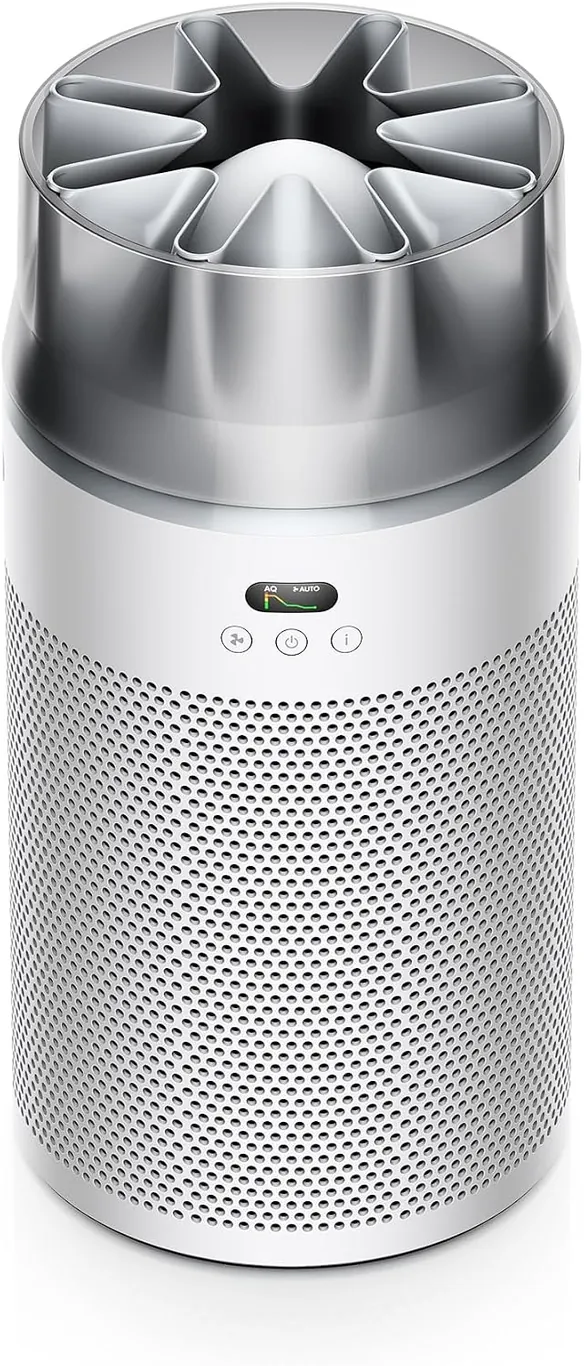
2. Dyson Hushjet Compact Air Purifier
This model is the Best Budget pick in this lineup, and the only one here that skips True HEPA for electrostatic filtration. The 360-degree Electrostatic filter, which Dyson says reaches the same 99.97%-at-0.3-micron benchmark as True HEPA, pairs with an Activated Carbon stage for odors and gases. This is not a HEPA H13 unit.
Dyson Hushjet Compact Air Purifier Specs
| Filter Type | Electrostatic plus Activated Carbon (not HEPA H13) |
| Manufacturer-Claimed Room Coverage | 203 sq ft (per Dyson) |
| Noise Level (Lowest Setting) | 24 dB (Sleep mode, per Dyson) |
| Control Method | MyDyson app plus voice assistant |
| Item Weight | 6.9 lbs |
| Key Technology | 360-Degree Electrostatic Filtration with Activated Carbon |
Key Features
- The 360-degree Electrostatic filter captures particles as small as 0.3 microns, which Dyson says matches the True HEPA benchmark without using HEPA filter media.
- The Activated Carbon stage removes pet and cooking odors, along with gases such as NO2, which the HEPA-only models in this lineup do not target as directly.
- Sleep mode drops noise to 24 decibels, among the quietest settings in this entire lineup.
- The MyDyson app tracks air quality over time and sets schedules, a feature the HP10 and TP10 both lack.
- A compact 18.5-inch-tall footprint fits under a desk or on a shelf, unlike the floor-standing towers elsewhere on this list.
The Dyson Hushjet Compact Air Purifier suits readers who prioritize a compact footprint and a budget-tier model. Owner feedback often mentions odor control in small spaces rather than whole-home coverage. Dyson's own spec sheet lists this unit for rooms up to 203 square feet.
The five-year filter-life claim is the other reason this unit reads as a budget-tier pick: the electrostatic filter can last up to five years for buyers who mainly care about odor and dust control.
The trade-off for that smaller size is filtration technology: electrostatic capture is a different mechanism than sealed HEPA H13, even at a similar claimed efficiency number.
Why We Chose This
It combines a compact footprint with an electrostatic filter rated to last up to five years while still carrying app control and odor-focused carbon filtration, which makes it the easiest entry point into the Dyson ecosystem.
Owners describe odor control near a cat litter box and a rabbit area.
Looking at owner feedback across all nine models, the pattern that recurs for the Hushjet is praise for how little space it takes up paired with genuine surprise at how effective the odor control is in a small room. The 24-decibel sleep mode is quiet enough that one owner reported forgetting it was running.
Pros
- Smallest, most budget-friendly Dyson in this lineup
- App-based air quality tracking and scheduling
- Strong odor control in small, enclosed rooms
- Whisper-quiet 24-decibel sleep mode
- Five-year filter-life claim lowers upkeep over time
- Voice assistant compatibility built in
- Compact enough to fit under a desk
Cons
- Not a True HEPA H13 unit
- Different filtration mechanism from HEPA
Set against the rest of the lineup, the Hushjet is less a scaled-down HP10 than a different category built for close-range rooms rather than open living spaces. Buyers who need certified HEPA H13 performance for allergies or asthma should move up to the TP10, HP2 De-NOx, or HP10 instead. Electrostatic filtration done well still beats skipping air purification altogether.
Final Verdict
The Hushjet earns Best Budget status by trading sealed HEPA H13 for a compact, app-connected electrostatic system that owners praise for odor control in small spaces. It is the easiest Dyson to recommend on a tight footprint and a tight budget.
Shoppers who need a certified option without the Dyson price premium will find the complete value-tier selection in my best budget air purifiers guide.
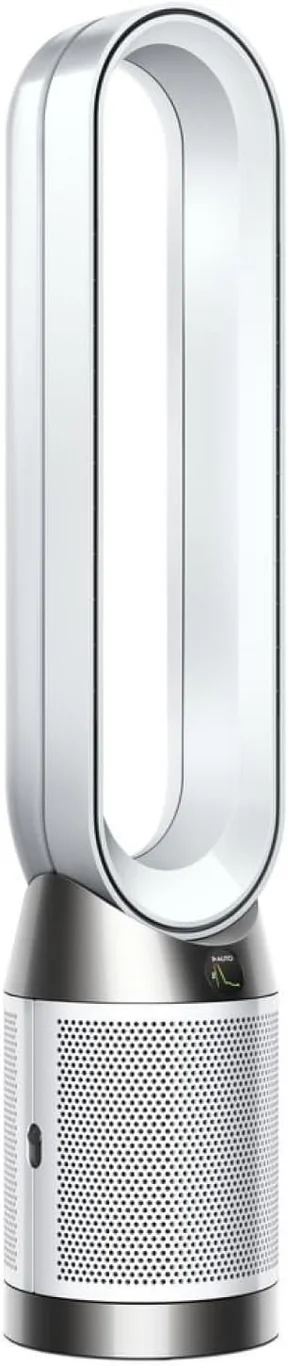
3. Dyson Purifier Cool Gen1 TP10
This model strips the lineup down to its simplest form: a cool-only tower with sealed HEPA filtration and nothing else competing for attention. There is no app, no heating mode, or formaldehyde claim, just filtered air moving around a room. Fully sealed HEPA filtration carries over from the HP10 even though this model drops the heating hardware entirely.
Dyson Purifier Cool Gen1 TP10 Specs
| Filter Type | Fully Sealed HEPA |
| Manufacturer-Claimed Room Coverage | 101 sq ft (per Dyson) |
| Noise Level (Lowest Setting) | Not published by Dyson |
| Control Method | Remote only, no app |
| Item Weight | 10.4 lbs |
| Key Technology | Fully Sealed HEPA with 350-Degree Oscillation |
Key Features
- The fully sealed HEPA filter traps particles down to 0.3 microns, with no heating or humidifying stage taking up space inside the machine.
- 350-degree oscillation spreads cooled, filtered air across a wider arc than a standard desk fan.
- The curved, magnetized remote stores on the machine itself, matching the HP10's control setup.
- Programmable auto-off timers run at 1, 2, 4, or 8 hours.
- Night mode dims the display and holds the unit at its quietest setting.
The Dyson Purifier Cool Gen1 TP10 offers remote-controlled cooling and filtration without app connectivity. Owner feedback often describes the TP10 as a straightforward room fan with a real filtration stage, rather than a smart-home gadget. Dyson's own spec sheet lists this unit for rooms up to 101 square feet.
For anyone comparing this as a dyson purifier cool tower fan against a plain box fan or a cheaper tower, the real difference is the sealed HEPA stage: a standard fan just moves air around, while this one filters it on the way through. The bladeless column design also means there is no exposed blade to collect dust or pose a hazard around kids and pets.
Pet owners who want units tested specifically around pet hair, dander, and odors will find the dedicated lineup in my air purifier for pets guide.
No app, no formaldehyde destruction, no heating. Buyers who want any of those three should look further down this list instead.
Why We Chose This
It is the clearest example in this lineup of sealed HEPA filtration without any added functionality, which makes it the easiest comparison point for judging what Dyson's other models actually add on top.
One owner review mentions vacuuming the filter clean between changes, though Dyson still sells it as a replace-only part.
Looking at owner feedback across all nine models, the pattern that recurs for the TP10 is appreciation for how little there is to think about: point it, turn it on, and it filters and cools. The lack of app control reads as a feature to some owners and a dealbreaker to others, which says more about the buyer than the product.
Pros
- Fully sealed HEPA filtration without added complexity
- No exposed blades, safer around kids and pets
- Simple remote-only operation
- Night mode for quieter overnight use
- Auto-off timers prevent all-day unattended operation
- Lower weight than the Hot+Cool models
- Straightforward maintenance with no heating hardware to service
Cons
- No app control or air quality history
- No published noise-level figure from Dyson
Set against the HP10 and HP2 De-NOx, the TP10's appeal is really about what it leaves out: no heating hardware, no formaldehyde catalyst, no app, just a sealed HEPA tower at a lower complexity level. Buyers who already have a separate heater or do not need one will not miss the missing features. Cooling and filtration alone are still a complete answer for a lot of rooms.
Buyers fitting out a small bedroom or nursery and looking beyond the Dyson brand will find dedicated small-room options in my best small room air purifier guide.
Final Verdict
The TP10 earns Best Classic Tower Fan status by keeping the formula simple: sealed HEPA filtration and cooling, with none of the heating, app, or formaldehyde features found elsewhere in this lineup. It is the no-frills pick for a single room.
4. Dyson Purifier Hot+Cool HP2 De-NOx
The Dyson Purifier Hot+Cool HP2 De-NOx adds a capability none of the first three models offer: continuous formaldehyde destruction built into a 3-stage, sealed HEPA H13 system. It still heats and cools like the HP10, but does more chemical work. A catalytic filter that continuously breaks down formaldehyde is the headline feature here, not a stronger HEPA rating.
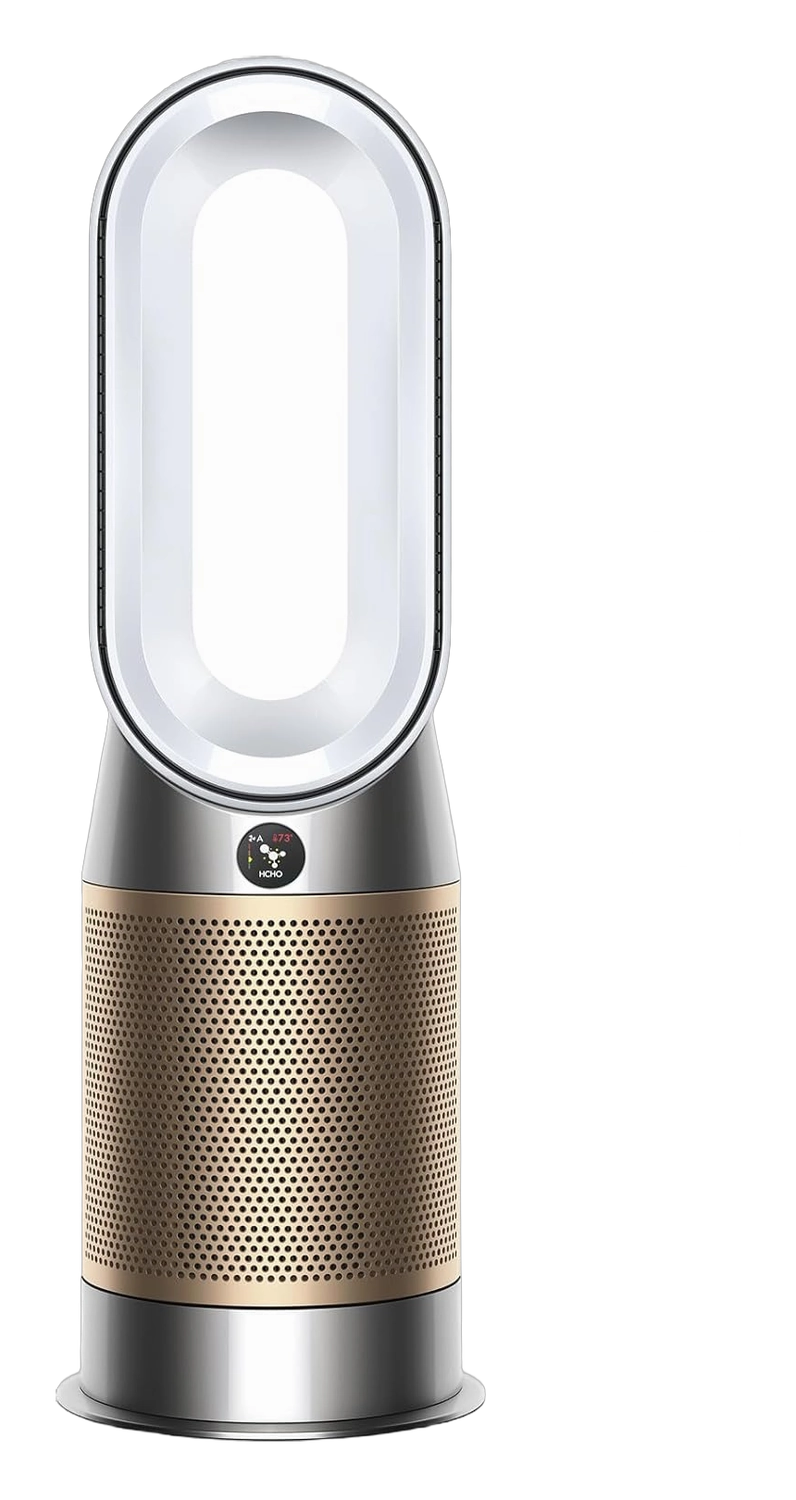
Dyson Purifier Hot+Cool HP2 De-NOx Specs
| Filter Type | Fully Sealed 3-Stage HEPA H13 |
| Manufacturer-Claimed Room Coverage | 109 sq ft (per Dyson) |
| Noise Level (Lowest Setting) | Not published by Dyson |
| Control Method | MyDyson app plus remote |
| Item Weight | 12.2 lbs |
| Key Technology | Catalytic Formaldehyde Destruction with HEPA H13 |
Key Features
- The 3-stage, fully sealed HEPA H13 filter captures 99.97% of particles as small as 0.3 microns before air ever reaches the room.
- A catalytic stage continuously destroys formaldehyde rather than just trapping it, which means the filter does not saturate the way carbon-only designs do.
- Dyson's Air Multiplier technology projects a stated 76 gallons per second of airflow to heat or cool a room evenly.
- The MyDyson app pairs with voice assistants for remote scheduling and air quality reports.
- 350-degree oscillation and a magnetized remote carry over from the rest of the Hot+Cool lineup.
This model carries both CARB and EPA certification, which matters because of the formaldehyde claim: the listing does not identify the certification programs or their scope. This is the only model under the HP2 De-NOx name. Dyson's own spec sheet lists this unit for rooms up to 109 square feet.
Formaldehyde is a gas, not a particle, which is why standard HEPA media cannot capture it: HEPA relies on physical interception and diffusion, mechanisms that do not apply to gas-phase molecules. The catalytic filter here instead breaks formaldehyde down continuously into carbon dioxide and water rather than adsorbing and saturating like activated carbon.
Owner feedback consistently praises the heating performance in larger rooms, with one supplied owner excerpt noting very low noise.
Why We Chose This
It combines continuous formaldehyde destruction with heating, cooling, and particle filtration, which earns it a dedicated slot for households concerned about off-gassing from new furniture, flooring, or paint.
Buyers dealing with wildfire smoke or cooking smoke at a room level will find the CADR-verified options in my air purifier for smoke guide.
The same gas-phase filtration logic applies to cigarette smoke; my air purifier for indoor cigarette smoke guide covers the certified units ranked by activated carbon weight and verified smoke CADR.
One reviewer noted the heating mode is remote-only, with no app shortcut, a limitation worth knowing before buying for that feature specifically.
Looking at owner feedback across all nine models, the recurring theme for the HP2 De-NOx is satisfaction with how evenly it heats a larger room paired with genuine appreciation for the air quality tracking in the app. CARB and EPA certification give this unit a safety credential beyond what some of the other models in this lineup carry.
Pros
- Continuous formaldehyde destruction, not only capture
- Fully sealed 3-stage HEPA H13 filtration
- CARB and EPA certified for safety
- Heats evenly in larger rooms per owner feedback
- App and remote control both included
- 350-degree oscillation spreads airflow evenly
- One machine covers heating and gas-phase filtration
Cons
- No published noise-level figure from Dyson
- Heating mode is remote-only, no app shortcut
Set against the TP09 Cool Formaldehyde model, the HP2 De-NOx adds heating on top of the same formaldehyde-destruction approach, making it the better fit for households that want winter heat and gas-phase filtration from one machine. Combining heating and gas-phase filtration in a single unit is a genuinely different use case.
Final Verdict
The HP2 De-NOx earns Best De-NOx Filtration status by pairing formaldehyde destruction with sealed HEPA H13 capture and genuine heating power, a combination none of the other eight models match. It is the pick for households fixated on gas-phase filtration.
5. Dyson Purifier Big+Quiet Formaldehyde BP03
Stepping up in size and scope, the Dyson Purifier Big+Quiet Formaldehyde BP03 is built for open-plan living rooms rather than a single bedroom. Dyson says it projects filtered air over 32 feet, a different design goal than the bladeless towers covered earlier. Dyson describes the HEPA H13 filter as 3.8 times larger than the previous generation.
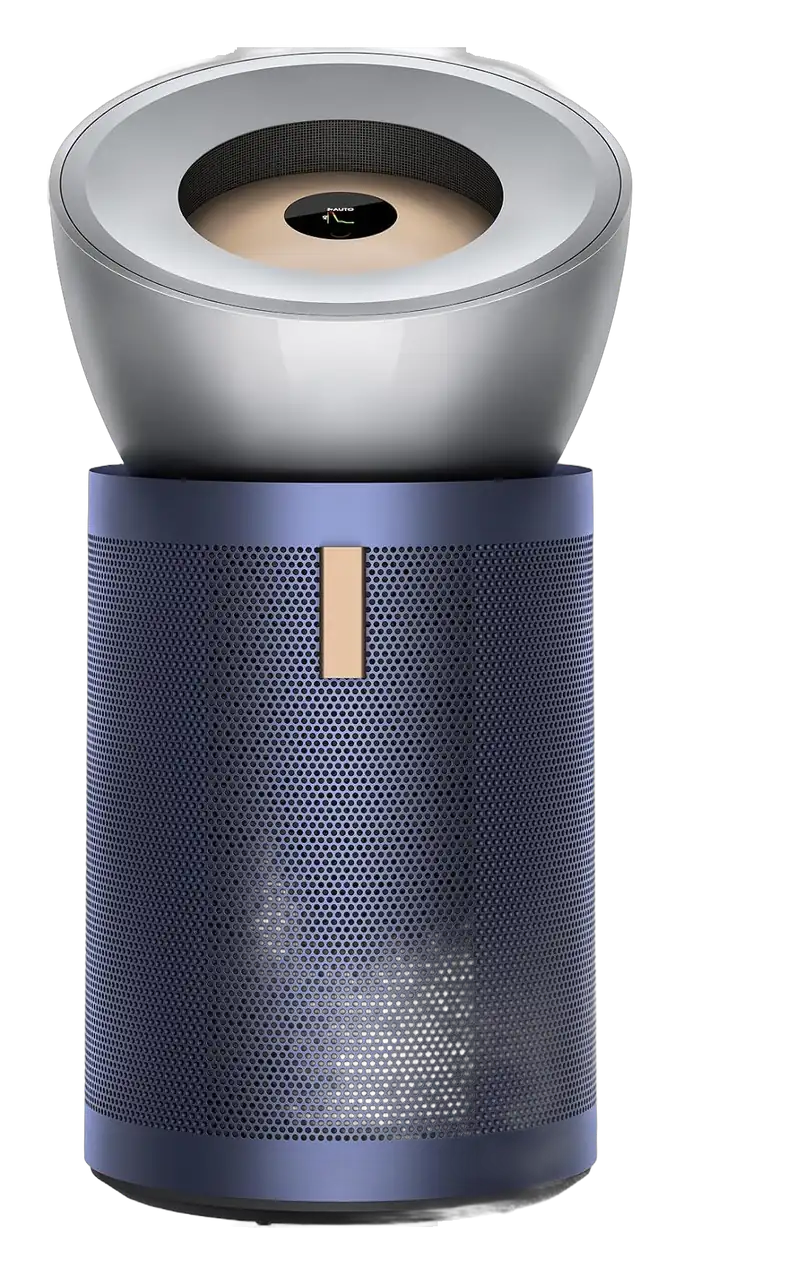
Dyson Purifier Big+Quiet Formaldehyde BP03 Specs
| Filter Type | HEPA H13 (3.8x larger media) |
| Manufacturer-Claimed Room Coverage | Not given in sq ft; Dyson states airflow projects over 32 feet |
| Noise Level (Lowest Setting) | Not published by Dyson |
| Control Method | MyDyson app |
| Item Weight | 26.24 lbs |
| Key Technology | Formaldehyde Destruction with Oversized HEPA H13 Filter |
Key Features
- Dyson states that the BP03 projects filtered air over 32 feet, which suits large or open-plan rooms rather than a single corner.
- The BP03 detects and destroys formaldehyde and also uses a HEPA H13 filter for particles.
- The oversized filter media, 3.8 times larger than the previous generation, carries a 5-year life claim.
- Breeze mode recreates a natural, varying airflow pattern instead of one constant stream.
- Do-not-disturb mode dims the display and holds the unit at its quietest setting for overnight use.
Anyone shopping specifically for a dyson air purifier big quiet is almost certainly dealing with an open floor plan or a combined living and dining space where a standard bedroom-sized tower would get overwhelmed.
Dyson does not publish a square-footage coverage figure for this model the way it does for the HP10, TP10, or HP2 De-NOx, instead presenting the 32-foot airflow projection as the relevant number. That framing makes sense for an open room, but it also means buyers cannot directly compare this unit's coverage claim to the others on a square-foot basis.
The 5-year filter-life claim applies specifically to the oversized HEPA H13 media, not to the unit's other components.
Why We Chose This
It is the only model in this lineup engineered for open-plan and larger rooms specifically, pairing a bigger HEPA H13 filter with formaldehyde destruction for households that outgrew a bedroom-sized purifier.
Buyers who want to address air quality at the whole-home HVAC level will find rated filter options in my best air filter for home guide.
Do-not-disturb mode uses the quietest settings and dims the display.
Pros
- Airflow projects across large, open-plan rooms
- Oversized HEPA H13 filter, 3.8x larger media
- Continuous formaldehyde destruction built in
- Five-year filter-life claim on the HEPA stage
- Do-not-disturb mode for quiet overnight use
- MyDyson app control and air-quality monitoring
- Breeze mode varies airflow for a natural feel
Cons
- Heaviest unit in this entire lineup
- No published square-footage coverage figure
Set against the TP09 Cool Formaldehyde model covered later in this guide, the BP03 trades a smaller footprint for genuine room-filling reach, at the cost of being the heaviest unit in this lineup at just over 26 pounds. Open-plan living rooms and great rooms are where it actually earns its size.
Final Verdict
The BP03 earns Best for Large Rooms status by trading a compact footprint for genuine open-plan reach, backed by an oversized HEPA H13 filter and built-in formaldehyde destruction. It is the long-term choice for open-plan living.
6. Dyson Purifier Cool Formaldehyde TP09
The Dyson Purifier Cool Formaldehyde TP09 earns its spot by tackling a pollutant none of the other Cool-only models address directly. What stood out comparing these nine spec sheets is that it pairs sealed HEPA H13 filtration with a separate catalytic stage built to detect and break down formaldehyde. This cooling-only purifier suits households concerned about formaldehyde.
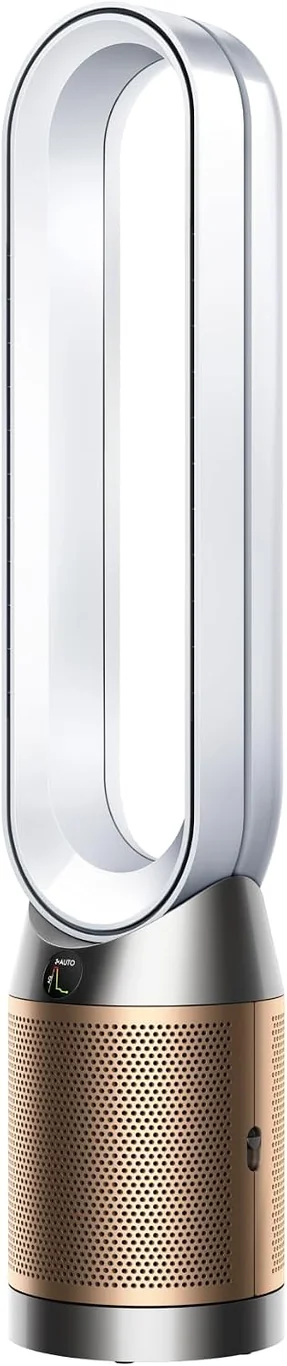
Dyson Purifier Cool Formaldehyde TP09 Specs
| Filter Type | HEPA filtration plus formaldehyde destruction |
| Manufacturer-Claimed Room Coverage | 101 sq ft (manufacturer claim) |
| Noise Level (Lowest Setting) | Not published; Dyson claims 20% quieter than the prior model |
| Control Method | Remote, MyDyson app |
| Item Weight | 11 pounds |
| Key Technology | Sealed HEPA H13 + catalytic formaldehyde destruction |
Key Features
- The catalytic filter continuously breaks down formaldehyde instead of just trapping it.
- The sealed HEPA H13 system captures 99.97% of particles down to 0.3 microns.
- The MyDyson app reports air quality and filter status from anywhere.
- The Night mode setting dims the display and runs the fan at its quietest level.
- The programmable timer turns the unit off automatically after 30 minutes to 8 hours.
Standard HEPA filtration cannot capture formaldehyde because it is a gas rather than a particle, which is why Dyson built a dedicated catalytic filter into this model instead of a thicker HEPA stage. The TP09 still runs the same sealed HEPA H13 filtration as most of the lineup, so particulate performance is not the trade-off.
Dyson lists this model for rooms up to 101 sq ft, a listed floor-area figure with no stated test method.
The combination of sealed particulate filtration and gas-phase formaldehyde destruction is rare in a tower fan this compact.
Why We Chose This
It is the only Cool-only model in this lineup built specifically to neutralize formaldehyde rather than just filter particles, for households that want cooling and formaldehyde destruction together.
Night mode dims the display and caps the fan at its quietest setting, worth checking if the unit will sit in a bedroom.
The app pairs with the MyDyson ecosystem, allowing you to control the purifier and monitor air quality from a phone. What the spec comparison makes obvious is that choosing between this and the plain TP07 comes down to gas-phase protection, not fan performance, since the two sit in different tiers of this lineup.
Pros
- Only Cool-only model in this lineup built to destroy formaldehyde
- Sealed HEPA H13 construction keeps captured particles from leaking back out
- Real-time air quality tracking from the MyDyson app
- Night mode runs quietly with a dimmed display for bedroom use
- Flexible auto-off scheduling for convenience
- Backward airflow mode purifies without blowing cold air
- Energy Star certified for efficiency
Cons
- No heating function, Cool-only design
- Formaldehyde-destruction claims are not independently verified
The 20% quieter claim Dyson makes against the previous generation is self-reported, not independently verified, so treat it as a comparison point rather than a settled number. Buyers who only care about particulate filtration and never deal with formaldehyde-emitting furniture or flooring are paying for a capability they may not need.
Final Verdict
The TP09 is the right call when formaldehyde from new furniture, flooring, or cabinetry is a real concern, since it is the only Cool-only model here built to destroy that gas rather than just filter particles. It is the formaldehyde specialist.
7. Dyson Purifier Cool TP07 Smart Purifier
Next, the Dyson Purifier Cool TP07 Smart Purifier leans on sensing and reporting rather than a formaldehyde-specific filter, auto-adjusting fan speed as its sensor reads the room and reporting that data on the LCD screen and the MyDyson app. What stood out comparing these nine spec sheets is how much of the TP07's value sits in software rather than extra hardware.
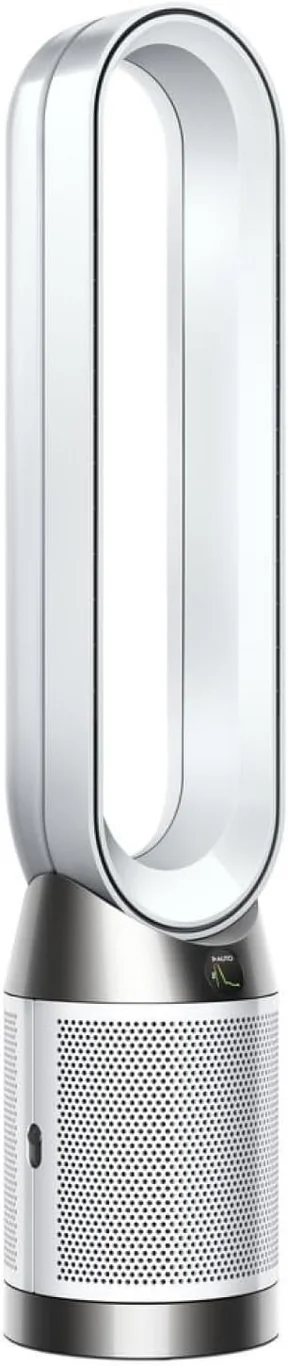
Dyson Purifier Cool TP07 Smart Purifier Specs
| Filter Type | Sealed True HEPA H13 |
| Manufacturer-Claimed Room Coverage | 99 sq ft (manufacturer claim) |
| Noise Level (Lowest Setting) | 78 dB rated; quieter in Night mode (exact figure not published) |
| Control Method | App, Voice Assistant, Remote |
| Item Weight | 11 pounds |
| Key Technology | Sealed HEPA H13 + auto-sensing air quality reporting |
Key Features
- The onboard sensor auto-adjusts fan speed as air quality changes in real time.
- The LCD screen reports pollution levels directly on the machine, not only in the app.
- Voice assistant compatibility sets this model apart from the mostly remote-only lineup.
- The MyDyson app tracks filter life and air quality history remotely.
- The programmable timer turns the unit off automatically after 30 minutes to 8 hours.
As a dyson air purifier for home use, the TP07 is built around the same fully sealed HEPA H13 standard as most of the other models here, meaning the whole machine is sealed so captured particles cannot leak back out. Air Multiplier technology pulls air from across the room into the machine rather than only filtering what passes directly in front of it.
Dyson lists this model for rooms up to 99 sq ft, a listed floor-area figure with no stated test method. Voice assistant compatibility is a genuine differentiator here, since HP10, TP10, and TP7A are listed with remote control rather than app control. Our research kept circling back to how rarely that voice feature gets mentioned outside Dyson's own listing.
The LCD screen doubles as a filter-life tracker, saving a trip to the app.
Why We Chose This
It is the only Cool-only model in this lineup that pairs voice assistant support with real-time air quality reporting on its own screen, not only inside the app.
Backward airflow mode purifies the room without blowing cold air across it, useful during cooler months.
A 78 dB noise figure appears on Dyson's own spec sheet for this unit, well above the under-35 dB range ideal for bedrooms, so buyers running it overnight should weigh that carefully. Night mode uses the quietest settings and dims the display.
Pros
- Auto-sensing fan speed adjusts to real-time air quality
- Real-time LCD screen shows pollution levels at a glance
- Voice assistant compatibility, rare in this lineup
- Fully sealed HEPA H13 filtration throughout the machine
- MyDyson app tracks filter life and air quality history
- Backward airflow mode purifies without blowing cold air
- Programmable shut-off from 30 minutes to 8 hours
Cons
- 78 dB noise rating on Dyson's own spec sheet
- No heating function and no formaldehyde-specific filtration
The TP07 does not destroy formaldehyde or add heating, so buyers who need either of those should look at the TP09, HP2 De-NOx, or HP07 instead. What this model does well is give a clear, numeric read on air quality without paying for Hot+Cool hardware most living rooms do not need.
Final Verdict
The TP07 is the pick for anyone who wants to see their air quality data in real time without paying for heating or formaldehyde destruction they will not use. It is the smart-sensing all-rounder.
8. Dyson Purifier Hot+Cool HP07
After that, the Dyson Purifier Hot+Cool HP07 brings heating back into the lineup, running as a heater, fan, and sealed HEPA H13 purifier in one body for buyers who do not want a separate space heater. What the spec comparison makes obvious is that this model adds heating to its sealed HEPA H13 filtration and MyDyson app functionality, not a downgrade in filtration.
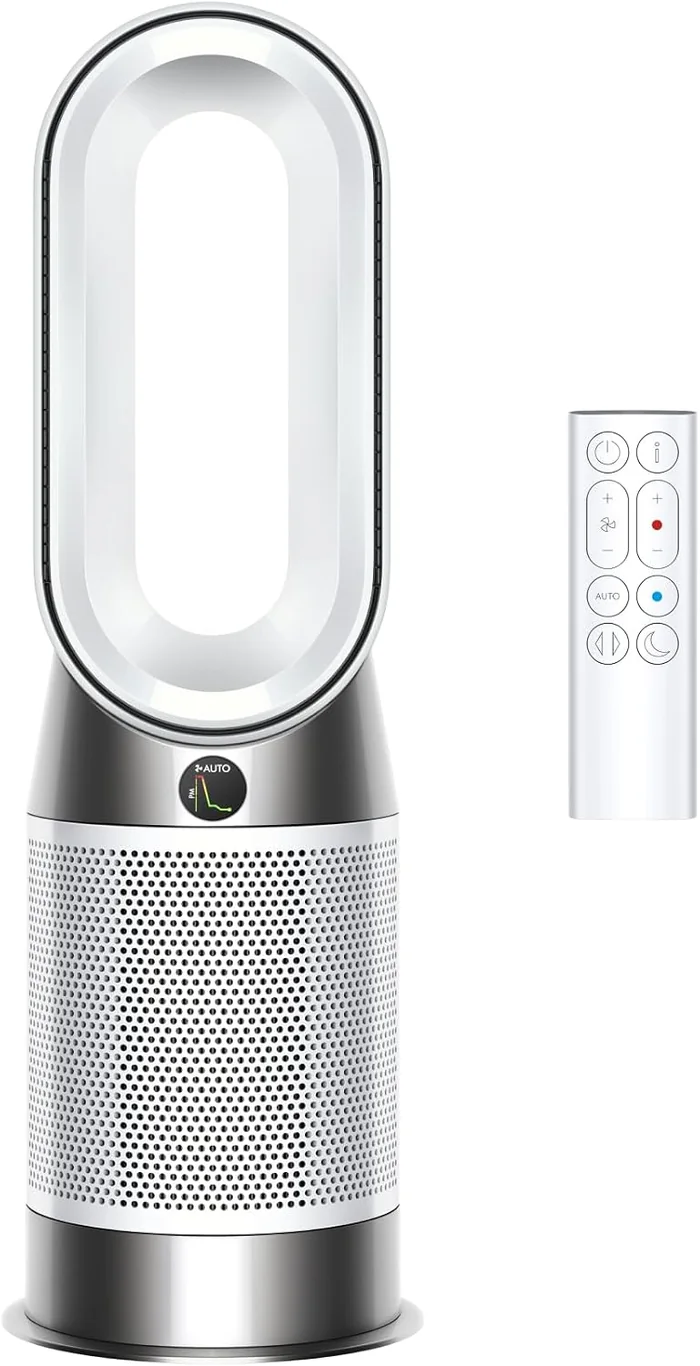
Dyson Purifier Hot+Cool HP07 Specs
| Filter Type | Sealed True HEPA H13 |
| Manufacturer-Claimed Room Coverage | 73 sq ft (manufacturer claim) |
| Noise Level (Lowest Setting) | 62 dB rated (exact low-setting figure not published) |
| Control Method | Remote, Voice Assistant, MyDyson app |
| Item Weight | 12 pounds |
| Key Technology | Sealed HEPA H13 + Hot+Cool heating and cooling |
Key Features
- The dual heating and cooling modes run from a single machine year-round.
- The sealed HEPA H13 filtration keeps captured particles from leaking back into the room.
- The real-time LCD display reports air quality readings as they change.
- The ETL certification confirms third-party electrical and fire safety testing.
- The programmable timer turns the unit off automatically after 30 minutes to 8 hours.
When we weigh this one as a candidate for the best dyson air purifier for allergies, the deciding factor is its fully sealed HEPA H13 filtration, which keeps captured allergens from leaking back into the room the way an unsealed housing can. Air Multiplier technology pulls distant pollutants into the machine instead of only filtering air drifting directly past it.
Dyson lists this model for rooms up to 73 sq ft, the smallest manufacturer-claimed footprint in this lineup, which makes it better suited to a bedroom or home office than an open living area. Real-time air quality reporting on the LCD screen and through the MyDyson app carries over from the rest of the current Dyson range.
ETL certification confirms third-party electrical and fire safety testing, separate from any ozone or filtration performance claim.
Why We Chose This
It is the smallest and most accessible Hot+Cool model in this lineup, giving heating and cooling in one unit with the same stated 350-degree oscillation range as the HP10.
A corded, electric-only power source means no battery backup, standard for a unit this size.
Dyson's own spec sheet lists noise at 62 dB, quieter than the TP07's figure but still audible enough that bedroom shoppers should check it against their own tolerance before buying on heating capability alone. Backward airflow mode purifies without cooling, so the machine still has a non-heating use case in warmer months.
Pros
- Heats and cools from a single machine
- Fully sealed HEPA H13 filtration throughout
- Smallest manufacturer-claimed footprint in the lineup, suited to bedrooms
- Real-time air quality reporting on LCD and MyDyson app
- ETL certified for electrical and fire safety
- Backward airflow mode purifies without cooling
- Programmable shut-off from 30 minutes to 8 hours
Cons
- No formaldehyde-destruction feature documented
- Smallest manufacturer-claimed coverage in the lineup, best for small rooms only
The HP07 sits in a premium tier among the Cool-only and Hot+Cool models in this lineup, and that premium buys heating capability, not better particulate filtration, since the sealed HEPA H13 stage is identical across most of the range. Buyers who only need cooling and purification, not heat, are better served by the lower-tier TP07 or TP10.
Final Verdict
The HP07 earns its spot for anyone who wants heating, cooling, and sealed HEPA H13 purification from a single remote-controlled unit with the same stated 350-degree oscillation range as the HP10. It is the three-season workhorse.
9. Dyson Purifier Cool Autoreact TP7A
Stepping up to the widest claimed coverage in this lineup, the Dyson Purifier Cool Autoreact TP7A lists a manufacturer figure of up to 290 sq ft, more than any of the other eight models here. What the spec comparison makes obvious is that this model trades the sensor-driven reporting of the TP07 for automatic mode-switching instead.
Dyson Purifier Cool Autoreact TP7A Specs
| Filter Type | HEPA H13 |
| Manufacturer-Claimed Room Coverage | 290 sq ft (manufacturer claim) |
| Noise Level (Lowest Setting) | Not published by Dyson for this model |
| Control Method | Remote only (no app) |
| Item Weight | 9 pounds |
| Key Technology | Sealed HEPA H13 + Autoreact Fan/Backward airflow switching |
Key Features
- You can choose between Fan mode and Backwards airflow mode.
- The sealed HEPA H13 filter captures 99.97% of particles down to 0.3 microns.
- The 360-degree filtration design draws in air from every direction, not only one side of the unit.
- The programmable timer turns the unit off automatically after a set interval.
- The remote-only control keeps setup simple, with no app pairing required.
The Autoreact name describes the choice between Fan mode and Backward airflow mode, letting you toggle between cooling and purify-only operation. The same sealed HEPA H13 filtration used across most of this lineup sits behind that automatic switching, so particulate capture is not the differentiator here.
Dyson lists this model for rooms up to 290 sq ft, a listed floor-area figure with no stated test method or fan setting. Control here is remote-only, with no app or voice layer from the TP07 or HP07. Our research kept circling back to how rarely large-room coverage claims hold up at lower fan speeds.
The listing gives a power rating of 1,000 watts.
Why We Chose This
It gives you a choice between cooling and purify-only airflow, and it claims the widest coverage of any Dyson purifier reviewed here.
At 9 pounds, it is lighter than the tower models, but the 6.9-pound Hushjet is lighter still.
The Amazon listing for this model is thinner on documented detail than the rest of the lineup, with fewer published specs for noise level and app compatibility than the TP07 or HP07 carry. Buyers who want granular air quality reporting, not only automatic mode-switching, should look at the TP07 instead.
Pros
- Highest manufacturer-claimed coverage in the lineup, up to 290 sq ft
- Lets you switch between Fan and Backward airflow modes
- Sealed HEPA H13 filtration
- Weighs 9 pounds
- 360-degree filtration pulls air in from all directions
- Programmable shut-off timer
- Simple remote-only operation, no app setup required
Cons
- No app, voice assistant, or real-time air quality reporting
- Highest published wattage of any model in this lineup
No app, no voice control, and no formaldehyde-specific filtration make this the most straightforward model in the lineup to operate, which is either a strength or a limitation depending on how much the buyer wants to monitor or tune. The trade-off for that simplicity is a listed floor area of 290 square feet and a weight of 9 pounds.
Final Verdict
The TP7A earns its spot for larger rooms where simple mode-switching matters more than app-based reporting or formaldehyde destruction, since nothing else in this lineup claims as much coverage at this weight. It is the hands-off auto-mode pick.
How to Choose the Best Dyson Air Purifier
Dyson's own naming does more to confuse buyers than help them, since labels like Cool, Hot+Cool, Hushjet, and Big+Quiet do not map obviously to room size or feature set. Working through the factors below is the fastest way to land on the best dyson air purifier for your exact room. The six factors below are the ones that actually separate these nine models, not the name printed on the box.
Room size and manufacturer-claimed coverage
The Hushjet listing states AHAM certification, while the other supplied listings do not identify an AHAM certification.
The supplied floor-area specifications do not identify their test methods.
Our research across all nine spec sheets puts claimed coverage anywhere from about 73 to 290 square feet depending on the model.
The compact Hushjet lists 203 square feet, while the TP10, TP09, and TP07 list 99 to 101 square feet, so treat the top-end number as a best case, not a guarantee. At the largest end of that range sits the dyson air purifier big quiet, built specifically for rooms the compact models cannot cover.
Two adjustments turn a manufacturer claim into a realistic household estimate:
- Run at a higher fan speed than Sleep mode: the supplied coverage figures do not specify the fan setting used.
- Round down for open floor plans: a unit rated for a closed room covers noticeably less of an open-plan living and kitchen area of the same square footage. This is exactly why a dyson air purifier for home use in a closed bedroom and the same model in an open floor plan can feel like two different machines.
Matching room category to purifier type is more reliable than chasing a single square-footage number:
| Room size tier | Which Dyson category fits |
| Up to 100 sq ft (bedroom, home office) | Compact or standard tower models |
| 100 to 200 sq ft (living room) | Standard Hot+Cool or Cool tower models |
| 200 sq ft and up (open-plan, great room) | The Big+Quiet category, designed for large spaces |
Heating and cooling needs
Only the Hot+Cool models in this lineup add heat; the Cool-only and Big+Quiet models move and filter air without raising the room's temperature.
Across the Hot+Cool models, 350-degree oscillation is the standard feature that spreads either airflow mode across the whole room instead of a fixed direction.
In our side-by-side read of the spec sheets, the trade-off is straightforward: a Hot+Cool unit covers two seasons but adds complexity, while a Cool-only tower is simpler and claims more floor area for a similar footprint.
Rule of thumb: if the room already runs warm or cold with the seasons, a Hot+Cool model earns its extra bulk; if it is already climate-controlled, a Cool-only tower delivers the same filtration without paying for heating hardware you will rarely use. That single trade-off is really the whole decision behind buying a dyson hot and cool air purifier in the first place.
Filtration technology: sealed HEPA H13 versus electrostatic
A straightforward dyson purifier cool tower fan uses sealed HEPA filtration alone, with no app or heating layer added on top. Most of this lineup uses Dyson's fully sealed True HEPA H13 filtration, which captures at least 99.97% of particles down to 0.3 microns according to the stated particle-capture claims.
Sealed construction matters because it stops captured particles from leaking back into the room around the filter's edges.
One model in this lineup swaps sealed HEPA H13 for a 360-degree electrostatic filter paired with activated carbon instead. Dyson's own testing claims this system reaches the same 99.97%-at-0.3-micron benchmark as True HEPA, though it is a different mechanism and not a HEPA-certified filter in the strict sense.
What the spec comparison makes obvious is that both technologies target the same particle size with different methods: electrostatic charging pulls particles toward a charged surface, while sealed HEPA media traps them mechanically as air passes through. Neither technology captures gases like formaldehyde, which is a separate factor below. For a simple dyson purifier cool tower fan without any gas-phase extras, sealed HEPA alone is still the baseline most buyers actually need.
For buyers evaluating that baseline outside the Dyson range, my certified HEPA air purifier comparison covers the field by AHAM-verified CADR rather than brand ecosystem.
Households running a Dyson as their primary unit can supplement with a higher-carbon option for the most mold-prone room, as I cover in my best air purifier for mold guide.
Sealed HEPA H13 models capture allergens such as pollen, dust mite debris, and pet dander at that same 99.97%-at-0.3-micron benchmark, which is also why they are the better pick if you are shopping for the best Dyson air purifier for allergies specifically.
Buyers with documented allergy or asthma concerns who want CADR-matched options across all brands will find the verified comparison in my best air purifier for allergies guide.
| Filtration type | What it actually captures |
| Sealed True HEPA H13 | Particles 0.3 microns and larger at 99.97% efficiency, according to the stated particle-capture claims |
| 360-degree electrostatic plus carbon | Dyson's own claim of 99.97% at 0.3 microns via charged-surface capture, not a HEPA-certified mechanism |
| Either technology alone | Gases like formaldehyde pass through untouched; that requires carbon or catalytic media |
Formaldehyde and VOC destruction
HEPA filtration cannot capture formaldehyde, because it is a gas rather than a particle. The same mechanical fibers that trap pollen and dust mite debris have nothing to grab onto a molecule that small, and the same limitation applies to other VOCs like benzene and toluene.
Three models here destroy formaldehyde: the HP2 De-NOx, BP03, and TP09. Several models in this lineup add a catalytic filter instead of relying on HEPA alone. Dyson describes it as a media that continuously breaks formaldehyde down into carbon dioxide and water rather than just trapping it, so the filter does not saturate the way plain activated carbon eventually does.
Our read of the catalytic-filter research is that this feature only matters if formaldehyde is an active concern in your home, typically from new furniture, fresh paint, or pressed-wood cabinetry, rather than everyday household dust. Outside that specific scenario, a standard dyson formaldehyde air purifier upgrade buys little beyond peace of mind.
Not every model in this lineup fights formaldehyde the same way:
- Standard HEPA H13 models capture particles only; formaldehyde and other VOCs pass through untouched.
- Catalytic formaldehyde models add a filter that decomposes formaldehyde continuously instead of just storing it.
Smart features and app connectivity
Roughly half of this lineup connects to the MyDyson app; the rest relies on the included remote only.
App-enabled models add real-time particulate and VOC readings on an onboard display or phone screen, instead of a vague light-ring color code.
Our side-by-side pass through the control specs turned up a clear split: app-connected models add scheduling and remote on and off control from a phone, while remote-only models keep the interface simpler at the cost of that live data.
App connectivity buys three things beyond convenience:
- Live particulate and VOC readings on the home screen rather than a color-coded light ring.
- Remote scheduling so the unit can start cleaning a room before you arrive.
- Filter-life tracking that flags replacement timing instead of leaving it to guesswork.
Noise level for bedroom use
Hushjet lists 24 dB in Sleep mode; the HP10 and HP07 noise figures do not specify a fan setting.
For context, a change of 10 decibels reads as roughly twice as loud to the human ear, so that gap is noticeable at the bedside.
What stood out comparing all nine spec sheets is that the quietest numbers come from the smallest, app-connected model, while the Hot+Cool machines trade some quiet for the added heating hardware.
If a bedroom is the primary use case, the sleep-mode number matters more than the headline room-coverage figure. That number alone is often the deciding factor in picking the best dyson air purifier for a bedroom specifically.
My bedroom air purifier options guide covers the sleep-compatible alternatives across brands for households where the bedroom is the primary placement.
Fan speed and realistic use split roughly into three bands:
| Fan speed | Typical use |
| Sleep or low | Bedroom overnight, library-quiet range |
| Medium | Living areas during the day |
| Max or turbo | Fastest clearing, not ideal for sleeping rooms |
What About the Dyson Air Purifier and Humidifier?
Readers comparing this lineup to find a Dyson air purifier and humidifier combo often expect to see one specific model here. A true dyson air purifier and humidifier combo simply is not part of this specific lineup right now. This roundup does not include a humidifying model. If a humidifying Dyson purifier is genuinely the priority, checking Dyson's current humidifying lineup directly is the better next step.
My Overall Verdict
Narrowing nine overlapping Dyson models down to three recommendations comes down to matching the machine to the room, not chasing the newest release. Each one still qualifies as a genuine dyson air purifier for home use, just suited to a different room. The three picks below cover the three most common needs in this lineup: an all-rounder, a budget-friendly option, and a straightforward cooling-only tower.
- Dyson Purifier Hot+Cool Gen1 HP10 [Best Overall] - a year-round pick that heats, cools, and fully seals HEPA H13 filtration in one machine.
- Dyson Hushjet Compact Air Purifier [Best Budget] - a compact, whisper-quiet pick that pairs app control with Dyson's electrostatic filtration at the lineup's most accessible tier.
- Dyson Purifier Cool Gen1 TP10 [Best Classic Tower Fan] - a cool-only, sealed HEPA tower fan for anyone who wants straightforward filtration without heating or app features.
Each of these three handles a different household situation, and the right one for you comes down to whether heating, budget, or simplicity matters most in your space. If you only remember one thing from this guide, it is that the Hot+Cool Gen1 HP10 is the best Dyson air purifier for most households that want year-round use from a single machine.
Buyers comparing home air purifier options across brands will find the fully verified selection in my best air purifier for home guide.
That said, this lineup rewards matching need to model more than most roundups do: readers who care most about formaldehyde destruction or a quieter overnight mode should look past the top pick toward the models built specifically for those needs. Buyers chasing the dyson air purifier big quiet specifically should start with the BP03 reviewed above rather than the compact models.
Why Dyson Purifier Hot+Cool Gen1 HP10 Might Be the Best Choice
Across all nine models in this Dyson lineup, the Hot+Cool Gen1 HP10 combines heating, cooling, and fully sealed HEPA H13 filtration in a single machine. This is the best dyson air purifier pick for anyone who wants one machine to run all year. That three-in-one coverage is what pushed it to the top of this ranking, not any single standout spec.
The trade-off is control: the HP10 skips the MyDyson app entirely and relies on remote-only operation, so there is no live air quality reporting or phone scheduling. If app control matters more to you than heating, the smart tower models later in this lineup cover that gap instead. Even without an app, this is still the best dyson air purifier for anyone who wants heating and cooling from one machine.
What makes the HP10 worth the extra footprint:
- Year-round heating and cooling in one machine, replacing both a space heater and a fan.
- Fully sealed HEPA H13 filtration that captures 99.97% of particles down to 0.3 microns without leaking captured air back into the room.
- 350-degree oscillation for whole-room airflow instead of a single fixed direction.
- Night mode with a dimmed display for bedroom use without a glowing screen.
- Programmable auto-off timers that shut the unit down on a schedule instead of running all night by default.
FAQs
What is the best Dyson air purifier right now?
The best Dyson air purifier right now is the Hot+Cool Gen1 HP10, a model that combines heating, cooling, and fully sealed HEPA H13 filtration in one machine. Your ideal pick can still shift if you need a smaller footprint, formaldehyde-specific filtration, or a simpler budget pick instead.
Buyers who also filter at the HVAC system level will find MERV ratings and replacement schedules in my best furnace filter guide.
Is a Dyson air purifier worth buying?
A Dyson air purifier is worth buying if you want sealed HEPA H13 filtration, app-based air quality reporting, and formaldehyde-specific filtration in select models, features most mid-range competitors do not combine. You are paying a premium for that combination, and Dyson's own coverage figures are self-reported rather than independently verified.
What is the difference between the Dyson air purifiers?
The difference between the Dyson air purifiers in this lineup comes down to three things: heating versus cooling-only, sealed HEPA H13 versus the compact model's electrostatic-plus-carbon system, and standard filtration versus formaldehyde-destroying filtration. Matching those three axes to your room and needs matters more than comparing model numbers side by side.
Buyers who want to compare Dyson's performance against the full market before deciding will find the complete overview in my best air purifier guide.
Which Dyson air purifier is most recommended for everyday use in a typical room?
The TP10 or HP10 are the most recommended Dyson air purifiers for a typical room, since Dyson's own spec sheets list coverage of 101 square feet for the TP10 and 73 square feet for the HP10. If your space is larger or open plan, the Big+Quiet model offers more coverage and is the better starting point instead.
Buyers who want a broader selection of large-room options beyond the Dyson lineup will find coverage-verified picks in my large room air purifier guide.
Does a Dyson air purifier remove formaldehyde?
A standard Dyson air purifier does not remove formaldehyde, because HEPA filtration only captures particles and formaldehyde is a gas, not a particle. Select catalytic models in this lineup continuously break formaldehyde down instead of trapping it, which is the feature to look for if that is a concern in your home.
References:
- U.S. EPA, "What is a HEPA filter?" - https://www.epa.gov/indoor-air-quality-iaq/what-hepa-filter
- AHAM Verifide, "AHAM's Air Filtration Standards" - https://ahamverifide.org/ahams-air-filtration-standards/
- CDC, "Improving Ventilation and Air Quality" - https://www.cdc.gov/respiratory-viruses/prevention/air-quality.html
- U.S. EPA, "Indoor Air Quality" Report on the Environment - https://www.epa.gov/report-environment/indoor-air-quality
Medical Disclaimer: This content is for informational purposes only. It is not a substitute for professional medical advice, diagnosis, or treatment. If you have concerns about your water quality or air quality and their effects on your health, consult a qualified healthcare professional.
Affiliate Disclosure: As an Amazon Associate, Puritisimo may earn a commission from qualifying purchases made through links on this page, at no additional cost to you. Our recommendations are independent and editorial.