
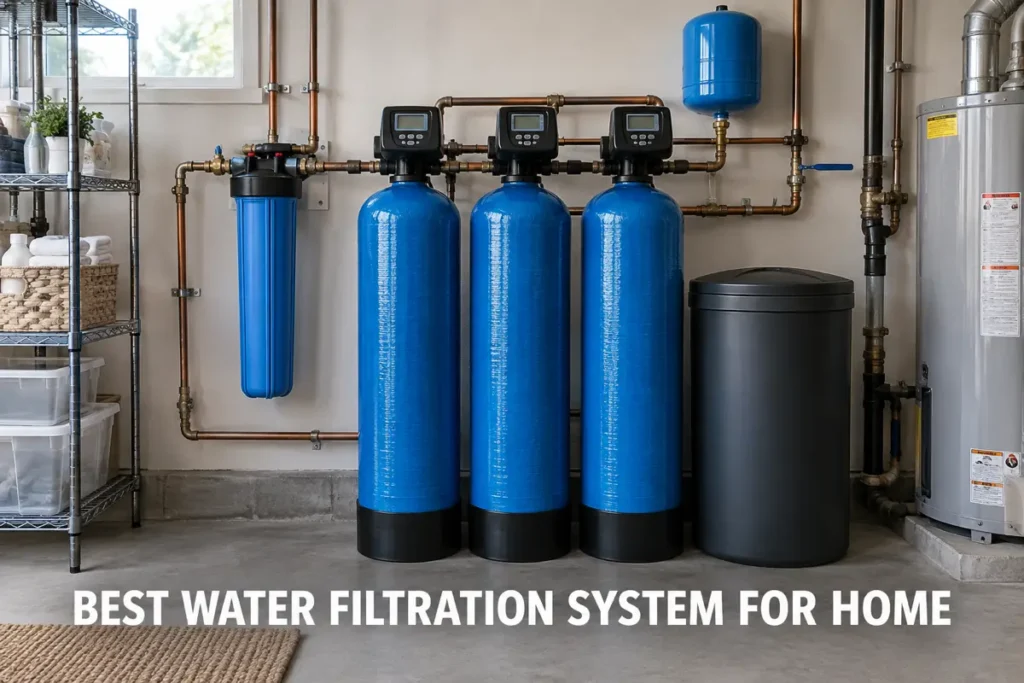
The best water filtration system for home use matters more than ever: the EPA regulates more than 90 contaminants in U.S. tap water, yet the CDC estimates 7.15 million waterborne illnesses occur annually at a direct healthcare cost of $3.33 billion. The EPA's 2024 PFAS rule sets a 4 ppt limit for PFOA and PFOS, affecting an estimated 70 to 94 million people served by impacted water systems. Even city water that meets all EPA standards can contain chloramine, lead from aging pipes, or PFAS from upstream industrial sites.

Finding the best rated water filtration system for home starts with the certification tier, not the product description. NSF/ANSI 42 covers chlorine taste and odor only and delivers zero verified health protection. NSF/ANSI 53 is the health-effects standard covering lead, PFAS, cysts, and VOCs; NSF/ANSI 58 certifies full RO systems for TDS reduction of 75% or more. You can verify any NSF certification claim at info.nsf.org/certified/dwtu/ before purchasing; 'tested to NSF standards' on packaging is a self-claim with no third-party audit.
My Recommended Top 3 Best-Buys for Water Filtration Systems for Home: Reviewed and Rated
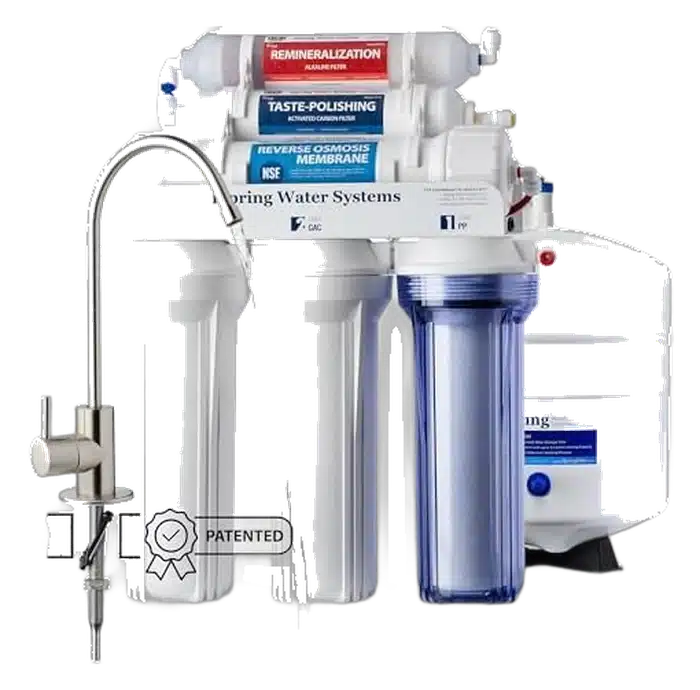
- The alkaline remineralization stage restores calcium and magnesium ions after the membrane strips them, raising pH into a mildly alkaline range without a separate alkaline cartridge purchase.
- The patented top-mounted faucet eliminates the under-sink drilling step that derails most first-time RO installs.
- NSF certification verifies the contaminant claims rather than relying on the meaningless 'tested to NSF standards' phrasing common in this category.
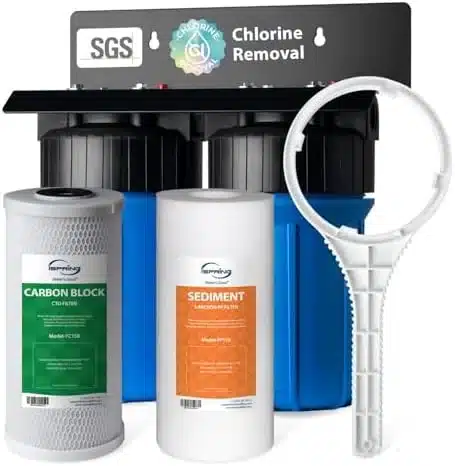
- The 1-inch inlet/outlet ports support 15 GPM flow with minimal pressure drop, which is adequate for 3+ bathroom homes.
- The CTO coconut-shell carbon block reduces chlorine, VOCs, pesticides, herbicides, and industrial solvents at every fixture in the home.
- The 5-micron sediment pre-filter captures rust, dirt, sand, and silt that would otherwise foul appliances and clog faucet aerators.
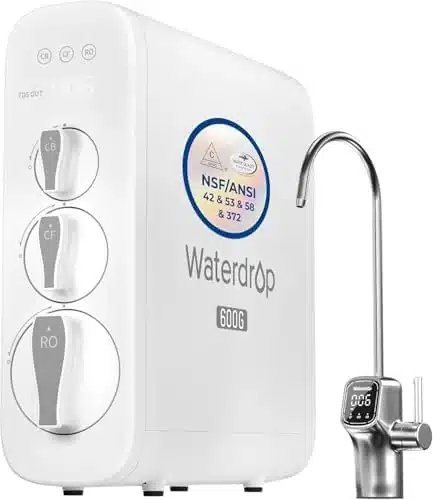
- The NSF/ANSI 42, 53, 58, and 372 certification stack makes this the most certification-complete unit in our roundup, covering aesthetics, health contaminants, full TDS reduction, and lead-free hardware.
- The 2:1 pure-to-drain ratio is one of the most water-efficient ratios available, compared to the 3:1 or 4:1 waste of traditional RO systems.
- The tankless on-demand design eliminates the under-sink space penalty and the running-the-tank-dry problem of conventional RO systems.
Best Water Filtration System for Home in 2026: Our Top 9 Picks
We reviewed 9 systems across every installation type, from whole-house and under-sink RO to countertop portable units, to help you find the best water filtration system for the home. Our top pick is the iSpring RCC7AK, a 6-stage alkaline RO with NSF certification under $200. The list covers every use case: well water, whole-home coverage, and renter-friendly no-install options.
1. iSpring RCC7AK
The iSpring RCC7AK is a 6-stage under-sink reverse osmosis system with an alkaline remineralization final stage, and it earned Best Overall in our roundup because it covers what most homeowners actually need. NSF certification, a pH+ stage that most sub-$200 RO systems omit, and a 5,000 monthly purchase rate that signals proven reliability at scale. For the majority of households that want one filter to handle drinking-water quality without a custom build, this is our default recommendation.
iSpring RCC7AK Specs
| Filtration Stages | 6 (sediment, GAC, carbon block, RO membrane, post-carbon, alkaline remineralization) |
| Installation Type | Under-sink |
| Filter Life | Pre-filters 6-12 months; RO membrane 2-3 years |
| Flow Rate | 75 GPD rated; 37 to 56 GPD real-world |
| Power Source | No power required |
| Warranty | 1-year manufacturer plus lifetime US support from Atlanta, GA |
Key Features
- The alkaline remineralization stage restores calcium and magnesium ions after the membrane strips them, raising pH into a mildly alkaline range without a separate alkaline cartridge purchase.
- The patented top-mounted faucet eliminates the under-sink drilling step that derails most first-time RO installs.
- NSF certification verifies the contaminant claims rather than relying on the meaningless 'tested to NSF standards' phrasing common in this category.
- Lifetime US-based customer support from Atlanta, GA, which distinguishes the brand from overseas-only support chains.
- The 6-stage configuration hits the contaminants RO handles best, including lead, PFAS, fluoride, and nitrates.
The membrane produces 75 GPD at lab conditions (77F, 50 PSI, 250 ppm NaCl), and real-world output in cooler or lower-pressure homes lands in the 37 to 56 GPD range. The six stages run in fixed order: 5-micron polypropylene sediment, granular activated carbon, carbon block, TFC RO membrane, post-carbon polish, then the alkaline calcium and magnesium remineralization stage that corrects the flat taste of demineralized water and raises pH into a mildly alkaline range. The system is Amazon Choice with a long verified-purchaser history.
In our experience, the 6-stage configuration removes the contaminant spectrum RO handles best: lead, PFAS, fluoride, nitrates, arsenic, and dissolved TDS in the 90 to 99% range. The Stage 6 remineralization restores calcium and magnesium ions after the membrane strips them, which corrects the flat taste of pure RO water. One caveat for chloramine-treated city water: the Stage 2 GAC handles chloramine less effectively than catalytic carbon. If chloramine is your primary concern, the Home Master TMAFC-ERP later in this list addresses it directly.
The remineralization stage distinguishes this system from comparably priced 5-stage RO units, which produce neutral or slightly acidic water. The RCC7AK's Stage 6 raises output to a mildly alkaline range without a separate cartridge purchase.
Why We Chose This
NSF-certified 6-stage RO with alkaline remineralization, a patented top-mounted faucet that simplifies installation, and lifetime US customer support.
Our one flag: the system requires a pressure tank that occupies 4 to 6 inches of under-sink depth, and homes with PSI below 40 will see output drop and may need a booster pump.
iSpring pre-assembles the system on a mounting bracket and includes a filter wrench and installation kit, so most households complete the install without a plumber. Filter change interval is straightforward: pre-filter stages every 6 to 12 months, the RO membrane every 2 to 3 years, and the post-carbon and remineralization stages every 12 months. Lifetime US-based customer support from Atlanta, GA backs the system, and replacement cartridges are widely available through standard retail channels.
Pros
- Verified NSF certification (not just 'tested to NSF standards')
- Alkaline remineralization included at sub-$200 price
- Patented top-mounted faucet skips the drill step
- 5,000-per-month purchase rate signals proven reliability
- Lifetime US-based phone support from Atlanta
- DIY-friendly install with all hardware included
- Replacement filters widely available at fair prices
Cons
- Pressure tank takes 4-6 inches of cabinet depth
Also, the iSpring RCC7AK delivers 6-stage certified filtration with alkaline remineralization at a cost that undercuts most 5-stage competitors. Compared to the Waterdrop G3P600, the RCC7AK trades tankless delivery and a higher GPD rating for a price that stays well under $200 while delivering the same fundamental certified RO performance.
For a full breakdown of the RCC7AK's 6-stage filtration stack and alkaline remineralization performance, my iSpring RCC7AK review covers every certified spec tested on a live household system.
Final Verdict
The iSpring RCC7AK is the best water filtration system for home drinking water that most households should buy. NSF certification, alkaline remineralization, and a proven installation design combine into the clearest all-around recommendation in this category.
2. iSpring WGB21B
Next, the iSpring WGB21B is a 2-stage whole-house point-of-entry filtration system that covers every tap, shower, and appliance in the home. It earns Best Budget because it provides whole-house sediment and chlorine filtration at the lowest price among whole-house units in this list. The target buyer is a city-water household frustrated by chlorine smell at every fixture, not a household needing dissolved-contaminant removal.
iSpring WGB21B Specs
| Filtration Stages | 2 (5-micron polypropylene sediment, CTO coconut-shell carbon block) |
| Installation Type | Whole-house point-of-entry |
| Filter Life | 50,000 gallons (approx. 12 months for a family of four) |
| Flow Rate | Up to 15 GPM via 1-inch inlet/outlet ports |
| Power Source | No power required |
| Warranty | 1-year manufacturer plus 30-day money-back guarantee |
Key Features
- The 1-inch inlet/outlet ports support 15 GPM flow with minimal pressure drop, which is adequate for 3+ bathroom homes.
- The CTO coconut-shell carbon block reduces chlorine, VOCs, pesticides, herbicides, and industrial solvents at every fixture in the home.
- The 5-micron sediment pre-filter captures rust, dirt, sand, and silt that would otherwise foul appliances and clog faucet aerators.
- The 50,000-gallon capacity delivers roughly one year of clean water for a family of four between cartridge changes.
- The standard Big Blue housing accepts widely available replacement cartridges, which keeps long-term ownership cost predictable.
Stage 1 is a 5-micron polypropylene sediment filter (model FP15B), and Stage 2 is a CTO coconut-shell carbon block (model FC15B) rated to remove over 90% of chlorine plus a wide range of VOCs. The 10-inch by 4.5-inch Big Blue housing accepts standard-size replacement cartridges, and the 1-inch inlet and outlet ports support up to 15 GPM with negligible pressure drop. Capacity is rated at 50,000 gallons per filter set, which lands at approximately one year of service for a family of four.
We found the performance well-matched to what a 2-stage carbon system can reasonably do: chlorine is dramatically reduced at every tap, and the yellowish sediment tint that occurs after municipal well-switching events clears up immediately. 15 GPM flow means virtually no pressure drop, which is the practical limitation of most whole-house filters. For households on standard chlorine-treated city water, this is the entry-point system that does the most for the least money.
Unlike RO, this system does not reduce TDS, so calcium and magnesium stay in the water. For households that value mineral retention and only need chlorine and sediment coverage, this is an advantage.
Why We Chose This
It delivers whole-house chlorine and sediment filtration at the lowest price in this roundup, with 15 GPM flow that protects shower pressure and a 50,000-gallon cartridge cycle.
The 2-stage design does not remove dissolved heavy metals, lead, PFAS, fluoride, nitrates, or bacteria. Households with lead pipe concerns or PFAS contamination need a dedicated under-sink RO in addition to this system.
The system ships pre-assembled on a mounting bracket, and DIY installation is straightforward if you have easy access to the main supply line. iSpring includes a filter wrench and a pressure-release valve for safe filter changes, and a plumber can complete the install in under an hour. The 30-day money-back guarantee plus 1-year manufacturer warranty (with registration) is standard for iSpring, and lifetime US customer support is available from the same Atlanta team that backs the RCC7AK.
Pros
- Lowest-priced whole-house unit in this roundup
- 15 GPM flow with negligible pressure drop
- 50,000-gallon cartridge life keeps annual cost low
- Standard Big Blue housing accepts third-party cartridges
- DIY-friendly pre-assembled mounting bracket
- Pressure-release valve simplifies cartridge changes
- Lifetime US support backed by 1-year warranty
Cons
- No removal of lead, PFAS, fluoride, or nitrates
At its current price (discounted at the time of writing this), the WGB21B is the most affordable path to whole-house filtration in this list. The annual filter replacement cost (one sediment cartridge plus one CTO carbon) keeps ongoing ownership cost low. Compared to the PRO+AQUA Elite GEN2 (which handles heavy metals), the WGB21B is the right call for renters of city-water homes that only need chlorine and sediment coverage.
Final Verdict
For city-water households that need whole-house chlorine and sediment coverage without the budget or space for a heavy-metals system, the iSpring WGB21B is the best water filtration system for home use at this price tier. It is straightforward, proven, and accessibly priced. Renters or single-tap households needing only drinking-water filtration can consider a faucet-mount filter as the lighter-footprint starting point.
3. Waterdrop G3P600
After that, the Waterdrop G3P600 is an 8-stage tankless under-sink reverse osmosis system certified to NSF/ANSI 42, 53, 58, and 372 simultaneously, and it earns the title of best drinking water filtration system for home use because it eliminates the storage tank entirely. Water is purified on demand and dispensed at 600 GPD capacity, so the faucet delivers filtered water at near-tap flow without a wait period. The target buyer is someone who wants the cleanest possible drinking water and finds tank-based RO inconvenient.
Waterdrop G3P600 Specs
| Filtration Stages | 8 tankless |
| Installation Type | Under-sink (tankless) |
| Filter Life | Twist-off cartridges; RO membrane 2-3 years |
| Flow Rate | 600 GPD rated; 300 to 450 GPD real-world |
| Power Source | Corded electric |
| Warranty | 1-year manufacturer |
Key Features
- The NSF/ANSI 42, 53, 58, and 372 certification stack makes this the most certification-complete unit in our roundup, covering aesthetics, health contaminants, full TDS reduction, and lead-free hardware.
- The 2:1 pure-to-drain ratio is one of the most water-efficient ratios available, compared to the 3:1 or 4:1 waste of traditional RO systems.
- The tankless on-demand design eliminates the under-sink space penalty and the running-the-tank-dry problem of conventional RO systems.
- The smart LED faucet displays real-time filter life and water quality readouts directly at the spout.
- The 600 GPD rated capacity delivers 300 to 450 GPD in real-world conditions, which keeps a large family supplied without a refill wait.
Eight filtration stages in a tankless configuration achieve the 2:1 pure-to-drain ratio, one of the most water-efficient ratios in this roundup. The 600 GPD rated capacity (real-world: 300 to 450 GPD at typical house pressure) means even a large family will not drain it faster than it refills, and NSF/ANSI 372 certification covers lead-free components throughout the system. The smart LED faucet displays real-time filter life so you replace cartridges on data, not on calendar guesswork. For the best home water filtration system for drinking, this is the technically strongest pick.
In our experience, the multi-standard certification stack (NSF 42 + 53 + 58 + 372) provides verified coverage across the full contaminant hierarchy: chlorine and aesthetics (42), health contaminants including lead, cysts, PFAS, and VOCs (53), overall TDS reduction confirmed at 90%+ (58), and lead-free hardware (372). The on-demand delivery format eliminates the common complaint of running the RO tank dry during high-demand cooking and entertaining periods.
The tankless design saves 12 to 15 inches of cabinet depth versus tank-based systems, which is meaningful in compact kitchens or when retrofitting into existing cabinetry.
Why We Chose This
The widest NSF certification stack in this roundup, tankless 600 GPD on-demand delivery, the smart LED faucet, and a category-best 2:1 water-efficiency ratio.
At its current price, the G3P600 is the highest-priced under-sink unit in this roundup by a notable margin, and it requires an outlet for the pump.
Waterdrop designs the G3P600 for DIY installation with push-to-connect fittings and a step-by-step manual, and the smart faucet integrates the LED display directly into the spout so no separate control module is required. Filter replacement uses a twist-off cartridge system that takes seconds, and Waterdrop's optional app tracks filter life and water quality metrics. US-based customer support is available for installation and troubleshooting questions.
Pros
- Widest NSF certification stack (42 + 53 + 58 + 372)
- Tankless design saves 12-15 inches of cabinet depth
- 600 GPD throughput keeps large families supplied
- 2:1 pure-to-drain ratio reduces long-term water waste
- Smart LED faucet shows live filter life
- Twist-off cartridge swaps take seconds
- DIY-friendly push-to-connect fittings
Cons
- Requires a power outlet for the pump
The premium pricing is justified for households that place maximum value on certification breadth, water efficiency (a 2:1 ratio reduces monthly waste meaningfully over years), and tankless convenience. For buyers who primarily want the cleanest drinking water and do not have a budget ceiling, the G3P600 is the most capable unit here. Households that do not mind a small storage tank should compare against the iSpring RCC7AK or APEC ROES-PH75 for lower cost.
Final Verdict
The Waterdrop G3P600 is the best drinking water filtration system for home buyers who want tankless on-demand flow, the widest NSF certification stack in this roundup, and category-best water efficiency. The higher price is the only barrier worth considering.
From there, the Express Water RO5DX is a 5-stage under-sink NSF-certified reverse osmosis system that earns the title of best home water filtration system for well water because of its layered pre-filtration approach plus one feature no other RO system in this list includes: a built-in leak detection sensor that automatically shuts off water flow when moisture is detected at the unit. Well water carries more sediment, iron, and dissolved solids than treated city water, and that makes the RO5DX's pre-filter stages and safety sensor particularly appropriate.
Five stages run in fixed order: 5-micron polypropylene sediment, granular activated carbon, 1-micron carbon block, TFC RO membrane (50 GPD), and post-carbon polish. The system ships with a 4-gallon pressurized storage tank, a dedicated chrome faucet, and an extra full set of Stages 1-3 filters. That extra-filter inclusion is a meaningful cost saving in the first year. The unit is rated at a maximum TDS input of 300 ppm and an operating temperature range of 39F to 100F.
In our experience, the 5-stage pre-filtration sequence protects the RO membrane from the sediment and iron loads characteristic of well water, which extends membrane life and sustains removal performance. The 50 GPD membrane operates well at the 40 to 80 PSI range typical of residential well pump systems. For the best well water filtration system for home use, the RO5DX hits the essential bases: sediment capture, chemical reduction, and dissolved-solids removal, all within an accessibly priced package.
The leak detection feature is a genuine differentiator: an automatic shutoff valve stops water flow when moisture is detected, which prevents the cabinet flooding that is a known failure mode for under-sink RO systems.
At 50 GPD rated capacity, real-world output drops to 25 to 37 GPD in homes with cooler water or PSI below 60. A heavy-use family of four may exhaust the 4-gallon tank during peak draw and experience a wait period.
Express Water's installation kit is rated for DIY completion, and the system arrives with all fittings, a drain saddle, and tubing. Filter changes use a standard wrench-and-unscrew procedure, NSF certification covers the full system, and replacement filters are widely available. The coconut-shell carbon filters deliver a clean, natural taste that verified buyers consistently single out, and Express Water's US-based support team is reachable for technical questions.
The RO5DX is priced accessibly (discounted at the time of writing this), and the included extra filter set further reduces first-year ownership cost. Compared to the Waterdrop G3P600, it trades tankless delivery and a higher GPD rating for a lower price and the leak-stop safety feature. For households on well water who want reliable RO performance and the peace of mind of leak protection, the trade is worth making.
Express Water RO5DX Specs
| Filtration Stages | 5 (sediment, GAC, carbon block, RO membrane, post-carbon) |
| Installation Type | Under-sink with 4-gallon pressurized tank |
| Filter Life | Pre-filters 6-12 months; RO membrane 2-3 years |
| Flow Rate | 50 GPD rated; 25 to 37 GPD real-world |
| Power Source | No power required |
| Warranty | 1-year manufacturer |
Key Features
- The built-in leak detection sensor automatically shuts off water flow when moisture is detected, which prevents the cabinet flooding that derails most RO ownership stories.
- The 5-stage pre-filtration sequence protects the RO membrane from the sediment and iron loads characteristic of well water, extending membrane life.
- The included extra filter set reduces first-year ownership cost meaningfully by skipping the second pre-filter purchase.
- The coconut-shell carbon stages deliver the clean, natural taste that verified buyers consistently single out as a differentiator.
- The 4-gallon pressurized tank stores filtered water for instant draw at the dedicated chrome faucet.
Why We Chose This
5-stage NSF-certified RO with multi-stage pre-filtration tuned for well-water sediment loads, an automatic leak shutoff, and an included extra filter set that lowers first-year cost.
Pros
- Built-in leak detection with automatic shutoff
- Extra filter set included reduces first-year cost
- NSF certification covers the full system
- Multi-stage pre-filtration tuned for well-water sediment
- DIY-friendly fittings and drain saddle included
- Coconut-shell carbon delivers clean, natural taste
- US-based technical support
Cons
- 50 GPD throughput limits heavy-use families
Final Verdict
The Express Water RO5DX is the best home water filtration system for well water households that need RO-level dissolved-solids removal, multi-stage sediment pre-filtration, and an automatic leak safety shutoff in one package.
5. Bluevua RO100ROPOT
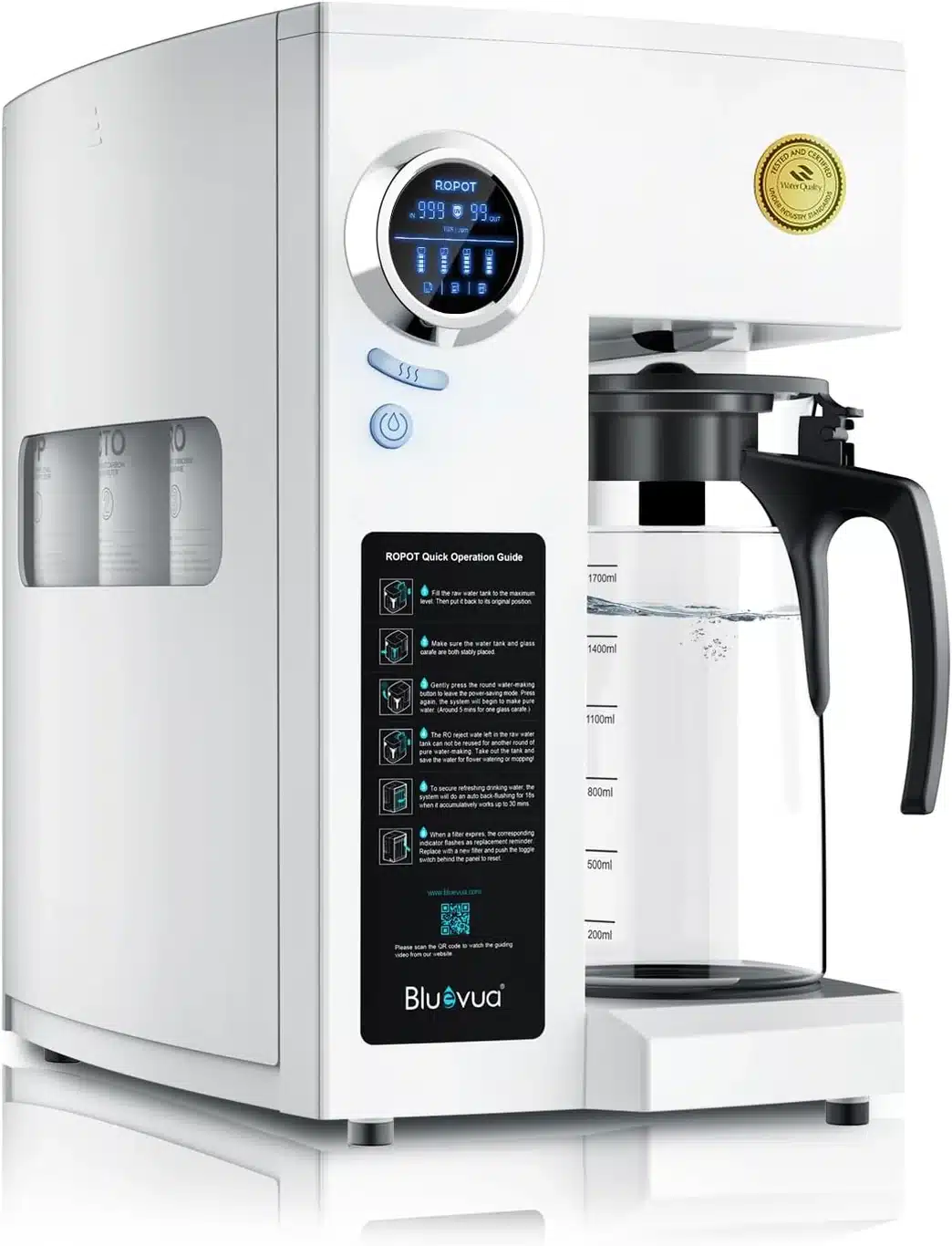
Stepping up to the no-installation tier, the Bluevua RO100ROPOT earns Best Countertop because it is the only unit in this roundup that requires zero plumbing, zero installation, and zero drilling. It is a plug-in countertop reverse osmosis system with a borosilicate glass carafe, WQA certification, and a built-in UV sterilization stage. It is ideal for a renter, apartment dweller, or homeowner who needs a secondary filtration point in a kitchen island or RV.
Bluevua RO100ROPOT Specs
| Filtration Stages | 6 (sediment, carbon block, RO, post-carbon, remineralization, UV) |
| Installation Type | Countertop, no plumbing required |
| Filter Life | 12 to 24 months (per manufacturer) |
| Flow Rate | 0.26 L/min into 1,700 mL borosilicate glass carafe |
| Power Source | Corded electric (auto power-saving standby) |
| Warranty | 1-year limited (with registration) |
Key Features
- The borosilicate glass carafe replaces the polypropylene reservoirs used by competing units, eliminating plastic-water contact in the final container.
- The built-in UV sterilization stage inactivates bacteria and viruses that the RO membrane alone may not fully block, which adds a critical layer for biological contamination concerns.
- WQA Gold Seal certification confirms third-party testing to the same NSF/ANSI protocols used for NSF-certified systems.
- The 2:1 pure-to-drain ratio is efficient for a countertop unit, beating most pitcher and competing countertop RO systems.
- The plug-and-pour setup requires no tools, no drilling, and no plumber, which makes it the only viable RO option for renters.
Six filtration stages run in sequence: sediment pre-filter, carbon block, RO membrane, carbon post-filter, remineralization mineral filter, then a UV sterilization stage. The borosilicate glass carafe (1,700 mL capacity) replaces the plastic storage containers used by most countertop RO units, reducing the risk of plastic leaching into purified water. A digital display shows filter service life and output water quality in real time, filters are rated for 12 to 24 months between replacement (per manufacturer specification), and the unit auto-enters power-saving standby when not in use.
WQA certification confirms third-party testing to the same NSF/ANSI protocols used for NSF-certified systems, and the 6-stage process including UV provides the most complete microbial coverage of any unit in this roundup. The UV stage inactivates bacteria and viruses that the RO membrane alone may not fully block at the membrane's rated pore size, which matters for households concerned about biological contamination from well backups or boil-water advisory areas. We found the output water quality consistent with what a certified RO membrane should produce.
The glass carafe is the clearest product differentiation in the countertop RO category. Where competing units use polypropylene or ABS plastic reservoirs, the borosilicate glass eliminates plastic-water contact in the final container.
Why We Chose This
WQA-certified 6-stage RO with UV sterilization, a borosilicate glass carafe, and a true plug-and-pour setup that requires no plumbing, drilling, or installation.
The 1,700 mL (roughly 1.5 quart) carafe is the primary operational limitation. A family of four will refill multiple times per day, and the 0.26 L/min fill rate means each refill takes 6 to 7 minutes.
Setup is genuinely no-tool: place on a countertop, plug into an outlet, fill with tap water, and run an initial flush cycle per the manual. Filter replacement is a twist-off cartridge swap, and the system's compact footprint (10.9 by 15.4 by 14.3 inches) fits on most counters. Bluevua includes a cleaning brush, power adapter, and four initial filters plus the mineral filter in the box, and the 1-year limited manufacturer warranty covers defects under normal use with registration.
Pros
- Borosilicate glass carafe (no plastic-water contact)
- WQA-certified 6-stage RO with UV sterilization
- True plug-and-pour setup with no plumbing
- Real-time digital filter-life and water-quality display
- 12 to 24-month filter life lowers annual cost
- Auto power-saving standby reduces idle draw
- Cleaning brush and full filter set in the box
Cons
- 1,700 mL carafe limits family-of-four use
The RO100ROPOT is priced in the mid-range of this roundup (discounted at the time of writing this), higher than basic pitcher filters and roughly on par with entry-level under-sink RO systems. No installation cost and no plumber fee changes the total cost equation for renters significantly. The 12 to 24-month filter life (per manufacturer specification) means annual cartridge expense is lower than the 6 to 12-month interval of most RO pre-filter stages.
Final Verdict
The Bluevua RO100ROPOT is the best countertop water filtration system for home use when installation is not an option. WQA-certified 6-stage RO with UV sterilization and a glass carafe makes it the most complete no-installation option in this category.
6. APEC ROES-PH75
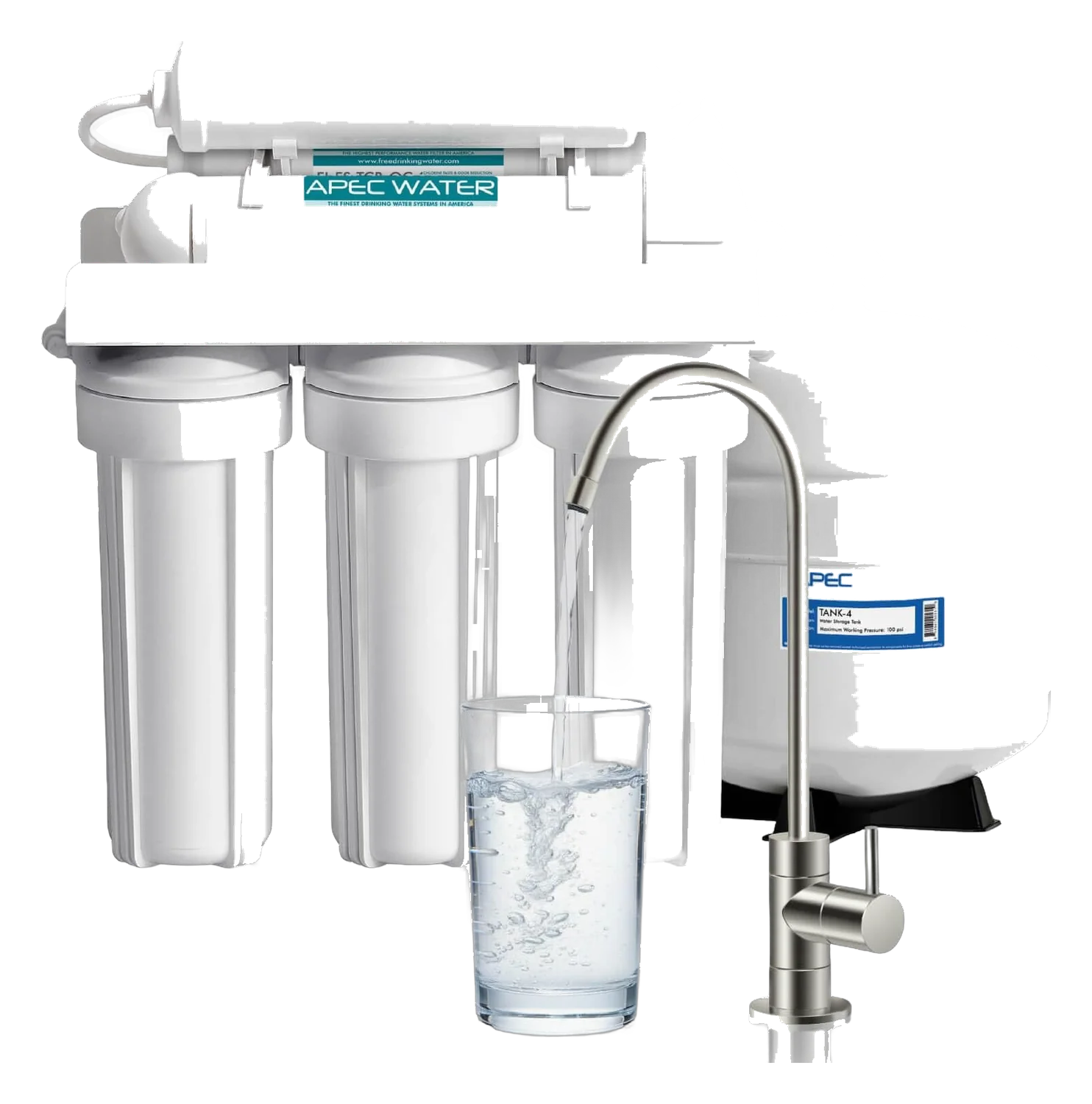
Next, the APEC ROES-PH75 is a 6-stage under-sink reverse osmosis system with an alkaline pH+ remineralization final stage from APEC Water Systems, a US-based manufacturer with one of the longest track records in the residential RO category. It earns Best Reverse Osmosis System because it combines certified RO performance with domestic manufacturing standards and a remineralization stage at a price that competes with import-only alternatives. For buyers focused on brand history, APEC's track record is the differentiating factor.
APEC ROES-PH75 Specs
| Filtration Stages | 6 (sediment, GAC, carbon block, RO membrane, post-carbon, alkaline remineralization) |
| Installation Type | Under-sink |
| Filter Life | Pre-filters 6-12 months; RO membrane 2-3 years |
| Flow Rate | 75 GPD rated |
| Power Source | No power required |
| Warranty | 1-year manufacturer plus extended with registration |
Key Features
- The 6-stage configuration with pH+ remineralization restores calcium and magnesium ions that the membrane strips, raising pH into a mildly alkaline range.
- The US-sourced filter components provide a verifiable quality claim that import-only systems cannot match, with consistent media specifications.
- The ultra-safe TFC RO membrane (75 GPD) delivers 90 to 99% TDS removal across the full contaminant spectrum RO handles best.
- The chrome dispensing faucet and pressure tank are sized to match the 75 GPD output for steady draw without lag.
- The long category track record backed by 4,000-plus verified reviews indicates consistent real-world performance across diverse water profiles.
Six stages run in fixed order: sediment pre-filter, granular activated carbon, carbon block, ultra-safe TFC RO membrane (75 GPD), post-carbon polishing filter, and a calcium and magnesium remineralization stage that adjusts pH. APEC sources filters from US suppliers, which APEC states means tighter quality control at the media level than systems using overseas-only filter components. The system includes a chrome dispensing faucet and a storage tank sized for the 75 GPD output. APEC certifies the system as meeting NSF/ANSI standards (verify specific contaminant claims at the NSF database).
In our experience, the 6-stage configuration covers the same fundamental contaminant spectrum as other certified RO systems in this roundup: 90 to 99% TDS removal, lead, PFAS, fluoride, nitrates, and arsenic. The Stage 6 alkaline remineralization corrects the flat taste of RO water and restores a mildly alkaline pH. APEC's manufacturing transparency, including the explicit US-sourced filter claim, provides verifiable quality beyond brand reputation alone.
APEC's domestic filter sourcing means replacement components stay consistently available and meet stated specifications without the quality variability sometimes seen with third-party replacements for import-only systems.
Why We Chose This
NSF-certified 6-stage RO with alkaline pH+ remineralization, US-sourced filter components from a long-track-record domestic brand, at a price that matches our Best Overall pick.
Like other tank-based 75 GPD systems, the ROES-PH75 occupies under-sink cabinet space with the storage tank, and homes below 40 PSI need a booster pump (sold separately). It does not include the leak detection that the Express Water RO5DX offers.
APEC provides a detailed installation manual and a video support library, and the system uses standard quarter-inch push-to-connect tubing throughout. The filter wrench, faucet, tank, and all tubing are included. APEC's customer support is US-based, and the system is DIY-installable for homeowners comfortable with basic under-sink plumbing. Filter changes follow the same 6-12 month and 2-3 year schedule as other RO systems in this class.
Pros
- US-sourced filter components from domestic brand
- 6-stage RO with alkaline pH+ remineralization
- Long track record with 4,000+ verified reviews
- 75 GPD output with quality dispensing faucet
- NSF-level certified contaminant removal
- DIY-friendly with comprehensive video support
- US-based customer support team
Cons
- No leak detection (Express Water RO5DX has it)
The ROES-PH75 is priced in the same tier as the iSpring RCC7AK (discounted at the time of writing this), and the choice between the two comes down to brand trust and filter sourcing preference. APEC's domestic manufacturing claim contrasts with iSpring's patented top-mounted faucet and Atlanta support team. For the best reverse osmosis water filtration system for home use from a long-track-record US brand, APEC is the technically equivalent alternative.
Final Verdict
The APEC ROES-PH75 is the best reverse osmosis water filtration system for home buyers who want a proven domestic brand with US-sourced filters and a long category track record. It delivers alkaline RO performance on par with our Best Overall pick at a comparable price.
7. CuZn UC-200
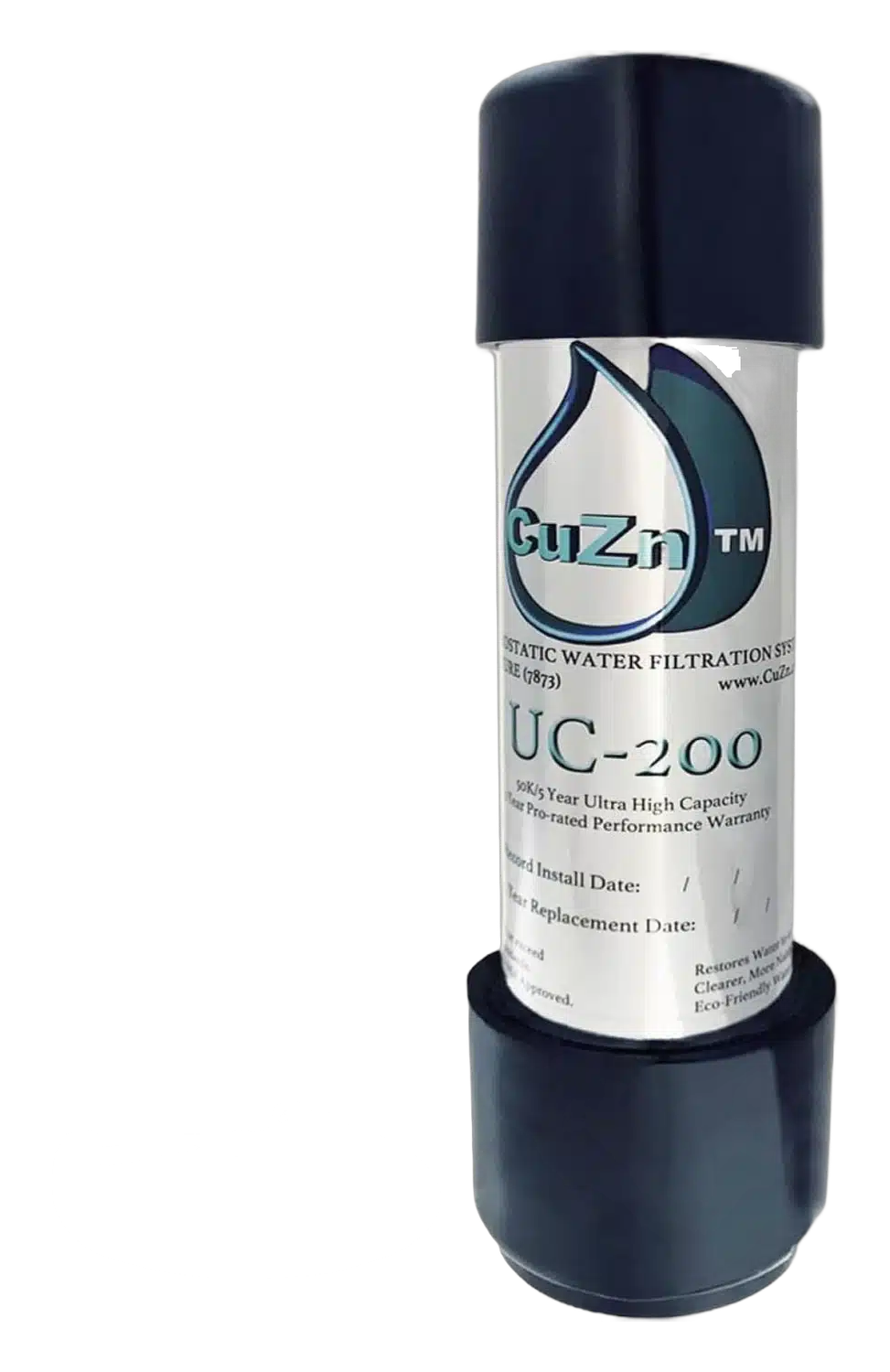
From there, the CuZn UC-200 is a 3-stage under-sink inline water filter that earns Best Under-Sink for one defining reason: its filter cartridge lasts 5 years or 50,000 gallons between replacements, the longest service life of any filter in this list. CuZn Water Systems specializes in KDF-based filtration, and the UC-200 uses a precise blend of Micro Sediment Membranes, KDF-55 media, and coconut-shell carbon to reduce PFAS, PFOS, lead, and chlorine without reducing TDS, which means healthy minerals stay in. For the best water filtration system for home under sink without TDS removal, the 5-year cartridge changes the total cost calculation dramatically.
CuZn UC-200 Specs
| Filtration Stages | 3 (Micro Sediment Membranes, KDF-55, coconut-shell carbon) |
| Installation Type | Under-sink inline (no drilling, no tank) |
| Filter Life | 5 years / 50,000 gallons per cartridge |
| Flow Rate | Matches line pressure (no flow restriction) |
| Power Source | No power required |
| Warranty | Manufacturer-backed CuZn support |
Key Features
- The 5-year / 50,000-gallon cartridge reduces maintenance to a single filter change per half-decade, which dramatically lowers total ownership cost over time.
- The KDF-55 redox media specifically targets PFAS compounds (including PFOA and PFOS) plus up to 99% of chlorine and up to 98% of lead, mercury, and other heavy metals.
- The Micro Sediment Membranes capture sediment and particulates ahead of the carbon stage, protecting the downstream media from premature fouling.
- The no-tank inline design requires no drilling, no electricity, and no under-sink storage tank, which keeps installation under 30 minutes.
- NSF/ANSI 42 and 372 certification verifies aesthetic reduction performance and lead-free hardware components.
Three filtration media work in sequence: Micro Sediment Membranes (sediment and particulates), KDF-55 (a copper-zinc redox alloy that removes up to 99% of chlorine and up to 98% of lead, mercury, and other heavy metals through electrochemical reaction), and coconut-shell activated carbon (VOCs, taste, odor, pesticides). NSF/ANSI 42 certified for aesthetic reduction; NSF/ANSI 372 certified for lead-free components. The system does not reduce TDS, so it cannot remove fluoride, nitrates, dissolved salts, or biological contaminants. No tank required: it sits inline between the supply line and faucet, connected via stainless-steel hose.
KDF-55's redox mechanism specifically targets PFAS compounds including PFOA and PFOS, which standard activated carbon handles inconsistently at short chain lengths. The UC-200 is independently tested and approved for PFAS and PFOS reduction, which makes it an appropriate choice when PFAS contamination is the primary concern but full TDS removal is not desired. For households researching the best under sink water filtration system for home use without going to RO, the UC-200's KDF + carbon stack is the targeted answer. We also found a consistent pattern of 5-year service life confirmation.
The 5-year filter life is the practical differentiator. Most carbon or RO pre-filters require replacement every 6 to 12 months at $15 to $50 each, while the UC-200 compresses that cycle to once per half-decade.
Why We Chose This
NSF-certified 3-stage under-sink filter targeting PFAS, PFOS, lead, and chlorine with a 5-year / 50,000-gallon cartridge that requires no drilling, electricity, or tank.
The UC-200 does not reduce TDS and cannot remove fluoride, nitrates, or dissolved heavy metals at the ionic level RO achieves. Households with documented well-water nitrates need an RO system instead.
Installation requires no drilling: the stainless-steel connection hose adapts to standard kitchen or bathroom faucet supply lines, and CuZn provides all necessary installation hardware plus a tutorial video. Physical installation takes under 30 minutes for most users, and the unit is compact (4.5 by 4.5 by 16 inches) so it fits in tight under-sink configurations. CuZn's customer support is reachable directly, and replacement cartridges are available through Amazon and CuZn's website.
Pros
- 5-year / 50,000-gallon cartridge cuts maintenance
- NSF/ANSI 42 and 372 certified
- KDF-55 targets PFAS, PFOS, and heavy metals
- Retains beneficial minerals (no demineralization)
- No drilling, no tank, no electricity
- Compact 4.5 by 4.5 by 16-inch footprint
- Lowest per-year-of-filtration cost in this list
Cons
- Does not reduce TDS or remove fluoride/nitrates
At its current price, the UC-200 is among the lowest-priced units in this roundup on a per-year-of-filtration basis. The 5-year cartridge divided into annual cost significantly undercuts any system requiring 6 to 12-month replacements. For city-water households whose primary concerns are PFAS, lead, and chlorine, and who do not need TDS removal, the UC-200 offers the best under-sink value proposition in this list.
Final Verdict
The CuZn UC-200 is the best under sink water filtration system for home buyers who want targeted PFAS, lead, and chlorine reduction with a 5-year filter life, no tank, no electricity, and no drilling.
8. PRO+AQUA Elite GEN2 PRO-100-E
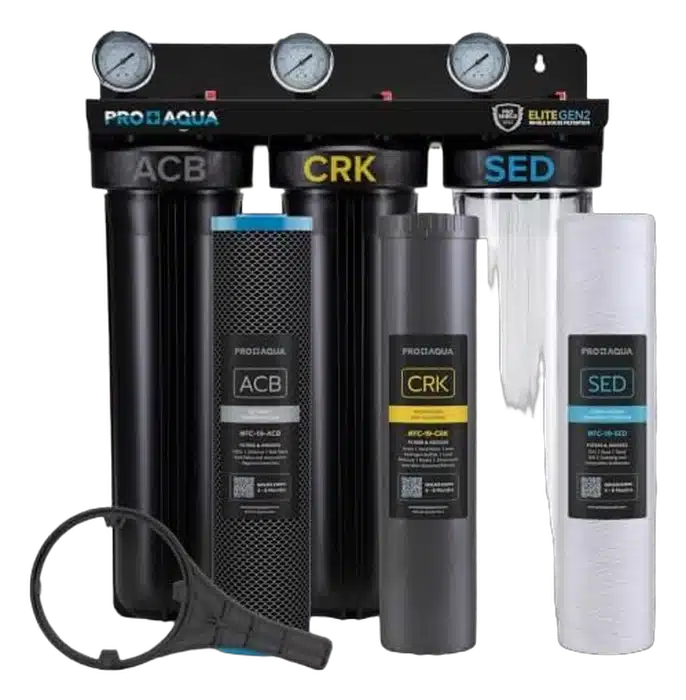
After that, the PRO+AQUA Elite Series GEN2 PRO-100-E is a 3-stage whole-house point-of-entry filtration system that earns the title of best water filtration system for whole home protection because it is the only whole-house unit in this roundup with stainless-steel pressure gauges and a Stage 2 CRK media that specifically targets heavy metals plus hydrogen sulfide. For households on city water leaving residue on fixtures, or on well water with iron or hardness issues, the PRO+AQUA delivers heavy-metals coverage that the iSpring WGB21B (Best Budget) cannot match.
PRO+AQUA Elite GEN2 Specs
| Filtration Stages | 3 (sediment, CRK heavy-metals media, coconut-shell carbon block) |
| Installation Type | Whole-house point-of-entry |
| Filter Life | 100,000 gallons (replace every 6 months for best performance) |
| Flow Rate | Up to 15 GPM via 1-inch inlet/outlet ports |
| Power Source | No power required |
| Warranty | 5-year manufacturer plus lifetime US tech support |
Key Features
- The stainless-steel pressure gauges show real PSI across each stage so you replace cartridges based on actual filter loading, not calendar guesswork.
- The Stage 2 CRK media reduces heavy metals (lead, iron, mercury, nickel, chromium) plus hydrogen sulfide and inhibits bacterial and algae growth in the housing.
- The 5-year manufacturer warranty is one of the longest in the whole-house filtration category, backed by lifetime US tech support.
- The Stage 3 coconut-shell carbon block handles chlorine, VOCs, pesticides, herbicides, and odor at 5-micron filtration.
- The 1-inch inlet/outlet ports support 15 GPM with minimal pressure drop, which is suited to 3+ bathroom homes.
Three stages run in fixed order: clear-housing sediment filter (rust, dust, silt; the clear housing lets you visually confirm cartridge load), Stage 2 CRK proprietary blend (lead, iron, mercury, nickel, chromium, hydrogen sulfide, plus bacterial and algae growth inhibition), and Stage 3 activated coconut-shell carbon block (chlorine, VOCs, pesticides, herbicides, odors at 5-micron). The 100,000-gallon capacity per filter set is double the WGB21B's rating, though replacement every 6 months is recommended for best performance. The system handles 15 GPM through 1-inch inlet and outlet ports.
In our experience, the stainless-steel pressure gauges are the operational feature that elevates this system over comparable whole-house units. Rather than guessing filter condition by elapsed calendar time, the gauges show real PSI across each stage; a pressure differential of 10 to 20 PSI signals a loaded cartridge regardless of elapsed weeks. This protects plumbing and downstream appliances from running on fouled media, and verified buyers report measurable water-quality improvements at the kitchen tap and shower.
The CRK Stage 2 media inhibits bacterial and algae growth within the filter housing itself, which matters for well-water systems where slow-moving media can harbor biofilm.
Why We Chose This
3-stage whole-house filtration with CRK heavy-metals media, stainless-steel pressure gauges for data-driven cartridge changes, and a 5-year warranty backed by lifetime US tech support.
At its current price, the PRO+AQUA Elite GEN2 is the highest-priced whole-house unit in this list, with monthly purchase volume lower than the iSpring WGB21B.
Installation is rated as professional (per manufacturer spec), though the system uses standard 1-inch NPT fittings and many experienced DIYers complete the install themselves. PRO+AQUA includes all mounting hardware plus documentation. The 5-year manufacturer warranty (one of the longest in the whole-house category) requires online warranty registration after installation, and lifetime US technical support is available. PRO+AQUA recommends filter replacement every 6 months for best filtration and flow rate maintenance.
Pros
- Stainless-steel pressure gauges enable data-driven changes
- CRK heavy-metals media (lead, iron, mercury, nickel)
- 5-year manufacturer warranty plus lifetime US support
- 100,000-gallon capacity per filter set
- Bacterial/algae growth inhibition in CRK stage
- 15 GPM flow through 1-inch ports
- Clear housing on Stage 1 enables visual cartridge check
Cons
- Manufacturer recommends professional installation
For households with documented heavy-metal concerns, whether from well-water iron or municipal lead-pipe leaching, the PRO+AQUA Elite GEN2 is the appropriate whole-house investment. Its Stage 2 CRK media handles contaminants the iSpring WGB21B's 2-stage carbon design cannot touch. The pressure gauges further justify the premium by extending filter life through data-driven replacement timing rather than guesswork.
Final Verdict
The PRO+AQUA Elite GEN2 is the best water filtration system for whole home protection when heavy metals and hydrogen sulfide are part of the contamination profile. Stainless gauges, a 3-stage heavy-metals process, and a 5-year warranty make it the most complete whole-house option in this roundup.
9. Home Master TMAFC-ERP
Stepping up to the highest-rated system in this list, the Home Master TMAFC-ERP is a 7-stage under-sink reverse osmosis system with a patented 2-pass alkaline remineralization process and catalytic carbon in its pre-filtration stage. It earns the title of best home water filtration system for hard water because catalytic carbon breaks down chloramine at 97%-plus removal versus standard carbon's 40 to 65%, and because the 2-pass remineralization adds iron and manganese reduction alongside calcium and magnesium restoration. Hard water supplies are typically high in dissolved minerals and frequently served by chloramine-treated municipal systems, and this unit addresses both.
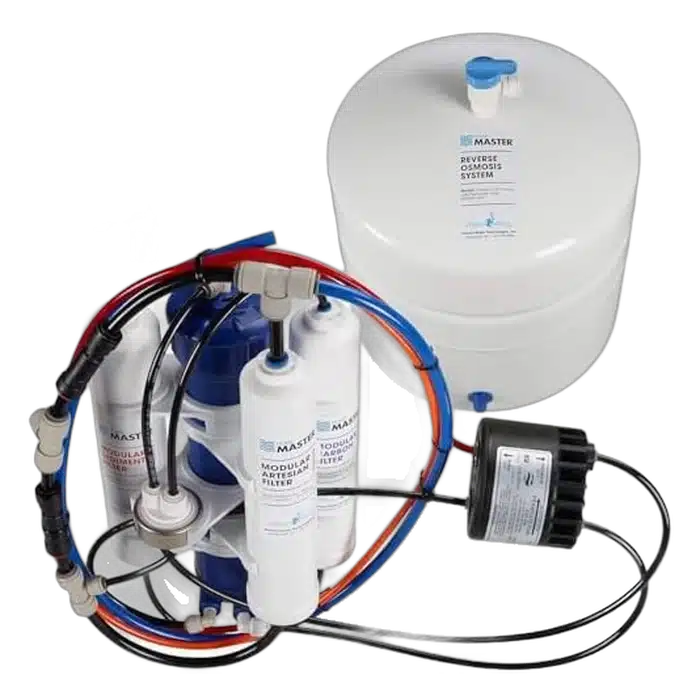
Home Master TMAFC-ERP Specs
| Filtration Stages | 7 (sediment, two catalytic carbon, RO membrane, post-carbon, two-pass alkaline remineralization) |
| Installation Type | Under-sink |
| Filter Life | Pre-filters 12 months; RO membrane 2-3 years; remineralization 2 years |
| Flow Rate | 75 GPD; 4.5-second tank fill rate |
| Power Source | No power required |
| Warranty | 5-year limited parts |
Key Features
- The catalytic carbon pre-filter (8.5-inch block) removes chloramine at 97%+ versus the 40 to 65% achieved by standard activated carbon.
- The patented 2-pass alkaline remineralization first reduces iron and manganese, then adds calcium and magnesium back, raising pH into the alkaline range.
- The 1:1 waste ratio is the most water-efficient ratio among tank-based RO systems in this roundup, beating the typical 3:1 or 4:1 of older designs.
- The fast 4.5-second tank fill rate delivers water meaningfully faster than standard 50 GPD systems at the dispensing faucet.
- The 5-year limited parts warranty covers most system components, which is a reassuring backstop for a 7-stage build.
Seven stages run in fixed order: sediment, two catalytic carbon stages (the 8.5-inch block targets chloramine), TFC RO membrane, post-carbon, first-pass remineralization (iron and manganese reduction), and second-pass remineralization (calcium, magnesium, pH adjustment). The 1:1 waste ratio is the most water-efficient among tanked RO systems in this roundup. The tank fill rate is 4.5 seconds per draw at rated conditions, which Home Master describes as 'fast fill,' meaningfully quicker than a standard 50 GPD system. The 5-year limited parts warranty covers most system components.
In our experience, the catalytic carbon distinction matters for the roughly one-third of US water utilities that use chloramine instead of free chlorine. Standard activated carbon reduces chloramine by only 40 to 65%, while catalytic carbon achieves 97%-plus removal. The 2-pass remineralization is more thorough than single-pass systems: the first pass reduces iron and manganese (which standard remineralization skips), and the second pass adds calcium and magnesium. For hard-water plus chloramine households, this two-stage mineral management is the key differentiator.
The 1:1 waste ratio means for every gallon produced, one gallon goes to drain, far better than the 3:1 or 4:1 of traditional RO systems. Over years of daily use, that delivers meaningful water savings.
Why We Chose This
7-stage RO with catalytic carbon (97%+ chloramine removal), patented 2-pass alkaline remineralization (iron/manganese reduction + calcium/magnesium addition), and a category-best 1:1 waste ratio.
The TMAFC-ERP is mid-to-high among the RO systems here, and homes with supply pressure below 40 PSI will see real-world output drop and may require a booster pump (sold separately).
Home Master includes comprehensive installation documentation plus phone and email support, and the system uses 3/8-inch tubing with standard push-to-connect fittings. Filter replacement intervals are friendly: pre-filters every 12 months (the larger catalytic carbon blocks last longer than standard carbon), the RO membrane every 2 to 3 years, and the remineralization cartridges every 2 years. Home Master's US-based customer support team is reachable for installation and troubleshooting.
Pros
- Catalytic carbon for 97%+ chloramine removal
- Patented 2-pass alkaline remineralization
- Category-best 1:1 waste ratio for tanked RO
- 5-year limited parts warranty
- Fast 4.5-second tank fill rate
- Iron and manganese reduction in first remin pass
- US-based phone and email support
Cons
- Booster pump needed below 40 PSI
The TMAFC-ERP's combination of catalytic carbon, 2-pass remineralization, and 1:1 waste ratio occupies a specific performance tier above standard 5 to 6-stage RO systems. For households where chloramine treatment and hard-water minerals are both confirmed issues, it is the technically correct recommendation. For standard chlorine-treated soft city water, the iSpring RCC7AK or APEC ROES-PH75 deliver equivalent core RO performance at a lower price.
Final Verdict
The Home Master TMAFC-ERP is the best home water filtration system for hard water and chloramine-treated supplies, combining catalytic carbon pre-filtration, 2-pass alkaline remineralization, and a 1:1 waste ratio in the highest-rated system in this roundup.
How to Choose the Best Water Filtration System for Home
Choosing the right system means matching technology to confirmed contaminants, not chasing stage counts or marketing claims. The framework below walks through the six factors that separate genuinely effective home filtration from cosmetic upgrades. Start with what is actually in your water; build outward from there.
Filtration stages and contaminant removal capability
Contaminant removal follows filtration technology, not stage count. An 8-stage carbon-only system removes less than a 3-stage RO.
The category splits cleanly into three tiers, ranked by contaminant scope:
- Whole-house sediment plus carbon (iSpring WGB21B, PRO+AQUA GEN2): removes chlorine, sediment, VOCs, taste, and odor; does not touch dissolved heavy metals, fluoride, nitrates, PFAS, or TDS.
- Reverse osmosis (iSpring RCC7AK, Waterdrop G3P600, APEC ROES-PH75, Home Master TMAFC-ERP, Express Water RO5DX, Bluevua RO100ROPOT): semi-permeable membrane with 0.0001-micron pores that strips dissolved salts, lead, PFAS, nitrates, arsenic, and fluoride at 90 to 99%.
- KDF redox plus carbon (CuZn UC-200): electrochemical reduction of chlorine, lead, mercury, and PFAS without removing TDS, so calcium and magnesium stay in the water.
Carbon's core strength is adsorption of organic compounds: chlorine at 95 to 99%, plus VOCs, THMs, pesticides, herbicides, and taste or odor. Catalytic carbon, used in the Home Master TMAFC-ERP, extends removal to chloramine at 97% and above, which matters because roughly one-third of US utilities use chloramine instead of free chlorine and standard carbon removes only 40 to 65%.
If you do not know which disinfectant your utility uses, check your annual Consumer Confidence Report (mailed by the EPA or posted at your utility's site). For best reverse osmosis water filtration system for home concerns, the disinfectant type drives the carbon-block choice. The best water softener and filtration system for home use is almost always two appliances: a softener for hardness ions, plus a separate under-sink RO for dissolved health contaminants.
NSF/ANSI and WQA certification tier
NSF certification is the only verified performance claim for water filters. The standards split by what they cover, and the gap between NSF 42 and NSF 53 is the difference between cosmetic and protective.
The four standards relevant to home filtration each cover a distinct contaminant class:
WQA Gold Seal tests to the same NSF/ANSI protocols and carries equal certification stature; the Bluevua RO100ROPOT is WQA-certified and the Waterdrop G3P600 holds the full NSF 42, 53, 58, and 372 stack. The phrase 'tested to NSF standards' is not equivalent to NSF certification: it means a company ran its own tests using NSF methods, with no third-party audit and no ongoing surveillance.
Verify any certified claim by searching the exact brand and model number at info.nsf.org/certified/dwtu/ before purchase. If a product does not appear in that database, it is not certified, regardless of packaging claims. The best rated water filtration system for home use is the one whose certification you can find in the registry, not the one with the loudest marketing badge.
| Standard | What it covers | Reader meaning |
| NSF/ANSI 42 | Aesthetic contaminants (chlorine taste, odor) | No verified health protection on its own |
| NSF/ANSI 53 | Health-effects: lead (96.7%+ from 150 ppb challenge), PFAS (7 compounds at 20 ppt cap), cysts (99.95%), VOCs, mercury | The gold standard for protective claims |
| NSF/ANSI 58 | Complete RO systems; minimum 75% TDS reduction | The full-system cert for under-sink RO |
| NSF/ANSI 372 | Lead-free hardware components | Safe contact with the wetted plumbing path |
Installation type and placement (whole house, under-sink, or countertop)
Point-of-entry whole-house systems install at the main supply line before any fixture, treating water at every tap, shower, and appliance simultaneously. They require minimum 10 GPM flow capacity for 1 to 2-bathroom homes and 15 to 20 GPM for homes with 3 or more bathrooms. Whole-house is the right choice for systemic problems: chlorine smell at every fixture, sediment fouling appliances, or well water that affects every tap.
Under-sink reverse osmosis systems treat water at a single tap, providing the highest contaminant removal performance but covering only one faucet. The expert-recommended approach for comprehensive coverage is a combination: a whole-house sediment and carbon filter at point-of-entry to protect plumbing and appliances, paired with an under-sink RO at the kitchen for drinking and cooking.
The three installation patterns at a glance:
Countertop systems require no plumbing and are the best water filtration system for the home in rental situations where installation is not permitted. They trade convenience for lower throughput. The Bluevua RO100ROPOT is the only no-installation RO option in this list; the CuZn UC-200 represents the best under sink water filtration system for home use when drilling is permitted but tank space is tight.
| Type | Coverage | Best for |
| Whole-house | Every tap, shower, appliance | Systemic chlorine and sediment, well-water iron |
| Under-sink RO | One faucet (typically kitchen) | Drinking water, lead, PFAS, fluoride |
| Countertop RO | Carafe-served at a single counter spot | Renters, RVs, no-installation situations |
Filter lifespan and annual replacement cost
Filter replacement cost compounds over the life of the system and frequently exceeds the initial purchase price. The CuZn UC-200's KDF cartridge stretches that interval to 5 years or 50,000 gallons, compressing maintenance to one swap per half-decade.
Lifespan varies sharply by media chemistry and use case:
- Activated carbon block (most under-sink and whole-house cartridges): 6 to 12 months per cartridge.
- TFC RO membrane: 2 to 3 years; the largest single replacement cost in any tanked RO system.
- Remineralization stage (iSpring RCC7AK, APEC ROES-PH75): 12 months on average, longer on the Home Master TMAFC-ERP at 24 months.
- KDF-55 plus carbon (CuZn UC-200): 5 years or 50,000 gallons, whichever comes first.
Calculate total cost of ownership before comparing systems on sticker price alone. A worked example: a system priced at $190 with $120 a year in cartridges costs $790 over five years; a system priced at $440 with $60 a year costs $740. The 5-year math often favors the higher upfront investment. The best water filtration system for home under $500 is rarely the cheapest one on day one. Usually, it is the one whose 5-year ownership total stays under that ceiling.
Always verify replacement cartridge availability for the exact model before purchase. Some brands use proprietary filter sizes that limit supplier options and lock buyers into single-vendor pricing. Standard 10-inch x 4.5-inch Big Blue cartridges and standard 1/4-inch RO formats keep the secondary market open.
Water flow rate and pressure impact
Whole-house systems require adequate flow rate at the main supply line. The minimum for a 1 to 2-bathroom home is 10 GPM; a 3-bathroom-or-larger home needs 15 to 20 GPM. Both the iSpring WGB21B and PRO+AQUA Elite GEN2 use 1-inch inlet/outlet ports, which support higher flow rates with less pressure loss than 3/4-inch ported systems.
A properly sized, clean whole-house filter causes only 1 to 3 PSI of pressure drop. A clogged or undersized filter can cause drops of 10 to 20 PSI that affect shower pressure and appliance performance, which is also the threshold that signals replacement is overdue.
RO systems require 40 to 80 PSI operating pressure at the membrane for rated GPD output. Homes with supply pressure below 40 PSI (common in rural well-pump systems at distance from the wellhead) need a booster pump, typically $50 to $150, to maintain membrane performance. Real-world GPD output is 50 to 75% of the rated number under ideal lab conditions of 77F, 50 PSI, and 250 ppm NaCl, so a 75 GPD system produces 37 to 56 GPD in real-world conditions.
For families who draw heavily from an RO faucet and refrigerator line simultaneously, a tankless system like the Waterdrop G3P600 at 600 GPD eliminates the tank-drain problem. The trade-off is a corded electric requirement and a higher price point that most households will not justify unless tankless delivery is a clear priority.
Water source compatibility (city vs. well water)
City water is treated to meet EPA Maximum Contaminant Levels for over 90 regulated contaminants, but treatment introduces its own concerns: chlorine or chloramine disinfection byproducts, lead from aging service lines, and PFAS from upstream industrial sites. The EPA's 2024 Lead and Copper Rule Improvements confirmed there is no safe level of lead exposure, with the action level now set at 10 ppb. A filter certified to NSF/ANSI 53 for lead reduction is the appropriate response.
Well water is entirely untreated at the household level. You are responsible for testing and addressing whatever contaminants your specific aquifer carries, and the contamination profile drives the system choice.
Common well-water contaminants and their thresholds:
- Iron above 0.3 mg/L: stains fixtures and fouls sediment filters rapidly.
- Hydrogen sulfide above 0.05 mg/L: detectable rotten-egg odor and corrodes copper plumbing.
- Hardness minerals: scale on shower glass and shortened appliance lifespan.
- Nitrates above 10 mg/L (EPA MCL): hazardous to infants under six months.
- Bacteria: possible if well casing integrity is compromised.
Before purchasing a system for well water, have your water tested by an NSF-certified laboratory. The best home water filtration system for well water is the one matched to your specific test results, not a generic recommendation. A typical well-water stack starts with a sediment pre-filter, then technology appropriate to confirmed contaminants: iron filtration, KDF, RO, or UV in any combination.
The best well water filtration system for home use rarely fits in a single appliance. The Express Water RO5DX is our top pick for well households because its 5-stage layered pre-filtration plus built-in leak detection sensor handles the sediment load and the eventual fitting failure that taxes RO systems hardest in private-well installations.
City Water vs. Well Water: Which Home Filtration System Do You Need?
City water arrives pre-treated but is not contaminant-free. Treatment itself introduces chlorine or chloramine byproducts (THMs and haloacetic acids), and aging infrastructure adds lead from pipe leaching. PFAS from upstream industrial sites is increasingly detected in municipal supplies.
The EPA's first-ever PFAS drinking water standards, finalized in April 2024, set MCLs of 4 ppt for PFOA and PFOS, with many water systems required to upgrade treatment before the 2031 compliance deadline. For city-water households, an under-sink RO certified to NSF 53 and 58 is the most targeted response: it addresses lead, PFAS, fluoride, and chlorine byproducts at the drinking tap without disrupting whole-house mineral content.
Well water has no upstream treatment. Every contaminant in your local aquifer arrives at the tap: iron above 0.3 mg/L stains fixtures and clogs sediment filters; hydrogen sulfide above 0.05 mg/L creates rotten-egg odor and corrodes copper plumbing; nitrates above 10 mg/L are hazardous to infants. No single filter technology addresses all of these simultaneously, which is why the best whole home water filtration system for well water is almost always a multi-stage stack matched to a confirmed water test.
The practical split: if you are on city water and your main concerns are drinking water quality (taste, lead, PFAS), an under-sink RO paired with an optional whole-house sediment and carbon filter covers the home. If you are on well water, start with a whole-house sediment and carbon system at point-of-entry, then add an under-sink RO at the kitchen for the dissolved-contaminant layer. Hard-water and chloramine-served households face a separate question; the best home water filtration system for hard water typically pairs catalytic carbon with 2-pass remineralization in the under-sink unit, as in the Home Master TMAFC-ERP.
Buyers comparing point-of-use options should read the best reverse osmosis system guide for a full ranked breakdown of NSF-certified under-sink, tankless, and countertop RO builds.
My Overall Verdict
Our final stack reflects the reality of home water filtration: the right system depends on your water source, your installation constraints, and whether drinking water or whole-house coverage is the priority. We narrowed the nine evaluated systems down to three picks that cover the three most common scenarios buyers face.
- iSpring RCC7AK [Best Overall] - The choice for most households: NSF-certified 6-stage RO with alkaline remineralization, proven at scale at an accessible price.
- iSpring WGB21B [Best Budget] - The entry point for whole-house chlorine and sediment coverage without an RO budget.
- Waterdrop G3P600 Reverse Osmosis [Best for Drinking Water] - Top pick for households that want instant tankless RO delivery, the widest certification stack in this list, and category-best water efficiency.
We acknowledge that most households are best served by a layered approach rather than one system alone: a whole-house sediment and carbon filter for systemic protection, paired with an under-sink RO at the kitchen for drinking and cooking. Our top three reflect the right starting point depending on which layer you tackle first, and we built the stack around 9 systems we tested across every installation type and water-source scenario.
Our methodology weighed certification breadth, real-world output verified against rated GPD, and total 5-year cost of ownership over sticker price. What is best water filtration system for a home is ultimately the system whose certification scope matches your tap's confirmed contamination profile.
For most households, the best water filtration system for home starts with understanding your water source, matching filtration technology to confirmed contaminants, and selecting a system backed by third-party NSF or WQA certification.
Why the iSpring RCC7AK Might Be the Best Choice
The iSpring RCC7AK earned Best Overall in our roundup because it solves the three problems most homeowners hit when shopping for an RO system: contaminant removal that holds up against verifiable certification, a remineralization stage that fixes the flat taste of standard RO output, and an installation design that does not require drilling a faucet hole through a granite countertop. Most accessibly priced RO systems deliver one or two of these; the RCC7AK delivers all three.
The trade-off is that you give up tankless on-demand delivery; the system uses a pressurised storage tank that occupies 4 to 6 inches of under-sink depth and refills slowly when drawn down. For families that draw heavily from both the RO faucet and a refrigerator line at peak times, that tank can run dry, and the wait period frustrates households used to instant flow. The Waterdrop G3P600 in this roundup solves the tank-drain problem at a higher price point. Households treating water at the point of entry are often mid-project on indoor air as well, and our air purification guides cover that side.
Why we chose the iSpring RCC7AK as our Best Overall:
- NSF certified for the contaminant spectrum RO covers (lead, PFAS, cysts, VOCs, TDS).
- 6-stage alkaline remineralization restores calcium and magnesium after the membrane strips them.
- Patented top-mounted faucet design eliminates the most common RO installation pain point.
- Lifetime US-based customer support from Atlanta, GA.
- Standard 1/4-inch fittings and widely available replacement cartridges keep ownership costs predictable.
FAQs
What is the best water filtration system for a house?
The best water filtration system for a house depends on water source: most city-water homes pair an under-sink NSF 58-certified RO for drinking with a whole-house sediment and carbon filter at the main line. What is the best water filtration system for home use is the one whose certification scope matches your tap's contamination profile.
What is the best drinking water filtration system for home use?
The best drinking water filtration system for home use is a multi-stage reverse osmosis system certified to NSF/ANSI 58, which reduces TDS by 90 to 99% including lead, PFAS, fluoride, and nitrates. Selecting the best home water filtration system for drinking comes down to a remineralization stage that restores calcium and magnesium so the water tastes natural.
Why am I thirsty after drinking reverse osmosis water?
You may feel thirsty after drinking reverse osmosis water because standard RO removes virtually all dissolved minerals alongside contaminants, and demineralized water can feel flat and may not trigger normal hydration signals for some people. A remineralization filter, as found in the iSpring RCC7AK and APEC ROES-PH75, adds calcium and magnesium back to correct that.
What is the best water filter for well water in a home?
The best water filter for well water in a home is a multi-stage system with a sediment pre-filter, then carbon or KDF for chemical removal, then RO or UV for dissolved contaminants and bacteria, since well water carries iron, sediment, hydrogen sulfide, and possible biological contamination. Get a certified water test first so you target the contaminants present.
How often should you replace filters in a home water filtration system?
You should replace sediment and carbon cartridges every 6 to 12 months, RO membranes every 2 to 3 years, and whole-house carbon block filters every 6 to 12 months, with KDF filters like the CuZn UC-200 lasting up to 5 years. A pressure drop of 10 to 20 PSI across a filter signals replacement is overdue.
References:
- U.S. Environmental Protection Agency. 'National Primary Drinking Water Regulations.' EPA.gov. https://www.epa.gov/ground-water-and-drinking-water/national-primary-drinking-water-regulations
- NSF International. 'Standards for Drinking Water Treatment Units.' NSF.org. https://www.nsf.org/consumer-resources/articles/standards-water-treatment-systems
- U.S. Environmental Protection Agency. 'PFAS Drinking Water Regulations (April 2024).' EPA.gov. https://www.epa.gov/sdwa/and-polyfluoroalkyl-substances-pfas
- Centers for Disease Control and Prevention. 'Waterborne Disease in the United States.' CDC.gov. https://www.cdc.gov/healthy-water-data/waterborne-disease-in-us/results.html
Medical Disclaimer: This content is for informational purposes only. It is not a substitute for professional medical advice, diagnosis, or treatment. If you have concerns about your water quality or air quality and their effects on your health, consult a qualified healthcare professional.