
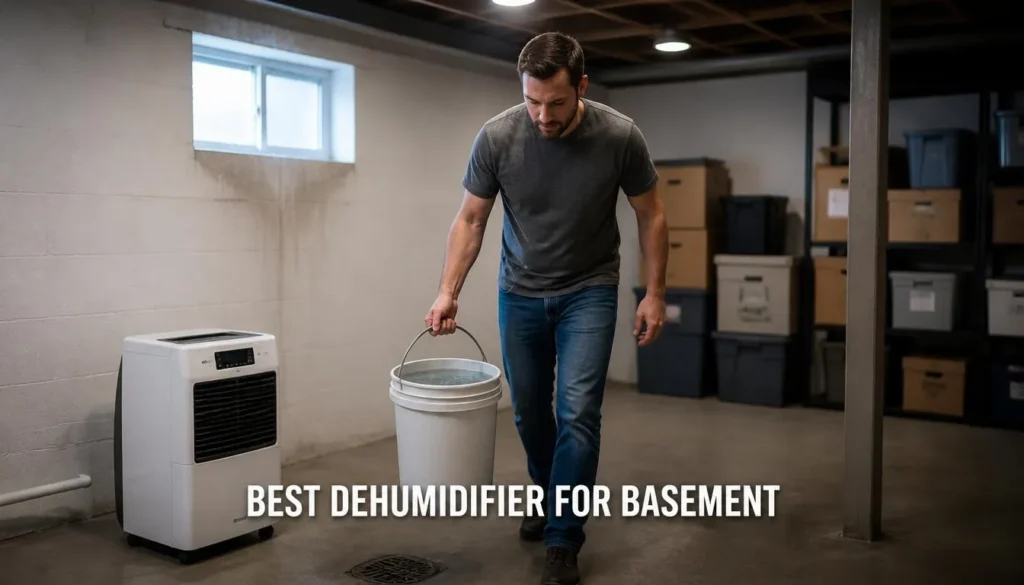

The best dehumidifier for basement use keeps indoor humidity between 30 and 50 percent, the range the EPA recommends, because damper air lets mold and dust mites thrive. A basement is usually the coolest and dampest room in the house, so the unit has to pull water at low temperatures and drain without you emptying a tank every few hours.

We sorted the 8 picks below by type, rated capacity on the current DOE test, drainage and a check against the ENERGY STAR registry. Listing headlines often run far higher than the DOE figure because makers quote hotter, wetter conditions, so we flag the gap between headline and DOE rating wherever we found one. The Top 3 come first if you want a short answer.
My Recommended Top 3 Best-Buys for Basement Dehumidifiers: Reviewed and Rated

- The rotary compressor uses internal-thread copper tubing, according to the maker.
- Five operating modes cover auto, constant humidity, continuous, smart drying and sleep.
- The drain hose and garden hose adapter come in the box, so continuous drainage needs no extra parts.
- Two drainage options include a small tank with auto shut-off or the supplied drain hose.
- The LED touch panel shows humidity and sets the target, fan speed and timer.
- Power failure memory restores your last settings when the power returns.
- Wi-Fi control works through the SmartHome app, Alexa and Google Assistant.
- The 1.6-gallon tank stops the unit when full and restarts after you empty it.
- A built-in drain socket accepts a standard hose for continuous draining.
Best Dehumidifier for Basement Reviews 2026: 8 Top Models for Damp Spaces
The 8 picks run in order of role, from a compact budget unit to two whole-house models. Where a listing and the registry disagreed we say which figure we used, and where we could not find a registry listing we say so plainly instead of calling the model uncertified.
1. AEOCKY 5500 Sq.Ft Energy Star Dehumidifier
The AEOCKY takes the top spot because it pairs a rotary compressor with the most complete drainage and control set in this group. The listing claims 56 pints per day at 86F and 80% RH, a damp-basement condition, and 80 pints at 95F and 95% RH. Both are maker figures, not the 2019 DOE test, which ENERGY STAR lists at 24.5 pints per day.
AEOCKY 5500 Sq.Ft Energy Star Dehumidifier Specs
| Type | Portable compressor |
| Rated Capacity (pints per day) | 80 at 95F and 95% RH; 56 at 86F and 80% RH (maker) |
| Test Standard | 65F, 60% RH DOE portable test: 24.5 pints per day |
| Coverage | 5,500 sq ft (listing claim) |
| Tank Capacity | 1.45 gallons |
| Drainage | Tank, included drain hose, garden hose adapter |
| Noise Level | 44 dB at the lowest fan speed (maker) |
| Energy Star Status | Certified, Most Efficient; listed under RHEA-RCS25(Y)-N4-3-25 |
Key Features
- The rotary compressor uses internal-thread copper tubing, according to the maker.
- Five operating modes cover auto, constant humidity, continuous, smart drying and sleep.
- The drain hose and garden hose adapter come in the box, so continuous drainage needs no extra parts.
- Power-off memory resumes the last settings after an outage, and a child lock is included.
- The slim 31-pound body measures 14.45 by 8.66 by 24.09 inches and fits beside a furnace.
Drainage is where it earns its place. The box includes a drain hose and a garden hose adapter, so you can run it to a floor drain without buying parts. The 1.45-gallon tank suits occasional use, but in a damp basement it fills quickly, so we would plan on the hose from day one.
Control is the other strength. The listing describes five modes, including a constant humidity mode and a sleep mode. We read that as a unit built for set-and-forget basement duty, though we only have the maker's word on how accurate its humidity sensor is.
Our one flag: the 80-pint headline is not its DOE capacity.
Why We Chose This
We placed it first for its drainage kit, five operating modes and compact 31-pound body. ENERGY STAR lists its DOE capacity as 24.5 pints per day.
RHEA-001 appears in the ENERGY STAR registry under RHEA-RCS25(Y)-N4-3-25.
Noise is listed at 44 dB on the lowest fan speed, which the maker says is quieter than rivals at their lowest setting. We treat that as a claim, not a measurement. The slim footprint is easier to tuck beside a water heater than the boxier units on this page.
Pros
- Drain hose and adapter included
- Five operating modes
- Power-off memory after an outage
- Slim, lightweight body
- Low fan speed listed at 44 dB
- Low-coil-temperature defrost sensors
- Child lock and timer
Cons
- Headline capacity exceeds its DOE rating
- DOE capacity is 24.5 pints per day
Against the rest of the page, this is the all-rounder. The VEAGASO is smaller and the Midea has a verified capacity, but the Midea ships without a hose.If the maker figures hold up, it is the unit we would try first, and if they slip, the drainage kit still makes it practical.
Final Verdict
The AEOCKY gives a damp basement the easiest start, with hose drainage, five modes and a slim body. Treat its capacity numbers as maker figures and size with room to spare. It is the practical all-rounder for a damp basement.
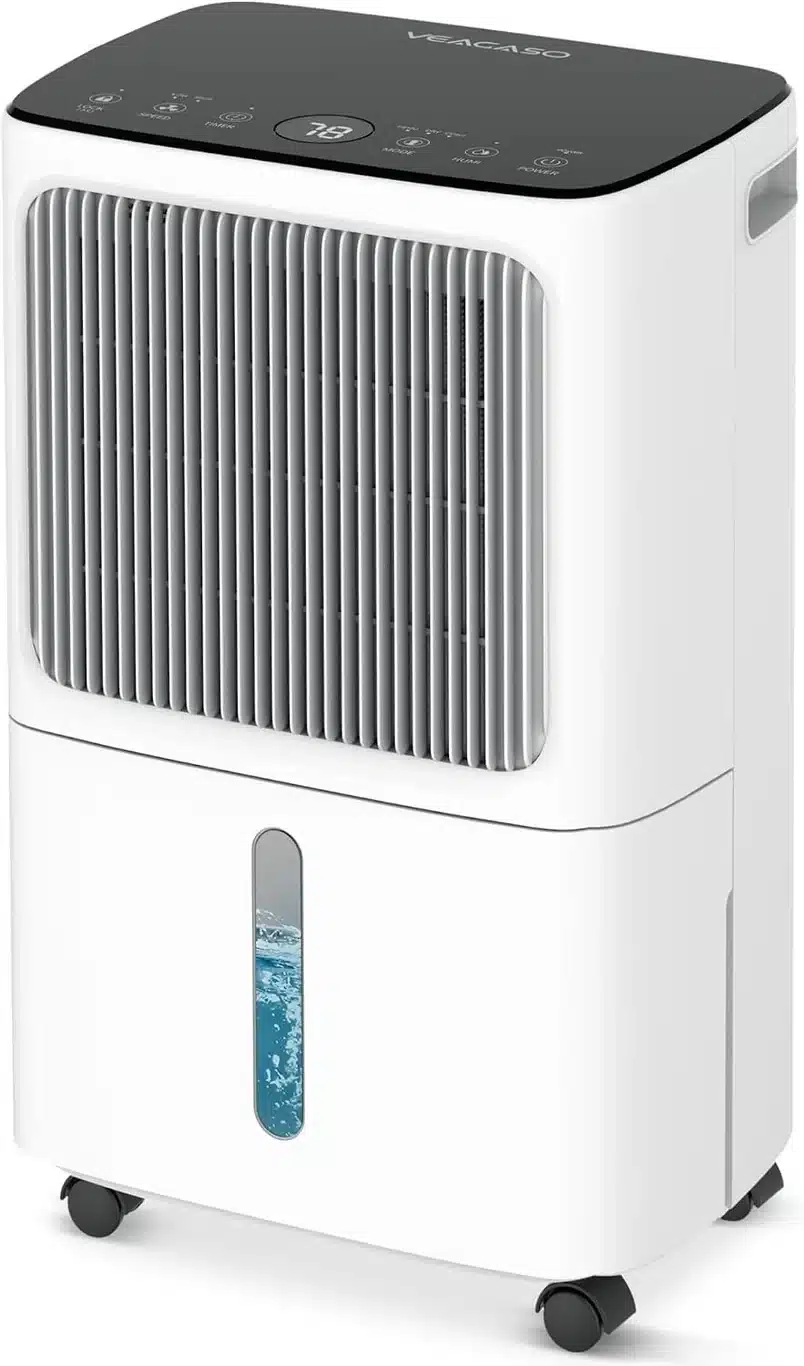
2. VEAGASO VG380 34 Pint Dehumidifier
Next, the VEAGASO is the entry point, and it suits a small or lightly damp space. The maker lists 34 pints per day and 2,500 square feet, but the listing does not state the test basis. If it is the older 80F rating, the 2019 figure would be roughly 22 to 24 pints, which is our inference and unconfirmed.
VEAGASO VG380 34 Pint Dehumidifier Specs
| Type | Portable compressor |
| Rated Capacity (pints per day) | 34 (maker) |
| Test Standard | Not stated on the listing |
| Coverage | 2,500 sq ft (listing claim) |
| Tank Capacity | 2 liters (about 0.53 gallon) |
| Drainage | Tank or included drain hose |
| Noise Level | Up to 40 dB on low speed (maker) |
| Energy Star Status | No listing found in the registry |
Key Features
- Two drainage options include a small tank with auto shut-off or the supplied drain hose.
- The LED touch panel shows humidity and sets the target, fan speed and timer.
- Power failure memory restores your last settings when the power returns.
- The recessed handle and swivel casters make it easy to roll across a basement floor.
- A washable filter and a 2-year warranty come with the unit.
Drainage is simple. The 2-liter tank is small and will need emptying often, so the included drain hose for continuous gravity drainage matters. Run it to a floor drain or sink and the tank stops being a daily chore.
That makes it the best dehumidifier for small basement use on a tight budget, where a few hundred square feet stay cool and clammy rather than wet. In that role we found the 230 W draw and washable filter easy to live with on paper. For a large or flooding-prone space it is too small.
Our one flag: we could not find an ENERGY STAR listing for this model.
Why We Chose This
It is the lowest-cost compressor model in our pool and still includes a drain hose, a washable filter and a 2-year warranty. It fits small or lightly damp basements.
Do not expect a heavy-water machine: the tank is only about half a gallon.
The maker says it runs at up to 40 dB on low speed, which would suit a finished basement with a bed or desk nearby. We could not confirm that figure independently. The compact 12.5 by 10 by 19 inch body also fits tight corners.
Pros
- Entry point among the compressor models
- Drain hose included
- Compact and easy to roll
- Washable filter
- Maker lists 40 dB on low speed
- Power failure memory
- 2-year warranty
Cons
- Test basis for capacity is not stated
- No ENERGY STAR listing found
Compared with the Midea, which has a verified registry result, the VEAGASO is the lighter, smaller choice. Pick it for a small damp room and step up in capacity if the walls feel wet or the floor sweats.
Final Verdict
The VEAGASO is a sensible, plain machine for a small or lightly damp basement. Use the hose, keep expectations modest and do not oversize the job. It is the low-cost starter for a small space.
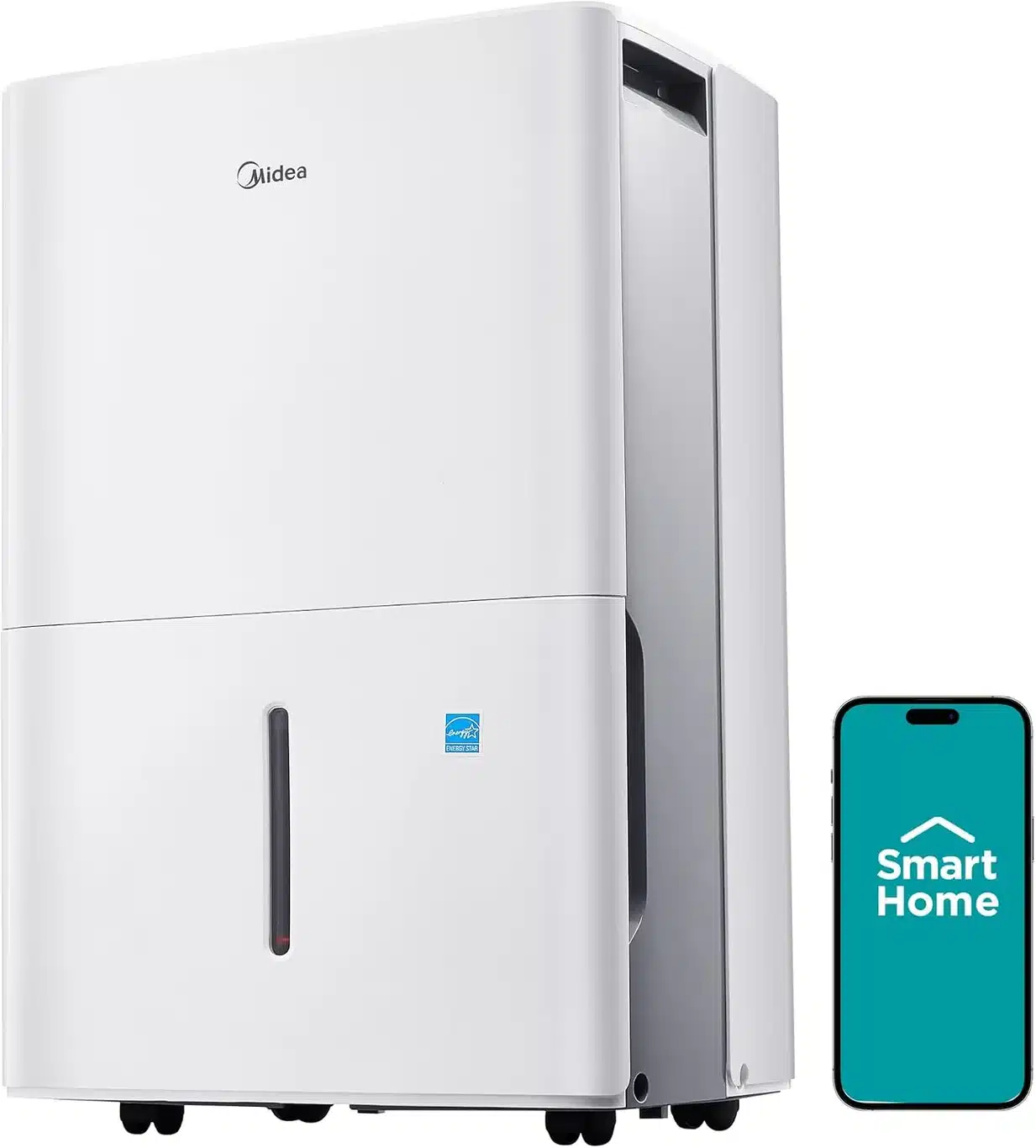
3. Midea 50 Pint Dehumidifier
After that, the Midea is the one unit whose listing capacity matches its registry result. ENERGY STAR lists model MAD50C1AWS-A at 49.74 pints per day on the 2019 test, against the 50 pints on the listing. That match is rare on this page, and it makes the Midea easy to size against.
Midea 50 Pint Dehumidifier Specs
| Type | Portable compressor |
| Rated Capacity (pints per day) | 49.74 |
| Test Standard | 2019 DOE test (65F, 60% RH) |
| Coverage | 4,500 sq ft (listing claim) |
| Tank Capacity | 1.6 gallons |
| Drainage | Tank or built-in hose socket (hose not included) |
| Noise Level | 49 dBA on low (maker) |
| Energy Star Status | Certified, not Most Efficient |
Key Features
- Wi-Fi control works through the SmartHome app, Alexa and Google Assistant.
- The 1.6-gallon tank stops the unit when full and restarts after you empty it.
- A built-in drain socket accepts a standard hose for continuous draining.
- Three fan speeds and 223.7 cfm of airflow move air through a large room.
- The 360-degree wheels and handles help you move the 41.2-pound body between rooms.
ENERGY STAR gives it an efficiency factor of 2.01 liters per kWh, a useful comparison number between units, not a promise of bill savings. We like that the certification is checkable, which is more than we can say for several rivals here.
Drainage needs one purchase. The tank holds 1.6 gallons and a garden hose adapter sits inside it, but a standard drain hose is not included. Budget for one if the unit will run unattended in a basement.
Our one flag: the listed upper limit is 90F, so keep it out of hot utility rooms.
Why We Chose This
It is the only unit where the registry result matches the listing capacity, and it adds Wi-Fi and voice control. That makes it the easiest mid-size pick to size honestly.
The warranty is one year, shorter than several competitors.
Noise is listed at 49 dBA in low mode, which is louder than the 40 to 44 dB claims on other units here. In our view that is the price of a stronger fan, and it suits an unfinished basement better than a bedroom wall.
Pros
- Verified 49.74 pints on the 2019 test
- ENERGY STAR certified
- Wi-Fi app and voice control
- Large 1.6-gallon tank
- Auto shut-off and restart
- Strong 223.7 cfm airflow
- Rolling wheels and handles
Cons
- Drain hose is not included
- One-year warranty only
Next to the AEOCKY, the Midea trades a bundled hose for a result you can check. If your basement is moderately to very damp and you want a portable unit you can size with confidence, this is where we would start.
Final Verdict
The Midea is the honest mid-size choice, with a capacity you can verify and smart controls that actually help. Add a drain hose and it handles most damp basements. It is the verified middle-weight pick.
4. Avylo ADC018 Dehumidifier with Pump
Following the Midea, the Avylo is the pick for anyone who cannot drain by gravity. Its built-in pump has a 15 ft lift and a 15 ft hose, so water can climb to a sink or out a window. The listing headline reads 90 pints per day, but ENERGY STAR lists about 24.5 pints on the current DOE test.

Avylo ADC018 Dehumidifier with Pump Specs
| Type | Portable compressor with pump |
| Rated Capacity (pints per day) | 24.50 |
| Test Standard | 2019 DOE test (65F, 60% RH); listing headline of 90 is a maker figure |
| Coverage | 4,500 sq ft (listing claim) |
| Tank Capacity | 2.11 gallons |
| Drainage | Tank, gravity hose or built-in pump |
| Noise Level | 41 dB on low (maker) |
| Energy Star Status | Certified, listed as Most Efficient |
Key Features
- The built-in pump lifts water 15 ft and comes with a 15 ft drain hose.
- The 2.11-gallon top-mounted tank has a full-tank reminder and auto shut-off.
- Intelligent humidity control reads humidity and temperature on an LED display.
- A key sound and light switch plus a 24-hour timer suit night running.
- The 120F upper limit and compressor overload protection suit a warm utility room.
Here is the detail that changes who should buy it. The registry result is about 24.5 pints per day on the current DOE test, and the 90-pint headline is a maker figure at hotter, wetter conditions. Do not read it as a 90-pint machine.
What we want to flag is the fit. It suits a small or moderately damp basement where the pump saves you from carrying a bucket, such as a laundry corner below the sink line. The 2.11-gallon tank is the largest of the portable units here, so manual emptying is less frequent.
Our one flag: size it on 24.5 pints, not 90.
Why We Chose This
A registry-verified result and a built-in pump with a 15 ft lift make it the best answer when there is no floor drain nearby. It is a small-space unit, not a heavy-water machine.
ENERGY STAR lists it as certified in 2026 and Most Efficient.
The listing quotes 41 dB on the low setting, plus a key sound and light switch that mutes the beeps. We could not test the figure, but those two features make it one of the easier units to run near living space. The 235 W draw is modest.
Pros
- Built-in pump with 15 ft lift
- 15 ft drain hose included
- ENERGY STAR certified, Most Efficient
- Large 2.11-gallon tank
- Low 235 W power draw
- Listed at 41 dB on low
- Overload and overheat protection
Cons
- Real capacity is about 24.5 pints
- Listing headline overstates everyday output
Compared with the Midea, the Avylo gives up capacity for convenience. Choose it when drain location is your main problem and the space is modest. If the basement is very damp, step up to a larger unit.
Final Verdict
The Avylo solves the drain problem better than anything else in the group, but it is a small-basement tool. Match it to the right job and it works well. It is the pump-first pick for a small basement.
5. AprilAire E080 Whole-House Dehumidifier
Stepping up, the AprilAire E080 is a different kind of machine. Shoppers who search for a "dehumidifier whole house" usually want this kind of unit, and it is the one we would shortlist. ENERGY STAR lists it at 65 pints per day on the current DOE test, against 80 pints on the older test.
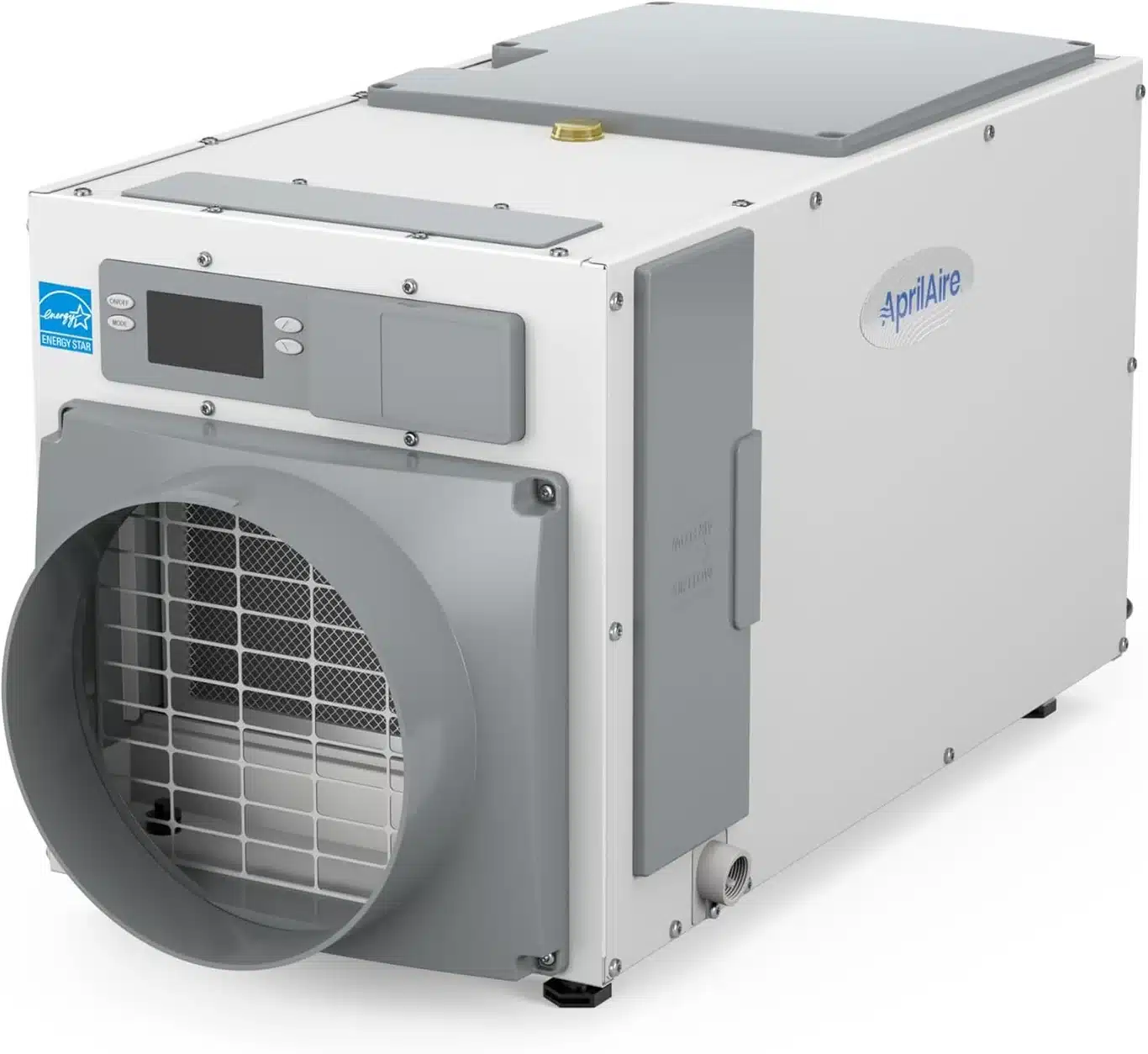
AprilAire E080 Whole-House Dehumidifier Specs
| Type | Whole-home compressor, ducted or free-standing |
| Rated Capacity (pints per day) | 65.00 |
| Test Standard | DOE whole-home test (73F, 60% RH); 80 pints at 80F, 60% RH |
| Coverage | Up to 4,400 sq ft (listing claim) |
| Tank Capacity | None, drains by hose or floor drain |
| Drainage | Hose or floor drain (no tank, no pump) |
| Noise Level | Not listed |
| Energy Star Status | Certified, listed as Most Efficient |
Key Features
- Smart sensing starts dehumidifying when humidity rises above your target.
- The no-tank design drains through a hose or sits over a floor drain.
- The washable MERV 8 filter ships with duct collars and a backdraft damper.
- Corrosion-resistant aluminum coils are built in the U.S.A., according to the maker.
- A 104F upper limit and automatic defrost suit unconditioned spaces.
It can sit on the floor beside a drain or connect to ducts, so one machine can treat a whole floor. We think that flexibility is its main appeal, because 185 cfm of airflow is meant to move air through a space, not a single corner.
There is no tank and no pump, so it needs a floor drain or a hose that runs downhill. If your basement has neither, plan the drain before you buy. The 63-pound cabinet measures 14 by 26 by 15 inches, so it is a fixture, not something you carry between rooms.
Our one flag: it sits in the premium tier.
Why We Chose This
A verified 65-pint result, a Most Efficient listing and ducted or free-standing use make it the clear whole-house pick, if you can accept the premium tier.
The listing is silent on noise, so check the manual first.
The listing gives a 612 W draw. ENERGY STAR lists an integrated energy factor of 2.35 liters per kWh under the whole-home test at 73F, so compare it with other whole-home ratings. Use that as a comparison number, not as a savings promise. The 8-foot power cord keeps outlet placement simple.
Pros
- Verified 65 pints on the 2019 test
- Most Efficient ENERGY STAR listing
- Ducted or free-standing use
- Strong 185 cfm airflow
- Washable MERV 8 filter
- Built in the U.S.A.
- Handles up to 104F
Cons
- Premium-tier purchase
- No tank and no pump
Next to the portables, the E080 is for owners who want a permanent answer. If one machine must dry a whole level, this is the one to look at. If you only need to fix a small damp corner, a portable unit is the simpler choice.
Final Verdict
The E080 is built for a permanent install and has the verified numbers to back its place. Plan the drain first and it will run quietly in the background for years. It is the permanent whole-level solution.
6. AprilAire E100 Whole-House Dehumidifier
From there, the AprilAire E100 is the biggest unit on the page. ENERGY STAR lists it at 85 pints per day on the current DOE test, against 100 pints on the older test. That is the largest verified capacity here, and it sits in the premium tier.
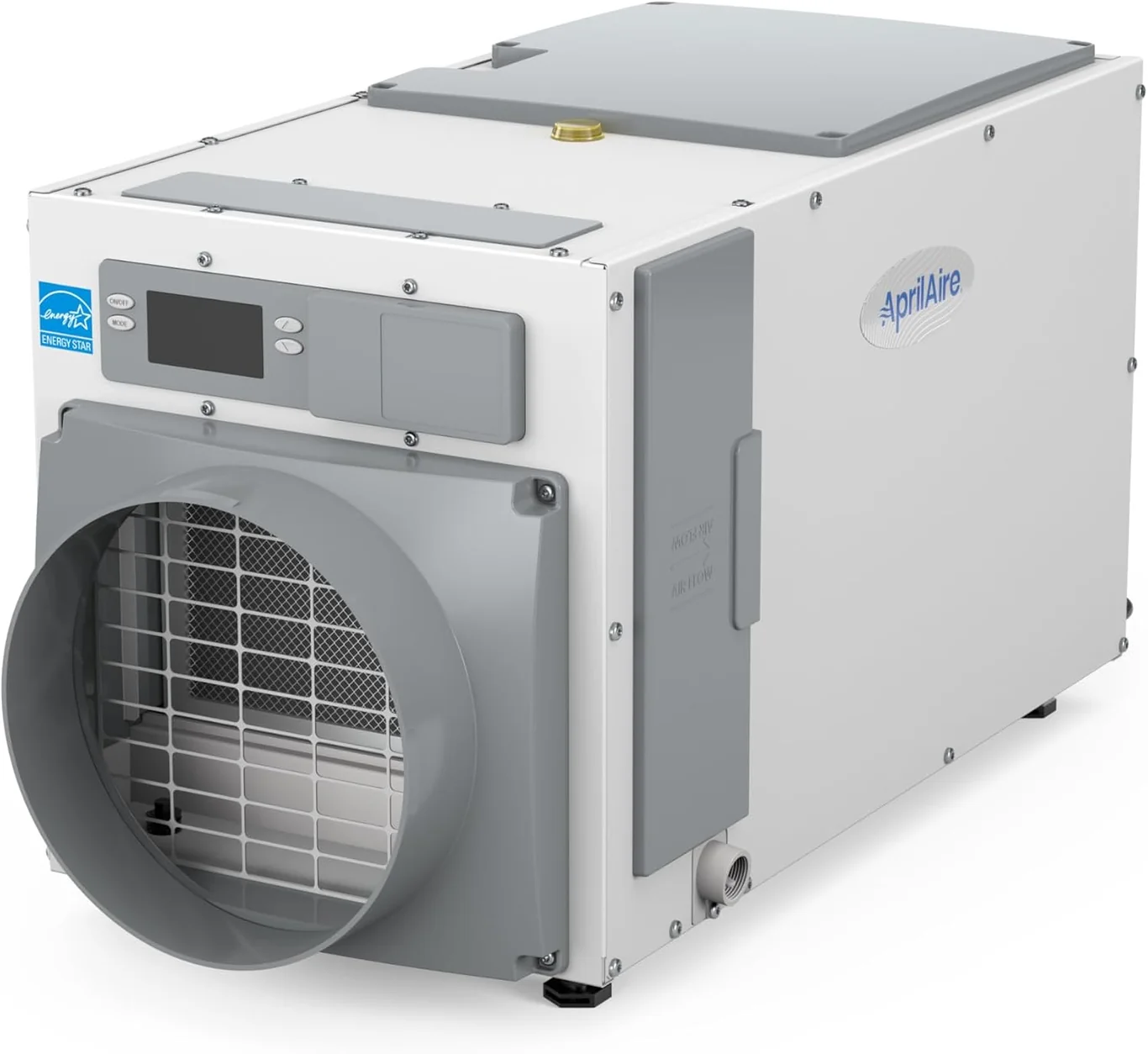
AprilAire E100 Whole-House Dehumidifier Specs
| Type | Whole-home compressor, ducted or free-standing |
| Rated Capacity (pints per day) | 85.00 |
| Test Standard | DOE whole-home test (73F, 60% RH); 100 pints at 80F, 60% RH |
| Coverage | Up to 5,500 sq ft (listing claim) |
| Tank Capacity | None, drains by hose or floor drain |
| Drainage | Hose or floor drain only |
| Noise Level | Not listed |
| Energy Star Status | Certified, listed as Most Efficient |
Key Features
- Smart sensing runs the unit only when humidity climbs above your target.
- The 280 cfm fan moves more air than any other unit on this page.
- The no-tank design drains by hose or over a floor drain.
- The washable MERV 8 filter comes with duct collars and a backdraft damper.
- A 104F upper limit and automatic defrost cover most basement conditions.
If you are shopping for a whole home dehumidifier that treats a large footprint, this is the one that matches the job. The listing claims coverage up to 5,500 square feet, which is a listing figure. Real coverage still depends on dampness and ceiling height.
It shares the E080 cabinet, so the install story is the same. It needs a floor drain or a downhill hose, and it has no tank and no pump. We would confirm the drain route before ordering, because moving a 64-pound cabinet twice is no fun.
Our one flag: 828 W is a serious power draw.
Why We Chose This
It has the highest verified capacity on the page and the strongest airflow, and it belongs in a very large or very wet basement.
It is overkill for an ordinary damp basement.
The registry lists the same 2.35 liters per kWh efficiency factor as the E080, so the larger capacity does not cost you efficiency. Use that as a comparison between units. The listing does not give a noise figure, so check the manual for fan levels.
Pros
- Largest verified capacity at 85 pints
- Strongest airflow at 280 cfm
- Most Efficient ENERGY STAR listing
- Ducted or free-standing use
- Washable MERV 8 filter
- Built in the U.S.A.
- Same efficiency factor as the E080
Cons
- Premium-tier purchase
- Too much machine for small damp rooms
Next to the E080, the E100 is the bigger tool for a bigger problem. Buy it for a large or very wet space, where the extra 20 pints per day on the DOE test matter. For anything smaller, the E080 or a portable is the better fit.
Final Verdict
The E100 is the strongest and best-documented machine here, built for large footprints and wet conditions. Only buy it if the space truly needs it. It is the heavy-duty option for a large wet basement.
7. Gasbye DryPrime 50 Dehumidifier
Next, the Gasbye DryPrime 50 is the flexible portable. ENERGY STAR lists model DryPrime-50-B at 49.7 pints per day on the current DOE test. The 115-pint headline on the listing is a maker figure, and the spec table on the same page also shows 100 pints, so we ignore both for sizing.
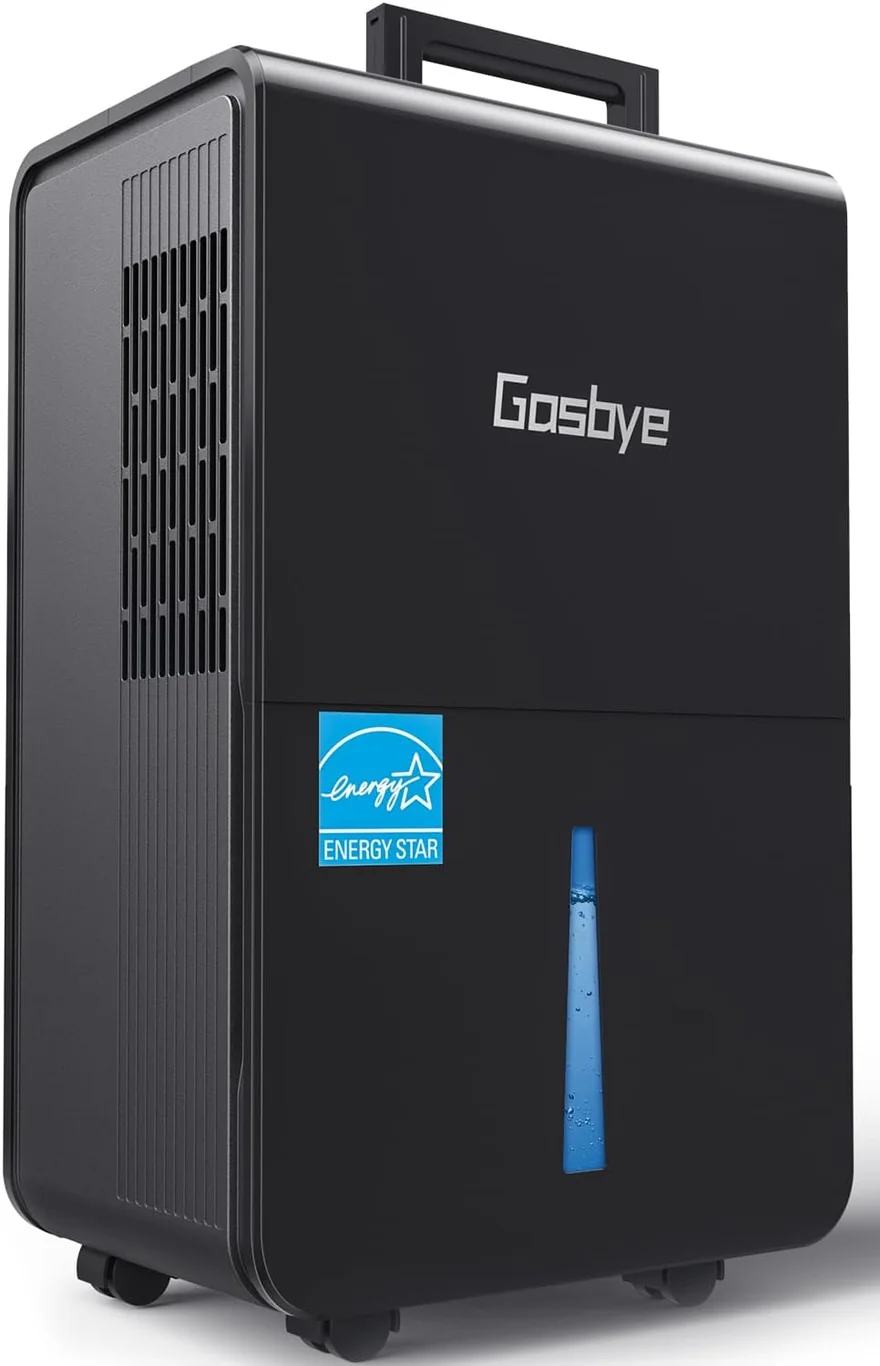
Gasbye DryPrime 50 Dehumidifier Specs
| Type | Portable compressor |
| Rated Capacity (pints per day) | 49.70 |
| Test Standard | 2019 DOE test (65F, 60% RH); 115 is a maker headline |
| Coverage | 4,500 sq ft in the spec table, 6,000 in the title (listing claims) |
| Tank Capacity | 1.72 gallons |
| Drainage | Tank, included 5 ft hose or garden hose adapter |
| Noise Level | About 45 dB (maker) |
| Energy Star Status | Certified, not Most Efficient |
Key Features
- Three drain options cover the tank, an included 5 ft hose and a garden hose outlet.
- The copper tubing is reinforced for durability, according to the maker.
- Smart humidity control shuts the compressor off 3% below target and restarts 3% above it.
- Four modes include Normal, Turbo, Comfort and Continuous.
- The 2-year coverage includes a refund or replacement offer from the maker.
The drainage setup is its strength. If you need a dehumidifier for basement with drain hose use, the included 5-foot hose and 3/4-inch garden hose outlet let you reach a floor drain or run a longer line. The 1.72-gallon tank covers the days you want it disconnected.
The humidity control is thoughtful. After the compressor stops, the fan keeps running briefly to use the cold coil, which is a sensible detail for energy use. We could only read about it, not time it, so treat it as a maker description.
Our one flag: the listing contradicts itself on capacity and coverage.
Why We Chose This
It is registry-verified and offers the most flexible drainage on the page, including an included hose and a garden hose outlet.
The listed upper limit is 86F, fine for basements, not for hot rooms.
The maker lists about 45 dB and the weight is 43 pounds. In our view that is a middle-of-the-road profile, louder than the quietest claims on this page but still reasonable for an unfinished basement. The 500 W draw is moderate.
Pros
- Verified 49.7 pints on the 2019 test
- Three drain options
- Hose and garden adapter included
- ENERGY STAR certified
- Four operating modes
- Large 1.72-gallon tank
- 2-year coverage from the maker
Cons
- Listing capacity figures conflict
- Upper limit of only 86F
Against the Midea, the Gasbye matches the registry result and adds an included hose. Choose it for drainage flexibility, and ignore the headline capacity. It has less brand history than Midea, so we lean on the registry entry.
Final Verdict
The DryPrime 50 is a verified mid-size portable with the best drain choices here. Size it on 49.7 pints and ignore the bigger headlines. It is the drain-flexible portable.
8. hOmeLabs 50 Pint Dehumidifier with Pump
Finally, the hOmeLabs is the long-running favorite with a large owner base. The listing gives 50 pints per day and a separate maximum of 120 pints at 95F and 90% RH. The listing does not state the test basis for the 50-pint figure, so we do not convert it.
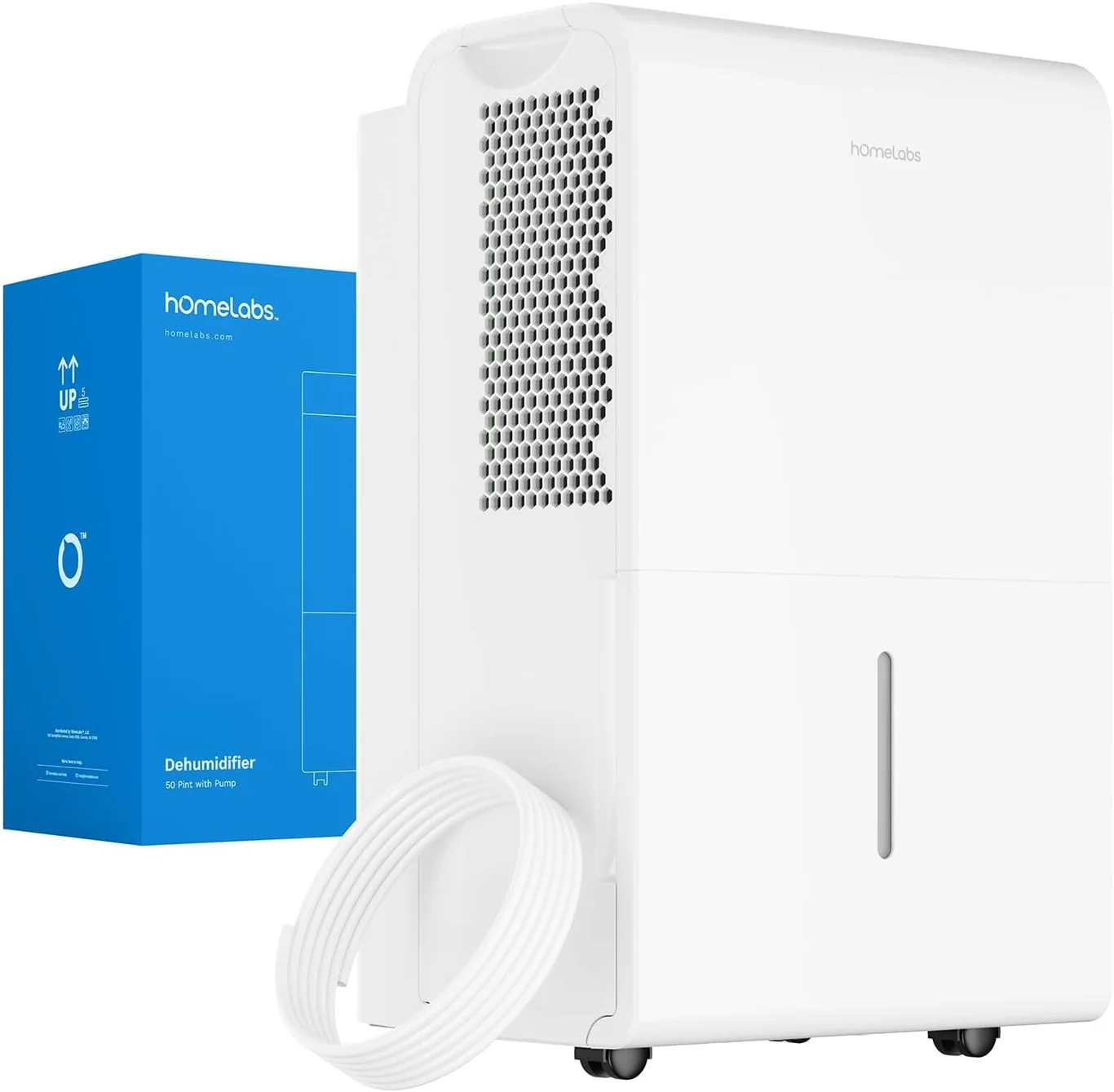
hOmeLabs 50 Pint Dehumidifier with Pump Specs
| Type | Portable compressor with pump |
| Rated Capacity (pints per day) | 50 (maker); test basis not stated |
| Test Standard | Test basis not stated; 120 at 95F, 90% RH |
| Coverage | 7,500 sq ft (listing claim) |
| Tank Capacity | 1.6 gallons |
| Drainage | Tank or built-in pump |
| Noise Level | Not listed |
| Energy Star Status | Model HME1004 not found in the registry |
Key Features
- The built-in pump supports continuous drainage without a floor drain.
- Wi-Fi control lets you adjust settings from your phone.
- Three modes cover Comfort, Turbo and Continuous, with timer settings.
- A check-filter indicator reminds you to clean the washable filter.
- The 30.5-pound body is the lightest of the portable units here.
Its appeal is track record. Anyone hunting for the best rated basement dehumidifier will see this model everywhere, and the built-in pump with Wi-Fi is a combination few rivals offer. We would not lean on that popularity for capacity, though.
For sizing, confirm the DOE capacity for the exact unit first, because we could not find it in the registry. The 7,500 square foot coverage claim alone does not show it suits your basement.
Our one flag: we could not find an ENERGY STAR listing for this exact model.
Why We Chose This
It has a large owner base, a built-in pump and Wi-Fi, which makes it easy to run without a floor drain.
The registry lists other hOmeLabs models, not HME1004.
Maintenance is easy, with a check-filter indicator and a washable filter. The listing gives no noise level, so check the manual if the unit will sit near living space. We found it simple on paper to keep running, though we have no timed data.
Pros
- Built-in pump for continuous drainage
- Wi-Fi control
- Large owner base
- Check-filter indicator
- Three fan speeds
- Lightest portable unit here
- Timer and Continuous mode
Cons
- No registry match for this model
- Test basis for the 50 pints is not stated
Next to the Avylo, the hOmeLabs offers a similar pump with more owner history but a weaker paper trail. Choose it for the pump and Wi-Fi, and size it conservatively. If registry proof matters more to you, the Midea or Gasbye is safer.
Final Verdict
The hOmeLabs is a familiar, easy-to-run pump model for a small or moderately damp basement. Ignore the 120-pint headline and confirm the DOE capacity for the exact unit before sizing. It is the familiar pump-and-Wi-Fi choice.
How to Choose the Best Dehumidifier for Basement
A good basement dehumidifier comes down to a handful of checks that a listing headline rarely makes easy. We sorted the eight picks above by rated capacity on the current DOE test, drainage and certification, and the factors below show you how to repeat that sort yourself.
Rated capacity and the test behind it
In our experience the spec sheet only tells half the story, and capacity is where it hides. Pints per day means little until you know the test behind it. The DOE test uses 65F and 60% relative humidity for portable units, and 73F and 60% relative humidity for whole-home units.
Older ratings used 80F, and maker headlines often use 80F or 95F with 90 to 95% relative humidity. Hotter, wetter test conditions can produce much larger capacity figures, so compare ratings measured under the same conditions.
The table below shows how to read each kind of rating.
Compare units using DOE ratings within the same test category. For example, the AprilAire E080 is about 65 pints per day on the current test, against 80 pints on the older one. Several other listing headlines on this page sit far above their ENERGY STAR figures.
| Rating basis | Test conditions | How to read it |
| Current DOE test (2019) | Portable: 65F, 60% relative humidity; whole-home: 73F, 60% relative humidity | Compare ratings within the same test category. |
| Older test | 80F, 60% relative humidity | Reads much higher for the same machine. |
| Maker headline | 80F or 95F, 90 to 95% relative humidity | Not comparable. Treat it as an upper bound at best. |
Basement size and dampness
Choosing a dehumidifier for basement use starts with two questions: how large is the space, and how damp does it feel? Floor area alone is a poor guide. What we found mattered more than the square footage on a listing was how often the walls feel clammy.
Use these three dampness tiers as a rough guide:
- Lightly damp: a musty smell in humid months, but the walls and floor stay dry.
- Damp: clammy walls, or condensation on cold pipes and a floor that feels cool and moist.
- Wet: water stains or standing water after rain. Fix the water source first, because a dehumidifier will not keep up.
Coverage figures in square feet on listing titles are maker claims, not test results. If you are sizing a dehumidifier for 1000 sq ft basement, match the pints per day on the 2019 test to your dampness tier, and move up a size when the space feels wet.
Compressor or desiccant for a cool basement
All eight picks are compressor units, which chill a coil to pull water out of the air. Compressor models are the usual choice for a basement, but their output falls as the coil gets colder. In our experience that trade-off matters most in an unheated space.
The two types compare like this:
- Compressor: the usual basement choice, efficient at normal room temperatures, but it can frost over when the coil gets cold.
- Desiccant: copes better with cold air, but it falls outside this guide and none of our picks uses it.
Rule of thumb: if the basement stays cool for months, expect less than the rated figure. DOE ratings use 65F for portable units and 73F for whole-home units; colder air generally reduces moisture removal.
Operating temperature and defrost
Defrost is the feature we looked at first on a cool-basement shortlist. When frost builds on the coil, the unit has to pause and thaw it, which cuts the water it removes. AEOCKY says its defrost sensors keep the unit running at low temperatures, a maker claim we could not test.
Upper limits matter less in a basement, but they differ widely. The listed maximums on this page range from 86F to 120F, which is worth knowing if the unit sits near a dryer.
Check the lower temperature limit in the manual, not only on the listing. Maker figures for it differ from one model to the next.
Drainage with a tank, hose or pump
A tank is fine for occasional use, but it fills within hours in a damp basement. Among the units with tanks, capacity runs from about 0.53 to 2.11 gallons, so drainage deserves more weight than tank size.
Pick the drain method that fits your basement:
- Hose to a floor drain or sink: water runs out by gravity, so the drain must sit lower than the unit.
- Built-in pump: lifts water to a sink or out a window. The Avylo ADC018 Dehumidifier with Pump lists a 15 ft lift and 15 ft hose, and the hOmeLabs 50 Pint Dehumidifier with Pump has a pump too.
- Tank only: best kept for occasional or lightly damp use.
A basement dehumidifier with hose drainage removes the daily chore, so confirm the hose is in the box. The Midea 50 Pint Dehumidifier has a built-in drain socket but does not include a hose. Choose continuous drainage for regular basement use.
Portable or whole-house
Portable units sit on the floor and use a tank, a hose or a pump. The two AprilAire models are whole-home types that run ducted or free-standing over a floor drain, and they drain by hose or floor drain only, with no tank and no pump. In our experience that suits anyone who wants to install once and stop thinking about it.
For most single basements, the best home dehumidifier is a portable compressor unit with continuous drain, because it is simpler to set up and easy to move.
Rule of thumb: choose a whole-house unit when you want to dry several rooms through ducting or need the largest verified capacity on this page, which is 85 pints per day on the DOE test.
Noise and energy use
Noise matters most in a finished basement. The low-speed ratings on this page run from 40 to 49 dB, and they are maker figures that depend on how the unit was measured. In our comparison noise ranked below capacity and drainage.
For energy use, compare ENERGY STAR liters of water per kWh within each test category, where higher is better. The two whole-home AprilAire models list 2.35 at 73F, while the portable Avylo lists 2.05 and the Midea and Gasbye about 2.01 at 65F. Use it to compare units, not as a promise of lower bills.
Why Basements Get Damp and What Humidity to Aim For
A basement is surrounded by soil and cool concrete, which makes it the dampest room in many homes. Warm, humid air that meets cool walls condenses into moisture, and ground water adds more through the slab and walls.
- Ground moisture: water vapor moves through concrete floors and block walls even when nothing looks wet.
- Humid outdoor air: summer air that enters through windows and doors condenses on cool surfaces.
- Indoor sources: laundry, a dryer vent, a shower or a slow pipe leak.
The EPA advises keeping indoor humidity between 30 and 50 percent, and a small hygrometer shows you where your basement sits. Measure before you start running a unit so you can see what changed.
A dehumidifier for mold works by lowering humidity so growth stops, and it does not kill or remove mold that is already there. Existing patches need cleanup. The unit only helps prevent new growth.
A musty smell is a clue that humidity is high somewhere nearby. Look for damp insulation, stored cardboard or a seep along a wall. A "dehumidifier mold smell" search usually points to a moisture source, so fix the source first and let the unit hold the air dry afterward.
Water that enters from outside is a building problem, not a humidity problem. Clean gutters, downspouts that discharge away from the foundation and sealed wall cracks often cut moisture more than any machine. Drainage outside the house comes first, and the dehumidifier handles what is left.
Dust mites do better in damp air, so a "dehumidifier dust mites" search comes down to keeping humidity between 30 and 50 percent. The unit alone does not remove mites, so keep bedding and stored fabrics clean and dry.
Take a hygrometer reading at the same spot each day to see whether the unit is keeping up. If humidity stays above 50 percent while the unit runs steadily, check drainage, airflow, operating temperature, moisture sources and sizing.
A dehumidifier for black mold is not a cleanup tool either. Visible black growth needs cleanup, and large patches call for professional remediation. Lower the humidity afterward so it does not return.
How to Place and Run a Basement Dehumidifier
Place the unit in the dampest open spot, away from walls and furniture so air flows freely at the intake and the outlet. Follow the clearances in the manual, since they differ by model. In our experience a unit boxed in by shelves works harder and removes less.
Run through this setup list on day one:
- Close doors and windows: a unit cannot dry the whole outdoors.
- Set the target humidity: aim for the 30 to 50 percent band and use a constant-humidity mode if the unit has one.
- Connect continuous drain: run the hose to a drain or sink, or set up the pump line.
- Empty the tank: only needed when the unit is not on continuous drain.
Clean the filter and the coil on a schedule. A clogged filter cuts airflow and a dirty coil removes less water, so follow the care steps in the manual. Several units here have washable filters, including the AprilAire models, which use a washable MERV 8 filter.
A unit in a garage faces colder air, so a dehumidifier for a garage needs the same lower-limit check described above. Compressor output falls and frost risk rises in cold air, so confirm the model's operating range before using it in an unheated garage.
My Overall Verdict
Our recommended dehumidifier for most damp basements is the AEOCKY 5500 Sq.Ft Energy Star Dehumidifier, because it pairs an included drain hose with five operating modes. The next two picks suit a smaller budget and a buyer who wants a verified capacity.
- AEOCKY 5500 Sq.Ft Energy Star Dehumidifier [Best Overall] - a hose-drain unit with five operating modes and a verified DOE capacity of 24.5 pints per day
- VEAGASO VG380 34 Pint Dehumidifier [Best Budget] - a small unit with an included drain hose for a lightly damp basement, rated about 34 pints per day on the maker's basis
- Midea 50 Pint Dehumidifier [Best Mid-Size] - the one unit whose listed capacity matches its ENERGY STAR result, with Wi-Fi and voice control
Choose by the 2019 DOE rating and your drain setup, not by the largest number on a listing. Continuous drainage matters more than a bigger tank in a damp basement, and it is the first thing we check on any unit.
If water enters during rain, fix that first, because no dehumidifier keeps up with active seepage.
Match the rated pints on the current test to how damp the space feels, and you will find the best dehumidifier for basement use in your home.
Why AEOCKY 5500 Sq.Ft Energy Star Dehumidifier Might Be the Best Choice
The AEOCKY takes our top spot because it packs a drain hose, a garden hose adapter and five operating modes into one unit. That is the most complete drainage and control feature set in this group.
The trade-off is that its 80-pint headline is measured at 95F and 95% relative humidity, and the maker's 56 pints is at 86F and 80%. Neither equals its DOE figure. ENERGY STAR lists RHEA-001 under RHEA-RCS25(Y)-N4-3-25 as Most Efficient, with a DOE capacity of 24.5 pints per day.
What stands out:
- Rotary compressor design: the maker lists a rotary compressor with copper coil tubing.
- Drain hose included: the box holds a hose for continuous drainage, so you can skip the tank.
- Humidity control: an adjustable humidity setting and five modes, including constant humidity, continuous and sleep.
- Large coverage claim: the listing title states 5,500 sq ft, which is a maker claim, so size by dampness as well.
- Flexible drain options: a 1.45-gallon tank, plus a garden hose adapter stored in the tank.
SHOP ON AMAZONAvailability and current price shown on Amazon
FAQs
What is the best dehumidifier for basement dampness?
The best dehumidifier for basement dampness is a compressor unit sized to your damp area using its pints per day rating on the current 2019 DOE test. Pick one that can drain continuously through a hose or built-in pump, so you never depend on emptying a small tank every few hours.
What size dehumidifier do I need for a basement?
You need a dehumidifier whose DOE-rated capacity matches the floor area and how damp the space feels. Portable models are rated at 65F and 60% relative humidity; whole-home models use 73F and 60% relative humidity. Be careful with older 80F ratings and 95F maker numbers on listings, because the same machine can usually read much higher on those.
What humidity level should a basement stay at?
A basement should stay between 30 and 50 percent relative humidity, which is the indoor range the EPA recommends. A dehumidifier slows mold growth by keeping the air in that band, but it does not remove mold that is already growing on walls or stored items, so existing patches still need proper cleanup.
Will a dehumidifier work in a cold basement?
A dehumidifier will work in a cold basement, but a compressor unit removes less water as its coil gets colder and can frost over. Choose a model with automatic defrost and check the lower temperature limit in the manual before you buy, because listed limits differ from one model to the next.
Do I need a pump or a drain hose?
You need a drain hose or a pump if the basement stays damp, because a tank alone fills within hours and needs emptying. A hose runs to a floor drain or sink by gravity, while a built-in pump lifts the water to a sink or out a window, so choose by where your drain sits.
References:
- ENERGY STAR Certified Dehumidifiers product finder (U.S. EPA): https://www.energystar.gov/productfinder/product/certified-dehumidifiers
- U.S. EPA, A Brief Guide to Mold, Moisture and Your Home: https://www.epa.gov/mold/brief-guide-mold-moisture-and-your-home
- U.S. DOE, Dehumidifiers test procedure and conservation standards (10 CFR 430 Subpart B, Appendix X1): https://www.energy.gov/eere/buildings/dehumidifiers
- AHAM Verifide Dehumidifier Certification program: https://ahamverifide.org
Medical Disclaimer: This content is for informational purposes only. It is not a substitute for professional medical advice, diagnosis, or treatment. If you have concerns about your water quality or air quality and their effects on your health, consult a qualified healthcare professional.
Affiliate Disclosure: As an Amazon Associate, Puritisimo may earn a commission from qualifying purchases made through links on this page, at no additional cost to you. Our recommendations are independent and editorial.