
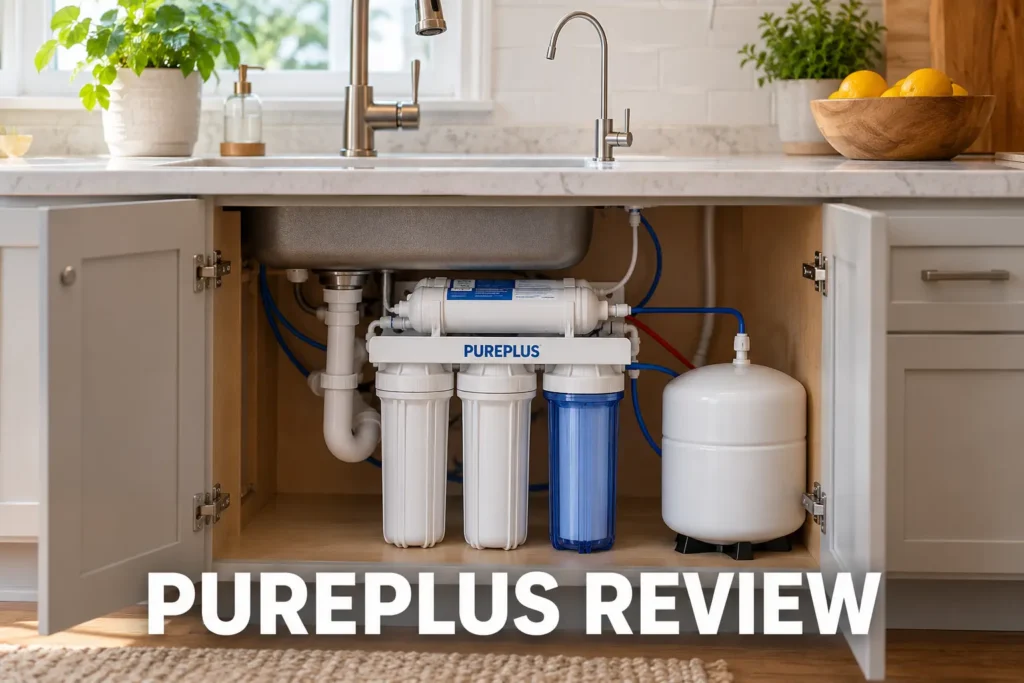
This PUREPLUS review comes down to one distinction: it is NSF 42 certified, not NSF 53, so I would use it on municipal tap water without hesitation and skip it entirely on a well, exactly as PUREPLUS itself recommends.

The rest of this pureplus water filter review breaks down the specs, including the cartridge PUREPLUS rates for up to 30,000 gallons, what NSF 42 does and does not cover, the real running cost tier, and who should send their money toward a different cartridge instead.
Quick Verdict
PUREPLUS certifies this cartridge to NSF 42 for chlorine taste, odor, and sediment reduction, and rates it for up to 30,000 gallons at a recommended replacement interval of every 3 to 6 months.
- Noticeably better-tasting, clearer tap water at every faucet in the house instead of one filtered pitcher.
- Fewer sediment particles reaching your water heater, washing machine, and other downstream appliances.
- A cartridge swap every few months instead of a full filtration system to install and maintain.
What This PUREPLUS Review Covers
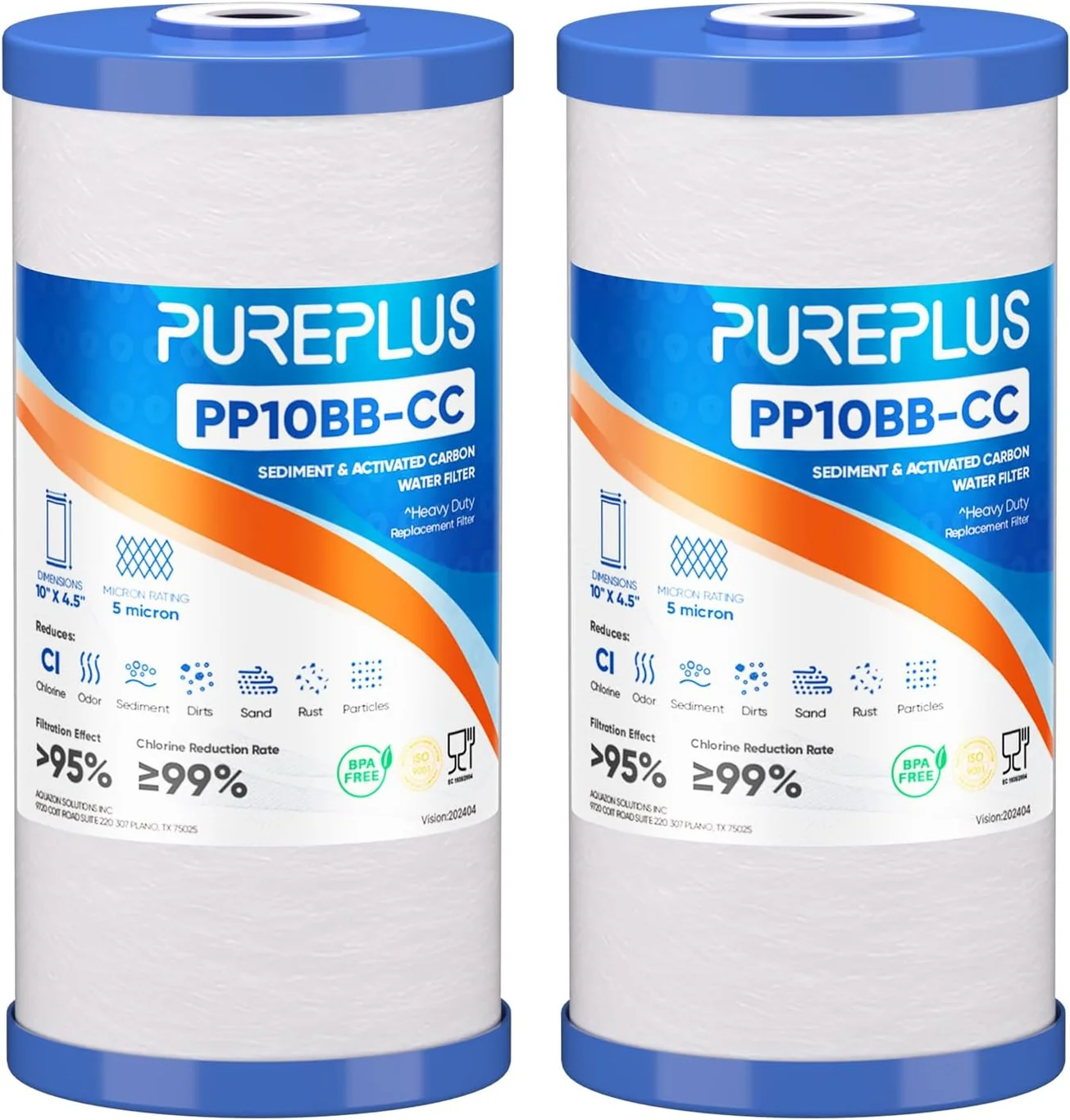
PUREPLUS sells this 5 micron dual-media cartridge as a generic, cost-effective replacement for the whole house housings that OEM brands like GE, Culligan, and Pentek already sell cartridges for. It is a sediment-and-carbon cartridge, not a full filtration system: it drops into a 10 x 4.5 inch housing you already own.
Households who want a complete certified multi-stage system rather than a replacement cartridge can compare a well-reviewed option in my iSpring RCC7 system review.
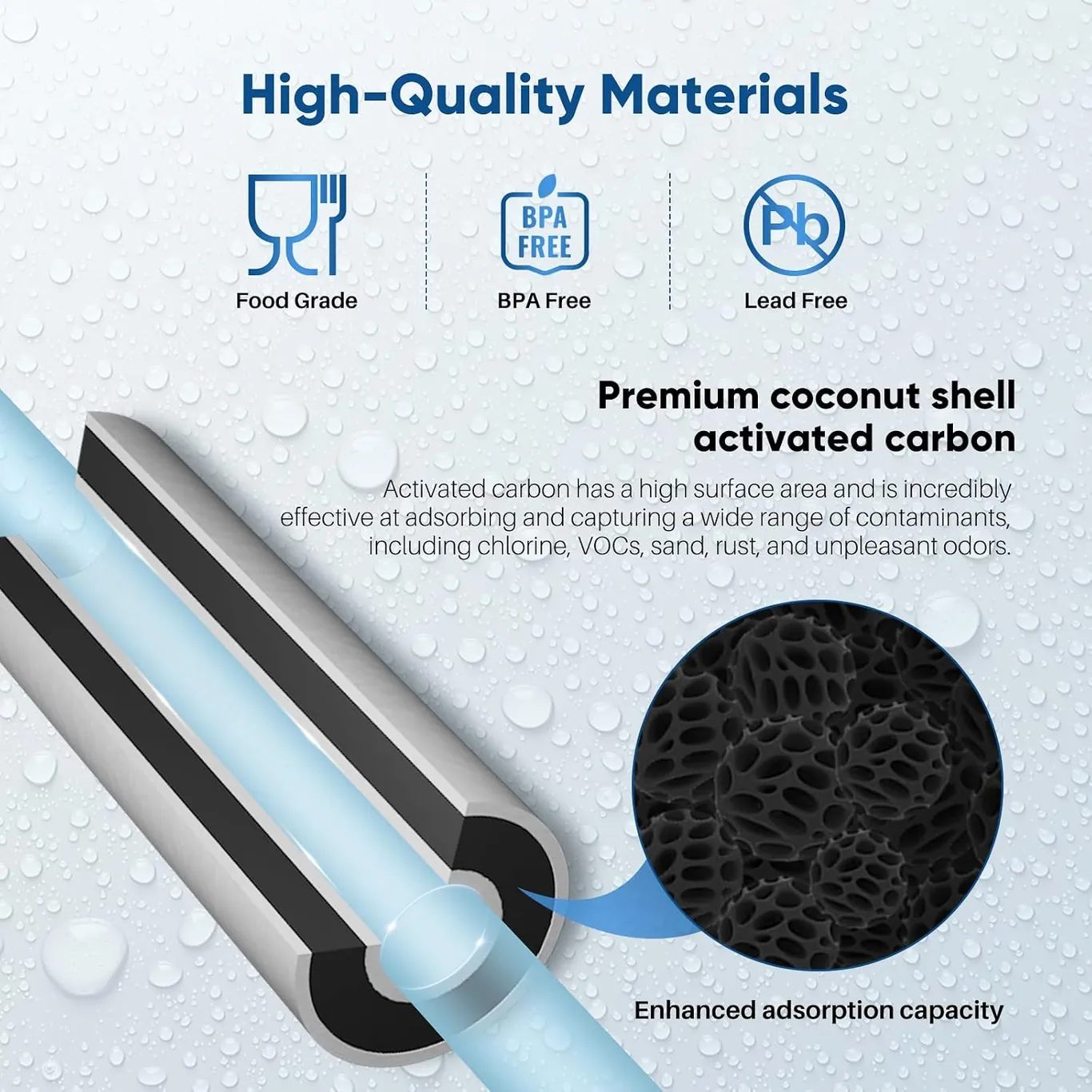
I look at this kind of cartridge the same way I look at the pre-filter stage on my own under-sink reverse osmosis system: its job is to protect what comes after it, not to be the last word in water quality on its own. PUREPLUS builds it from three layers of polypropylene sediment media wrapped around a coconut shell activated carbon core, which is a fairly standard construction for this category.
Buyers who want a certified standalone faucet-mount system rather than a cartridge for an existing housing can compare the complete option in my PUR Plus hands-on review.
Specifications
| Specification | Detail |
| Micron rating | 5 micron |
| Housing size | 10 x 4.5 inches |
| Item weight | 1.59 kg |
| Rated capacity | Up to 30,000 gallons |
| Replacement interval | Every 3 to 6 months |
| Certification | NSF 42 (aesthetic effects) |
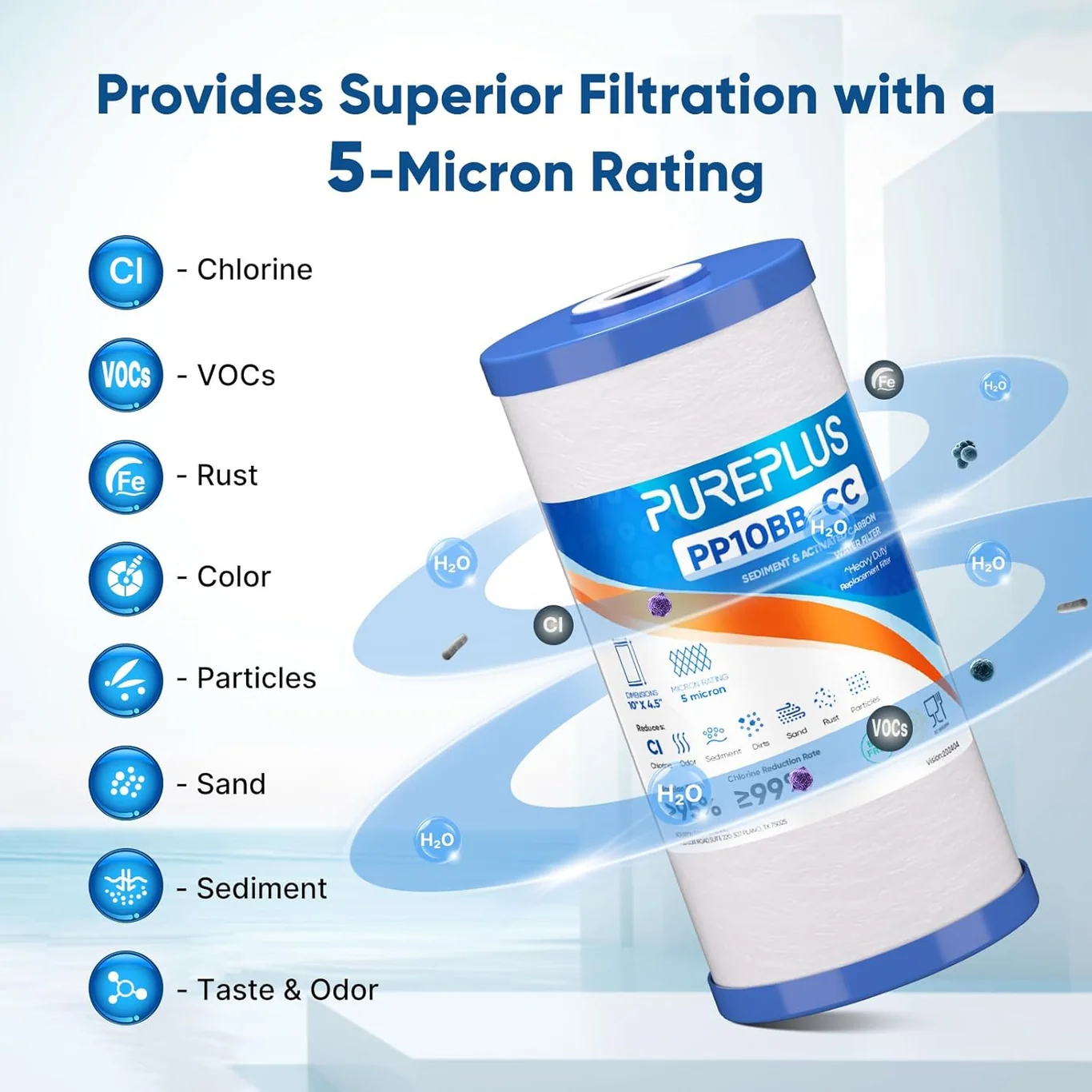
| Contaminant reduction claim | Up to 99% of chlorine, sand, rust, sediment, and color |
| Media construction | 3-layer polypropylene sediment plus coconut shell activated carbon |
Key Features
- Three-layer polypropylene sediment media plus a coconut shell activated carbon layer – traps grit and rust while pulling chlorine taste and odor out at the same time.
- NSF 42 certification – independently verified for the aesthetic-effects claims PUREPLUS makes about chlorine taste and odor.
- Rated for up to 30,000 gallons – enough capacity that most households only think about replacement twice a year.
- Direct drop-in compatibility with GE, Culligan, and Pentek 10 x 4.5 inch housings – no new housing required if you already run one of those.
- Simple swap-only design with a 5-minute first-use flush – no housing to clean, no separate gasket to source.
What the PUREPLUS Cartridge Actually Removes
PUREPLUS rates the cartridge at 5 microns, built from three polypropylene sediment layers plus a coconut shell activated carbon layer, and PUREPLUS claims it reduces up to 99% of chlorine, sand, rust, sediment, and color. I read that up-to-99% figure as a best-case ceiling rather than a promise, the same way I’d treat any spec sheet claim that tops out at a round number.
NSF lists it as certified to NSF 42, the aesthetic-effects standard covering chlorine taste, odor and particulate reduction. It is not NSF 53, the standard covering health-effect contaminants like lead, PFAS or VOCs beyond taste and odor, and nothing in PUREPLUS’s own materials claims that broader standard. I would not lean on this cartridge for lead or PFAS reduction, because the paperwork for that simply isn’t there.
Buyers who need certified health-effect contaminant reduction can compare the tested options in my guide to the best under-sink water filter.
The listing also carries a Food Grade Material Meets European EC1935-2004 Regulations claim, an Australia Water Mark reference, REACH compliance, and a BPA-free label. I treat those as material-safety and manufacturing claims, not water-quality certifications, and I don’t count them as extra proof the filter removes anything specific. PUREPLUS states that the filter does not lower TDS, so if you’re shopping this to strip minerals out of your water, you’re shopping the wrong category.
Buyers who want both health-effect certified reduction and a remineralization stage can compare a system built for that in my iSpring RCC7AK review.
Living With the PUREPLUS Cartridge Day to Day
PUREPLUS’s own materials aren’t fully consistent on replacement cadence. The main product description says every 3 to 6 months for the average household, while the installation Q&A says every 6 months or when water taste changes or flow drops off. I’d go with the combined, honest version PUREPLUS effectively gives you: every 3 to 6 months, sooner if taste or flow noticeably declines. At that interval, you’re looking at roughly 2 to 4 cartridges a year.
Running cost is where I’d put this PUREPLUS water filter in the modest tier for a whole-house pre-filter. PUREPLUS markets itself explicitly as a budget alternative to OEM cartridges, calling itself the most cost-effective brand in its own copy, and it lists itself as a replacement for GE FXHTC, GXWH40L, GXWH35F, GNWH38S, Culligan RFC-BBSA, WRC25HD, and Pentek RFC-BB housings. If you’re already running one of those housings, this is cheaper to keep running than staying on the proprietary OEM part.
There’s nothing to report on noise here, and I don’t have anything to add beyond that, it’s a passive inline cartridge with no motor or moving parts. Maintenance is swap-only; nothing in PUREPLUS’s materials describes cleaning the housing itself. Two steps matter: shut off the water supply before changing the cartridge, and flush the new one for 5 minutes after installation before drinking from the line, per PUREPLUS’s own installation notes. There’s no separate gasket in the box either, the seal comes from the cartridge’s own end caps compressing against the housing lid when you tighten it down.
Buyers who prefer no filter housing at all and want a standalone countertop unit can find the tested options in my guide to the best countertop water filter.
As a category, I’d rate this on the cheaper end to own long-term; if you want to see how it stacks up against other whole-house sediment and carbon options, our full water filter cartridge roundup lays out the full field side by side.
Pros
- NSF 42 certified for chlorine taste, odor and sediment reduction
- Rated for up to 30,000 gallons before replacement is due
- Fits standard 10 x 4.5 inch housings, compatible with GE FXHTC, Culligan RFC-BBSA and other OEM cartridges
- Three-layer polypropylene plus coconut shell carbon media construction
- Modest running cost compared with proprietary OEM cartridges
- Simple swap-only maintenance, no housing cleaning required
Cons
- Only certified to NSF 42 (aesthetic effects), not NSF 53, so it does not reduce lead, PFAS or other health-effect contaminants
Who Should Skip the PUREPLUS Cartridge
I’d send four kinds of buyers elsewhere. Anyone on well water or rainwater catchment should skip this cartridge outright, PUREPLUS states directly that it isn’t recommended for that source and points buyers toward a different SKU built for it. Anyone chasing health-effect contaminant reduction, lead, PFAS, VOCs beyond taste and odor, should skip it too; the only certification here is NSF 42, aesthetic effects only, not the NSF 53 standard that covers those contaminants.
Anyone without an existing 10 x 4.5 inch filter housing should skip it as well, this is a replacement cartridge, not a standalone filtration system, so there’s nothing to install it into on its own. And if you’re specifically trying to lower TDS or strip minerals out of your water, I’d look elsewhere, PUREPLUS states plainly that this filter does not lower TDS.
Buyers without a filter housing who need point-of-use tap filtration can compare the certified options in my guide to the best faucet water filter.
For that last group, and for anyone who needs whole-house coverage beyond a single pre-filter cartridge, I’d point them toward a complete whole house filtration system instead of trying to make one cartridge do a system’s job.
My guide to the best water filtration system for home covers the tested multi-stage whole-house systems suited to that level of coverage.
| Model | How it differs | Pick it instead if |
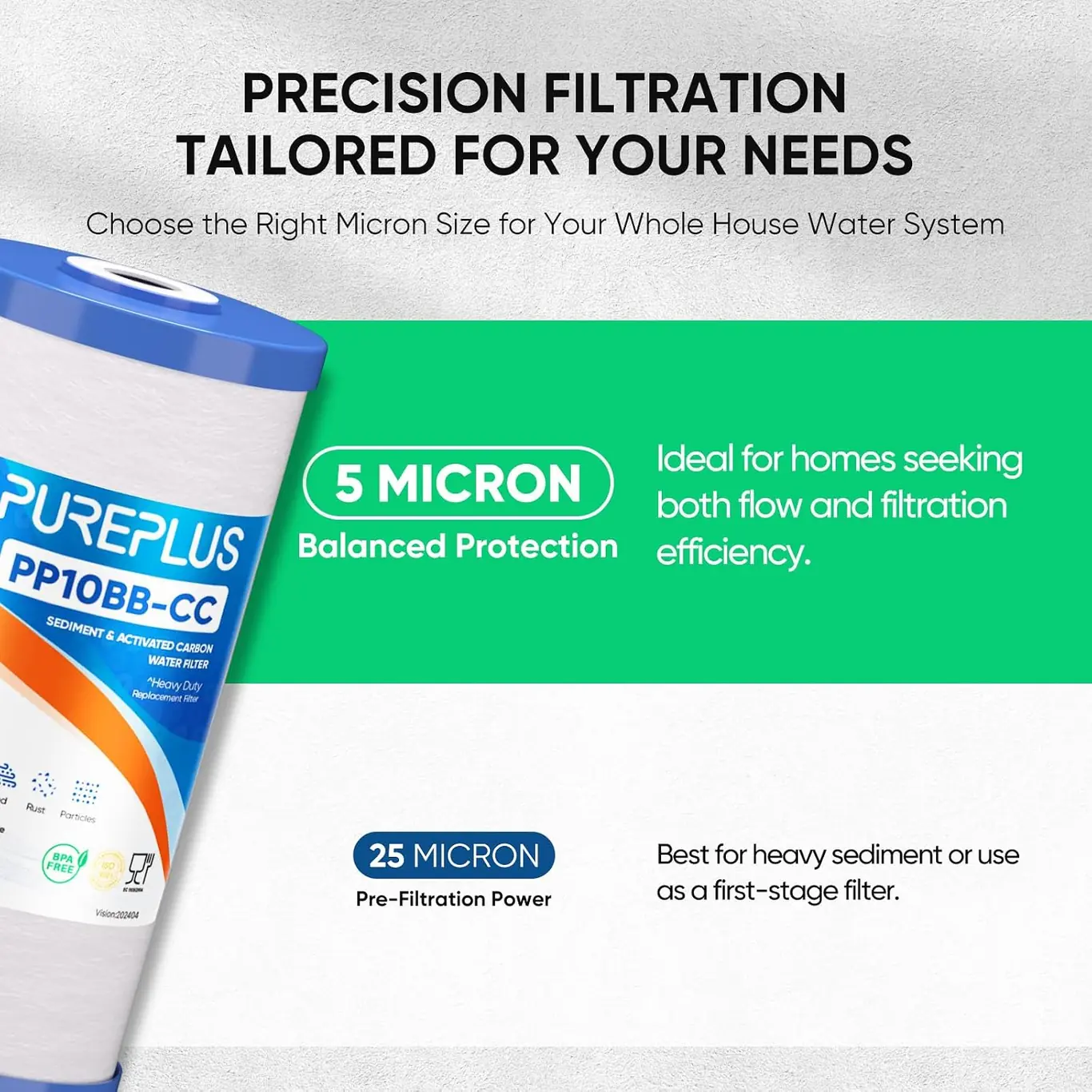
| PUREPLUS 5 Micron Dual-Media Whole House Cartridge | This is the cartridge reviewed here: PUREPLUS builds it as a 5-micron rated dual-media design from three polypropylene layers plus a coconut shell carbon layer. | You want a general-purpose tap water pre-filter with fine sediment capture and no special water source needs. |
| PUREPLUS 25 Micron Sediment & Carbon Filter | The listing for that model gives a rating of 25 microns, coarser media that trades fine-particulate filtration for less flow restriction. | Your incoming water runs visibly gritty and you’d rather avoid frequent clogging than capture the finest sediment. |
| PUREPLUS String Wound Water Filter | The listing recommends that sibling cartridge for well water or rain water, using a string-wound design instead of the layered PP-and-carbon build reviewed here. | Your supply is a well or rain catchment, since the cartridge in this review is explicitly not recommended for that source. |
| PUREPLUS CTO Carbon Block Filter | The listing for that model states it removes chlorine, VOCs, sediment and odor as a solid carbon block rather than a layered cartridge. | VOC reduction matters more to you than the layered sediment capture this reviewed cartridge is built around. |
Common Problems With the PUREPLUS Cartridge
There’s no owner-review data behind this section, so I’m not going to pretend there is one. What follows comes from PUREPLUS’s own installation and compatibility notes, not from a pattern of owner complaints.
The single most likely way a buyer ends up unhappy with this PUREPLUS water filter is running it on well water. PUREPLUS’s own listing warns the cartridge may not filter well water effectively and points to a different SKU for that source. Confirm your water source is municipal or treated tap before you buy, and this problem doesn’t apply to you at all.
Seal failure is the second one worth flagging. There’s no separate gasket, the seal depends entirely on the cartridge’s own end caps compressing correctly when the housing is tightened down. A cartridge that isn’t seated straight can leak at the housing lid. Seat it fully before hand-tightening and this stops being an issue.
The third is skipping the initial flush. PUREPLUS’s installation notes call for a 5-minute flush before first use; skip it and you can pull carbon fines or discolored water through the first draws, which reads like a defect but isn’t one. Run the tap the full 5 minutes after installation before you drink from it.
I run an under-sink RO system at home myself, so my frame of reference for a cartridge like this is as a pre-filter protecting downstream equipment, not a standalone drinking-water solution. If that’s your situation too, pairing a sediment pre-filter with a reverse osmosis system is the setup I’d actually recommend.
My guide to the best reverse osmosis system covers the certified options that pair cleanly with a whole-house pre-filter in that configuration.
My Overall Verdict
I’d treat the up to 30,000 gallons capacity paired with a 3 to 6 month replacement window as a ceiling figure, not a guarantee, since usage and incoming water quality both move that number around in practice. The well-water disclaimer is, to me, the one honest, non-marketing line in an otherwise adjective-heavy listing, and it’s earned this brand a bit more trust from me on that specific point.
Households that want a no-plumbing countertop alternative without any filter housing can compare the gravity-fed option in my Royal Berkey countertop review.
The gap most buyers will miss is NSF 42 versus NSF 53. If you assume ‘NSF certified’ means this filter strips out lead, you’d be wrong here, and that’s a legitimate reason to think twice before buying it for that purpose. For municipal tap water where taste, odor and sediment are the actual complaint, though, it does the job it’s built for at a modest running cost.
Buyers who want a simpler point-of-use format instead can find the certified options in my guide to the best water filter pitcher.
Final Verdict
for a household on city water that wants a straightforward, inexpensive sediment-and-carbon pre-filter and doesn’t need lead or PFAS reduction, I’d install this cartridge without hesitation, which is the honest conclusion of this PUREPLUS review.
Frequently Asked Questions
Is PurePlus a good water filter?
For municipal tap water where chlorine taste, odor and everyday sediment are your main complaints, this cartridge does what PUREPLUS designs it to do, backed by an NSF 42 certification for those aesthetic effects. It is not the right pick if you are on well water or need certified reduction of health-effect contaminants like lead.
How long does a Pure Plus water filter last?
PUREPLUS recommends replacing it every 3 to 6 months, sooner if taste or flow drops off, which works out to roughly 2 to 4 cartridges a year for an average household. Rated capacity tops out at up to 30,000 gallons, though treat that as a ceiling figure rather than a guarantee for your water.
Is Pure Plus better than Brita?
They solve different problems: PUREPLUS is a whole house cartridge treating all the water entering your home, while Brita is a small point-of-use pitcher or faucet filter treating water at a single tap. Neither is objectively better, the right one depends on whether you want whole-house sediment and chlorine reduction or a portable countertop solution. If the portable countertop option is what fits your household, my Waterdrop PT-07B pitcher review covers the most compact certified choice in that format.
Is PurePlus a good filter?
PUREPLUS builds this cartridge from three polypropylene sediment layers plus a coconut shell carbon layer, and it carries an NSF 42 certification for chlorine taste, odor and sediment reduction, a genuine standard rather than a marketing claim. Judge it as a tap water pre-filter and it holds up; judge it as a health-contaminant filter and it falls short.
Does PurePlus filter lead?
The only certification on record here is NSF 42, which covers aesthetic effects like chlorine taste, odor and sediment, not the NSF 53 standard that covers lead and other health-effect contaminants. If lead reduction matters to you, look for a cartridge or system that specifically carries an NSF 53 certification instead.
References
- NSF International. NSF/ANSI 42 Standard for Aesthetic Effects. nsf.org
- U.S. EPA. Drinking Water Contaminants and Chlorine Disinfection Byproducts. epa.gov
- CDC. Water Treatment and Home Filtration Guidance. cdc.gov
- WQA. Water Quality Association Certification and Standards Overview. wqa.org
Medical Disclaimer: This content is for informational purposes only. It is not a substitute for professional medical advice, diagnosis, or treatment. If you have concerns about your water quality or air quality and their effects on your health, consult a qualified healthcare professional.