
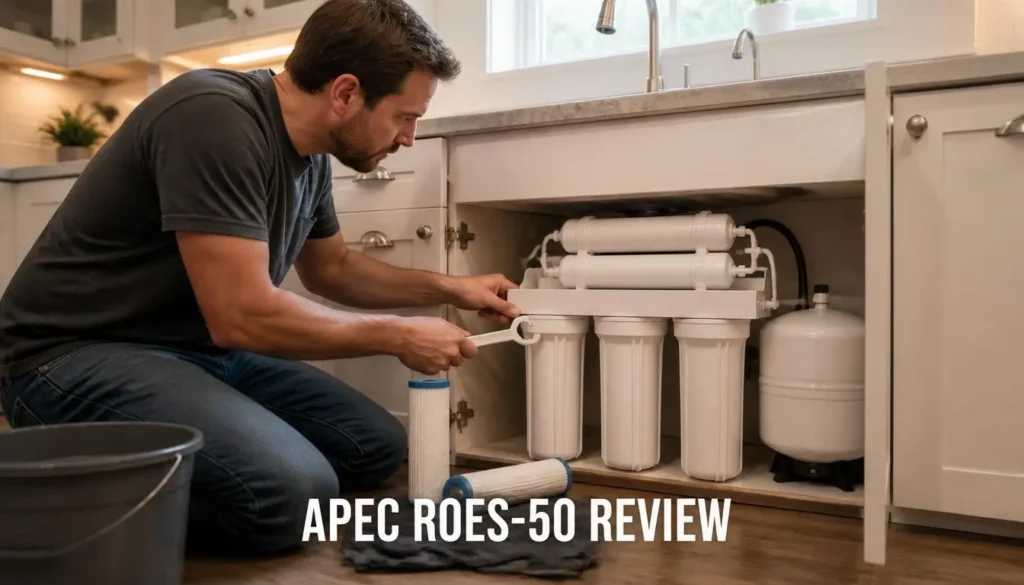

This APEC ROES-50 review comes down to one point: I would buy this system for a household that wants a plain, serviceable under-sink reverse osmosis unit, and I would not buy it on the strength of its contaminant list alone. APEC says the ROES-50 is a WQA Gold Seal certified system, but the scope I could confirm is narrower than the sales copy, so I treat lead, fluoride, arsenic and PFAS reduction as APEC’s claims until the listing for your exact model shows them.

I wrote this page for the decisions the spec sheet leaves open: what the certification covers, how often the filters need changing, what goes wrong in ownership and who should look elsewhere. I run an under-sink reverse osmosis system at home with three children drinking from it, so I read the APEC ROES-50 as a buyer would, with the upkeep and the drain connection in mind rather than the headline output.
Quick Verdict
APEC says the ROES-50 is a WQA Gold Seal certified system, rates it at 50 gallons per day at 60 psi and lists a 4 gallon storage tank. APEC recommends changing the three pre-filters every 6 to 12 months, which is the upkeep I would plan around.
- You get filtered drinking water from a dedicated faucet at the sink, with a tank that holds a reserve for pots and bottles.
- You follow a simple schedule, with three pre-filters on a shorter cycle and the membrane and post-filter on a much longer one.
- You know which contaminant claims to confirm on the certification listing before you rely on them.
SHOP ON AMAZONAvailability and current price shown on Amazon

APEC ROES-50 Review: What You Are Buying
The APEC Water ROES-50 5-Stage Reverse Osmosis System is the Essence Series under-sink unit from APEC Water Systems. APEC describes it as a drinking-water system that sits under the sink and delivers filtered water to its own brushed nickel faucet, with the tank storing the reserve.
I place it in the plain, serviceable group of reverse osmosis systems. It has no remineralization stage, so the water comes out as plain RO water, and it relies on your household pressure, which APEC specifies as 40 to 85 psi. I would check your pressure before ordering, not after the box arrives.
APEC’s headline is that the system removes up to 99.99% of impurities, and I do not treat that as a verified reduction percentage for each contaminant APEC names. The next section covers what the certification actually backs up.
Specifications
| Specification | Detail |
| Output rating | APEC rates it at 50 gallons per day at 60 psi |
| Output at lower feed pressure | APEC rates it at 30 gallons per day at 50 psi and 77F |
| Storage tank | APEC lists a 4 gallon tank |
| Feed water pressure | APEC specifies a feed water pressure of 40 to 85 psi |
| Maximum dissolved solids | APEC lists a maximum of 2,000 ppm |
| Feed water temperature | The Amazon listing gives a feed water temperature range of 40F to 100F |
| Pre-filter interval | APEC recommends changing the three pre-filters every 6 to 12 months |
| Membrane and post-filter | APEC lists the membrane and post-filter at 2 to 4 years |
| Certification | APEC says it is a WQA Gold Seal certified system, and the Amazon listing names NSF/ANSI 58 and 372 |
Key Features
- Five filtration stages: a sediment filter, two carbon block filters, the reverse osmosis membrane and a carbon post-filter, which is how APEC describes the system. The pre-filters protect the membrane, the part I most want to keep alive.
- Under-sink installation with a storage tank: APEC lists a 4 gallon tank, so you draw from a reserve rather than waiting on the membrane for every glass.
- Quick-connect fittings and colored tubing: APEC says these make set-up and filter changes easier for a DIY installer, which matters because you will change filters yourself.
- Brushed nickel faucet and installation kit included: the listing names a faucet, a tank, a filter set and instructions as part of the package.
- WQA Gold Seal certification: APEC states the system is certified, and it is the first thing I check on any reverse osmosis unit before I read anything else.
What the APEC ROES-50 Removes and What Its Certification Covers
APEC states that the ROES-50 is a WQA Gold Seal certified system, and the Amazon listing says it is certified to NSF/ANSI 58 and 372. NSF/ANSI 58 is the standard for point-of-use reverse osmosis drinking water systems, and WQA is the certifier behind the Gold Seal. That much I am comfortable stating plainly.
Here is where I slow down. One published read of WQA’s listing reports only total dissolved solids reduction under NSF/ANSI 58, plus lead-free materials under NSF/ANSI 372. I could not open the listing myself, I did not find a listing for APEC at NSF International, and the sources I read do not agree on anything broader.
APEC’s sales copy goes further and names arsenic, chlorine, lead, fluoride, heavy metals and PFAS. I read those as APEC claims, not certified claims until the listing for your exact model shows them. The CDC gives the same advice, to check the system’s label for the specific chemicals it removes, and the Water Quality Association advises choosing independently certified products.
If a particular contaminant is the reason you are buying, I would open WQA’s Find Certified Products page and search for the ROES-50 before you order. If the claim you need is not on that listing, the system may still reduce it, but nobody independent has put their name to it, and I would weigh that when I compare it with a system that does carry the claim.

Living With the APEC ROES-50: Filter Life and Upkeep
APEC recommends changing the three pre-filters, the sediment filter and the two carbon blocks, every 6 to 12 months, and APEC lists the membrane and post-filter at 2 to 4 years. The Amazon listing is broader, saying to replace filters every 6 to 24 months depending on incoming water quality, and I read that as a sign the schedule bends with your tap water.
Running cost is modest for this class in my reading, because the yearly job is mostly the pre-filter set and the membrane is a purchase you make every few years. I will not quote filter prices, because they move, so check current price on APEC’s site before you build a budget around it.
The spec I actually care about here is the pre-filter interval, because it is the one you meet most often. I would set a reminder for the early end of APEC’s range and let your water, not the calendar, decide whether you stretch toward the late end. Sediment-heavy water is where I would change them sooner.
The sources I read give no drain ratio for the ROES-50 and no noise figure, so I will not put a number on either. What I can say is that every reverse osmosis system sends part of the water to the drain, and this one needs a drain connection and a faucet hole, which I would confirm in your sink or counter before ordering.

Pros
- APEC states it is a WQA Gold Seal certified system
- Five stages, with a three-filter pre-filter set that is simple to change
- APEC lists a 4 gallon tank, so you draw from a reserve
- Quick-connect fittings and colored tubing for a DIY install, per APEC
- Brushed nickel faucet and installation kit in the box, per the listing
- APEC lists the membrane and post-filter at 2 to 4 years, so the long-cycle upkeep is light
Cons
- The contaminant claims in the sales copy go further than the certification scope I could confirm, so check the listing before relying on it for lead, fluoride, arsenic or PFAS
Who Should Skip the APEC ROES-50 and Who It Suits
I would recommend the ROES-50 to a household that wants a plain under-sink reverse osmosis system, is comfortable with a DIY install and has municipal water inside APEC’s feed water range of 40 to 85 psi. As a father of three, what I value most is a system simple enough that I would actually keep up with the filter changes.
I would skip it if you want a remineralization stage, because the ROES-50 has none and plain RO water can taste flat to some people. I would point you to the APEC ROES-PH75 Alkaline RO System, or to the iSpring RCC7AK 6-Stage Reverse Osmosis System, which iSpring lists with a pH+ remineralization stage.
I would also skip it if your pressure sits below APEC’s minimum of 40 psi and you do not want to add a pump, if your supply is above APEC’s maximum of 2,000 ppm dissolved solids, or if you rent and cannot drill a faucet hole. To weigh other options first, read my guide to the best reverse osmosis systems before you commit.

| Model | How it differs | Pick it instead if |
| APEC Water ROES-50 5-Stage Reverse Osmosis System | APEC rates it at 50 gallons per day at 60 psi and lists a 4 gallon tank, with no remineralization stage | You want a plain, serviceable reverse osmosis system with a WQA Gold Seal |
| iSpring RCC7AK 6-Stage Reverse Osmosis System | iSpring’s listing names it a 6-stage system with a pH+ remineralization stage, which the ROES-50 does not have | You want the water to be remineralized after the membrane |
| APEC ROES-PH75 Alkaline RO System | APEC lists it as an alkaline reverse osmosis system, so it is APEC’s option for buyers who want more than plain RO water | You want to stay with APEC but want an alkaline option |
Common Problems With the APEC ROES-50 and How to Avoid Them
The sources I read give no failure counts for this system, so I describe the patterns that come up in ownership and what I would do about each, as reasoning from the product facts and not as a tally.
Slow tank refill after heavy use is the first. A reverse osmosis tank refills slowly by design, so filling several large pots back to back drains the reserve faster than the membrane rebuilds it. I would draw water in smaller batches, and I would check your pressure against APEC’s range of 40 to 85 psi if the refill is slow all the time.
Output that falls with pressure is the second, and APEC’s own ratings show it: APEC rates the system at 50 gallons per day at 60 psi but 30 gallons per day at 50 psi and 77F. I read the 50 gallons per day figure as a best case, so a house on lower pressure should expect less than the headline.
Flat taste and cabinet space are the last two. The taste follows from the missing remineralization stage, and APEC’s manual asks for under-sink space for the tank of 11 inches deep by 18 inches high, so I would measure the cabinet first. If the flat taste, the drain line or the space bother you, consider a non-RO option from the best under sink water filter models. A sediment and carbon system keeps dissolved minerals and needs no RO drain line or storage tank, but you still need to check its cabinet-space requirements.
My Overall Verdict
I think the ROES-50 is a sound, plain reverse osmosis system for the right household. I like that the upkeep is predictable, with APEC recommending the three pre-filters every 6 to 12 months and the membrane and post-filter every 2 to 4 years. I like less that the certified scope I could confirm is narrower than the sales copy.
I would buy it for a household on municipal water inside APEC’s pressure range that wants a simple system and will keep up with the filter changes. I would look at a remineralization model if taste matters most, and I would check the WQA listing for your exact model if a specific contaminant is your reason for buying.
Final Verdict
I recommend the APEC Water ROES-50 5-Stage Reverse Osmosis System for plain, serviceable reverse osmosis, with the certification check done first, and that is the honest conclusion of this APEC ROES-50 review.
SHOP ON AMAZONAvailability and current price shown on Amazon
Frequently Asked Questions
Are APEC RO systems good?
They are a reasonable fit if you want a plain, serviceable system and you read the certification listing for the exact model first. APEC states the ROES-50 is WQA Gold Seal certified, but you should confirm which contaminants the listing covers before you rely on it for lead, fluoride, arsenic or PFAS.
What is the downside to drinking reverse osmosis water?
The main downside is taste and mineral content, because the membrane removes most dissolved solids, so a system with no remineralization stage, like the ROES-50, can taste flat. You also send some water to the drain and you must keep up with filter changes, so you should plan for both.
Which is better, APEC or iSpring?
It depends on what you need, because neither brand wins on every point for every household. APEC states the ROES-50 is WQA Gold Seal certified, while iSpring’s listing names the RCC7AK a 6-stage system with remineralization, so you should choose by taste preference, certification scope and the upkeep you will accept.
Which APEC water filter is best?
It depends on your water and your taste preference, so you should match the model to your problem. The ROES-50 suits you if you want a plain under-sink system, while the alkaline ROES-PH75 suits you if you want more than plain RO water, and you should check each listing for its certified scope.
How often do you replace the filters on the APEC ROES-50?
APEC recommends changing the three pre-filters every 6 to 12 months and the membrane and post-filter every 2 to 4 years. You should lean toward the shorter end if your water carries a lot of sediment, and you can read the Amazon listing as saying 6 to 24 months depending on incoming water quality.
References
- Centers for Disease Control and Prevention. About Home Water Treatment Systems. cdc.gov/drinking-water/about/about-home-water-treatment-systems.html
- U.S. EPA. Home Drinking Water Filtration Fact Sheet. epa.gov/ground-water-and-drinking-water/home-drinking-water-filtration-fact-sheet
- Water Quality Association. Contaminants. wqa.org/learn-about-water/common-contaminants
- World Health Organization. Guidelines for drinking-water quality, 4th edition, incorporating the 1st addendum. who.int/publications/i/item/9789241549950
Medical Disclaimer: This content is for informational purposes only. It is not a substitute for professional medical advice, diagnosis, or treatment. If you have concerns about your water quality or air quality and their effects on your health, consult a qualified healthcare professional.

