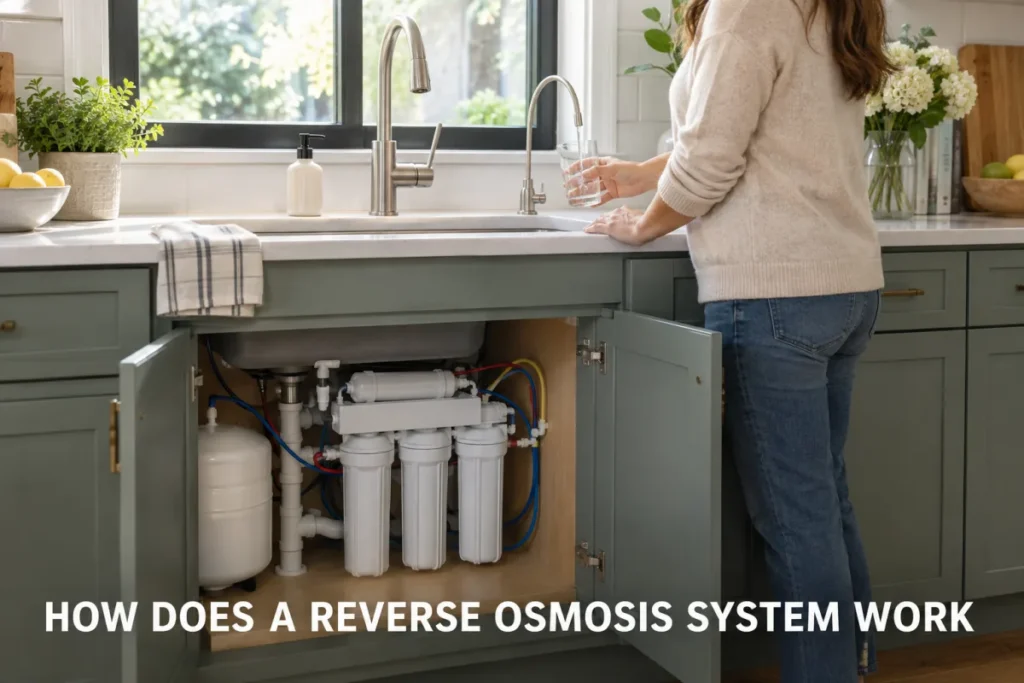
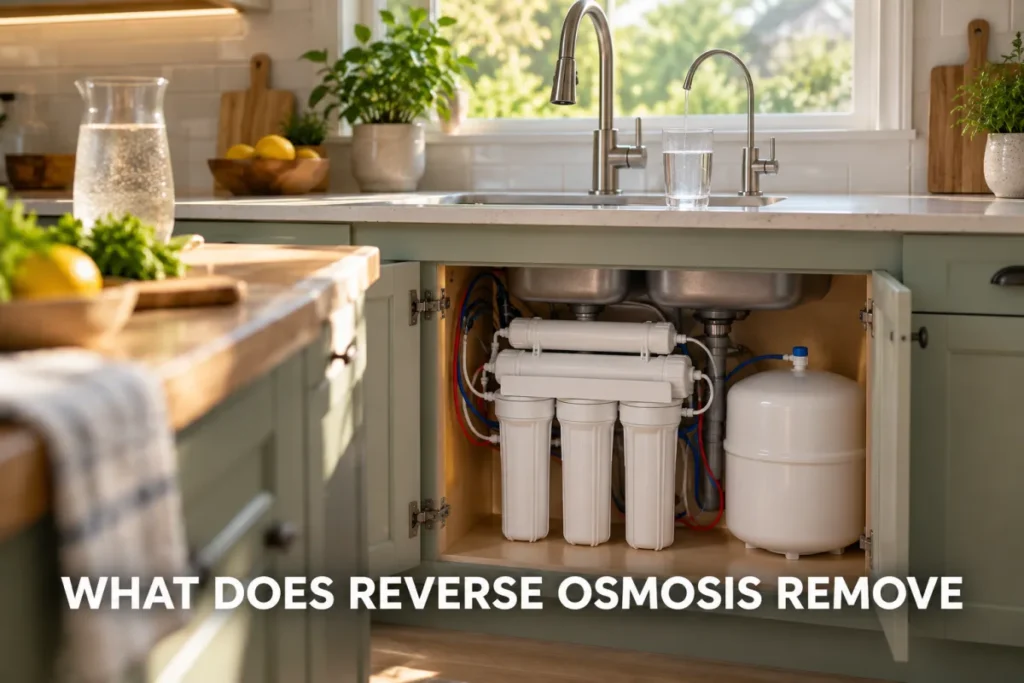
Reverse osmosis removes the large majority of dissolved contaminants in tap water. That includes heavy metals, nitrates, fluoride, PFAS (long-lasting synthetic chemicals known as forever chemicals), and microorganisms. It works by forcing water through a semipermeable membrane (a filter so fine that mostly water molecules pass through). The result is water stripped of nearly everything dissolved in it, for better or worse.

By the end of this guide, you will know exactly which contaminants reverse osmosis removes. You will also see the rate for each one. You will also see which contaminants need a separate carbon filter stage. There is one trade-off, mineral loss, worth understanding before you buy a system.
Key Takeaways
- Reverse osmosis removes roughly 85-95% of fluoride, more reliably than standard carbon filters.
- The RO (reverse osmosis) membrane alone does not remove chlorine or chloramine; carbon filter stages handle that job.
- Reverse osmosis removes over 90% of PFAS. It also blocks bacteria and viruses because of the membrane’s pore size.
- Reverse osmosis also strips beneficial minerals like calcium and magnesium. That is why remineralization (adding minerals back) filters exist.
What Does Reverse Osmosis Remove From Water?
Reverse osmosis removes four broad types of contaminants. These include dissolved salts and heavy metals, harmful microorganisms, dissolved chemicals like pesticides and PFAS, and dissolved minerals. Each type gets trapped as water passes through the membrane under pressure.
- Dissolved salts and heavy metals: sodium, lead, arsenic, and similar charged particles trapped by the membrane.
- Microorganisms: bacteria, viruses, and cysts too large to pass through the membrane’s pores.
- Dissolved organic chemicals: pesticides, solvents, and PFAS rejected along with everything else.
- Minerals: calcium, magnesium, and other minerals removed along with the contaminants. More on this later.
The EPA’s WaterSense program lists point-of-use reverse osmosis systems as effective against several contaminants. These include lead, arsenic, PFAS, and disease-causing bacteria and viruses. That is the same four-category framework this guide follows. Each category gets its own deep dive later. Those sections include exact removal rates for fluoride, chlorine, and nitrates.
The membrane strips out calcium and magnesium along with contaminants. WHO research notes the resulting water can taste flat. Because of this, some households add a remineralization filter. That is a taste preference, not a safety requirement.
Fluoride Removal With Reverse Osmosis
Reverse osmosis removes about 85 to 95 percent of fluoride from tap water. The exact rate depends on membrane condition and water pressure. The EPA‘s National Primary Drinking Water Regulations set an enforceable limit of 4 mg/L for fluoride. A lower guideline of 2 mg/L addresses dental fluorosis risk in children. The membrane blocks fluoride ions the same way it blocks most dissolved minerals. It works by size and electrical charge, not by targeting fluoride on its own.
Standard carbon filters are a common source of confusion. Activated carbon is the media used in most pitcher and refrigerator filters. It does not remove fluoride in any real amount. Fluoride ions simply slip through carbon’s pore structure. Reverse osmosis is one of the few home water treatments that reliably removes fluoride. That is why it shows up so often in fluoride-specific buying guides.
Certification backs this up. Systems tested to NSF/ANSI 58, the standard covering reverse osmosis drinking water treatment units. A system can carry an optional fluoride reduction claim once it is independently verified. Not every RO system carries that claim. Buyers who want fluoride gone should check the system’s certification sheet. They should not assume removal is automatic.
Households on fluoridated municipal water who want the fluoride gone have one reliable choice. That choice is reverse osmosis with a fresh membrane. It works more consistently than a standard carbon pitcher. It is also simpler to maintain than distillation.
Chlorine and Chloramine Removal
Here’s a detail most buyers miss. The reverse osmosis membrane itself does not remove chlorine or chloramine. That job falls to the carbon pre-filter and post-filter stages. Both are built into every RO system. For the complete picture of how a reverse osmosis system works, each stage handles a distinct job in the sequence. These stages strip the disinfectant before water reaches the membrane and polish the taste afterward. Skip the carbon stages and the membrane will wear out faster. Chlorine breaks down the thin material RO membranes are made from.
The EPA‘s maximum residual disinfectant level for chlorine is 4.0 mg/L. This limit is set mainly for taste, not acute health risk, at typical municipal levels. Standard carbon removes chlorine easily. Chloramine, the more stable disinfectant many utilities now use instead, is harder to strip. Standard carbon removes only about 40 to 65 percent of it. Catalytic carbon, a specially treated form of activated carbon, pushes removal above 97 percent.
Filter certification reflects this split. NSF/ANSI 42 certifies chlorine taste and odor reduction. A filter certified under that standard is not certified for chloramine too. The two are tested and rated separately. Anyone on a chloraminated water supply should confirm chloramine reduction directly, not assume a chlorine certification covers it.
In practice, the carbon stages do at least as much work as the membrane. That work covers disinfectant byproducts and taste. Even so, the membrane gets most of the credit for what reverse osmosis removes overall.
Nitrates and Heavy Metals: What Does Reverse Osmosis Remove?
Reverse osmosis removes an estimated 83 to 95 percent of nitrates from drinking water. This matters most for households on well water. Nitrate contamination from farm runoff is common there. The EPA‘s maximum contaminant level for nitrate is 10 mg/L, measured as nitrogen. This limit exists for a reason. Infants who drink water above it risk methemoglobinemia, commonly called blue baby syndrome.
Heavy metals are where reverse osmosis performs best. Lead and arsenic are both blocked at rates well above 95 percent. Their dissolved form is exactly what an RO membrane is built to stop. The EPA has stated plainly that no lead exposure level is safe. That is one reason RO remains a default recommendation. It fits households with older plumbing or lead pipes.
The iSpring RCC7 carries NSF/ANSI 58 certification at the whole-system level for dissolved lead and PFAS; my iSpring RCC7 lead removal review covers the stage-by-stage removal breakdown for a certified 5-stage under-sink unit.
Together, nitrates and heavy metals cover a large share of what reverse osmosis removes. A standard carbon filter cannot touch either one. That is because carbon adsorbs organic compounds and chlorine far better than it catches other things. It struggles with dissolved metal ions and nitrate.
Bacteria, Microplastics, and PFAS Reverse Osmosis Removes

Reverse osmosis also handles several smaller contaminants worth naming, starting with microplastics. RO’s membrane pores measure around 0.0001 microns (a micron is a millionth of a meter). That is roughly a thousand times smaller than the smallest known bacteria. Microplastic fragments, which are far larger, are rejected almost completely.
That same pore size is why reverse osmosis is effective against E. coli, coliform bacteria, and most other waterborne pathogens. It works without using chemical disinfection. The CDC estimates roughly 7.15 million waterborne illnesses occur in the United States each year. Organisms like Cryptosporidium and Giardia resist chlorine well. That is why physical filtering, not disinfection alone, matters for a private well or an old municipal line.
Pesticides are removed less evenly. Reverse osmosis blocks most common farm pesticides at rates above 90 percent. That is because their weight and charge resemble other dissolved chemicals the membrane already blocks. A few small, uncharged pesticide molecules pass through at lower rates than the membrane usually achieves.
PFAS are the so-called forever chemicals. Reverse osmosis has become the most trusted household option against them. A USGS national study looked at this question directly. It found that at least 45 percent of U.S. tap water samples contain one or more types of PFAS. Reverse osmosis reduces PFAS at rates of 90 to 99 percent or higher. That is more reliable than a standard carbon filter alone.
Removal rates vary enough across these contaminant types that a side-by-side view is more useful than more paragraphs:
| Contaminant Type | RO Removal Rate | Notes |
| Bacteria and E. coli | Greater than 99.99% | Rejected by membrane pore size alone, no disinfection needed |
| Microplastics | Nearly 100% | Far larger than the membrane’s 0.0001-micron (millionth-of-a-meter) pores |
| Pesticides | 90% or higher for most compounds | A few small, uncharged molecules pass through at lower rates |
| PFAS (forever chemicals) | 90 to 99% or higher | Effective across both short and long chain lengths |
Minerals Reverse Osmosis Removes Too
Reverse osmosis does not tell a contaminant from a nutrient. Along with everything else, it strips out calcium and magnesium. These are the two minerals behind water’s mineral taste. This reduces total dissolved solids (TDS, the combined measure of minerals and metals dissolved in water). Levels drop from typical tap water values down to roughly 5 to 25 ppm.
WHO research on taste panels backs up what many RO users notice. Water with very low TDS tends to taste flat or different from tap water. The minerals that give water its familiar taste are mostly gone. This is not a safety issue by itself. It ties into whether reverse osmosis water is good for you overall. It is a taste and mineral-intake trade-off worth knowing before you buy a system.
Remineralization filters fix this. Installed as an extra stage after the membrane, remineralization filters add calcium and magnesium back into the water. The levels stay low and steady. This restores taste without adding back the contaminants the membrane just removed. Anyone concerned about losing dietary minerals from drinking water, rather than food, has an option. They can add this stage for a modest added cost.
The iSpring RCC7AK includes that remineralization step built into the system as its sixth certified stage; my iSpring RCC7AK remineralization stage review covers how the alkaline AK stage restores mineral content after the membrane.
How We Research
We check every claim against primary sources. Federal agencies like the EPA and CDC come first. Certification bodies like NSF and AHAM come next. We verify each standard number against the issuing body. We review this guide on a set schedule.
Why Trust This Guide
Puritisimo covers only water and air quality. Our guidance is editorial and independent. We cite every health figure so you can check it. We never present a promotional claim as fact.
Weighing What Reverse Osmosis Takes Out of Your Water
Across nearly every category tested, reverse osmosis removes most of what is dissolved in tap water. Heavy metals, nitrates, fluoride, PFAS, and microorganisms all drop by 80 percent or more. That happens once water passes through the membrane. First, the membrane alone does not touch chlorine or chloramine. Carbon stages handle that. Second, the same process also strips beneficial minerals like calcium and magnesium. That is why some systems add a remineralization filter. Understanding what reverse osmosis removes helps you decide whether it belongs under your sink, and how much a reverse osmosis system costs to run.
Frequently Asked Questions
What can’t reverse osmosis remove from water?
Knowing what reverse osmosis removes is only half the picture. A handful of things pass through the membrane untouched. Others need a companion filter stage. Dissolved gases such as chlorine and chloramine are the clearest examples. The EPA sets chlorine’s maximum residual disinfectant level at 4.0 mg/L. Removing it depends on the system’s carbon stages, not the membrane itself.
What is the downside of reverse osmosis?
The main downside is mineral loss. Reverse osmosis strips beneficial minerals like calcium and magnesium right along with contaminants. WHO taste-panel research confirms that very low-mineral water can taste flat compared to tap water. Remineralization filters fix this by adding minerals back after the membrane stage.
Does reverse osmosis remove everything from water?
No. Reverse osmosis works well. It blocks 90 to 99 percent or more of most dissolved contaminants, according to the EPA’s WaterSense program. It is not a perfect barrier. A small number of contaminants, mainly dissolved gases like chlorine and chloramine, pass through the membrane. They need a carbon stage to catch them.
Is it okay to drink reverse osmosis water every day?
Yes, reverse osmosis water is safe to drink every day. The one thing worth knowing is mineral loss. The membrane strips out calcium and magnesium along with contaminants. WHO research notes the resulting water can taste flat. Because of this, some households add a remineralization filter. That is a taste preference, not a safety requirement.
Does reverse osmosis remove PFAS?
Yes. Reverse osmosis removes roughly 90 to 99 percent or more of PFAS. That holds true across short and long chain lengths. It is the most reliable method available to homeowners. A USGS national study backs this up. It found PFAS in at least 45 percent of U.S. tap water samples. That is why RO has become the default recommendation for households worried about these chemicals.
References
- EPA. National Primary Drinking Water Regulations. U.S. Environmental Protection Agency. 2024.
- USGS. Tap Water Study Detects PFAS Forever Chemicals Across the US. U.S. Geological Survey. 2023.
- WHO. Total Dissolved Solids in Drinking Water: Background Document. World Health Organization. 2003.
Medical Disclaimer: This content is for informational purposes only. It is not a substitute for professional medical advice, diagnosis, or treatment. If you have concerns about your water quality or air quality and their effects on your health, consult a qualified healthcare professional.