
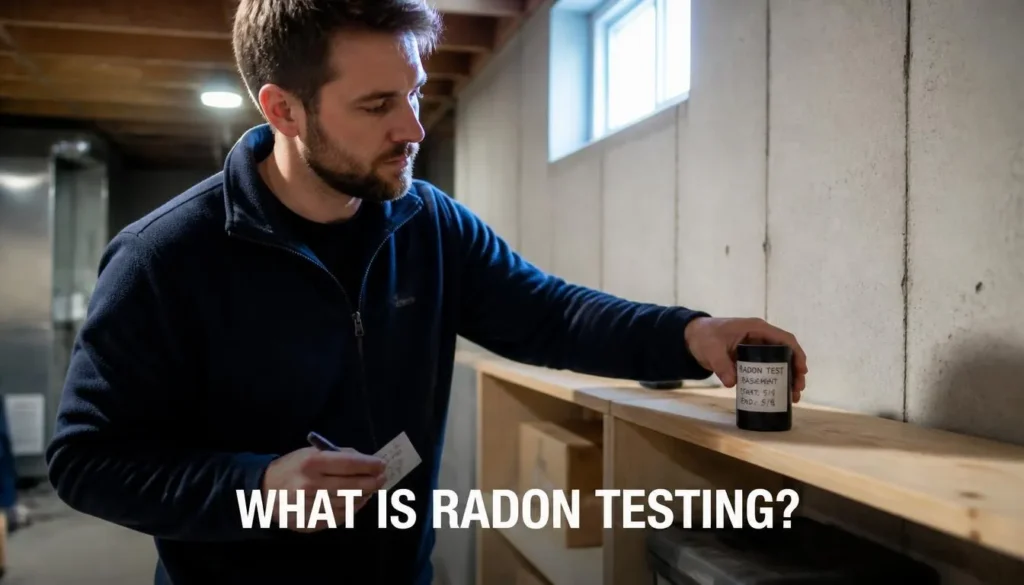
Radon testing is a simple measurement of radon, a radioactive gas, in your home’s air. Results use picocuries per liter (pCi/L), a unit that counts radioactive decay in each liter of air. The EPA recommends fixing a home when the result reaches 4 pCi/L or higher. Because you cannot see or smell radon, a test is the only reliable way to determine your level.
This guide explains how radon tests work, how short-term and long-term tests differ, and how to interpret your number. It also covers testing during a home sale and how often to test again.
Key Takeaways
- Radon testing measures radon gas in indoor air. The EPA says to fix a home at 4 pCi/L or higher.
- Short-term tests run 2 to 90 days. Long-term tests run more than 90 days and better show your yearly average.
- Place the kit in the lowest lived-in level, at least 20 inches above the floor, with windows closed.
- Retest after any radon fix, and about every two years after that, to confirm levels stay low.
What Is Radon Testing and Why Do Homes Need It?
Radon testing is the process of measuring how much radon gas is in the air of a building. A small device collects air for a set number of days, and then a lab or a built-in sensor reads the result in picocuries per liter.
Radon is a natural radioactive gas that moves up from the soil and can accumulate indoors. The CDC identifies it as the second leading cause of lung cancer deaths in the United States after cigarette smoke, with more than 21,000 deaths each year.
Only a test can reveal your level, and the EPA estimates that nearly 1 out of every 15 U.S. homes has elevated radon, although any home may have a problem.
Short-Term vs. Long-Term Radon Tests
A short-term test stays in your home for 2 to 90 days, depending on the device. A long-term test stays for more than 90 days. Short-term devices include charcoal canisters (small containers of charcoal that absorb radon from the air) and continuous monitors (electronic units that record radon levels as time passes).
Radon concentrations shift from day to day and season to season. A short-term test is consequently less likely than a long-term test to show your year-round average. Long-term tests commonly use alpha track and electret detectors (passive devices that need no power). When you need answers quickly, a short-term test followed by a second short-term test can still guide the decision to fix.
A radon testing kit is the usual do-it-yourself choice, and many kits sell online and in home improvement stores, while some state radon programs offer free or discounted ones (EPA).
The table below compares the two test types side by side.
| Feature | Short-term test | Long-term test |
| Length | 2 to 90 days | More than 90 days |
| Common devices | Charcoal canister, alpha track, electret, continuous monitor | Alpha track, electret |
| Best for | A quick first answer | Your yearly average |
| Main limit | Less likely to show yearly average | Takes much longer |
How Radon Testing Is Done Step by Step
A home test takes only a few minutes to set up, and then the device works independently for several days. If your test runs just 2 or 3 days, close windows and outside doors at least 12 hours before you begin.
You can still live in the home as usual, but keep windows and outside doors closed as much as you can and skip fans that bring in outside air. Fans that only recirculate indoor air may run, and you should postpone a 2 or 3 day test during unusually severe storms or high winds. Mold tests work differently, and our guide on how to test for mold in the air explains how.
Follow these five steps with a standard kit:
- Read the directions on the package and note how long the test must run before you open it.
- Close windows and outside doors before the test starts.
- Pick the lowest lived-in level of the home, in a room you use often, but not the kitchen or bathroom.
- Set the kit at least 20 inches above the floor, away from drafts, high heat, high humidity, and outside walls.
- Leave it for the time on the package, reseal it, and mail it to the lab right away. Results come back in a few weeks.
How to Read Your Radon Test Results
The average indoor level in the U.S. is about 1.3 pCi/L, and outdoor air usually holds about 0.4 pCi/L, so your result shows how far your home sits above ordinary background levels.
Use these EPA rules of thumb to read your number:
- 4 pCi/L or higher: the EPA recommends fixing your home, although a high short-term result should be confirmed with a follow-up test first. See how much a radon mitigation system costs for typical prices.
- Over 8 pCi/L on a first short-term test: take a second short-term test right away.
- 2 to 4 pCi/L: the EPA chart says to consider fixing.
- Below 2 pCi/L: the EPA says no level of radon is safe, so you may want to test again later.
Results close to the line are less clear. If two short-term tests average 4.1 pCi/L, there is about a 50% chance that your year-round average is somewhat below 4, and a long-term test can settle the question. The CDC also says there is no known safe level of radon.
What Is Radon Testing for Home Sales and Inspections?
In a home sale, radon testing is the same measurement on a faster clock. The EPA says home sales move quickly, so sellers should test early and save the results for interested buyers.
Buyers often want a test by someone who is not involved in the sale. Two short-term tests placed side by side, four inches apart, can also guide the decision to fix. Asking for a radon test alongside a home inspection is therefore a reasonable request. A new home needs a test after someone moves in, even when it has radon-resistant features. Buyers may also ask about areas the seller never tested, such as a basement they plan to finish.
Professional radon testing means hiring a qualified tester instead of using a kit, and your state radon program keeps a list of credentialed testers. EPA says these testers come from a state process or from two national programs: the National Radon Proficiency Program (NRPP) and the National Radon Safety Board (NRSB).
Retesting After a Fix and Over the Years
Test again after any fix to confirm that the concentration dropped. The CDC says to retest after any repairs. Most soil suction systems (pipes that pull radon from under the house and vent it outdoors) include a monitor. The EPA also suggests a retest every two years to confirm that levels remain low.
Retest whenever your home changes in a meaningful way. If you start using a lower level, such as a basement, test that level. Major renovation can change radon in any home, so test again when the work ends, because even a result below 4 pCi/L may deserve another test someday. Radon is only one indoor air concern, and our guide to testing air quality in your home covers the others.
How We Research
We check every claim against primary sources. Federal agencies like the EPA and CDC come first. Certification bodies like NSF and AHAM come next. We verify each standard number against the issuing body. We review this guide on a set schedule.
Why Trust This Guide
Puritisimo covers only water and air quality. Our guidance is editorial and independent. We cite every health figure so you can check it. We never present a promotional claim as fact.
Putting Your Radon Test to Work
A radon test takes little effort and gives a clear answer. Choose a short-term kit for a fast initial result, or a long-term kit for your yearly average, and place it in the lowest lived-in level with windows closed. If the number is 4 pCi/L or higher, confirm it, then hire a contractor trained in radon reduction. Retest after any fix to confirm the result. That is what radon testing is: a small check that tells you if your home needs action.
Frequently Asked Questions
How to use radon test kit?
Radon testing with a home kit starts with closing windows and outside doors. Next, place the kit at least 20 inches above the floor in the lowest lived-in level, away from the kitchen and bathroom. Leave it for the time on the package, then reseal it and mail it to the lab.
What happens if your house tests high for radon?
A short-term result of 4 pCi/L or higher calls for a follow-up test to be sure. A first result more than twice that level calls for a second short-term test right away, and confirmed high levels mean hiring a contractor trained in radon reduction.
Is radon testing necessary?
Yes, because you cannot see or smell radon, and only a test shows your level. Nearly 1 in 15 U.S. homes has elevated radon, although any home may have a problem, and a test is easy because it takes only a few minutes to set up.
Can you be in the house during a radon test?
Yes, you can live in the home as usual. The main rule is to keep windows and outside doors closed as much as possible. Do not run fans or machines that bring in outside air, but normal use of the home, including recirculating heating and cooling fans, is fine.
How often should radon testing be done?
Retest after any radon fix, then about every two years to confirm that levels stay low. Test again after major renovation or if you start living on a lower level, since even a result below 4 pCi/L may be worth repeating later.
References
- EPA. A Citizen’s Guide to Radon: The Guide to Protecting Yourself and Your Family From Radon. U.S. Environmental Protection Agency. 2016.
- CDC. About Radon. Centers for Disease Control and Prevention.
- EPA. Radon Testing. U.S. Environmental Protection Agency.
Medical Disclaimer: This content is for informational purposes only. It is not a substitute for professional medical advice, diagnosis, or treatment. If you have concerns about your water quality or air quality and their effects on your health, consult a qualified healthcare professional.

