
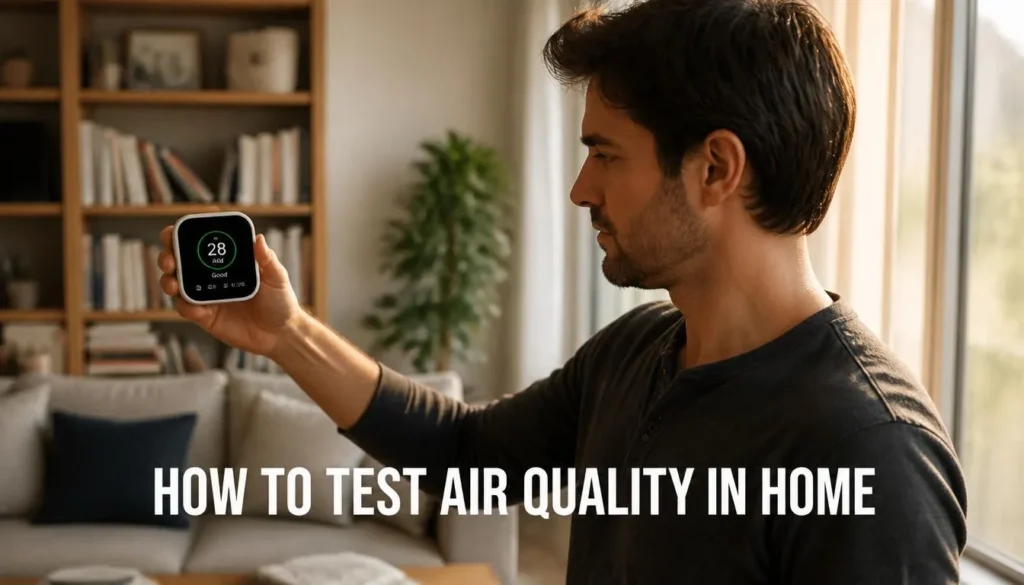
You can test the air in your house with three tools: an air quality monitor, a test kit, or a trained professional, and each one measures different things. Learning how to test air quality in a home means matching the tool to the pollutant, such as fine dust, carbon monoxide, radon, or humidity. No single gadget checks all of them.
This guide covers what to measure, which tool fits each pollutant, and how to read the results. A monitor, an air quality test kit, and CO alarms cover most homes. By the end, you will know which readings need action and which do not.
Key Takeaways
- Each pollutant needs its own sensor, so one device cannot test everything in your home.
- The EPA says to fix your home if a radon test reads 4 picocuries per liter (pCi/L) or more.
- Keep humidity at 30 to 50%, and treat carbon dioxide above 1,000 parts per million (ppm) as stale air.
- Home monitors show trends, and routine mold air tests do not give results you can act on.
How to Test Air Quality in Home, Step by Step
Testing works by measuring one pollutant at a time with a sensor or a lab kit, then comparing each number to a health benchmark.
Follow these five steps in order:
- Look for sources first. Note damp spots, gas appliances, smoking, candles, and fresh paint or new furniture. A sensor only tells you when these sources act up.
- Install carbon monoxide (CO) alarms. Put one on every floor and outside sleeping areas, and choose a model that meets the UL 2034 safety standard.
- Order a radon test. Radon is a radioactive gas that seeps up from soil. Run a short-term kit for a few days on the lowest lived-in floor, then compare the result with the EPA action level.
- Put an indoor air quality monitor where you breathe, such as a bedroom or living room. Keep it away from windows, stoves, and vents, and log readings for one to two weeks.
- Compare each reading with the benchmarks in the readings section below. Then decide whether to fix the cause, retest, or call a professional.
Two traps are worth knowing. The EPA notes that monitor alerts are not designed to warn of immediate danger, so a monitor never replaces a CO alarm. Also, the alarm’s test button only checks its circuitry, not its sensor, per the CPSC. Replace the unit when the maker says to.
How to Test Indoor Air Quality in Home: What to Measure

Seven things are worth measuring, and each has its own source and its own best tool. Start with the two that carry the biggest health risks: carbon monoxide and radon. Then add fine particles and humidity.
Two terms need a plain definition. PM2.5 means fine particles 2.5 microns or smaller (a micron is about 1/100th the width of a human hair). VOCs are volatile organic compounds, gases that leak from paint, cleaners, and furniture.
The table below lists each pollutant with its usual source and best tool:
| Pollutant | Common sources | Best tool |
| PM2.5 | Cooking, candles, smoke | Plug-in monitor |
| Carbon dioxide | People breathing | Monitor with CO2 sensor |
| VOCs | Paint, cleaners, furniture | Monitor, then lab test |
| Humidity | Showers, damp basements | Monitor or hygrometer |
| Radon | Soil under the house | Radon test kit |
| Carbon monoxide | Gas heaters, stoves | Certified CO alarm |
| Mold | Leaks, damp walls | Visual inspection |
Choosing How to Test Air Quality in Home: Monitor, Kit, or Pro
Each route answers a different question. A monitor shows what happens hour by hour, a kit gives one lab number, and a professional can trace a problem you cannot find yourself.
Here is how the three routes compare:
- Air quality monitor: a device that tracks only what its sensors support, so check for PM2.5, carbon dioxide, and humidity. It helps you spot what raises levels, such as cooking.
- Air quality test kit: a passive radon canister or a mailed lab sample. It is best for radon, but a high short-term result calls for a second test before repairs.
- Professional home air quality test: a trained inspector samples several pollutants and checks ventilation. It fits best when symptoms persist or after a water leak.
- Free home air quality test: some state radon programs offer free or discounted radon kits, so check your state health or radon office first.
Be realistic about monitor accuracy. The EPA says there is limited information on the accuracy of low-cost monitors, and no widely accepted indoor performance criteria exist for most of them. Treat the numbers as a trend, not a lab result.
Skip mold air tests. NIOSH, part of the CDC, says there are no health-based standards for mold in indoor air and does not recommend routine air sampling. A visual check for damp spots is more reliable. For more, see whether an air purifier helps with mold in the air.
What Your Readings Mean
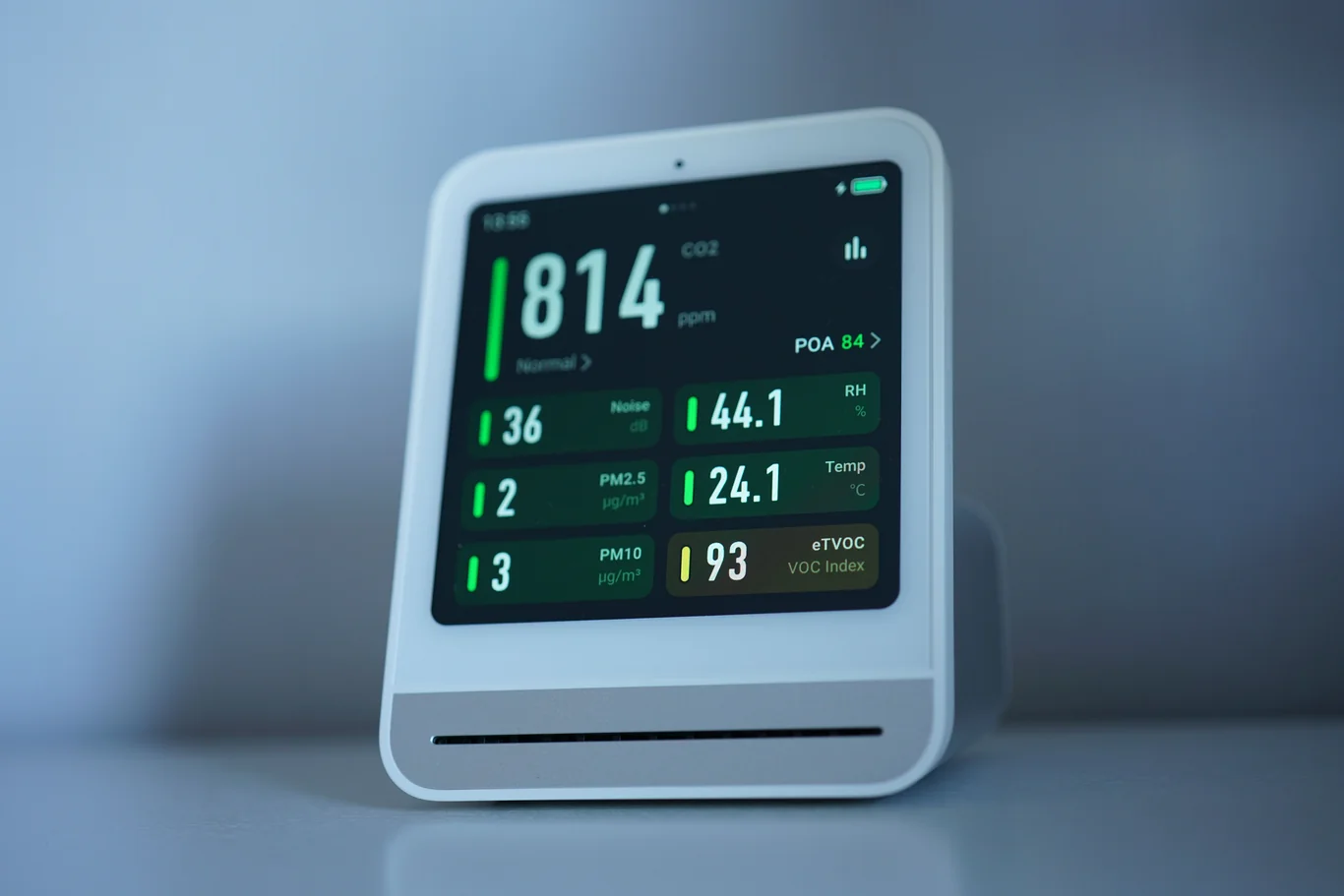
For fine particles, the closest yardstick is the EPA’s outdoor annual standard of 9.0 µg/m3 (micrograms per cubic meter of air). It applies to annual averages over three years, so it gives long-term context, not a pass-or-fail line for one indoor reading. Cooking can cause brief spikes, but a quick drop does not prove the air was safe. If levels stay high, look for steady indoor sources and for outdoor pollution entering the home. Our AQI levels guide shows when outdoor air calls for action.
Carbon dioxide tells you about ventilation, not toxicity. The EPA says peaks above 1,000 ppm in the breathing zone point to ventilation problems. Readings below that level suggest that fresh air is keeping up with the number of people in the room.
Humidity is the easy win. The EPA says indoor relative humidity should stay below 60 percent, ideally between 30 and 50 percent. Damp air feeds mold, so a basement that stays above that range deserves attention and probably a dehumidifier.
For radon, the EPA recommends fixing a home at 4 pCi/L or higher and says to consider fixing between 2 and 4, since no level is known to be safe. Outdoor air averages about 0.4 pCi/L. Short-term tests swing day to day, so confirm a high result with a second test before you pay for repairs.
Mold has no health-based indoor standard. A combined reading for VOCs has no single health threshold either, so treat a rising number as a cue to find the source, such as new paint or furniture. NIOSH notes that a spore count has nothing to be measured against. Use a reading for VOCs the same way: to see which activity raises it, such as painting, not as a pass-or-fail grade.
What to Do After a High Reading
For non-emergency readings, fix the source before you buy any device. Ventilation and source control come first, because the EPA says filtration does not replace the need to control pollutants and ventilate. Run exhaust fans that vent outdoors, and open windows only when outdoor air and weather allow. If a CO alarm sounds, leave at once and call emergency services, as the CPSC advises. Do not look for the source or go back in until responders say it is safe.
Then match the filter to the pollutant. HEPA (high-efficiency particulate air) filters trap fine particles, while the EPA points to activated carbon filters for gases. Neither fixes carbon monoxide or radon at the source. For steady fine-particle readings, our best air filter for home picks are a good start.
Plants are not the fix. A 2019 review in the Journal of Exposure Science & Environmental Epidemiology found that potted plants remove VOCs far more slowly than normal air exchange does.
Finally, retest. Run the same monitor in the same spot for another week, or repeat the radon test, so you compare like with like. If a result stays high or symptoms continue, book a professional visit and talk to a health care provider.
How We Research
We check every claim against primary sources. Federal agencies like the EPA and CDC come first. Certification bodies like NSF and AHAM come next. We verify each standard number against the issuing body. We review this guide on a set schedule.
Why Trust This Guide
Puritisimo covers only water and air quality. Our guidance is editorial and independent. We cite every health figure so you can check it. We never present a promotional claim as fact.
Turning Readings Into a Cleaner Home
A good home air check is small: CO alarms on every level and outside sleeping areas, one radon kit, and one monitor that runs for a couple of weeks. Each tool covers a gap the others leave open, but each has limits. Read the numbers as trends and thresholds, not verdicts. For non-emergency readings, fix sources first, add filtration where the data shows a steady problem, and retest to see what changed. If readings stay high, call a professional. That mix of simple tools and honest limits is the practical core of how to test air quality in a home.
Frequently Asked Questions
How to test air quality in home?
Knowing how to test air quality in a home starts with three tools. You need a plug-in monitor for fine dust, carbon dioxide, and humidity, plus a radon test kit and a carbon monoxide alarm. Each one covers a pollutant the others miss, so together they handle the main risks without a paid inspection.
Does English ivy filter air?
English ivy does not clean a room’s air fast enough to matter. Lab studies used sealed chambers, and a 2019 review found plants remove gases far more slowly than normal air exchange. Open windows, an exhaust fan, and the right filter do much more.
What is IAQ concerned with?
IAQ (indoor air quality) is concerned with the gases, particles, and moisture inside buildings and how they affect comfort and health. It covers sources such as cooking and cleaning products, plus ventilation, which controls how fast fresh air replaces stale air.
Why is indoor air quality important?
Pollutants from cooking, cleaning, and building materials stay in a closed space until fresh air dilutes them. Poor ventilation lets them build up. Headaches or irritated eyes can follow, and a few pollutants, such as radon and carbon monoxide, carry serious risks.
Are there free ways to test air quality at home?
Yes, in a few cases. Some state radon programs give out free radon kits, and a monitor you already own gives readings at no extra cost. A free reading shows a trend, not a diagnosis, so use it to decide if a lab kit or professional visit is worth it.
References
- EPA. Low-Cost Air Pollution Monitors and Indoor Air Quality. U.S. Environmental Protection Agency.
- EPA. What Is EPA’s Action Level for Radon and What Does It Mean? U.S. Environmental Protection Agency.
- CPSC. Carbon Monoxide Fact Sheet. U.S. Consumer Product Safety Commission.
- EPA. Common IAQ Measurements: A General Guide. U.S. Environmental Protection Agency.
- CDC NIOSH. Mold, Testing, and Remediation. National Institute for Occupational Safety and Health.
- EPA. Mold Course Chapter 2: Moisture Control. U.S. Environmental Protection Agency.
Medical Disclaimer: This content is for informational purposes only. It is not a substitute for professional medical advice, diagnosis, or treatment. If you have concerns about your water quality or air quality and their effects on your health, consult a qualified healthcare professional.

