
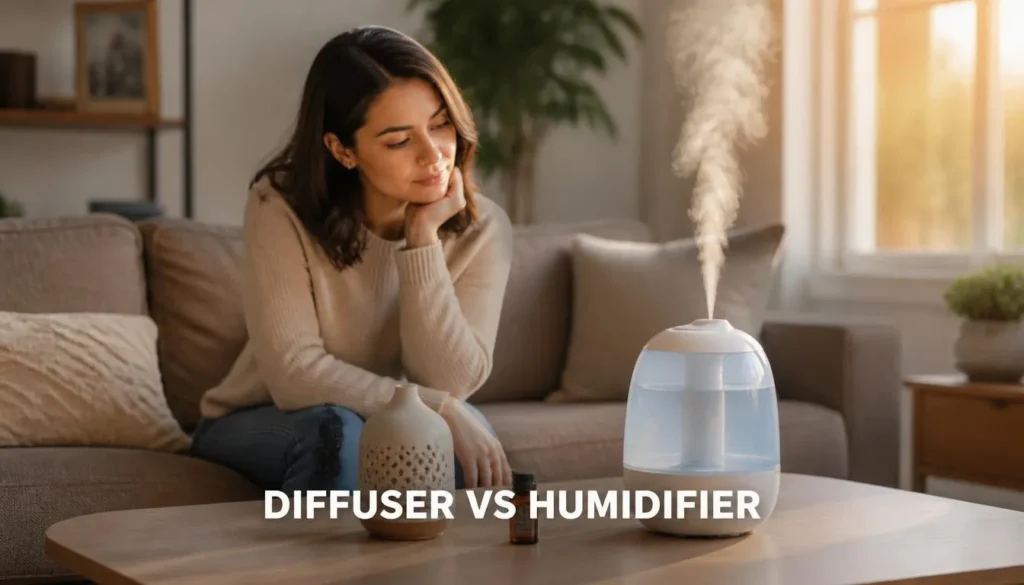
In the diffuser vs humidifier choice, a humidifier adds real moisture to dry air, while a diffuser mostly adds scent. Pick a humidifier to raise humidity, and pick a diffuser only for aroma. Water-based ultrasonic diffusers look much like ultrasonic humidifiers, though other types work in other ways. Their jobs differ, though. A diffuser’s moisture output depends on its type and size, and the oils it releases bring their own air-quality trade-off.
This guide explains the humidifier and diffuser difference in plain terms, from water output to oil safety. You will know which machine fits your room, whether oils belong in a humidifier, and what to ask before using either near a baby.
Key Takeaways
- A humidifier raises room humidity. A diffuser mostly spreads scent and any moisture it adds depends on its type and size.
- The EPA says not to humidify above 50 percent and to use distilled water in humidifiers.
- Most humidifier makers say to use plain water only, so check your manual before adding oils.
- Safety research on scent oils is thin, so ask your doctor before using one near a baby.
Diffuser vs Humidifier at a Glance
Choose a humidifier if the air feels dry, and choose a diffuser if you want a light scent. A humidifier adds real moisture, and a diffuser adds less, and at times none.
If you are also weighing steam units, see the difference between a vaporizer and a humidifier.
A humidifier works toward a humidity target. The EPA says to keep indoor relative humidity (the share of water vapor the air holds compared with the most it could hold) at or below 50 percent. A diffuser has no such target because it does not aim to change humidity. Oil diffuser vs humidifier, then, is a choice between aroma and moisture.
The table below lines up the main differences side by side:
| Factor | Diffuser | Humidifier |
| Main job | Spreads scent from essential oils | Adds moisture to dry air |
| Water output | Varies by type, often small | Large enough to raise humidity |
| Room coverage | Small area near you | A whole room, by size |
| Essential oils | Built for them | Most makers say water only |
| Air-quality trade-off | Releases VOCs (gases from the oils) | Can leave white mineral dust |
| Upkeep | Rinse and refill the tank | Daily refill, deep clean every third day |
| Best for | Scent in a small space | Dry air in a bedroom or living room |
What a Humidifier Does and How to Run One Safely
A humidifier adds moisture to the air by evaporation, ultrasonic or impeller mist, or steam, which lifts humidity when the air is dry. The EPA says not to go past 50 percent, because higher levels may encourage biological growth in the home. A hygrometer (a small gauge that reads humidity) shows where you stand.
A second EPA guide puts the ideal range at 30 to 50 percent relative humidity. Ultrasonic and impeller units can also leave white mineral dust when the water holds dissolved minerals, and a dirty tank can harbor germs. The EPA lists these steps for portable units:
- Fill the tank with bottled water labeled “distilled.” Spring, artesian, and mineral water have not been treated to remove minerals.
- Empty the tank, wipe every surface dry, and refill it daily.
- Clean the unit every third day.
- Rinse the tank with several changes of tap water after cleaning, so no chemicals get into the mist.
Essential Oil Diffuser vs Humidifier: What Diffusing Adds
An ultrasonic diffuser (a small plate that vibrates fast to break water into fine mist) is a tiny humidifier with oil added. Its effect on room humidity depends on its water output, runtime, room size, and airflow. No cited source measures that effect, so pick a humidifier sized for the room when humidity matters.
What it does add is scent and VOCs (volatile organic compounds, gases that evaporate from products at room temperature). A 2022 study in the International Journal of Environmental Research and Public Health ran one ultrasonic diffuser with four oils. It found total VOCs as low as 0.6 ppb (parts per billion, a tiny share of the air), falling below 0.1 ppb soon after.
Treat that result as early, since it covers one diffuser and four oils. The authors still called for a fuller inhalation study. The EPA says not much is known about health effects at the low organic levels found in most homes, though higher levels can irritate the eyes, nose, and throat.
Can You Put Essential Oils in a Humidifier?
Usually not. Most humidifier makers say in their manuals to fill the tank with water only. Check your own manual, because this rule comes from the maker, not a health agency. Our guide to humidifier setup and daily care explains which water to put in the tank.
The EPA does not mention oils on its humidifier page. It does say to rinse the tank well after cleaning so chemicals are not dispersed into the air. The same logic applies to oils, in plain terms: whatever sits in the tank can leave with the mist.
If you want scent and moisture, you have two good options. Run a diffuser and a humidifier as separate machines, or buy a unit that the maker designed for both. Some models add a separate scent tray so oils never touch the water tank.
Humidifier vs Diffuser for Sinus and Cough Concerns
The humidifier vs diffuser for sinus question comes down to moisture. Dry air is the problem a humidifier addresses, and the EPA target is 30 to 50 percent relative humidity. A diffuser has less moisture to offer than a humidifier built for the job.
The humidifier vs diffuser for cough question works the same way. None of the agency pages cited in this guide says either machine treats a cough or sinus trouble. A humidifier can make dry air feel better, and a diffuser can make a room smell pleasant. If symptoms last, see a doctor.
Oils add a risk for sensitive airways. The EPA says people with lung diseases or respiratory allergies may be particularly susceptible to airborne pollutants. If you have asthma, hold off on diffusing oils until your doctor agrees.
Can a Diffuser Be Used as a Humidifier for Baby?
Not reliably. A diffuser may add some moisture, but its output may not keep a nursery at the right humidity. A humidifier sized for the room is the safer choice, and a hygrometer shows the result.
If a baby’s room is dry, a humidifier is the right tool. Follow the EPA rules: distilled water, a daily refill, a hygrometer, and humidity at or below 50 percent. The EPA also says to keep steam vaporizers out of the reach of children, and it notes that the young may be particularly susceptible to airborne pollutants.
Oils are a separate question. Safety research on scent oils is thin, and the 2022 study above called for a fuller safety assessment. No source cited here supports diffusing oils near a baby, so ask your doctor before you try.
Humidifier vs Diffuser vs Purifier and Combo Units
A purifier does a third job. It pulls room air through a fan and filter to trap particles, and it adds no moisture or scent. Neither a humidifier nor a diffuser cleans the air, so one machine cannot stand in for another.
A diffuser humidifier combo packs mist and scent into one body. It still has the diffuser’s limits if its tank is small, so check the water output the maker lists before you count on it for dry air.
Some units pair a humidifier with a purifier in one case. The two functions work separately, so judge each one by its own listed spec, such as the maker’s stated water output and the filter’s stated rating.
Which Should You Choose?
Match the machine to the problem, not to the look. Moisture is a humidifier job, and scent is a diffuser job.
Choose a humidifier if:
- A hygrometer reads below 30 percent and the air feels dry.
- You can commit to a daily refill and a deep clean every third day.
- You want one machine to cover a whole bedroom or living room.
Choose a diffuser if:
- You want scent only, and the air is not dry.
- Nobody in the room has asthma or airway trouble, and no baby sleeps there.
- You will rinse and refill the tank often, as with any water tank.
How We Research
We check every claim against primary sources. Federal agencies like the EPA and CDC come first. Certification bodies like NSF and AHAM come next. We verify each standard number against the issuing body. We review this guide on a set schedule.
Why Trust This Guide
Puritisimo covers only water and air quality. Our guidance is editorial and independent. We cite every health figure so you can check it. We never present a promotional claim as fact.
Matching the Machine to the Room
Humidifiers and diffusers can look alike, but they solve different problems. A humidifier fixes dry air, and the EPA says to keep humidity under 50 percent while you run one. A diffuser adds scent, and the research on diffused oils is still thin, with one small study and a call for more. Keep oils out of the humidifier tank unless the maker allows them. If a baby, a child, or someone with asthma shares the room, ask a doctor before you diffuse anything. The diffuser vs humidifier choice comes down to one question: do you need moisture or only scent?
Frequently Asked Questions
Diffuser vs humidifier: which one raises room humidity?
In the diffuser vs humidifier comparison, the humidifier is made to raise room humidity. A water-based diffuser adds some moisture, but its effect depends on its output and the room, so a humidifier sized for the room is the safer pick. If a hygrometer reads below 30 percent, a humidifier is the machine to use.
What is the purpose of an air humidifier?
A humidifier adds moisture to indoor air that is too dry. The EPA suggests keeping homes between 30 and 50 percent humidity, and a hygrometer shows where you are. It does not clean the air or add scent, so you need other tools for those jobs.
Are diffusers ok for lungs?
Research is thin, so the answer depends on the person. A 2022 study measured very low levels of volatile organic compounds from one ultrasonic diffuser, yet its authors called for a fuller inhalation study. The EPA says people with lung disease or respiratory allergies may be more susceptible to airborne pollutants, so ask a doctor first.
Is a diffuser humidifier combo worth buying?
A combo can work if you want moisture and scent from one machine. Check the water output the maker lists, because a small tank may add little humidity. Also confirm the maker allows oils in the tank, since most humidifiers are meant for water only.
How often should I clean a diffuser?
Follow your manual first. As an editorial default, use the EPA schedule for portable humidifiers: empty, dry, and refill daily, then deep clean every third day. A diffuser holds standing water just as a humidifier does, so the same routine is a sensible starting point.
References
- U.S. Environmental Protection Agency. Use and Care of Home Humidifiers. Indoor Air Quality. Accessed November 9, 2026.
- U.S. Environmental Protection Agency. A Brief Guide to Mold, Moisture, and Your Home. Accessed November 9, 2026.
- U.S. Environmental Protection Agency. Volatile Organic Compounds’ Impact on Indoor Air Quality. Accessed November 9, 2026.
- Itoh T, et al. Examination of VOC Concentration of Aroma Essential Oils and Their Major VOCs Diffused in Room Air. International Journal of Environmental Research and Public Health. 2022.
Medical Disclaimer: This content is for informational purposes only. It is not a substitute for professional medical advice, diagnosis, or treatment. If you have concerns about your water quality or air quality and their effects on your health, consult a qualified healthcare professional.

