
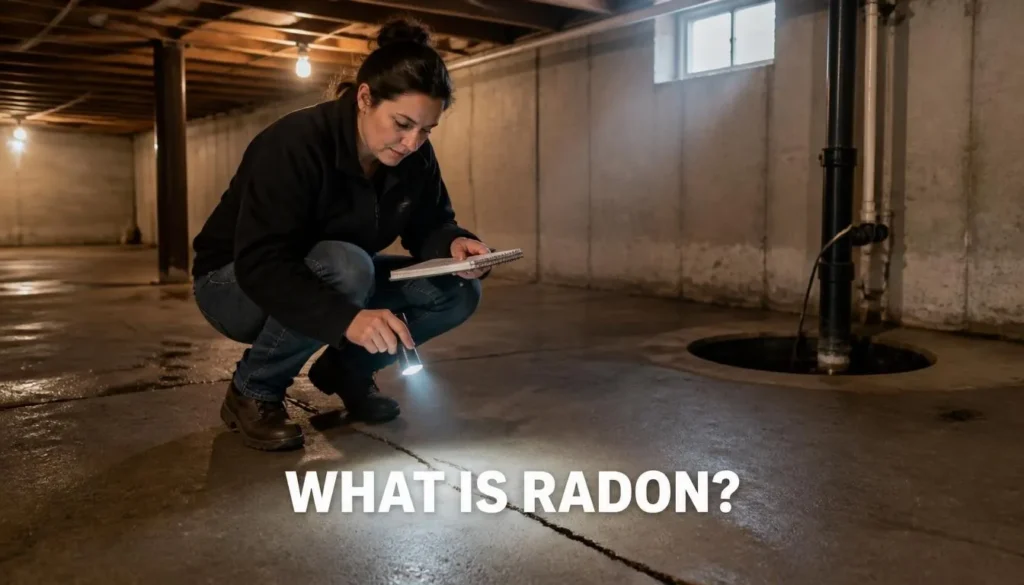
Radon is a natural radioactive gas that forms in soil and rock and can seep into your home, even though you can’t see, smell, or taste it. The EPA estimates that it causes about 21,000 lung cancer deaths in the U.S. each year, which makes it the leading cause of lung cancer among people who have never smoked. A simple home test shows whether you have a problem.
Below, you’ll learn what radon is, where it comes from, which levels matter, how a test works, and how a fix removes it from your home. Every number comes from EPA, CDC, or WHO pages.
Key Takeaways
- Radon is an invisible, odorless gas from decaying uranium in soil and rock, and it can build up indoors.
- The EPA says fix your home at 4 pCi/L or higher and consider fixing it at 2 to 4.
- Radon causes no early symptoms, so a home test is the only way to know your level.
- A soil suction system from a qualified contractor can cut radon by up to 99 percent.
What Is Radon and Where Does It Come From?
Radon is a colorless, odorless, radioactive gas that forms when uranium in soil, rock, and water breaks down naturally. The gas moves up through the ground and into the air you breathe. Outdoors it thins out fast, but inside a building it can build up. Because you cannot see or smell it, a radon test is the only way to learn your level.
That answers where radon comes from: the natural breakdown of uranium in soil, rock, and water, according to the EPA. The WHO adds that uranium is found in all rocks and soils. So radon exists in every region, and it forms through a slow, steady natural process that has no pollution or human cause behind it.
Because the source is the ground itself, radon says nothing about how clean or how old your house is. The EPA reports that it shows up in new and old homes, drafty and tight ones, and homes with or without basements. Lower air pressure inside a home can draw radon-bearing soil gas through foundation cracks and other openings.
How Radon Gets Into Your Home
Soil gas is the principal source of indoor radon, says the EPA. The gas typically moves up through the ground and into your home through cracks and other holes in the foundation. Your home then traps the gas inside, where it can build up to levels that raise your health risk over many years.
The most common entry points are cracks in solid floors, construction joints, cracks in walls, gaps in suspended floors, and gaps around service pipes. Cavities inside walls and the water supply can also let radon in, so even a well-built house is not automatically safe.
Well water contributes radon in some homes, while building materials rarely create a problem on their own. The EPA estimates that nearly 1 out of every 15 U.S. homes has elevated radon, so a gas that feels rare is common enough to test for.
What Is a Safe Level of Radon?
The EPA says no level of radon exposure is known to be safe, so it publishes action points rather than declaring any specific level harmless EPA. Radon concentration is measured in pCi/L (picocuries per liter, a unit that counts radioactive decay in each liter of air).
These are the reference points worth knowing:
- Outdoor air: about 0.4 pCi/L on average, according to the EPA.
- Typical indoor air: about 1.3 pCi/L on average.
- 2 to 4 pCi/L: the EPA says to consider fixing your home.
- 4 pCi/L or higher: the EPA recommends fixing your home.
- WHO reference level: 100 Bq/m3 (becquerels per cubic meter, the metric version of the same measure), with a ceiling of 300 if 100 is out of reach, per the WHO.
The reason for acting early is the health record. The EPA says radon is responsible for about 21,000 lung cancer deaths every year, and about 2,900 of them are among people who never smoked EPA. The CDC adds that radon ranks second behind cigarette smoke as a cause of lung cancer deaths. If you smoke and your home has high radon, your risk is especially high.
First Signs of Radon Poisoning
Radon exposure produces no early warning signs that you can feel. The CDC says most people have no symptoms until lung cancer is advanced, and by then it is harder to treat.
Lung cancer takes years to develop, so the CDC advises reducing your radon exposure throughout your whole life, because the damage builds gradually. Breathing high levels over time may cause lung cancer, and that is the main health effect tied to radon. If you have health worries, see your doctor. A home test provides far more reliable information than any symptom can.
What Is a Radon Test and How to Take One
A radon test is a small device that measures the radon in your indoor air. You can buy an inexpensive kit by mail or at some hardware stores, or you can hire a qualified tester. Short-term tests run two days to 90 days, and long-term tests run more than 90 days, says the EPA. A long-term test better shows your year-round average, because radon shifts from day to day and season to season.
Follow these EPA steps for a short-term kit:
- Keep windows and outside doors closed as much as possible during the whole test, and for a 2 to 3 day test, start this at least 12 hours before.
- Put the kit on the lowest lived-in level of your home, in a room you use often but not the kitchen or bathroom.
- Place it at least 20 inches above the floor, away from drafts, heat, humidity, and outside walls.
- Leave it for the time on the package, then reseal it and mail it to the lab right away.
- If the result is 4 pCi/L or higher, take a follow-up test: a long-term test, or a second short-term test if you need quick answers.
Results come back within a few weeks, and our guide to testing air quality in your home covers other tests. If your first short-term result is more than twice the 4 pCi/L action level, the EPA says to take a second short-term test right away.
What Is Radon Mitigation and How to Get Rid of Radon
Radon mitigation means lowering the concentration of radon in a building. The main method is a soil suction system: a vent pipe and fan pull radon from beneath the house and vent it outside, per the EPA. Some systems cut radon by up to 99 percent, and most homes can be brought to 2 pCi/L or below.
Use a contractor trained to fix radon problems, because the right design depends on how your home was built and on how air moves under it. Once the system runs, the fan should never be turned off. Retest after the work and at least every two years, says the EPA’s reduction guide.
Sealing cracks helps, but the EPA does not recommend sealing alone, because it has not been shown to lower radon significantly or consistently. The table below shows how much each method can cut radon:
| Method | Typical reduction | Note |
| Active subslab suction | 50 to 99 percent | Fan pulls air under slab |
| Passive subslab suction | 30 to 70 percent | No fan, less effective |
| Crawlspace membrane suction | 50 to 99 percent | Less heat loss |
| Crawlspace natural ventilation | 0 to 50 percent | Costs vary |
Radon in Water and Air Purifiers
Radon in water is usually a smaller risk than radon in soil gas, according to the EPA. A water problem is more likely with ground water, such as a private well, than with surface water. Most of the risk comes from radon released into the air when you shower or use water around the house.
If a private well supplies your home, have the water tested. The EPA says whole-house treatment where water enters can remove radon, while tap-only devices treat a small share of your water. The reduction guide lists aeration at 95 to 99 percent removal and GAC (granular activated carbon, a bed of carbon grains that traps contaminants) at 85 to 95 percent.
Radon in air is a different problem, because it is a gas that rises through your foundation all day. The fix is to block it at the source rather than to filter the room. In our editorial view, a portable air purifier is no substitute for a radon test and a mitigation system.
How We Research
We check every claim against primary sources. Federal agencies like the EPA and CDC come first. Certification bodies like NSF and AHAM come next. We verify each standard number against the issuing body. We review this guide on a set schedule.
Why Trust This Guide
Puritisimo covers only water and air quality. Our guidance is editorial and independent. We cite every health figure so you can check it. We never present a promotional claim as fact.
Your Next Step: Test Before You Worry
Radon is a natural gas you can’t sense, and a test is the only way to learn your level. Buy an inexpensive kit, place it on the lowest lived-in level, and follow the package instructions for the testing period. If the result is 4 pCi/L or higher, repeat the test and then contact a qualified contractor about a soil suction system. If a private well supplies your water, test it too. Those few minutes of effort turn an invisible hazard into a measured number. That is the practical answer to what radon is and what it means for your home.
Frequently Asked Questions
What is radon gas and why is it dangerous?
Here is what radon is: a natural radioactive gas released when uranium in soil and rock breaks down. You can’t see, smell, or taste it. Breathing high levels over time may cause lung cancer, and radon ranks second behind smoking as a cause of lung cancer deaths in the U.S.
Is it safe to live in a house with radon?
Living with radon carries some risk, because no level of radon is known to be safe. The EPA recommends fixing your home at 4 pCi/L or higher and says to consider fixing it between 2 and 4. A properly placed test is the only reliable way to learn where your home stands.
What would cause radon in a house?
Most indoor radon is soil gas that moves up through the ground and enters through cracks and holes in the foundation. Gaps around pipes, construction joints, and wall cavities are common entry locations. Well water and building materials can add radon, but they cause far fewer problems than the soil under your home.
How do you get rid of radon?
A soil suction system is the main method: a vent pipe and fan pull radon from beneath the house and vent it outside. A trained contractor should design, install, and verify it. Sealing cracks alone does not lower radon reliably, so test again after any work.
Where is radon most commonly found?
Radon is found all over the U.S., in homes, offices, and schools alike. Nearly 1 out of every 15 homes is estimated to have elevated levels, and levels vary by area. Your state radon office can tell you about your area, but only a test shows your own home’s level.
References
- EPA. A Citizen’s Guide to Radon. EPA 402/K-12/002. 2025.
- EPA. Health Risk of Radon.
- EPA. What Is EPA’s Action Level for Radon and What Does It Mean?
- CDC. About Radon.
- WHO. Radon and Health. Fact sheet.
- EPA. Consumer’s Guide to Radon Reduction. EPA 402/K-10/005.
Medical Disclaimer: This content is for informational purposes only. It is not a substitute for professional medical advice, diagnosis, or treatment. If you have concerns about your water quality or air quality and their effects on your health, consult a qualified healthcare professional.

