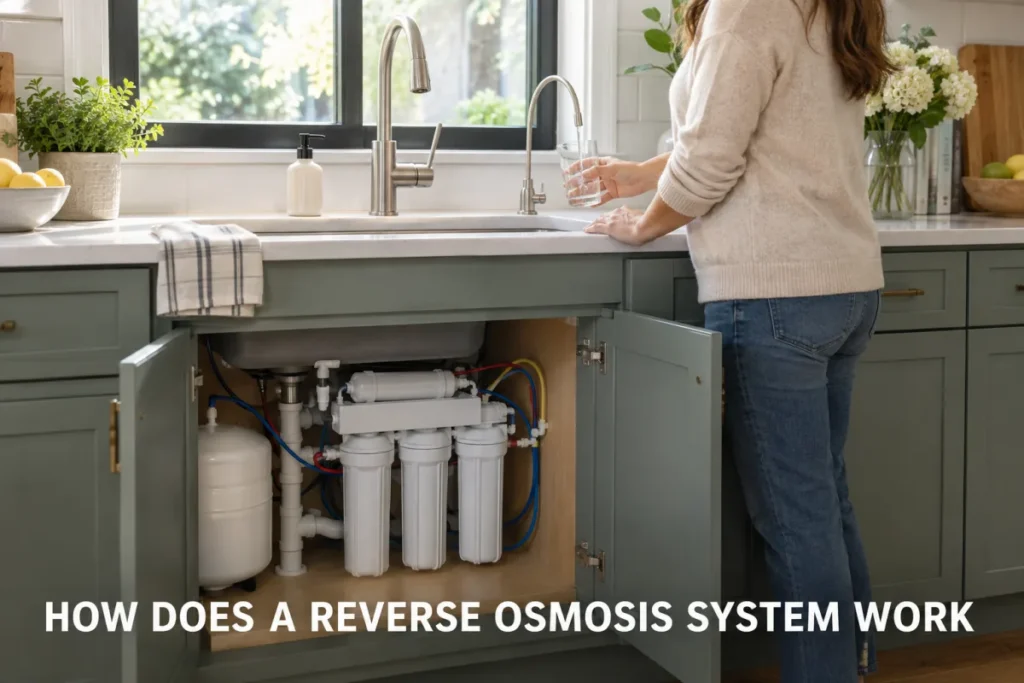

Reverse osmosis water is safe to drink for most healthy adults who eat a normal, varied diet. Research shows RO (reverse osmosis) systems reduce or remove more than 99% of common water contaminants. That includes lead and PFAS (long-lasting man-made chemicals also called forever chemicals). The system forces water through a semipermeable membrane (a filter with pores too small for most contaminants). That membrane is a filter so fine that almost nothing but water molecules passes through. The trade-off is that the same membrane strips out helpful minerals like calcium and magnesium along with the contaminants.

By the end of this guide, you will know exactly what reverse osmosis removes and what it strips out. You will also know whether reverse osmosis water is good for you and your household’s specific water quality. That answer depends less on the technology. It depends more on what is already in your tap water before it reaches the membrane.
Key Takeaways
- Reverse osmosis water is safe to drink for most people who eat a normal, varied diet.
- RO membranes reject more than 99% of dissolved contaminants, including PFAS and lead.
- RO also strips out helpful minerals like calcium and magnesium along with contaminants.
- NSF/ANSI 58-certified systems meet the safety and taste benchmarks for daily use.
Is Reverse Osmosis Water Good for You?
Reverse osmosis water is ordinary tap water pushed through a semipermeable membrane that traps dissolved solids and contaminants. That membrane then lets purified water through. That filtered water is safe to drink every day. This holds for most healthy adults who eat a normal, varied diet. It is often much cleaner than the water it started as. Our guide to what RO water is covers the basics if you want the fuller picture.
That safety claim rests on a real certification standard, not a brand’s own promise. Under NSF/ANSI 58, certified home systems must cut TDS (total dissolved solids, the combined minerals and salts dissolved in water). The reduction must reach at least 75%. Most certified systems on the market reduce it by 90 to 96% in practice.
Most of the debate about reverse osmosis water is not about safety. It’s about nutrition. Minerals like calcium and magnesium make up only a minor share of what a typical diet supplies. Food, not water, is the primary mineral source for most people. That is why safety agencies focus on contaminant removal, not on mineral content. This applies when judging drinking water quality.
How Reverse Osmosis Filtration Works
A home reverse osmosis system treats water in stages, not in one pass. Tap water first moves through pre-filters that strip out grit and chlorine. Next it passes through the semipermeable membrane that does the real work. Then it moves through a polish filter before it reaches the tap. Reverse osmosis drinking water systems usually hold four to five stages. Each stage protects the membrane from the stage before it. Water filtration by reverse osmosis relies on pressure, not chemicals. It forces water through that membrane.
For a deeper look at what reverse osmosis actually is as a process, our dedicated guide covers it step by step.
- Sediment pre-filter: traps rust, sand, and other visible particles before they reach the membrane.
- Carbon pre-filter: removes chlorine and chloramine, which would otherwise degrade the membrane over time.
- RO membrane: forces water through pores about 0.0001 microns (roughly 1/100th the width of a human hair) wide. It rejects dissolved salts, metals, and most organic molecules.
- Carbon post-filter: polishes the water’s taste right before it exits the faucet.
A faucet-mount filter delivers that same final carbon-polishing stage at the tap for households that do not need full RO.
According to the CDC, home reverse osmosis water filter systems remove several chemicals. These include lead, copper, chromium, chloride, and sodium. The membrane blocks anything larger than a water molecule.
There is one detail brands rarely explain. The gallons-per-day (GPD, how much filtered water the system can produce daily) rating on the box assumes ideal lab conditions. That means 77F feed water at steady pressure. In an average home, real output usually lands at 50-75% of that rated GPD. That is why a 100 GPD system often produces less water in practice. Output typically lands closer to 60-70 gallons a day.
Health Benefits of Drinking Reverse Osmosis Water
The health case for reverse osmosis is simple. It comes down to what it keeps out of your glass. The membrane’s pores are roughly 0.0001 microns wide. That is small enough to block dissolved solids that pass straight through most pitcher filters. Because of that, a certified system reduces several contaminant categories at once.
- PFAS (per- and polyfluoroalkyl substances, “forever chemicals”): the EPA’s 2024 rule sets an enforceable limit of 4 parts per trillion. That limit applies to PFOA and PFOS. It names reverse osmosis as an effective treatment technology.
- Heavy metals: reduces lead, copper, and chromium. These can leach from aging pipes and fixtures.
- Waterborne pathogens: the membrane rejects more than 99% of bacteria and viruses. Both are too large to pass through it.
- Excess sodium: strips most of the dissolved sodium tap water can carry. That is useful for anyone managing blood pressure through diet.
Outside testing backs up the PFAS claim directly. A 2020 study in ES&T Letters tested dozens of point-of-use filters in real homes. It found under-sink reverse osmosis achieved near-complete PFAS removal. Standard carbon filters averaged only 60-70% removal for the longer-chain compounds.
The iSpring RCC7 is one of the NSF/ANSI 58 certified under-sink systems that achieves removal rates in that class for PFAS; my iSpring RCC7 certified system review covers the certified figures across lead, arsenic, and dissolved solids.
The Downsides: Mineral Loss and Other Concerns
Reverse osmosis is not without trade-offs. The same membrane that blocks contaminants also strips out calcium, magnesium, and other helpful minerals. It cannot tell the difference between a contaminant and a nutrient dissolved in water. A typical system reduces total dissolved solids (TDS, the minerals and metals in water) from several hundred parts per million (ppm). The result is roughly 5-25 ppm.
A 6-stage system with an alkaline remineralization stage addresses that TDS drop directly by adding minerals back after the membrane; my iSpring RCC7AK alkaline RO review covers how the RCC7AK handles that mineral trade-off with its sixth stage.
This mineral loss raises a health question people ask often. Does drinking mineral-free water long-term affect bone health? Some observational research has examined a possible link between long-term low-mineral water consumption and declining bone mineral density. This evidence is preliminary. It does not establish that reverse osmosis water causes bone loss on its own. That holds particularly for people who get calcium and magnesium from food.
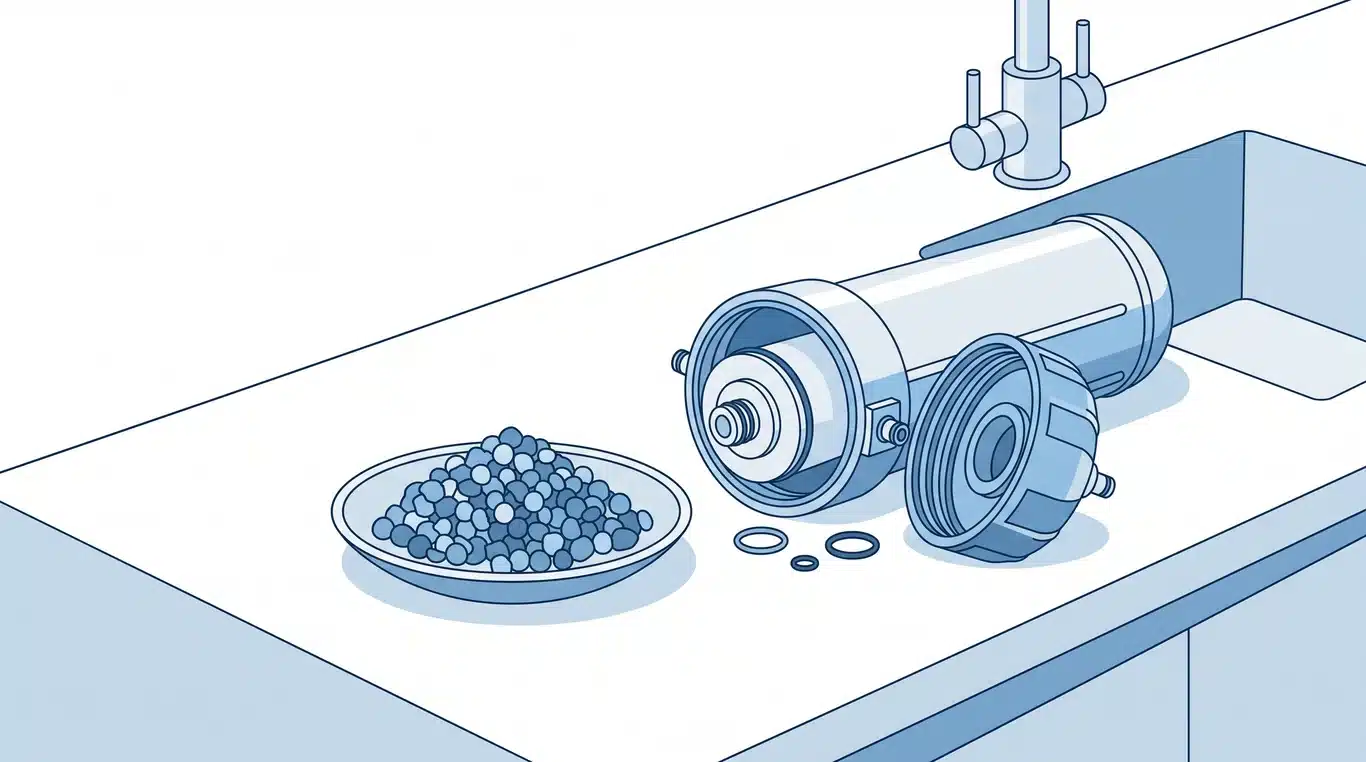
Upkeep is the other trade-off. Pre-filters usually need replacing every 6-12 months and the membrane itself every 2-3 years. Skipping that schedule lets scale and sediment shorten the system’s lifespan. None of this makes reverse osmosis water unsafe. The mineral loss and maintenance are real costs to weigh against the contaminant removal.
Types of Reverse Osmosis Systems for the Home
Reverse osmosis water filtration for home use generally falls into three formats. Choosing a reverse osmosis water home system mainly comes down to how much of your house you want covered. Reverse osmosis water filters under sink models are compact. They treat only drinking and cooking water, not the whole-house supply. A reverse osmosis water filtration under sink kit is also usually the easiest of the three to install. It typically does not need a plumber. A well-sized unit usually produces 50-100 gallons a day.
For anyone who wants treated water at every fixture, there is the reverse osmosis water filter whole house setup. It ties into the main line where it enters the home. Whole-house water filter systems reverse osmosis treat every tap, shower, and appliance. Output often reaches 300 or more gallons a day. They need more space, a dedicated drain line, and usually a professional install.
A countertop unit sits between the two: no permanent plumbing. It works well for renters. It produces roughly half the output of a home reverse osmosis water filter installed under the counter. If you are ready to compare specific models. Our guide on whether you can buy reverse osmosis water walks through what to look for before you buy.
One spec worth checking before you buy: standard systems send three to four gallons down the drain for every gallon produced. Newer designs with a permeate pump narrow that ratio closer to one-to-one. That is worth the extra cost if water waste matters to your household. If you are still deciding whether a reverse osmosis system is the right fit at all. Our overview of what a reverse osmosis system actually is walks through the basics first.
The three formats differ mainly in installation, coverage, and output, summarized below:
| Feature | Under-Sink | Whole-House | Countertop |
| Installation location | Under the kitchen sink | Where the main line enters the home | Sits on the counter, no plumbing |
| Water coverage | Drinking and cooking taps only | Every tap, shower, and appliance | Drinking water only |
| Typical install | DIY-friendly | Usually needs a professional | DIY, no tools |
| Output speed | Moderate | Highest, matched to whole-house demand | Slowest of the three |
Is Reverse Osmosis Water Good for You Every Day?
Yes, drinking reverse osmosis water every day is safe for most healthy adults. That holds true if you eat a normal, varied diet. The EPA’s National Primary Drinking Water Regulations set enforceable limits for more than 90 contaminants. Water treated to meet those standards counts as safe for daily use, whether through municipal treatment or a certified in-home system.
The people who should think twice are those relying on tap water as a real source of daily calcium or magnesium. That includes someone with an already mineral-poor diet. For nearly everyone else, the contaminant reduction outweighs the small mineral loss. That is especially true once a remineralization filter (a cartridge that adds calcium and magnesium back into the water after filtering) is added back in.
So what does that mean for a household that drinks nothing but filtered water, day after day? In practice, it means treating reverse osmosis the same way you would treat any other safe water source. Pair it with a normal diet and replace filters on schedule. It remains one of the more thoroughly tested ways to remove what municipal treatment leaves behind.
How We Research
We check every claim against primary sources. Federal agencies like the EPA and CDC come first. Certification bodies like NSF and AHAM come next. We verify each standard number against the issuing body. We review this guide on a set schedule.
Why Trust This Guide
Puritisimo covers only water and air quality. Our guidance is editorial and independent. We cite every health figure so you can check it. We never present a promotional claim as fact.
Making the Right Call for Your Household
Deciding whether reverse osmosis belongs in your kitchen comes down to weighing two things: what is actually in your tap water. It also depends on how much you value having minerals filtered out along with it. For most households dealing with lead, PFAS, or heavy chlorine taste, a certified system solves a real problem. A pitcher filter cannot solve that same problem. For households with already mineral-rich diets and clean municipal water, the trade-off may not be worth it. The wastewater and upkeep costs can outweigh the benefit.
If you want the deeper reasoning behind the contaminant-versus-mineral trade-off, our guide on why reverse osmosis water is good for you breaks it down further. Weighed against those downsides, most healthy adults will find that reverse osmosis water is good for them. That holds especially when it is paired with a varied, mineral-rich diet.
Frequently Asked Questions
Is reverse osmosis water good for you?
Reverse osmosis water is good for you and safe for most healthy adults to drink every day. That holds provided you eat a normal, varied diet. The one trade-off worth knowing is that the same membrane which removes contaminants also strips out calcium and magnesium. That is why some systems add a remineralization filter back in.
What are the negatives of reverse osmosis?
The main negatives are mineral loss, water waste, and upkeep. Reverse osmosis strips beneficial minerals like calcium and magnesium along with contaminants. It also sends several gallons down the drain for every gallon produced, and needs filter and membrane replacements on a schedule to keep working properly.
Is reverse osmosis water hard on kidneys?
No credible evidence links reverse osmosis water to kidney damage in healthy adults. The research people point to involves observational studies on long-term low-mineral water intake and bone density, not kidney function itself. The link to kidney health remains unproven.
What is the #1 healthiest water to drink?
There is no single healthiest water to drink. Safety depends on what is actually in your source water. It also depends on whether your treatment method addresses it. A system certified to NSF/ANSI 58 (the standard for home reverse osmosis systems) matters more than any one branded water type. The same is true of any NSF/WQA-certified filter matched to your water’s contaminants.
Which is better, reverse osmosis or alkaline water?
Reverse osmosis and alkaline water solve different problems. Reverse osmosis removes dissolved contaminants such as lead and PFAS. Alkaline treatment only raises pH. There is no EPA- or NSF-backed evidence behind the health claims often attached to it.
References
- NSF International. NSF/ANSI 58 Reverse Osmosis Systems Standard. 2024.
- EPA. PFAS National Primary Drinking Water Regulation. 2024.
- ES&T Letters. Point-of-Use and Point-of-Entry PFAS Filter Performance in US Homes. Environmental Science & Technology Letters. 2020.
Medical Disclaimer: This content is for informational purposes only. It is not a substitute for professional medical advice, diagnosis, or treatment. If you have concerns about your water quality or air quality and their effects on your health, consult a qualified healthcare professional.