
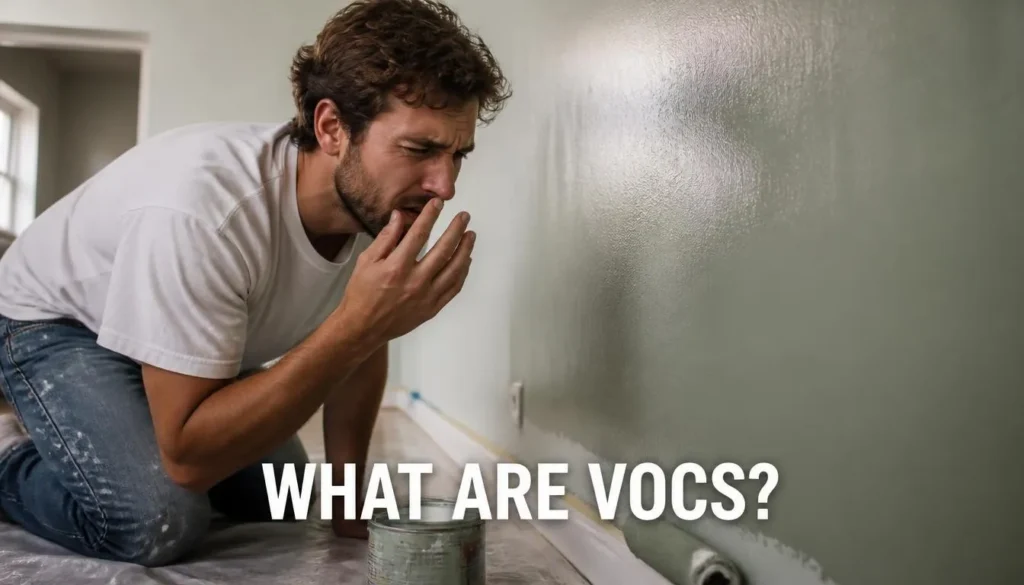
Volatile organic compounds (VOCs) are carbon-based chemicals that evaporate easily into gases at room temperature. Paints, cleaners, glues, and furniture all release them, so most homes hold a mix of VOCs at any time. Some are harmless at normal levels, while others irritate your eyes and throat or raise cancer risk.
This guide explains what VOCs are and where they come from. You will also learn which ones matter for your health, your paint jobs, and your drinking water.
Key Takeaways
- A VOC (volatile organic compound) is a carbon-based chemical that evaporates into gas at room temperature.
- Indoor VOC levels can run up to ten times higher than outdoor levels, according to the EPA.
- Health effects depend on the compound, the level, and how long you breathe it.
- Activated carbon filters trap VOC gases, while HEPA filters (fine-particle filters) only catch particles.
What Are VOCs? Volatile Organic Compounds Explained
Volatile organic compounds (VOCs) are carbon-based chemicals that easily evaporate from solids or liquids and enter the air as gases. The word volatile means the chemical turns to vapor at normal room temperature. The word organic means the molecule is built around carbon atoms.
The EPA describes VOCs as chemicals emitted as gases from certain solids or liquids. Indoors, most of them come from the products and materials that contain them.
Chemists also use a boiling point (the temperature where a liquid turns to vapor). The EPA describes the EU threshold as an initial boiling point at or below 482F (250C), measured at standard atmospheric pressure (normal sea-level air pressure).
Common examples include formaldehyde, toluene, acetone, and ethanol. The EPA also lists isopropyl alcohol, d-limonene (the citrus scent in many cleaners), and hexanal. Organic is a chemistry term here. It does not mean natural or safe.
Some people hope houseplants can clear VOCs from a room. The evidence says they barely change the air, as our guide to indoor plants that purify air explains.
What Are VOCs in the Air You Breathe at Home?
Indoor air usually holds more VOCs than outdoor air. The EPA reports that concentrations of many VOCs are up to ten times higher indoors than outdoors. Its TEAM study (a large EPA study of everyday personal exposure) found about a dozen common organic pollutants at 2 to 5 times higher levels inside homes.
Most of that indoor load comes from four groups of sources:
- Household products: paints, paint strippers, aerosol sprays, cleansers, air fresheners, and stored fuels.
- Building materials and furnishings: items that slowly release gas into the room.
- Office equipment: copiers, printers, glues, adhesives, and markers.
- Other everyday items: dry-cleaned clothing and pesticides.
Levels climb while you use these products. The EPA warns that elevated concentrations can persist in the air long after the activity is completed, and gases can even leak from closed containers.
What VOCs Are in Paint

Paint can release VOCs as its solvents (liquids that carry the color) and other ingredients evaporate during drying. Water-based paint mainly releases water vapor, which is not a VOC, but it can still emit VOCs. The EPA lists paints and paint strippers among the main household VOC sources.
Paint stripping is the extreme case. During stripping, indoor levels may reach 1,000 times the outdoor background level. Methylene chloride, also called dichloromethane, is a VOC found in some products. IARC (the International Agency for Research on Cancer) classifies it as probably carcinogenic to humans (Group 2A).
Labels need a careful read. The EPA notes that terms like low-VOC and zero VOC may not account for every VOC a product gives off. Ventilate during the job and after it, because levels can stay raised once the work ends.
Are Volatile Organic Compounds Dangerous?
It depends on the compound, the amount, and the time you spend breathing it. The EPA says the extent of health effects depends on the level of exposure and length of time exposed.
Short-term effects include eye, nose, and throat irritation, headaches, loss of coordination, and nausea. Some VOCs can damage the liver, kidneys, and central nervous system. The EPA adds that some are suspected or known to cause cancer in humans.
The EPA is also honest about a gap: little is known about health effects at the levels usually found in homes. Indoor VOCs can also react with ozone (a lung-irritating gas). That reaction forms sub-micron particles (particles smaller than a millionth of a meter) that may affect sensitive people.
VOCs in Water and How the EPA Limits Them
VOCs are not only an air problem. Some also dissolve in tap or well water, and the EPA sets legal limits for them in public drinking water. A limit is called a maximum contaminant level (MCL), the highest amount allowed in the water you drink.
The table below lists five regulated VOCs and their MCLs in milligrams per liter (mg/L). The EPA lists these potential health effects for long-term exposure above those limits.
| Contaminant | MCL (mg/L) | Health effect listed by the EPA |
| Benzene | 0.005 | Anemia, fewer blood platelets, higher cancer risk |
| Toluene | 1 | Nervous system, kidney, or liver problems |
| Trichloroethylene | 0.005 | Liver problems, higher cancer risk |
| Vinyl chloride | 0.002 | Higher cancer risk |
| Tetrachloroethylene | 0.005 | Liver problems, higher cancer risk |
How to Lower VOC Levels at Home

Cutting the source works better than cleaning the air afterward. The EPA advises you to increase ventilation when using products that emit VOCs.
These steps cover most homes:
- Ventilate: open windows or run exhaust fans while you paint, clean, or glue.
- Read labels: follow the warnings and use outdoor areas when the label says so.
- Buy small: get only the amount you will use soon.
- Dispose safely: take old paint and solvents to local hazardous waste collection.
Most filters handle either particles or gases, not both. A HEPA (high-efficiency particulate air) filter traps particles but not VOC gases. The EPA says to choose a unit with an activated carbon filter (a bed of porous carbon that holds gas molecules) for gases.
Carbon works best when the filter holds a large amount of material, the thicker the better. No widely used rating covers gas removal, and CADR (clean air delivery rate) measures particles only. Avoid units that intentionally make ozone, and keep ventilating.
How We Research
We check every claim against primary sources. Federal agencies like the EPA and CDC come first. Certification bodies like NSF and AHAM come next. We verify each standard number against the issuing body. We review this guide on a set schedule.
Why Trust This Guide
Puritisimo covers only water and air quality. Our guidance is editorial and independent. We cite every health figure so you can check it. We never present a promotional claim as fact.
Keeping VOCs Under Control in Your Home
VOCs are everyday gases from paints, cleaners, furnishings, and even tap water. The EPA finds them up to ten times more concentrated indoors, and health effects depend on the compound, the dose, and the time. Source control and fresh air do most of the work. An air purifier with a carbon filter can add a little help for gases, but it never replaces ventilation. Knowing what VOCs are is the first step to keeping them low.
Frequently Asked Questions
What are VOCs in chemistry?
Chemists describe what VOCs are with two traits: they contain carbon and evaporate easily at room temperature. The EU definition uses an initial boiling point at or below 482F (250C), measured at standard atmospheric pressure (normal sea-level air pressure). Formaldehyde and toluene both fit.
What is meant by volatile organic compounds?
Each word in the name carries a clue. Volatile means the chemical turns to gas easily, and organic means it contains carbon. The name says nothing about whether a compound is natural or harmful, because some VOCs are mild and others are toxic.
What are common VOCs?
The EPA lists formaldehyde, toluene, acetone, ethanol, isopropyl alcohol, d-limonene, and hexanal. You meet them in paints, nail polish remover, rubbing alcohol, citrus cleaners, and many glues. Benzene and methylene chloride are other well-known VOCs with stricter health concerns.
Are VOCs harmful to breathe in?
Some VOCs can irritate your eyes, nose, and throat or cause headaches and nausea, depending on the compound and exposure. Some are known or suspected to cause cancer. Cutting sources and bringing in outdoor air can lower exposure, but ventilation alone does not guarantee low levels.
Do VOCs eventually go away?
Levels fall as products dry and fresh air moves through the room, but the drop can be slow. Elevated levels can last long after the job ends, and closed containers can still leak gas. Opening windows and storing chemicals outside living areas speeds up the clearing.
References
- EPA. Volatile Organic Compounds’ Impact on Indoor Air Quality. U.S. Environmental Protection Agency.
- EPA. Technical Overview of Volatile Organic Compounds. U.S. Environmental Protection Agency.
- EPA. National Primary Drinking Water Regulations. U.S. Environmental Protection Agency.
- EPA. Guide to Air Cleaners in the Home. U.S. Environmental Protection Agency.
Medical Disclaimer: This content is for informational purposes only. It is not a substitute for professional medical advice, diagnosis, or treatment. If you have concerns about your water quality or air quality and their effects on your health, consult a qualified healthcare professional.

