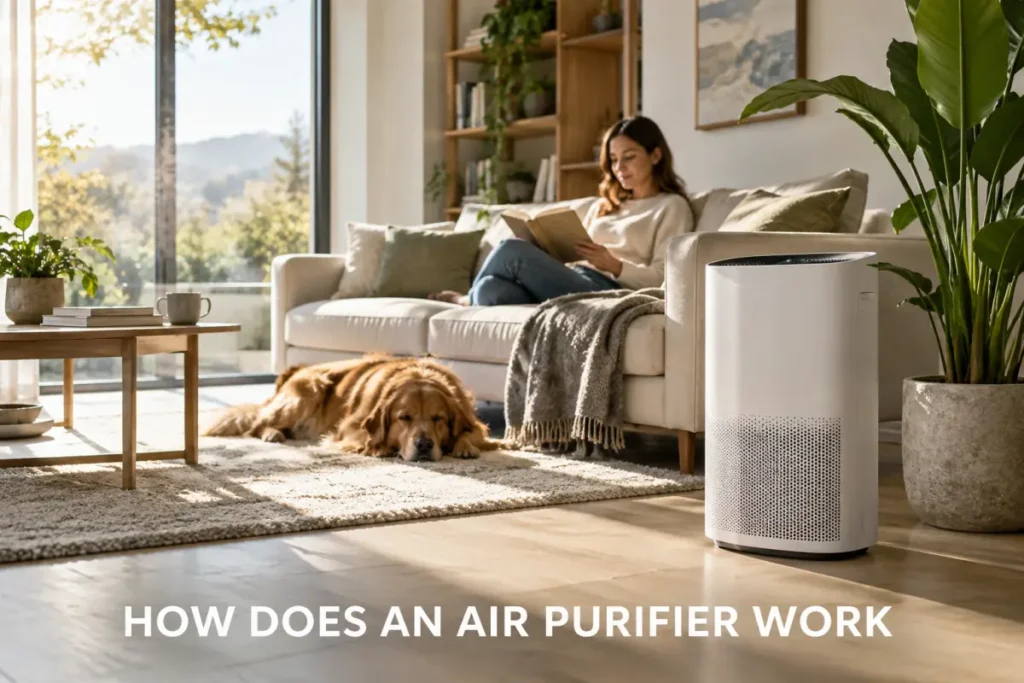
How does an air purifier work? A fan pulls room air through a stack of filters that trap particles, then pushes the cleaned air back out. That cycle repeats nonstop, so the same air passes through the filters again and again, and pollutant levels keep dropping. The exact process depends on the filter stack, but the fan-and-filter loop is the same in nearly every unit on the market.

By the end of this guide, you will know what each filter stage captures and cannot touch, and how to size a unit right. That includes the difference between particles like dust and pollen and gases like VOCs (volatile organic compounds, fumes from paint and cleaning products). Most filters never touch VOCs at all.
Key Takeaways
- A fan pulls air through a HEPA (fine-mesh) filter, trapping 99.97% of particles at 0.3 microns (a tiny dust-sized unit).
- HEPA filters capture pollen, dust mite debris, mold spores, and pet dander as air passes through.
- Standard HEPA filters cannot remove VOCs, odors, or gases; that requires added activated carbon.
- AHAM’s 2/3 rule says smoke CADR (clean air delivery rate) should equal two-thirds of the room’s square footage.
How Does an Air Purifier Work? A Fan-and-Filter Breakdown
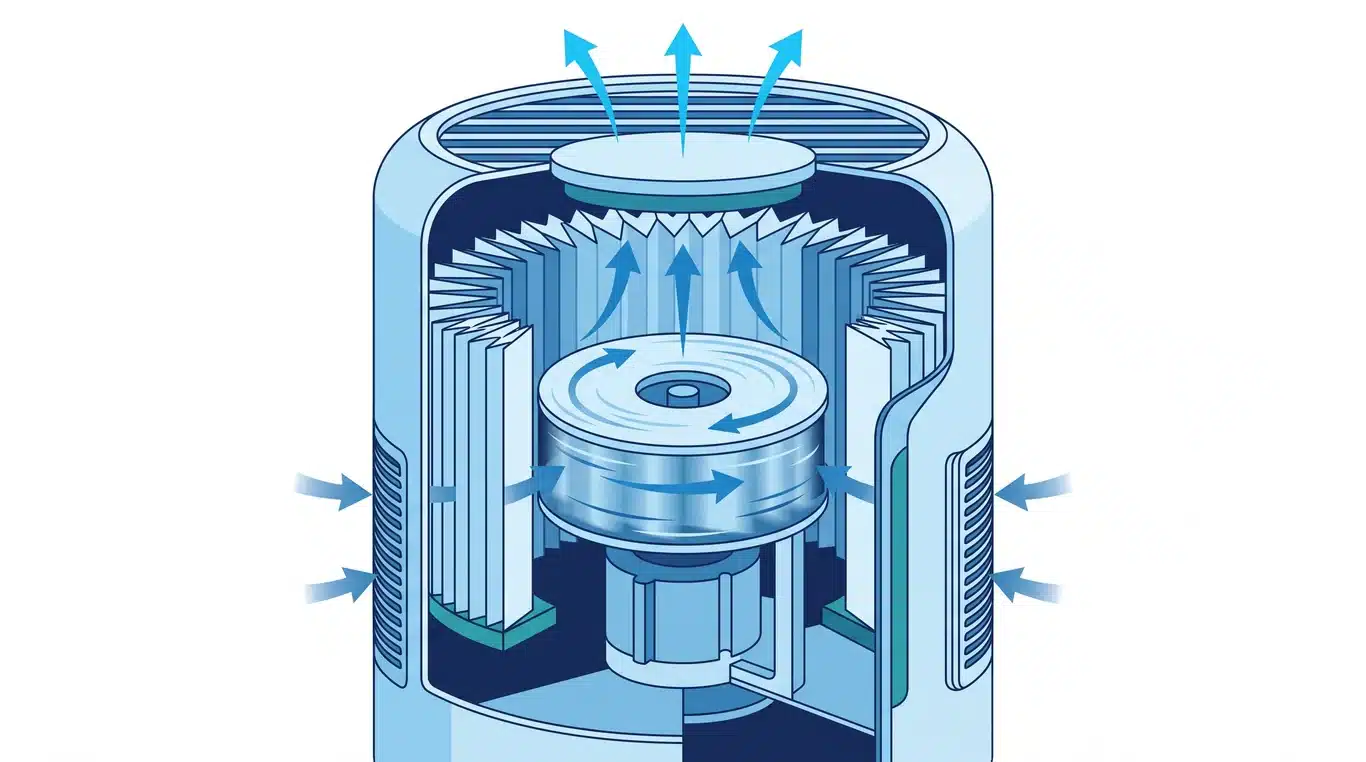
A fan pulls room air into a sealed housing and forces it through a stack of filters before pushing the cleaned air back into the room. The filter that catches the most is a HEPA (High-Efficiency Particulate Air) filter. It must trap at least 99.97% of particles at 0.3 microns (about 1/100th the width of a human hair), per the federal DOE standard.
Counterintuitively, 0.3 microns is not the smallest particle a filter faces, it is the hardest to catch. Larger particles slam into the fibers by impaction and smaller ones zigzag into them by diffusion, but mid-size particles slip through both mechanisms most easily.
The clearest limitation is what a standard filter cannot touch: VOCs, smoke gases, and household odors pass straight through a HEPA layer unless the unit adds activated carbon.
The two-thirds rule, set by AHAM Verifide, states that a purifier’s smoke CADR should equal at least two-thirds of the room’s square footage, for standard eight-foot ceilings.
- Intake: A fan pulls room air through an intake vent and into the unit’s housing.
- Pre-filter: A coarse screen catches larger debris, hair, and dust before it reaches the fine filter.
- HEPA stage: Air passes through the dense HEPA media, where particles get trapped by impaction, interception, and diffusion.
- Optional carbon or UV stage: Some units add carbon, UV-C, or an ionizer to target odors and airborne particles.
- Return: The fan pushes the filtered air back into the room, and the cycle repeats nonstop.
What Air Purifiers Remove From Your Home’s Air
A high-efficiency particulate air (HEPA) filter is not built for one type of particle. It is built for a size range, and most household allergens fall inside it. That range covers most of what triggers seasonal and pet allergies alike. According to the EPA, portable air cleaners are designed to filter particulate matter, such as pollen, dust, and mold spores, from the air in a single room.
The particles a HEPA layer reliably captures include:
- Pollen and outdoor allergens tracked indoors
- Dust mite debris, the actual allergen left behind, not the mite itself
- Mold spores
- Pet dander, including the fraction that stays airborne longest
- Everyday household dust and skin cells
Pet dander deserves a second look. Its smallest flakes are light enough to stay suspended in the air far longer than the fibers in carpet or bedding, which is the exact size range continuous filtration targets. That is also why a HEPA air purifier for pets or an allergy air purifier is built around that one distinction.
What Air Purifiers Cannot Remove Without Extra Filtration
A HEPA filter has one job: trap solid particles as air passes through its fibers. Volatile organic compounds (VOCs) are not solid particles. They are gas-phase molecules, and a particle filter has no way to catch a molecule that small. According to the EPA, VOC (volatile organic compound) concentrations run consistently higher indoors than outdoors, often up to ten times higher. The usual sources are paint, cleaning products, and furniture off-gassing.
Removing gas-phase pollutants takes a different path: activated carbon. Carbon works by adsorption, not filtration; odor and VOC molecules stick to its porous surface as air flows past. That surface can only hold so much, though, and it fills up well before a HEPA layer needs replacing. That is one reason filter cost is an ongoing consideration, not a one-time purchase.
Which stage handles which pollutant comes down to this:
| Contaminant Type | HEPA Filter | Activated Carbon |
| Pollen, dust, mold spores | Captured | Not needed |
| VOCs (paint fumes, cleaning products) | Passes through | Captured |
| Cooking and pet odors | Passes through | Captured |
| Wildfire and cigarette smoke | Partially captured (particle fraction) | Captured (gas fraction) |
How Does an Air Purifier Work in a Whole-House vs. Portable System?
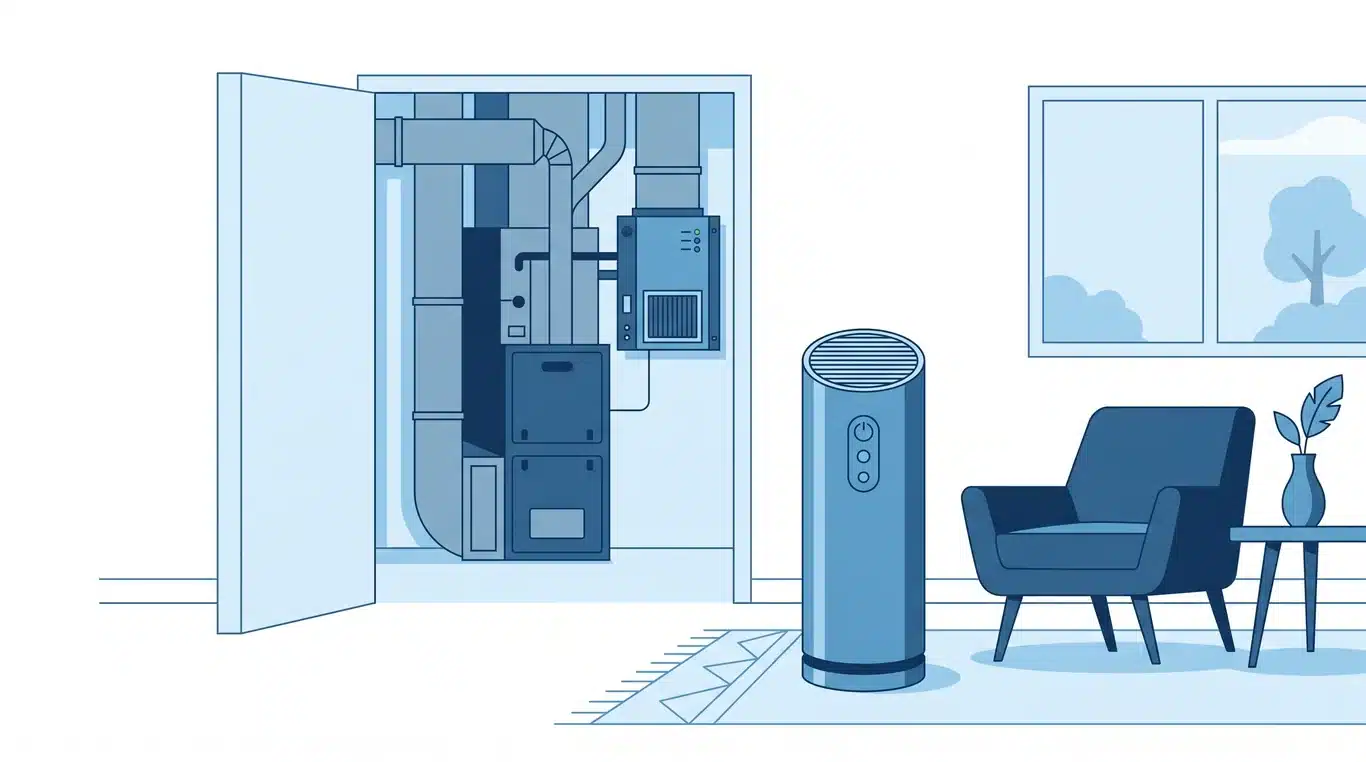
The fan-and-filter process itself does not change based on size. What changes is where that process happens and how much air it can reach. A portable air purifier is a self-contained unit: its own fan, its own filter stack, reusing the air in one room again and again.
A whole-house air purifier works differently. It installs directly into the home’s HVAC ductwork and filters air only while the furnace or air handler fan is running. Sizing is rated differently too. According to AHAM Verifide, portable units are rated by CADR (clean air delivery rate, the volume of filtered air a unit puts out per minute). That is a single-room metric. Whole-house systems are sized instead to match the home’s total airflow.
That difference has real trade-offs. A portable unit is cheaper up front and easy to move between rooms, but it only cleans the air near it. An entire home air purifier reaches every room already served by the ducts, at a higher setup cost and only when the HVAC system is cycling air.
How to Tell an Air Purifier Is Actually Working
CADR and room size are the two numbers that matter most. AHAM Verifide‘s two-thirds rule states that a purifier’s smoke CADR should equal at least two-thirds of the room’s square footage, for standard eight-foot ceilings. Fall short of that ratio, and the unit will run at full speed nonstop and still lag behind.
The evidence for real-world impact is solid. A 2023 review of 148 studies found that HEPA air purifiers reduce indoor PM2.5 by a mean of 49 percent. That number assumes correct sizing, though. An undersized unit, or one left on a low fan setting, will not get close to it.
Running the unit nonstop also matters. Consistent operation keeps ACH (air changes per hour, how many times a room’s air volume gets filtered in an hour) higher than switching the purifier on and off. That steadier rate is closer to the airflow levels health agencies advise. In practice, two reasons explain most underperformance: a fan left on a low setting, or a unit sized for a smaller room than it is running in.
It is fine to run an air purifier overnight while you sleep. A low or sleep setting cuts noise but keeps filtering. That keeps ACH steady through the night instead of stopping.
Whole-home HVAC filtration works on the same continuous-airflow principle but covers every room through the ductwork rather than a single space; my best furnace filter guide covers the top MERV-rated replaceable options for whole-house particle capture.
How We Research
We check every claim against primary sources. Federal agencies like the EPA and CDC come first. Certification bodies like NSF and AHAM come next. We verify each standard number against the issuing body. We review this guide on a set schedule.
Why Trust This Guide
Puritisimo covers only water and air quality. Our guidance is editorial and independent. We cite every health figure so you can check it. We never present a promotional claim as fact.
The Short Version: What’s Actually Happening Inside the Unit
Every stage inside an air purifier solves one problem. A fan alone moves air; a filter traps what passes through it. Together they strip out what a HEPA layer is rated to catch. Activated carbon then removes the gas-phase odors and VOCs a HEPA layer cannot touch. That holds true in a portable unit and in whole-house ductwork; only the scale changes. What decides whether a purifier does its job is CADR, room size, and a proper fit between the two. Once those numbers check out, how an air purifier works comes down to one fan-and-filter loop, repeating nonstop.
Frequently Asked Questions
How does an air purifier work?
An air purifier works by pulling room air through a fan and forcing it through a stack of filters, typically a pre-filter and a HEPA layer. Those filters trap particles before the unit pushes clean air back into the room. Some models add an activated carbon stage to pull out the odors and gases a HEPA layer cannot touch.
What are the disadvantages of an air purifier?
The clearest limitation is what a standard filter cannot touch: VOCs, smoke gases, and household odors pass straight through a HEPA layer unless the unit adds activated carbon. The EPA is direct about this trade-off, noting that no air cleaner removes every pollutant from a room. Replacement filters also add an ongoing cost over time.
Do air purifiers actually clean the air?
Yes, when the filter and fan are sized right for the room. A 2023 review of 148 studies found that HEPA air purifiers reduce indoor PM2.5 by a mean of 49 percent. That figure assumes correct sizing, though; an undersized unit or one left on a low fan speed will clean far less air than that.
What is the 2/3 rule for air purifiers?
The two-thirds rule, set by AHAM Verifide, states that a purifier’s smoke CADR should equal at least two-thirds of the room’s square footage, for standard eight-foot ceilings. A unit rated below that threshold will run at full speed nonstop and still under-clean a large room.
Do you leave the air purifier on all day?
Running the unit nonstop keeps air changes per hour higher and more consistent than switching it on and off, which lines up with the airflow levels health agencies generally advise. For allergy relief specifically, the benefit builds gradually, often taking several months of consistent use before symptoms noticeably improve.
References
- EPA. Air Cleaners and Air Filters in the Home. 2024.
- EPA. Volatile Organic Compounds and Indoor Air Quality. 2024.
- AHAM Verifide. AHAM’s Air Filtration Standards. n.d.
- PubMed. Systematic review of portable air cleaner effectiveness on indoor PM2.5. Science of the Total Environment. 2023.
Medical Disclaimer: This content is for informational purposes only. It is not a substitute for professional medical advice, diagnosis, or treatment. If you have concerns about your water quality or air quality and their effects on your health, consult a qualified healthcare professional.