
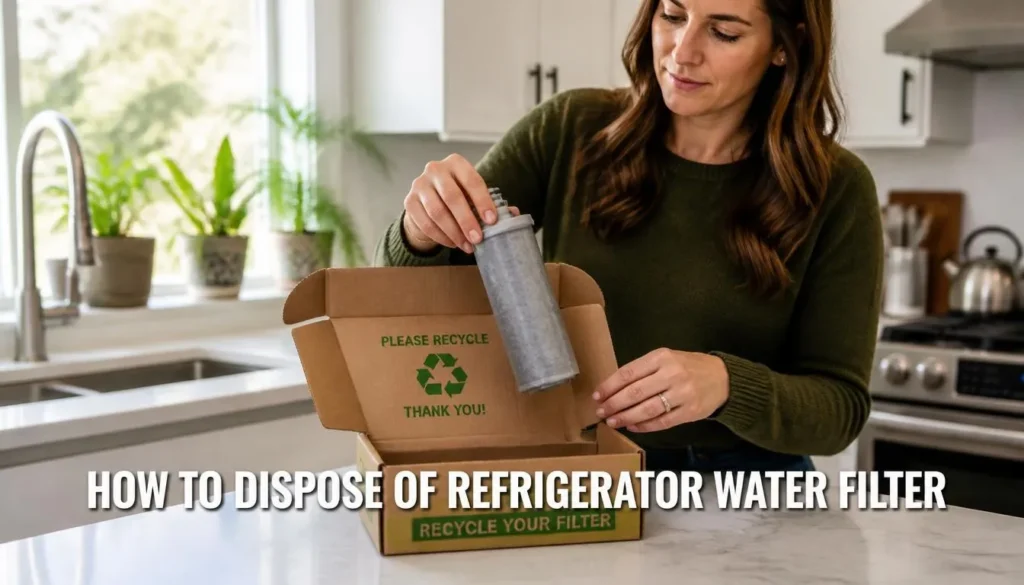
To dispose of a refrigerator water filter, drain it, let it dry, seal it in a bag, and put it in the household trash. Some makers and mail-back services take used cartridges instead, so check for that option first. Many curbside programs do not accept these cartridges, because each one packs hard plastic, loose carbon, and rubber seals into a single sealed unit.
You will see the five steps in order, then compare three routes: trash, curbside bin, and mail-back. By the end, you will know which route fits your home, why a used filter needs time to dry, and when to swap the next one.
Key Takeaways
- Drain the cartridge, let it dry, bag it, then check for a mail-back program before you use the trash.
- Many curbside programs reject filter cartridges, so confirm with your local recycling office before you toss one in the bin.
- Check the certification listing, not the box front, to see which chemicals your filter is rated to reduce.
- Many makers suggest a swap about every six months, so mark the date when you install a new filter.
How to Dispose of Refrigerator Water Filter Cartridges
A refrigerator water filter is a sealed cartridge. It has a carbon block (a solid piece of pressed charcoal that traps chemicals) inside a plastic shell, so you dispose of it as one sealed unit.
Follow these five steps in order:
- Remove it: Take out the old cartridge the way your manual shows, and keep it upright so the water stays inside.
- Drain it: Hold the cartridge over a sink and let the leftover water run out.
- Dry it: Set it on a towel until it feels dry to the touch. A dry cartridge is lighter and less likely to leak in a trash bag.
- Bag it: Seal it in a plastic bag so any drips stay inside.
- Route it: Look for a maker or mail-back program first. If none fits, put the bag in your household trash.
Community recycling programs accept only some plastics, and the EPA tells you to check with your local program because the rules differ from place to place.
Drying is the only step that takes real time. Remove the old filter first and leave it on a towel while you install the new one.
If yours is a GE model, our guide on how to change a GE refrigerator water filter shows how the XWFE, RPWFE and MWF cartridges come out and how to flush the new one.
Trash, Curbside Bin, or Mail-Back: Which Route Fits

For most homes, the household trash is the simplest route, and it works well once you drain, dry, and bag the cartridge. A mail-back or maker program is a better fit when one covers your brand, because the plastic and carbon get handled on purpose instead of buried.
The curbside bin is the route people guess wrong. A cartridge mixes hard plastic, a carbon block, and rubber seals, and a sorting plant usually cannot pull those parts apart. The EPA notes that community programs accept only some plastics and that rules vary by location, so one call to your local program settles the question.
Where a mail-back program exists, you usually pack the used cartridges in a box and send them with a label, or drop them at a collection point. Fees and rules differ, so read the program page before you start. Keep the cartridge dry and bagged either way.
The table below compares the three routes side by side:
| Route | Best when | Watch out for |
| Household trash | No program is nearby | Skipping the drain step |
| Curbside bin | Your list names filters | Many programs reject them |
| Mail-back program | A program covers your brand | Shipping rules may apply |
What a Used Filter Holds and What Certification Means

A used filter is a sponge for the things it caught. The carbon block holds some organic chemicals and odor compounds on its surface. It also reduces free chlorine through a chemical reaction that turns it into chloride, a dissolved ion. That is why you drain and bag it: a wet cartridge can drip and leave a mess in the trash.
Filter boxes can sound alike, so it helps to know the standards behind them. According to NSF International (an independent group that tests water products), NSF/ANSI 42 covers aesthetic effects (how water tastes and smells), such as chlorine taste and odor. NSF/ANSI 53 covers health effects.
The same logic applies if you wonder whether your filter handles PFAS (per- and polyfluoroalkyl substances, long-lasting man-made chemicals often called forever chemicals). NSF advises you to look for a filter certified to NSF/ANSI 53 or 58 with a PFAS designation (58 is the standard for reverse osmosis systems). It also asks you to confirm the specific contaminant claim, not only the standard number, on its PFAS guidance.
The distinction manufacturers rarely make clear is that a certification covers the named filter, but its reduction claims are specific to named contaminants. A filter can be certified for chlorine taste and carry no PFAS listing at all. Read the listing for your exact model before you rely on the box.
None of this changes the disposal steps. Whatever the certification, a spent cartridge goes through the same drain, dry, and bag routine.
Mistakes to Avoid: How to Dispose of Refrigerator Water Filter Safely
Most disposal problems come from rushing the job. A few small habits keep the cleanup simple and keep your local program happy.
Avoid these five mistakes:
- Cutting it open: Opening the shell spills carbon and gains you nothing.
- Tossing it wet: A wet cartridge can leak through a thin trash bag.
- Guessing at the curbside bin: Check your local list first, because a rejected item adds work for the sorting plant.
- Burning or composting it: Neither fits a plastic cartridge with a carbon core.
- Tossing the manual: Keep the paperwork, since it may list the maker’s return option.
Rules also differ by state. According to the EPA, federal law excludes ordinary household waste from hazardous waste rules, but state and local rules decide how you may discard it. Call your local solid waste office if you are unsure.
When to Change Your Filter Before You Dispose of It

Refrigerator water filter replacement is a routine job, and the timing matters more than most people expect. Many makers suggest a swap about every six months, or sooner when the indicator light comes on. Your manual has the final word for your model.
Changing refrigerator water filter cartridges usually takes only a few minutes and needs no tools. A clogged filter often slows the water flow at the dispenser, which is a clear sign that it is overdue.
A filter does not work forever. The carbon has room for only so much, and a full filter does less over time. Your water may taste or smell different, and the flow may slow. That is your cue to swap it, even before the six-month mark.
Brand steps differ in small ways, such as how far to turn the old cartridge and whether to flush the line afterward. Many manuals ask you to flush the new filter by running water through the dispenser, so follow the flush step in yours.
Households that follow the six-month advice change refrigerator water filter cartridges twice a year, and each swap leaves one spent cartridge to dispose of. Write the swap date on the new filter or in your phone so the next one is not a surprise.
How We Research
We check every claim against primary sources. Federal agencies like the EPA and CDC come first. Certification bodies like NSF and AHAM come next. We verify each standard number against the issuing body. We review this guide on a set schedule.
Why Trust This Guide
Puritisimo covers only water and air quality. Our guidance is editorial and independent. We cite every health figure so you can check it. We never present a promotional claim as fact.
A Clean Swap and a Smarter Send-Off
A good filter swap ends with a good send-off. Drain the old cartridge, let it dry on a towel, and seal it in a bag before it goes anywhere.
Then check two things. Does your maker or a mail-back service take it? Does your local program list filters as accepted? If neither applies, the household trash is the right default. Keep the swap date on the new filter, and the next change will be just as easy. Drain it, dry it, bag it, and check for a take-back option, and you have the whole routine for the way you dispose of a refrigerator water filter.
Frequently Asked Questions
How to dispose of refrigerator water filter or Brita cartridges?
The way you dispose of a refrigerator water filter also works for a Brita cartridge, so it can usually go in the household trash. Let it drain and dry first, then seal it in a bag. Check for a maker take-back program before you toss it, since some brands accept used cartridges.
Which supermarkets recycle water filters?
Availability depends on your country and filter brand. In the UK, BRITA lists Tesco, Sainsbury’s and selected Waitrose stores among its cartridge collection partners, so check the store and accepted cartridge types first. Your best options are the filter maker’s program, a mail-back service, or your local solid waste office, which can tell you what your area accepts.
Do refrigerator filters remove forever chemicals?
Only some do. A refrigerator filter reduces PFAS (long-lasting man-made chemicals) only when its certification listing carries a PFAS claim, such as one under NSF/ANSI 53 (NSF/ANSI 58 covers reverse osmosis systems). A filter certified only for taste and odor makes no such promise, so read the listing for your exact model.
Can a used refrigerator water filter be recycled?
Usually not at the curb. A sealed filter cartridge mixes plastic, carbon, and rubber, so many local programs reject it. Check whether your filter maker runs a take-back program, and ask your local recycling office what it accepts before you fill the bin.
How often should you change a refrigerator water filter?
Many makers suggest about every six months, or sooner if the indicator light comes on or the dispenser slows. Your manual gives the exact interval for your model. Marking the install date on the new filter makes the next swap easy to remember.
References
- EPA. How Do I Recycle Common Recyclables. U.S. Environmental Protection Agency.
- EPA. Household Hazardous Waste (HHW). U.S. Environmental Protection Agency.
- NSF International. NSF Standards for Water Treatment Systems. NSF International.
- NSF International. PFAS in Drinking Water. NSF International.
Medical Disclaimer: This content is for informational purposes only. It is not a substitute for professional medical advice, diagnosis, or treatment. If you have concerns about your water quality or air quality and their effects on your health, consult a qualified healthcare professional.

