
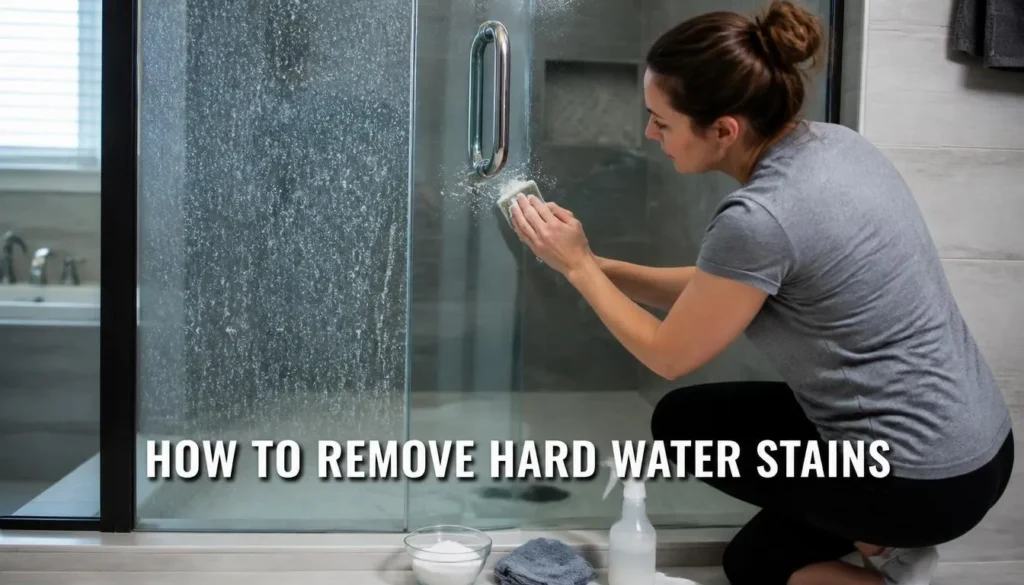
You remove hard water stains by dissolving the mineral film with a mild acid, such as white vinegar or citric acid, and then wiping it away. The white crust is calcium carbonate, a mineral that stays behind when hard water dries. Water counts as hard above 120 mg/L (milligrams per liter, a measure of how much mineral sits in each liter) of hardness, expressed as calcium carbonate. That figure is based mainly on the calcium and magnesium dissolved in the water. Soap cannot dissolve that crust, which is why plain scrubbing so often fails.
This guide gives you steps that work on most surfaces. You will learn which acid fits glass, steel, plastic and toilet bowls, what you must never mix, and how to stop the film from returning. Each step explains why it works, so you can adjust the method for your own bathroom.
Key Takeaways
- Mild acids such as white vinegar or citric acid dissolve the calcium carbonate that forms hard water stains.
- Match the method to the surface: soft cloths for plastic and steel, a stone-safe cleaner for marble.
- Never mix bleach with vinegar or lime removers, because the mix releases chlorine gas.
- An ion exchange softener removes the calcium and magnesium behind new stains, so they return more slowly.
How to Remove Hard Water Stains With Acid and Gentle Scrubbing
Hard water stains are mineral crust, and acid breaks that crust down while soap does not. The USGS explains that hardness comes from calcium and magnesium, and that heated hard water leaves behind solid calcium carbonate deposits. Calcium carbonate is a base, so an acid reacts with it and turns it into dissolved salts that simply rinse away with the water.
Follow these five steps on most sealed, hard surfaces:
- Rinse first: Wash off loose dirt and soap scum so the acid can reach the minerals underneath.
- Apply the acid: Spray or wipe on diluted white vinegar, or a citric acid solution made by dissolving citric acid powder in warm water. Use full-strength vinegar only on thick crust.
- Let it sit: Give the acid several minutes to react with the minerals. On a vertical surface, lay a soaked cloth over the stain so the liquid stays in place.
- Scrub gently: Use a soft sponge, a microfiber cloth or a non-scratch pad. Steel wool and gritty powders leave fine scratches in glass and plastic.
- Rinse and dry: Rinse with clean water, then dry with a towel. This clears the dissolved minerals before they settle again.
Thick or old buildup needs repeat rounds. Several short soaks work better than one long one, because fresh acid keeps reacting with the mineral that is left. A store-bought hard water stain remover follows the same chemistry, and the options are compared later in this guide.
How to Remove Hard Water Stains From Glass, Windows, and Shower Doors
Glass shows mineral film more than any other surface, because its clear, smooth face makes every dried drop visible as a cloudy haze that thickens with each shower. The USGS describes the same spots and film on glassware as unsightly but not dangerous, so this is a cleaning job, not a safety problem.
The best fix for shower doors is a mild acid held on the glass long enough to react. Each surface needs one small change to the basic steps:
- Shower doors and glass: Soak a cloth or paper towel in vinegar and press it onto the pane for several minutes. It keeps the acid in contact with the glass, where a spray would run off.
- Shower walls and tile: Check the tile and grout makers’ cleaning instructions first, then use a cleaner approved for both materials. Scrub the grout lines with a soft brush and rinse well. Avoid acid on cement-based grout unless the maker specifically allows it.
- Windows: Work in shade so the cleaner does not dry on the pane. Rinse, then dry with a clean cloth.
- Bathtub: Check the material first. Acrylic and enamel finishes scratch easily, so use a soft cloth and test a hidden spot.
A squeegee is the least expensive prevention tool you can own. Pull it across the glass after each shower, and the water leaves before it can dry into a visible film, so less standing water means fewer minerals left behind.
Toilet Bowls, Stainless Steel, and Plastic Need Different Care
A toilet bowl builds a ring at the waterline, where standing water leaves a little mineral each day. That ring is made of the same calcium and magnesium minerals the USGS ties to hardness. Apply the acid right on the ring with a cloth or brush, so it reaches the stain instead of washing into the water below. Then brush, wait and flush.
Stainless steel shows the same white film as hazy water marks, and diluted vinegar on a soft cloth removes it when you move with the grain of the metal. Rinse and dry the steel at once, because steel wool and scouring pads scratch the finish and make the remaining spots easier to see.
Plastic is softer than glass or steel, so you need a gentler approach. Start with the mildest acid, such as diluted vinegar or citric acid, and keep contact short. Test a hidden corner first, because some plastics become dull or cloudy when a harsh cleaner touches them.
Choosing a Hard Water Stain Remover That Is Safe to Use
Three kinds of cleaner can dissolve mineral crust, and all three of them are acids. White vinegar is mild, cheap and slow. Citric acid, sold as a powder you mix into warm water, has a gentler odor. Store-bought lime, calcium and rust removers are stronger acids, so they work faster but need more care.
Stronger does not mean different, because all three do the same job, so begin with the mildest option and move up only when the mineral film remains. Always read the label, wear gloves, and open a window when you use a store-bought product. One product at a time is the safest habit.
The most important rule is about mixing. The New Jersey Department of Health warns that when bleach meets an acid, chlorine gas forms. It lists vinegar and lime, calcium and rust removers among the products to keep away from bleach. Even low levels of chlorine gas can irritate your eyes, nose and throat and cause coughing.
The same alert notes that hydrogen peroxide and vinegar together form peracetic acid, which can irritate the eyes, skin and lungs. Rinse the surface well before you switch from one product to another.
Natural stone is the main exception to everything above. The detail many labels skip is that marble and limestone consist of calcium carbonate too, so an acid can etch the polished surface along with the stain. On stone, use a pH-neutral cleaner made for stone, and ask the stone maker before you try any acid.
Why Hard Water Stains Keep Coming Back and How to Slow Them
Stains return because the cause is still in your pipes. The Water Quality Association (WQA), a water treatment trade group, says that dissolved calcium and magnesium salts are primarily responsible for most scale in pipes and water heaters. Every drop that dries on a surface leaves a little more of them behind.
Start by learning how hard your water is, which your utility’s yearly water report or a home test kit will show you. Hardness is reported in mg/L as calcium carbonate, and the table below shows how the classes break down. Knowing your class tells you how often to expect a cleaning job.
An ion exchange softener is a common whole-house treatment for hardness. Its tank of resin beads (small plastic balls that trap minerals) swaps calcium and magnesium for sodium or potassium. Reverse osmosis and distillation also remove hardness minerals, but home systems usually treat drinking water at a single tap. NDSU Extension explains that about 8 mg/L of sodium is added for every grain of hardness removed, and one grain per gallon equals 17.1 mg/L. The WQA points to NSF/ANSI 44 as the standard for hardness reduction.
Scale-control gadgets work differently. The WQA says that devices using magnets, electronic signals, or a release of citric acid or phosphate do not reduce total calcium or magnesium. They are not proven to make soft water, because they aim to discourage scale while the hardness stays in your water.
This table shows five hardness classes, drawn from NDSU Extension, and what you may notice at home:
| Hardness class | mg/L as calcium carbonate | What you may notice |
| Soft | Under 17 | Little or no film or scale |
| Slightly hard | 17 to 60 | Occasional light spotting |
| Moderately hard | 61 to 120 | Spots on glass and faint scale on faucets |
| Hard | 121 to 180 | Frequent film and visible scale on fixtures |
| Very hard | Above 180 | Heavy crust that returns quickly |
How We Research
We check every claim against primary sources. Federal agencies like the EPA and CDC come first. Certification bodies like NSF and AHAM come next. We verify each standard number against the issuing body. We review this guide on a set schedule.
Why Trust This Guide
Puritisimo covers only water and air quality. Our guidance is editorial and independent. We cite every health figure so you can check it. We never present a promotional claim as fact.
Clean Once, Then Keep the Minerals Away
Mineral deposits often come off when the acid suits the surface. Cleaning cannot undo etching, the permanent wear on glass or stone. Start with diluted white vinegar or citric acid, scrub softly, then rinse and dry. Move to a stronger lime remover only when the film stays, and keep bleach away from it, and treat natural stone separately. To keep glass clear, squeegee after each shower and check your water hardness. A whole-house ion exchange softener can cut the calcium and magnesium in your shower water. These habits help you remove hard water stains and keep them away.
Frequently Asked Questions
How to remove hard water stains from a toilet bowl?
To remove hard water stains from a toilet bowl, apply an acid cleaner made for toilets onto the ring and let it sit for a few minutes. Then scrub with a brush and flush. Use one product at a time, and never mix it with bleach. Repeat the process if the ring is thick.
Does CLR remove hard water stains?
Products like CLR belong to the group of lime, calcium and rust removers, which are acid cleaners made for mineral deposits, so they can lift hard water stains. Follow the label, wear gloves, and test a hidden spot first. Never mix it with bleach, because acid and bleach release chlorine gas.
Does WD-40 really remove limescale?
WD-40 is a petroleum-based lubricant, not an acid, so it does not dissolve limescale the way vinegar or citric acid does. It may loosen a thin film, but it leaves an oily residue you then have to clean off. For dependable results, use an acid cleaner and rinse the surface well.
What causes water marks on stainless steel?
Water marks on stainless steel are mineral film left behind when water dries on the surface. Hard water leaves more of it, because it carries more dissolved calcium and magnesium. Wiping the steel dry after each use removes the water before the minerals can settle.
Can hard water stains become permanent?
Mineral film can build into thick layers that need repeated acid soaks, but it usually comes off in time. The lasting damage comes from etching, which is wear to the glass or stone itself. Etching does not wash away, so remove stains early and keep acid off marble.
References
- USGS. Hardness of water. USGS Water Science School.
- Water Quality Association. Scale deposits. Learn About Water.
- New Jersey Department of Health. Hazard alert: mixing bleach with other cleaning products can be deadly. Worker Health and Safety.
- NDSU Extension. Water softening (ion exchange). Publication WQ1031. 2022.
Medical Disclaimer: This content is for informational purposes only. It is not a substitute for professional medical advice, diagnosis, or treatment. If you have concerns about your water quality or air quality and their effects on your health, consult a qualified healthcare professional.

