
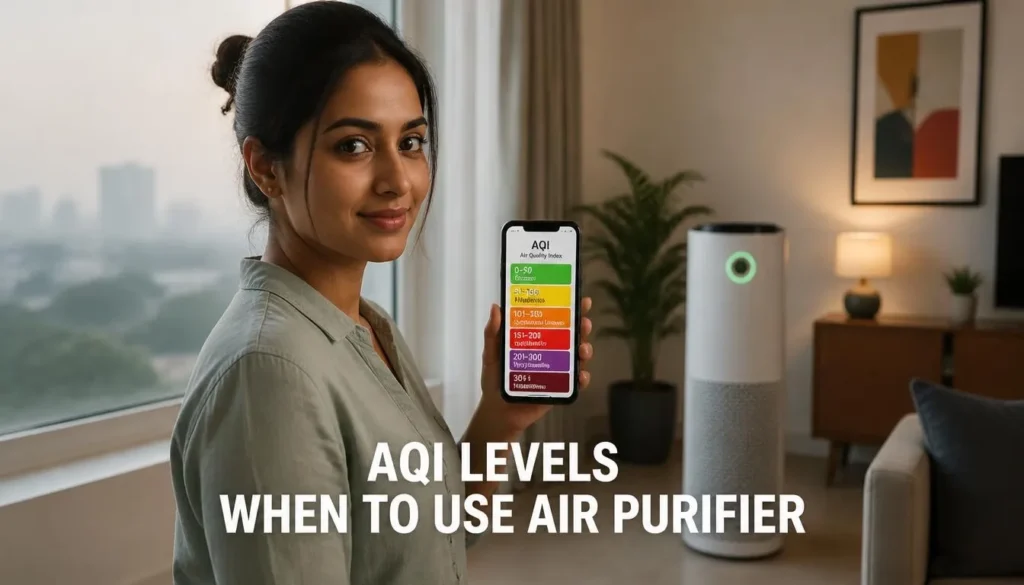
Our rule of thumb is to start using an air purifier when the particle-pollution AQI rises above 100. AQI stands for air quality index, a color-coded scale that rates outdoor air from 0 upward. Above 100, sensitive people can feel effects, and above 150 everyone might. Below 100, a purifier is optional for most homes, though your health, your house, and nearby smoke can move that line.
This guide explains each AQI category, how PM2.5 (tiny airborne particles) drives the number, and why indoor air can differ from the outdoor reading. By the end, you will know which AQI level should make you switch a purifier on and what else to do.
Key Takeaways
- An AQI above 100 is the usual point to start running a purifier, and sooner for sensitive groups.
- PM2.5 means tiny particles in smoke and haze, the kind a purifier filter is built to catch.
- The AQI rates outdoor air, so the air inside your home can read better or worse.
- At an AQI of 151 or higher, close windows and run the purifier on its highest fan setting.
AQI Levels When to Use Air Purifier: What Each Range Means

The air quality index (AQI) is a color-coded scale that turns outdoor pollution readings into one number, starting at 0. A higher number means dirtier air and a bigger health concern, so the scale works as a quick warning before you decide how to protect your lungs.
An AQI of 100 generally matches the short-term national health standard for a pollutant, according to AirNow. That is why values at or below 100 count as satisfactory, and values above it count as unhealthy for at least some people. The AQI covers five pollutants: ozone, particle pollution, carbon monoxide, sulfur dioxide, and nitrogen dioxide.
A standard particle filter catches particles, not gases. Some units add gas filters, but results depend on the gas. The EPA says the CADR rating (clean air delivery rate, a measure of how fast a unit cleans air) covers particles only. So an ozone-heavy day is a different problem from a smoky one.
The table below lists the six AQI categories and what each one means for you.
| Category | AQI range | What it means |
| Good | 0 to 50 | Little or no risk |
| Moderate | 51 to 100 | Acceptable, but unusually sensitive people may be at some risk |
| Unhealthy for Sensitive Groups | 101 to 150 | Sensitive groups may have effects; most people are less likely to |
| Unhealthy | 151 to 200 | Everyone may have effects; sensitive groups may have more serious ones |
| Very Unhealthy | 201 to 300 | A health alert; the risk is higher for everyone |
| Hazardous | 301 and higher | Emergency conditions; everyone is more likely to be affected |
Air Purifier PM2.5 Levels: How Fine Particles Set the AQI
PM2.5 refers to fine particles that are 2.5 micrometers or smaller. A micrometer is one-millionth of a meter, so these particles are tiny. The EPA says an average human hair is about 70 micrometers wide, which is 30 times larger than the largest fine particle.
Size matters because of where the particles go: the EPA says particles under 10 micrometers can get deep into your lungs, and some may even reach your bloodstream. Of these, the smallest fine particles pose the greatest health risk, which is why purifier makers focus on them. On smoky and hazy days, PM2.5 often drives the number you see on the AQI.
Since 2024, EPA ties AQI 50 to a 24-hour average PM2.5 level of 9.0 micrograms per cubic meter. This unit measures how much particle mass floats in a given volume of air. These daily breakpoints do not classify an instant sensor reading. The same rule keeps AQI 100 at 35.4 and AQI 150 at 55.4, as the Federal Register notice shows.
Because an AQI of 100 lines up with the health standard for each pollutant, the same number carries the same level of concern whether ozone or particles caused it. That makes the scale easy to read across days and places. It also hides which pollutant is responsible, so check which pollutant your local report names before you decide that a purifier is the right tool.
Many home purifiers also display their own PM2.5 reading from a built-in sensor. That number describes the air in your room, so it is not the same as the AirNow AQI. Brands pick their own color bands, so check your manual before you compare the two. To check more than particles, see how to test air quality in your home.
When Should You Use an Air Purifier at Each AQI Level?
The EPA sets no single AQI number for switching on a purifier, so this list is an editorial rule of thumb built on the health messages for each category:
- AQI 0 to 50: Optional. Outdoor air is satisfactory, so run a purifier only for indoor sources such as pets or cooking.
- AQI 51 to 100: Optional for most people. Sensitive people may want it running in the rooms where they spend the most time.
- AQI 101 to 150: Start running it. Sensitive groups can feel effects at this level, so keep windows closed while the number stays here.
- AQI 151 to 200: Run it all day on its highest fan setting if you can. The general public may feel effects, so keep windows closed if you can stay cool.
- AQI 201 and higher: Use one clean room and run the purifier on its highest fan setting, as the EPA advises for heavy smoke.
Sizing is the next decision after timing, and it decides whether the purifier can keep up at the higher levels. To size a unit, multiply the room’s length by its width in square feet. Then compare the result with the maximum room size on the package, as the EPA guide to air cleaners explains. The EPA’s CADR chart assumes an eight-foot ceiling, so a room with higher ceilings needs a unit with more capacity.
Timing matters as much as the number. Respond to the current reading and your own sensitivity. Do not wait for unhealthy smoke to last for a day or more before you act. The EPA says local authorities may advise you to stay indoors or create a clean room when unhealthy smoke levels are forecast. Check the forecast along with the current reading, because smoke can arrive or clear within a few hours.
Check the AQI before you open a window, not after. Run time depends on room size and how long the smoke lasts, so this guide gives only the headline. Our separate guide on how long to run an air purifier covers hours per day.
Outdoor AQI vs. Indoor Air: What the Number Cannot Tell You

The AQI describes outdoor air at a monitoring site, not the air in your living room. Indoor air can read better than the outdoor number when windows stay shut, but it can also read worse, because cooking, candles, and smoking all add particles inside.
A purifier cleans only the room it sits in. The EPA says portable air cleaners are designed to filter the air in a single room, and that no air cleaner will remove every pollutant from a home. See the EPA guide to air cleaners for the full list of limits.
Particles also come from sources inside the house. Frying food, burning incense, and running a gas stove can push indoor PM2.5 up even when the AQI outside reads Good. A purifier still helps in that case, because it filters the room no matter where the particles came from. You can also run a range hood or open a window briefly to clear cooking fumes.
Opening a window on a high-AQI day can let outdoor particles in faster than a purifier removes them. A low AQI does not guarantee clean indoor air, and a high AQI does not mean the air inside is bad. The most reliable approach is to watch the outdoor number and, if you can, an indoor PM2.5 monitor.
Who Should Act Sooner at Lower AQI Levels
Some people feel the effects of smoke and fine particles earlier than others. The CDC lists people with chronic conditions such as asthma, COPD (chronic obstructive pulmonary disease, a long-term lung condition), diabetes, chronic kidney disease, and heart disease. It also lists people who are pregnant and children, as the CDC page on wildfire smoke explains.
If you are in one of these groups, treat an AQI of 51 or higher as your cue to check the forecast and prepare. Treat 101 or higher as the point to run a purifier in the rooms where you sleep and spend time. Ask your doctor for a personal plan, since this guide is general information, not medical advice.
Time spent outdoors also changes the picture. A person who works outside all day takes in more outdoor air than someone who stays inside, so the AQI matters more for outdoor workers. The hours they spend back at home become their chance to breathe cleaner air, which is one more reason to keep the bedroom purifier running during smoky weeks.
A purifier helps, but it is not a treatment. The EPA notes that studies of portable HEPA units (high-efficiency particulate air filters, dense filters that trap very small particles) found small improvements in heart and lung health. The EPA guide adds that the gains are usually modest.
How to Set Up a Clean Room When the AQI Climbs
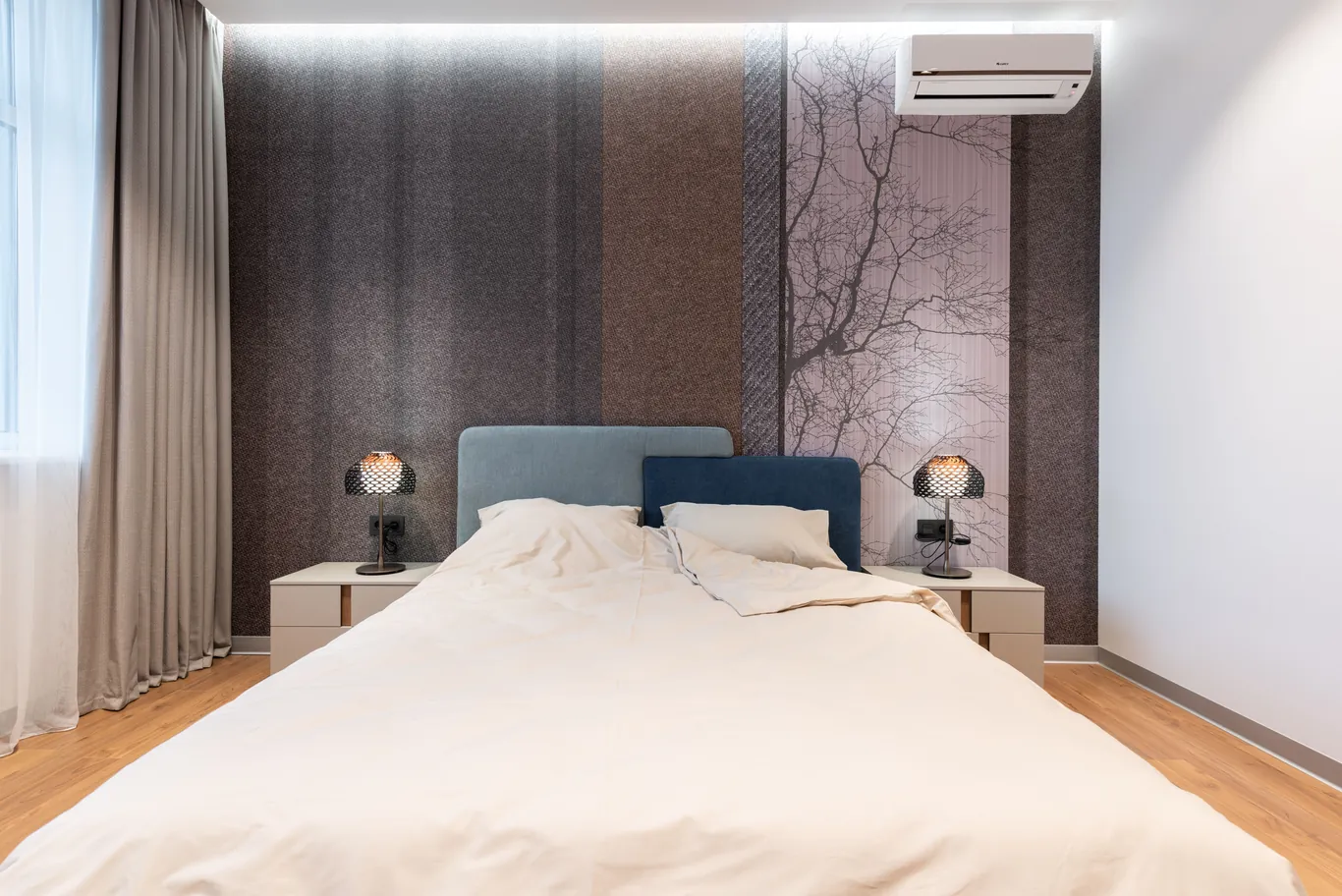
A clean room is one room set up to keep smoke and other particles as low as possible. The EPA steps below work best when the AQI stays high for hours or days:
- Pick a comfortable room that fits everyone who needs it, ideally one with a door.
- Close all windows and doors in that room, keep exits clear, and keep the room safely cool. Seek a cooler, cleaner shelter if heat, a power outage, or smoke makes staying unsafe.
- Use a portable air cleaner that is the right size for the room and does not make ozone (a gas that irritates the lungs).
- Run the air cleaner continuously on its highest fan setting if you can.
- Skip candles, smoking, and frying in that room, since they add particles.
Filters work harder in smoke. The EPA says to replace the filter in your air cleaner or HVAC system (your home heating and cooling system) more often than the maker recommends during heavy smoke. See our guide to the best air purifier for smoke.
How We Research
We check every claim against primary sources. Federal agencies like the EPA and CDC come first. Certification bodies like NSF and AHAM come next. We verify each standard number against the issuing body. We review this guide on a set schedule.
Why Trust This Guide
Puritisimo covers only water and air quality. Our guidance is editorial and independent. We cite every health figure so you can check it. We never present a promotional claim as fact.
Matching Your Purifier to the Number on Your Phone
The AQI gives you a simple dial for your purifier. Below 100, running one is mostly a personal choice, but above 100 it becomes a smart habit, especially if asthma, heart disease, pregnancy, or young children share your home. At 151 or higher, close the windows, set up one clean room, and run the unit on a high setting. Remember that the AQI describes outdoor air, so your indoor air can differ. Knowing which AQI levels call for an air purifier, and when to use one, comes down to checking the number and matching your response.
Frequently Asked Questions
Do air purifiers help with AQI?
An air purifier cannot change the outdoor AQI, but the AQI tells you when to use an air purifier indoors. The unit filters particles from the air in one room. That can lower the indoor particle level on smoky or hazy days, which is the number that matters for your lungs while you are inside.
What is a good air quality reading on an air purifier?
Many purifiers show a PM2.5 reading from a built-in sensor, and each brand sets its own color bands. As a rough anchor, the AirNow Good range is 0 to 50. Check your manual to see what your unit’s colors mean, since a sensor reading is not the same as the official outdoor AQI.
How to tell if your house has poor air quality?
Common signs are visible dust, smoke or cooking haze, strong odors, and symptoms that ease when you step outside. None of these proves a problem on its own. An indoor PM2.5 monitor gives a number you can track, and it shows how cooking, candles, or outdoor smoke change your room.
Why is an air purifier important?
An air purifier filters fine particles from the air in one room. It helps most when outdoor smoke or indoor sources raise particle levels. It has limits, though: no air cleaner removes every pollutant, and most filters target either particles or gases, not both equally.
What air quality is bad for asthma?
People with asthma are a sensitive group, and AirNow starts warning sensitive groups at an AQI of 101. Some people react earlier, so use your own asthma plan as the guide. Ask your doctor what AQI level should trigger changes, such as staying indoors or running a purifier.
References
- AirNow. Air Quality Index (AQI) Basics. U.S. Environmental Protection Agency.
- EPA. Particulate Matter (PM) Basics. U.S. Environmental Protection Agency.
- Federal Register. Reconsideration of the National Ambient Air Quality Standards for Particulate Matter. 2024.
- EPA. Create a Clean Room to Protect Indoor Air Quality During a Wildfire. U.S. Environmental Protection Agency.
- CDC. How Wildfire Smoke Affects Your Body. Centers for Disease Control and Prevention.
- EPA. Guide to Air Cleaners in the Home. U.S. Environmental Protection Agency.
Medical Disclaimer: This content is for informational purposes only. It is not a substitute for professional medical advice, diagnosis, or treatment. If you have concerns about your water quality or air quality and their effects on your health, consult a qualified healthcare professional.

