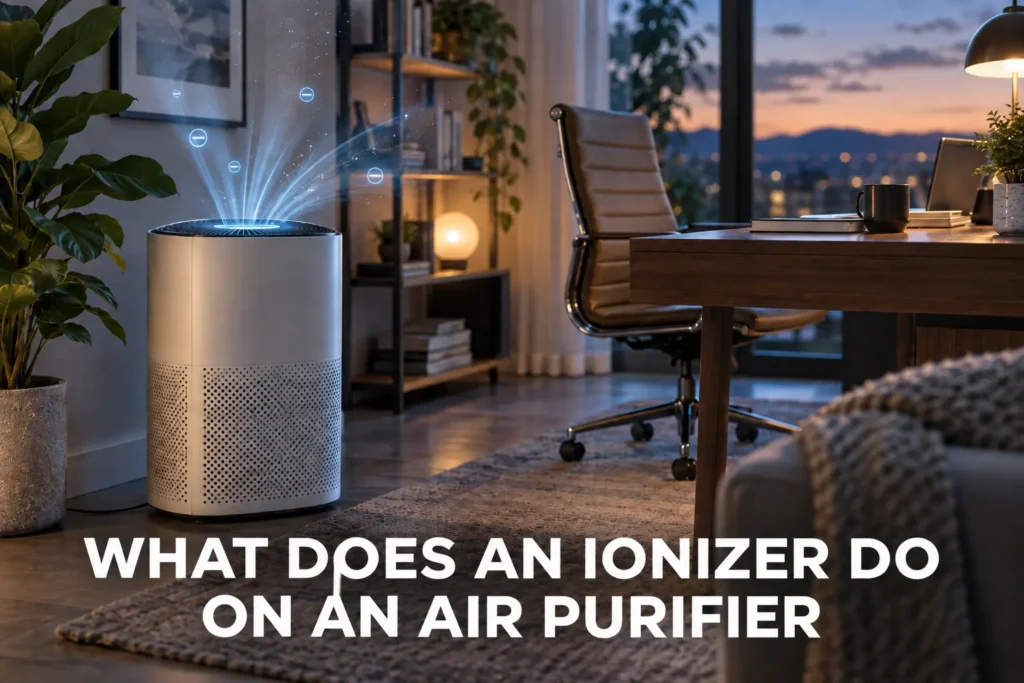
An ionizer on an air purifier releases negatively charged ions. Those ions attach to airborne particles like dust, pollen, and smoke. The charge makes each particle heavier. It then falls out of the air and sticks to nearby surfaces instead of staying airborne. This is different from filtering, since nothing captures or removes the particle from the room.

By the end you will know what an ionizer does on an air purifier compared with real filtration. You will also know whether running one is safe for your household, and what to look for if you would rather skip it.
Key Takeaways
- An ionizer charges airborne particles so they stick to surfaces instead of staying airborne.
- A standalone ionizer has no filter and carries no AHAM-verified CADR (Clean Air Delivery Rate) rating, unlike a real air purifier.
- The EPA warns ion generators can produce ozone, a lung irritant, at levels above what is seen as safe.
- CARB-certified units cap ozone at 50 ppb (0.050 ppm), so check certification before leaving an ionizer running.
What Does an Ionizer Do on an Air Purifier?
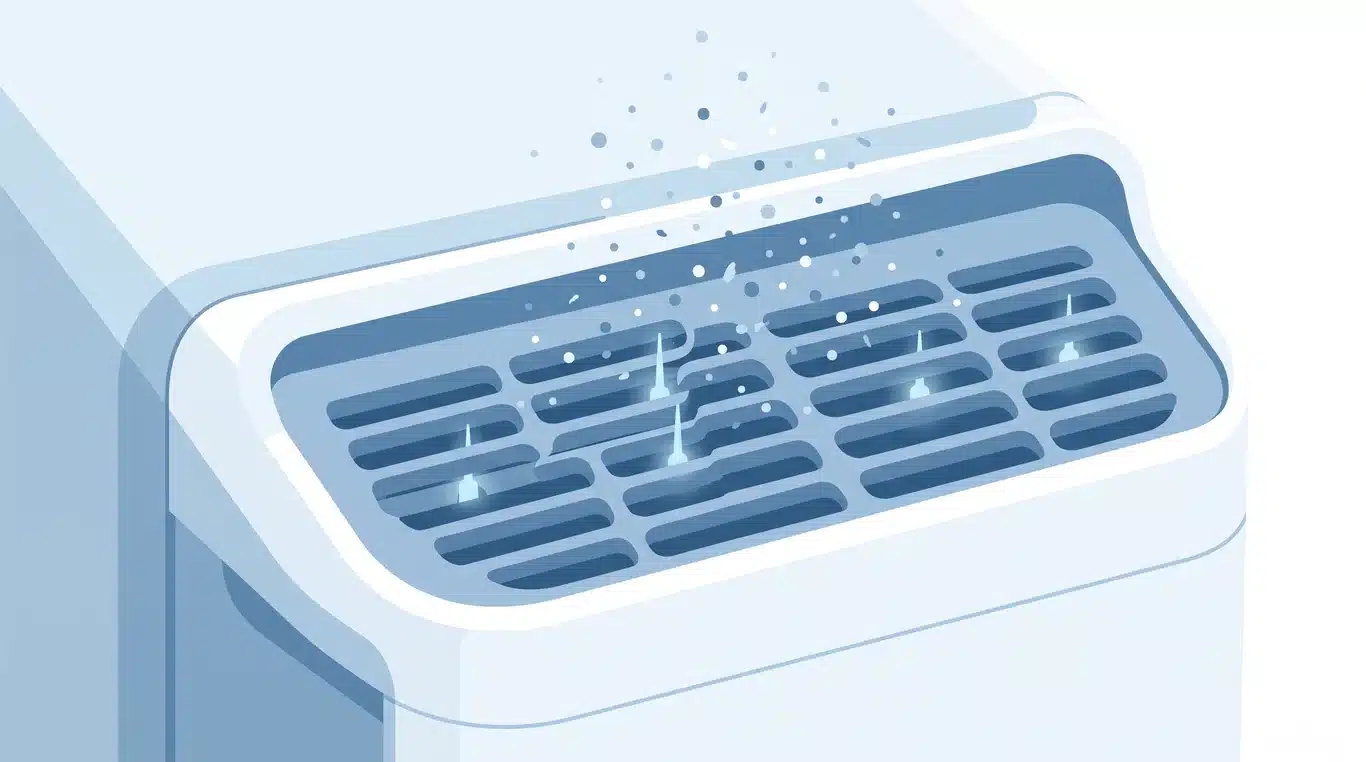
An ionizer on an air purifier is a high-voltage part that releases negatively charged ions into the room. The ions attach to airborne particles and add a static charge. The charged particles then clump together and grow heavier. They settle onto walls, floors, and furniture instead of staying in the air you breathe.
Standard ionizers differ from electrostatic precipitators (devices with metal plates that trap charged particles inside the unit). A plain ionizer skips that trapping step. According to the EPA, ion generators charge particles with the same high-voltage discharge. Without a collector plate, the charged dust and pollen are redistributed onto walls, floors, and furniture. None of it is removed from the room.
Most ionizing air purifiers push the charged ions out with a small fan. The effect from ionization reaches only a few feet into the room, not the whole space at once. That is the key difference from how a real air purifier filters the room. The ionizer moves particles out of the air, not out of the room.
Ionizer vs. Air Purifier: What Is the Real Difference?
An ionizer and a true air purifier solve the same problem in very different ways. An ionizer releases charged particles into the air but has no filter to catch anything. A full air purifier pulls air through a physical filter that traps dust, pollen, and other debris.
Verified air purifiers carry a lab-tested Clean Air Delivery Rate (CADR). That rating comes from AHAM Verifide, the certification program run by the Association of Home Appliance Manufacturers (AHAM). It measures how much smoke, dust, and pollen a unit clears from a room each hour. Standalone ionizers carry no CADR rating at all, because there is nothing to test. They charge the air instead of filtering it.
Feature by feature, the two devices rarely overlap:
| Feature | Standalone Ionizer | Full Air Purifier |
| Filters air | No, only charges particles | Yes, air passes through filter media |
| Removes particles from room | No, particles settle on nearby surfaces | Yes, particles stay trapped in the filter |
| Carries a CADR rating | No, nothing to test | Yes, when AHAM Verifide certified |
| Produces ozone | Can, depending on design | Not applicable, no ionizer function |
| Replacement filter cost | Not applicable, no filter to replace | Recurring, typically every 3 to 6 months |
Ionizer Side Effects and Ozone Risk

Running the ionizer setting carries a short list of real downsides, not just theories. The EPA (Environmental Protection Agency) singles out ozone, a byproduct of ion generators, as a lung irritant. At high levels, it can make breathing harder.
The downsides worth knowing before you flip the switch:
- Ozone byproduct: ion generators can release ozone in a small or poorly ventilated room.
- No real removal: an ionizer settles particles onto surfaces instead of pulling them out of the room, so nothing actually leaves your air.
- Dust buildup: homes running ionizers for months can see a fine dark film build up on walls and around outlets. That film is charged particles that landed nearby instead of vanishing.
- Harder on sensitive lungs: anyone with asthma or COPD is more likely to feel irritation from ozone than a healthy adult would.
This is not a new debate either. Consumer Reports once pulled its rating from a top-selling ionic air cleaner in the mid-2000s. Testing found the unit cleaned air no better than doing nothing. That case still makes reviewers doubt ionizer-only devices today.
Should You Turn On the Ionizer Setting on Your Air Purifier?

The choice to leave the ionizer setting on comes down to two questions. One is how well the room is ventilated, and the other is who is breathing the air in it. A healthy adult in a large, airy room will likely not notice the ionizer running in the background.
What Does an Ionizer Do on an Air Purifier in Sleep or Auto Mode? On most units, the ionizer keeps running at a low, steady output. That holds even when the fan drops to its quietest setting. That is right when ventilation is weakest and any ozone produced has the least chance to disperse.
The most concrete way to judge the risk is certification, not guesswork. Under California Air Resources Board (CARB) rules, a legal unit may emit no more than 0.050 ppm (50 ppb) of ozone. Those rules apply to any purifier sold nationwide, including everything listed on Amazon. Checking for CARB certification before you leave the ionizer running takes only five seconds. That check rules out the main risk.
Anyone with asthma or COPD (chronic obstructive pulmonary disease) should be cautious about the ionizer setting. The same goes for a home with a baby, young child, or pet spending real time in the room. In those cases, the safer call is to leave the ionizer off and let the base filter do the work alone. A well-ventilated room with no sensitive lungs in it is the ideal setting. Running the ionizer alongside the filter makes sense there.
Check that the unit carries CARB certification first, since that caps ozone output at a safe legal limit.
Air Purifiers Without an Ionizer: What to Look for Instead
Skipping the ionizer does not mean settling for less clean air. Look instead for a unit built around True HEPA (High-Efficiency Particulate Air) filtration, a trait of the best air purifiers. That standard captures 99.97 percent of particles. It catches particles down to 0.3 microns (about 1/100th the width of a human hair) in size. That size is the hardest for any filter to catch.
Add an activated carbon layer if odors or gases are the concern. HEPA alone catches particles but does nothing for smells or chemical fumes. A handful of purifiers add a UV-C (short-wavelength ultraviolet light) stage. It damages the DNA of bacteria and mold spores as they pass through. It only adds to the filter. It does not replace it.
How We Research
We check every claim against primary sources. Federal agencies like the EPA and CDC come first. Certification bodies like NSF and AHAM come next. We verify each standard number against the issuing body. We review this guide on a set schedule.
Why Trust This Guide
Puritisimo covers only water and air quality. Our guidance is editorial and independent. We cite every health figure so you can check it. We never present a promotional claim as fact.
Deciding If the Ionizer Setting Is Worth Running
Every ionizer question comes back to the same trade-off. It charges particles instead of removing them. That only pays off in a well-ventilated room where nobody breathing the air is sensitive to ozone. A standalone ionizer has no filter and no CADR rating, so it does not replace a real air purifier. At best, it is a small add-on running alongside one.
Check for CARB certification. Skip the setting if anyone in the home has asthma, COPD, or is very young. If you would rather not think about it at all, lean on a True HEPA and activated carbon unit instead. Once you understand what an ionizer does on an air purifier, the choice comes down to two things. Those are ventilation and who is in the room.
Frequently Asked Questions
What does an ionizer do on an air purifier?
An ionizer on an air purifier releases negatively charged ions that attach to dust, pet dander, and other airborne particles. According to the EPA, that charge makes the particles heavy enough to fall out of the air. They then settle on nearby surfaces instead of staying in the air.
Should you turn on the ionizer setting on your air purifier?
Turn it on only if the room is well ventilated. Also confirm no one breathing the air has asthma, COPD, or is a young child or pet. Ozone exposure affects sensitive lungs more than healthy adult lungs. Check that the unit carries CARB certification first, since that caps ozone output at a safe legal limit.
What happens if you stay in a room with an ionizer?
Charged particles drift down onto your walls, furniture, and floor instead of leaving the room. A standalone ionizer has no filter to remove them. In a small or poorly ventilated space, the EPA notes that the ozone these devices produce can build up. That buildup can reach unsafe levels with long exposure.
What are the disadvantages of ionic air purifiers?
The biggest drawbacks are ozone output and the lack of real filtration. The EPA calls ozone a lung irritant, and charged particles simply settle nearby instead of leaving the air. Over months of use, that settling can leave a faint dark film on walls and outlets near the unit.
How can you tell if an ionizer is working?
Two signs often show up. One is a faint, fresh-smelling or slightly metallic odor near the unit, and the other is a dark film on nearby walls or outlet covers within days. Neither sign means the air is being filtered, since an ionizer only charges particles instead of removing them.
References
- AHAM Verifide. AHAM’s Air Filtration Standards. Association of Home Appliance Manufacturers. n.d.
- US EPA. What Are Ionizers and Other Ozone-Generating Air Cleaners? n.d.
- California Air Resources Board (CARB). Indoor Air Cleaning Devices Regulation. n.d.
Medical Disclaimer: This content is for informational purposes only. It is not a substitute for professional medical advice, diagnosis, or treatment. If you have concerns about your water quality or air quality and their effects on your health, consult a qualified healthcare professional.