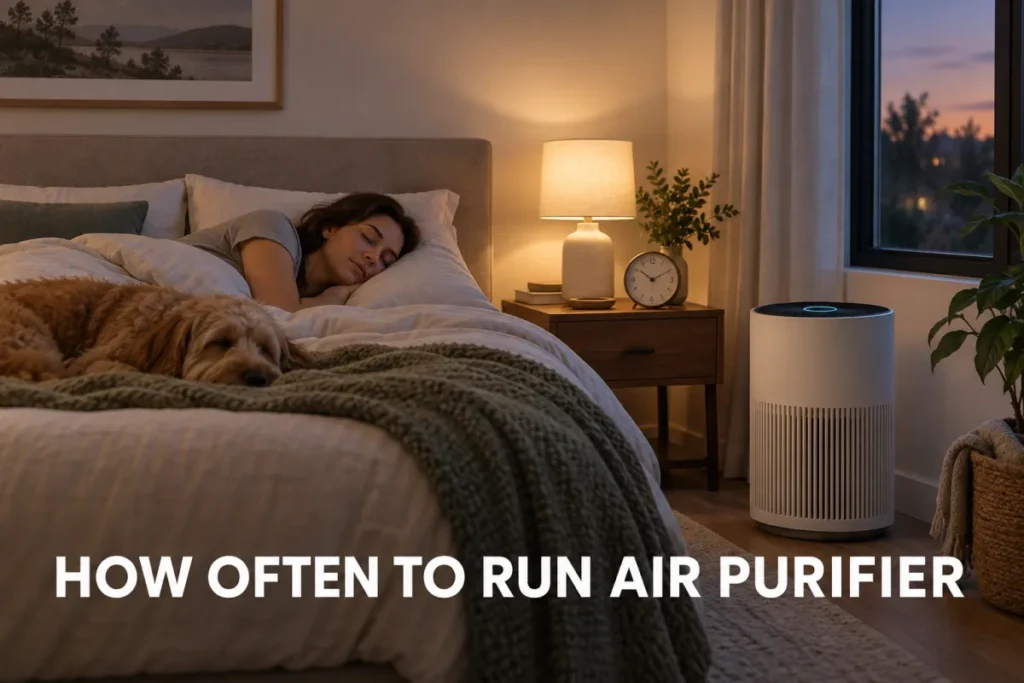
Most air purifiers should run continuously, or for most of the hours a room is occupied, to keep indoor air clean. Continuous use matches the CDC’s benchmark of at least five air changes per hour, or ACH. That is the point where pollutant levels stay low. Switching a unit on for just an hour or two a day lets dust and allergens build back up between sessions. The filter does not get another chance to catch them until it runs again.

By the end, you’ll know how often to run your air purifier for your room. It also covers whether continuous operation fits your household, and how allergies, asthma, or pets change that number. You’ll also see what daily operation costs in energy, not dollars.
Key Takeaways
- Continuous or near-continuous operation is the usual advice, not just occasional or spot use.
- Room size, pollutant sources, and filter type all change how many hours a day you need.
- Allergy and asthma households benefit most from a higher air-change target and closer to round-the-clock use.
- A typical 50-watt purifier uses roughly 438 kWh a year if it runs around the clock.
How Often to Run Air Purifier
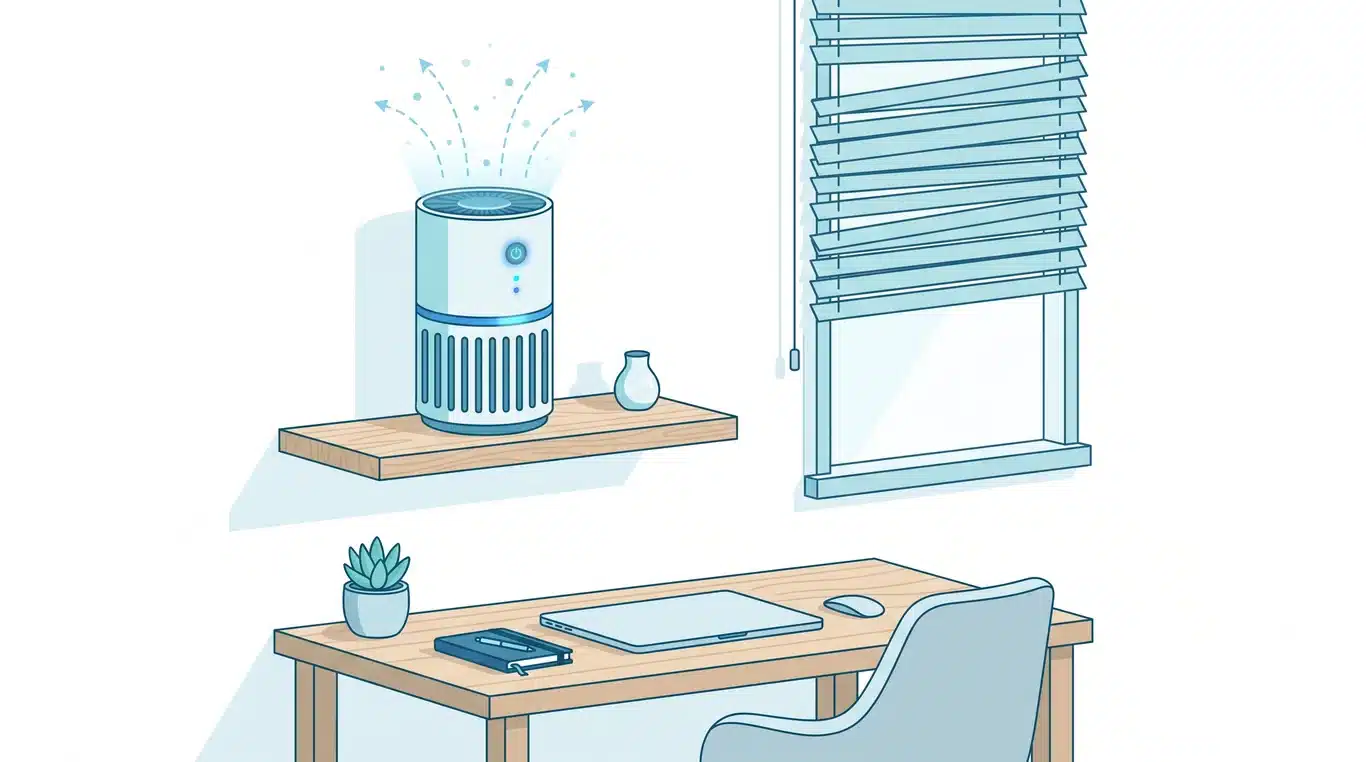
Most air purifiers should run continuously, or for every hour a room is occupied. This cycles the air at least five times per hour.
The Centers for Disease Control and Prevention recommends at least five air changes per hour (ACH) for indoor spaces. That rate helps cut airborne particles and viruses. A purifier that only reaches this rate for a couple of hours a day falls short of that benchmark. This is true even if it runs at full power while it is on.
That baseline works for most homes with average pollutant levels and typical room sizes. Your own runtime depends on room size, what your purifier is rated to handle, and how much dust, smoke, or dander it deals with each day. The next sections cover those points.
How Often To Run Air Purifier Based on Room and Air Quality
The right runtime for an air purifier comes down to four variables. Those are room size, pollutant source strength, filter type, and occupancy patterns. Manufacturers rate coverage using clean air delivery rate (CADR), the cubic feet of filtered air a unit delivers per minute. That number only holds up once it is matched to the room using AHAM’s sizing standard.
Four factors decide the real number:
- Room size versus CADR: a unit rated for a room twice its actual coverage never reaches a healthy air-change rate. This holds no matter how long it runs. Central heating and cooling systems rely on a separate furnace filter to condition air throughout the rest of the house.
- Pollutant source strength: cooking, smoking, wildfire smoke, and pets all raise the runtime a room needs.
- Filter type and stage: a true HEPA (high-efficiency particulate air) filter clears particles faster than a lower-grade filter, cutting the hours needed to hit your air-change target.
- Occupancy patterns: bedrooms need coverage overnight, while a living room mainly needs it during waking hours.
One number is worth checking twice before you buy. A purifier marketed to cover 1,500 square feet is usually tested at just 1 air change per hour. That is well short of the 5 ACH (air changes per hour) the CDC recommends for healthy indoor air. Run the same math at 5 ACH, and that coverage claim shrinks to roughly 300 square feet. That fivefold gap catches most buyers off guard.
According to the CDC, that keeps a room at or above the recommended 5 ACH benchmark.
The 2/3 Rule comes from AHAM: a unit’s smoke CADR should be at least two-thirds of the room’s square footage at 8-foot ceilings.
Running It Continuously vs. On a Schedule
Running an air purifier continuously keeps particle counts lower and steadier than switching it on and off. Pollutant levels creep back up the moment filtration stops. According to the CDC, near-continuous operation is what keeps a room at or above the recommended 5 ACH benchmark. Auto or sensor-based scheduling gets close, but only if the sensor reacts fast enough to catch a spike.
A separate rule sometimes confuses buyers here. AHAM’s 2/3 Rule says a unit’s smoke CADR should cover at least two-thirds of a room’s square footage at 8-foot ceilings. That is a sizing standard, not a runtime schedule. Even a right-sized unit still needs enough daily hours to reach that room’s target air-change rate.
One detail manufacturers rarely flag: CADR ratings are tested only at a unit’s top fan speed. Run the same purifier continuously on a quieter low or medium setting. Its real-world output can then fall well short of the rated number. That gap disappears only if the schedule or auto-mode ramps the fan up during peak pollution.
Here is how the two approaches compare across what matters most:
| Factor | Continuous (24/7) | Scheduled / Auto Mode |
| Air quality consistency | Stays near the target ACH consistently | Dips between cycles; recovers quickly with a responsive sensor |
| Energy use | Higher, though ENERGY STAR models cut typical draw by about 27%. | Lower overall, since the fan runs fewer hours |
| Filter wear | Faster clogging; needs closer monitoring | Slower wear; easier to under-run without noticing |
| Best for | Allergy, asthma, and pet households | Well-ventilated rooms with light, occasional pollutant loads |
Setting Up a Runtime Schedule That Actually Works
If continuous operation is not practical in your home, a well-built schedule can still get close to the same result. Matching runtime to your room’s actual size and habits matters more than picking a random number of hours. It only takes a few minutes to set up right.
A five-step setup covers most rooms:
- Confirm the fit. Check that the unit’s smoke CADR meets AHAM’s 2/3 Rule for the room before setting any schedule.
- Start on auto mode. Use sensor-based operation if the unit has it, so the fan speeds up automatically during a spike.
- Set base hours around occupancy. Schedule the bulk of the runtime for when the room is in use, not empty.
- Add a high-speed boost. Run 30 to 60 minutes at top speed after cooking, cleaning, or painting.
- Check the filter monthly. How often to change your air purifier filter affects this number too. A clogged filter quietly lowers the effective air changes per hour, even on a schedule that was correct when set.
None of this needs a smart plug or an app, though either makes the schedule easier to stick to. The goal is to spend as many occupied hours as possible inside the air-change window your room’s CADR can actually support.
Homeowners pairing a portable purifier with HVAC filtration can extend clean-air coverage to every room at once; my 3M Filtrete MERV 11 review covers the furnace filter that fits that dual-layer setup.
Running It Longer for Allergies, Asthma, and Pets
Households managing air purifier allergies or asthma symptoms mostly do best closer to continuous operation. Aim for a higher air-change target of 5 to 6 ACH rather than the general 5 ACH baseline. That is a lot of people. More than 27 million Americans, 8.6% of adults and 6.5% of children, live with asthma, according to the CDC. Another 31.7% of adults reported a diagnosed seasonal allergy, eczema, or food allergy in the same year, per CDC data.
A HEPA (high-efficiency particulate air) setup aimed at allergy relief works best run most of the day the room is occupied, not in short bursts. Dust mite debris and pollen keep settling back into the air between cycles, so gaps let levels climb again. For asthma, the practical answer leans toward near-continuous use in the bedroom overnight. That is when flare-ups are most disruptive to sleep.
For a compact bedroom option that runs quietly at lower fan speeds overnight, my Levoit Core 300-P bedroom purifier review covers the certified CADR and noise level at sleep-compatible settings.
Pet dander is a continuously regenerated pollutant, unlike a one-time event such as painting. That is another reason pet households lean toward round-the-clock rather than scheduled use. Look for the asthma & allergy friendly (AAFA) certification. It needs at least 90% airborne allergen reduction, with at least half of that captured in the filter rather than redistributed. That bar only holds up with sustained runtime, not occasional bursts.
What It Costs to Run an Air Purifier Daily
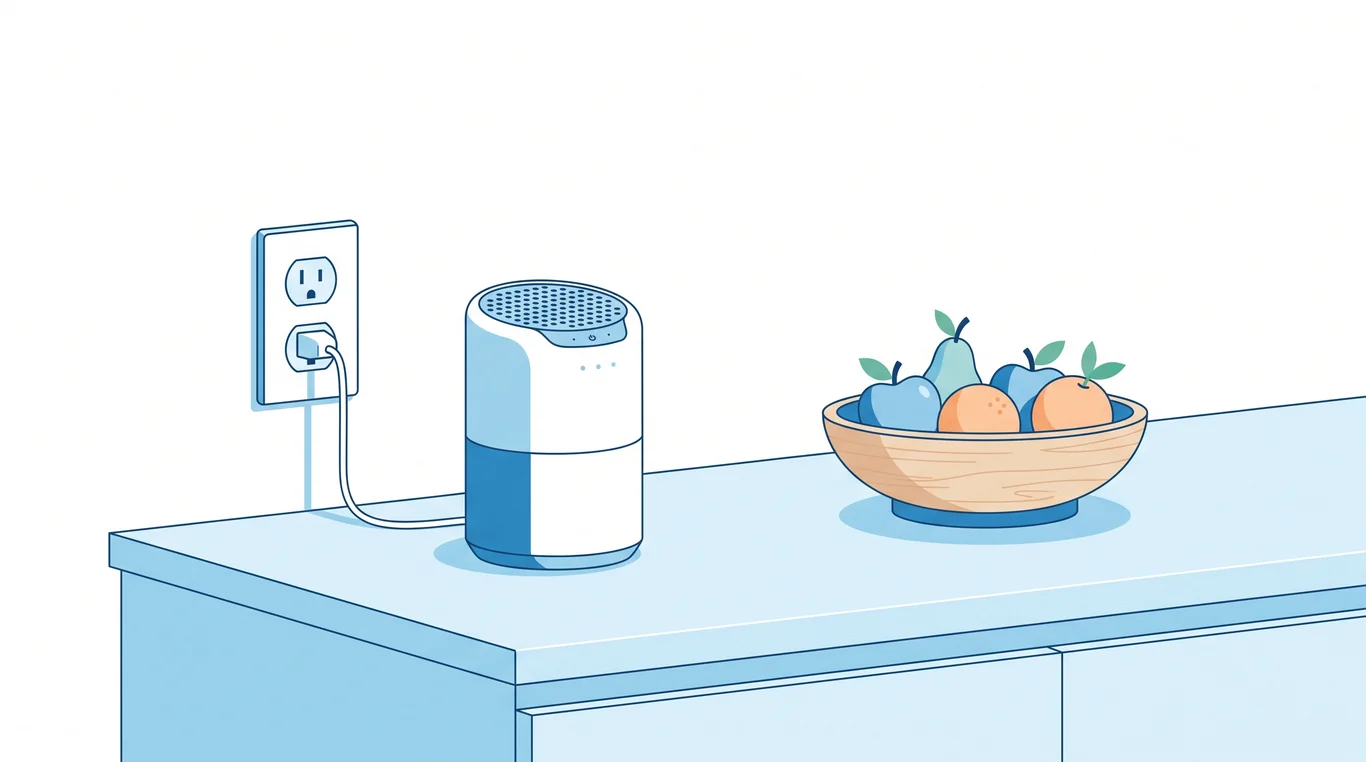
Air purifier running costs are easiest to understand in energy, not dollars. A typical 50-watt air purifier run around the clock uses roughly 438 kWh a year. That works out to 50 watts times 24 hours times 365 days, divided by 1,000. That is like leaving a couple of LED-lit rooms on continuously. According to ENERGY STAR, certified models cut that figure by about 27% through better motors and fans. Filtration performance does not change.
That efficiency gap is worth checking before ruling out continuous operation as impractical. A certified unit closes most of the difference between running on a schedule and running it around the clock. It does this without losing air quality. The same certification often comes with a quieter motor at lower fan speeds too. For most households, the practical running cost is a minor factor next to how much cleaner the air actually stays.
For a larger living space where continuous operation is most effective, my Levoit Core 400S-P review covers the AHAM-certified CADR and energy draw at different fan settings.
How We Research
We check every claim against primary sources. Federal agencies like the EPA and CDC come first. Certification bodies like NSF and AHAM come next. We verify each standard number against the issuing body. We review this guide on a set schedule.
Why Trust This Guide
Puritisimo covers only water and air quality. Our guidance is editorial and independent. We cite every health figure so you can check it. We never present a promotional claim as fact.
Finding the Right Runtime for Your Home
The short version is that most rooms do best with continuous or near-continuous filtration. The exceptions are narrow. A small, well-sized unit in a lightly used room can work. So can a household willing to build a careful schedule around occupancy and pollutant spikes. Our guide to how long to run an air purifier each day breaks down session length by room type. Room size relative to CADR decides whether that schedule can even work. Allergy, asthma, and pet households almost always land on the continuous side of that line.
Energy use is real but modest, especially with an ENERGY STAR-certified unit. It is rarely the deciding factor once air quality is on the table. Once you know your room’s actual air-change needs, deciding how often to run an air purifier stops being a guess and becomes straightforward math.
Frequently Asked Questions
How often to run air purifier?
How often you should run an air purifier depends mainly on room size. It also depends on how many air changes per hour (ACH) it delivers. For most homes, the general answer is continuous or near-continuous operation during occupied hours. According to the CDC, that keeps a room at or above the recommended 5 ACH benchmark. The room-size and schedule sections above cover the exceptions.
Should I let my air purifier run all the time?
Yes, running your air purifier continuously or on a schedule that matches occupancy is the better default. Pollutant concentration creeps back up once filtration stops. Leaving it off for long stretches lets air quality drift below the CDC’s 5 ACH recommendation between sessions.
What is the 2/3 rule for air purifiers?
The 2/3 Rule comes from AHAM: a unit’s smoke CADR should be at least two-thirds of the room’s square footage at 8-foot ceilings. It is a sizing rule, not a runtime rule. A right-sized unit still needs enough daily hours to reach a healthy air-change rate.
Is an air purifier safe to use every day?
A true HEPA unit without an ozone-generating ionizer mode is safe for daily, continuous use. Models carrying CARB, UL, or ENERGY STAR certification have been independently tested to confirm it. The only exception is ionizing or ozone-generating modes, which some units include as an optional add-on feature.
How long should an air purifier be on in the room?
Long enough, and often enough, to complete several full air changes while the room is occupied. In practice, that means running it most of the day rather than for a quick burst. After a high-pollutant event like cooking, cleaning, or fresh paint, extend that to a longer 12- to 24-hour stretch on a higher setting.
References
- CDC. Improving Ventilation and Reducing Exposure to Respiratory Viruses Indoors. 2024.
- AHAM Verifide. AHAM’s Air Filtration Standards. 2024.
- CDC/NCHS. Asthma FastStats. 2024.
Medical Disclaimer: This content is for informational purposes only. It is not a substitute for professional medical advice, diagnosis, or treatment. If you have concerns about your water quality or air quality and their effects on your health, consult a qualified healthcare professional.