
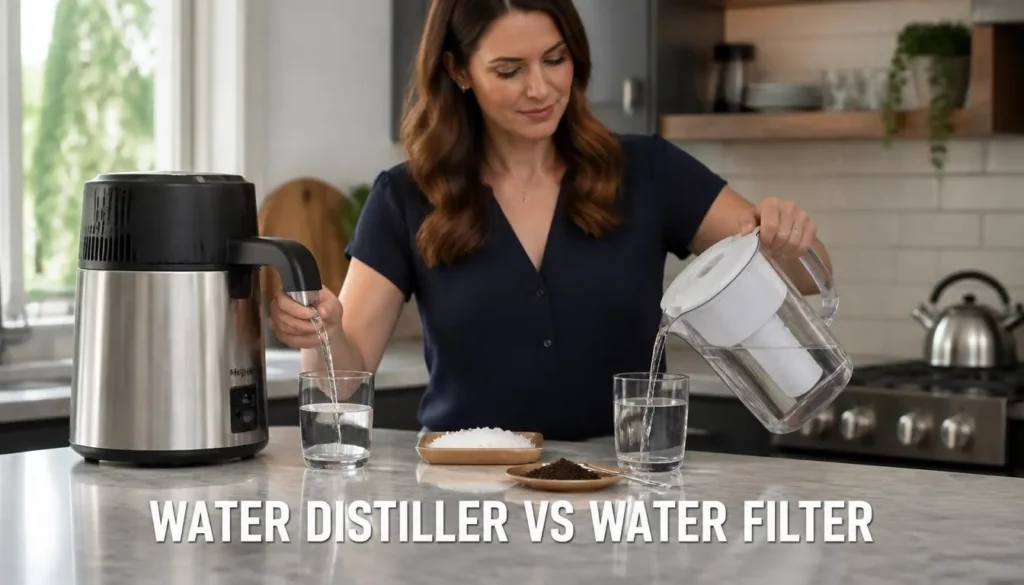
Water distiller vs water filter comes down to one trade. A distiller removes nearly every dissolved mineral but is slow, while a filter is fast but removes only what it was built to catch. Pick a distiller if you want the widest removal and can wait for a few gallons a day. Pick a filter if you want quick daily water and a fix aimed at one problem, such as lead or chlorine taste.
Both machines clean tap water, but they work in very different ways. By the end, you will know what each one removes, what it misses, and which one fits your home.
Key Takeaways
- A distiller removes more than 99.9% of dissolved minerals, but it makes only 4 to 12 gallons a day.
- Distillation can pass some volatile chemicals (ones that evaporate easily) unless a carbon filter follows it.
- A filter is faster and targets named contaminants, so look for NSF/ANSI 53 or 58 on the label.
- Distillers use more energy and take longer, while filters need cartridges changed on schedule.
Water Distiller vs Water Filter at a Glance
Both machines clean tap water with different methods. A distiller boils water and collects the steam as it cools, according to the CDC. That leaves most dissolved solids in the boiling chamber. A filter instead forces water through a cartridge or membrane that catches particular contaminants, and University of Georgia Extension describes each method on its own terms.
The table sets the two side by side on seven factors that decide most purchases:
| Factor | Water distiller | Water filter |
| Method | Boils water, then cools the steam | Carbon block, resin, or membrane |
| Dissolved minerals | Removes more than 99.9% | Carbon leaves most in; reverse osmosis removes many |
| Germs | Boiling kills bacteria | Varies; reverse osmosis alone is not advised for bacteria |
| Volatile chemicals | Some pass through with the steam | Carbon is the usual fix |
| Output per day | 4 to 12 gallons | Carbon flows on demand; reverse osmosis makes 5 to 20 gallons |
| Energy and time | More energy, slower | Carbon needs little; reverse osmosis uses water pressure |
| Upkeep | Regular cleaning; coils can grow bacteria when idle | Replace cartridges or membranes on schedule |
How a Water Distiller Handles Contaminants
Distillation is a simple idea. The unit heats water to boiling, and the steam rises into a cooling chamber, where it turns back into liquid. UGA Extension says it normally removes more than 99.9% of dissolved minerals. The CDC adds that arsenic, barium, cadmium, chromium, lead, and nitrate stay behind, along with calcium, magnesium, and sodium.
Heat also takes care of germs. Boiling kills bacteria, and the CDC lists parasites and viruses among the germs distillation leaves behind. That makes a distiller a strong option when a private well carries a wide mix of salts and metals. Our water distiller picks compare countertop and stovetop models.
The weak spot is volatile organic compounds (VOCs, chemicals that evaporate easily). They turn to vapor with the water and can ride the steam into your glass. The CDC says distillation does not remove some VOCs, solvents, and certain pesticides. UGA Extension says a vent on the unit, or a carbon filter after the still, removes most of them.
Two more limits matter. Output is small: UGA says a typical home unit makes 4 to 12 gallons of treated water per day. And the CDC warns that bacteria may grow on the cooling coils while the unit sits unused. Run it often and clean it as the maker directs.
How a Water Filter Handles Contaminants
“Water filter” covers several devices, so the answer depends on which one you mean. A carbon filter uses activated carbon (a porous material with huge surface area that grabs chemicals). UNL Extension notes that activated carbon handles chlorine. Unlike a still, a carbon filter is not built to strip dissolved minerals.
The EPA says three methods can greatly reduce PFAS (man-made “forever chemicals”). They are granular activated carbon (GAC, loose carbon granules), ion exchange (resin beads that swap one dissolved ion for another), and reverse osmosis. It tells shoppers to look for certification under NSF/ANSI 53 or 58 for PFAS reduction, and to check the listing for the PFAS covered.
Reverse osmosis (RO, a filter that pushes water through a membrane) comes closest to a distiller. The CDC puts its pore size at about 0.0001 micron (a micron is one millionth of a meter). UGA Extension says many RO units remove up to 95% of many inorganic chemicals, so minerals drop sharply, though less completely than with a still.
RO has limits too. UGA says dissolved gases such as hydrogen sulfide (the rotten-egg gas) pass through, and a damaged membrane can let bacteria by. Most home systems recover only 20 to 30 percent of the feed water as drinking water, says UNL, so the rest goes down the drain.
Minerals, Taste, and Daily Output
Removing minerals is the main reason people buy a distiller, and it is also its main trade-off. The WHO says water with extremely low TDS may taste flat. TDS (total dissolved solids, the salts and minerals dissolved in water) is mostly calcium, magnesium, sodium, and potassium. WHO rates water under 300 mg/L (milligrams of solids per liter) as excellent for taste, so some minerals are not a flaw.
A distiller leaves water with almost none of these minerals. A carbon filter is not designed to remove them, so your water keeps its usual taste. RO falls between the two. If you like your tap water, a carbon filter keeps it. If your water carries a salt or nitrate problem, a still or RO can fix it.
Carbon and RO are the two filter types most often compared, so see how a carbon filter differs from reverse osmosis.
Output is the other split. UGA gives 4 to 12 gallons a day for a home still and 5 to 20 for a typical RO unit. A pitcher or faucet filter simply treats water as you use it, until the cartridge is spent. A household that cooks and drinks a lot of treated water will feel the still’s slow pace.
Water Distiller vs Water Filter Cost, Energy, and Upkeep
Distillers use energy to boil water, while filters need replacement cartridges or membranes, so upkeep costs depend on the model and usage. The CDC says distillation generally uses more energy and takes longer than other water treatment systems. UGA also lists the ongoing cost of energy. In general, a basic pitcher filter costs far less upfront than a countertop still.
Filters ask for a different kind of care. The EPA says to follow the replacement directions, because expired cartridges work less well. For RO, UNL says damaged membranes are not easily detected, so it recommends testing the treated water from time to time.
Instead of comparing sticker prices, compare cost per gallon. For a still, divide each batch’s electricity cost by the gallons it makes. For a carbon filter, divide the cartridge price by the gallons it treats. For RO, divide the cartridge, membrane, water, and power costs by the gallons it produces.
Water Distiller vs Water Filter: Which Should You Choose?
No single winner exists, but most homes do well with a certified filter. Match the device to the problem you actually have. A water report or lab test tells you what is in your water, so start there.
Use the two lists below as a starting point.
Choose a water distiller if:
- Minerals: you want nearly all dissolved minerals and metals gone, for example after a test shows high nitrate.
- Patience: you can live with 4 to 12 gallons a day.
- Routine: you will run the unit often and keep it clean.
- Chemicals: you will add a vent or a carbon filter for volatile chemicals.
Choose a water filter if:
- Speed: you want treated water on demand at the tap or in a pitcher.
- Targets: you need to reduce a named contaminant, such as lead, chlorine taste, or PFAS.
- Certification: you will check the specific claim, such as NSF/ANSI 42 for chlorine taste, 53 for lead or PFAS, or 58 for RO.
- Upkeep: you will replace cartridges on the maker’s schedule.
How We Research
We check every claim against primary sources. Federal agencies like the EPA and CDC come first. Certification bodies like NSF and AHAM come next. We verify each standard number against the issuing body. We review this guide on a set schedule.
Why Trust This Guide
Puritisimo covers only water and air quality. Our guidance is editorial and independent. We cite every health figure so you can check it. We never present a promotional claim as fact.
Making the Call for Your Water
The right answer depends on your water, not the machine. A distiller leaves nearly all dissolved minerals and metals behind, but it is slow and uses energy. A filter is faster and can target lead, chlorine, or PFAS with the right certification, though cartridges need timely replacing. Start with a water report, then match the device to it. If your tap is fine, a certified carbon filter works. If it carries salts or metals, a still or an RO system earns its place. Weighing a water distiller versus a water filter this way avoids paying for needless removal.
Frequently Asked Questions
Water distiller vs water filter: which one is better for drinking water?
In the water distiller vs water filter match-up, the better pick depends on your tap water. A distiller removes more than 99.9% of dissolved minerals but works slowly. A certified filter is faster and targets named problems, such as lead. Test your water first, then choose.
Is water from a Brita filter distilled?
No, a Brita pitcher filter does not distill water. It passes water through a cartridge, so many dissolved minerals can stay in the glass. Distilled water is boiled and condensed, which leaves nearly all of them behind. Check the cartridge label for what it is certified to reduce.
What is the difference between a water purifier and a water distiller?
Water purifier is a loose label for any device that treats water, so it can mean a carbon filter, an RO system, or an ultraviolet unit. A distiller is one specific type that boils water and condenses the steam. Check what a purifier is certified to remove before you buy it.
Does purified water have electrolytes?
Usually very few. Distilled and RO water remove most of the minerals that act as electrolytes (charged minerals such as sodium, potassium, calcium, and magnesium). Some bottled brands add minerals back, so read the label to see what the water holds.
Is filtered water good for you?
It depends on the filter and your tap water. A filter certified for a named contaminant, such as lead, can lower your exposure to it. A filter only helps when you replace the cartridge on time, because an expired cartridge works less well. A water report shows what your tap carries.
References
- CDC. About Home Water Treatment Systems. Centers for Disease Control and Prevention.
- University of Georgia Extension. Water Quality and Common Treatments for Private Drinking Water Systems. Bulletin 939.
- WHO. Total Dissolved Solids in Drinking-water: Background Document. World Health Organization.
- University of Nebraska-Lincoln Extension. Reverse Osmosis (G1490).
- EPA. Identifying Drinking Water Filters Certified to Reduce PFAS. U.S. Environmental Protection Agency.
- EPA. Basic Information about Lead in Drinking Water. U.S. Environmental Protection Agency.
Medical Disclaimer: This content is for informational purposes only. It is not a substitute for professional medical advice, diagnosis, or treatment. If you have concerns about your water quality or air quality and their effects on your health, consult a qualified healthcare professional.

