
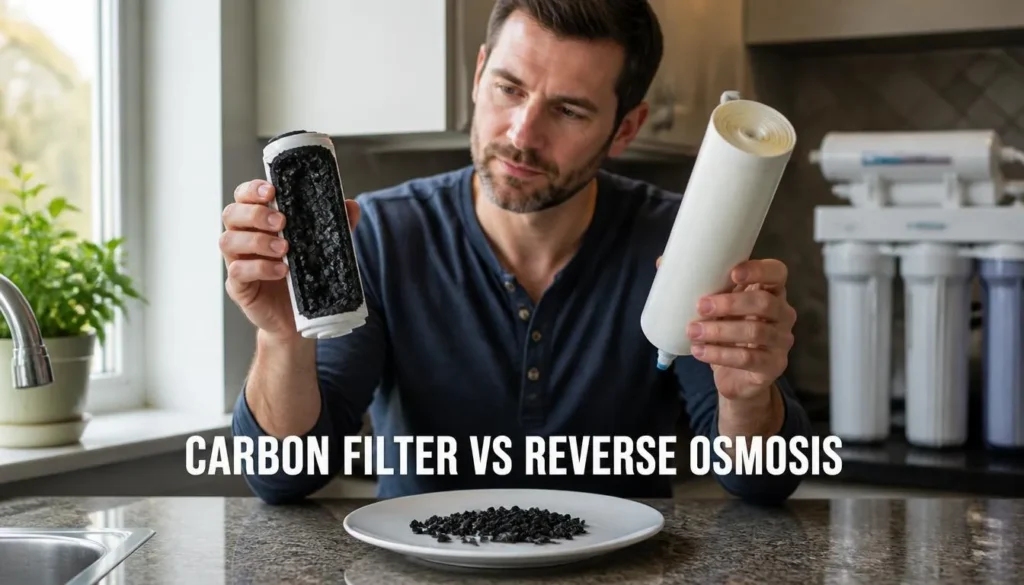
Carbon filter vs reverse osmosis comes down to what is in your water. A carbon filter fixes taste and smell at low cost. Reverse osmosis (RO, a filter that pushes water through a membrane so fine that almost only water gets through) also cuts dissolved salts and metals. Pick carbon for chlorine taste. Pick RO for lead or high dissolved solids, if you accept more waste and upkeep.
This guide shows what each filter removes, what it misses, and what it costs you in water and upkeep. You will know which one fits your tap water before you buy.
Key Takeaways
- Carbon filters improve taste and smell; the CDC says they are not designed to remove germs.
- RO removes more kinds of chemicals than carbon, including lead, copper, and sodium.
- A typical RO unit sends five gallons or more of reject water down the drain per gallon made.
- Check the label for NSF/ANSI 42, 53, or 58, then match that claim to your problem.
Carbon Filter vs Reverse Osmosis at a Glance
Which one fits depends on the problem you want to solve. Carbon suits taste and smell, while RO suits dissolved contaminants.
The CDC says the easiest way to check what a filter removes is to read its NSF certification label. NSF Standard 42 covers taste and odor, Standard 53 covers cyst (a hardy parasite form) reduction, and Standard 58 covers reverse osmosis.
The EPA says a typical RO unit makes five gallons or more of reject water for every gallon of treated water. Carbon cartridges do not produce a reject stream during filtration, but some whole-house carbon systems use water for backwashing.
Here is how the two compare across six factors that matter at home:
| Factor | Carbon filter | Reverse osmosis |
| Main job | Taste, smell, and chlorine | Dissolved salts, metals, and some chemicals |
| Total dissolved solids (TDS) | Most pass through | Most are reduced |
| Germs | Not designed to remove them | Check the label for a germ claim |
| Wastewater | No continuous reject stream; some whole-house systems need backwashing | Typically five gallons or more per gallon made; WaterSense models use 2.3 or less |
| Upkeep | Replace one cartridge on schedule | Replace several cartridges and a membrane |
| Typical setup | Pitcher, faucet, under-sink, whole house | Under-sink or countertop unit |
| NSF/ANSI standard | 42 and 53 | 58 |
How Each Filter Cleans Your Water
Activated carbon is a very porous charcoal. Contaminants stick to its huge surface in a process called adsorption. The CDC says carbon filters mostly improve the taste and smell of water, so they work best on chlorine and odors rather than on health risks.
RO works in a different way. According to the EPA, RO uses pressure to force water through a semipermeable membrane (a screen that lets water pass but blocks most dissolved particles). Salts and metals stay behind on the membrane and flow out to the drain.
Most under-sink RO systems use both ideas, which is why a 3-stage or 5-stage unit still contains carbon. Water usually moves through these steps in order:
- Sediment filter: catches grit, sand, and rust.
- Carbon prefilter: removes chlorine and improves taste.
- RO membrane: blocks dissolved salts and many metals.
- Carbon post-filter: polishes the taste before the faucet.
What Each Filter Removes and Misses
Carbon is strong on taste, smell, and chlorine. The CDC adds that carbon filters are not designed to remove germs, and that some are used to reduce lead only when the label says so.
RO covers a wider list. The CDC says RO filters remove lead, copper, chromium, chloride, and sodium, and may partly reduce arsenic and fluoride. The EPA adds VOCs (volatile organic compounds, chemicals that evaporate easily) and PFAS (man-made “forever chemicals”) to its list of possible targets.
The label matters more than the filter type. The EPA tells shoppers to look for NSF/ANSI 53 or 58 when the goal is PFAS reduction. It also notes that current standards do not yet show that a filter reaches the newest EPA limits.
A carbon filter without a Standard 53 claim may only improve taste. An RO unit without a Standard 58 claim may not prove its reduction. Always read the claim before you trust the type.
Carbon Filter vs Reverse Osmosis: Key Differences in Minerals and Waste
Minerals: A carbon filter leaves most dissolved minerals in the water. An RO membrane reduces them. WaterSense certification even includes a TDS (total dissolved solids, the minerals and salts in water) reduction test, so RO water usually carries far fewer minerals than carbon-filtered water does.
Meaning of low TDS: The EPA sets its 500 mg/L limit for TDS as a non-mandatory guide for taste, deposits, and staining. It is not a health limit, so a high reading does not by itself mean unsafe water.
Wastewater: The EPA says a typical RO unit makes five gallons or more of reject water for every gallon of treated water it produces. Some inefficient units reach 10 gallons. WaterSense labeled systems must send 2.3 gallons or less to the drain.
Trade-off: Carbon filtration keeps most dissolved minerals and makes no continuous reject stream, although some whole-house systems use backwash water. RO gives broader dissolved-contaminant reduction while making reject water. Many homes pick RO only for the kitchen tap, where they drink and cook.
Upkeep and Filter Changes
Any filter works only while it is maintained. The CDC tells owners to change filters on the manufacturer’s schedule. The EPA adds that carbon media has a limited capacity, so spent carbon stops doing its job even when water still flows.
RO means more parts to track. A system has a sediment filter, one or two carbon filters, and a membrane. WaterSense requires the membrane to last at least one year before it needs replacement.
Under-sink RO units also need a drain connection and a dedicated faucet. A pitcher or faucet carbon filter needs no installation, which is one reason renters and small households often start there.
Which Should You Choose for Your Home?
Start with your water, not the product, because a local water report or a lab test shows what to remove. Match the contaminant to a certified claim.
Choose a carbon filter if:
- Your main complaint is chlorine taste or a musty smell.
- Your water report shows no dissolved contaminant of concern.
- You want a low cost and no drain line or reject water.
- You rent, or you want a pitcher or faucet model.
Choose reverse osmosis if:
- Testing shows lead, high dissolved solids, or other dissolved contaminants.
- You want PFAS reduction and the label shows an NSF/ANSI 53 or 58 claim.
- You can fit an under-sink unit and accept the reject water.
- You will replace the membrane and several cartridges on time.
How We Research
We check every claim against primary sources. Federal agencies like the EPA and CDC come first. Certification bodies like NSF and AHAM come next. We verify each standard number against the issuing body. We review this guide on a set schedule.
Why Trust This Guide
Puritisimo covers only water and air quality. Our guidance is editorial and independent. We cite every health figure so you can check it. We never present a promotional claim as fact.
Match the Filter to Your Water
Neither filter wins in every home, so the right pick depends on your water. Carbon is the simple, low-waste choice for taste, smell, and chlorine. RO is the stronger choice for dissolved contaminants like lead, sodium, and PFAS, but it adds waste and upkeep. Many RO systems already include carbon stages, so you often get both in one unit. Whatever you pick, check the NSF label and change the filter on schedule. That is the practical answer to the carbon filter vs reverse osmosis question: match the filter to the problem in your water.
Frequently Asked Questions
Carbon filter vs reverse osmosis: which cleans tap water better?
The carbon filter vs reverse osmosis choice depends on the contaminant. Carbon is better for chlorine taste, while RO covers more dissolved metals and salts. Test your water first, then pick a filter whose NSF label matches the problem you found.
Are reverse osmosis filters good?
Reverse osmosis filters are good at reducing dissolved contaminants such as lead, copper, and sodium. The trade-offs are reject water and upkeep. A typical unit sends five gallons or more down the drain per gallon made, and the membrane needs regular replacement.
Why are carbon filters better?
Carbon filters are better in a few areas, not all. Pitcher and faucet carbon filters generally cost less than RO systems, are easy to set up, and make no reject stream during filtration. Whole-house carbon systems need installation, and some use water for backwashing. They also leave most minerals in place. They are not better at dissolved contaminants, where RO usually has the edge.
What do carbon filters not remove from water?
Carbon filters are not designed to remove germs, according to the CDC. Most also pass dissolved salts such as sodium and chloride. A carbon filter removes more only when its label shows a specific claim, such as NSF/ANSI 53 for lead.
How do reverse osmosis filters work?
Reverse osmosis filters use pressure to push water through a semipermeable membrane. Dissolved salts and metals stay behind and go down the drain as reject water. Most units add sediment and carbon stages before and after the membrane.
References
- CDC. Choosing Home Water Filters and Bottled Water. Centers for Disease Control and Prevention. 2024.
- EPA. Point-of-Use Reverse Osmosis Systems. WaterSense. U.S. Environmental Protection Agency.
- EPA. Identifying Drinking Water Filters Certified to Reduce PFAS. U.S. Environmental Protection Agency.
- EPA. Secondary Drinking Water Standards: Guidance for Nuisance Chemicals. U.S. Environmental Protection Agency.
Medical Disclaimer: This content is for informational purposes only. It is not a substitute for professional medical advice, diagnosis, or treatment. If you have concerns about your water quality or air quality and their effects on your health, consult a qualified healthcare professional.

