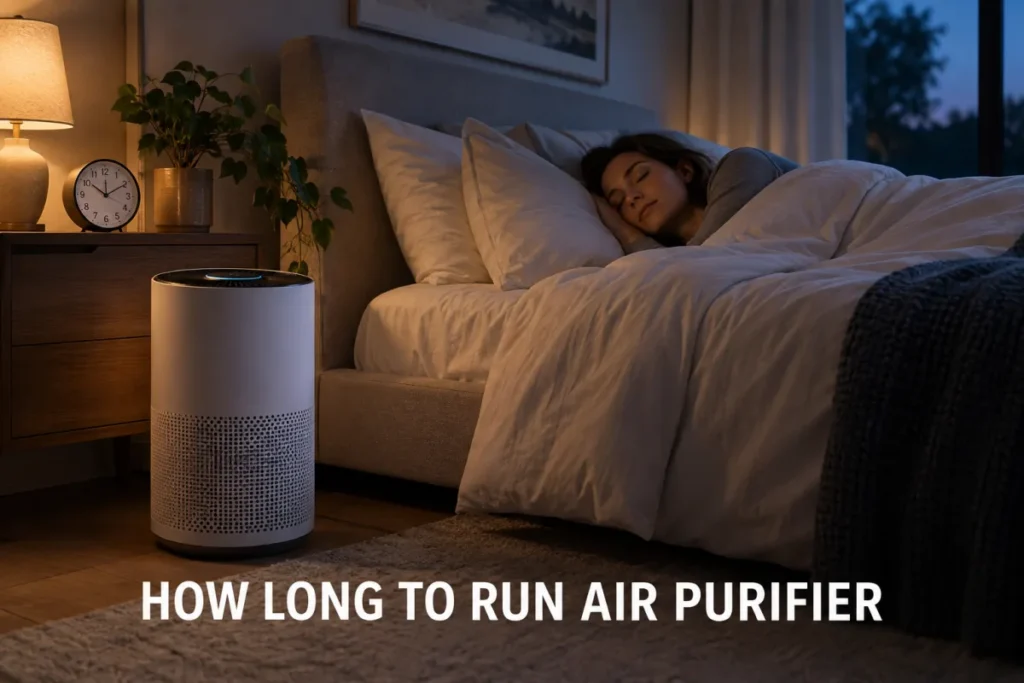
How long you should run an air purifier depends on your goal. The general advice is continuous, 24/7 use, since it keeps air changes per hour (ACH) steady. If that is not possible, run yours at least 8 to 12 hours a day to keep most rooms much cleaner. Shorter stretches still help, but pollutant levels rise again once the unit shuts off.

By the end, you will know how room size and air changes per hour change that baseline. You will also see why overnight use and after-cooking use matter. Allergy and pet-dander households often need longer, steadier runtimes than most homes.
Key Takeaways
- Continuous, 24/7 use is generally safe and keeps air changes per hour (ACH) steady.
- Larger or high-activity rooms need more daily runtime than small, low-traffic ones.
- Sleep and night modes run quiet enough, around 20 to 35 decibels, for safe overnight use.
- After cooking, cleaning, or painting, run the purifier longer on a higher setting to clear fumes.
How Long to Run Air Purifier Every Day
The general advice is to run an air purifier nonstop, 24 hours a day. Particle levels rise again within minutes once a unit shuts off. If constant use is not possible, aim for 8 to 12 hours daily, covering the hours you spend in that room.
This works because portable units are rated for air changes per hour (ACH). ACH is the number of times a purifier filters a room’s entire air volume in 60 minutes. The CDC recommends at least 5 air changes per hour of clean air for most indoor spaces. That target only holds steady with near-continuous operation.
Under the AHAM 2/3 rule, a purifier’s smoke CADR (clean air delivery rate, how fast it filters air) has a minimum coverage requirement. It should cover at least two-thirds of a room’s square footage. Skip that sizing step, and even round-the-clock use falls short of clearing the air.
None of this means you need to run the unit at full blast nonstop. Lower or sleep-mode fan speeds still count toward that runtime, they just move air more slowly. That is why room size and activity level end up shaping how often to run your air purifier more than the clock does.
Continuous, 24 hour use is the general advice, according to the CDC.
How Long to Run Air Purifier by Room Size and ACH
Room size and target air changes per hour (ACH) decide the real runtime a space needs. The CDC recommends at least 5 ACH for good indoor air quality, and that number only holds up with sustained use.
That target matters more than a purifier’s rated power alone. A unit’s CADR (clean air delivery rate, how much filtered air it outputs per minute) covers far less floor area at the CDC’s 5 ACH benchmark. The same unit covers far more area at a 1 ACH benchmark. That lower figure is what some product listings lean on to make coverage sound bigger, based on AHAM Verifide‘s coverage formula. Where you place the unit matters too, since blocked airflow can shrink its real coverage well below the rated number.
Here is how that target ACH translates into daily runtime across common room types:
| Room Type | Target ACH | Recommended Daily Runtime |
| Small bedroom, low activity | 4-5 ACH | 8-12 hours, ideally overnight |
| Medium living space | 4-6 ACH | 12-16 hours, or continuous if practical |
| Large room or allergy/pet household | 5-6+ ACH | Continuous, 24 hours a day |
Should You Run It Overnight or Only While You’re Home
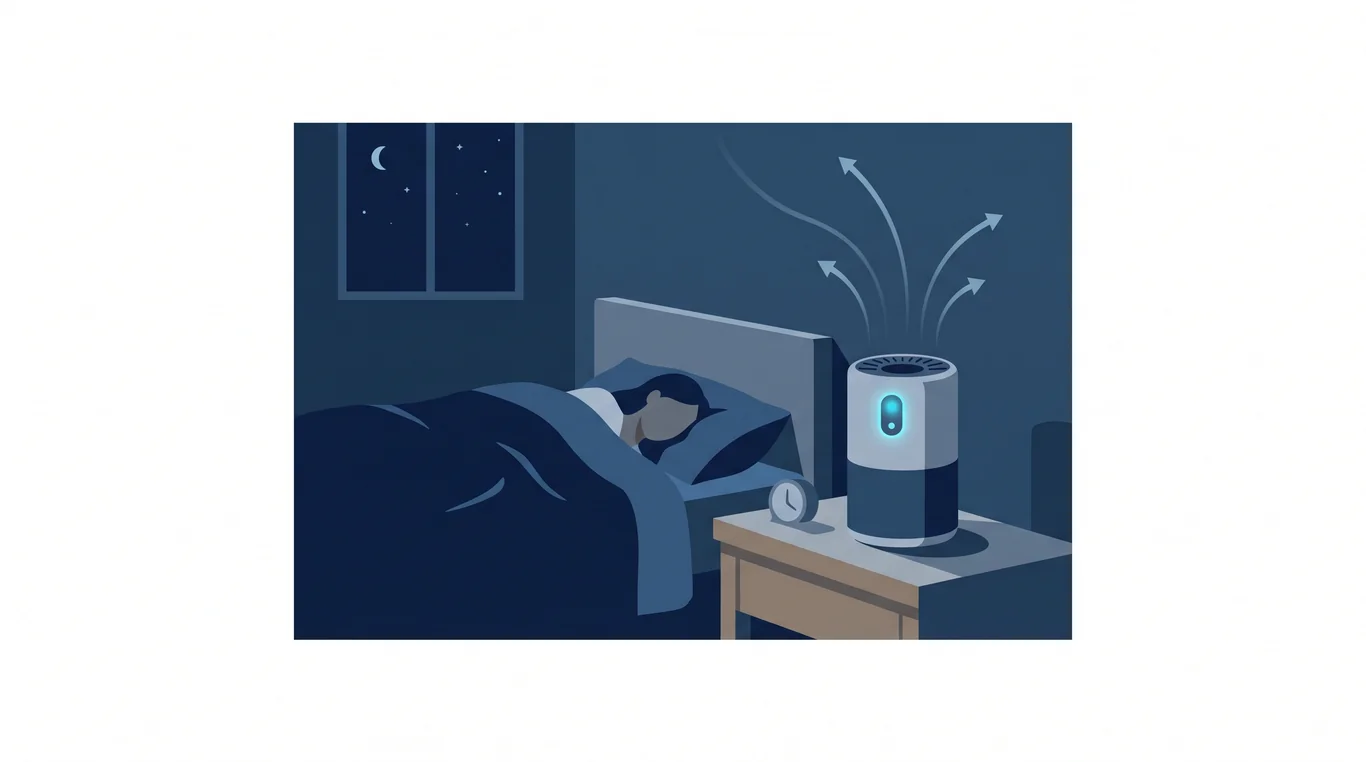
The choice between running a purifier around the clock or only while someone’s home comes down to pollutant rebound. Levels climb back up fast once a unit cycles off, undoing hours of filtering in a short window. The CDC’s guidance supports continuous or near-continuous portable HEPA (high-efficiency particulate air) use. That fits as part of a solid indoor air plan. Most modern units also draw little power on low or sleep settings, which makes constant use easy.
Continuous use tends to make the most sense when:
- Allergies or asthma: someone in the household reacts to pollen, dust, or mold spores.
- Pets in the home: dander and hair keep shedding into the air throughout the day.
- Heavy outdoor pollution nearby: traffic, wildfire smoke, or industrial activity sits close to the house.
- Limited ventilation: windows rarely open and the HVAC system doesn’t bring in much fresh air.
Continuous use isn’t required in every home. A space with none of those factors, decent airflow, and low baseline pollution needs less constant coverage. It can often get by on eight to twelve hours a day. Time it around when people are actually indoors. Even then, sleep or night mode settings typically run at 20 to 35 decibels. That’s quiet enough that overnight use works for light sleepers too.
What to Do After Cooking, Cleaning, or Painting

Certain daily tasks spike indoor pollutants well above the baseline. The EPA has found that VOCs (volatile organic compounds, gases released from products like paint, cleaners, and some cookware) run steadily higher indoors than outdoors. Cooking, cleaning, and painting are some of the biggest short-term sources.
When one of those activities spikes the air, run through this sequence:
- Switch the purifier to its highest safe setting for the room size.
- Keep it running well past the point where the odor or haze clears, not just until the activity ends.
- Crack a window or turn on a vent fan at the same time, if weather allows. Ventilation and filtration work faster together than either one alone.
- Drop back to the normal daily schedule once the air clears and the smell is gone.
Running an Air Purifier Longer for Allergies and Pet Dander
Searches for air purifier allergy relief usually point to the wrong culprit. The problem is rarely the filter, it’s the schedule. A HEPA filter already captures most allergens on a single pass. What allergy and pet-dander households actually need is more hours of runtime, not a stronger filter.
The detail most buyers miss: HEPA’s hardest particle to catch isn’t the smallest one. It’s 0.3 microns, the MPPS (most penetrating particle size), and that’s a worst-case rating. Pollen and pet dander both run larger than that. A HEPA air purifier for allergies already filters them well on every pass. That means runtime, not filter power, is what limits results for most households.
This is why the same continuous-use guidance from the CDC carries extra weight for allergy and pet-dander households. Sustained runtime prevents the rebound in airborne allergens that happens the moment a unit cycles off. That matters more when the trigger is a shedding cat or a pollen-heavy season than in a low-allergen home.
How We Research
We check every claim against primary sources. Federal agencies like the EPA and CDC come first. Certification bodies like NSF and AHAM come next. We verify each standard number against the issuing body. We review this guide on a set schedule.
Why Trust This Guide
Puritisimo covers only water and air quality. Our guidance is editorial and independent. We cite every health figure so you can check it. We never present a promotional claim as fact.
Setting the Right Air Purifier Schedule for Your Home
The right schedule comes down to a few factors working together. Room size, ventilation, and whether anyone in the household deals with allergies, asthma, or pet dander all play a role. Running a unit nonstop, or as close to it as a household’s routine allows, keeps air changes per hour steady. It also avoids the pollutant rebound that comes with cycling a purifier on and off.
Extra runtime after cooking, cleaning, or painting handles the short-term spikes that a fixed schedule misses. If you’re running a Honeywell or Levoit air purifier, the manual lists exact fan-speed and ACH ratings, and knowing how to clean it keeps those numbers accurate. Checking both takes ten minutes. Those specifics tighten up the general guidance here. Once you factor in room size, routine, and any allergy needs at home, you have what you need. Deciding how long to run an air purifier stops being a guess.
Frequently Asked Questions
How long to run an air purifier?
How long you run an air purifier depends mainly on how steady you want your air changes per hour (ACH) to stay. Continuous, 24 hour use is the general advice, according to the CDC. If round-the-clock use isn’t possible, aim for at least 8 to 12 hours a day to keep most rooms clean.
Should you run your air purifier all the time?
Yes. Continuous operation prevents the pollutant rebound that happens when a unit cycles off, so levels don’t creep back up between runs. Most modern purifiers are quiet enough and draw little power on low or sleep settings. That makes constant use easy for nearly any household.
What is the 2/3 rule for air purifiers?
The 2/3 rule comes from AHAM Verifide. A purifier’s smoke CADR (clean air delivery rate for smoke) should equal at least two-thirds of the room’s square footage. That assumes standard 8-foot ceilings. For wildfire smoke specifically, AHAM recommends matching the full square footage instead.
When’s the best time to use an air purifier?
There’s no single best time of day. What matters more is running it during and right after activities that spike particles or VOCs. That includes cooking, cleaning, vacuuming, hosting guests, or painting. Bumping the fan speed up during and after those moments clears the air faster than sticking to a fixed schedule.
Is it okay to leave the air purifier on all night?
Yes, and it’s common practice. Sleep or night modes typically run in the 20 to 35 decibel range. That’s quiet enough not to disturb most sleepers. Even at that lower fan speed, the unit still keeps useful air changes per hour going overnight.
References
- Centers for Disease Control and Prevention. Ventilation and Air Quality: Improving Ventilation in Buildings. 2024.
- AHAM Verifide. AHAM’s Air Filtration Standards. 2024.
- United States Environmental Protection Agency. Volatile Organic Compounds’ Impact on Indoor Air Quality. 2024.
Medical Disclaimer: This content is for informational purposes only. It is not a substitute for professional medical advice, diagnosis, or treatment. If you have concerns about your water quality or air quality and their effects on your health, consult a qualified healthcare professional.