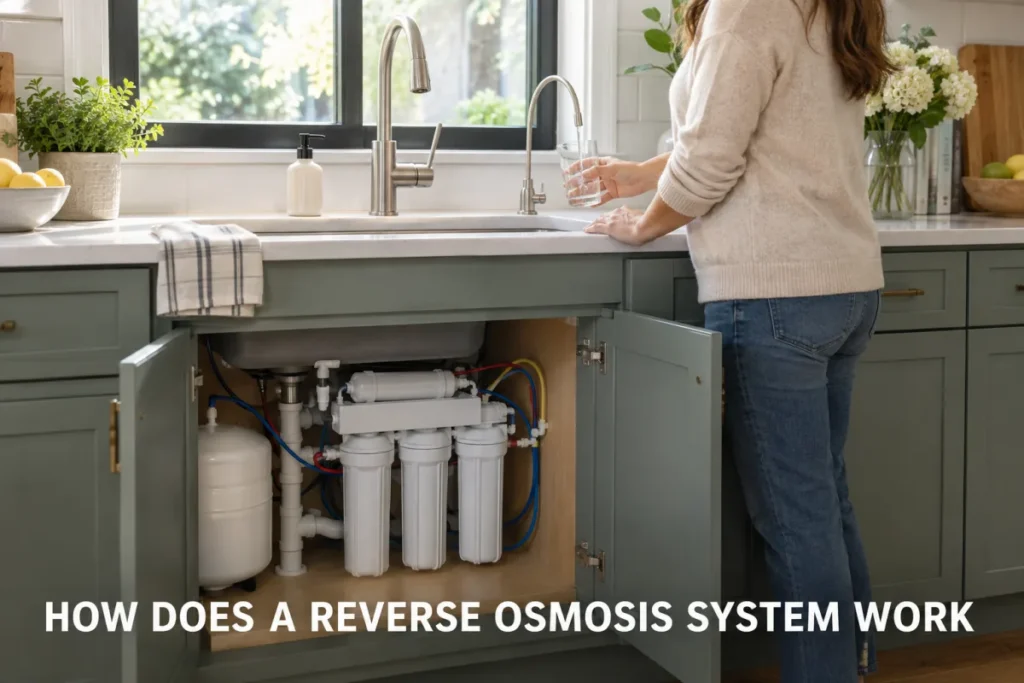
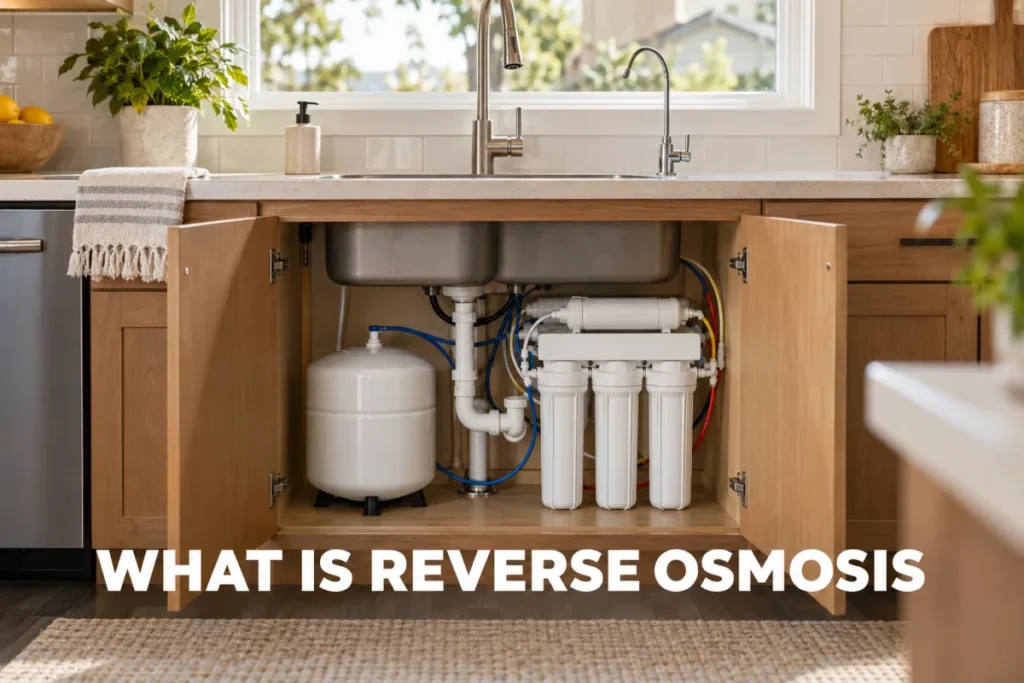
A reverse osmosis system is a multi-stage water filter built around a semi-permeable membrane. It removes dissolved contaminants that ordinary carbon filters cannot catch. Water gets pushed through several stages, sediment, carbon, and the membrane itself, before it reaches your glass. Homeowners install these units under the sink or, less often, for the whole house. This depends on how much water needs treating.

By the end of this guide, you will know exactly what a reverse osmosis system is, stage by stage. You will see how under-sink and whole-house setups differ. You will also see what separates a certified unit from an unverified claim. It also covers what drives the cost of owning one over time.
Key Takeaways
- A reverse osmosis system forces water through a membrane. The membrane is fine enough to block dissolved salts, metals, and most contaminants.
- Under-sink systems treat water at one faucet; whole-house systems filter each tap before water reaches it.
- NSF/ANSI 58 certification requires at least 75% TDS (total dissolved solids, the minerals and salts in water) reduction. This applies under standardized testing. This is the baseline credibility check.
- Well water often needs iron, sulfur, or sediment pre-treatment before it reaches the RO membrane.
What Is a Reverse Osmosis System?
A reverse osmosis (RO) system is a home water filtration unit. It is built around a semi-permeable membrane, a thin barrier with tiny pores. Those pores are small enough to block dissolved salts and heavy metals. The membrane still lets water molecules pass through under pressure while it blocks other pollutants.
That definition matches the EPA’s own description of point-of-use RO systems. That system is a filtration device connected to one fixture. It uses the reverse osmosis process to remove contaminants from tap water. In the United States, systems built for one faucet are certified under NSF/ANSI 58. That is a national standard for point-of-use water treatment. This standard requires at least a 75% reduction in total dissolved solids under standardized lab testing. Certified units test well above that floor, often removing 90 to 96 percent of TDS in practice.
A faucet-mount filter, which attaches to the aerator and routes water through a carbon block, is certified under NSF/ANSI 42 and 53 for lighter filtration needs.
Inside the unit, water often passes through four stages. Our guide on how a reverse osmosis system works walks through each one in more depth. First comes a sediment pre-filter that catches grit and rust. Then comes a carbon filter that pulls out chlorine and odors. Next is the reverse osmosis membrane itself. Finally, a carbon post-filter polishes the taste before water reaches the faucet.
The membrane does the real work. Its pores measure about 0.0001 microns (a micron is one-millionth of a meter). That is thousands of times narrower than a human hair. That is why it blocks dissolved salts and metals. A standard carbon filter lets those same contaminants straight through.
A 6-stage under-sink system certified to NSF/ANSI 58 uses that same membrane but adds an alkaline remineralization stage after it; my iSpring RCC7AK system review covers one of the most reviewed certified options in that format.
That is how the EPA’s WaterSense program defines a point-of-use RO system.
Independent testing found under-sink reverse osmosis achieved near-complete PFAS removal, well ahead of activated carbon alone.
What Is a Reverse Osmosis System: Under-Sink vs. Whole-House Types
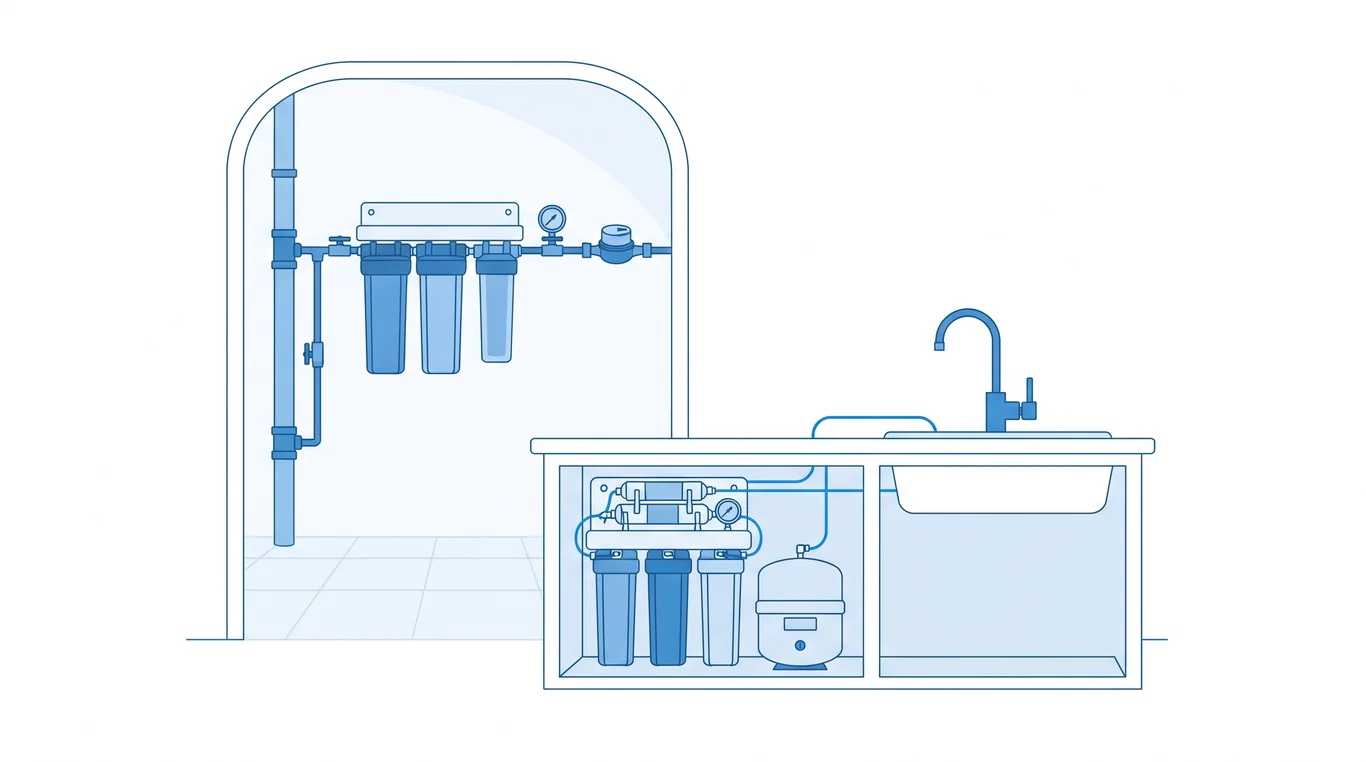
Most home reverse osmosis (RO) setups are under-sink systems. They sit directly beneath the kitchen sink and connect to just one faucet. Water moves through the full sediment-carbon-membrane-carbon sequence inside a compact unit tucked into the cabinet. Only that single tap delivers filtered water. Under-sink units are the standard reverse osmosis system for home purchase. They need no rerouting of the house’s main water line.
Whole-house, or point-of-entry reverse osmosis systems, intercept water where it enters the home. They treat each fixture downstream instead of one faucet. These setups are far less common than under-sink units. They often need licensed installation, higher flow capacity, and their own drain line. Whichever type a household chooses, what a reverse osmosis system is at its core does not change. A semi-permeable membrane still does the work of blocking dissolved contaminants.
One nuance worth knowing: NSF/ANSI 58 is written specifically for point-of-use systems. NSF, the standard’s source, is an independent product-safety certifier. It requires at least 75% total dissolved solids (TDS) reduction under certified testing. Whole-house RO setups are not standardized the same way. That is part of why they are rarer and pricier to install correctly.
The practical differences between the two setups come down to three factors:
| Feature | Under-Sink (POU) | Whole-House (POE) |
| Installation location | Beneath a single sink | Where the main line enters the home |
| Water treated | One dedicated faucet | Every fixture in the house |
| Typical installer | DIY-friendly for most homeowners | Often a licensed plumber |
What Makes a Good Reverse Osmosis System
Not every reverse osmosis system on the market performs the same. Some look nearly identical under the sink but perform differently. A few checks separate a certified system from a bare sales claim. Skipping any of them is how buyers end up with a filter that under-delivers.
The iSpring RCC7 clears those checks at the whole-system NSF/ANSI 58 level rather than the cartridge level; my iSpring RCC7 certified review covers the certification scope and what each of its five stages contributes.
- Certification: Look for NSF/ANSI 58 (or an equivalent ANSI-accredited seal) on the spec sheet. Do not settle for just the word “certified” printed on the box. This confirms independent testing rather than a manufacturer’s own claim.
- GPD rating: Gallons-per-day (GPD) output should match household size. An undersized membrane produces slow, low-pressure water at the tap.
- Stage count: Most home units run four to six stages. These are usually sediment, carbon, membrane, post-carbon, and sometimes a remineralization (adding minerals back after filtration) cartridge. More stages usually means broader contaminant capture, not just padding for show.
- Documented removal data: A 2020 study testing real-home water filters found under-sink reverse osmosis achieved near-complete removal of PFAS (per- and polyfluoroalkyl substances). Activated carbon alone removed just 60 to 70 percent of the same compounds. See our guide to what a reverse osmosis system removes for the complete contaminant list.
The gap between what a reverse osmosis system claims on the label and what it actually delivers is rarely visible from the outside. This is why paperwork, not the price tag, is the more reliable signal.
Installing and Setting Up a Reverse Osmosis System
Installing an under-sink reverse osmosis system is a multi-step plumbing job. Most homeowners with basic tools can finish it in an afternoon. Whole-house installation is the exception. It often calls for a licensed plumber because of the drain-line sizing and pressure requirements.
- Turn off the cold water supply line under the sink and open the faucet briefly to relieve pressure.
- Mount the pre-filter, post-filter, and membrane housings on the cabinet wall or a bracket. Follow the unit’s stage order.
- Install the feed-water adapter on the cold supply line. Connect tubing from the adapter to the first pre-filter stage.
- Drill the drain saddle into the sink drain pipe above the trap. Then run the drain line and its own faucet line to a new hole in the sink or countertop.
- Flush the system for 15 to 20 minutes before first use to clear carbon fines. Then recheck each fitting for leaks under full pressure.
A poorly seated fitting is the single most common install mistake. It usually shows up as a slow drip under the sink within the first week, not immediately. Checking each push-to-connect fitting a second time after the initial flush catches most of these problems. Left unaddressed, they turn into a cabinet full of water damage.
Reverse Osmosis Systems for Well Water
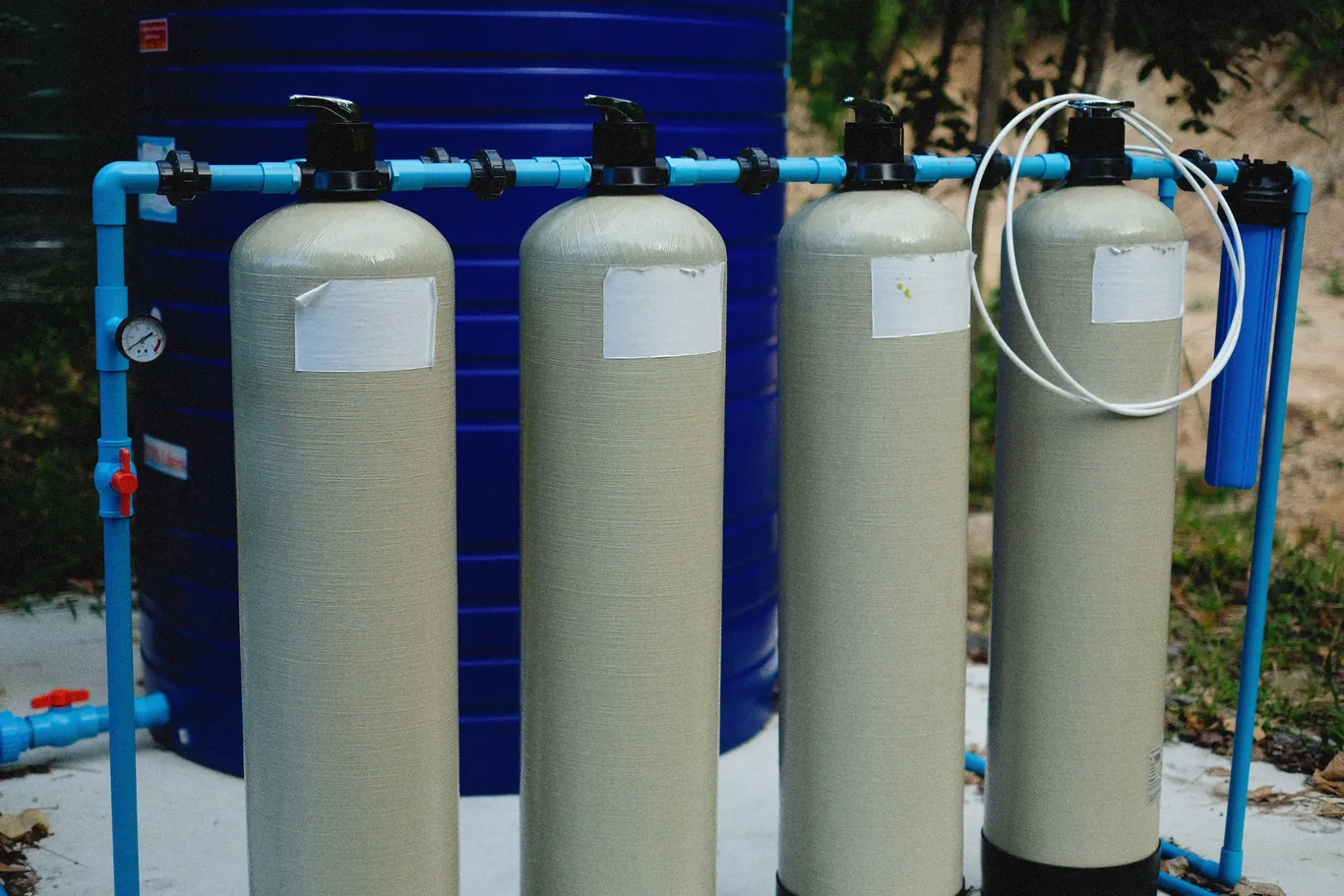
Reverse osmosis membranes are more sensitive to raw well water than to treated municipal supplies. Iron, sulfur, sediment, and hardness minerals are common in well water. They can clog or scale a membrane within months if the water reaches it untreated. This can happen well before the membrane’s normal service life is up.
That is why a well-fed RO system almost always sits behind a dedicated pre-treatment stage. That could be a sediment filter at minimum, often a water softener or iron filter. That is different from the standard two-stage carbon pre-filter built into most under-sink kits. Skipping this step is the single most common reason a reverse osmosis system for well water fails early.
Private wells also fall outside the routine oversight that public water utilities operate under. Testing the water before installing any treatment system, RO included, is the homeowner’s responsibility. A utility does not handle this step on its own. Run a basic water test for iron, hardness, and bacteria before purchase. It tells you which pre-treatment stage, if any, the RO system needs.
Assuming the same setup used for city water will work the same way is a mistake. It is the most common early-failure cause in well-fed systems. It is not a defect in the RO unit itself.
Reverse Osmosis System Cost and Maintenance
Cost comparisons between reverse osmosis systems are more useful in relative terms than absolute ones. Unit prices shift with brand and stage count. An under-sink system costs less upfront than a whole-house setup. The gap widens further once licensed installation is added to the whole-house total. The larger long-term cost driver for either type is not the initial unit at all. It is the recurring filter and membrane replacement schedule that keeps the system performing at its rated output.
When a reverse osmosis system needs repair, the failure often traces to one of three points. It could be a fouled or scaled membrane. It might also be a worn check valve that lets the storage tank lose pressure, or a slow leak at a push-to-connect fitting. NSF/ANSI 58 certification includes structural integrity testing, 100,000 cyclic pressure cycles on the housing and fittings. That is part of why a certified unit tends to last longer under years of daily pressure changes. It does cost more to buy.
Budgeting for a whole-house reverse osmosis system means planning ahead for recurring costs. That includes filters and a replacement membrane every two to three years. You should also budget for occasional fitting repairs, rather than treating the sticker price as the whole picture.
How We Research
We check every claim against primary sources. Federal agencies like the EPA and CDC come first. Certification bodies like NSF and AHAM come next. We verify each standard number against the issuing body. We review this guide on a set schedule.
Why Trust This Guide
Puritisimo covers only water and air quality. Our guidance is editorial and independent. We cite every health figure so you can check it. We never present a promotional claim as fact.
Deciding Whether a Reverse Osmosis System Is Right for Your Water
A reverse osmosis (RO) system earns its cost when tap water carries contaminants a standard filter cannot catch: arsenic, PFAS, or high TDS. It matters less when the concern is only chlorine taste or sediment, since cheaper filters handle those; a countertop water filter covers chlorine taste, sediment, and lead reduction at a fraction of the price with no permanent installation. The right setup depends on the home. An under-sink unit fits most kitchens. A whole-house system suits a household on well water or one that wants each tap protected.
Before buying, test the water and compare long-term filter and membrane replacement costs, not just the unit price. That comparison settles the decision faster than any spec sheet. See our complete guide to how much a reverse osmosis system costs for the full breakdown.
RO water is healthy and safe for most people to drink daily. Mineral loss from the membrane is not a documented health risk. NSF/ANSI 58 certification confirms the membrane meets recognized safety standards. A normal diet supplies any minerals the filtration removes.
Frequently Asked Questions
What is a reverse osmosis system?
A reverse osmosis system is a water filtration device that forces tap water through a semi-permeable membrane. It is fine enough to block dissolved salts, metals, and other contaminants, alongside sediment and carbon pre-filters. That is how the EPA’s WaterSense program defines a point-of-use RO system. Most residential units are under-sink models built around this same core process.
What is the downside of reverse osmosis water?
The main tradeoff with reverse osmosis water is what it takes out along the way. The filtration process produces more wastewater than purified water during operation. The same membrane that blocks contaminants also strips out beneficial minerals like calcium and magnesium. Neither is a documented health risk for someone eating a normal diet. The mineral loss can flatten the water’s taste compared with tap or spring water. Slower flow rate is another common disadvantage of reverse osmosis systems. Storage tanks help offset this by holding filtered water in reserve.
Is it healthier to drink reverse osmosis water?
Reverse osmosis water is not inherently healthier in a general sense. It is more effective at removing specific regulated contaminants, including lead, arsenic, and PFAS. This depends on whether the source water actually contains them. Independent testing found under-sink reverse osmosis achieved near-complete PFAS removal, well ahead of activated carbon alone. The health benefit depends entirely on what is in the water to begin with. Distilled water is not the same as RO water. Distillation boils water, then recondenses the steam. RO forces water through a membrane instead. Both remove most minerals, but through different methods.
Why would I need a reverse osmosis system?
A standard carbon or sediment filter improves taste and catches particles. It does not remove dissolved contaminants like arsenic, PFAS, or high total dissolved solids (TDS). TDS refers to the minerals and metals present at the molecular level. A reverse osmosis system is what pulls those dissolved substances out. This matters most for a household on well water. It also matters in an area with a documented contaminant issue in the local water report.
How much does an RO water system cost?
An RO system’s overall cost depends more on type and upkeep than on the sticker price alone. Under-sink units cost less upfront than whole-house systems. Licensed installation, common for whole-house setups, adds further to the total. The bigger long-term expense is ongoing: filters and membranes need periodic replacement. That keeps the system performing at its rated output, no matter which type is installed.
References
- NSF International. Standards for Water Treatment Systems (NSF/ANSI 58). 2024.
- EPA WaterSense. Point-of-Use Reverse Osmosis Systems. U.S. Environmental Protection Agency. 2024.
- ACS Publications, Environmental Science & Technology Letters. Real-World Performance of Point-of-Use and Point-of-Entry Water Treatment Devices for PFAS Removal. 2020.
Medical Disclaimer: This content is for informational purposes only. It is not a substitute for professional medical advice, diagnosis, or treatment. If you have concerns about your water quality or air quality and their effects on your health, consult a qualified healthcare professional.