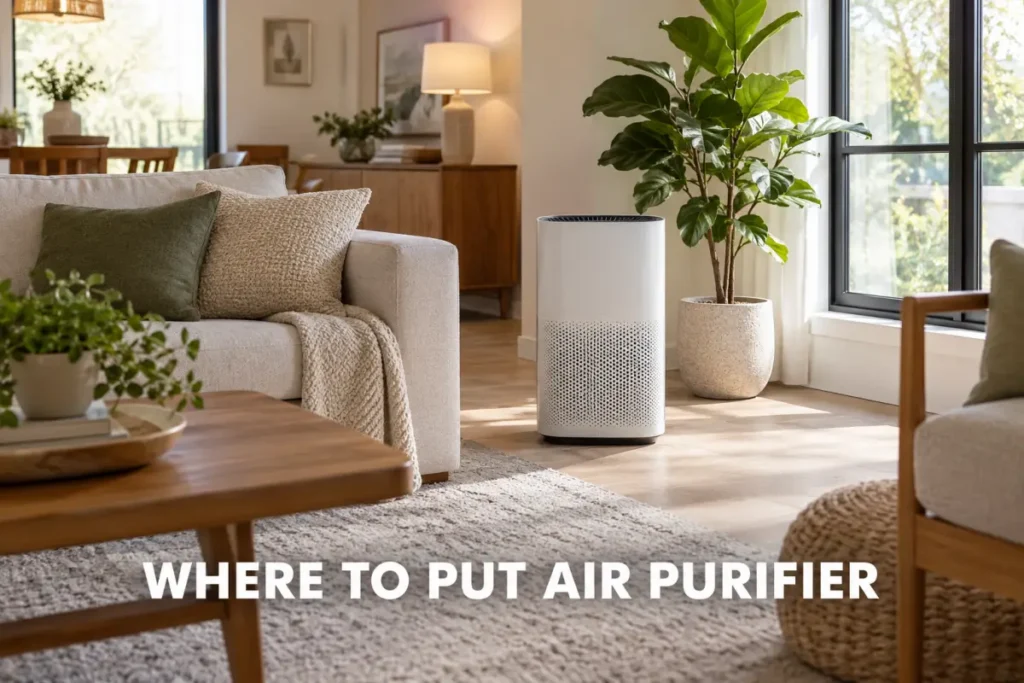
Where you put an air purifier matters as much as the model you buy. The best spot is a central, open location, clear of walls and furniture. Size it to the room using the unit’s CADR (clean air delivery rate, how much filtered air it puts out each minute). A corner or a crowded shelf blocks airflow. That cuts real-world performance well below what the box promises.

By the end of this guide, you’ll know the general placement rule and the best spot in every room. You’ll also know whether floor or raised placement works better, and how to adjust for pets, smoke, or a nursery. Each section gives a specific, no-guesswork answer you can use today.
Key Takeaways
- Match your purifier’s smoke CADR to at least two-thirds of the room’s square footage.
- Central, open spots with airflow clean a room faster than corners or crowded shelves.
- Position it between the smoke source and your living space for stronger odor capture.
- Keep ozone-generating units, including most ionizers, well away from a nursery or crib.
Where to Put Air Purifier: What Good Placement Means
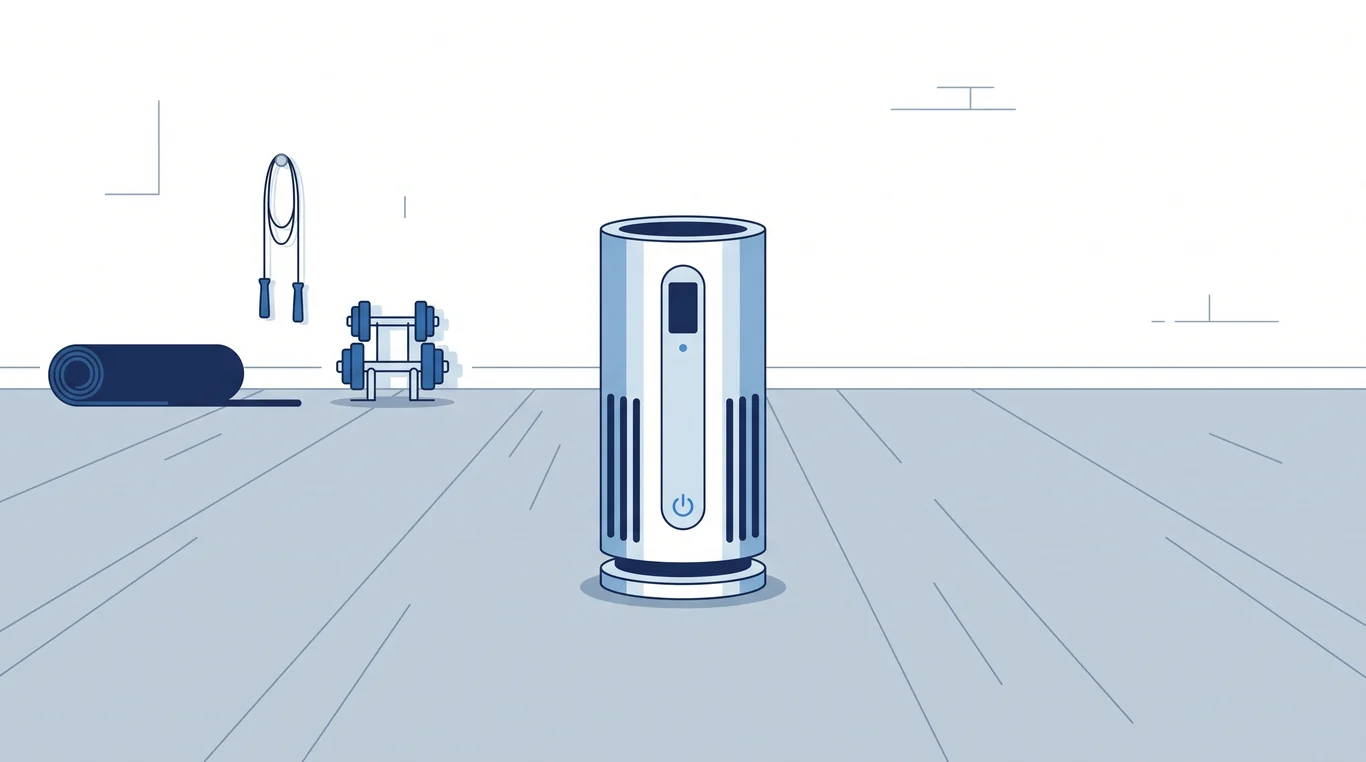
Good air purifier placement means a central, open spot with a few feet of clearance on every side. Keep it away from walls, corners, and furniture that block airflow. Size the unit to the room using its smoke CADR. That is the clean air delivery rate for smoke-sized particles, not just the overall CADR number.
The rule of thumb: smoke CADR should equal at least two-thirds of the room’s square footage. That assumes an 8-foot ceiling, per AHAM Verifide’s air filtration standards. For wildfire smoke, match CADR to the room’s full square footage instead. The Centers for Disease Control and Prevention (CDC) recommends at least 5 air changes per hour (ACH) of clean air indoors. An open, unobstructed spot moves more air than a corner does.
Here’s a detail most buyers miss: CADR ratings come from tests at the unit’s highest fan speed, inside a sealed chamber. That test chamber has no walls or furniture in the way. Run the unit on a quieter setting in a normal room. Real-world coverage then shrinks below what the box lists. That is one more reason to pick an open, central spot instead of a corner. A corner may look tidy, but it still blocks airflow.
For a mid-size unit where central placement in a larger room unlocks the full CADR class, my Core 400S-P air purifier review covers the certified output figures for an open living-room spot.
Size the unit with the smoke CADR two-thirds rule.
Where to Put Air Purifier in Different Rooms of Your Home
Room choice comes down to where you spend the most time. That is where clean air matters most. The U.S. Environmental Protection Agency (EPA) reports that Americans spend close to 90 percent of their time indoors. That is why a bedroom or main living space should come before a rarely used guest room. Match placement to daily habits, not to what looks tidiest.
The right spot still depends on the room:
- Bedroom: Keep the unit three to six feet from the head of the bed. That is close enough to clean the air you breathe while sleeping. It is also far enough that airflow reaches the whole room instead of one spot.
- Living room: Set it in a central, open spot between the main seating area and the room’s biggest pollution source. That might be a kitchen doorway or a window you open often.
- Kitchen: Position it near the stove or trash can, but not directly in a range hood’s exhaust path. Otherwise the two airflows work against each other.
- Studio apartment: Place it centrally and slightly raised. One unit can then reach cooking, sleeping, and living zones without furniture blocking its intake.
Floor, Table, or Elevated: Where Height Matters
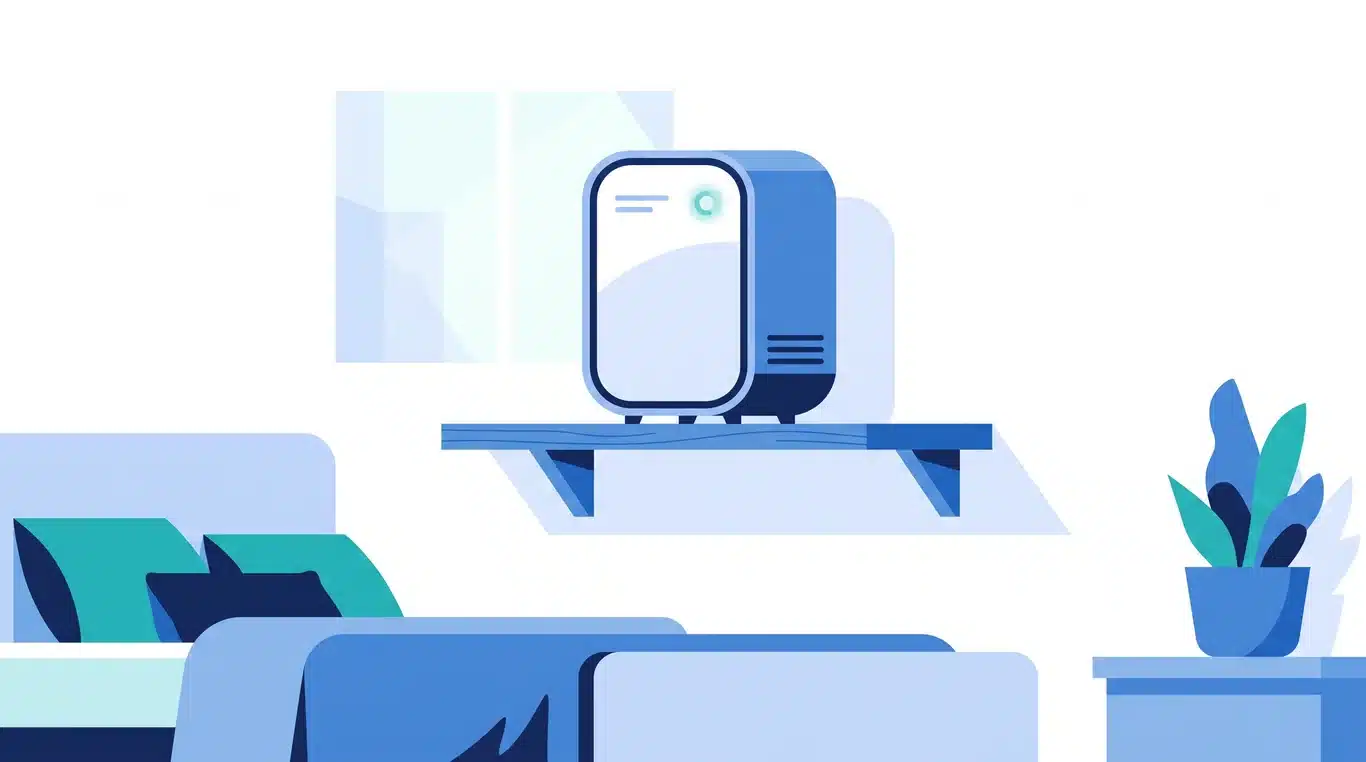
Height changes how much air a purifier cleans, not just where it fits visually. The EPA‘s Guide to Air Cleaners in the Home explains that real-world performance depends on airflow and fan settings as much as filter grade. A unit boxed in by furniture at floor level pulls in less air. A unit with open space around its intake pulls in more.
Heavy allergen particles, like dust mite debris and pet dander clumps, settle out of the air within minutes. They collect near the floor. Raising a purifier’s intake by two to three feet helps it recapture settled dust and dander before it resettles.
For a compact unit suited to that raised placement in a single bedroom, my Core 300-P review covers its 360-degree intake design and AHAM-certified bedroom coverage.
The difference between the two approaches becomes clear side by side:
| Factor | Floor Level | Elevated or Table |
| Airflow and reach | Nearby furniture blocks intake and shortens effective range | Open airflow lets the unit pull in and circulate air across a larger area |
| Dust and allergen capture | Close to settled dust, but weaker circulation limits recapture | Catches airborne particles before they resettle, improving recapture |
| Safety around kids and pets | Easier for toddlers and pets to bump, tip, or block | Out of reach of curious hands and paws, though cords need securing |
Air Purifier Placement for Pets and Cat Allergies
Pet dander does not stay confined to wherever the animal naps. Research indexed in PMC (PubMed Central), the National Library of Medicine’s database, found the cat allergen protein Fel d 1 in 99.9 percent of U.S. homes. It also found the dog allergen protein Can f 1 in almost every home, whether or not a pet lives there now.
Litter boxes and pet beds: Place the unit a few feet away rather than pointed directly at either one. Direct blasting stirs up dander and litter dust instead of trapping it. Nearby placement still pulls those particles in as they drift.
High-shed zones: Couches, rugs, and doorways where a pet regularly rests collect the most dander over time. Running the unit all the time, not just when the pet is visible, keeps those zones from building up between cleanings.
Air Purifier Placement for Smokers and Tobacco Odor
Tobacco smoke carries a uniquely large chemical load. The Centers for Disease Control and Prevention (CDC) documents that secondhand smoke contains more than 7,000 chemical compounds. Dozens of them are known carcinogens. That is why source-based placement matters more here than in almost any other room.
Cigarette smoke particles average about 0.1 to 1.0 micron (about 1/25,000 of an inch). That size is one of the hardest for any filter to trap. The particles are too small for simple impaction and too large to diffuse predictably. That is why the smoke Clean Air Delivery Rate (CADR) number, not the general CADR rating, determines how well a purifier clears tobacco odor.
Getting placement right for smoke follows a simple sequence:
- Identify the smoke source first, such as a stove, fireplace, or a smoking area. Placement only works once it is tied to where the smoke starts.
- Position the purifier between that source and the rest of the living space. That way, air passes through the filter before it spreads to other rooms.
- Size the unit to its smoke CADR rating, not its overall CADR rating. Manufacturers test smoke clearance separately, so the two numbers often differ.
- Run it the whole time during and after smoking. Odor and fine particles linger in the air for hours after visible smoke clears.
Air Purifier Placement for a Nursery or Baby’s Room
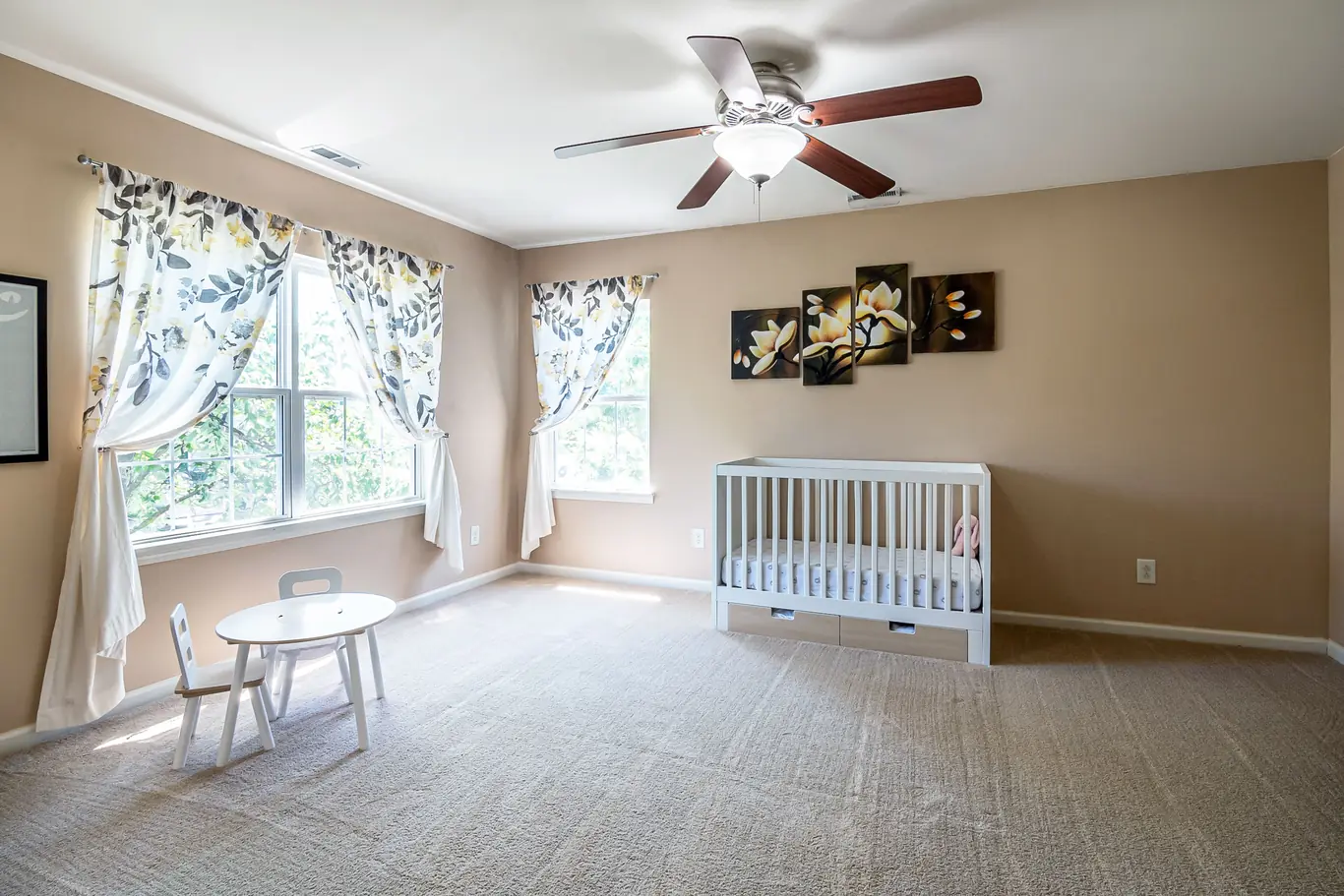
A nursery calls for extra caution because some air cleaners generate ozone as a byproduct. The EPA warns that ion generators and similar ozone-generating air cleaners can produce ozone concentrations above levels considered harmful to breathe. That rules out most ionizing units for a baby’s room.
Distance from the crib: Keep the unit several feet away rather than right beside it. That is close enough to clean the air the baby breathes. It is also far enough that neither the airflow nor the noise reaches the crib directly.
Filter type: Choose an ozone-free, CARB-compliant unit with a true HEPA filter (a dense mesh screen that traps at least 99.97% of tiny particles) rather than an ionizer. It removes particles instead of adding an extra gas to the air.
Noise level: Run it on its lowest setting during sleep hours. Place it far enough from the crib that low-level fan noise blends into the background instead of waking the baby.
How We Research
We check every claim against primary sources. Federal agencies like the EPA and CDC come first. Certification bodies like NSF and AHAM come next. We verify each standard number against the issuing body. We review this guide on a set schedule.
Why Trust This Guide
Puritisimo covers only water and air quality. Our guidance is editorial and independent. We cite every health figure so you can check it. We never present a promotional claim as fact.
Placing Your Air Purifier for Real-World Results
The best spot for an air purifier is rarely the corner it landed in on move-in day. A central, open location, sized to the room’s smoke CADR, outperforms a shelf against the wall in almost every case. The specifics shift once pets, smokers, or a nursery enter the picture. Keep it closer to litter boxes and pet beds. Position it between a smoke source and the rest of the home. Or set it a safe few feet from a crib, running an ozone-free unit on its lowest setting.
None of this calls for a bigger or pricier machine, only a smarter spot for the one already sitting in the room. That is why where you put an air purifier matters as much as which model ends up on the shopping list.
Frequently Asked Questions
Where to put air purifier?
Where you put an air purifier matters most for airflow, not just for looks. The best spot is central and unobstructed. Keep it clear of walls, curtains, and furniture that can block intake and output. Size the unit with the smoke CADR two-thirds rule. That means matching its rating to at least two-thirds of the room’s square footage for reliable results.
What is the 2/3 rule for air purifiers?
The two-thirds rule means a purifier’s smoke CADR should equal at least two-thirds of the room’s square footage. That assumes standard eight-foot ceilings. For wildfire smoke, match the CADR to the room’s full square footage instead. Outdoor smoke events call for faster air exchange.
Is it good to sleep with an air purifier?
Yes, running an air purifier overnight is generally a good idea. Sleep is often when people spend the most hours in a row breathing the same room air. Keep the unit three to six feet from the head of the bed rather than right beside the pillow. That way, it moves air across the whole room instead of blasting one spot.
Should the bedroom door be closed when using an air purifier?
Closing the bedroom door helps an air purifier clean a smaller, contained volume of air more quickly. That is useful right before bed or during allergy flare-ups. Leaving the door open lets air move between rooms. But it also spreads the unit’s cleaning power across a larger space, which weakens results in the bedroom itself.
Should an air purifier go in the bedroom?
Yes, the bedroom is one of the best rooms for an air purifier in most households. People typically spend more hours in a row there than anywhere else in the home. Keep it three to six feet from the head of the bed. That way it can move clean air across the room without direct airflow or added noise disturbing sleep.
References
- AHAM Verifide. AHAM’s Air Filtration Standards. Association of Home Appliance Manufacturers.
- U.S. Environmental Protection Agency. Report on the Environment: Indoor Air Quality.
- PMC, National Library of Medicine. Persistence and Prevalence of Cat and Dog Allergens (Fel d 1 and Can f 1) in Indoor Environments.
Medical Disclaimer: This content is for informational purposes only. It is not a substitute for professional medical advice, diagnosis, or treatment. If you have concerns about your water quality or air quality and their effects on your health, consult a qualified healthcare professional.