
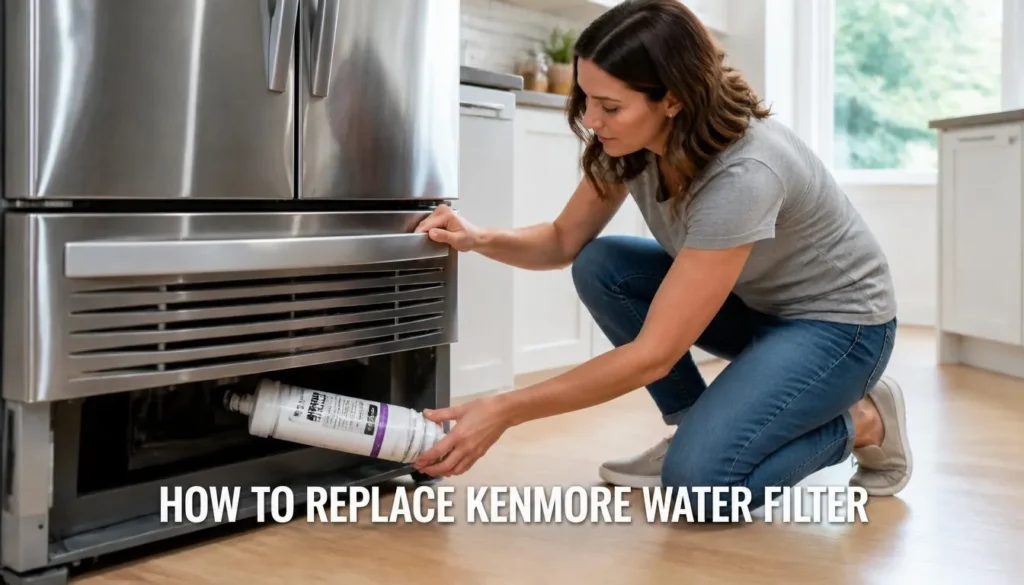
You can replace a Kenmore refrigerator water filter in about five minutes. You release the old cartridge, seat the new one, and flush the line. Then you reset the indicator light if your refrigerator has one. Swapping a Kenmore water filter cartridge is easy once you know your release style (push-button, pull-down, or twist). Most Kenmore manuals call for a new cartridge about every six months.
Below you’ll find the steps, a quick way to spot your filter style, and the signs a change is due. You’ll also learn what to do when a cartridge won’t budge. By the end, you’ll know what to do before, during, and after the swap.
Key Takeaways
- Release the old cartridge, seat the new one, flush about 2 gallons, then reset the light.
- Kenmore fridges use push-button, pull-down, or twist cartridges, so match your manual to your model.
- Change the cartridge about every six months, or sooner when the indicator light comes on.
- A stuck cartridge usually frees up once you shut off the water and release the pressure.
How to Replace Kenmore Water Filter in Six Steps
Your refrigerator sends tap water through a carbon cartridge (a block of activated charcoal that catches chlorine taste and some particles). The water then continues to the dispenser and the ice maker. The steps below fit most Kenmore refrigerators. The release style does change from model to model, so keep your owner’s manual nearby while you work.
The EPA tells filter owners to follow the manufacturer’s instructions exactly and to use only the cartridge that is compatible with your filter. That advice matters because an incompatible cartridge may not seal correctly and can leak.
Follow these steps in order:
- Find the filter housing. Depending on your model, it sits behind the bottom grille or inside the fresh food compartment.
- Release the old cartridge. Press the release button and slide it out, pull it down, or twist it free, depending on its style.
- Unpack the new cartridge and remove any protective caps or covers. Leave the O-rings (the rubber rings that seal the connection) in place and clean. On grille filters, move the reusable decorative cap over from the old cartridge.
- Seat the new cartridge using the locking method in your manual. Align the lock marks, push until the eject button snaps out, or close the cover. Do not force it past its stop.
- Check for leaks. Hold a glass under the dispenser and watch the connection. Spurting and sputtering are normal while trapped air escapes.
- Flush and reset. Run about 2 gallons through the dispenser, then hold the Filter or Reset button for about 3 seconds if your model has one.
Find Your Filter Style and Model Number First
Kenmore is a brand name that has appeared on refrigerators from several manufacturers, so no single removal procedure fits every refrigerator. Your model number tells you which cartridge fits and how the old one comes out. You can usually find it on a label inside the fresh food compartment.
The part number is also printed on the old cartridge, so read it before you buy a replacement. The EPA lists refrigerator filters among the styles that can be certified to reduce lead. For lead, it advises looking for NSF/ANSI 53 (a standard for health-related contaminants) certification specifically for lead. It also advises NSF/ANSI 42 Class I particle reduction (reduction of very small particles).
You can buy the Kenmore-branded cartridge or a compatible cartridge from another brand. Either way, confirm that the part number matches and that the box shows the NSF marks you want. Kenmore Elite models follow the same logic, so read that manual too.
These are the three release styles you’ll meet most often:
| Release style | How the old cartridge comes out | What to check on the new one |
| Push-button | Press the release button, then slide it out | It stops, then sits flush with the button |
| Pull-down | Pull the cartridge down, then out | The cover pushes up and clicks shut |
| Twist | Twist to unlock, then pull it free | It twists until it locks in place |
When to Change a Refrigerator Water Filter
Plan to change refrigerator water filter cartridges approximately every six months. Many Kenmore manuals give that interval, although some older ones allow six to nine months or about 400 gallons of use. Go by the number in your own manual, because the interval depends on the model. Other filter types follow different schedules, as our guide to how often to change a water filter explains.
Changing refrigerator water filter cartridges on time matters because carbon has a limit. The EPA says activated carbon filters (filters that use charcoal to trap contaminants) are built to treat a set amount of water. After that, they clog and stop working.
Watch for these signs that a replacement cartridge is due:
- Indicator light: the fridge says it is time. On many models the light counts time or water use, not water quality.
- Slow flow: the dispenser trickles, or the ice maker fills slowly.
- Taste or smell: a chlorine taste or odor comes back.
- Calendar: six months have passed since the date on the cartridge.
When a filter has no indicator light, the EPA says you should track the days or gallons since install and set your own reminder. Writing the install date on the cartridge makes that easy.
One more case is worth knowing. If the fridge has sat unused, such as during a move, one Kenmore Elite manual says to change the cartridge before you hook the fridge back up. A fresh cartridge gives the line a clean start.
How to Replace Kenmore Water Filter When It Is Stuck
A stuck cartridge is common and rarely means anything is broken. One frequent cause is pressure left in the housing (the plastic socket that holds the cartridge), and another is using the wrong release motion for your style.
Start with your manual and confirm the style. A push-button cartridge needs the button pressed first. A pull-down cartridge needs a firm, steady pull. A twist cartridge needs a gentle turn, never a hard yank. Our general guide to changing a water filter in a fridge covers other brands too.
Prepare for a little mess before you attempt the removal. The housing holds some water, and one Kenmore Elite manual warns that small amounts can be released. Lay a towel under the housing and clear food from the shelf below it, since the housing has drain holes on its underside.
If it still won’t move, shut off the water supply to the fridge. Then press the dispenser lever to relieve the pressure and try again with even force. Avoid pliers and wrenches, because they can crack the housing, and a cracked housing causes leaks. If nothing works, contact Kenmore customer support with your model number ready.
Flush the Line and Reset the Filter Light
Run water through the dispenser immediately after the installation of the new cartridge. Kenmore installation guides and manuals call for about 2 to 2.5 gallons. One Kenmore guide has you run it in cycles of 30 seconds on and 60 seconds off, not all at once. Go by the amount and cycle in your manual.
Expect spitting and sputtering at first. That is trapped air leaving the line, which is expected after any installation. While you flush, check the housing for drips. A steady leak can come from poor seating, damaged seals, or a cracked cartridge. Shut off the water, inspect the parts, and reseat the cartridge. Call service if leaks continue.
Then reset the replacement reminder. On many models you hold the Filter or Reset button for about 3 seconds, and the light changes to confirm it. Some models use a different control, so follow your manual. The reset only restarts the countdown. It does not evaluate the water or the cartridge, so press it after you change the filter, never before.
What a New Cartridge Can and Cannot Do
A fresh cartridge restores what your filtration system was designed to do, which is mostly to improve the taste and smell of the water and to catch particles. NSF International (a nonprofit that tests and certifies water products) sets the standards. NSF/ANSI 42 covers aesthetic effects such as chlorine taste and odor, and its certification is granted per contaminant.
The detail many owners miss is that a cartridge certified for one contaminant is not automatically certified for another. Read the exact claim on the box, not just the logo, and compare it with the specific contaminants you want the filter to reduce in your household.
A carbon filter has other limits too. The EPA says an activated carbon filter by itself is not designed to remove all disease-causing organisms. It also says carbon filters have a set shelf life, so replace them according to the manufacturer’s instructions. If you use a private well, the EPA recommends testing for nitrates and coliform bacteria (a group of germs that signals possible contamination) every year.
How We Research
We check every claim against primary sources. Federal agencies like the EPA and CDC come first. Certification bodies like NSF and AHAM come next. We verify each standard number against the issuing body. We review this guide on a set schedule.
Why Trust This Guide
Puritisimo covers only water and air quality. Our guidance is editorial and independent. We cite every health figure so you can check it. We never present a promotional claim as fact.
Keeping Your Kenmore Fridge Water Fresh
Swapping a cartridge is a short job. You only need three things: your release style, your change interval, and your after-swap steps. Release the old cartridge, seat the new one until it stops, flush about 2 gallons, and reset the light. If it sticks, shut off the water and release the pressure first. Write the date on the new filter so the next change never sneaks up on you. A fresh cartridge helps with taste, smell, and particles, but only with good care. With these steps in hand, you can swap a Kenmore cartridge the right way.
Frequently Asked Questions
How do I replace the water filter on my Kenmore refrigerator?
Replacing a Kenmore water filter cartridge comes down to three moves. Release the old cartridge the way your model allows, seat the new one until it stops or clicks, then flush about 2 gallons through the dispenser. Finish by resetting the indicator light if your refrigerator has one.
Why can’t I get the filter out of my refrigerator?
Most stuck cartridges come from pressure in the housing or the wrong release motion. Push-button, pull-down, and twist styles each need a different move, so confirm yours in the manual. Shutting off the water and relieving the pressure often lets the cartridge release with gentle, steady force.
My Kenmore refrigerator water filter is stuck. How do I remove it?
Shut off the water supply to the fridge first. Then press the dispenser lever to relieve pressure and try the release again with steady, gentle force. Avoid pliers, because they can crack the housing. If the cartridge still holds, call Kenmore support with your model number.
How to reset Kenmore refrigerator after replacing water filter?
On many models, hold the Filter or Reset button for about 3 seconds after you install the new cartridge. The light then changes to show the reset worked. Models differ, so check your manual. The reset only restarts the timer, and it does not test the water.
How to change water filter in Kenmore side by side refrigerator?
Side by side models vary, so first look for the housing inside the fresh food compartment or behind the bottom grille. Release the old cartridge, seat the new one, and flush about 2 gallons. Your manual shows the exact release style for your model number.
References
- EPA. Learn how to maintain your water filter. 2025.
- EPA. Water Health Series: Filtration Facts. 2005.
- EPA. Choose the water filter that’s right for you. 2025.
- NSF International. Standards for water treatment systems.
Medical Disclaimer: This content is for informational purposes only. It is not a substitute for professional medical advice, diagnosis, or treatment. If you have concerns about your water quality or air quality and their effects on your health, consult a qualified healthcare professional.

