
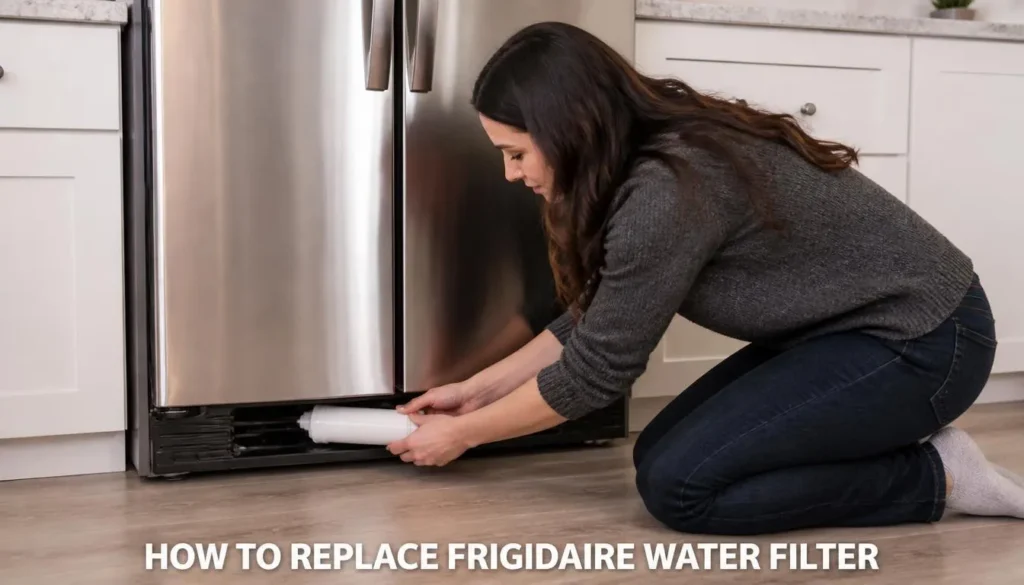
Replacing a Frigidaire water filter means swapping a sealed cartridge, so you take out the old one, lock in a new one, and run water through it. The whole job is a quick one, and you don’t need tools. This guide covers Frigidaire water filter replacement for the two designs covered here, twist-in and push-in, and the motion you need depends on your filter model.
Below, you’ll get the exact steps for each design, the priming step Frigidaire asks you to do before first use, and how often to swap the cartridge. By the end, you’ll know which filter you have and how to put the new one in correctly.
Key Takeaways
- The PureSource Ultra II twists in 90 degrees to the right. The PurePour PWF-1 pushes in until it locks.
- Run water through the dispenser for about 3 minutes, or 1.5 gallons, and pour it out before drinking.
- Change the filter every 6 months or 125 gallons, whichever comes first.
- Certification is per contaminant, so read the filter’s Performance Data Sheet for its exact list.
How to Replace Frigidaire Water Filter: The Ultra II Steps

A fridge filter is a sealed cartridge that locks into a housing, and replacing it means unlocking the old one and locking in a new one.
Before you start, have the new filter unwrapped and a towel ready for drips. Keep the fridge plugged in and the water supply on, but switch the ice maker off before you remove the filter. While the dispenser runs, check the housing for leaks. After flushing, turn the ice maker back on and reset the filter indicator using your model’s instructions.
These steps are for the PureSource Ultra II, part number EPTWFU01, and follow Frigidaire’s own care instructions:
- Get the right filter. Match the part number, EPTWFU01, to your fridge before you buy.
- Remove the old filter and discard it. Your fridge manual shows the release for your model.
- Slide the new filter in with the grip pointing sideways.
- Push the filter in firmly, then turn it 90 degrees to the right. The grip should now point up and down.
- Prime the filter by running water through the dispenser for about 3 minutes, or 1.5 gallons. Discard that water afterward.
The grip is the small handle on the end of the filter. It points sideways when you slide the filter in and points up and down once it is locked. That change from sideways to upright is your visual check that the filter turned the full quarter turn.
If your filter has no grip to turn, it is probably a push-in design, which is covered next. Don’t force a filter that won’t move.
How to Replace Frigidaire Water Filter Types Beyond the Ultra II
Frigidaire sells more than one fridge filter, and the install motion changes with the model. The PureSource Ultra II (EPTWFU01) twists in. The PurePour (PWF-1, also listed as FPPWFU01) pushes in and locks. The older PureSource Ultra (ULTRAWF) is a different filter again, so don’t assume it uses the same steps.
Gallery is a refrigerator line, not a filter name, so look up your fridge’s model number to find which filter it takes. If you plan to replace Frigidaire Gallery water filter parts, start there. Your manual gives the definitive answer.
Check the part number before you buy, since it appears in your manual, and the Ultra II and the ULTRAWF are not the same part. A wrong match may not lock in, so don’t push or twist harder than the filter allows, and return it and order the right one instead.
Here is how the two filters Frigidaire documents compare:
| Detail | PureSource Ultra II | PurePour PWF-1 |
| Part number | EPTWFU01 | PWF-1 (FPPWFU01) |
| Old filter out | See your manual | Push to release |
| New filter in | Slide in, push, turn 90 degrees right | Slide in, push until it locks |
| Prime before use | About 3 minutes or 1.5 gallons | About 3 minutes or 1.5 gallons |
Prime the New Filter Before You Drink the Water
Frigidaire tells you to run water through the dispenser for about 3 minutes, or 1.5 gallons, then pour it out. That step is called priming (running water through so the new filter fills and clears).
New filters made with carbon (a charcoal-like material that grabs chlorine and other contaminants) usually release loose carbon dust and trapped air at first. That is why the first glasses can look cloudy or sputter, so continue until the water runs clear.
Don’t pour that water back into the fridge or drink it, since Frigidaire says to discard it, but if the waste bothers you, use it on houseplants. The same priming rule applies every time you swap a filter, not only the first time. For flushing instructions after an LG filter replacement, see our guide on how to change an LG refrigerator water filter.
Don’t eyeball it. When you change your refrigerator’s water filter, use a timer or a pitcher so you reach the 3 minutes or 1.5 gallons Frigidaire sets.
When to Change a Refrigerator Water Filter
Frigidaire’s rule for both filters above is simple: replace every 6 months or 125 gallons (473 liters), whichever comes first. Replacing a refrigerator water filter on time keeps it inside its rated capacity.
Refrigerator water filter replacement comes down to two clocks:
- Time limit: mark your calendar for 6 months after you install the new filter.
- Volume limit: 125 gallons works out to about 0.7 gallons a day over six months, so a busy household can reach the limit early.
- Whichever first: change the filter at the earlier limit, even if the water still tastes fine.
For timing advice across all filter types, see our guide to how often to change a water filter, but your fridge’s own manual still takes precedence.
What a Frigidaire Filter Does and Does Not Remove
Frigidaire says its Ultra II filter was tested against NSF/ANSI standards 42, 53 and 401. NSF (a nonprofit group that tests and certifies water products) uses standard 42 for chlorine taste, odor, and particulates (tiny solid bits in water). It uses standard 53 for health effects, such as lead and cysts (parasites enclosed in protective walls).
Standard 401 covers emerging contaminants (trace compounds like some drugs and pesticides). Certification is awarded per contaminant, according to NSF, so a filter can earn it for lead and not for something else. Read the Performance Data Sheet, not a blanket claim.
Lead is the one worth a closer look. According to the EPA, there is no safe level of lead exposure, and drinking water can add 20% or more of a person’s total lead exposure. The practical point: a lead rating only counts while the cartridge is inside its 125 gallon capacity.
PFAS (long-lasting chemicals found in many products) are a separate question. The EPA tells shoppers to look for a certification that names PFAS directly. Frigidaire’s summary list does not mention PFAS, so check the data sheet if they matter to you.
One more point is about capacity, since a rated capacity is the volume of water a filter was tested to treat. Past that point, the filter media can fill up and stop catching what it was certified to catch. That is an editorial read of how filters work, not a Frigidaire claim, but it is why the 125 gallon limit matters as much as the 6 month limit.
How We Research
We check every claim against primary sources. Federal agencies like the EPA and CDC come first. Certification bodies like NSF and AHAM come next. We verify each standard number against the issuing body. We review this guide on a set schedule.
Why Trust This Guide
Puritisimo covers only water and air quality. Our guidance is editorial and independent. We cite every health figure so you can check it. We never present a promotional claim as fact.
Getting the New Filter In and Running Right
The job is short once you know your filter. Check the model number first, because the twist-in Ultra II and the push-in PWF-1 lock differently. Then pull the old cartridge, lock in the new one, and prime it for about 3 minutes or 1.5 gallons before you pour a glass. If you also own a different brand, our guide to changing a fridge water filter covers the general routine. Finally, mark your next change date at 6 months or 125 gallons, whichever comes first. That is everything you need to replace Frigidaire water filter cartridges correctly.
Frequently Asked Questions
How to replace Frigidaire water filter PWF-1?
To replace a PWF-1 cartridge, the short version is to push to release the old one, slide the new one in, and push until it locks. Then run water through the dispenser for about 3 minutes, or 1.5 gallons, and pour it out. Check your manual for your fridge’s exact layout.
How to remove Frigidaire water filter FPPWFU01?
The FPPWFU01 is the PurePour PWF-1 filter, and Frigidaire’s instructions say to push to release it. The old cartridge comes out, and you discard it. Slide the new one into the housing and push until it locks. Prime it before drinking.
How to change Frigidaire Gallery water filter?
Gallery is a fridge line, so the filter inside depends on your exact model number, so look that number up in your manual to find the filter type. The Ultra II twists in 90 degrees to the right, and the PWF-1 pushes in until it locks. Always prime the new filter afterward.
How to replace Frigidaire water filter ice maker?
The ice maker uses the same filtered water supply as the dispenser, so you swap the one filter in your fridge. There is no separate ice-maker filter step in Frigidaire’s instructions. Follow the steps for your filter type, then prime the filter by running the dispenser for about 3 minutes.
How to change air filter in Frigidaire refrigerator?
The air filter is a separate part from the water filter, with its own steps, and this guide covers the water filter only. Check your refrigerator’s use and care guide for the air filter location and how to change it, because the layout varies by model.
References
- NSF International. Standards for Water Treatment Systems. NSF. Accessed 2026.
- NSF International. NSF/ANSI 42, 53 and 401 Filtration Systems Standards. NSF. Accessed 2026.
- US EPA. Basic Information about Lead in Drinking Water. Accessed 2026.
- US EPA. Identifying Drinking Water Filters Certified to Reduce PFAS. Accessed 2026.
Medical Disclaimer: This content is for informational purposes only. It is not a substitute for professional medical advice, diagnosis, or treatment. If you have concerns about your water quality or air quality and their effects on your health, consult a qualified healthcare professional.

