
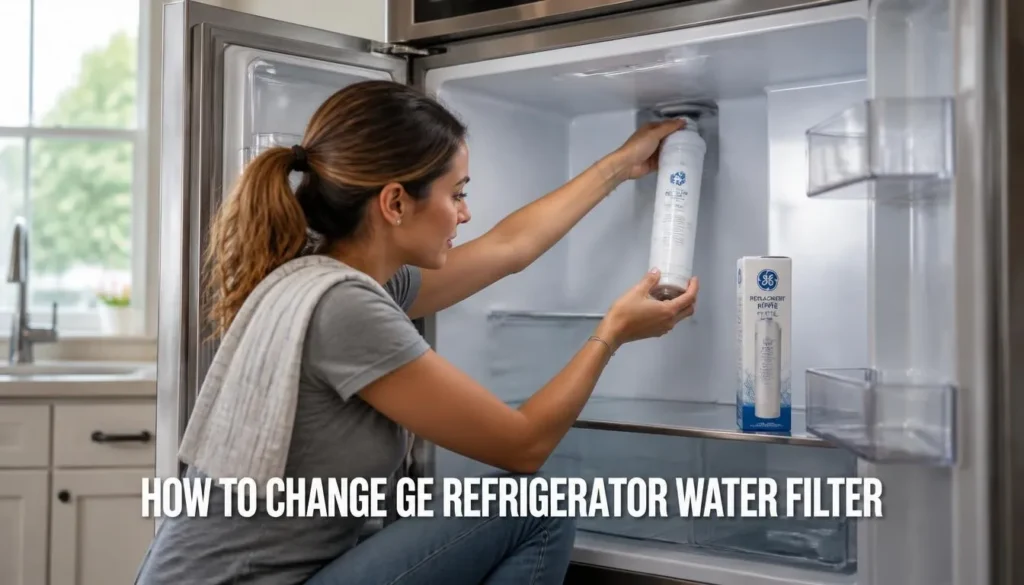
You change a GE refrigerator water filter by turning the old cartridge a quarter turn, pulling it out, and locking a new one in. Swing-out models move a little differently, and reminder reset steps vary by model, so the exact steps depend on your cartridge. The job takes only a few minutes, and you do not need to shut off the water supply.
This guide explains how to change a GE refrigerator water filter for the XWFE, RPWFE, and MWF cartridges, with the reasoning behind each step. You will know which filter you own, how it comes out, and how to flush it and clear the light. It also shows when the next replacement is due.
Key Takeaways
- Read the part number first: XWFE, RPWFE, and MWF cartridges come out in different ways.
- Flush the dispenser after every change: 1 1/2 to 2 gallons, about 3 to 5 minutes.
- Some models clear the reminder themselves. Pad models need a 3 second press.
- Plan to change the cartridge about every six months, or sooner if dispenser or ice flow drops.
How to Change GE Refrigerator Water Filter Step by Step
A GE refrigerator water filter is a sealed cartridge that locks into a holder on the water line. Changing it means unlocking the old cartridge and locking in a new one, which is simple once you know your model.
Follow these six steps for a typical twist-in GE model:
- Find the filter before you buy a replacement. On most side-by-side models it sits in the back, upper right corner of the fresh food compartment. On bottom-freezer models, look at the upper right, the upper left, or inside the left door.
- Turn the old cartridge about a quarter turn to the left until it loosens, then pull it straight out. A little water may drip while the cartridge comes out, so keep a cloth handy.
- Write the month and year of the installation on the new filter, or use the sticker that comes in the box.
- Fill the new filter with tap water before you install it, a step GE lists for XWFE and MWF cartridges. Your filter’s box shows if yours needs it.
- Turn the new filter to the right until it stops, and take care not to overtighten it, because the cartridge rises into position as you turn.
- Run the dispenser for 1 1/2 to 2 gallons, about 3 to 5 minutes, as your filter label says, to clear the trapped air. Then reset the reminder light as your model requires.
The CDC tells households to maintain any filter they use by changing it on the maker’s schedule. The dated label from step 3 is the easiest way to keep track of that schedule.
These steps fit twist-in cartridges. Swing-out RPWFE filters use a different motion, covered below, and other brands use their own steps. You do not need tools for any of the GE cartridges described in this guide.
Which GE Water Filter You Own and Where It Sits
GE sells several cartridges, and the part number on your current filter decides which steps apply to your refrigerator. The XWFE, RPWFE, and MWF are the most common cartridges, and GE also lists the GSWF and MSWF as replacements. Match the printed part number before you buy a new one.
The location depends on the refrigerator style, and the difference is easy to see once the door is open. On most side-by-side models the cartridge is in the back, upper right corner of the fresh food compartment. On built-in models it sits behind the top access panel above the doors. Bottom-freezer models put it in the upper right, the upper left, or inside the left door.
The table below compares the three most common filters:
| Filter | Style | How it comes out | Reminder light |
| XWFE | Twist-in, RFID chip | Quarter turn to the left | Automatic on select models; others need a manual reset |
| RPWFE | Swing-out, RFID chip | Blue holder: swing out, then quarter turn left. Grey holder: swing out and pull, no twist | Clears itself on most models |
| MWF | Twist-and-lock | Turn left until it stops | Pad press, if your model has one |
Changing a Swing-Out RPWFE Filter
The RPWFE sits in a holder that swings out toward you, which makes it feel different from a twist-in filter. GE describes two holder types, blue and grey, and each one releases the cartridge differently.
Here is how each holder type works:
- Blue holder: pull the bottom of the cartridge to free it from the clips, then swing it out until it clicks. Turn it a quarter turn to the left and pull it free. To install, point the word FRONT toward the top, push the cartridge fully back, and turn it a quarter turn right so FRONT faces out.
- Grey holder: pull the bottom to swing the cartridge out, then pull gently to unseat it. To install, center the new filter with FRONT facing out, push until it seats, and swing it in.
- Final check: keep the filter seated as you swing it shut. GE says the red indicators should not be visible when it sits correctly.
A genuine RPWFE shows a black square outline under the label, which marks the chip. GE says a filter without that chip is not a genuine RPWFE and will not work in the refrigerator.
XWFE and MWF Twist Filters, and What the Chip Does
The XWFE replaces the older XWF and keeps the same size, shape, and installation. It carries an RFID chip (a tiny tag the refrigerator reads to track the filter). On models with a Filter Status button, pressing it shows the remaining life as a percentage.
Fill the XWFE with water before you install it, then turn it to the right until it stops. A 2022 design change added slots at the top of the filter, so it may take more force to insert, and the arrows may not line up fully. GE says it still fits the same filter head.
The chip also helps protect your kitchen from leaks. The control can shut off the water valve when it senses a wet filter, a poorly seated filter, or a wrong or non-GE filter. You may see ERR or a flashing red light. GE says a new filter or its bypass plug, part WR17X33825, turns the valve back on. The plug has no leak detection.
The MWF uses a plain twist-and-lock motion that most owners find familiar. Place a cloth under it, then turn it left until it stops while you gently pull down, and keep it level. If it sticks, push in on the water dispenser to release pressure. Fill the top of the new filter, line up the arrow, push it up, and turn it right until it stops.
Flush the System and Reset the Filter Light
After any change, run water from the dispenser for 1 1/2 to 2 gallons, about 3 to 5 minutes, as your cartridge instructions say. Expect spurting and sputtering at first, because air is trapped inside the new cartridge when it goes in, and GE calls this normal.
The reminder light is often a timer rather than a sensor, so it counts the months and does not measure how much water has passed through the cartridge. It turns orange when the filter should be replaced soon and red when it is due. A power outage can reset the timer, so a light that never changes after six months can be normal.
On models with a pad, press and hold Reset Water Filter for about 3 seconds, until the light goes off or turns green. If you hold the pad too briefly, the light stays red, and if you hold it too long, the light turns off and then comes back on.
Chipped filters can work differently. On most RPWFE models and on touch-screen models, you cannot reset the reminder by hand, because the new filter resets it automatically once the refrigerator recognizes the chip. If the light stays on after a correct reset, check your owner’s manual for your model.
When to Change a GE Water Filter, and Why It Matters
GE says to replace the cartridge about every six months, or usually after 170 to 200 gallons of water. Change it sooner if flow to the dispenser or ice maker drops. A busy household can use up a cartridge early, so the gallon count matters as much as the calendar. Our guide to how often to change a water filter covers other filter types.
Knowing how to change a GE refrigerator water filter is only half the job, because timing protects water quality. The CDC notes that germs that grow in pipe slime can also live and multiply in water filters, which can happen when you do not replace them as directed. The CDC also says most pitcher and refrigerator filters are not designed to remove germs, so a fresh cartridge does not make unsafe water safe to drink.
A replacement cartridge only does what its certification says it does. The CDC lists NSF/ANSI standards (independent tests a filter must pass), including Standard 42 for taste and odor, 53 for cyst reduction, and 58 for reverse osmosis systems. For lead, the EPA’s consumer tool lists filters certified to NSF/ANSI 53 and 42 (EPA lead filter tool).
For PFAS (man-made “forever chemicals”), the EPA says to look for NSF/ANSI 53 or 58 certification for PFAS reduction. It also warns that current standards do not yet show filters remove PFAS to the levels the EPA has now set. Because filters have a limited capacity, they need periodic replacement according to the maker’s instructions.
How We Research
We check every claim against primary sources. Federal agencies like the EPA and CDC come first. Certification bodies like NSF and AHAM come next. We verify each standard number against the issuing body. We review this guide on a set schedule.
Why Trust This Guide
Puritisimo covers only water and air quality. Our guidance is editorial and independent. We cite every health figure so you can check it. We never present a promotional claim as fact.
Your GE Filter Change in Three Checks
A clean change comes down to three checks. First, read the part number so you follow the right motion for an XWFE, RPWFE, or MWF. Second, flush the dispenser for 1 1/2 to 2 gallons, about 3 to 5 minutes, so air and loose carbon leave the line. Third, date the new cartridge so the next swap is easy to plan, even if the light is a timer.
Once the old cartridge is out, see how to dispose of an old refrigerator filter. With the right filter, a full flush, and a dated label, you now know how to change a GE refrigerator water filter without guesswork.
Frequently Asked Questions
How to change GE refrigerator water filter XWFE?
This is how to change a GE refrigerator water filter of the XWFE type: turn the old one a quarter turn to the left until it releases. Fill the new one with water, turn it right until it stops, and do not overtighten it. Some models clear the light on their own, while others need Reset Water Filter held for 3 seconds.
How to replace GE water filter RPWFE?
On a blue holder, pull the bottom of the cartridge to swing it out, turn it a quarter turn left, and pull it free. Install the new one with FRONT facing the top, push it back, and turn it right so FRONT faces out. Then swing it shut. The chip handles the reminder on most models.
How to change GE refrigerator water filter ice maker?
The ice maker gets its water through the same filter as the dispenser, so one replacement covers both. GE says you do not need to shut off the water supply. The ice maker will not run without either a filter or a bypass plug, and some spurting after the change is normal.
How to change the water filter in a GE French door refrigerator?
Most French door models are bottom-freezer designs, so the filter is usually inside the refrigerator compartment. Look in the upper right or upper left of the fresh food compartment, or inside the left door, and read the part number first. Then follow your cartridge: twist-in filters turn slowly left to release, while grey-holder RPWFE filters swing out and pull free without twisting. Install the new one the same way, then flush for 1 1/2 to 2 gallons, about 3 to 5 minutes.
How to change the water filter in a GE side-by-side refrigerator?
On most GE side-by-side models the filter sits in the back, upper right corner of the fresh food compartment. Turn it a quarter turn left, pull it out, and turn the new one right until it stops. Flush for 1 1/2 to 2 gallons, about 3 to 5 minutes. Built-in models hide the filter behind the top access panel.
References
- CDC. Preventing Waterborne Germs at Home. Centers for Disease Control and Prevention.
- CDC. About Choosing Home Water Filters. Centers for Disease Control and Prevention.
- U.S. Environmental Protection Agency. Consumer Tool for Identifying Point-of-Use and Pitcher Filters Certified to Reduce Lead.
- U.S. Environmental Protection Agency. Identifying Drinking Water Filters Certified to Reduce PFAS.
Medical Disclaimer: This content is for informational purposes only. It is not a substitute for professional medical advice, diagnosis, or treatment. If you have concerns about your water quality or air quality and their effects on your health, consult a qualified healthcare professional.

