
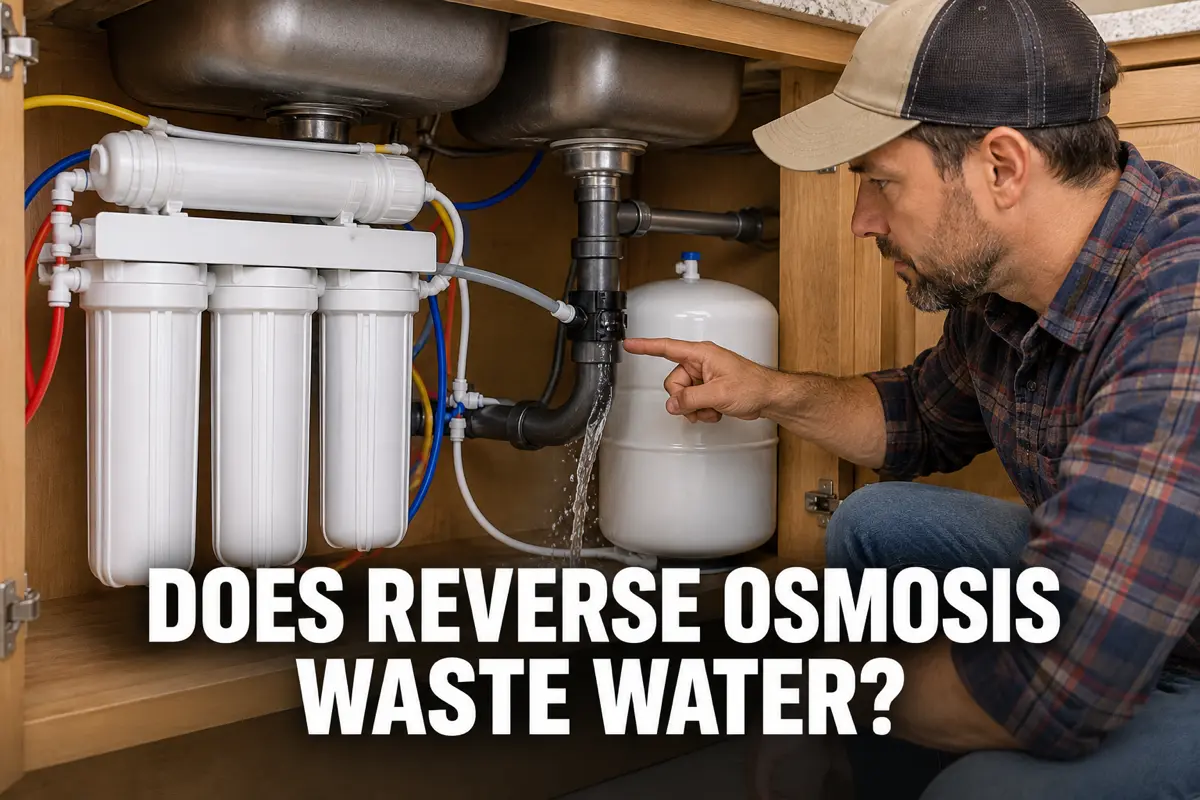
Yes, most reverse osmosis systems send part of your incoming water to the drain. Reverse osmosis (RO, a filter that forces water through a very fine screen) needs that drain stream to work. Many people ask whether reverse osmosis wastes water because the amount surprises them. The answer depends on the design, and it ranges from a little to quite a lot.
By the end, you’ll know how much water a typical system sends down the drain and why that waste is built in. You’ll also know how to cut it, and how reverse osmosis compares with distilled and filtered water.
Key Takeaways
- Yes. The reject stream sent to the drain is built into how reverse osmosis works.
- Traditional systems commonly send about 3 to 4 gallons to the drain for every gallon of drinking water.
- Choosing a more efficient design can cut the waste a lot.
- Reverse osmosis also removes minerals along with contaminants, so the water can taste flat.
Does Reverse Osmosis Waste Water? The Short Answer
Reverse osmosis is a water treatment process that forces tap water through a membrane (a screen with pores too small for most dissolved salts and metals). The water that carries those leftovers away is called the reject stream, and it goes down the drain. Our guide to what reverse osmosis is covers the basics.
Most home units sit under the kitchen sink and treat the water you drink and cook with. For these point-of-use systems (units that treat water at a single tap), NSF International (an independent testing group) publishes the standard NSF/ANSI 58.
So the waste is part of the design, not a defect. An RO system needs a way to remove the salts and metals it holds back. Most under-sink systems send them to the drain, and some countertop systems collect them in a tank you empty.
People choose reverse osmosis drinking water when they want fewer dissolved contaminants in the glass. The next sections show how much water that choice costs, why the cost exists, and what you give up besides water.
Why Reverse Osmosis Wastes Water: How the Membrane Works

Reverse osmosis (RO, a filter that pushes water through a screen so fine that almost nothing but water molecules gets through) wastes water by design. Its core part is a semipermeable (letting some things through, not others) membrane, a thin sheet that lets water pass but holds back most dissolved salts and metals. Only part of the water crosses it. The rest carries the rejected material away.
So how does reverse osmosis work inside an under-sink unit? Home water pressure, usually 40 to 80 PSI (pounds per square inch, a unit of pressure), pushes water through several stages in a row.
A common home layout, with its drain line and tank:
- Sediment filter: catches sand, silt and rust flakes so they do not clog the later stages.
- Carbon pre-filters: remove chlorine and many chemicals that affect taste and odor.
- RO membrane: holds back dissolved salts and metals while clean water passes through.
- Drain line: a separate path that sends the rejected water, which holds the concentrated material the membrane stopped, to the drain.
- Storage tank and carbon post-filter: the tank holds the clean water, and the post-filter polishes its taste before it reaches the faucet.
The drain line is not a flaw. The reject stream flushes concentrated salts off the membrane so they do not build up and block the pores. That blockage is called fouling. Some waste is built into the design, but how much varies a lot from one system to the next.
How Much Water Does Reverse Osmosis Waste?
Traditional tank systems commonly send about 3 to 4 gallons to the drain for every 1 gallon of clean water. That is a pure-to-waste ratio (clean water compared with drain water) of 1:3 or 1:4. Treat these as commonly reported industry ranges, not fixed values.
Rated output is a lab figure. GPD (gallons per day) ratings depend on set test conditions, such as water temperature, pressure and salt level, so check the model’s data sheet. Real output is often lower than the rating. Claims of a 1:1 ratio also assume ideal conditions, and real homes often see a higher waste ratio.
Certified systems are tested against NSF/ANSI 58 (the standard for reverse osmosis units that treat water at a single tap). The waste ratio is a spec worth comparing before you buy. The EPA WaterSense label (a federal water-efficiency mark) allows no more than 2.3 gallons of reject water per gallon of treated water.
The table below sets out the commonly reported ranges by system type.
| System type | Drain water per gallon made |
| Traditional tank | 3 to 4 gallons |
| Permeate pump | Varies by model |
| Tankless | Varies by model |
| Real-world 1:1 claims | Depends on conditions |
Ways to Cut Reverse Osmosis Waste at Home
You cannot remove the reject stream, but you can shrink it. Most of the gain comes from a few design and upkeep choices.
These changes help most:
- Permeate pump: a small pump that uses drain-side pressure to move clean water into the storage tank, which eases back pressure on the membrane. Makers report it can cut waste by up to 80%, depending on the system.
- Enough inlet pressure: RO needs 40 to 80 PSI. Below that range, a booster pump (a small pump that raises water pressure) may be needed for the system to work as rated.
- On-time membrane changes: a membrane often lasts 2 to 3 years, depending on your water, so follow the maker’s schedule. Rising TDS (total dissolved solids, the minerals and metals in water) in the output is one sign it is due.
- Tankless design: some tankless units list a lower waste ratio than tank models, so compare each model’s stated ratio and which way it is written.
- Working shut-off valve: it should stop the drain flow once the storage tank is full. If water keeps running to the drain, have the valve checked.
Reject water carries the concentrated salts and metals the membrane held back. Treat it as drain water, not as a free supply for other uses.
Reverse Osmosis Health Effects: Benefits and Trade-Offs
Much of RO’s health appeal comes from what it keeps out of your glass. According to the EPA, two of three RO systems kept the tested PFAS (a large family of long-lasting synthetic chemicals) below detection in one-week lab tests. The third had detectable levels during intermittent operation. The detection limit was 3 ppt (parts per trillion, a tiny concentration).
A 2020 study in Environmental Science & Technology Letters tested 76 point-of-use filters in homes. Under-sink RO achieved near-complete PFAS removal, while activated carbon averaged 60 to 70% for long-chain PFAS.
RO can also reduce other dissolved contaminants, such as arsenic and nitrate. Our guide to whether reverse osmosis removes lead covers that contaminant in detail. Check the NSF/ANSI 58 listing for the exact contaminant you care about. Our editorial note: a TDS reading near zero shows removal of dissolved solids, not safety, because a meter cannot detect bacteria, PFAS or pesticides.
The trade-off is minerals. RO lowers TDS a lot, but the final level depends on your incoming water and the membrane (ppm means parts per million, a unit of concentration). That removes calcium and magnesium along with contaminants, so the water can taste flat. Many systems add a remineralization (adding minerals back) stage, a filter that returns some minerals.
In our editorial view, drinking water is only one source of minerals, and the rest of your diet matters too. If you have a health condition, ask your doctor about your water.
Reverse Osmosis vs Distilled and Filtered Water
Distilled water comes from boiling water and cooling the steam back into liquid. This process, called distillation, leaves nearly all dissolved minerals behind, so the result has very low mineral content, like RO water. The difference is how it gets there. Distillation needs heat and sends no stream to a drain, while RO uses pressure and does.
Carbon filters and pitchers work differently. Activated carbon (a porous material that grabs chemicals onto its surface) improves taste and removes chlorine, VOCs (volatile organic compounds, chemicals that easily turn to vapor) and some pesticides. It does not remove dissolved salts, fluoride or nitrates.
RO sits between the two. It can reduce fluoride, nitrate and arsenic, which carbon cannot, and it needs no heat. Its cost is the drain stream that carbon filters do not have.
If drain water is your main worry, a point-of-use carbon filter sends no reject stream to the drain, but it generally leaves dissolved salts in place. Some carbon filters certified for metal reduction can lower lead, so check the exact certification. If dissolved contaminants are the worry, RO is the stronger fit. For the health side, see our guide on whether reverse osmosis water is good for you. Your local water quality report shows which problem you actually have.
How We Research
We check every claim against primary sources. Federal agencies like the EPA and CDC come first. Certification bodies like NSF and AHAM come next. We verify each standard number against the issuing body. We review this guide on a set schedule.
Why Trust This Guide
Puritisimo covers only water and air quality. Our guidance is editorial and independent. We cite every health figure so you can check it. We never present a promotional claim as fact.
What the Waste Really Costs You in Return
Reverse osmosis trades extra drain water for cleaner drinking water. A traditional tank system commonly sends about 3 to 4 gallons to the drain for each gallon it makes. A permeate pump or an efficient tankless design can bring that down, depending on the model. The membrane needs that flow to stay clear, so you can trim the waste but not remove it. Weigh it against the contaminants removed and the minerals lost. With those facts in hand, you can decide whether reverse osmosis wastes water in a way that matters for your home.
Frequently Asked Questions
Does reverse osmosis waste water?
Reverse osmosis wastes water because most systems send part of the incoming water to the drain, along with the salts and metals the membrane held back. Traditional tank systems commonly send 3 to 4 gallons to the drain per gallon made, an industry-reported range. Certified systems follow NSF/ANSI 58, the standard for these units.
What is reverse osmosis waste water?
Reverse osmosis waste water, also called the reject stream, is the water that carries away what the membrane held back. It holds the concentrated salts, metals and other dissolved material from the supply. It flows to the drain instead of your faucet, which keeps the membrane from clogging.
Does reverse osmosis raise your water bill?
It can, a little, because the system sends extra water down the drain on top of what you drink. The size of the rise depends on the system’s waste ratio and on how much water your household drinks and cooks with. A permeate pump or a tankless design can shrink it.
What are the downsides of reverse osmosis water?
RO has three main downsides. It sends extra water to the drain, it removes calcium and magnesium along with contaminants, which can leave the water tasting flat, and its filters and membrane need regular replacement. Some systems add a remineralization stage (a filter that returns some minerals) to ease the taste.
Is reverse osmosis water hard on kidneys?
No source reviewed for this guide shows that reverse osmosis water harms healthy kidneys, and none proves it risk free either. What matters most is your overall mineral intake from food. If you have kidney disease or another health condition, ask your doctor before you change your drinking water.
References
- NSF International. Standards for Water Treatment Systems.
- U.S. EPA. EPA Researchers Investigate Effectiveness of Point-of-Use/Point-of-Entry Systems to Remove PFAS. Science Matters.
- Environmental Science & Technology Letters. PFAS Removal by Point-of-Use and Point-of-Entry Filters in Homes. 2020.
Medical Disclaimer: This content is for informational purposes only. It is not a substitute for professional medical advice, diagnosis, or treatment. If you have concerns about your water quality or air quality and their effects on your health, consult a qualified healthcare professional.

