
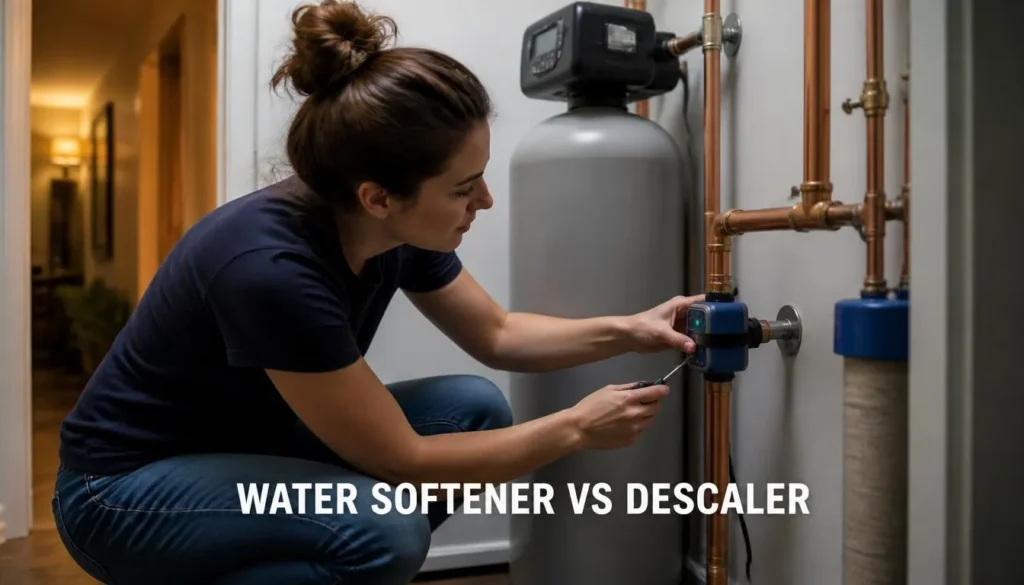
In the water softener vs descaler choice, pick a softener when you want hardness minerals removed from your water. Pick an electronic descaler (a small plug-in box that sends a signal through your pipe) only if you want a no-salt, low-upkeep unit and can accept unclear results. A softener works by ion exchange (swapping calcium and magnesium for sodium), while a descaler removes nothing.
Hard water leaves scale in pipes and heaters, and both devices target it, but they do not do the same job. You will learn what each one does, what the evidence backs, and which one fits your home.
Key Takeaways
- A salt-based softener removes calcium and magnesium. The WQA says descalers do not lower them.
- Softeners add sodium, about 8 mg/L per grain of hardness, and need salt and a drain.
- Descaler results are mixed. One 2023 magnetic treatment test found no significant effect.
- Choose a softener for truly soft water. Choose a descaler only if you accept unclear scale results.
Water Softener vs Descaler at a Glance
Both devices target scale, but only one lowers hardness. Hardness is the amount of dissolved calcium and magnesium in water. The USGS rates water above 120 mg/L (milligrams per liter) as calcium carbonate as hard, and calls hardness a nuisance, not a health concern.
The WQA says antiscaling devices, a group that includes electronic descalers, do not reduce total calcium or magnesium. That is the core of any water descaler vs water softener comparison.
The table below sets the two devices side by side:
| Factor | Water softener | Electronic descaler |
| What it does | Swaps calcium and magnesium for sodium or potassium | Aims to change how scale forms, using a signal from a coil on the pipe |
| Removes hardness minerals | Yes | No |
| Water at the tap | Soft water | Total calcium and magnesium stay in the water |
| Added sodium | Yes, from the resin swap | None |
| Salt and drain line | Needs both | Needs neither |
| Upkeep | Salt refills and regeneration cycles | Plug-in, little care |
| Hardness reduction standard | NSF/ANSI 44 | Not applicable, no hardness is removed |
How Does a Water Softener System Work?
A water softener is an ion exchange device (a tank of tiny resin beads that trade one charged mineral for another). The University of Nebraska Extension says household softeners replace calcium and magnesium with sodium, using a salt brine rinse to recharge the beads.
A typical cycle runs in four steps:
- Hard water enters the resin tank.
- The beads trap calcium and magnesium and release sodium into the water.
- When the beads fill up, the unit flushes them with salt brine, which pushes the trapped minerals off.
- The rinse carries the brine and the hardness minerals down a drain.
Hard water with water softener resin in its path loses its calcium and magnesium and gains sodium. The Nebraska guide puts the added sodium at about 8 mg/L for each grain per gallon (gpg, a unit of hardness). Water at 10 gpg ends up with about 80 mg/L. By our math, that is roughly 19 mg of sodium in an 8-ounce glass.
Context matters here. The EPA set its 20 mg/L sodium guidance for people who must limit sodium to 500 mg a day, and says it should not be applied to everyone. Taste is a separate issue. The EPA suggests 30 to 60 mg/L as the range most people will not notice. Potassium chloride can replace salt, but Nebraska notes it costs more and may work less well.
What an Electronic Descaler Does and What the Evidence Shows
An electronic descaler (a small box that drives a coil of wire wrapped around your pipe) aims to change how scale forms. It does not remove hardness minerals. The WQA files electronic and magnetic units under *physical water treatment*, meaning devices that change water by physical means and add no chemicals.
The WQA is direct about the limits: antiscaling devices do not lower total calcium or magnesium and are not proven to achieve soft water. It adds that parts of the technology are less understood, and that differences in home water make results hard to predict.
Research on the idea is mixed. A 2023 study in the journal Membranes tested magnetic treatment on scale in a reverse osmosis (RO) setup, a system that pushes water through a very fine membrane. It found the effect statistically insignificant. The authors also said results vary widely between test setups and that no one agrees on the conditions under which it works.
The same paper notes that 86% of earlier studies on membrane systems reported less scale, and the authors do not rule out a benefit in some uses. Those were studies on membrane systems, and the paper only cites that figure from an earlier review. They do not show what a home unit does in your pipes. The fair reading is that results are unclear. They depend on your water.
That gap matters in any electronic descaler vs water softener comparison. A softener shows its result on a hardness test, while a descaler leaves the minerals unchanged, so any benefit has to show up as less scale over many months.
Another non-salt option is a conditioner, so see how a water conditioner differs from a softener.
Key Differences for a Whole House: Hardness, Sodium, and Upkeep
For a whole house descaler vs water softener decision, five things separate the two devices. Each one affects what you will see at the tap.
Hardness result: a softener lowers calcium and magnesium, so the water tests soft. A descaler leaves both in the water, so the total calcium and magnesium stay the same, as the WQA describes.
Scale: a softener prevents most scale because the scale-forming minerals are gone. A descaler only aims to change how scale forms, and the evidence above is mixed.
Sodium: a softener adds about 8 mg/L per grain of hardness, according to Nebraska Extension. A descaler adds none, which matters to anyone on a sodium-restricted diet.
Upkeep: a softener needs salt refills, a drain line, and water for each regeneration. In a water softener vs electronic descaler match on upkeep alone, the descaler wins, because it plugs in and needs little care.
Standards: the WQA points buyers to hardness reduction products certified to NSF/ANSI 44, the standard for softeners. A descaler removes no hardness, so that standard has nothing to measure.
Neither device is a filter, since a softener treats hardness only. To reduce pollutants in drinking water, the CDC advises checking the filter label for certification to NSF/ANSI 53 or 58 for the contaminant you care about.
Water Softener vs Descaler: Which Should You Choose?
A softener is the better pick for most homes that want soft water. It is the only one of the two that removes hardness minerals, and the one the WQA points to for a certification standard (NSF/ANSI 44). If you go that way, see our guide to the best water softeners.
Choose a water softener if:
- You want water that tests soft at every tap.
- Your water tests hard on a home or lab hardness test.
- You accept buying salt and adding a drain line.
- Nobody at home must limit sodium, or you can ask a plumber about a bypass for the drinking tap.
Choose an electronic descaler if:
- You want no salt, no drain line, and no added sodium.
- You rent and cannot add plumbing for a softener.
- You accept that the benefit may be small or absent.
- You will check the result yourself, for example by watching scale in a kettle or water heater for several months.
Whichever you pick, test your water first, since a hardness test shows whether you need either device and gives you a baseline for later. If your water tests soft already, you need neither.
How We Research
We check every claim against primary sources. Federal agencies like the EPA and CDC come first. Certification bodies like NSF and AHAM come next. We verify each standard number against the issuing body. We review this guide on a set schedule.
Why Trust This Guide
Puritisimo covers only water and air quality. Our guidance is editorial and independent. We cite every health figure so you can check it. We never present a promotional claim as fact.
Settling the Choice for Your Home
A softener and an electronic descaler are not two versions of the same tool. A softener removes calcium and magnesium, asks for salt and a drain line, and adds some sodium. A descaler removes nothing, needs almost no upkeep, and has mixed evidence behind it. Test your water first, then match the device to the soft water you want. For pollutants, add a filter certified to the right NSF/ANSI standard. That difference is the heart of the water softener vs descaler decision. If you have well water, start with our best water softener for well water guide.
Frequently Asked Questions
Water softener vs descaler: which one removes hardness minerals?
The water softener vs descaler question has a clear answer on removal: only the softener removes hardness minerals. It swaps calcium and magnesium for sodium. An electronic descaler leaves them in the water and aims to change how scale forms, so total calcium and magnesium stay the same before and after.
What does a water descaler do?
A water descaler is a physical treatment device that tries to change how scale forms in pipes and heaters. It does not lower calcium or magnesium. Studies of magnetic and electronic units give mixed results, so treat any scale-reduction claim as unproven until you see it in your own pipes.
Does a water softener help clean water?
A water softener treats hardness, not pollutants, so it does not clean water the way a filter does. It removes calcium and magnesium and adds sodium. To reduce pollutants, add a filter certified to the matching NSF/ANSI standard for that contaminant.
What is the difference between a water softener and a water filter?
A softener swaps hardness minerals for sodium. A filter removes particles or specific pollutants, and its claims are certified to a standard such as NSF/ANSI 53 or 58. They solve different problems, so a home can use a softener on the main line and a filter at the drinking tap.
What are the pros and cons of an electronic water descaler?
The pros are that it needs no salt or drain and adds no sodium. The cons are that it removes no hardness and the scale evidence is mixed. Softeners can be certified to NSF/ANSI 44 for hardness reduction, but a descaler removes none to certify.
References
- USGS. Hardness of Water. USGS Water Science School.
- WQA. Scale Deposits. Water Quality Association.
- Skipton SO, Dvorak BI. Drinking Water Treatment: Water Softening (Ion Exchange). NebGuide G1491. University of Nebraska-Lincoln Extension. 2014.
- EPA. Drinking Water Advisory: Consumer Acceptability Advice and Health Effects Analysis on Sodium. 2003.
- Lei Q, et al. Evaluating the Efficiency of Magnetic Treatment for Feed Water in Reverse Osmosis Processes. Membranes. 2023.
- CDC. About Choosing Home Water Filters.
Medical Disclaimer: This content is for informational purposes only. It is not a substitute for professional medical advice, diagnosis, or treatment. If you have concerns about your water quality or air quality and their effects on your health, consult a qualified healthcare professional.

