
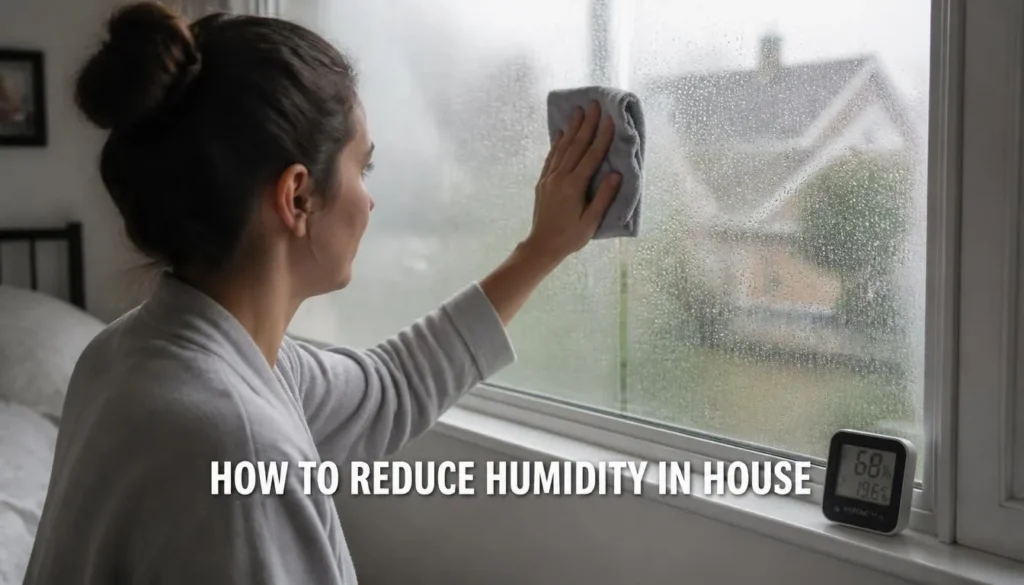
To cut humidity at home, find and shrink the moisture sources, ventilate, and let air conditioning or a dehumidifier finish the job. Your goal is a safe level of indoor relative humidity (RH, how much water vapor the air holds compared with its limit). Most homes get there with a few habit changes and one well-placed machine.
This guide covers practical ways to reduce humidity in your house, from measuring it to sizing a dehumidifier. You will learn which six steps to take in order, what works without a dehumidifier, and why the number matters for the air you breathe.
Key Takeaways
- Keep indoor relative humidity between 30 and 50 percent, and never above 60 percent.
- Measure first. A hygrometer (a small humidity gauge) shows whether you have a problem at all.
- Cut the source before buying gear: vent fans, a dryer that exhausts outdoors, and no indoor laundry drying.
- If readings stay high, a right-sized dehumidifier fixes what habits cannot, especially in damp rooms.
How to Reduce Humidity in House: Six Steps in Order
Moisture enters your home through cooking, showers, laundry, leaks, and even breathing. Ventilation, air conditioning, or a dehumidifier carries it back out. The EPA lists cooking, showering, and unvented dryers as common moisture sources. So the fastest fix is to stop adding water first, then remove what is left.
Your target also comes from the EPA, which says indoor RH should stay below 60 percent, ideally between 30 and 50 percent. ENERGY STAR adds that vent fans in bathrooms and kitchens remove humidity at the source, so those come early in the plan.
Follow these six steps in order:
- Measure it. Put a hygrometer in the room you worry about most and read it at different times of day. Our guide to what humidity is explains what the hygrometer measures.
- Fix water entry. Repair leaks, clear gutters, and point downspouts away from the foundation.
- Vent at the source. Run bathroom and kitchen fans during showers and cooking, and send dryer exhaust outdoors.
- Stop adding water. Dry laundry outside the living space and cover pots when you cook.
- Ventilate and cool. Run your central air conditioner in warm weather, and open windows only when the outdoor air is drier than the indoor air.
- Add a dehumidifier if the reading stays above 50 percent, then recheck every week or two.
Signs of Too Much Moisture in a House
The clearest sign is condensation, the water droplets that form when warm, humid air touches a cold surface such as a window. The EPA notes that condensation can signal high humidity. It also says mold often grows on walls in cold corners behind furniture, where that condensation forms.
Look for these warning signs around your home:
- Fogged windows: water beads or runs down the glass on cold mornings.
- Musty smell: a damp, earthy odor in closets, bathrooms, or basements. The CDC says mold can smell musty.
- Visible spots: black, green, or white patches on walls, ceilings, or window frames.
- Peeling paint or warped wood: moisture working its way into the surface.
- Clammy air: a sticky feel, or towels and laundry that never fully dry.
- High readings: a hygrometer that stays above 60 percent.
One sign does not prove a health problem. The CDC notes that damp, moldy places may cause a variety of health effects, or none at all. It also does not recommend mold testing, and you do not need to know the mold type to remove it. Treat the signs as a cue to measure and fix the cause.
How to Reduce Humidity in House Without Dehumidifier
You can lower humidity a lot without buying anything, because most indoor moisture comes from daily habits. Every shower, pot of pasta, and load of wet laundry adds water to the air. The EPA lists cooking and showering as moisture sources, so controlling them cuts the load on everything else.
Start with fans and lids. Run the bathroom fan during and after a shower, and use the range hood when you cook. ENERGY STAR advises vent fans in bathrooms and kitchens to remove humidity at the source. Check that they vent outdoors, not into the room.
Laundry is the next big source. ENERGY STAR says to vent clothes dryers outdoors and to avoid drying clothes indoors when you can. Wet clothes on a rack release all of their water into the room air.
Air conditioning also works as a dehumidifier. One job of a heating, ventilation, and air conditioning (HVAC) system is to remove moisture from the air before it is distributed, according to the EPA. Run it in muggy weather and keep a clean filter in place so air flows freely. To lower humidity fast, combine the three quick moves: fans on, AC on, wet items out.
For one damp room, the same ideas work on a smaller scale. Open the door so air can move, aim a fan toward a drier space, and pull furniture a few inches off cold outside walls. Open windows only when the air outside is drier. On a muggy day, an open window adds moisture instead of removing it.
Check outside, too. ENERGY STAR advises clearing gutters, extending downspouts away from the foundation, and sloping soil away from the house. Water that soaks in near the foundation eventually shows up as indoor humidity.
Humidity in Winter and Summer: What Changes
Winter flips the problem. Cold glass and cold walls make condensation easy, so the safe target drops. ENERGY STAR suggests 30 to 40 percent RH during the heating season in cold climates to prevent window condensation. To reduce humidity in your house in winter, turn down any humidifier, skip indoor laundry drying, and use bath and kitchen fans. Excess moisture from a humidifier can also encourage mold growth on damp surfaces.
Sealed, well-insulated homes hold moisture because little outdoor air leaks in. A few minutes of fresh air usually helps in winter, because cold outdoor air carries very little water vapor. Close the window again before the room cools too much.
Summer humidity comes mostly from outside. To reduce humidity in your house in summer, keep windows closed during muggy hours. Let the air conditioner work, since it removes moisture as it cools. A dehumidifier fills the gaps in rooms the AC does not dry well. Fix gutters and downspouts before the rainy season starts.
When You Need a Dehumidifier and What Size to Buy
Buy a dehumidifier when the steps above leave your hygrometer above 50 percent, or when one room stays damp no matter what you do. Look for a built-in humidistat (a sensor that switches the unit on and off at the humidity level you set). ENERGY STAR certified models use 20 percent less energy than a similar conventional unit while removing the same amount of water.
Run the unit with doors and windows closed so it treats only that room’s air. If the room often drops below 65F, pick a low-temperature or anti-frost model, because frost hurts performance. Keep the unit away from dust sources, which can clog its coils.
Capacity is rated in pints of water removed per day. ENERGY STAR says it is better to oversize than undersize, and its guide is below.
| How damp the space is | Under 2,000 sq ft | Over 2,000 sq ft |
| Slightly to moderately damp (50-75% RH) | 20-30 pints | 30+ pints |
| Very damp (75-90% RH) | 25-40 pints | 40+ pints |
| Wet (90-100% RH) | 30-50 pints | 50+ pints |
Why the Humidity Number Matters for Your Air
Humidity decides what thrives in your air and your bedding. The American Lung Association says dust mites love warm, humid settings, and that humidity is the biggest factor in their growth. It advises keeping humidity below 50 percent, and notes that about 4 in 5 U.S. homes have dust mite allergens in at least one bed.
Mold follows the same rule. The CDC says people with asthma or mold allergy may have severe reactions in damp and moldy places. People with chronic lung disease or weak immune systems may get lung infections. Drier air gives mold less to grow on.
A HEPA filter (high-efficiency particulate air, a dense filter that traps very small particles) can capture mold spores and allergens already floating in the room. An air purifier does not remove water vapor or fix the damp source. Moisture control comes first, and filtration is the backup. For more, see whether an air purifier helps with humidity.
How We Research
We check every claim against primary sources. Federal agencies like the EPA and CDC come first. Certification bodies like NSF and AHAM come next. We verify each standard number against the issuing body. We review this guide on a set schedule.
Why Trust This Guide
Puritisimo covers only water and air quality. Our guidance is editorial and independent. We cite every health figure so you can check it. We never present a promotional claim as fact.
Keeping Your Home in the Safe Range
Humidity control is a loop, not a one-time fix. Measure with a hygrometer and find the source. Vent fans and dryers outdoors, and let your air conditioner work in warm weather. Add a right-sized dehumidifier only when the number stays high. In winter, drop your target to 30 to 40 percent so windows stay clear. Keep your heating and cooling system healthy too, and see how often to change a home air filter so air keeps flowing. Hold the 30 to 50 percent range, and you will know how to reduce humidity in a house and keep it down.
Frequently Asked Questions
How to reduce humidity in house in winter?
To reduce humidity in your house in winter, lower your target to 30 to 40 percent and turn down any humidifier. Run bathroom and kitchen fans, vent the dryer outdoors, and dry laundry away from living areas. A few minutes of fresh air also helps, since cold outdoor air carries little moisture.
Do dehumidifiers use a lot of energy?
Energy use depends on the size of the unit and how long it runs, but a humidistat stops it once you reach your target. ENERGY STAR certified models use about 20 percent less energy than conventional units that remove the same amount of water. Running one in the damp room only, with doors closed, keeps the cost down.
Why does humidity go up at night?
Relative humidity rises at night because cooler air holds less water vapor, even when the amount of moisture stays the same. Sleeping people also add moisture with every breath, and closed windows trap it. A bedroom reading that climbs overnight is normal, and a dehumidifier or an open door can help.
How does a dehumidifier work?
A dehumidifier uses a fan to pull room air across a cold coil. Water vapor condenses on the coil into droplets, which drip into a bucket or a drain, and the drier air returns to the room. A humidistat cycles the unit on and off to hold your target.
What is the ideal humidity level for a bedroom?
A bedroom should sit between 30 and 50 percent relative humidity, and staying below 50 percent helps keep dust mites down. Check it with a hygrometer on your nightstand, because readings often climb overnight. If it stays high, ventilate during the day and run a dehumidifier before bed.
References
- US Environmental Protection Agency. Mold Course Chapter 2: Why, Where and When Mold Grows. EPA. 2024.
- ENERGY STAR. Dehumidifiers: Product Information and Sizing Guide. US EPA and US Department of Energy. 2024.
- American Lung Association. Dust Mites. Indoor Air Pollutants. 2024.
- Centers for Disease Control and Prevention. About Mold and Your Health. CDC. 2024.
Medical Disclaimer: This content is for informational purposes only. It is not a substitute for professional medical advice, diagnosis, or treatment. If you have concerns about your water quality or air quality and their effects on your health, consult a qualified healthcare professional.

