
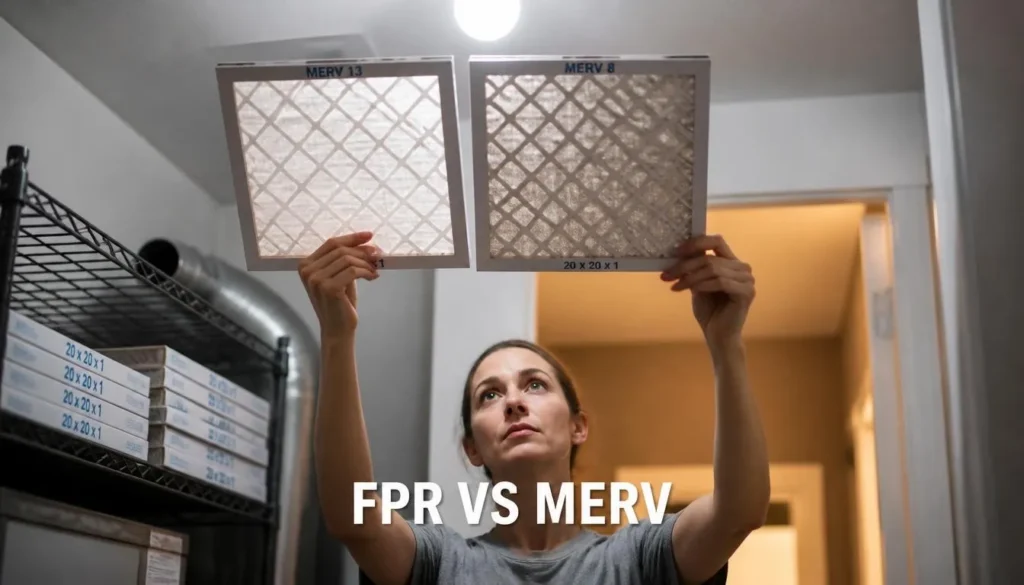
FPR vs MERV (Minimum Efficiency Reporting Value, a lab-test score from 1 to 16) is a choice between a store label and a test standard. Use MERV when you want to compare filters across brands, and use FPR only to rank filters on The Home Depot’s shelves. No official chart converts FPR to MERV, so every match you see is an estimate.
Here you will see what each scale measures, how the usual matches line up, and how to pick a filter that your particular system can run without strain. You will know which number to trust on the box and which filter fits your home.
Key Takeaways
- MERV is a standard 1 to 16 score, while FPR is a Home Depot label with no official MERV equivalent.
- The EPA suggests MERV 13, or the highest rating that your system can accommodate, with frequent replacement.
- Every FPR to MERV chart is approximate, so always read the MERV number printed on the filter box before you buy.
- A thicker filter can carry a higher rating with less airflow resistance, so check your filter slot depth and size first.
FPR vs MERV at a Glance
Choose MERV when you need one number that works across every brand, and read FPR only when you compare filters sold at a single store. MERV comes from a published test standard, while FPR is a retail scale whose full method is not public.
According to the EPA, MERV runs from 1 to 16, and a higher number means the filter traps more particles of a given size. FPR is a shelf label from The Home Depot, and it tends to appear on the Honeywell-brand filters that the store sells.
The table below compares the two scales on seven points that matter when you read a filter box:
| Factor | FPR | MERV |
| Who sets it | The Home Depot, as a retail label | ASHRAE Standard 52.2, an industry lab test |
| Scale | 1 to 12, according to The Home Depot | 1 to 16 |
| What it reports | One weighted score, with the full method not public | Average capture in three particle size ranges |
| Particle sizes shown | No | Yes, in three ranges |
| Official conversion | None published | Not applicable |
| Works across brands | Mainly filters sold at Home Depot | Yes, any brand |
| Named in EPA guidance | No | Yes, MERV 13 or higher |
What the MERV Scale Measures
According to an EPA Indoor airPLUS bulletin, MERV comes from ASHRAE Standard 52.2, a lab test that counts how many particles a filter catches at different sizes. Each filter earns average capture figures in three size ranges, measured in microns (a micron is about 1/100th the width of a human hair).
The gaps between steps are large. A MERV 8 filter catches at least 70% of particles 3 to 10 microns wide, but the EPA lists no minimum for the smallest range. MERV 11 catches at least 85% of the large particles and at least 20% of those from 0.3 to 1 micron, per the EPA. MERV 13 lifts the smallest range to at least 50% of those fine particles.
The EPA also notes that HEPA (high-efficiency particulate air, a class that catches at least 99.97% of 0.3 micron particles) sits outside this scale. For context, a typical 1-inch fiberglass furnace filter rates MERV 1 to 4, so even a modest pleated filter is a real step up from the cheapest option.
FPR vs MERV vs MPR: How Each Rating Is Built
FPR stands for Filter Performance Rating, a scale that The Home Depot uses on the filters it sells. Published summaries describe a weighted score that rewards large-particle catch first, small-particle catch next, and dust-holding last. We found no public test method or particle sizes behind it, so FPR works as a rough guide.
The same confusion shows up with FPR vs MERV vs MPR, because 3M’s Filtrete line uses its own Microparticle Performance Rating (MPR), a third scale with different numbers. FPR belongs to one retailer and MPR belongs to one maker, while MERV is the only one tied to a shared industry testing standard.
The EPA bulletin warns that some makers use proprietary scales. A MERV rating and an FPR number on the same box can therefore disagree because they measure different things, so do not assume one maps onto the other.
FPR to MERV Conversion: What the Charts Say
No standards body publishes an FPR to MERV conversion, so the matches you find online come from retailers and sellers and differ by a step or two. Treat every chart as an estimate, and use it only to get a rough idea.
FPR 5 to MERV 7 or 8: this is a basic pleated filter that handles lint and home dust well. The EPA lists no minimum capture below 1 micron for MERV 8.
For a closer look at basic dust filtration, our MERV 5 vs MERV 8 guide compares the particle sizes and minimum capture requirements for those two ratings.
FPR 7 to MERV 10 or 11: this is the mid-grade tier. At MERV 11, the EPA table lists at least 20% capture of the finest range, which is why many allergy-minded buyers start at this level.
FPR 9 to MERV 11 or 12: charts place this tier just above mid-grade, and the match is the loosest of the group. Some sellers show FPR 8 or 9 in the same MERV 11 to 12 band, so the charts do not agree.
FPR 10 to MERV 13: many charts pair FPR 10 with about MERV 13, though Home Depot also sells FPR 12 filters rated MERV 13. Some listings show an FPR 10 filter beside different MERV numbers, so read the MERV printed on the package before you buy.
Which Should You Choose?
For most homes, MERV is the better guide, and the EPA advises a filter rated at least MERV 13, or as high as your system can handle. FPR still has a use when you stand in one store aisle, so match your own situation to the lists below.
Choose MERV if:
- You compare brands: one standard lets you line up filters from any maker side by side.
- You follow EPA guidance: the agency names MERV 13 and publishes particle-size capture minimums for each step of the scale.
- You need to check system limits: your equipment manual gives filter requirements, and an HVAC technician can check airflow if it gives none.
Choose FPR if:
- You shop only at Home Depot: the label ranks that store’s filters against each other on one shelf.
- The box shows no MERV number: FPR can give a rough guess, which you then confirm with the maker.
- You are stepping up one level: moving from FPR 5 to FPR 7 is a simple, same-brand upgrade within one store’s line.
How to Pick a Filter Your System Can Handle
The furnace filter FPR vs MERV choice matters less than airflow. According to PNNL, a filter that resists airflow too much can lower efficiency, overheat a furnace, freeze coils or wear out a blower motor.
Follow these steps to match a filter to your system:
- Check your filter slot and equipment manual for the correct size and any filter limits that the manufacturer sets.
- Choose by the MERV number first, and if the box shows only FPR, look up the MERV on the maker’s specification sheet.
- Aim for MERV 13 if your system allows it, and otherwise pick the highest rating that it accepts.
- Consider a thicker filter, because PNNL’s example shows 4-inch MERV 7 filters with less airflow resistance than 1-inch ones.
- Ask an HVAC technician if you are unsure about the fit, since the EPA recommends one for borderline cases.
The EPA says makers typically recommend a new filter every 60 to 90 days, and most systems can take MERV 13 if you replace it often. PNNL adds that homes with pets, smokers, allergies or nearby construction should change filters sooner.
How We Research
We check every claim against primary sources. Federal agencies like the EPA and CDC come first. Certification bodies like NSF and AHAM come next. We verify each standard number against the issuing body. We review this guide on a set schedule.
Why Trust This Guide
Puritisimo covers only water and air quality. Our guidance is editorial and independent. We cite every health figure so you can check it. We never present a promotional claim as fact.
Making the Right Call on Your Filter
The two ratings are not really rivals, because one is a recognized standard and the other is a store label. Pick MERV for any real comparison, and treat FPR as a rough hint when the box offers nothing else. Then confirm that your system can run the filter you chose, since a furnace filter cleans air only while the blower runs. A portable air cleaner with a HEPA filter can add steady cleaning in the rooms you use most. In short, the FPR vs MERV choice is simple: read the MERV, confirm the fit, and change the filter on time.
Frequently Asked Questions
What is FPR vs MERV?
FPR vs MERV compares two filter rating scales. FPR is The Home Depot’s Filter Performance Rating, while MERV is a standard 1 to 16 score from laboratory testing. Because the scales have different owners, no official chart converts one into the other, so use MERV for a fair comparison between brands.
What is FPR 5 in MERV rating?
Retailer charts usually match FPR 5 to about MERV 7 or 8, but that is only an estimate and not an official equivalent. A MERV 8 filter catches at least 70% of particles 3 to 10 microns wide, so check the MERV printed on your filter’s package for the real figure.
Is FPR 7 good for home?
FPR 7 is a mid-range choice, and charts usually place it near MERV 10 or 11. It suits most homes well, since it catches more fine dust than a basic filter and usually works with standard systems. If you have pets, allergies or smoke, consider the next step up, but only if your system allows it.
How often should I change furnace filter?
Most makers advise a new filter every 60 to 90 days, but change it sooner if it looks dirty or if you have pets, smokers or allergies. Check it monthly at first, then set a reminder schedule that matches what you actually see.
What are the key differences between MERV 8 and MERV 11 filters?
MERV 11 catches more fine particles than MERV 8 does, and the gap is clearest in the smallest size range. MERV 8 sets no minimum below 1 micron, while MERV 11 catches at least 20% of that range. For 3 to 10 micron dust, MERV 11 reaches at least 85% against at least 70% for MERV 8. A denser filter can restrict airflow more, so check your system first.
References
- EPA. What is a MERV rating? Indoor Air Quality.
- EPA. Guide to Air Cleaners in the Home. Indoor Air Quality.
- Pacific Northwest National Laboratory. High MERV filters. Building America Solution Center.
- EPA Indoor airPLUS. Filtration technical bulletin. 2019.
Medical Disclaimer: This content is for informational purposes only. It is not a substitute for professional medical advice, diagnosis, or treatment. If you have concerns about your water quality or air quality and their effects on your health, consult a qualified healthcare professional.

