

The best dehumidifier for bedroom use is a quiet one that still pulls enough moisture out of the air, because a damp room smells musty and a noisy unit ruins sleep. The U.S. EPA puts healthy indoor humidity at 30 to 50 percent, so the goal is to hold the room in that range without a motor humming beside your pillow.

We sorted six models into four compressor units and two thermoelectric minis, and we put noise first. If you want a quiet dehumidifier, the thermoelectric minis are quiet on paper, with one stating under 30 dB, but they remove far less water. Every pint figure below names its test condition, and every decibel and room-size number is maker-stated.
My Recommended Top 3 Best-Buys for Bedroom Dehumidifiers: Reviewed and Rated
- The ENERGY STAR certification is confirmed in the ENERGY STAR product finder, and the maker states 31% energy savings over traditional dehumidifiers.
- The 47 dBA noise level is a maker figure, higher than the 36 to 40 dB figures quoted for other compressor models here, though makers use different methods.
- The 0.8-gallon tank stops the unit when full and restarts it after you empty it.
- The dual-core thermoelectric module removes moisture without a compressor, which keeps the body at about 5.5 pounds.
- The Sleep Mode is rated by the maker at under 30 dB, with no test method stated.
- The 2.5-liter removable tank shuts the unit off with a red warning light when it is full or misplaced.
- The Sleep Mode switches the ambient light off and lowers noise, though the maker gives no decibel figure.
- The auto shut-off powers the unit down when the water tank is full.
- The 95-ounce tank holds the collected water until the shut-off stops the unit.
Best Dehumidifier for Bedroom Reviews 2026: 6 Top Models for Sleeping Rooms
Compressor units cool the air to condense water and handle real dampness. Thermoelectric units use a small semiconductor, use no compressor and suit closets and tiny, mildly damp rooms. Pint figures only compare fairly under the same test, and only the Midea figure here is a DOE 2019 value, so we label the test condition next to every other number.
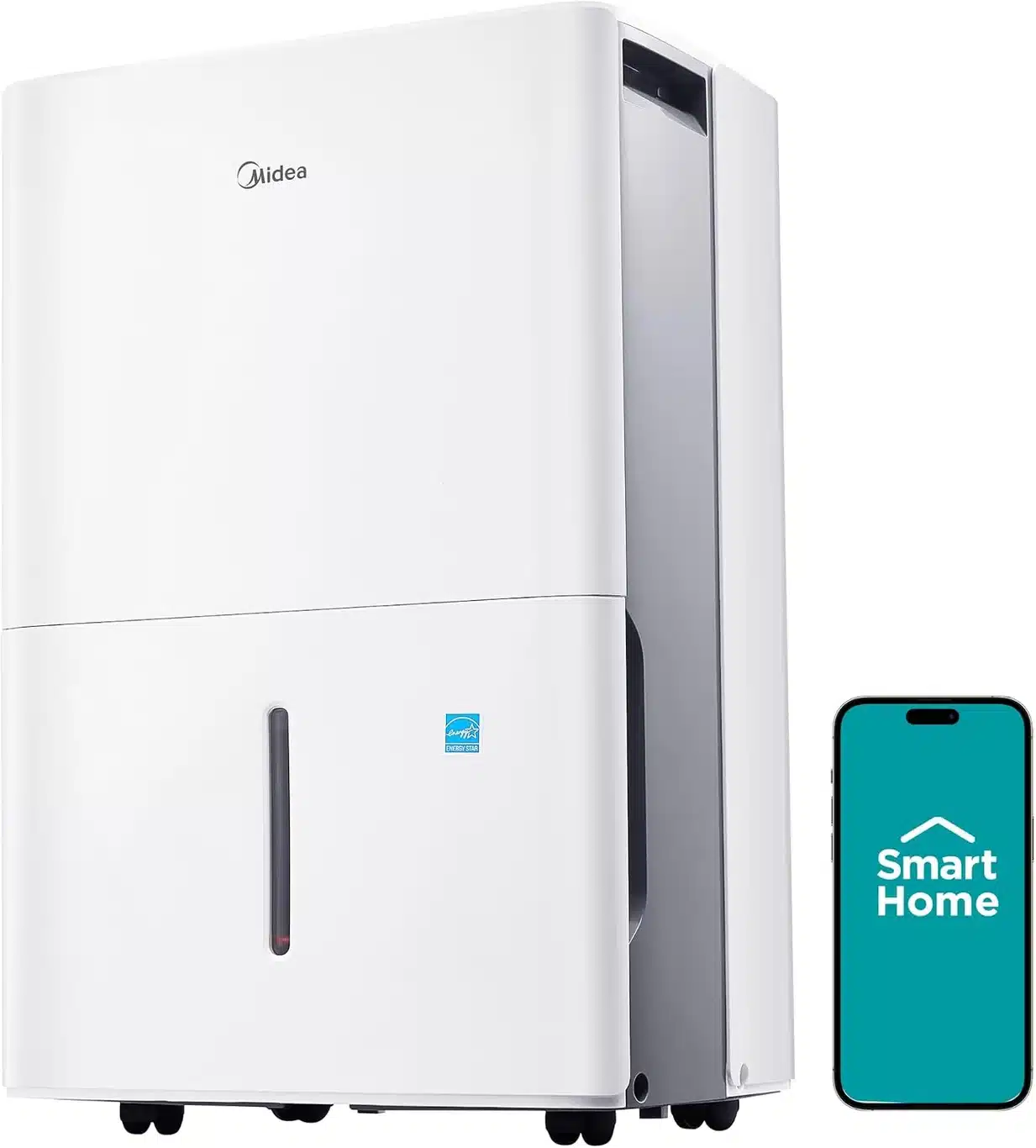
1. Midea EasyDry 22 Pint Dehumidifier
The Midea EasyDry 22 Pint Dehumidifier is the unit we would start with for a damp bedroom that needs real water removal. Its 22.31 pints per day on the DOE 2019 test (65F, 60% RH) is the only pint figure here measured at current federal conditions, taken from the ENERGY STAR entry. That makes it the one capacity number we can hold against a standard.
Midea EasyDry 22 Pint Dehumidifier Specs
| Type | Compressor |
| Rated capacity | 22.31 pints per day (DOE 2019 test, 65F and 60% RH) |
| Tank size | 0.8 gallon |
| Maker-stated noise | 47 dBA |
| Room size (maker) | Up to 1,500 sq ft |
| Sleep mode and auto shut-off | No sleep mode listed; auto shut-off when the tank is full, auto restart after power loss |
Key Features
- The ENERGY STAR certification is confirmed in the ENERGY STAR product finder, and the maker states 31% energy savings over traditional dehumidifiers.
- The 47 dBA noise level is a maker figure, higher than the 36 to 40 dB figures quoted for other compressor models here, though makers use different methods.
- The 0.8-gallon tank stops the unit when full and restarts it after you empty it.
- The built-in drain socket accepts a standard hose for continuous draining, though the hose is not included.
- The auto defrost and auto restart functions keep it running in cooler rooms and bring your settings back after a power cut.
Noise is where a bedroom buyer should be careful. The maker rates the Midea at 47 dBA, and its listed features include two fan speeds but no dedicated sleep mode. From the listing, the quietest option is simply the low speed, so it suits a room where a steady hum is acceptable rather than one that needs near silence.
Capacity is where it earns the top slot. A rating of 22.31 pints per day at 65F and 60% RH is harder to reach than the same pint number quoted at 95F and 90% RH, so it tells you more about real damp. The maker's 1,500 sq ft coverage is generous for one bedroom, so the extra headroom matters mainly if the damp problem spreads beyond the sleeping room.
The ENERGY STAR listing is the strongest paperwork behind any unit in this article.
Why We Chose This
It combines a confirmed ENERGY STAR entry and a DOE 2019 capacity of 22.31 pints per day with a wheeled 33.5-pound body that rolls between rooms.
We would still pair it with a hygrometer, since the target is 30 to 50% indoor humidity, not a bone-dry room.
Where it falls short for sleeping rooms is size and sound. At 33.5 pounds it is the heaviest unit here with a listed weight, although the casters make moving it easy. What surprised us is that a unit this capable skips a sleep mode, so a light sleeper has to accept the fixed noise floor of the low fan speed.
Pros
- Confirmed ENERGY STAR certification
- DOE 2019 capacity of 22.31 pints per day
- 1,500 sq ft maker coverage
- Continuous drain socket for a hose
- Auto defrost for cooler rooms
- Auto restart after power loss
- Casters for moving between rooms
Cons
- 47 dBA noise figure
- Heavy at 33.5 pounds
For a bedroom with a persistent musty smell, this is the best bedroom dehumidifier on our list to start with, provided you can live with the noise. Connect a hose to the drain socket and you also skip carrying a 0.8-gallon tank to the sink every morning.
Final Verdict
Choose it for a bedroom with genuine dampness, where verified capacity and an ENERGY STAR entry outweigh the 47 dBA noise figure. Skip it if silence at the pillow matters more than water removal. It is the benchmark every other unit here is measured against.
2. WoEleLigt CT9 Thermoelectric Dehumidifier
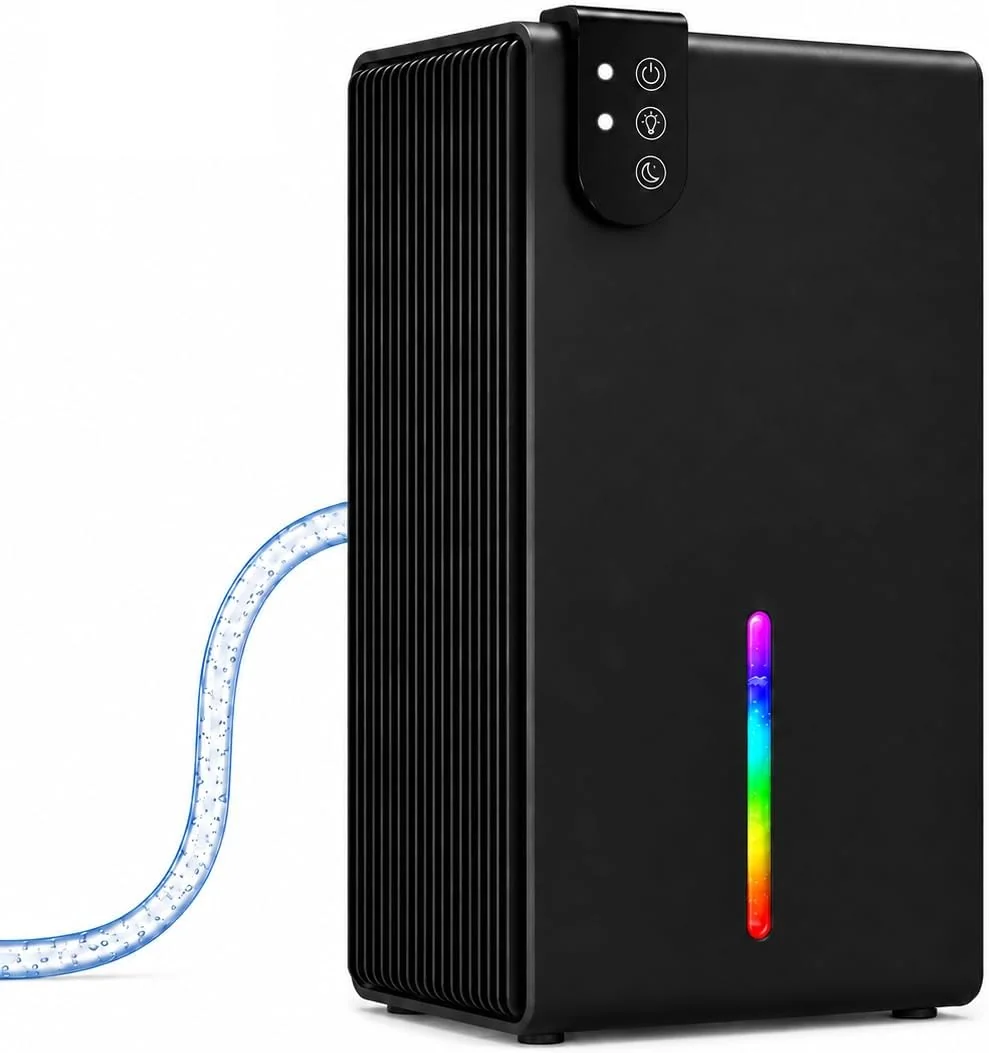
Next, the WoEleLigt CT9 Thermoelectric Dehumidifier is the best budget dehumidifier for bedroom use when the room is small and only mildly damp. It is a thermoelectric (semiconductor) design with no compressor, and the maker states a Sleep Mode under 30 dB. We want to be clear from the start that this is a small-capacity machine.
WoEleLigt CT9 Thermoelectric Dehumidifier Specs
| Type | Thermoelectric (semiconductor) |
| Rated capacity | 1 liter per day (maker figure, test condition not stated) |
| Tank size | 2.5 liters (98 fluid ounces) |
| Maker-stated noise | Under 30 dB in Sleep Mode (no test method stated) |
| Room size (maker) | Up to 1,000 sq ft (maker claim) |
| Sleep mode and auto shut-off | Sleep Mode; auto shut-off with a red warning light when the tank is full |
Key Features
- The dual-core thermoelectric module removes moisture without a compressor, which keeps the body at about 5.5 pounds.
- The Sleep Mode is rated by the maker at under 30 dB, with no test method stated.
- The 2.5-liter removable tank shuts the unit off with a red warning light when it is full or misplaced.
- The included drain hose lets you drain continuously instead of emptying the tank.
- The 7-color night light can be locked to one color, left to cycle or turned off for sleep.
The headline number is 1 liter per day, and the maker does not say at what temperature or humidity. We never convert that to pints as a headline, because without a test condition it cannot be compared with the DOE value for the Midea. It is a small fraction of what the compressor models in this list are rated for.
The maker lists coverage of up to 1,000 sq ft, and we treat that as an overclaim for a unit this size. Closets, nurseries and small bedrooms are the realistic targets. When we compared the listing, what surprised us was how often the 1,000 sq ft claim sits beside a 1 liter per day rating.
The Sleep Mode and the lights-off option are the two features that matter most at night.
Why We Chose This
It is a small, roughly 5.5-pound thermoelectric unit with Sleep Mode, auto shut-off and a drain hose, which makes it an inexpensive way to test whether a small damp room needs more.
Treat the under 30 dB figure as maker-stated, since no test method is given.
The honest trade-off is capacity and track record. The seller is less established than the Midea or Kesnos brands, and the listing carries far fewer ratings, which we flag here rather than quote a count. In our read of the specs, a thermoelectric unit rated at 1 liter per day will struggle in a room that is truly damp.
Pros
- Under 30 dB Sleep Mode (maker-stated)
- Portable 5.5-pound body
- 2.5-liter removable tank
- Drain hose included
- Auto shut-off with warning light
- Night light can be turned off
- No compressor to cycle on and off
Cons
- Small capacity of 1 liter per day
- Less established seller, no certification found
We found no entry for this unit in the ENERGY STAR product finder or the AHAM Verifide list, so we make no certification claim. Thermoelectric units rarely appear in those lists, but it does mean the sleep-mode noise figure rests on the maker alone. Empty the tank each morning and keep the unit on a stable surface clear of bedding.
Final Verdict
Pick it for a closet or small bedroom with mild dampness and a tight budget. Skip it if you can see condensation on walls or smell mold, because it will not keep up. It is the small-room starter unit.
3. BEDRED CT11 Thermoelectric Dehumidifier
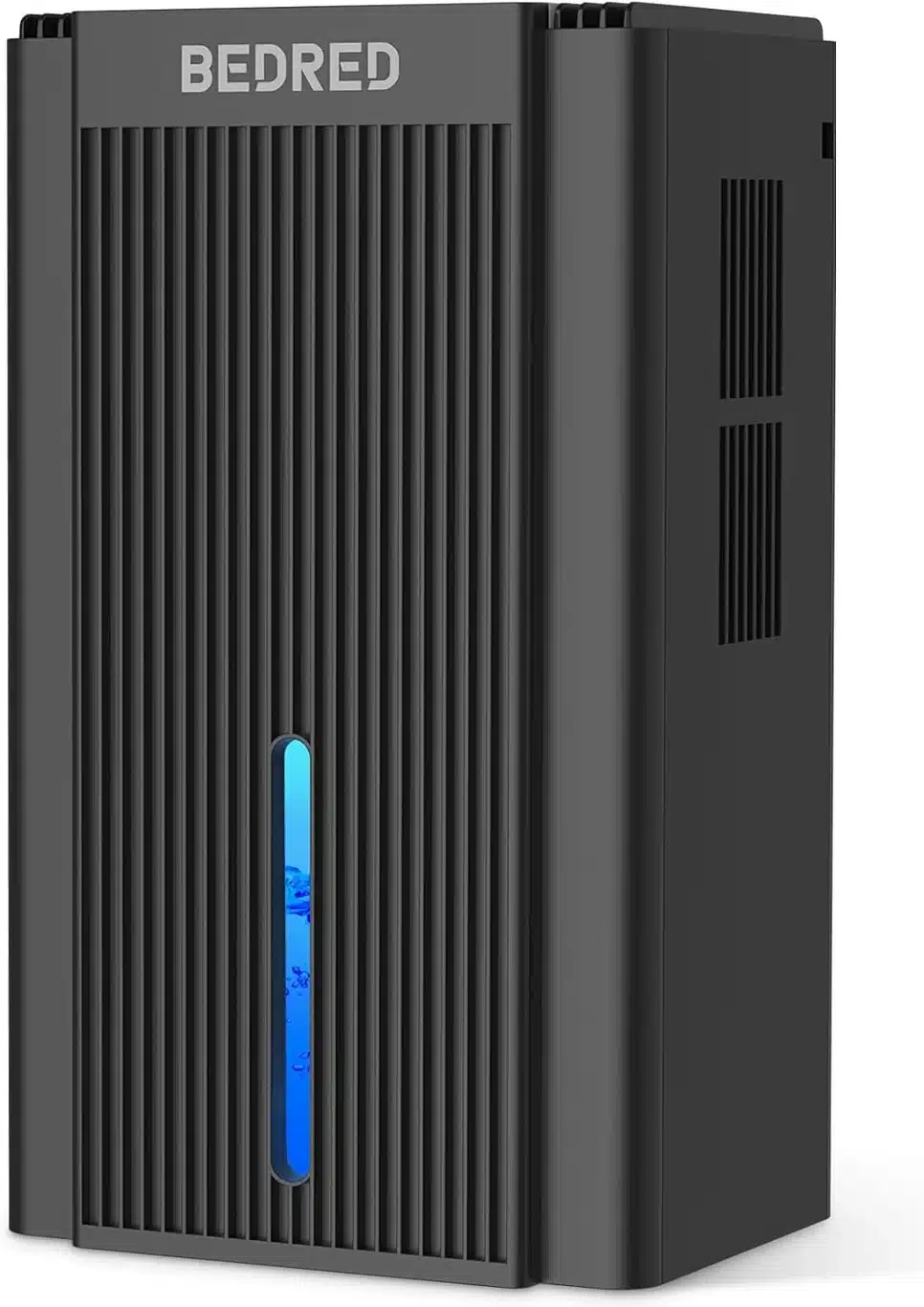
Following the budget pick, the BEDRED CT11 Thermoelectric Dehumidifier is a 5.8-pound compact unit for small bedrooms and closets. The part that matters for sleeping is its Sleep Mode, which the maker says turns the ambient light off and lowers the noise.
BEDRED CT11 Thermoelectric Dehumidifier Specs
| Type | Thermoelectric (semiconductor) |
| Rated capacity | Not stated by the maker |
| Tank size | 95 ounces |
| Maker-stated noise | No decibel figure given; Sleep Mode lowers noise |
| Room size (maker) | Up to 1,000 sq ft (maker claim) |
| Sleep mode and auto shut-off | Sleep Mode turns the ambient light off; auto shut-off when the tank is full |
Key Features
- The Sleep Mode switches the ambient light off and lowers noise, though the maker gives no decibel figure.
- The auto shut-off powers the unit down when the water tank is full.
- The 95-ounce tank holds the collected water until the shut-off stops the unit.
- The 7-color ambient light doubles as a night light, and Sleep Mode is how you turn it off.
- The 85-watt thermoelectric module needs no compressor, so the body weighs only 5.8 pounds.
Capacity is the unknown. The listing gives no rated pints per day, and the one capacity field on the page shows a weight rather than a removal rate, so we cannot offer a removal figure we trust. Everything we say about performance therefore stays qualitative.
The maker says it covers 1,000 sq ft, and the same overclaim caution applies as with the WoEleLigt. We would use it in a small bedroom, nursery or closet and treat anything larger as a stretch. What we noticed comparing the two thermoelectric listings is that the BEDRED page gives no dB number where the WoEleLigt page gives one.
The Sleep Mode is the reason this unit earns a bedroom slot.
Why We Chose This
It pairs a Sleep Mode that turns the light off with auto shut-off in a 5.8-pound body that is easy to move between small rooms.
Because no noise figure is published, we cannot promise silence.
The trade-off is the same as with any thermoelectric unit: tiny removal capacity and no published rating to check. In our read of the specs, the word quiet in the listing is a claim, not a measurement. The ambient light also needs to be off or in Sleep Mode, since a bright color in a dark bedroom works against rest.
Pros
- Sleep Mode turns the ambient light off
- Auto shut-off when the tank is full
- Compact 5.8-pound body
- 95-ounce tank
- Low 85-watt draw
- No compressor in the design
- Color options for night use
Cons
- No published noise or removal figure
- No certification found
We found no entry for the CT11 in the ENERGY STAR product finder or the AHAM Verifide list, so we make no certification claim. Use it where mild dampness and a closed door are the problem, and empty the tank before it fills and shuts the unit off.
Final Verdict
Choose it for a small bedroom or closet where light, noise and size matter more than removal power. Skip it for anything beyond mild dampness. It is the compact option for tiny rooms.
4. Kesnos CTH30B 30 Pint Dehumidifier
Stepping up to a compressor, the Kesnos CTH30B 30 Pint Dehumidifier is our pick when quiet matters most. The maker quotes 36 dB at low fan speed, the lowest compressor figure in this list, plus a Comfort mode that dims the display after 60 seconds. That combination suits a light sleeper.
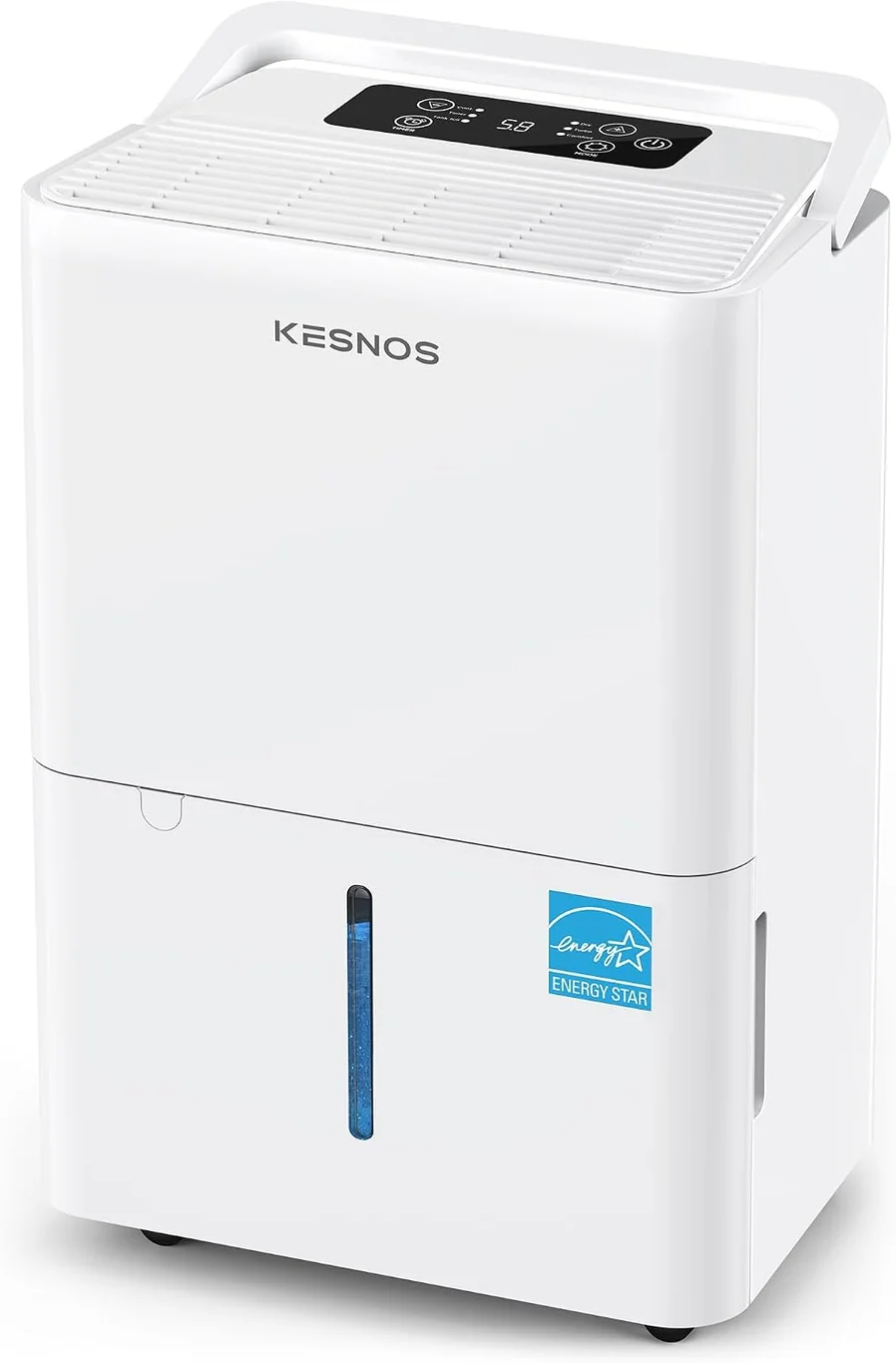
Kesnos CTH30B 30 Pint Dehumidifier Specs
| Type | Compressor |
| Rated capacity | 30 pints per day (maker figure at 95F and 90% RH, not a DOE 2019 test) |
| Tank size | 0.39 gallon |
| Maker-stated noise | 36 dB at low fan speed |
| Room size (maker) | Up to 2,500 sq ft |
| Sleep mode and auto shut-off | Comfort mode dims the display after 60 seconds; auto shut-off with a tank-full beep |
Key Features
- The 36 dB low-fan setting is the maker's figure, and makers measure noise in different ways.
- The Comfort mode adjusts to room temperature and dims the display after 60 seconds.
- The four modes are Dry, Turbo, Comfort and Continuous, which covers everyday control and faster drying.
- The 0.39-gallon tank shuts the unit off and beeps when full, and a 3.3-foot drain hose is included.
- The reliability features include automatic defrost, a 3-minute compressor delay and memory restart after a power cut.
Capacity needs a careful read. The maker's 30 pints per day is measured at 95F and 90% RH, an older and easier test than the DOE 2019 conditions behind the Midea figure, so the DOE equivalent will be lower. Do not compare the two pint for pint.
If you want a quiet dehumidifier for a bedroom, the low-speed setting is what you will run at night. Turbo mode raises the fan from 44 to 59 CFM, which is the setting to keep for daytime drying. The maker says Comfort mode needs no manual humidity setting.
At 22.6 pounds with casters and a lift handle, it moves between rooms more easily than the Midea.
Why We Chose This
It offers the lowest quoted fan noise among the compressor units here, a display that dims itself and 2,500 sq ft of maker coverage that leaves headroom.
The 3-minute compressor delay means it may wait before restarting, so do not mistake the pause for a fault.
The caveats are the small tank and the paperwork. The 0.39-gallon tank fills quickly in a damp room, so we would attach the included drain hose for any overnight run. The ETL and CEC marks are maker-stated only, and we make no ENERGY STAR claim for this model.
Pros
- 36 dB maker figure at low fan
- Comfort mode dims the display
- Four modes with a turbo option
- Auto shut-off with tank-full beep
- 3.3-foot drain hose included
- Memory restart after power loss
- Casters and lift handle
Cons
- 0.39-gallon tank fills quickly
- Certification marks are maker-stated only
Looking at the whole list, it is the best quiet dehumidifier here for people who sleep lightly and still want compressor-level removal. Keep in mind that quiet is a range, and 36 dB is a maker figure at low fan speed, not a promise at every setting.
Final Verdict
Choose it when sleep comes first and the room needs a real compressor unit. Skip it if you want certification evidence beyond the maker's word. It is the quiet compressor pick.
5. CLEVAST DH07 25 Pint Compressor Dehumidifier
After that, the CLEVAST DH07 25 Pint Compressor Dehumidifier suits apartment bedrooms, where a 17-pound body and a hose-ready tank matter. It runs four modes, including a Sleep Mode that the maker says keeps the room at 52 to 60% RH at as low as 37 dB.
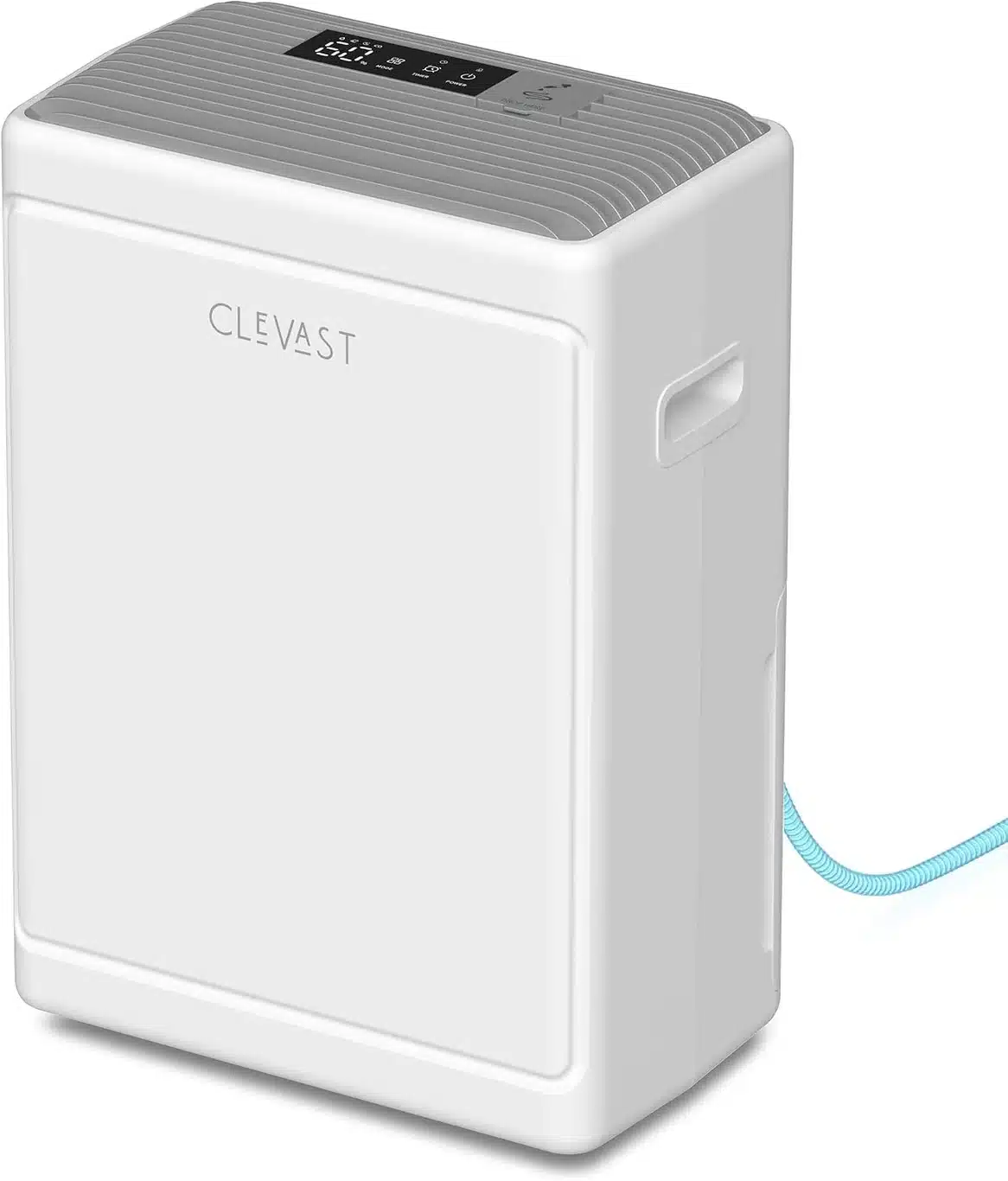
CLEVAST DH07 25 Pint Compressor Dehumidifier Specs
| Type | Compressor |
| Rated capacity | 25 pints per day (maker figure at 86F and 80% RH, not a DOE 2019 test) |
| Tank size | 0.58 gallon (2.2 liters) |
| Maker-stated noise | 37 dB in Sleep Mode |
| Room size (maker) | Up to 2,000 sq ft |
| Sleep mode and auto shut-off | Sleep Mode holds 52 to 60% RH; auto shut-off when the tank is full |
Key Features
- The four modes are Continuous, Auto (48 to 55% RH), Laundry and Sleep (52 to 60% RH).
- The 0.58-gallon tank shuts the unit off when full, and a 4.9-foot hose allows continuous drainage.
- The BLDC fan motor is the maker's route to 37 dB in Sleep Mode.
- The built-in aroma box holds three pads for essential oil, an optional extra you can leave empty.
- The washable filter and power-outage memory reduce upkeep and spare you from re-entering settings.
For anyone shopping for a dehumidifier for apartment living, weight is the first filter. At 17 pounds it is the lightest compressor unit here with a listed weight, and the maker's 2,000 sq ft coverage is far beyond what one bedroom needs.
Capacity is the maker's 25 pints per day at 86F and 80% RH, which is not a DOE 2019 figure, so it cannot be compared directly with the Midea's 22.31 pints. What we noticed is that this test condition differs from the 95F and 90% RH used for the Kesnos and GoGuess figures, so none of the three pint numbers sits on the same scale.
Sleep Mode keeps the room at 52 to 60% RH and runs quietly.
Why We Chose This
It is the lightest compressor unit with a listed weight at 17 pounds, with a hose, a sleep-focused mode and a 37 dB maker figure that suit a small apartment.
The maker says it works with a smart plug for remote on and off, though the plug is not included.
The caution is evidence. We found no spec sheet outside the Amazon listing and no DH07 entry in the ENERGY STAR product finder or the AHAM Verifide list, so almost every figure here is single-source. In our view that is acceptable for a bedroom unit, but the 37 dB and 25 pint numbers deserve less weight than the Midea's registry data.
Pros
- 17-pound body, light for the class
- Sleep Mode at 37 dB (maker-stated)
- 4.9-foot drain hose included
- Washable air-inlet filter
- Power-outage memory
- 24-hour timer
- Laundry mode alongside Sleep Mode
Cons
- Single-source specifications only
- No registry listing found
If you rent and move often, it is the best dehumidifier for apartment bedrooms on our list: light, hose-ready and quiet at night. Place it clear of curtains and bedding so the fan inlet stays open.
Final Verdict
Choose it for a rented bedroom where weight, a sleep mode and a drain hose matter. Skip it if you want third-party certification behind the numbers. It is the light, apartment-friendly pick.
6. GoGuess YC3D6-PRO 21 Pint Compressor Dehumidifier
To finish the list, the GoGuess YC3D6-PRO 21 Pint Compressor Dehumidifier is the best small dehumidifier for bedroom use if you want a compressor in a compact body. It draws 80 watts, offers three fan speeds, and its Sleep mode turns the display lights off.
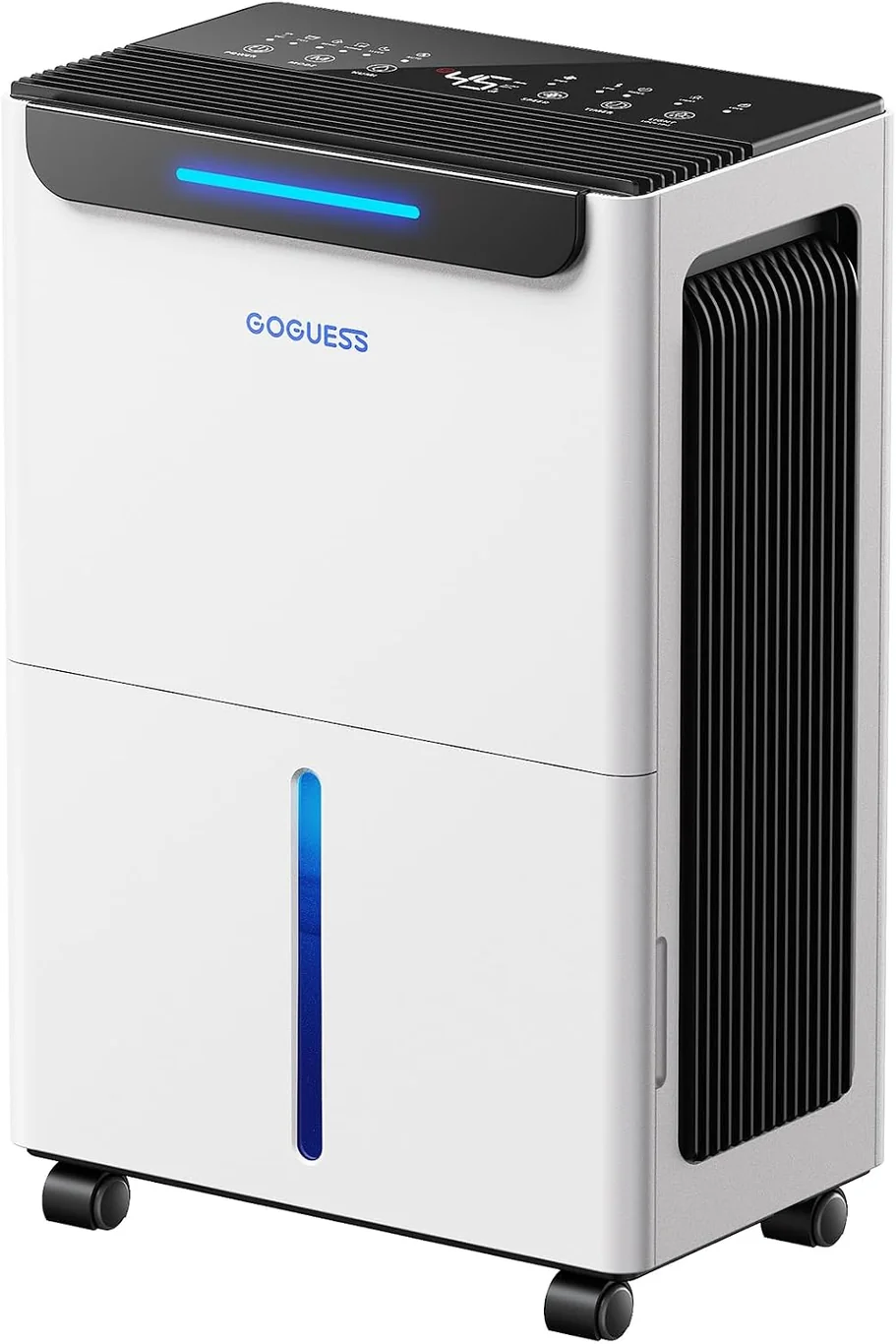
GoGuess YC3D6-PRO 21 Pint Compressor Dehumidifier Specs
| Type | Compressor |
| Rated capacity | 21 pints per day (maker figure at 95F and 90% RH, not a DOE 2019 test) |
| Tank size | 2.3 liters |
| Maker-stated noise | 40 dB |
| Room size (maker) | Up to 1,600 sq ft |
| Sleep mode and auto shut-off | Sleep mode turns the display lights off; auto shut-off with an indicator light when the tank is full |
Key Features
- The three modes are DEHU (30 to 80% RH setting), TURBO and SLEEP.
- The Sleep mode turns the display lights off and lowers the noise further.
- The 2.3-liter tank triggers an automatic shut-off and an indicator light when full, and a 3.28-foot drain hose is included.
- The safety set covers overload protection, automatic defrost and a child lock.
- The humidity indicator is a color-changing LED that shows real-time humidity even when the unit is off.
Noise is stated at 40 dB, which the maker compares to a typical conversation, with no test method given. In Sleep mode the display lights turn off and the noise is reduced further, which is the setting you would use at night.
The 21 pints per day figure is measured at 95F and 90% RH, the older and easier condition, so the DOE 2019 equivalent will be lower. If you are choosing the best dehumidifier for small room use, size it to the dampness you actually have, not to the pint number on the box.
The listing states a 2-year warranty.
Why We Chose This
It gives you a compressor, a sleep mode that turns the display off and a child lock in a body that draws only 80 watts.
Its child lock stops accidental setting changes, a small plus in a shared room.
The gaps are evidence and weight. No weight is listed, and we found no entry in the ENERGY STAR product finder or the AHAM Verifide list, so we make no certification claim. What we noticed in the specs is that the compact size comes with a 2.3-liter tank, which fills faster than the Midea's 0.8-gallon tank, so the hose is the sensible choice overnight.
Pros
- 40 dB maker figure
- Sleep mode turns display lights off
- Three fan speeds
- Child lock
- 2-year warranty listed
- Low 80-watt draw
- Overload protection and auto defrost
Cons
- No listed weight
- Pint figure from an older test condition
Keep it where you can see the LED indicator, because it shows real-time humidity even when the unit is off. That works as a quick check, though a separate hygrometer is still the better reference for the 30 to 50% target.
Final Verdict
Choose it for a small bedroom that needs a compressor, a sleep mode and a child lock. Skip it if you need third-party certification or want a listed weight before you buy. It is the compact compressor choice.
How to Choose the Best Dehumidifier for Bedroom
A bedroom dehumidifier has a different job from a basement unit, because you sleep next to it. Quiet running and a light you can switch off matter as much as raw capacity. The six factors below are the ones we weigh first, in the order they usually decide a purchase.
Thermoelectric or compressor
A compressor unit chills a coil to pull water from the air, much like a small air conditioner. A thermoelectric unit uses a semiconductor plate and has no compressor. That one design choice sets how much water a unit removes and how much noise it makes. In our experience the spec sheet only tells half the story here, so we read the design before anything else.
Here is how the two designs compare on the figures the makers state:
Rule of thumb: pick a compressor unit when the damp is real, and pick a thermoelectric mini only when the room is tiny and the damp is mild. A mini will not rescue a wet bedroom.
| Feature | Compressor | Thermoelectric |
| Best for | Bedrooms with real damp | Closets and tiny rooms with mild damp |
| Noise | 36 to 47 dB on maker figures | One unit states under 30 dB in sleep mode; the other gives no figure |
| Capacity | 21 to 30 pints a day on maker figures | Small; one unit states 1 liter a day |
| Weight | 17 to 33.5 lb for the units that list it | 5.5 to 5.8 lb |
Real capacity and the test behind it
Pints per day only means something with a test condition next to it. Many listings quote the old 95F and 90% relative humidity condition, which is far wetter than a bedroom. The current DOE 2019 test runs at 65F and 60% relative humidity, so the same machine shows a lower number under it.
These are the test conditions we found behind the figures in this guide:
- DOE 2019 (65F, 60% RH): the Midea EasyDry 22 Pint Dehumidifier is rated at 22.31 pints a day.
- 95F and 90% RH: the Kesnos CTH30B 30 Pint Dehumidifier states 30 pints a day, and the GoGuess YC3D6-PRO 21 Pint Compressor Dehumidifier states 21.
- 86F and 80% RH: the CLEVAST DH07 25 Pint Compressor Dehumidifier states 25 pints a day.
- No condition given: the WoEleLigt CT9 Thermoelectric Dehumidifier states 1 liter a day.
Rule of thumb: never compare pint figures across different test conditions. What we found mattered more than the headline number was the condition printed beside it. The 22 in the Midea name is the DOE value, not a maker claim.
Energy use is the other figure worth reading. The Midea carries an annual rating of 278 kWh and an integrated energy factor of 1.7 L/kWh in its ENERGY STAR entry. We found no confirmed ENERGY STAR listing for the other five models, so we make no certification claim for them.
Noise at night
Noise is the factor a sleeper feels first, and a quiet dehumidifier is the goal for any bedroom. The compressor models here state 36 to 47 dB, and the thermoelectric minis are said to run quieter but remove far less water. Treat every dB figure as a maker claim, not a measured result, because most listings do not print a test method.
Maker noise figures in this guide, from quietest to loudest:
- Under 30 dB: the WoEleLigt CT9 Thermoelectric Dehumidifier in sleep mode, with no test method stated.
- 36 dB: the Kesnos CTH30B 30 Pint Dehumidifier at low fan.
- 37 dB: the CLEVAST DH07 25 Pint Compressor Dehumidifier in sleep mode.
- 40 dB: the GoGuess YC3D6-PRO 21 Pint Compressor Dehumidifier.
- 47 dBA: the Midea EasyDry 22 Pint Dehumidifier.
Bottom line: quiet is a range, not a promise. In our experience a stated sleep or low-fan figure matters more than a top-speed figure, because you will run the unit on its lowest setting overnight. The BEDRED CT11 Thermoelectric Dehumidifier gives no dB figure at all, so we judge it only on its sleep mode description.
Sleep mode and display light
A glowing display is a real nuisance in a dark bedroom, and the units here handle it differently. Comfort mode on the Kesnos dims the display, the GoGuess turns its display lights off in sleep mode, and the BEDRED sleep mode turns the ambient light off. Look for a light that goes fully off, not one that is only dimmer.
A target humidity setting matters as much as the light. The EPA advises keeping indoor humidity between 30 and 50 percent. The CLEVAST states an auto mode of 48 to 55% RH, which overlaps only the top of that band, while the GoGuess states a 30 to 80% humidity range that you can set yourself.
Other controls that help at night:
- 24-hour timer: stated on the CLEVAST and the GoGuess, so the unit can stop after you fall asleep.
- Auto restart or power-outage memory: stated on the Midea, the Kesnos, the CLEVAST and the GoGuess, so a power cut does not leave the room unprotected.
- Child lock: stated on the GoGuess, useful in a shared or kids room.
In our experience a unit with an adjustable target is the easier one to live with. Set the target inside the EPA band, then let the unit cycle off on its own.
Room size and tank size
Match the unit to the damp, not only to the floor area. Maker coverage claims in this guide run from 1,000 to 2,500 sq ft. A 1,000 sq ft claim on a mini that weighs under 6 lb is an overclaim, and we treat those minis as closet and small bedroom units.
If your room is large, a bedroom unit is the wrong tool. The best large room dehumidifier is a bigger machine, usually in the 50 pint class, and none of the six picks here belongs in that group. A bedroom unit works hard in an open living space and still falls short.
Tank size and coverage, as the makers state them:
Our quality floor: a smaller tank fills sooner, so pair a small tank with a drain hose if the room is damp. Otherwise the unit shuts off before morning and the damp returns.
| Product | Tank size | Maker coverage |
| Midea EasyDry 22 Pint Dehumidifier | 0.8 gallon | 1,500 sq ft |
| WoEleLigt CT9 Thermoelectric Dehumidifier | 2.5 L (98 fl oz) | 1,000 sq ft |
| BEDRED CT11 Thermoelectric Dehumidifier | 95 oz | 1,000 sq ft |
| Kesnos CTH30B 30 Pint Dehumidifier | 0.39 gallon | 2,500 sq ft |
| CLEVAST DH07 25 Pint Compressor Dehumidifier | 0.58 gallon (2.2 L) | 2,000 sq ft |
| GoGuess YC3D6-PRO 21 Pint Compressor Dehumidifier | 2.3 L | 1,600 sq ft |
Drainage and auto shut-off
A tank can fill overnight in a damp room, so the way a unit handles a full tank matters. Auto shut-off stops the unit when the tank is full, and a drain hose avoids the problem. If you want a dehumidifier for apartment living, check where the hose can run before you buy, because many apartments have no floor drain.
Drain options stated on the units in this guide:
- Continuous drain: stated on the Midea and the Kesnos.
- 4.9 ft drain hose: stated on the CLEVAST, with a continuous mode.
- Drain hose included: stated on the WoEleLigt, Kesnos, CLEVAST and GoGuess; the Midea has a hose socket but no hose, and the BEDRED lists none.
- Auto shut-off when the tank is full: stated on the BEDRED.
Bottom line: we would not put a unit in a bedroom without auto shut-off. A unit that overflows beside your bed is worse than a unit that stops.
Do you need a dehumidifier in the bedroom?
Not every stuffy bedroom needs a machine. Start with a hygrometer, a small meter that reads relative humidity, and watch it for a few days. The EPA advises keeping indoor humidity between 30 and 50 percent, so a steady reading inside that band means you can skip the purchase.
Signs that point to a moisture problem:
- Condensation: water beads on windows or cold walls in the morning.
- Musty smell: the room smells stale even after cleaning.
- Visible mold or damp patches: usually near corners, closets or outside walls.
If the reading stays above 50 percent, look for the cause before you buy. Leaks, weak ventilation and drying laundry indoors all push humidity up. Fix leaks and ventilation first, then add a unit for the damp that remains.
My Overall Verdict
Our top choice is the Midea EasyDry 22 Pint Dehumidifier, the only unit here with a DOE 2019 rating and an ENERGY STAR listing. The next two picks cover a small budget and a compact room, and the rest of the list fills specific needs.
- Midea EasyDry 22 Pint Dehumidifier [Best Overall] - an ENERGY STAR certified compressor unit rated at 22.31 pints a day under the DOE 2019 test.
- WoEleLigt CT9 Thermoelectric Dehumidifier [Best Budget] - a small thermoelectric mini with a sleep mode and a night light you can turn off, for closets and small rooms.
- BEDRED CT11 Thermoelectric Dehumidifier [Best Compact Unit] - a light thermoelectric mini whose sleep mode turns the ambient light off, suited to tiny rooms.
Choose the Midea when the damp is real, and choose one of the two minis when the room is tiny and only mildly damp. The Kesnos, the CLEVAST and the GoGuess stay on the list for a lower noise figure, an apartment fit and a compact compressor, in that order.
Before you buy, read the test condition beside every pint figure and set your target between 30 and 50 percent.
For most sleeping rooms, the best dehumidifier for bedroom use is the Midea EasyDry 22 Pint Dehumidifier.
Why Midea EasyDry 22 Pint Dehumidifier Might Be the Best Choice
The Midea EasyDry 22 Pint Dehumidifier is the one unit in this guide with a published DOE 2019 rating. Its 22.31 pints a day and 278 kWh a year are measured at a stated condition, so you can trust the figure in a way you cannot with a maker claim.
The trade-off is noise and size. The maker states 47 dBA, the highest figure among the compressor units here, and the unit weighs 33.5 lb. We would put it on its low speed overnight and move it on its casters.
Why it earns the top spot:
- ENERGY STAR certified: listed in the ENERGY STAR certified dehumidifier finder.
- 22.31 pints a day: the DOE 2019 capacity at 65F and 60% RH.
- 47 dBA: maker-stated noise, so it is not the quietest unit here.
- Auto restart and auto defrost: the unit resumes after a power cut and clears frost from its coil.
- 1,500 sq ft maker coverage: with a continuous drain option for hands-off use.
SHOP ON AMAZONAvailability and current price shown on Amazon
FAQs
What is the best dehumidifier for bedroom use?
The best dehumidifier for bedroom use is the Midea EasyDry 22 Pint Dehumidifier for most sleeping rooms, while thermoelectric minis suit closets and tiny rooms. You get a DOE-rated, ENERGY STAR certified compressor unit with the Midea, and you get minis that are quiet on paper, with one stating under 30 dB, though they remove far less water.
Is it safe to have a dehumidifier in the bedroom?
Yes, it is safe to have a dehumidifier in the bedroom when the unit has auto shut-off and sits clear of walls and bedding with its vents uncovered. You should also empty the tank each morning, or run the drain hose to a sink or tub, so the unit does not stop running overnight or overflow.
How loud is a bedroom dehumidifier at night?
A bedroom dehumidifier runs roughly 36 to 47 dB at night on maker figures for compressor units, and one thermoelectric mini states under 30 dB in sleep mode while the other gives no figure. You should treat every figure as a maker claim, because the minis remove far less water and the test methods are rarely printed.
What size dehumidifier do you need for a small room?
You need a dehumidifier sized to the damp in a small room, and most bedrooms suit a compact compressor unit in the 20 to 25 pint class on maker ratings, or a small thermoelectric unit for closets. You should read the test condition next to the pint figure, because a 95F rating overstates what the DOE 2019 test at 65F would show.
Are thermoelectric dehumidifiers worth it for a bedroom?
Thermoelectric dehumidifiers are worth it for a bedroom only when the room is tiny and the damp is mild, such as a closet or a small guest room. You should look at a compressor unit for real damp, because the only capacity figure these minis state is 1 liter a day with no test condition.
References:
- U.S. EPA, A Brief Guide to Mold, Moisture and Your Home (indoor humidity 30 to 50 percent): https://www.epa.gov/mold/brief-guide-mold-moisture-and-your-home
- ENERGY STAR, Certified Dehumidifiers product finder: https://www.energystar.gov/productfinder/product/certified-dehumidifiers
- U.S. Department of Energy, Dehumidifier test procedure and 2019 capacity standard (65F, 60 percent RH): https://www.energy.gov/eere/buildings/dehumidifiers
- AHAM Verifide, Dehumidifier ratings: https://www.ahamverifide.org/
Medical Disclaimer: This content is for informational purposes only. It is not a substitute for professional medical advice, diagnosis, or treatment. If you have concerns about your water quality or air quality and their effects on your health, consult a qualified healthcare professional.
Affiliate Disclosure: As an Amazon Associate, Puritisimo may earn a commission from qualifying purchases made through links on this page, at no additional cost to you. Our recommendations are independent and editorial.