

This Blueair Blue Pure 211i Max review comes down to one question: is your room close to the size Blueair rates it for? I think it is a very good large-room purifier if it is, because Blueair rates it for up to 674 sq ft and CARB has certified the model for electrical safety and ozone. If you want one unit to clean a whole open floor, I would read the headline coverage figure with more caution.

I wrote this for the buyer who already likes the look of the Blueair 211i Max and needs to know what its filtration claims actually cover. I go through the certification record, the filter upkeep, who I would send to a different model, and the problems worth planning for before you order.
Quick Verdict
CARB certified for electrical safety and ozone under Executive Order G-23-076, with Blueair listing CADR at 450 cfm for pollen, 452 cfm for dust and 435 cfm for smoke. Blueair says the main filter typically needs changing between 6 and 9 months of use.
- You get a purifier sized for a big living room or open-plan space, since Blueair rates it for up to 674 sq ft.
- You can check air quality and filter status in the Blueair app and let the sensors adjust the fan for you.
- You plan on a new filter once or twice a year and a quick clean of the fabric pre-filter in between.
SHOP ON AMAZONAvailability and current price shown on Amazon

Blueair Blue Pure 211i Max Review: What This Purifier Is
The Blueair Blue Pure 211i Max Air Purifier is the largest of the three Max models I compare here. Blueair lists dimensions of 22.7 x 14.4 x 14.4 inches, and the 360 degree intake means you do not need to push it flat against a wall, which I find makes placement far easier in a living room.
Inside, a washable fabric pre-filter sits around a combined particle and carbon main filter. Abt names the replacement as the F2MAX, so you buy the same cartridge each time and keep the fabric layer clean between changes.
I read the model names carefully because the family is confusing. The plain 211+ is an older purifier, and Abt says its filters do not fit the Blueair 211i Max. Buy filters by the exact model name, not by the brand.
Specifications
| Specification | Detail |
| Recommended room size | 674 sq ft |
| Time to clean that room once | 12.5 minutes |
| CADR | 450 cfm pollen, 452 cfm dust, 435 cfm smoke |
| Filtration | HEPASilent, particles down to 0.1 micron |
| Fan speeds | 5 fan speeds |
| Noise range | 23 to 53 dB |
| Power at highest speed | 46 W |
| Main filter change interval | 6 to 9 months |
| Dimensions | 22.7 x 14.4 x 14.4 inches |
| Warranty | 1 year |
Key Features
- HEPASilent filtration: Blueair says it combines mechanical and electrostatic filtration with carbon, so one cartridge handles particles and odors.
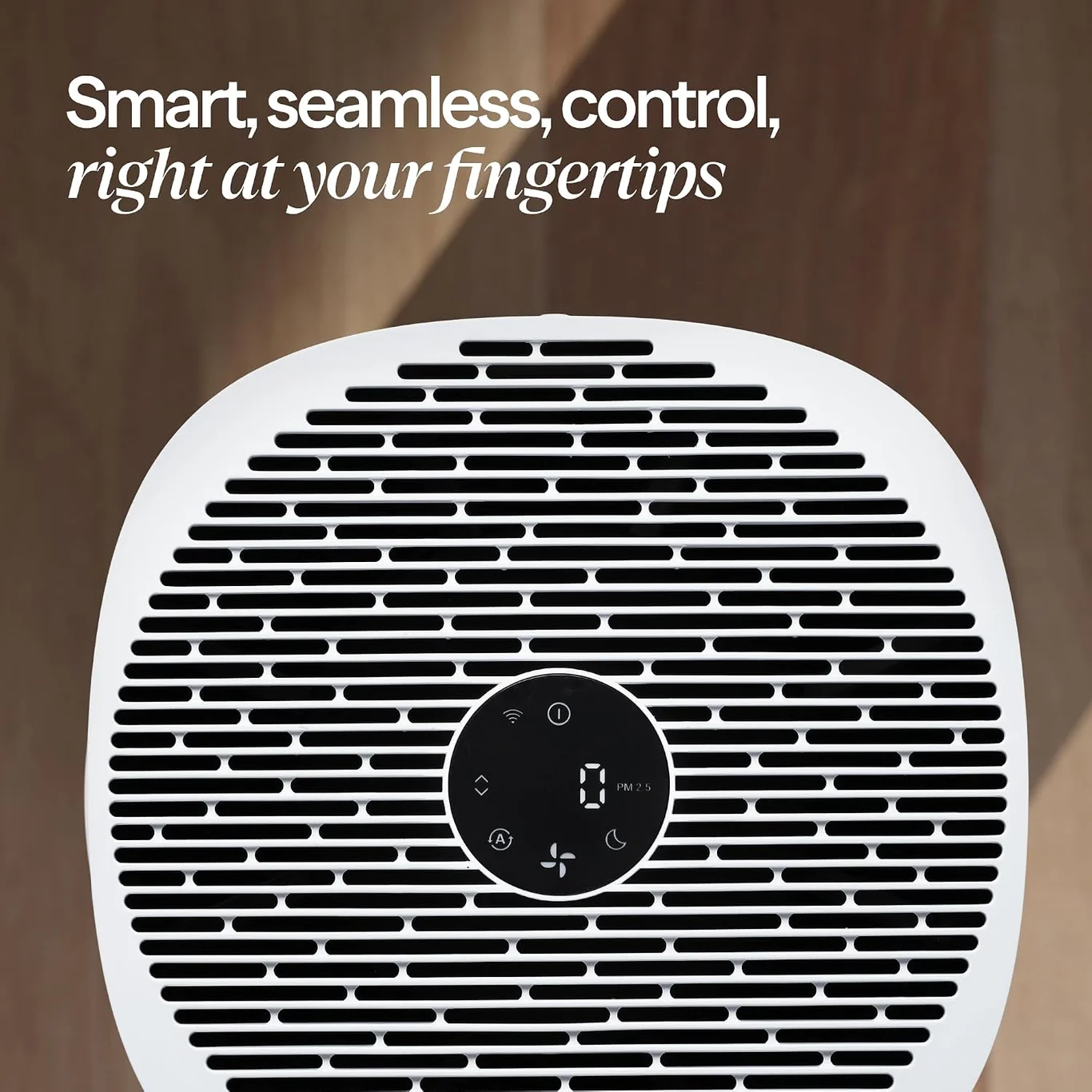
- Built-in air quality sensors: Blueair says they measure PM1, PM2.5 and PM10, so the fan speeds up when the air gets worse and settles when it clears.
- App control and filter tracking: the Blueair app lets you schedule runs and shows filter status, which saves you guessing when the cartridge is due.
- 360 degree air intake: Blueair designs it to draw air from every side, so you can place it away from a wall in a big room.
- CARB certified: the California Air Resources Board confirmed the model meets its electrical safety and ozone requirements, which matters for a purifier you run all day.
What the Blueair Blue Pure 211i Max Filters and What Its Certifications Cover
Blueair describes HEPASilent as mechanical and electrostatic filtration working together, and Blueair’s listing says it captures 99.97% of airborne particles, down to 0.1 micron. I want to be exact about that wording. HEPASilent is Blueair’s own name for the system, so I treat the figure as Blueair’s claim and not as a filter grade I can check against a lab report.
The record I trust most is California’s. CARB’s determination letter, dated April 18, 2023, covers model number 3613111100 and cites Executive Order G-23-076. It says the device meets the state’s testing, electrical safety and ozone requirements. That scope is safety and ozone, not cleaning performance, so I do not read it as a statement about particle removal.
Ozone is the reason I care about that record. The U.S. EPA warns against air cleaners that intentionally produce ozone, and notes that some electronic designs can emit it. A CARB certificate for ozone is the plain answer to that worry for this model.
Performance claims sit with a different program. Quiet Mark says the unit was third-party tested as part of the AHAM Verifide program, and Blueair lists CADR at 450 cfm for pollen, 452 cfm for dust and 435 cfm for smoke. I could not open the AHAM directory itself, so I treat those CADR figures as Blueair’s published numbers. Blueair’s earlier guidance listed 410 cfm. If you want to see where it sits against other filters, our HEPA air purifier roundup lays the options out.
Consumer Reports and Abt list the model as Energy Star certified, and Blueair lists its energy consumption at 46 W at its highest speed. I could not confirm the certificate on the Energy Star list, so I call it a listed claim, not a record I checked.

Living With the Blueair 211i Max: Filter Life, Noise and Upkeep
The number I care about most is the filter interval. Blueair says the main filter typically needs changing between 6 and 9 months of use, and the red indicator light and the app are the signals to watch. From Blueair’s 6 to 9 month interval, that works out to roughly 1.3 to 2 filters a year, and I would budget for the shorter end in a dusty or smoky home.
Running cost is modest for this class: you buy one proprietary F2MAX cartridge once or twice a year and nothing else. I will not quote a price because it moves, so check the current price on Amazon before you order.
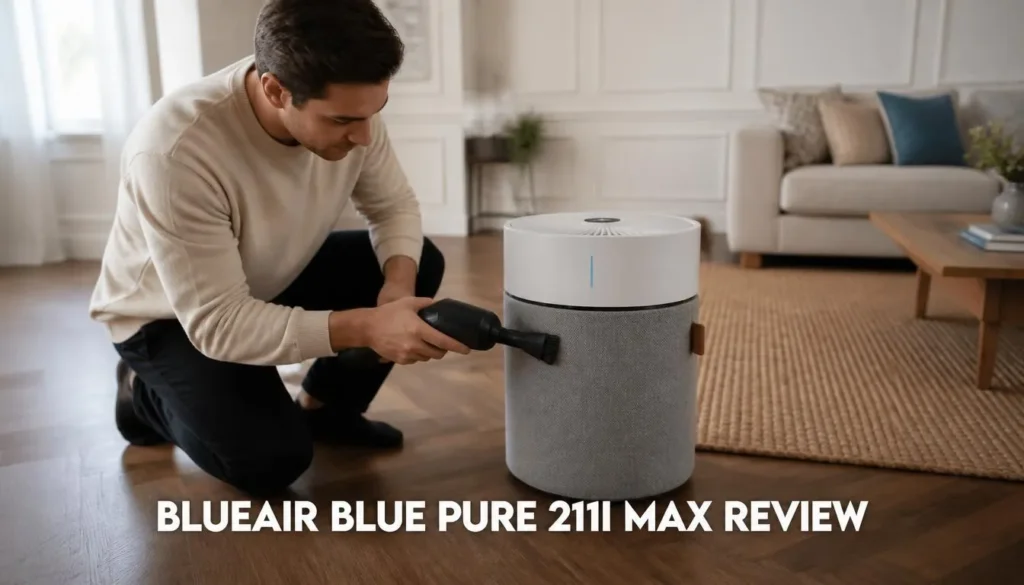
Between changes, the job is the fabric pre-filter. Blueair’s manual says to clean it regularly when you see dust or dirt, by vacuuming the fabric with a soft brush attachment and washing it by the label for a deeper clean. I would put that on a monthly reminder, because Blueair also says a clogged pre-filter or filter can raise noise levels.
Noise depends on the fan speed. Abt lists the range as 23 to 53 dB, and Abt lists 5 fan speeds plus an Auto mode. I would run it on Auto in a living room and drop to a low speed at night. With three children in the house, the night setting matters more to me than the top one. If you are still weighing it against a smaller unit for other rooms, our best air purifier for home guide covers the choices.
Pros
- CARB certified, with Executive Order G-23-076 covering electrical safety and ozone
- Blueair rates it for up to 674 sq ft, large for a single unit
- HEPASilent filtration that Blueair says combines mechanical and electrostatic filtration with carbon
- Sensors adjust the fan automatically, plus app control and filter tracking
- Abt lists 5 fan speeds and an Auto mode, with noise from 23 dB at the low end
- Washable fabric pre-filter extends the main filter’s working life
Cons
- Blueair says the proprietary F2MAX main filter typically needs changing between 6 and 9 months, and Abt says the older 211+ filters do not fit.
Who Should Skip the Blueair Blue Pure 211i Max, and Who It Suits
I would buy it for a large living room, an open-plan space or a family room where one unit has to do the work of two. Blueair rates it for up to 674 sq ft, and I would keep to that figure for any room I want cleaned several times an hour. With three children and the dust that comes with them, I like that Blueair says the sensors track PM1, PM2.5 and PM10 and adjust the fan on their own.
I would not treat the headline coverage figure as a promise. Blueair’s listing says it cleans up to 3,235 sq ft in one hour, and I read that as roughly one air change an hour, a ceiling for a very big open space and not a rate I would plan around. For a whole open floor I would point you to two units, or to our large-room air purifier roundup for other options.
I would skip it if you only need a bedroom unit. Blueair lists the 311i Max for 439 sq ft and the 511i Max for 237 sq ft, and either of those suits a smaller room better. I would also skip it if you want a standalone HEPA grade you can verify, since HEPASilent is Blueair’s own term and I found no independent filter grade.
It is also not for anyone who dislikes upkeep. You need the proprietary filter on a schedule and a regular pre-filter clean, so if you want a unit you can forget for a year, I would look elsewhere.
| Model | How it differs | Pick it instead if |
| Blueair Blue Pure 211i Max Air Purifier | Blueair rates it for up to 674 sq ft, with CADR at 450 cfm for pollen, 452 cfm for dust and 435 cfm for smoke. | Pick this one if you have a large living space and want one unit that covers it. |
| Blueair Blue Pure 311i Max | Blueair lists the 311i Max for 439 sq ft, with CADR at 365 cfm for pollen, 314 cfm for dust and 283 cfm for smoke. | Your room is closer to the size Blueair lists for the 311i Max. |
| Blueair Blue Pure 511i Max | Blueair lists the 511i Max for 237 sq ft, with CADR at 174 cfm for pollen, 159 cfm for dust and 153 cfm for smoke. | You need a unit for a bedroom or other small room. |
Common Blueair Blue Pure 211i Max Problems and How to Avoid Them
The most common trap is the numbers. Blueair’s current listing gives 674 sq ft, while Blueair’s earlier guidance listed 635 sq ft and a CADR of 410 cfm. Older pages still quote the old figures, so I would check the date on anything you read and compare coverage claims only when they come from the same source.
The second trap is the wrong filter. Abt says the filters for the older 211+ do not fit the Blueair 211i Max, and the replacement for this model is the F2MAX. Order by the exact model name, and I would check it before you open the box, because a mismatched filter is an easy mistake to make.
A clogged pre-filter is the one I would plan for. Blueair says a clogged pre-filter or filter can raise noise levels, so a unit that seems louder than it was is a prompt to clean the fabric first. Clean it before you blame the fan.
Last, resetting after a filter swap. Sources disagree on how long to hold the button, so follow the manual for this model and watch that the red light clears. I will not guess a number, because a wrong reset leaves the indicator useless.
My Overall Verdict
I like this purifier for the job it is built for, and I distrust the headline number around it. Blueair’s 674 sq ft rating and the CARB record give me confidence for a large living room, while the 3,235 sq ft figure Blueair quotes for an hour is a once-an-hour number I would not plan around.
The cost of admission is upkeep. You buy a proprietary filter once or twice a year, you clean a fabric pre-filter, and you check that you are reading current coverage figures. I would send anyone with a small bedroom to a smaller Blueair model and anyone with a whole open floor to two units.
Final Verdict
buy it for a large living room or open-plan space where you can accept the 6 to 9 month filter cycle Blueair describes, and skip it for a small bedroom or if you need a verified standalone HEPA grade. I recommend matching it to Blueair’s 674 sq ft rating, and that is the honest conclusion of this Blueair Blue Pure 211i Max review.
SHOP ON AMAZONAvailability and current price shown on Amazon
Frequently Asked Questions
Is the Blueair Blue Pure 211i Max a good air purifier for a large room?
Yes, if the room is near Blueair’s rating of 674 sq ft, because it pairs a combined particle and carbon filter with CADR that Blueair lists at 450 cfm for pollen. You should still plan for a new filter once or twice a year, since the cartridge is proprietary and Abt names it the F2MAX.
Is there a downside to using an air purifier?
Yes, the main downsides are noise at higher fan speeds, filter replacement and the electricity it draws. This model is CARB certified for ozone and electrical safety, but Blueair lists its power at 46 W on the highest speed, so you should expect a modest running cost from that alone.
What is the best air purifier for home in 2026?
The best choice depends on your room size, so you should match a unit’s rated coverage to the space and check its filter upkeep. For a large open room, Blueair rates this model for up to 674 sq ft, which is why it earns a place on a large-room shortlist.
What is the best air purifier recommended by consumer reports?
Consumer Reports keeps its full ratings behind a membership, so you should check its current tables for a ranked answer. Its public page for this model lists Energy Star certification and 5 fan speeds with an Auto mode, which shows the features it highlights for a buyer who is comparing models.
How long should you run an air purifier?
You should run it whenever you are in the room, and many people leave it on all day at a low or Auto setting. This model has an Auto mode that adjusts fan speed from its sensors, and Abt lists noise up to 53 dB, so a lower setting suits overnight.
References
- U.S. EPA. Guide to Air Cleaners in the Home. epa.gov/indoor-air-quality-iaq/guide-air-cleaners-home
- California Air Resources Board. Air Cleaner Regulation (AB 2276). ww2.arb.ca.gov
- Association of Home Appliance Manufacturers. AHAM Verifide Program. ahamverifide.org
- ENERGY STAR. Certified Room Air Cleaners Product Finder. energystar.gov/productfinder/product/certified-room-air-cleaners/results
Medical Disclaimer: This content is for informational purposes only. It is not a substitute for professional medical advice, diagnosis, or treatment. If you have concerns about your water quality or air quality and their effects on your health, consult a qualified healthcare professional.

