


The best sediment filter for well water catches sand, rust flakes and silt before they reach your fixtures and every finer filter. A well has no municipal treatment plant in front of it, so grit arrives at the tap unless something stops it. The right unit pairs a mesh screen or cartridge matched to your grit, fittings that suit your pipe, and a cleaning routine you keep up.

Below you will find 8 units, from our overall pick to the specialist options. Most are reusable spin-down screens, one is a complete two-stage housing, and two are replacement cartridges for a housing you may already own. If you want a simple home sediment filter that you flush instead of replace, the Top 3 picks come first for a quick answer.
My Recommended Top 3 Best-Buys for Sediment Filters for Well Water: Reviewed and Rated

- The lead-free brass head holds a stainless steel mesh screen that the maker says usually lasts 1 to 2 years.
- Flushable and reusable design lets you rinse trapped grit out instead of buying replacement cartridges.
- Double threads of 1 inch MNPT and 3/4 inch FNPT on both ends suit common supply line setups.

- The 316L stainless steel mesh is rated at 50 micron and blocks rust and small debris.
- A backwash function flushes trapped sediment from the screen without a cartridge swap.
- The PA12 housing shell is stated to withstand bursting pressure above 600 psi.
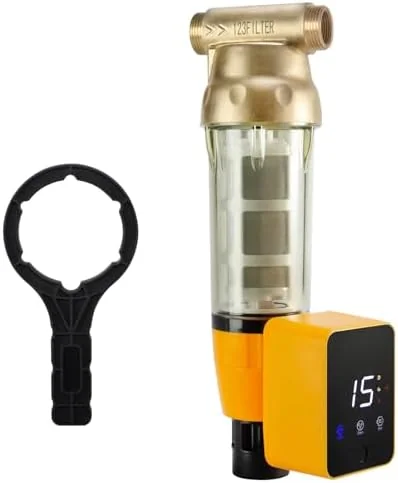
- The auto-flush module uses a scraper and runs on a schedule you set on the touch screen.
- Dual power from an adapter or three AA batteries keeps the schedule running.
- The lead-free brass head carries a 50 micron stainless steel mesh screen and a transparent housing.
Best Sediment Filter for Well Water Reviews 2026: 8 Top Models for Clear Flow
The 8 picks fall into three families: reusable spin-down screens, a two-stage housing with cartridges, and replacement cartridges. Any whole house sediment filter here goes on the main line, but ranks 6 and 7 need a standard 10 x 4.5 inch housing, which is not included.
1. iSpring WSP-50 Spin Down Sediment Filter
A 50 micron stainless steel mesh screen sits at the heart of this spin down sediment filter for well water, and it takes the sand and rust load before finer filters ever see it. We reached for it first because the design is simple and the see-through housing shows the grit as it collects.
iSpring WSP-50 Spin Down Sediment Filter Specs
| Filter type | Spin down stainless steel mesh screen |
| Filtration rating | 50 micron mesh |
| Maximum flow rate | Not stated in the listing |
| Connection size | 1 inch MNPT and 3/4 inch FNPT on both ends |
| Cleaning or replacement | Flush through the hose-barb valve; the maker says the screen usually lasts 1 to 2 years |
| Certification claim | None claimed by the maker |
Key Features
- The lead-free brass head holds a stainless steel mesh screen that the maker says usually lasts 1 to 2 years.
- Flushable and reusable design lets you rinse trapped grit out instead of buying replacement cartridges.
- Double threads of 1 inch MNPT and 3/4 inch FNPT on both ends suit common supply line setups.
- The see-through housing lets you check the screen by eye without opening anything.
- A hose-barb flush valve takes a garden hose so you can drain the captured sediment.
What we noticed first was the hose-barb flush valve. A short length of garden hose is all you need to drain the housing, which keeps routine upkeep to a few minutes. The brass head also feels solid in the hand, a good sign for a part that carries line pressure every day.
The unit is rated for 40 to 100F and 15 to 115 psi, and the maker states it is for indoor use only. That covers most basement or utility room installs. A pump house or outbuilding with freezing exposure falls outside that range.
Think of it as a coarse prefilter that protects everything behind it.
Why We Chose This
It pairs a reusable 50 micron screen, a lead-free brass head and a flush valve in a design simple enough for most well owners to install and maintain themselves.
That makes it our default first stage for most wells.
The trade-off is one the maker flags itself: 50 micron screens can clog quickly on high-sediment water. If your well pumps a lot of grit, plan on flushing more often. Our team would step up to a larger unit with more screen area in that case.
Pros
- Reusable mesh screen, no cartridges to buy
- Lead-free brass machine head
- See-through housing for quick visual checks
- Hose-barb valve makes flushing simple
- Dual 1 inch and 3/4 inch threads
- Compact enough for tight utility spaces
- Wrench and manual included
Cons
- Can clog quickly on gritty water
- Indoor use only, 100F upper limit
Because the mesh is coarse, it will not stop fine silt. On wells that run cloudy we would add a pleated or string wound cartridge behind it. The manufacturer does not claim any certification, so treat the 50 micron rating as a screen size rather than a tested performance claim.
Final Verdict
A simple, flushable prefilter with a clear housing and honest limits is the easiest place to start for most wells. It is the default recommendation.
2. Waterdrop RPFK Spin Down Sediment Filter
Following our top pick, this budget-friendly option uses a 50 micron 316L stainless steel mesh in a compact inline housing. We liked how much hardware the listing packs in at the entry level, especially the choice of four fitting types.
Waterdrop RPFK Spin Down Sediment Filter Specs
| Filter type | Spin down 316L stainless steel mesh with backwash function |
| Filtration rating | 50 micron mesh |
| Maximum flow rate | 20 gpm |
| Connection size | 1 inch MNPT, 3/4 inch MNPT, 3/4 inch FNPT and 3/4 inch push-fit |
| Cleaning or replacement | Backwash function flushes sediment off the screen |
| Certification claim | Maker states NSF/ANSI 372 for lead-free materials |
Key Features
- The 316L stainless steel mesh is rated at 50 micron and blocks rust and small debris.
- A backwash function flushes trapped sediment from the screen without a cartridge swap.
- The PA12 housing shell is stated to withstand bursting pressure above 600 psi.
- Four fitting types cover 1 inch and 3/4 inch MNPT, 3/4 inch FNPT and 3/4 inch push-fit lines.
- A blue nano-coating protects the copper fittings against corrosion, according to the maker.
As a backwashing sediment filter for well water, it relies on a built-in backwash function that flushes sediment off the screen. What stood out to us is that cleaning does not mean pulling the unit apart, which is what makes the upkeep feel routine.
The listing gives 20 gpm maximum flow and a 14.5 to 72 psi operating range, with a 100F upper temperature limit. Our one flag is that the maker notes the push-fit option is not meant for a 3/4 inch garden hose, so read the fitting notes before you plan the install.
The unit is rated for water up to 300 ppm TDS, a lower ceiling than the larger units.
Why We Chose This
Stainless 50 micron mesh, a backwash function and four fitting types at a lower entry point than the iSpring units make it the practical value pick.
It offers the same coarse protection as rank 1 with extra connection flexibility.
The maker states NSF/ANSI 372 certification, but that standard covers the lead content of wetted materials, not sediment reduction. An IAPMO R&T certificate dated March 5, 2026, lists WD-RPFK among the models covered for NSF/ANSI/CAN 372 lead content. This certification does not establish sediment-reduction performance, so check IAPMO for the current listing status.
Pros
- Stainless steel 50 micron mesh screen
- Backwash function for easy flushing
- Four fitting types in one unit
- 20 gpm maximum flow rating
- Tough PA12 housing shell
- Compact inline body
- One-year manufacturer warranty
Cons
- Lower TDS ceiling of 300 ppm
- Lead-content certification does not establish sediment reduction
The 50 micron mesh still passes fine silt, so a finer cartridge behind it makes sense on cloudy water. In practice we see this as the tight-budget way to get a flushable first stage, with the iSpring WSP-50 ahead of it mainly on build confidence.
Final Verdict
Flexible fittings and a backwash function make this a sensible first stage for tight budgets, as long as you read its certification claim for what it covers. It is the practical budget choice.
3. iSpring WSP50ARB Big Spin Down Sediment Filter
Stepping up, this is the unit we would choose for a busy household. It is a large sediment filter for well water with an auto-flush module and built-in scraper that handle the cleaning on a schedule you set.
iSpring WSP50ARB Big Spin Down Sediment Filter Specs
| Filter type | Spin down stainless steel mesh with auto-flush module |
| Filtration rating | 50 micron mesh |
| Maximum flow rate | Up to 25 gpm per the maker's feature list |
| Connection size | 1 inch MNPT and 3/4 inch FNPT |
| Cleaning or replacement | Auto, semi-auto or manual flush from a touch screen |
| Certification claim | None claimed in the listing |
Key Features
- The auto-flush module uses a scraper and runs on a schedule you set on the touch screen.
- Dual power from an adapter or three AA batteries keeps the schedule running.
- The lead-free brass head carries a 50 micron stainless steel mesh screen and a transparent housing.
- Flow of up to 25 gpm per the maker's feature list suits larger plumbing demand.
- No welding or glue is needed, and the unit works with copper, PEX and CPVC pipes.
What caught our attention was the touch-screen flush schedule. Choosing between auto, semi-auto and manual modes means you decide how hands-off the unit is, which suits a household that would otherwise forget a routine flush.
The maker lists a 1000 ppm TDS ceiling and flow of up to 25 gpm, which is generous for a mesh unit. The box includes the power adapter, a wrench, the manual and a mounting bracket, so the install needs little beyond fittings.
Batteries are optional, but the adapter keeps the schedule steady.
Why We Chose This
Automatic scheduled flushing removes the main chore of owning a mesh filter, which matters most in a larger household with heavy daily water use.
It is the pick for hands-off maintenance.
The listing makes no certification claim, and we could not find a registry record, so read the 50 micron figure as a screen size. We also treat the automation as a convenience rather than a filtration upgrade, because the mesh itself matches the smaller WSP-50.
Pros
- Auto-flush module with built-in scraper
- Touch-screen schedule, three flush modes
- Up to 25 gpm per the maker
- 1000 ppm TDS ceiling
- Lead-free brass machine head
- Mounting bracket and adapter included
- Works with copper, PEX and CPVC
Cons
- Costs more than manual units
- Needs adapter or batteries to run
Our one caution is that a 50 micron screen is still coarse, so fine silt passes through no matter how well the flush cycle runs. Add a finer cartridge behind it if your water looks cloudy, and expect the mounting to need more wall space than the smaller units.
Final Verdict
Scheduled flushing and high flow turn a basic mesh filter into a set-and-forget first stage for busy homes. It is the hands-off choice for large homes.
4. PUREPLUS 2-Stage Whole House Water Filter
From there, we move from a stand-alone screen to a complete housing system. As a whole house sediment filter for well water, it pairs a polypropylene and iron-removal composite cartridge with a carbon block in two clear housings that accept standard 10 x 4.5 inch cartridges.

PUREPLUS 2-Stage Whole House Water Filter Specs
| Filter type | Two-stage housing: sediment and iron composite, then carbon block |
| Filtration rating | Not stated in the listing |
| Maximum flow rate | Not stated in the listing |
| Connection size | 1 inch inlet and outlet |
| Cleaning or replacement | Replace cartridges; pressure gauges show when it is time |
| Certification claim | None claimed in the listing |
Key Features
- The first cartridge combines polypropylene with iron-removal media for particles and some iron.
- The second cartridge is a carbon block aimed at chlorine, odor and organic compounds.
- Pressure gauges let you watch flow pressure and judge when cartridges need changing.
- Two clear housings accept standard 10 x 4.5 inch cartridges and let you inspect the media.
- A 30000 gallon capacity is a maker figure, not a guaranteed cartridge life.
What we noticed is that the pressure gauges change how you maintain it. Instead of replacing cartridges on a calendar, you can watch the gauge and change them when pressure tells you the media is loading up. The wrench in the box is a small, practical touch.
The honest scope is simple: stage one handles particles and some iron, and stage two is carbon for chlorine and taste. For many private wells the sediment and iron stage does the real work, and the carbon stage matters mainly if your water also has taste or odor issues.
The unit is rated for 40 to 100F and 1000 ppm TDS.
Why We Chose This
It is the one entry that treats sediment, some iron and taste in a single housing, which suits owners who want one compact system instead of several stages.
It is the pick when you want two stages in one housing.
The listing claims no certification for this system, and we could not find one for model PP-WFM10BBT2-SZC. Some PUREPLUS cartridges carry their own certificates, but we would not extend those to this system, and the evidence behind it is thinner than for ranks 1 to 3.
Pros
- Sediment and iron stage plus carbon stage
- Pressure gauges show cartridge condition
- Clear housing for visual checks
- 1 inch inlet and outlet
- Uses standard 10 x 4.5 inch cartridges
- Wrench and cartridges included
- 1000 ppm TDS rating
Cons
- Thinner owner track record than ranks 1 to 3
- Cartridges are consumables you must replace
Because the cartridges are consumables, ongoing replacement cost and effort are the real trade-off against a flushable mesh screen. On gritty wells we would still put a spin-down screen ahead of it so the composite stage does not load up quickly.
Final Verdict
A compact two-stage housing with gauges suits owners who want sediment, iron and taste handled in one place and accept the cartridge upkeep. It is the all-in-one housing choice.
5. Rusco Vu-Flow 1-Inch 100
Next, we have a no-frills inline option built around a 100 mesh polyester screen in a T-style PVC body. The listing sits among replacement under-sink filters, a catalog quirk, but this is a 1 inch inline spin down unit.

Rusco Vu-Flow 1-Inch 100 Mesh Spin Down Filter Specs
| Filter type | Inline T-style spin down with polyester screen |
| Filtration rating | 100 mesh screen, roughly 150 micron |
| Maximum flow rate | Not stated in the listing |
| Connection size | 1 inch |
| Cleaning or replacement | Reusable screen that is cleaned rather than replaced |
| Certification claim | Listed by the seller as NSF and FDA tested, no standard number given |
Key Features
- The 100 mesh screen is a coarse prefilter for sand and grit.
- A T-style body keeps the design simple and the parts count low.
- The 1 inch connection suits inline placement on a main supply line.
- PVC and polyester construction keeps the unit light at roughly 1.3 pounds.
- A seller-listed NSF and FDA claim comes with no standard number, so treat it as unconfirmed.
What we noticed is how little there is to it: a T-style body, a screen and a 1 inch connection. As a spin down design it is meant to be flushed and cleaned, which makes it a reusable sediment filter for well water rather than a cartridge you keep buying.
Catalog filing aside, the real question is mesh size. A100 mesh screen sits near 150 micron, which makes it coarser than the 50 micron units above. It catches visible sand and rust flakes but lets finer particles pass, so we see it as a first stage only.
The body is PVC per the Amazon listing.
Why We Chose This
It is a compact, low-cost 1 inch inline screen for owners who only need to stop coarse sand and want a simple reusable part.
It suits wells with coarse sand and rust flakes.
The seller lists the unit as NSF and FDA tested with no standard number given, so we cannot say what that claim covers. The Amazon listing gives no flow rating, but the maker lists 1 to 25 gpm, so check your peak water demand before you commit.
Pros
- Simple T-style design, few parts
- Reusable polyester screen
- 1 inch inline connection
- Light PVC body at about 1.3 pounds
- Catches coarse sand and rust flakes
- NSF and FDA claim listed by seller
- Lower cost than automatic units
Cons
- Coarser screen than the 50 micron units
- 1 inch slip ports may require plumbing adapters
Where reviewers could overstate it: a coarse screen protects pipes and fixtures from large debris, but it does little for cloudy water. We would only choose it over the iSpring units where simplicity and a tight footprint matter more than screen fineness.
Final Verdict
A basic reusable screen that does one job for owners with coarse sand and little else to filter. It is the minimalist mesh pick.
6. Membrane Solutions 20 Micron Pleated Sediment Cartridge
After that, we move from screens to cartridges. This is the first of two replacement cartridges on our list, so you need a standard 10 inch sump housing, which is not included in the pack. Think of it as the finer stage that sits behind a spin-down screen.

Membrane Solutions 20 Micron Pleated Sediment Cartridge Specs
| Filter type | Pleated polyester cartridge, 9-7/8 x 4-1/2 inch |
| Filtration rating | 20 micron |
| Maximum flow rate | Not stated in the listing |
| Connection size | Fits standard 10 inch sump housings, not included |
| Cleaning or replacement | Washable and reusable; the listing says 3 to 6 months or 30,000 gallons |
| Certification claim | Listed as NSF, no standard number given |
Key Features
- The pleated polyester media gives a larger surface area than a plain sediment cartridge.
- A 20 micron rating catches sand, dirt, silt, rust and scale particles.
- Four cartridges come in the pack, which covers a year or more of changes.
- Washable construction allows reuse while the cartridge is still clean enough to work well.
- The maker lists this as a replacement for cartridges such as the Pentek ECP20-BB in compatible 10 x 4.5 inch housings.
As a pleated sediment filter, the folded media offers more surface area than a plain wound cartridge of the same size. What we noticed on paper is that this should slow loading and keep pressure steadier between changes.
The maker says each cartridge is good for up to 30,000 gallons or 3 to 6 months, depending on inlet water quality. Our advice is to confirm cartridge length and diameter against your own housing before ordering, because the listing text mentions more than one cartridge size.
It does not remove chlorine or improve taste, per the maker.
Why We Chose This
A washable pleated cartridge in a four-pack gives you a durable finer stage for a housing you may already own.
It is the pick for a finer second stage.
The listing shows NSF with no standard number, and we could not confirm a registry record for this model. Recheck the maker's NSF page in case something changed in the meantime, and treat the 20 micron figure as a nominal rating rather than a tested guarantee.
Pros
- Pleated media with large surface area
- Washable and reusable
- Four cartridges per pack
- 20 micron rating for silt
- Fits compatible 10 x 4.5 inch housings
- Steadier flow than plain cartridges, per maker
- Rated for 30,000 gallons per maker
Cons
- Housing not included in the pack
- Does not reduce chlorine or taste
Washing helps, but the maker notes it works best while the cartridge is not dirty, so do not expect endless reuse on sandy water. We would run it behind a spin-down screen so it only sees the fine particles that get past the mesh.
Final Verdict
A washable pleated cartridge that adds finer silt control behind a coarse screen, provided you already own or plan to buy the housing. It is the finer-stage upgrade.
7. PUREPLUS 5 Micron String Wound Sediment Cartridge
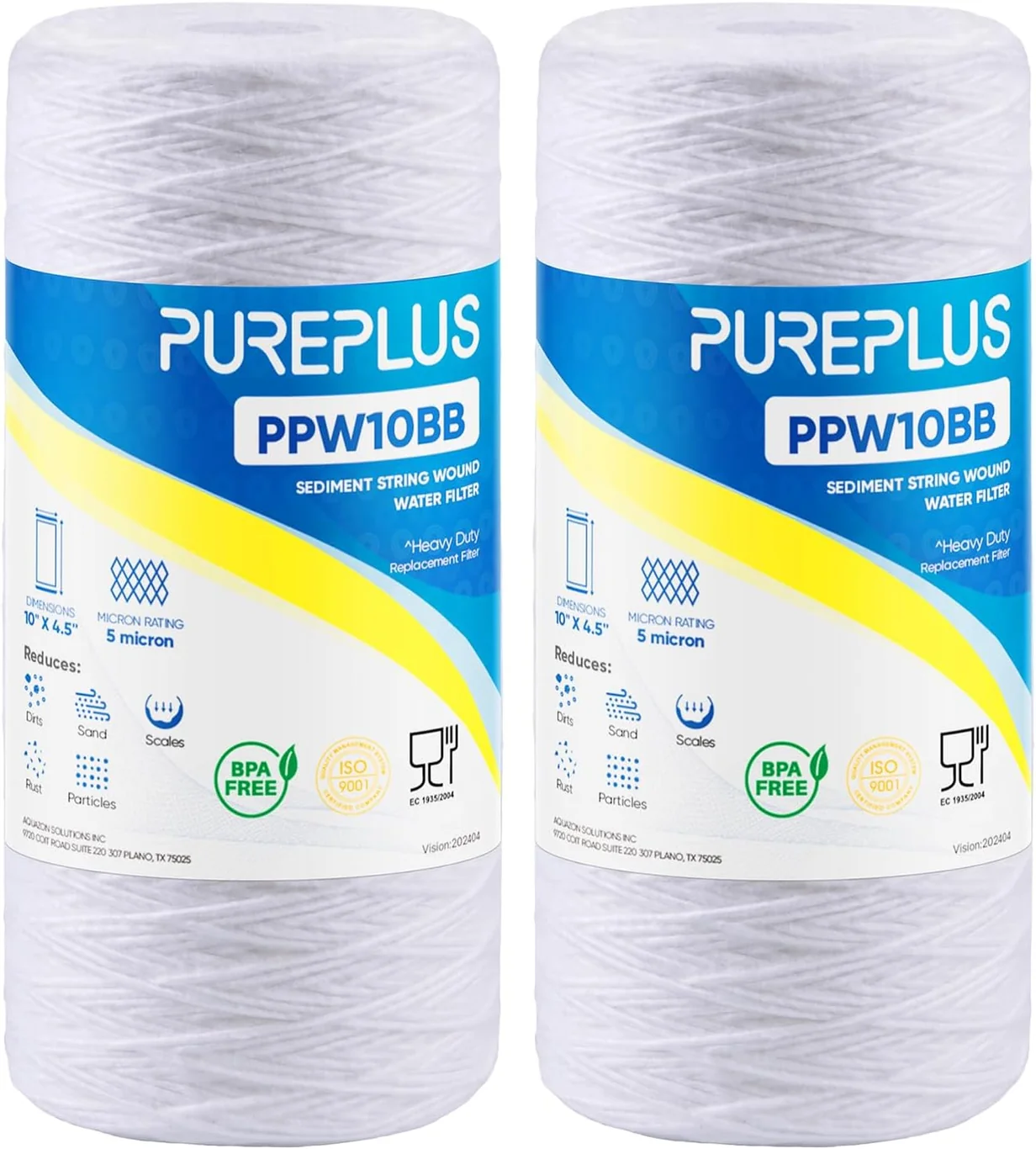
Next, this two-pack of cartridges is our choice for the finest stage. As a 5 micron sediment filter for well water, it uses string wound polypropylene to catch silt that coarse screens let through. Like rank 6, it needs a housing that is not included.
PUREPLUS 5 Micron String Wound Sediment Cartridge Specs
| Filter type | String wound polypropylene cartridge, 10 x 4.5 inch, 2 pack |
| Filtration rating | 5 micron nominal |
| Maximum flow rate | Maker lists up to 2.5 gpm |
| Connection size | Fits standard 10 x 4.5 inch housings, not included |
| Cleaning or replacement | Replace every 3 to 6 months per the maker |
| Certification claim | Listing says ANSI, no standard number given for this size |
Key Features
- A 5 micron string wound design gives deep-bed filtration that holds a lot of dirt.
- A two-pack gives you a spare cartridge for the next change.
- The maker's capacity figure is up to 30000 gallons, depending on water quality.
- Standard 10 x 4.5 inch fit works with many big blue style housings, including Pentek and Culligan models.
- Polypropylene construction is described by the listing as food grade material.
What we noticed is how widely compatible it is. The listing names a long run of standard 10 x 4.5 inch housings, so if you already own a big blue style housing, there is a good chance this cartridge fits it.
The maker suggests changing it every 3 to 6 months for an average household, and says it can handle up to 30000 gallons depending on water quality. On a gritty well, our team would expect the shorter end of that range, or sooner if no prefilter sits ahead of it.
Best placed behind a spin-down screen.
Why We Chose This
It is a fine 5 micron cartridge in a two-pack that fits many standard housings, which suits owners who need to catch silt after a coarse screen.
It is the pick for fine silt control.
The listing says ANSI with no standard number. PUREPLUS cites certificates for other cartridge sizes, and we could not confirm one for this exact model. NSF/ANSI 42 is an aesthetic-effects standard, so even a matching certificate would not be a health claim.
Pros
- Fine 5 micron rating catches silt
- Two cartridges per pack
- Fits many standard 10 x 4.5 inch housings
- Deep-bed string wound structure
- Replace every 3 to 6 months
- Polypropylene food grade material
- Easy to source for repeat changes
Cons
- Housing not included in the pack
- Not suited as a first stage on sandy water
The thing we want to flag: a fine rating loads quickly on sandy water. Pair it with a spin-down screen ahead of it, and check the listed flow figure against your peak demand, because it reads modest for a large home.
Final Verdict
A fine, widely compatible cartridge pair that works best as the polishing stage behind a coarse screen in a housing you already own. It is the silt-catching second stage.
8. Waterdrop BG103 Mega Spin Down Sediment Filter
Rounding out the list, this high-flow unit pairs a dual mesh screen stated as 500 and 200 micron with a forged brass head. We kept it last because owner feedback is more mixed than for the iSpring units, but its flush hardware is the most elaborate here.

Waterdrop BG103 Mega Spin Down Sediment Filter Specs
| Filter type | Dual mesh spin down with 2-way bypass and forged brass head |
| Filtration rating | Dual mesh stated as 500 and 200 micron |
| Maximum flow rate | 25 gpm |
| Connection size | 1 inch MNPT and 3/4 inch FNPT |
| Cleaning or replacement | 360 degree power flush; maker suggests cleaning every two weeks, with a monthly deep clean |
| Certification claim | None named; maker-reported water hammer test only |
Key Features
- The 25 gpm flow rating comes from a dual mesh with a larger surface area than a standard screen.
- The forged brass head carries a nano-coating for corrosion resistance.
- A 2-way bypass valve allows forward and reverse flushing.
- The 360 degree power flush uses water jets to scour the screen surfaces.
- A maker-reported test covers 200,000 water hammer cycles, which is a maker claim rather than a certification.
What stood out to us was the 2-way bypass and power flush. Forward and reverse flushing means you can scour both sides of the screen, which is a practical advantage when grit packs in. The maker advises cleaning about every two weeks.
The unit is rated for 25 gpm, 14.5 to 72 psi and up to 1000 ppm TDS, with a 100F upper temperature limit. That puts it alongside the iSpring auto-flush unit on flow, though without the automatic schedule.
The mesh is a dual layer, not one micron figure.
Why We Chose This
A 25 gpm rating and a 2-way flush system give larger plumbing a heavy-duty option beyond the iSpring units, with manual rather than automatic control.
It is the pick for manual high-flow flushing.
The maker also describes a magnetic scale prevention feature. We treat that as a maker claim, since we saw no proof it prevents scale, and we would not buy this unit for that reason. The water hammer test is likewise a maker-reported figure, not an NSF result.
Pros
- 25 gpm flow rating
- 2-way bypass for forward and reverse flush
- Forged brass head with nano-coating
- 360 degree power flush
- 1000 ppm TDS rating
- 1 inch and 3/4 inch threads
- Maker-reported water hammer testing
Cons
- Owner feedback more mixed than iSpring units
- Magnetic scale claim lacks independent proof
Because the dual mesh is stated as 500 and 200 micron, it should not be read as a single fine rating. It is a coarse prefilter with strong flush hardware. Pair it with a pleated or string wound cartridge if you need silt control, and plan on frequent cleaning.
Final Verdict
Strong flush hardware and high flow suit larger plumbing, but mixed owner feedback and unproven extras keep it at the end of our list. It is the heavy-flush alternative.
How to Choose the best sediment filter for well water
A sediment filter is the first line of defense for a private well, so the choice shapes everything downstream. Match the filter to the grit your well actually produces, then check the housing, flow and cleaning effort before you buy. The six factors below follow that order.
Filter type and how it handles sand
A spin-down filter uses a reusable mesh screen to stop sand and rust flakes, and you flush the trapped grit out through a valve. A cartridge filter holds finer silt in pleated or string-wound media and is rinsed or replaced. The two jobs are different, and many wells need both in sequence.
Rule of thumb: put a mesh spin-down screen first, then a pleated or string-wound cartridge behind it when the water also carries fine silt. In our experience the grit load of your well, not the rating printed on the box, decides which type works.
How the three families in this guide differ:
- Spin-down mesh screens: flush out sand and grit without new parts, and suit wells that send a lot of coarse material.
- Housing plus cartridge systems: hold finer silt and let you swap media, but the cartridge is a recurring part.
- Replacement cartridges: fit a standard housing you already own, and the housing itself is not included.
Micron rating and what it catches
A micron rating describes the particle size a filter is built to stop. It is a nominal figure, not a certification, and a coarser rating always passes more fine silt than a tighter one.
The table below shows how the ratings in our lineup map to the jobs they do.
What we found mattered more than the lowest number on the box was whether the screen could be cleaned. A tighter rating clogs faster on gritty water, so stack coarse to fine instead of jumping straight to 5 micron.
| Rating | What it catches | Best use |
| 50 micron mesh | Sand, grit and rust flakes | First stage on the main line |
| 20 micron pleated | Fine sand and coarse silt | Second stage behind a screen |
| 5 micron string wound | Fine silt and cloudy haze | Final polishing stage |
Flow rate and pressure drop
A whole house sediment filter sits on the main line, so it has to pass the demand of every fixture running at once. Listed flow figures are maker-stated maximums for a clean unit, for example 20 gpm for the Waterdrop RPFK and up to 25 gpm for the iSpring WSP50ARB per the makers.
Our quality floor: we treat a listed flow rate as a ceiling, not a promise. A loaded screen or cartridge always costs some pressure, and in our experience the drop is what households notice first, in the shower.
Bottom line: large homes with several bathrooms should favor the higher-flow units, and a tighter cartridge stage should only follow a screen that keeps it from clogging.
Housing size and cartridge compatibility
Spin-down units arrive with their own housing, while cartridges do not. The two cartridges in this guide are built for a standard 10 x 4.5 inch housing, so you must already own or buy a matching housing before they are useful.
Check these three things before you order:
- Pipe connection: match the 1 inch or 3/4 inch thread on your plumbing, or plan for an adapter.
- Cartridge size: the 10 x 4.5 inch format fits big blue style housings, and a 2.5 inch format does not.
- Clearance: leave room below the housing to remove the sump or cartridge.
We left out housing-only kits and listings that ship without a cartridge, because a housing alone filters nothing and would mislead a first-time buyer.
Cleaning and replacement effort
Every sediment filter needs upkeep, and the effort differs a lot. A mesh screen is flushed through a valve, while a cartridge is replaced or, for washable pleated media, rinsed. The right choice is the one you will actually maintain.
The table below sets out the routine each type needs, using the timing the makers give.
In our hands the flush valve and a see-through housing made upkeep easy to judge by eye. Gritty water shortens every one of these intervals, so treat the maker timing as a starting point.
| Type | Routine | Maker timing |
| Spin-down mesh | Flush through the drain valve | Screen lasts 1 to 2 years (iSpring) |
| Pleated cartridge | Rinse or replace | 3 to 6 months, depends on water |
| String-wound cartridge | Replace | 3 to 6 months |
Materials and certification claims
Most sediment claims are micron ratings, not certifications. NSF/ANSI 42 covers aesthetic effects, including particulate reduction classes, and NSF/ANSI 372 covers lead-free wetted materials only. Neither is a health-effects standard.
Our quality floor: a certification claim stays UNVERIFIED until we can match it to a registry listing for the exact model. Check the exact model, certifier, date and scope of each listing. An IAPMO R&T certificate dated March 5, 2026, names WD-RPFK for NSF/ANSI/CAN 372 lead-content compliance, which does not establish sediment-reduction performance. We could not match the other claims to a registry record.
Look instead at the wetted materials: lead-free brass heads, stainless steel mesh and food-grade polypropylene. Material quality is easy to verify from the listing, and it tells you more than a vague testing badge.
Where a sediment filter sits in a well water system
Install a sediment filter early in the line, either just before or just after the pressure tank, and always ahead of carbon filters and softeners. Those later stages clog quickly when sand and silt reach them, so the screen protects everything downstream.
A typical order looks like this:
- Well and pressure tank: the water leaves the source carrying grit.
- Sediment stage: a mesh screen, then a finer cartridge if the water still looks cloudy.
- Treatment stages: carbon, softening or other media that need cleaner water.
A sediment filter does not treat dissolved iron, sulfur or bacteria, because it only holds particles. Test your well before adding more stages, and treat those problems with their own dedicated equipment.
My Overall Verdict
After working through all eight, three filters stand out for different well situations. Each pick below matches the order of our top three, so you can compare them against the cards near the top of this page.
- iSpring WSP-50 Spin Down Sediment Filter [Best Overall] - a 50 micron stainless mesh screen with a lead-free brass head and a see-through housing that shows when grit builds up
- Waterdrop RPFK Spin Down Sediment Filter [Best Budget] - a 50 micron stainless mesh screen with four fitting options, built for homes that want a lower cost tier
- iSpring WSP50ARB Big Spin Down Sediment Filter [Best for Large Homes] - an auto-flush module with a scraper and a touch-screen schedule for homes with heavy demand
Most wells do well with a flushable mesh screen first and a finer cartridge only if the water stays cloudy. Choose the unit that fits your plumbing and your grit load, because that is how you find the best sediment filter for well water.
A correctly sized setup beats a bigger number on the box, and that is what makes the best sediment filter for well water right for your home.
Why iSpring WSP-50 Spin Down Sediment Filter Might Be the Best Choice
The iSpring WSP-50 earns the top slot because it does one job simply: a 50 micron stainless mesh screen that you flush clean and reuse. In our hands the see-through housing made the grit load easy to judge by eye, with no guessing about when to service it.
The trade-off is honest and worth knowing. The listing itself warns that 50 and 100 micron screens can clog quickly on high-sediment water, and the unit is rated for indoor use only, at 40 to 100F and 15 to 115 psi. Wells with very heavy sand may need a coarser screen or a larger spin-down unit; add a finer cartridge downstream only for smaller particles that pass through.
Key reasons we rank it first:
- 50 micron mesh: a stainless screen that catches sand, grit and rust flakes.
- Lead-free brass head: a sturdy fitting where the water meets the housing.
- See-through housing: you can see grit building up before flow drops.
- Hose-barb flush valve: drains the trapped grit without removing the screen.
- Dual threads: 1 inch male and 3/4 inch female connections suit common plumbing.
SHOP ON AMAZONAvailability and current price shown on Amazon
FAQs
What is the best sediment filter for well water?
The best sediment filter for well water for most homes is a spin-down prefilter such as the iSpring WSP-50, because its flushable mesh screen takes sand, rust flakes and grit first. Add a pleated or string-wound cartridge behind it if you also need to catch the finer silt that passes through the mesh screen.
What micron rating do you need for well water?
You need a micron rating that matches the particles in your water, typically 50 micron mesh for sand and grit and 5 to 20 micron cartridges for silt. Keep in mind that a micron rating is a nominal filtration size, not a certification, a health claim or a guarantee of performance.
How often should you clean or replace a sediment filter?
You should clean or replace a sediment filter on a schedule set by how much grit your well produces, and the makers suggest every 3 to 6 months for cartridges. Spin-down mesh screens are flushed as needed and last 1 to 2 years, so service either one sooner if flow drops.
Do you need a spin-down filter before a cartridge filter?
You do not strictly need a spin-down filter before a cartridge filter, but it helps on gritty wells because the screen takes the coarse load first. A cartridge alone is enough only when your well produces fine silt without much sand, since coarse grit would clog it and shorten its life.
Does a sediment filter remove iron or bacteria?
A sediment filter does not remove dissolved iron or bacteria, because it only catches solid particles that are larger than its micron rating. Treat those problems as a separate step, such as an iron filter or disinfection, and test your well water regularly so you know exactly what is in it.
References:
- U.S. EPA, Private Drinking Water Wells: https://www.epa.gov/privatewells
- NSF, Standards for Water Treatment Systems: https://www.nsf.org/consumer-resources/articles/standards-water-treatment-systems
- USGS Water Science School, Turbidity and Water: https://www.usgs.gov/special-topics/water-science-school/science/turbidity-and-water
- U.S. EPA, Protect Your Home's Water: https://www.epa.gov/privatewells/protect-your-homes-water
Medical Disclaimer: This content is for informational purposes only. It is not a substitute for professional medical advice, diagnosis, or treatment. If you have concerns about your water quality or air quality and their effects on your health, consult a qualified healthcare professional.
Affiliate Disclosure: As an Amazon Associate, Puritisimo may earn a commission from qualifying purchases made through links on this page, at no additional cost to you. Our recommendations are independent and editorial.