
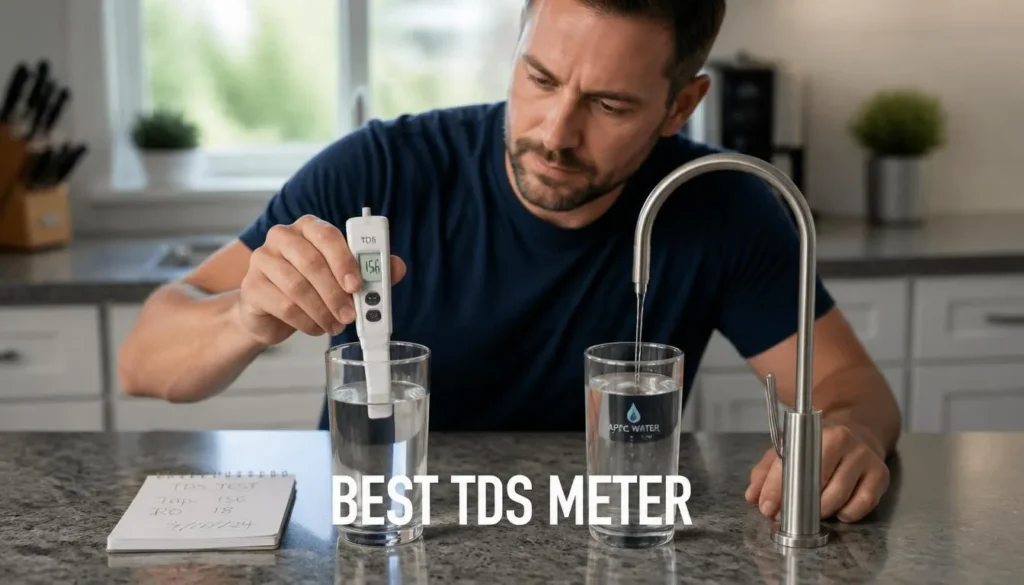

The best TDS meter estimates dissolved solids in seconds, helping you compare tap water with RO output or monitor a pitcher built to reduce TDS. It cannot verify the contaminant removal of a conventional pitcher filter. The number is a screening tool, not a safety verdict, so it helps most when you compare water before and after treatment. We went through six meters and kept the ones that fit that job.

You will find five handheld testers and one inline monitor for RO systems below, and we say plainly when a figure is the maker's own statement. We selected meters that measure TDS for home water checks and excluded pH-only testers. Several picks also support hydroponic or aquarium use.
My Recommended Top 3 Best-Buys for TDS Meters: Reviewed and Rated
- The carrying case includes a belt clip, so the pen stays protected in a toolbox or cabinet.
- Hold function saves a reading so you can lift the pen out of the glass before you record it.
- Auto-off after 10 minutes of non-use conserves the two LR44 cells.
- The backlit screen is described by the seller as 25% larger than older models.
- A titanium alloy probe is listed for stable readings.
- Auto-lock and hold keep the number on screen once it settles.

- Dual in and out probes let you switch between feed and product readings.
- The quick-connect probe fits 1/4 inch fittings, and two 1/4 inch T-fittings are included.
- A 0.6 m (2 ft) cable lets you place the display where you can read it.
Best TDS Meter Reviews 2026: 6 Top Models for Home Water Checks
A TDS meter measures electrical conductivity and converts it to parts per million with a factor, commonly 0.5 for sodium chloride. That makes it a screening tool, not a lab test. None of the six lists a third-party certification that we could find, so every accuracy figure here is the maker's own statement.
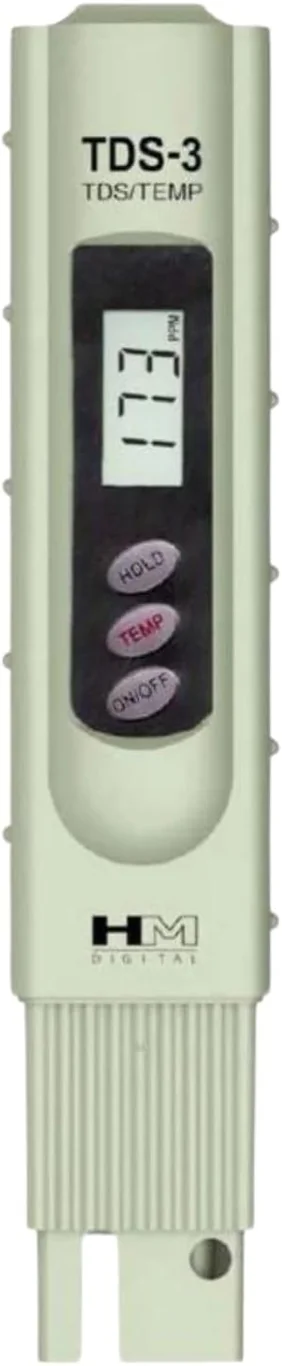
1. HM Digital TDS-3 Handheld TDS Meter
The HM Digital TDS-3 is the pen we would hand to most households first, because the maker publishes real numbers: a 0 to 9990 ppm range with plus or minus 2% accuracy. It arrives in a carrying case with a belt clip, and the metal body is built for repeated use. What we noticed when reading the maker sheet against the other five listings is how much easier this one is to check.
HM Digital TDS-3 Handheld TDS Meter Specs
| Meter type | Handheld pen with carrying case |
| What it measures | TDS, with a built-in thermometer |
| TDS range | 0 to 9990 ppm (maker) |
| Accuracy (maker) | Plus or minus 2% |
| Calibration | Factory set with 342 ppm sodium chloride; screwdriver recalibration |
| Power | Two LR44 cells, included; auto-off after 10 minutes |
| Best for | First-time buyers who want published specs |
Key Features
- The carrying case includes a belt clip, so the pen stays protected in a toolbox or cabinet.
- Hold function saves a reading so you can lift the pen out of the glass before you record it.
- Auto-off after 10 minutes of non-use conserves the two LR44 cells.
- A built-in thermometer shows water temperature, in Celsius only.
- Maker-stated factory calibration uses a 342 ppm sodium chloride solution.
Calibration is where this pen separates itself from the budget field. The maker states it is factory calibrated with a 342 ppm sodium chloride solution, and you can recalibrate it with a mini screwdriver if the reading drifts. In our view that adjustable trim matters more than any claim on a box, because a meter you cannot correct is a meter you replace.
The reading range suits both tap and RO checks. The display shows 1 ppm steps up to 999 ppm and then switches to 10 ppm steps, which an on-screen icon flags. RO output usually sits at the low end, so the fine steps are where you need them. Automatic temperature compensation covers 34F to 122F, which handles a cold tap or a warm kitchen.
The thermometer reads in Celsius only, a small annoyance for US users.
Why We Chose This
The maker publishes its range, accuracy, calibration method and compensation limits, so you can check every claim against the spec sheet.
The hold function freezes a reading so you can read it in good light.
Our one flag: none of the six meters in this guide lists a third-party certification that we could find, and this one is no exception. NSF/ANSI standards certify water treatment systems, not hand meters, so every accuracy figure here is the maker's own statement. Treat it as a screening tool, and compare it against a known solution if you need more confidence.
Pros
- Named brand with published specs
- Maker-stated accuracy of plus or minus 2%
- Adjustable calibration with a screwdriver
- Carrying case with belt clip included
- Hold function for easy reading
- Auto-off protects the batteries
- Metal body feels durable
Cons
- Thermometer reads in Celsius only
- Steps of 10 ppm above 999 ppm
HM Digital's TDS-3 manual specifies approximately 1,000 hours of battery life, while the marketplace listing gives a conflicting figure. Two LR44 coin cells are included, and the 10-minute auto-off helps them last. The trade-off we want to flag is the Celsius-only thermometer, which you convert in your head.
Final Verdict
A named brand, published accuracy and a recalibration screw make this the safest first pen for tap and RO checks. It is the default recommendation.
2. MEXYBE 4-in-1 TDS Meter Water Tester
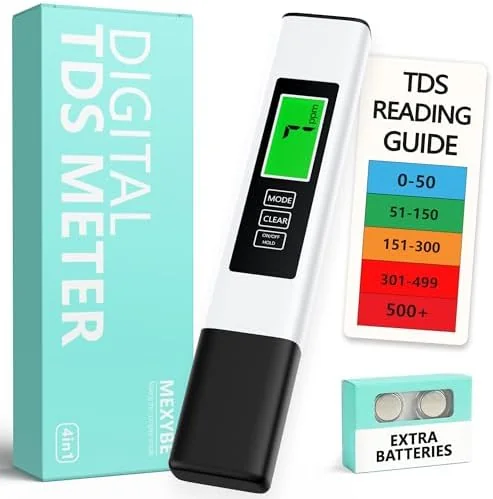
Next, the MEXYBE 4-in-1 is our budget pick: a three-reading pen with a big backlit screen. The listing says the display is 25% larger than older 3-in-1 models, and a colour TDS chart sits on the back of the body. We want to be plain about the name, because the 4-in-1 counts Celsius and Fahrenheit separately, which makes it three measurements.
MEXYBE 4-in-1 TDS Meter Water Tester Specs
| Meter type | Handheld pen with backlit screen |
| What it measures | TDS, EC and temperature in both units |
| TDS range | 0 to 9999 ppm (listing) |
| Accuracy (maker) | Not stated |
| Calibration | Factory calibrated; no recalibration method stated |
| Power | Battery powered; auto-off after 2 minutes |
| Best for | Low-cost trend checks at home |
Key Features
- The backlit screen is described by the seller as 25% larger than older models.
- A titanium alloy probe is listed for stable readings.
- Auto-lock and hold keep the number on screen once it settles.
- The colour TDS chart on the back helps first-time users judge what a number means.
- Auto-off after 2 minutes conserves the battery.
The pen reads TDS, EC and temperature, with a titanium alloy probe and a stated range of 0 to 9999 ppm. The listing says it is factory calibrated and locks the reading once it settles. What stood out in our review of the listing is the colour chart, which helps a new owner decide whether a number is high or low.
Here is the gap you should know about. The seller states no accuracy figure and no recalibration method in the material we found. That does not make the pen wrong, but you cannot verify its readings against a published spec, so we would compare it with a known solution before relying on it.
Auto-off after 2 minutes and an auto-lock hold keep battery use low.
Why We Chose This
It is the lowest-cost route among our first four picks to a working pen with a large screen and a colour chart.
The body measures 3.94 x 3.15 x 1.18 inches and weighs 3.53 ounces, so it is bulkier than a slim pen.
Our one flag (again): no third-party certification listing turned up for this pen, and the seller gives no accuracy number to stand in for one. Use it for trends and RO membrane checks, not for exact figures. The listing also mentions aquariums, pools and hydroponics, which tells you it is a general-purpose pen rather than one built around drinking water.
Pros
- Large backlit screen
- Colour TDS chart on the body
- Titanium alloy probe
- Auto-lock and hold functions
- Lowest cost of the first four picks
- Reads TDS, EC and temperature
- Auto-off saves battery
Cons
- No accuracy figure stated
- No recalibration method stated
Our team kept coming back to the screen. A big backlit display is a practical upgrade for older eyes or a dim cabinet under the sink, and it is the main reason this pen earns its place ahead of the other unbranded option in this guide.
Final Verdict
A low-cost pen with a big screen and a colour chart, best for trend checks rather than precise figures. It is the low-cost trend checker.
3. HM Digital DM-1 In-Line Dual TDS Monitor
Stepping up, the HM Digital DM-1 is an RO water TDS meter that stays installed in the line. Its IN/OUT switch displays either the feed or the product reading. It is the only inline monitor in this guide. Instead of dipping a cup each time, you flip the switch and compare two numbers to see what the membrane is doing.
HM Digital DM-1 In-Line Dual TDS Monitor Specs
| Meter type | In-line dual monitor with in and out probes |
| What it measures | TDS of feed water and product water |
| TDS range | 1 ppm steps up to 999 ppm, 10 ppm steps above (maker) |
| Accuracy (maker) | Plus or minus 2% |
| Calibration | Factory set with 342 ppm sodium chloride; analog recalibration |
| Power | Two LR44 cells per the maker; auto-off after 10 minutes |
| Best for | Owners of an RO system who want a permanent check |
Key Features
- Dual in and out probes let you switch between feed and product readings.
- The quick-connect probe fits 1/4 inch fittings, and two 1/4 inch T-fittings are included.
- A 0.6 m (2 ft) cable lets you place the display where you can read it.
- Maker-stated accuracy is plus or minus 2%.
- Auto-off after 10 minutes reduces battery drain.
The unit carries two probes, an in probe and an out probe. The maker says the dual probe fits 1/4 inch quick-connect fittings, and two 1/4 inch T-fittings come in the box. Versions for 3/8 and 1/2 inch tubing exist, so check your line size before you order.
The value of the dual probes is the comparison. Switch between the feed and product readings, then work out rejection as feed TDS minus product TDS, divided by feed TDS, multiplied by 100. A rising product reading warns you that the membrane is slipping. In our view tracking that rejection percentage against your baseline under similar conditions is worth more than a slightly better pen, if you own an RO unit.
Accuracy is plus or minus 2%, the maker says, with 10 ppm steps at higher readings.
Why We Chose This
It is the only product here that reads feed and product water in turn using an IN/OUT switch, which is the direct check an RO owner needs.
The cable is 0.6 m (2 ft), enough to reach from the fitting to a spot you can see.
Our one flag (again): the upper range differs between the maker page and the listing, so we do not quote one. For RO output the readings you care about are low, so it rarely matters. No third-party certification listing turned up for this monitor either, and the accuracy figure is the maker's own statement. Battery type also varies by seller, so check what ships.
Pros
- Switches between feed and product readings
- Shows membrane performance at a glance
- Maker-stated accuracy of plus or minus 2%
- T-fittings included in the box
- Named brand with published specs
- Analog recalibration available
- Compact display on a 2 ft cable
Cons
- Needs a quick-connect fitting in the line
- Not suited to dipping in a glass
Installation is the trade-off. It needs a quick-connect fitting in the RO line, so you cannot just drop it into a glass. If you only want to check a tap or a pitcher, a pen from rank 1, 2 or 4 is simpler. If you own an RO unit, this one earns its slot.
Final Verdict
A fixed dual monitor that turns membrane checks into a glance, at the cost of one plumbing step. It is the RO owner's monitor.
4. HoneForest 3-in-1 TDS Meter Water Tester
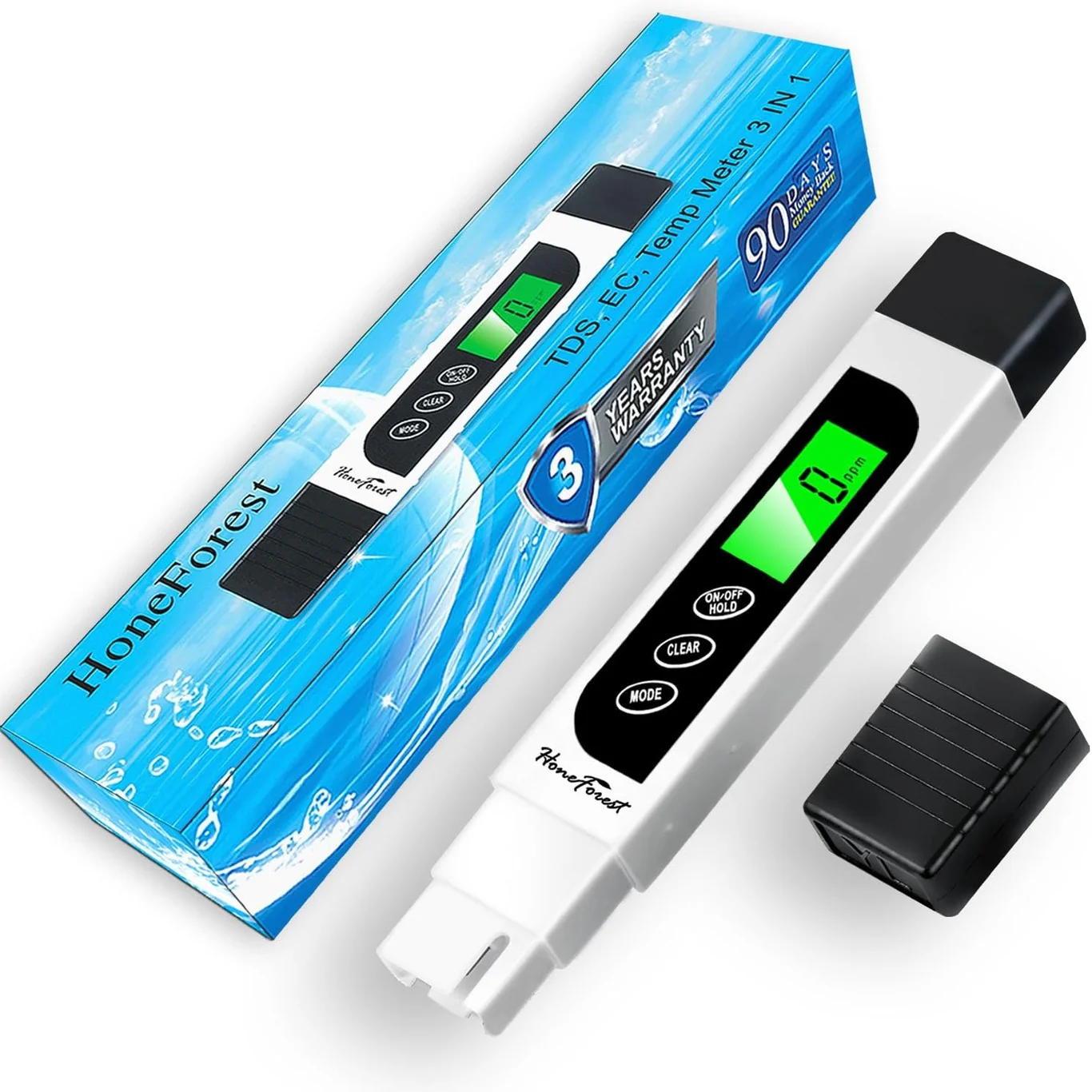
After that, the HoneForest 3-in-1 is the slimmest pen in this guide, at 6.29 inches long and 1.62 ounces. That makes it an easy portable TDS meter to keep in a drawer or a bag. The kit includes a leather bag for exactly that.
HoneForest 3-in-1 TDS Meter Water Tester Specs
| Meter type | Slim handheld pen with leather bag |
| What it measures | TDS, EC and temperature |
| TDS range | 0 to 9990 ppm (listing) |
| Accuracy (maker) | Not stated |
| Calibration | No recalibration method stated |
| Power | Battery powered; auto-off after 2 minutes |
| Best for | Pocket-size checks away from the kitchen |
Key Features
- The slim body measures 6.29 x 1.14 x 0.59 inches.
- A titanium alloy probe is listed for stable readings.
- Auto-lock holds the reading once it stabilises on the backlit screen.
- The leather bag ships in the box for carrying.
- Auto-off after 2 minutes saves the battery.
The pen reads TDS, EC and temperature in both units, with a stated range of 0 to 9990 ppm. The reading locks on screen once you stir gently and it settles, and the unit shuts off after 2 minutes. The backlit screen helps in a dim cabinet.
This is also one of the longest-listed pens here, on sale since 2017, so the design has been available for years. What we noticed comparing it with the MEXYBE is that the two share the same core features, which makes the decision about size and screen rather than function.
The listing gives no accuracy figure and no recalibration method.
Why We Chose This
It is the slim pen for people who want a bag-friendly meter, and we say plainly what the listing does not tell you.
Backlit screen and auto-lock make it easy to read in a dim spot.
Our one flag (again): no third-party certification listing turned up, and the seller names no accuracy figure, so treat readings as a rough guide. A marketplace note about certification exists, but it names no standard, so we do not rely on it. Use the pen to spot a clear change, such as a tap reading far above your usual number.
Pros
- Slimmest pen in this guide
- Leather bag included
- Titanium alloy probe
- Backlit screen
- Auto-lock on a stable reading
- Reads TDS, EC and temperature
- On sale since 2017
Cons
- No accuracy figure stated
- No colour chart or case with a clip
The HoneForest trades the larger screen of the MEXYBE for a slimmer body. Pick it if pocket size matters more than screen size. It also lacks the colour chart, so you will need to look up what a reading means.
Final Verdict
A slim three-reading pen with a long listing history, held back only by missing accuracy data. It is the pocket-size pen.
5. Apera AI316 PC60 Multi-Parameter Pocket Tester
Moving up in cost and scope, the Apera AI316 PC60 is a five-reading pocket tester, and the weakest fit for a pure TDS buyer. pH is one of its readings, and pH is not what you need to check tap or RO water. We include it because TDS is on its list, it is a named brand, and it sits in a much higher cost tier than any pen here.
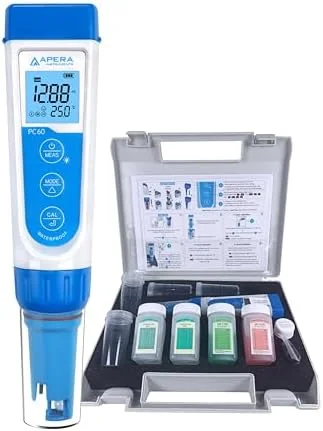
Apera AI316 PC60 Multi-Parameter Pocket Tester Specs
| Meter type | Multi-parameter pocket tester kit |
| What it measures | pH, EC, TDS, salinity and temperature |
| TDS range | 0.1 ppm to 10.00 ppt (manual) |
| Accuracy (maker) | pH plus or minus 0.01 (manual); TDS figure varies by listing |
| Calibration | One to three points; solutions included |
| Power | AAA cells, included in the kit |
| Best for | Buyers who also need pH and salinity |
Key Features
- The replaceable probe installs easily when the electrode wears out.
- Three backlight colours show which of the three modes you are in.
- A dual display shows temperature beside the main reading, with icons for stable readings.
- The complete kit includes calibration solutions, bottles, storage solution, batteries, a lanyard and a case.
- A two-year instrument warranty comes with a six-month electrode warranty.
The manual states a TDS range of 0.1 ppm to 10.00 ppt with an adjustable TDS factor from 0.40 to 1.00, plus salinity and temperature, and IP67 water resistance. Calibration runs from one to three points, and the kit ships with solutions, bottles, batteries, a lanyard and a case.
This is the model to consider if the TDS meter sensor matters to you. The probe is replaceable, so a worn electrode does not mean a new instrument. In our view that is the real reason to spend more, because the probe is the part of any meter that wears out first.
Apera lists a two-year instrument warranty and a six-month electrode warranty.
Why We Chose This
It is the multi-parameter option for buyers who also want pH and salinity, with a replaceable probe and a full calibration kit.
Three backlight colours show which mode you are in.
Our caution: pH readings do not suit distilled or deionised water, and RO output is close to that, so the pH function is beside the point on RO water. Conductivity and TDS still work. Some listings quote pH 0 to 14 and a 1% full-scale figure for TDS, which differ from the manual, so we rely on the manual only. No third-party certification listing turned up either.
Pros
- Replaceable multi-parameter probe
- Reads pH, EC, TDS, salinity, temperature
- Adjustable TDS factor from 0.40 to 1.00
- Complete kit with calibration solutions
- IP67 water-resistant body
- Two-year instrument warranty
- Dual display with stable-reading icons
Cons
- pH function not useful for RO water
- Much higher cost than any pen
Calibration takes effort. A multi-point routine with buffer solutions is more work than a pen that arrives ready to use, and the electrode needs proper storage between uses. If you only need TDS, rank 1, 2 or 6 is simpler and costs far less.
Final Verdict
A capable, serviceable tester for people who need pH too, and more instrument than a TDS buyer needs. It is the lab-style pocket kit.
6. Apera AI213 TDS20 Pocket TDS Tester
From there, the Apera AI213 TDS20 is the TDS-only Apera: a pocket tester with calibration solutions in the box. The listing states plus or minus 1% full-scale accuracy and a 0 to 10,000 ppm range. It reads differently from the PC60 because it does one job, and it comes with a calibration routine to keep that job honest.
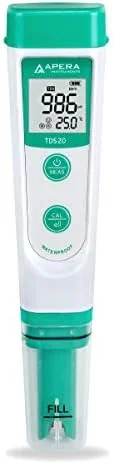
Apera AI213 TDS20 Pocket TDS Tester Specs
| Meter type | Pocket TDS tester kit |
| What it measures | TDS and temperature |
| TDS range | 0 to 10,000 ppm (10 ppt) |
| Accuracy (maker) | Plus or minus 1% of full scale (listing) |
| Calibration | One- or two-point, with auto buffer recognition |
| Power | Four AAA cells, included; up to 1,000 hours |
| Best for | Buyers who will calibrate for repeatable readings |
Key Features
- Two-point auto calibration with auto buffer recognition simplifies the routine.
- Automatic temperature compensation covers 32F to 122F.
- The large LCD shows temperature and ppm together, with reminders for completed calibration.
- The complete kit includes calibration solutions, batteries, a lanyard and a case.
- Up to 1,000 hours of operation on the AAA cells.
Calibration is the standout. The listing describes two-point auto calibration with auto buffer recognition, and Apera sources describe one- or two-point routines using 1413 uS and 12.88 mS solutions. Automatic temperature compensation covers 32F to 122F, so a cold tap reading is corrected.
Battery life is generous: the listing says up to 1,000 hours on AAA cells, and Apera sources describe an IP67 body that floats. In our view a calibratable pen with a rated body suits someone who wants repeatable readings over years, rather than a quick look.
The kit includes calibration solutions, batteries, a lanyard and a case.
Why We Chose This
It is the calibratable TDS-only pen for buyers who want a stated accuracy figure and a serviceable routine.
Auto power-off arrives after 8 minutes, according to maker-style sources.
Our one flag (again): no third-party certification listing turned up, so the 1% full-scale figure is the maker's statement. Accuracy depends on keeping the calibration solution fresh, which is an ongoing chore. One retailer says 3-point calibration, but the manual and the listing say one or two points, and we follow those.
Pros
- Stated accuracy of plus or minus 1% full scale
- Two-point auto calibration
- Auto buffer recognition
- Temperature compensation from 32F to 122F
- Complete kit with solutions and case
- Up to 1,000 hours on AAA cells
- TDS-only focus, no pH extras
Cons
- Calibration solution needs refreshing
- Higher cost tier than the pens
The trade-off is cost and effort. It sits in a higher cost tier than the unbranded pens, and the calibration routine asks more of you than a pen that is simply switched on. If your goal is only to see whether an RO membrane is slipping, rank 1 or rank 3 does that for far less.
Final Verdict
A well-specified TDS-only tester that rewards people who calibrate, and overkill for a casual tap check. It is the calibration-minded pick.
How to Choose the Best TDS Meter
A good meter comes down to a few checks that a listing headline rarely makes easy. We sorted the six picks above by how clearly the maker states accuracy and calibration, and the factors below show you how to repeat that sort yourself.
Handheld pen or inline monitor
In our experience the first decision is where the reading happens. A handheld pen goes into a cup of water, so you can check the tap, a pitcher filter or an RO tank in seconds, and it gives one reading at a time, which means you dip it twice to compare before and after.
The table below sets the two types side by side.
If you want a TDS meter for RO system monitoring, the HM Digital DM-1 is the only pick here that switches between feed and product readings, with one probe on each side of the membrane. A pen is the cheaper way to spot-check and works well when you only look now and then.
| Type | Best for | Main limit |
| Handheld pen | Spot checks of tap, pitcher and RO tank water | One reading at a time |
| Inline monitor | Watching an RO system all the time | Stays fitted to the water line |
Accuracy and calibration
In our experience accuracy is the spec line that decides whether a meter is worth keeping, and it is the line cheap pens most often leave out. HM Digital states plus or minus 2% for the TDS-3 and DM-1, and the Apera TDS20 listing states plus or minus 1% of full scale. The MEXYBE and HoneForest listings give no accuracy figure.
Worked example: a plus or minus 2% figure means a 100 ppm sample could read anywhere from 98 to 102 ppm, a gap that changes no decision about household water.
Calibration is the second check. The HM Digital meters ship factory calibrated with a 342 ppm sodium chloride solution and can be recalibrated with a small screwdriver, while the Apera TDS20 supports one or two calibration points and the PC60 supports up to three. Neither the MEXYBE nor the HoneForest listing explains how to recalibrate.
Our quality floor: none of the six lists a third-party certification that we could find, because NSF/ANSI standards certify treatment systems, not hand meters. Treat every accuracy figure as the maker's own statement.
TDS range and resolution
RO product water reads low, often in the single or double digits, so fine resolution matters more than a high upper range. Every pick here reaches several thousand ppm, which household tap water never needs.
Here is how the steps differ across the group:
- HM Digital TDS-3 and DM-1: the maker states 1 ppm steps up to 999 ppm and 10 ppm steps above that.
- Apera PC60: the manual lists a TDS range that starts at 0.1 ppm, with a factor you can adjust.
- MEXYBE and HoneForest: the listings state a top range only, so the step size is not confirmed.
Worked example: if the tap reads 300 ppm and the RO output reads 12 ppm, the system removes 96%. A meter that steps by 10 ppm would show 10 or 20 and hide that result, which is why we favor 1 ppm steps below 1,000 ppm.
Temperature compensation and extra readings
Conductivity rises as water warms, so a meter that does not correct for temperature reads high in a warm cup and low in a cold one. What we found mattered more than any extra readout was whether the maker says the meter compensates for temperature at all.
The HM Digital TDS-3 states automatic compensation from 34F to 122F, and the Apera TDS20 listing states compensation from 32F to 122F. Extra readings are a bonus only if you use them:
- Temperature display: useful for knowing when a sample is far from room temperature.
- Conductivity (EC): the raw reading that every TDS figure is calculated from.
- pH and salinity: the Apera PC60 adds both, but pH is not what a drinking water buyer needs.
The MEXYBE name says 4-in-1, yet it counts Celsius and Fahrenheit separately, so it is three measurements: TDS, conductivity and temperature.
Probe and sensor care
The probe is the part that wears, so a TDS meter sensor deserves the same care as the screen. Scale or residue on the probe makes readings drift, and in our experience that is the most common reason a good pen starts to disagree with itself.
Three habits keep a probe reading true:
- Rinse: dip the probe in clean water after every use.
- Storage: conductivity-only probes can be stored dry. For the Apera PC60, follow the maker's instructions for keeping the pH bulb in 3M KCl storage solution.
- Recheck: compare against a known solution now and then, which the Apera kits include.
The Apera PC60 is the only pick whose listing mentions a replaceable probe, so it is the one to choose if you expect years of heavy use.
What a TDS meter cannot tell you
A TDS meter reads dissolved ions through conductivity, so it cannot see lead at safe levels, bacteria, PFAS or pesticides. A low reading is not proof that water is safe, and a high reading from harmless minerals is not proof that it is unsafe.
Context on scale: the EPA lists 500 mg/L as a secondary guideline for taste and appearance, and it is not enforceable. The WHO background document rates water under 300 mg/L as excellent for taste and 900 to 1,200 mg/L as poor.
Our rule is to use the meter for comparisons and trends, and to send a sample to a certified lab when health is the question.
What is a good TDS reading for RO water?
A good reading for RO water is a small fraction of what comes in from the tap, and that fraction matters more than any fixed number. Take one reading of the feed water and one of the RO output, then compare them.
Worked example: a tap reading of 300 ppm and an RO output of 30 ppm means the system removes 90% of the dissolved solids.
The NSF/ANSI 58 standard for RO systems sets a 75% minimum TDS reduction at its stated test conditions, so a system that falls well below that in your home is worth a closer look.
Any RO water TDS meter in this guide can do the check, though the DM-1 does it without dipping. A product reading that climbs over several weeks is the cue to look at the membrane and prefilters, so write down your baseline when the system is new.
Does a TDS meter show if water is safe to drink?
No. A TDS meter shows how much is dissolved in the water, not what is dissolved, so it cannot separate harmless calcium from a harmful contaminant.
Here is what the reading can miss:
- Lead: it can sit at a harmful level with almost no change in conductivity.
- Bacteria: living organisms do not register as dissolved ions.
- PFAS and pesticides: they occur at trace levels that conductivity cannot see.
The EPA figure of 500 mg/L is a taste and appearance guideline, not a health limit. If safety is the question, use a certified lab test or your utility's annual water quality report, and keep the meter for comparing before and after a filter.
My Overall Verdict
Our recommended pick for most households is the HM Digital TDS-3 Handheld TDS Meter, because it pairs a carrying case with a maker-stated accuracy of plus or minus 2%. The next two picks suit a tighter budget and an RO system that you want to watch all the time.
- HM Digital TDS-3 Handheld TDS Meter [Best Overall] - a handheld pen with a carrying case, a hold function and a maker-stated accuracy of plus or minus 2%.
- MEXYBE 4-in-1 TDS Meter Water Tester [Best Budget] - a pen that reads TDS, conductivity and temperature, though the listing gives no accuracy figure.
- HM Digital DM-1 In-Line Dual TDS Monitor [Best Inline RO Monitor] - a dual monitor with two probes that lets you switch between feed and product readings.
Choose by the job: a pen for spot checks and the inline monitor for an RO system you want watched. None of the six replaces a lab test, and in our experience that is the point that buyers most often overlook.
If you only check the tap now and then, a pen is all you need.
Match the meter to your water and your routine, and the best TDS meter for your home is the one you will actually use each month.
Why HM Digital TDS-3 Handheld TDS Meter Might Be the Best Choice
The HM Digital TDS-3 takes our top spot because a named maker publishes its range, resolution and accuracy, which the MEXYBE and HoneForest listings do not do. That gives you a plain, checkable basis for trusting the reading.
The trade-off is that its 1 ppm steps stop at 999 ppm and its accuracy figure is the maker's own, and it reads temperature in Celsius only. For tap and RO checks that rarely matters, but it is worth knowing before you buy.
What stands out:
- Named brand: HM Digital publishes a spec sheet for the meter.
- Maker accuracy: plus or minus 2%, stated for 0 to 5000 ppm.
- Calibration: factory set with a 342 ppm sodium chloride solution, and recalibration needs only a mini screwdriver.
- Carrying case: it comes with a case that has a belt clip.
- Hold function: it saves the reading, and the meter switches off after 10 minutes to save the batteries.
SHOP ON AMAZONAvailability and current price shown on Amazon
FAQs
What is the best TDS meter?
The best TDS meter for most homes is the HM Digital TDS-3 Handheld TDS Meter, which pairs a carrying case with a maker-stated accuracy of plus or minus 2%. The right pick depends on whether you check a tap or want to monitor an RO system, because the HM Digital DM-1 reads feed and product water in turn with an IN/OUT switch.
How do you test RO water with a TDS meter?
You test RO water with a TDS meter by rinsing the probe, dipping it in a clean cup of RO water and waiting for the reading to settle. Take the same reading from your tap and compare the two, or use an inline monitor such as the HM Digital DM-1 to switch between feed and product readings.
What TDS reading means an RO membrane needs replacing?
No single TDS reading means an RO membrane needs replacing, because the better test is how much of the feed reading the membrane removes. NSF/ANSI 58 sets a 75% minimum TDS reduction at its test conditions, so if your product water reads close to your tap water, it is time to have the membrane checked.
Are cheap TDS meters accurate enough for home use?
Cheap TDS meters are accurate enough for home use when you want trends and RO checks, as long as you calibrate or check them against a known solution. Accuracy figures are the maker's own statement, and HM Digital and Apera publish theirs while many unbranded pens that you find online give none.
Does a TDS meter detect lead or bacteria?
A TDS meter does not detect lead or bacteria, because it reads electrical conductivity from dissolved ions and cannot see lead at safe levels, bacteria, PFAS or pesticides. If you worry about any of these in your home water, you need a certified lab test of the water, not a quick handheld reading.
References:
- US EPA, Secondary Drinking Water Standards: Guidance for Nuisance Chemicals (TDS 500 mg/L, non-enforceable): https://www.epa.gov/sdwa/secondary-drinking-water-standards-guidance-nuisance-chemicals
- USGS, Chloride, Salinity, and Dissolved Solids (specific conductance as a measure of dissolved solids): https://www.usgs.gov/mission-areas/water-resources/science/chloride-salinity-and-dissolved-solids
- WHO, Total dissolved solids in drinking-water, background document for development of WHO Guidelines for Drinking-water Quality: https://www.who.int/docs/default-source/wash-documents/wash-chemicals/total-dissolved-solids-background-document.pdf
- NSF, Water treatment system standards (NSF/ANSI 58 reverse osmosis, TDS reduction): https://www.nsf.org/consumer-resources/articles/standards-water-treatment-systems
Medical Disclaimer: This content is for informational purposes only. It is not a substitute for professional medical advice, diagnosis, or treatment. If you have concerns about your water quality or air quality and their effects on your health, consult a qualified healthcare professional.
Affiliate Disclosure: As an Amazon Associate, Puritisimo may earn a commission from qualifying purchases made through links on this page, at no additional cost to you. Our recommendations are independent and editorial.