
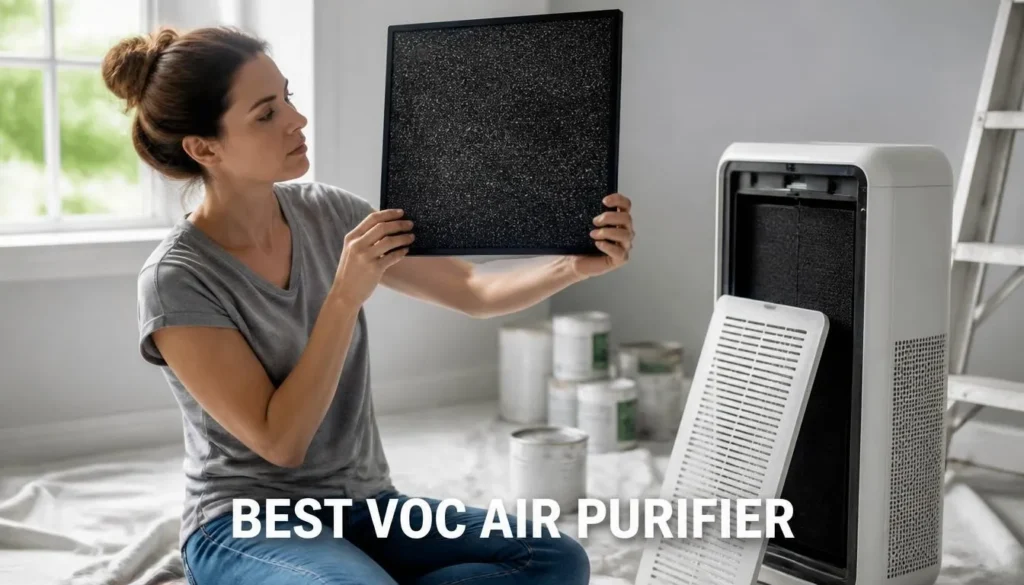

The best voc air purifier has a real activated carbon stage, because a HEPA filter alone catches particles and leaves gases untouched. VOCs come off paint, cleaning sprays and new furniture, and activated carbon or other suitable sorbents can capture some of them. How much carbon a unit holds is the spec that matters most.

We chose these seven by reading each maker's own description of its carbon stage and checking every model against the California Air Resources Board list of certified air cleaners. No maker here publishes its carbon weight, so we judged each unit by carbon type, replacement interval and independent certification.
My Recommended Top 3 Best-Buys for VOC Air Purifiers: Reviewed and Rated
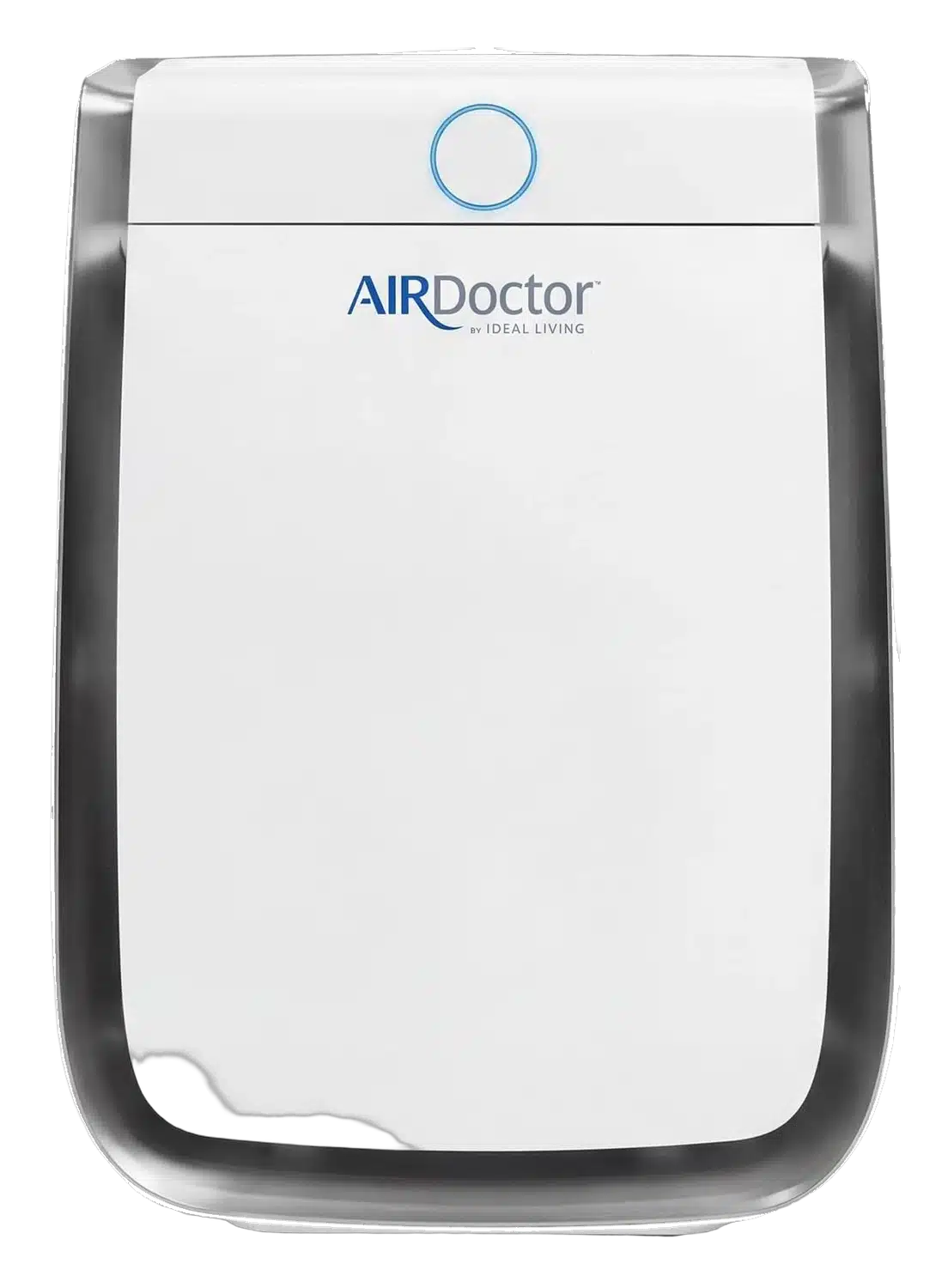
- The Premium Activated Carbon filter reduces gases, odors, cooking fumes and VOCs, according to the maker.
- The UltraHEPA filter captures 99.99% of particles at 0.003 micron, per the maker.
- The three-stage design places a pre-filter ahead of the carbon and UltraHEPA stages.
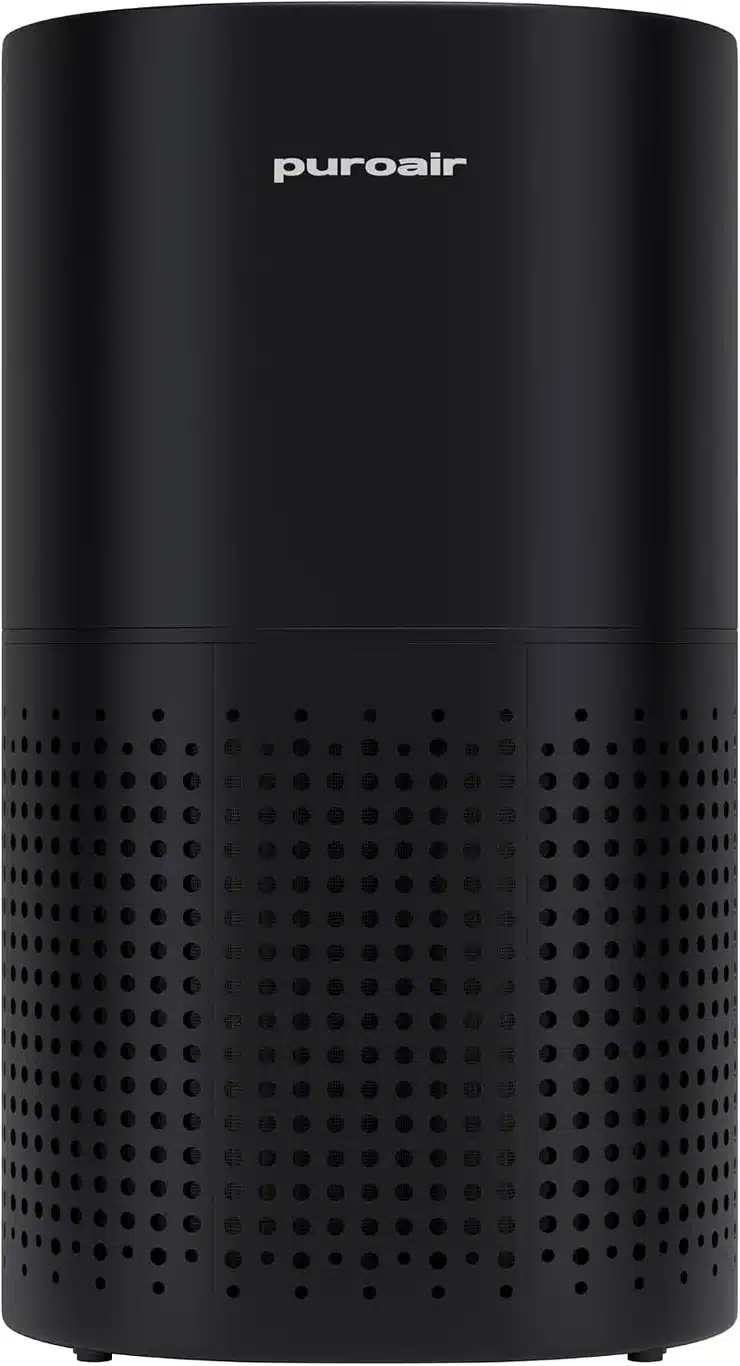
- The three-layer filter combines a pre-filter, a HEPA filter and activated carbon.
- The activated carbon layer is listed as reducing VOCs alongside dust, pollen, smoke and pet dander.
- The smart particle sensor raises fan power when it detects polluted air.
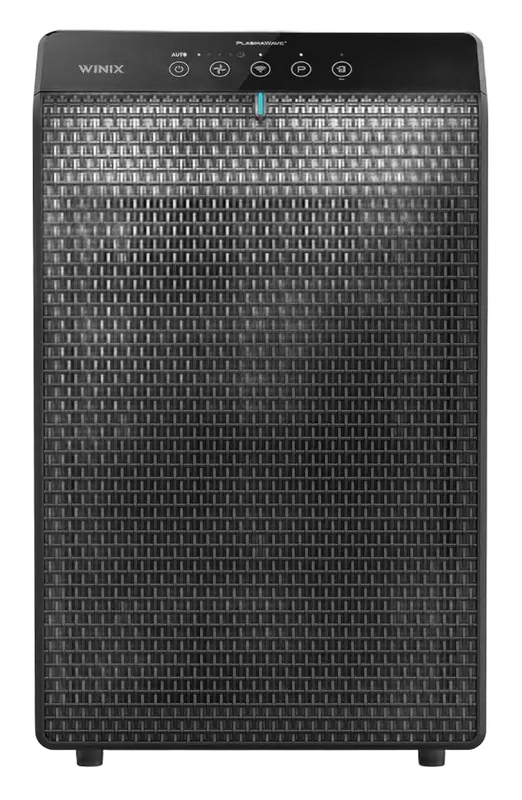
- The Advanced Odor Control Carbon Filter reduces VOCs and household odors from cooking, pets and smoke.
- The True HEPA filter captures 99.99% of particles down to 0.01 micron, per Winix.
- The washable fine mesh pre-filter catches the largest particles first.
Best VOC Air Purifier Reviews 2026: 7 Top Models for Gases
Each review covers the carbon stage, the particle filter, room coverage and the certifications we could verify. A CARB listing covers electrical safety and ozone limits, not gas removal, so read it as a safety floor rather than a VOC score.
1. AirDoctor AD3500 Air Purifier
The AirDoctor AD3500 Air Purifier is the only unit in our lineup with a dedicated chemical sorbent blend, which is why it opens this list. Its gas stage combines activated carbon with potassium permanganate to adsorb and break down gases instead of only trapping dust. We read that as the strongest VOC case among the mainstream purifiers we compared.
AirDoctor AD3500 Air Purifier Specs
| Best for | Medium to large rooms with heavy odor loads |
| Carbon stage | Premium Activated Carbon with potassium permanganate |
| Particle filter | UltraHEPA, 99.99% at 0.003 micron per the maker |
| Room coverage | Up to 2,520 sq ft per the title, roughly half that at 2 air changes an hour |
| Certifications | CARB listed, executive order G-23-273 |
| Filter change interval | Carbon every 6 months, UltraHEPA every 12 months |
| Weight | 24 lb |
Key Features
- The Premium Activated Carbon filter reduces gases, odors, cooking fumes and VOCs, according to the maker.
- The UltraHEPA filter captures 99.99% of particles at 0.003 micron, per the maker.
- The three-stage design places a pre-filter ahead of the carbon and UltraHEPA stages.
- Auto Mode with the Halo display reads PM2.5 and adjusts fan speed, with a Boost setting.
- The filter schedule calls for carbon every 6 months and UltraHEPA every 12 months.
What we noticed first is how clearly AirDoctor states its replacement cycle: carbon every 6 months and UltraHEPA every 12 months. That matters because carbon saturates, and a stated schedule lets you plan for the real running cost. Our team kept coming back to that transparency while comparing the lineup.
Coverage needs a careful read. The Amazon title says up to 2,520 square feet, while other retail pages list about 1,260 square feet at two air changes an hour. The lower figure describes air circulation at two changes per hour; it does not establish VOC-removal coverage, which also depends on the sorbent and the gas involved.
At 24 lb it is the heaviest unit on this list, so plan a permanent spot for it.
Why We Chose This
We chose it because its carbon is paired with a chemical sorbent, it holds a CARB listing, and its filter schedule is stated plainly. It is the strongest gas-focused option we could confirm among mainstream brands.
One honest limit: AirDoctor does not publish the carbon weight, so we cannot compare its bed size with the others.
Independent checks help here. We confirmed the AD3500 on the California Air Resources Board list under executive order G-23-273, which covers electrical safety and the ozone limit. That listing does not test gas removal, so we treat it as a safety result, not a VOC result. In our view the CARB listing for the AD3500 is a useful floor and nothing more.
Pros
- Carbon plus potassium permanganate gas stage
- UltraHEPA rated 99.99% at 0.003 micron
- Stated 6-month carbon replacement schedule
- CARB listed under G-23-273
- Auto Mode with color-coded air quality display
- Suited to medium and large rooms
- Quiet auto operation per the maker
Cons
- Premium tier cost and genuine filters only
- Carbon weight not published
Our concern is cost and track record. The AD3500 sits in the premium tier and has far fewer owner reports than the Winix or Levoit models, so long-term reliability data is thinner. Only genuine filters keep the third-party tested performance the maker describes, which ties you to its replacement supply.
Final Verdict
Buy the AD3500 if gas and odor control matter more than cost and you have a medium to large room. Plan for the 6-month carbon change and expect a heavy unit. It is the default recommendation for gases.
2. PuroAir 240 HEPA Air Purifier
Following the premium pick, the PuroAir 240 HEPA Air Purifier is the cheapest valid unit we found with a real activated carbon layer, which makes it our budget choice. It uses a pre-filter, HEPA filter and activated carbon, and the maker says it reduces VOCs. We see it as a sensible entry point rather than a heavy-duty gas remover.
PuroAir 240 HEPA Air Purifier Specs
| Best for | Budget buyers and bedrooms |
| Carbon stage | Activated carbon layer, weight not published |
| Particle filter | Pre-filter plus HEPA filter |
| Room coverage | Up to 1,000 sq ft per the listing |
| Certifications | CARB listed, G-21-288; listing also cites ETL, ISO and UL |
| Filter change interval | Not stated in the listing |
| Weight | 7.3 lb |
Key Features
- The three-layer filter combines a pre-filter, a HEPA filter and activated carbon.
- The activated carbon layer is listed as reducing VOCs alongside dust, pollen, smoke and pet dander.
- The smart particle sensor raises fan power when it detects polluted air.
- The built-in sleep mode suits bedrooms and round-the-clock running.
- The two-year warranty comes from a USA-based support team, per the maker.
What stood out to us is the certification list. PuroAir states CARB, ETL, ISO and UL, and we confirmed the CARB listing for the 240 under G-21-288; the others we did not check. For a budget unit that is a better paper trail than we expected.
On gas removal we are cautious. The listing says the unit reduces VOCs but does not state the carbon amount, and in our reading the carbon stage is thinner than the AirDoctor AD3500 Air Purifier sorbent blend. For light odors and everyday cooking smells it should help, while heavy paint or solvent fumes call for more carbon. For workshop fumes, see our best air purifier for garage picks.
PuroAir lists the unit at 14.2 inches tall, and the listing gives 7.3 lb, so it is easy to move between rooms.
Why We Chose This
We chose it because it is the lowest-cost unit with a real activated carbon stage, a CARB listing and a design built for round-the-clock use.
The compromise is the carbon stage, which is where VOC performance is won or lost.
The product title lists coverage of up to 1,000 square feet. We treat that as a one-hour style headline figure and suggest a bedroom or a small living room for gas control, since the air needs several passes through the carbon. In our comparison this is a common sizing trap with budget units.
Pros
- Activated carbon layer at a budget tier
- CARB listed under G-21-288
- Pre-filter, HEPA and carbon in one unit
- Sleep mode suits bedrooms
- Light at 7.3 lb
- Sensor raises fan speed automatically
- Two-year warranty
Cons
- Thinner carbon stage than the top picks
- Carbon replacement interval not stated
Filter upkeep matters on a budget machine. The listing does not state a carbon replacement interval, so check the maker's filter guidance before buying. Plan to replace the carbon on a regular schedule, because a saturated bed stops adsorbing gases.
Final Verdict
Pick the PuroAir 240 if you want a certified, quiet purifier with real carbon for bedroom odors and light VOCs, and you want to keep the cost down. Do not expect it to handle heavy fumes on its own. It is the budget entry point.
3. Winix 5520 Air Purifier
Next, the Winix 5520 Air Purifier earns our carbon filter label because, according to Winix, its odor stage uses carbon pellets rather than a thin coated mesh. The listing says the Advanced Odor Control Carbon Filter reduces VOCs and household odors from cooking, pets and smoke. It also adds True HEPA and a washable pre-filter.
Winix 5520 Air Purifier Specs
| Best for | Cooking, smoke and pet odors |
| Carbon stage | Odor control filter with carbon pellets, per Winix |
| Particle filter | True HEPA, 99.99% to 0.01 micron per the maker, plus washable pre-filter |
| Room coverage | About 392 sq ft by an AHAM-style figure; 1,882 sq ft in 1 hour per the title |
| Certifications | CARB listed, G-24-234; AHAM Verified per the maker |
| Filter change interval | Carbon approximately every 12 months per Winix, depending on conditions |
| Weight | 13.3 lb |
Key Features
- The Advanced Odor Control Carbon Filter reduces VOCs and household odors from cooking, pets and smoke.
- The True HEPA filter captures 99.99% of particles down to 0.01 micron, per Winix.
- The washable fine mesh pre-filter catches the largest particles first.
- Auto Mode with an air quality sensor adjusts fan speed in real time.
- The 23.5 dB lowest speed keeps it nearly silent in a bedroom, per the listing.
What we noticed in the Winix design is the light-triggered sleep mode, which drops the unit to its quiet setting when the room goes dark. For a bedroom unit that removes one more thing to adjust. Our team valued the 23.5 dB lowest fan speed for the same reason.
Sizing is where we part ways with the title. The Amazon title says up to 1,882 square feet in one hour, while third-party sites list an AHAM-style figure near 392 square feet. We use about 392 square feet, a third-party AHAM-style particle figure, rather than the one-hour number. It suits particle sizing better, but it does not establish gas-removal coverage.
At 13.3 lb it is easy to carry between rooms.
Why We Chose This
We chose it for the carbon pellet design, a CARB listing and a feature set that suits everyday cooking and pet odors.
Winix does not publish the carbon weight, so we cannot confirm the bed size.
Registry checks came back clean. We found the 5520 on the CARB list under G-24-234, and the listing and third-party sites also call it AHAM Verified, which we could not confirm in the AHAM directory. Treat the AHAM claim as maker-reported until you verify it yourself.
Pros
- Carbon pellet odor filter per Winix
- True HEPA down to 0.01 micron
- CARB listed under G-24-234
- Very quiet lowest speed
- Washable pre-filter cuts dust load
- Auto and light-based sleep modes
- Smart app control
Cons
- Real coverage far below the one-hour figure
- Carbon change interval not maker confirmed
Carbon replacement is the running cost to watch. Winix specifies approximately 12 months for the carbon and HEPA filters, and intervals vary with the environment. Heavy cooking, pets or heavy gas loads can exhaust carbon sooner.
Final Verdict
Choose the Winix 5520 if you want a proven carbon design for cooking, smoke and pet odors in a bedroom or mid-size room. Size it to about 392 square feet and plan for regular carbon changes. It is the carbon pellet pick.
4. Daikin MCB50YSAU Air Purifier
Stepping up on odor control, the Daikin MCB50YSAU Air Purifier layers pre-filters, a HEPA filter, a carbon filter and a UVC LED light. For small to mid-size rooms it is the best carbon air purifier for odor in our lineup, because it states a verified room size and a formaldehyde figure.
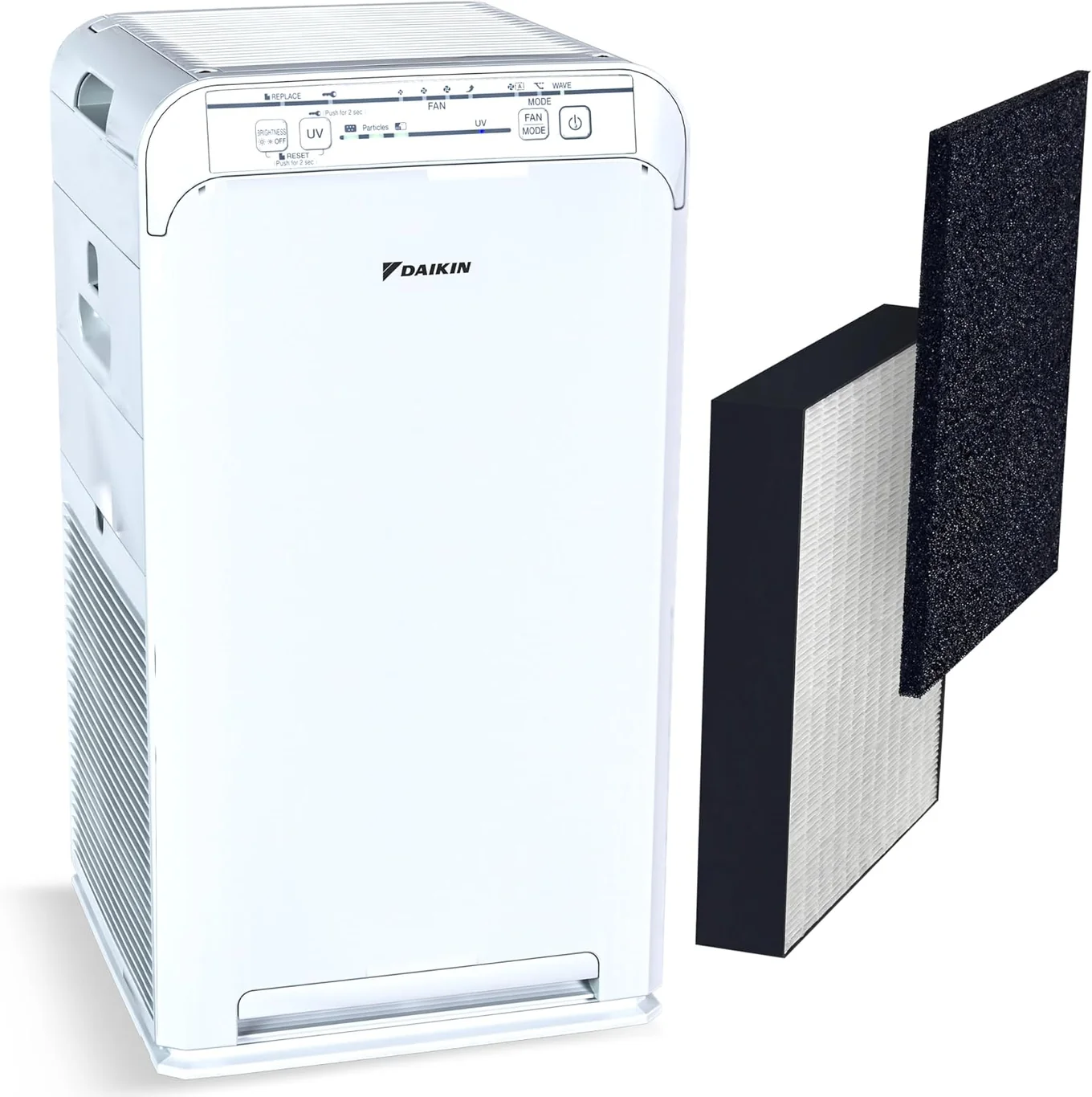
Daikin MCB50YSAU Air Purifier Specs
| Best for | Odors in small to mid-size rooms |
| Carbon stage | Carbon filter, weight not published |
| Particle filter | HEPA, 99.97% at 0.1 micron, plus pre-filters and UVC LED |
| Room coverage | 245 sq ft at 4.8 air changes, AHAM Verified per the listing |
| Certifications | CARB listed, G-22-270; AHAM Verified and Zero Ozone Product Certified per the maker |
| Filter change interval | Not stated in the listing |
| Weight | 15 lb |
Key Features
- The HEPA filter captures up to 99.97% of particles down to 0.1 micron.
- The carbon filter is listed for reducing odors from common household chemicals.
- The UVC LED light inactivates bacteria and viruses trapped in the HEPA filter, per the maker.
- The dust and odor sensors adjust operation without manual input.
- Quiet mode runs as low as 21 dB.
What caught our attention is the formaldehyde claim. The listing says the unit removes up to 50.3% of formaldehyde, a VOC, but it gives no test conditions. We read it as a useful signal, not a guarantee, and we would not rely on it for heavy formaldehyde sources.
Room sizing is among the clearest in our lineup. Daikin lists 245 square feet at 4.8 air changes as the AHAM Verified coverage, and up to 1,176 square feet in an hour. That makes it a small to mid-size room unit, not a whole-floor machine, and the honest figure is the first one.
At 15 lb with side handles, it moves easily between rooms.
Why We Chose This
We chose it for its stated formaldehyde figure, its AHAM-verified room size and its CARB listing, which together give more verifiable detail than most picks here.
The carbon weight is not published, so we judge the carbon by the listing.
Certifications are strong on paper. We confirmed the MCB50YSAU on the CARB list under G-22-270, and the listing adds AHAM Verified and Zero Ozone Product Certified status. We could not confirm the AHAM and zero-ozone claims in a registry, so we count them as maker-reported.
Pros
- Stated formaldehyde reduction figure
- AHAM Verified room size of 245 sq ft
- CARB listed under G-22-270
- Quiet mode as low as 21 dB
- Dust and odor sensors
- UVC LED adds a second stage
- Side handles for portability
Cons
- Limited coverage for large rooms
- Small owner base, no stated carbon interval
The caveat is track record. The Daikin has a much smaller owner base than the Winix and Coway units, so long-term filter and sensor reports are limited. The listing says both filters can be replaced at regular intervals but gives no carbon interval, so confirm it with Daikin.
Final Verdict
Choose the Daikin MCB50YSAU for a bedroom or small living room where odors are the main problem and you want verified sizing. It is a poor fit for a large open space. It is the odor control pick for small rooms.
5. Winix AT40 Air Purifier
From there, the Winix AT40 Air Purifier is our choice for buyers who want the best air purifier with carbon filter and HEPA filter in one unit for an extra large room, mainly because the maker includes two years of filters. The listing does not describe the carbon stage in detail, so we keep our VOC claims modest.
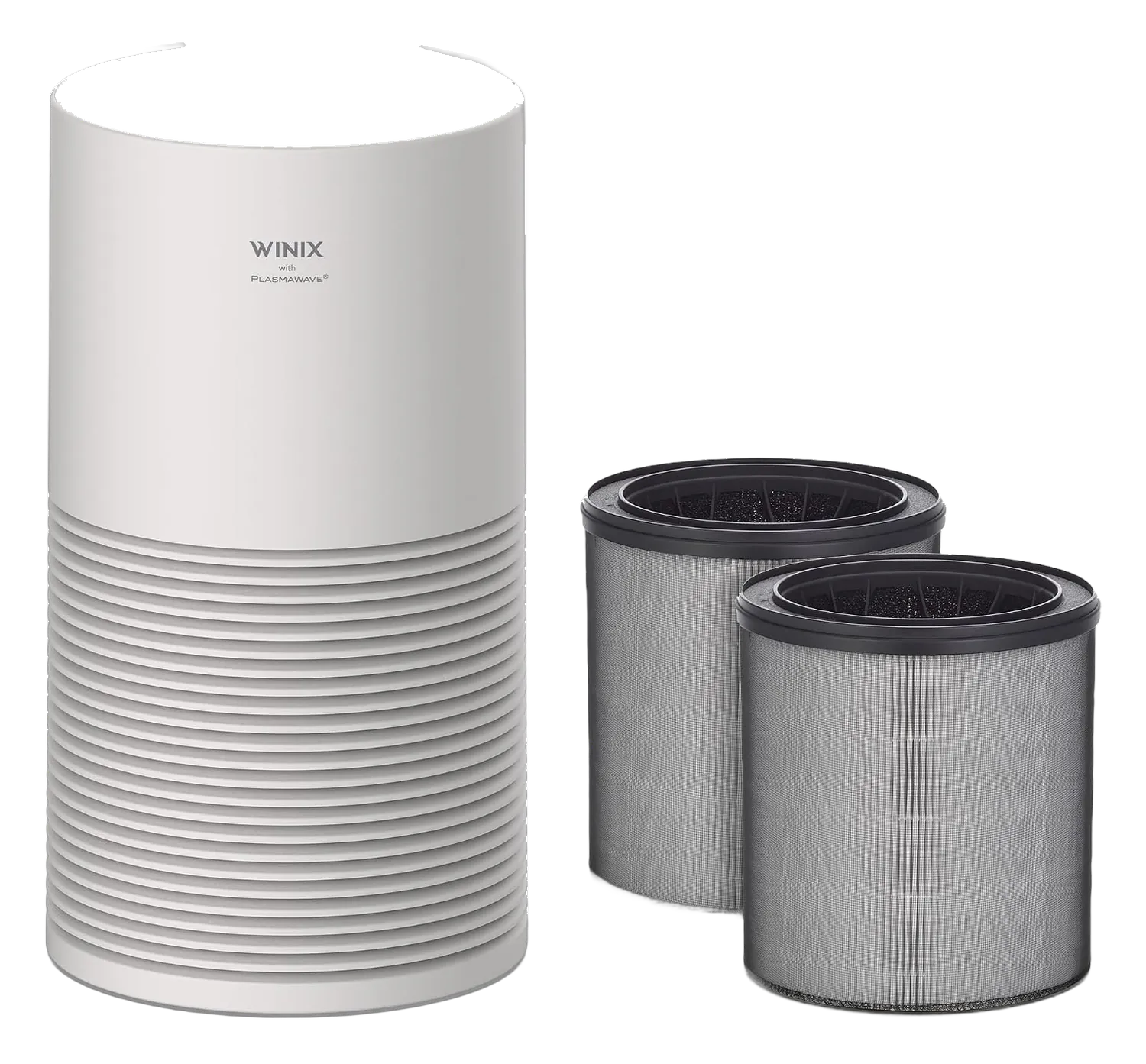
Winix AT40 Air Purifier Specs
| Best for | Extra large rooms and a long filter runway |
| Carbon stage | Carbon filter, not detailed in the listing |
| Particle filter | True HEPA, 99.99% to 0.01 micron per the maker |
| Room coverage | 410 sq ft AHAM Verifide per the maker; 1,968 sq ft in 1 hour |
| Certifications | CARB listed, G-26-150; AHAM Verifide per the maker |
| Filter change interval | Two years of filters included; interval not stated |
| Weight | 10.2 lb per Winix |
Key Features
- The AHAM Verifide coverage is listed at 410 square feet, with 1,968 square feet in one hour.
- The True HEPA filter captures 99.99% of particles down to 0.01 micron, per Winix.
- The carbon filter is named in the listing without further detail.
- The air quality display shows Good, Fair or Poor with blue, amber and red lighting.
- The Winix Smart App controls and monitors the unit over WiFi.
What we noticed is how little the listing says about the carbon. It names a carbon filter and stops there, so we cannot judge its size or type. Our team kept the claims about this unit modest for that reason.
The AT40 is brand new, with a first availability date in June 2026. That means no long track record with the filters, sensors or app. In our view a new model deserves less trust than the established Winix 5520 Air Purifier, and we would watch the first filter change closely.
It weighs 10.2 lb according to Winix.
Why We Chose This
We chose it for the two-year filter inclusion, the AHAM Verifide sizing claim and a CARB listing issued in June 2026.
The unknown is the carbon bed, which the listing never details.
Sizing follows the AHAM figure. Winix reports AHAM-verified particle-removal coverage of 410 square feet, with 1,968 square feet as the one-hour figure. Neither figure establishes VOC-removal coverage. Read the AHAM claim as maker-reported, because we could not confirm it in the directory. We did find the AT40 on the CARB list under G-26-150.
Pros
- Two years of filters included
- True HEPA down to 0.01 micron
- AHAM Verifide at 410 sq ft per the maker
- CARB listed under G-26-150
- Weighs 10.2 lb per Winix
- Color-coded air quality display
- App control over WiFi
Cons
- Carbon stage not described in the listing
- New model with no long track record
Running cost looks manageable at first, because two years of filters come in the box. The listing does not state the carbon change interval, but Winix lists a 12-month filter life, so check that against your own conditions before relying on it for gases.
Final Verdict
Pick the AT40 if you want carbon and True HEPA in a light unit with filters included, and you accept that its gas performance is unproven. For heavier VOC loads, the AirDoctor AD3500 Air Purifier is the safer choice. It is the long filter runway pick.
6. Coway Airmega Mighty2 Air Purifier
Next, the Coway Airmega Mighty2 Air Purifier is our large room pick, with a 2-in-1 HEPA and Active Carbon Max2 filter behind a washable pre-filter. The listing says it reduces more than 99.5% of volatile organic compounds and fumes such as ammonia and acetaldehyde, a maker claim with no stated test conditions.
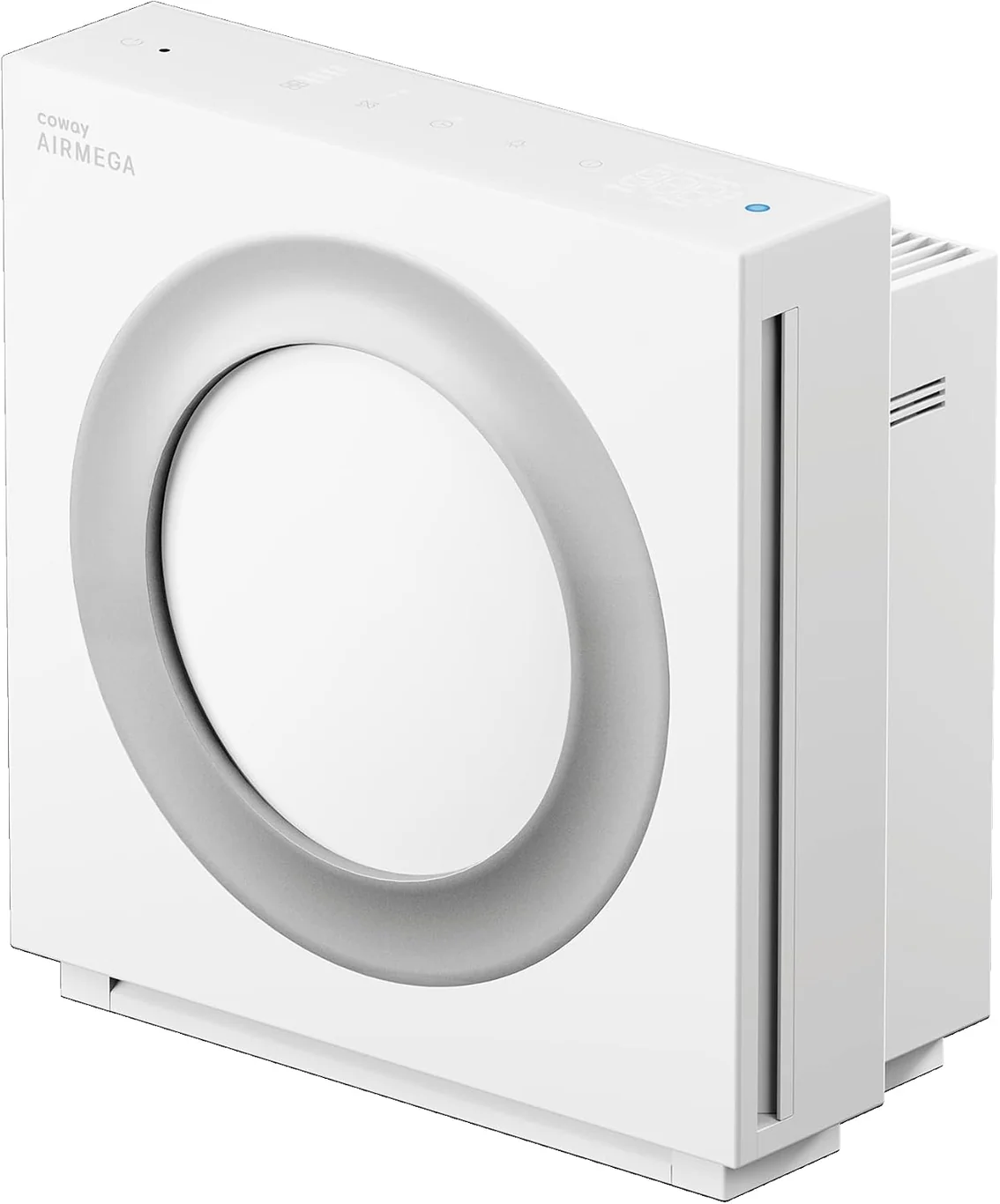
Coway Airmega Mighty2 Air Purifier Specs
| Best for | Large rooms and open living spaces |
| Carbon stage | Active Carbon Max2 built into the HEPA filter |
| Particle filter | 2-in-1 HEPA, 99.97% at 0.3 micron, plus washable pre-filter |
| Room coverage | Up to 1,800 sq ft per the listing |
| Certifications | CARB listed, G-26-042 |
| Filter change interval | Indicator shows remaining filter life; month interval not stated |
| Weight | 15.2 lb |
Key Features
- The 2-in-1 HEPA and Active Carbon Max2 filter combines particle and gas stages in a single filter.
- The HEPA layer reduces up to 99.97% of particles at 0.3 micron.
- The MegaScan laser sensor reads PM1, PM2.5 and PM10 in real time.
- The filter life indicator shows the remaining life of the pre-filter and the Max2 filter.
- The three-year limited warranty is longer than the two-year PuroAir cover.
What we noticed in the specs is the sleep mode. It runs as low as 19 dB, a light sensor triggers it when the room is dark, and the maximum draw is 56 W. That combination suits an always-on large room unit.
On the VOC claim we stay careful. The carbon sits inside the HEPA layer, so in our inference it is likely thinner than a bulk carbon bed. A figure of more than 99.5% without test conditions is a maker claim, not an independent result.
At 15.2 lb it is close in weight to the Daikin MCB50YSAU Air Purifier.
Why We Chose This
We chose it for large rooms, a clear filter life display and a long warranty. Its gas claim is the strongest on paper, though no test conditions are given.
The filter life indicator removes the guesswork about when to replace the Max2 filter.
Coway lists coverage up to 1,800 square feet. We treat that as a one-hour style figure, and we would size it for a living room or open plan space rather than a whole floor. We found the AP-1512N(W) on the CARB list under G-26-042, which covers safety and ozone only, and we did not claim an AHAM listing.
Pros
- Combined HEPA and Active Carbon Max2 filter
- Maker claims over 99.5% VOC reduction
- Covers up to 1,800 sq ft per listing
- Sleep mode as low as 19 dB
- Filter life indicator for both filters
- CARB listed under G-26-042
- Three-year limited warranty
Cons
- Carbon likely thinner than a bulk bed
- VOC claim has no stated test conditions
The unit is new, released in March 2026, so long-term filter data is thin. Replace the Max2 filter when the indicator reaches 0%, and wash the pre-filter on the same prompt. The listing does not state a month-based interval.
Final Verdict
Choose the Mighty2 for a large living space where you want a gas stage, a filter life readout and a long warranty. Treat its VOC claim as promising rather than proven. It is the large room choice.
7. Levoit Vital 200S-P Air Purifier
Last, the Levoit Vital 200S-P Air Purifier earns its place for pet households, and it is the weakest VOC performer on this list. As the best VOC air purifier for pets in our group, it wins on hair, dander and routine odor, not on heavy gas removal. Its U-shaped additional air inlet is built to trap pet hair and odors without clogging.
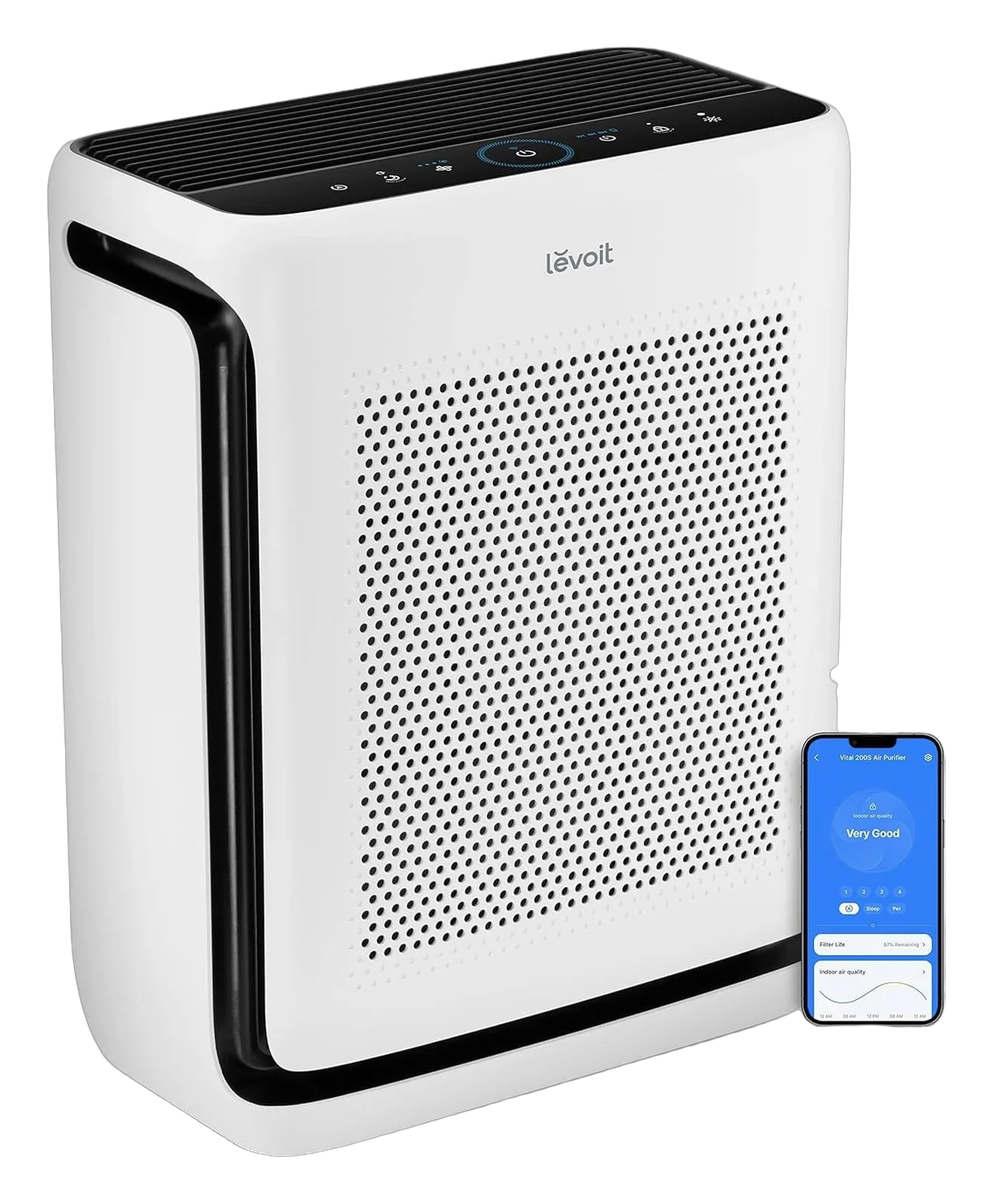
Levoit Vital 200S-P Air Purifier Specs
| Best for | Pet households and quiet bedrooms |
| Carbon stage | Carbon filter per the listing, not detailed |
| Particle filter | HEPA; CADR 250 smoke, 254 dust, 289 pollen CFM |
| Room coverage | Up to 1,875 sq ft per the listing |
| Certifications | CARB listed, G-22-455; AHAM Verifide per the maker |
| Filter change interval | Not stated in the listing |
| Weight | 13.2 lb |
Key Features
- The AHAM Verifide CADR figures are 250 CFM for smoke, 254 for dust and 289 for pollen, per the maker.
- The U-shaped additional air inlet traps pet hair and odors without causing clogs.
- The 27 dB bedroom mode keeps it quiet for sleep, per the listing.
- The air quality monitor shows room conditions at a glance.
- The large room rating is up to 1,875 square feet per the listing.
What we noticed is how the listing frames the unit. It talks about allergens, pet hair and dander, and never details the carbon stage. Our team read that as a sign this purifier is built around particles first.
Certified particle performance is its strength. The CADR figures of 250, 254 and 289 CFM are tested through AHAM per the maker, which gives clean numbers for sizing. For pet dander, dust and pollen that is a solid base.
At 13.2 lb it is manageable to move between rooms.
Why We Chose This
We chose it for pet households that need hair-friendly airflow, certified particle numbers and quiet bedroom running, with realistic VOC expectations.
Be clear on the limit: it is the weakest option here for VOCs.
We confirmed the LAP-V201S-WUS on the CARB list under G-22-455, which covers electrical safety and ozone emissions, not gas removal. The AHAM Verifide claim is maker-reported because we could not confirm it in the directory. If gases are your main worry, move up to the AirDoctor AD3500 Air Purifier or the Winix 5520 Air Purifier.
Pros
- AHAM Verifide CADR numbers per the maker
- U-shaped inlet traps pet hair
- 27 dB bedroom mode
- Covers up to 1,875 sq ft per listing
- CARB listed for the model sold
- Air quality monitor included
- Established model on sale since 2022
Cons
- Carbon stage not detailed in the listing
- Weakest VOC performance in this lineup
Pet odor is a mix of particles and gases. This unit handles the particles and some routine smell, but a heavy litter box or fresh paint may outpace it. Pair it with source control, and replace the filter according to the maker's guidance.
Final Verdict
Pick the Levoit Vital 200S-P if you live with pets, want verified particle numbers and need quiet bedroom running. Skip it if gases are the real concern. It is the pet household pick.
How to Choose the Best VOC Air Purifier
A purifier for gases is only as good as its carbon stage, and spec sheets rarely make that easy to judge. These six factors are the ones we weigh before recommending any unit, and each one explains what to look for and what to ignore.
Carbon stage size and type
In our experience the spec sheet only tells half the story. Carbon weight is the key VOC spec, because gas molecules stick to the carbon until it is full, and more carbon means more capacity.
Many listings promise the best air purifier with activated carbon filter performance, yet none of the makers in this roundup publishes a carbon weight in pounds or grams. Budget units tend to hold far less carbon than serious units.
The carbon types you will meet are:
- Coconut shell carbon: mostly microporous, which suits small VOC molecules.
- Carbon pellets or granules: a bulk bed holds more sorbent than a coated mesh, and Winix says its odor filter uses pellets.
- Thin carbon layers: carbon dusted on mesh or built into a HEPA sheet gives less capacity than a bulk bed.
- Potassium permanganate blends: AirDoctor adds it to its activated carbon, which its listing says helps break down gases and airborne chemicals.
All seven have CARB listings, but published carbon details and replacement guidance vary by model.
Room size and air changes per hour
What we found mattered more than the headline coverage was the number of air changes behind it. Many listings quote the area a unit cleans once in a full hour, which is a single air change per hour and slower than most buyers expect.
Rule of thumb: divide a one-hour coverage figure by the air changes per hour you want. Worked example: a unit listed for 1,200 square feet in an hour covers about 300 square feet at four air changes per hour.
The table shows the sizing figure we use for the units where sources disagree:
The Levoit Vital 200S-P Air Purifier lists a clean air delivery rate of 250 for smoke, 254 for dust and 289 for pollen, in cubic feet per minute. A verified delivery rate beats any one-hour coverage claim, but it describes particles, not gases.
| Model | Sizing figure we use | Where it comes from |
| AirDoctor AD3500 Air Purifier | About 1,260 square feet at two air changes per hour | Other retail pages; the Amazon title says 2,520 square feet |
| Winix 5520 Air Purifier | About 392 square feet | Third-party AHAM-style figure; the title says 1,882 square feet in one hour |
| Winix AT40 Air Purifier | 410 square feet | Maker-reported AHAM Verifide; the title says 1,968 square feet in one hour |
| Daikin MCB50YSAU Air Purifier | 245 square feet at 4.8 air changes per hour | AHAM Verified, per the listing |
Certifications that matter
Our quality floor here is a CARB listing, and all seven models appear on the California Air Resources Board list of certified air cleaning devices. CARB certifies electrical safety and an ozone emission limit of 0.050 ppm, not VOC removal.
Each badge covers a different claim:
- CARB listing: addresses electrical safety and limits ozone emissions from electronic air cleaners to 0.050 ppm; it does not certify zero ozone emissions or VOC removal.
- AHAM Verifide: verifies delivery rate and room size claims. Daikin, Winix AT40 and Levoit state it in their listings, and we treat those statements as maker-reported.
- Zero Ozone Product Certified: Daikin states it, and we treat it as maker-reported.
A certification only means something for the claim it covers, so match each badge to the job you need done.
Filter replacement cadence
Carbon saturates, and once it is full a unit keeps moving air without reducing gases. Replacement schedules vary by model and pollutant load: AirDoctor specifies 6 months for carbon, while Winix specifies approximately 12 months for the 5520, and heavy gas loads can exhaust carbon sooner.
The schedules we found are:
- AirDoctor AD3500 Air Purifier: carbon every 6 months and UltraHEPA every 12 months, per the listing.
- Winix 5520 Air Purifier: carbon and HEPA approximately every 12 months, depending on conditions, per Winix.
- Winix AT40 Air Purifier: the listing says it includes 2 years of filters, and Winix lists a 12-month life for its carbon and HEPA filters.
In our experience replacement filters are the real running cost of any carbon unit, so check the cost of the replacement set before you buy.
Noise at night
A purifier only cleans while the fan runs, so what we weigh is the noise at the speed you will actually use. A household that wants the best voc air purifier for allergies needs a model quiet enough to run all night on a low or middle speed.
The quietest settings the makers state are:
- Coway Airmega Mighty2 Air Purifier: sleep mode as low as 19 dB.
- Daikin MCB50YSAU Air Purifier: quiet mode at 21 dB.
- Winix 5520 Air Purifier: 23.5 dB on the lowest speed.
- Levoit Vital 200S-P Air Purifier: 27 dB in bedroom mode.
- AirDoctor AD3500 Air Purifier: described as quiet, with no decibel figure in its listing.
Bottom line: decibel figures are maker statements taken at the lowest speed, and gas removal happens at higher ones, so expect more noise when the sensor ramps up.
What a purifier cannot fix
No purifier replaces ventilation or removing the source. Formaldehyde needs specialized media, and a general carbon stage may reduce it only in part.
The Daikin MCB50YSAU Air Purifier listing claims it removes up to 50.3% of formaldehyde, but it gives no test conditions, so we treat that as a ceiling and not an expectation.
Our team kept coming back to one point: a purifier lowers the load of gases in a room, it does not clear their source.
Why a HEPA filter alone does not remove VOCs
A HEPA filter is a dense mat of fibers that traps particles such as dust, pollen and pet dander. VOCs are gases, so they pass straight through it.
Carbon works differently: gas molecules stick to its surface, a process called adsorption. A charcoal air purifier for home use is an activated carbon unit under another name, since activated carbon is made from charred material such as coconut shell.
Each stage has its own job:
- Pre-filter: catches hair and large dust before they reach the finer layers.
- HEPA: captures fine particles. AirDoctor lists UltraHEPA at 99.99% down to 0.003 micron, and Winix lists True HEPA at 99.99% down to 0.01 micron.
- Carbon: adsorbs gases and odors until it is full.
A true carbon air purifier holds a deep bed of carbon pellets or granules rather than a thin carbon-dusted mesh. No maker here publishes its bed weight, so we cannot confirm that any of these seven meets that standard.
Fix the source before you filter the air
The EPA says indoor VOC levels can be up to 10 times higher than outdoors, which is why source control comes first. Paint, solvents, cleaning sprays and new furniture release the most.
Three habits cut the load before any filter does:
- Ventilate: open windows during and after painting or heavy cleaning.
- Store smart: keep paints and solvents outside the living space.
- Air out new items: let new furniture off-gas in a ventilated room before you settle it into the bedroom.
In our experience a purifier works best as the second line of defense: ventilate first, filter second.
My Overall Verdict
After weighing carbon design, certifications and upkeep, we kept the shortlist to three units that suit different buyers. Each pick names the same product as its Top 3 card and its review, so you can jump straight to the full write-up.
- AirDoctor AD3500 Air Purifier [Best Overall] - Activated carbon with potassium permanganate, UltraHEPA and a 6-month carbon cycle.
- PuroAir 240 HEPA Air Purifier [Best Budget] - A budget-tier unit with a pre-filter, HEPA, activated carbon and a CARB listing.
- Winix 5520 Air Purifier [Best Carbon Filter] - A carbon pellet odor filter per Winix, True HEPA and a 23.5 dB lowest speed.
Choose the AirDoctor AD3500 Air Purifier if gas control is the priority and you can accept a premium tier. Choose the PuroAir 240 HEPA Air Purifier if budget limits the decision, and the Winix 5520 Air Purifier if you want a carbon filter built from pellets plus smart auto mode.
No maker here publishes its carbon weight, so read every VOC claim as a maker statement.
Match the unit to the room and the gas source, and the AirDoctor AD3500 Air Purifier is the best voc air purifier of the seven for most homes.
Why AirDoctor AD3500 Air Purifier Might Be the Best Choice
The AirDoctor AD3500 Air Purifier is the only unit in our selection with a dedicated chemical sorbent blend, which is why it ranks first. Its carbon filter combines activated carbon with potassium permanganate to handle gases, odors and wildfire smoke.
The trade-off is that it sits in the premium tier, it has far fewer reviews than the PuroAir or Winix units, and it does not publish its carbon weight. Its coverage claim also differs by source, so size the room with the lower figure.
What earns it first place:
- Carbon blend: activated carbon plus potassium permanganate for gases, odors and VOCs.
- UltraHEPA: captures 99.99% of particles down to 0.003 micron.
- Clear cycle: carbon every 6 months and UltraHEPA every 12 months.
- CARB listing: executive order G-23-273 for the AD3500.
- Auto mode: PM2.5 sensors and the Halo light adjust the fan, with quiet operation described by the maker.
SHOP ON AMAZONAvailability and current price shown on Amazon
FAQs
What is the best voc air purifier for a home?
The best voc air purifier for a home is one that pairs a substantial activated carbon stage with HEPA and is sized for your room. In our selection, the AirDoctor AD3500 Air Purifier is the strongest match for gases because its carbon filter blends activated carbon with potassium permanganate and sits beside UltraHEPA.
Do air purifiers remove VOCs?
Air purifiers remove VOCs only when they include a carbon or other sorbent stage, because HEPA filters capture particles rather than gases. Carbon fills up over time, so you need to replace that stage on the maker's schedule, and sooner after heavy use, to keep gas removal working properly in your home.
How often should you replace a carbon filter in a VOC air purifier?
Replacement timing depends on the model and the gas load, so follow your own unit's manual rather than a generic schedule. AirDoctor specifies 6 months for its carbon stage, and Winix specifies approximately 12 months for the 5520, with intervals varying by environment and heavy gas exposure exhausting carbon sooner.
Is a carbon air purifier safe if it is CARB certified?
A carbon air purifier that is CARB certified has met California's electrical safety rules and an ozone limit of 0.050 ppm. CARB certification does not establish zero ozone emissions or gas-removal performance, so you still need to judge the carbon stage and filter schedule yourself.
How big a room can a voc air purifier handle?
A VOC air purifier can handle the room size that its maker or AHAM verification states at a given number of air changes, not the one-hour figure in many product titles. Those AHAM ratings describe particle removal, not VOC removal, so gas performance also depends on the sorbent amount, the gas type and the pollutant load.
References:
- US EPA, Volatile Organic Compounds' Impact on Indoor Air Quality, https://www.epa.gov/indoor-air-quality-iaq/volatile-organic-compounds-impact-indoor-air-quality
- US EPA, Air Cleaners and Air Filters in the Home, https://www.epa.gov/indoor-air-quality-iaq/air-cleaners-and-air-filters-home
- California Air Resources Board, List of CARB-Certified Air Cleaning Devices, https://ww2.arb.ca.gov/list-carb-certified-air-cleaning-devices
- AHAM Verifide program, https://ahamverifide.org
Medical Disclaimer: This content is for informational purposes only. It is not a substitute for professional medical advice, diagnosis, or treatment. If you have concerns about your water quality or air quality and their effects on your health, consult a qualified healthcare professional.
Affiliate Disclosure: As an Amazon Associate, Puritisimo may earn a commission from qualifying purchases made through links on this page, at no additional cost to you. Our recommendations are independent and editorial.