


The best air quality monitor tells you when to open a window, but it does not clean the air. Three of the four monitors here centre on CO2, with temperature and humidity (and pressure on the Aranet4), and one adds particles and gases, so the right choice depends on what you want to watch for.

We sorted the four by what each one measures, how it is powered and how it alerts you. If you want an air quality monitor for home use, that order shows quickly whether you need a CO2 tracker, an all-in-one unit, a portable meter or an app-connected display.
My Recommended Top 3 Best-Buys for Air Quality Monitors: Reviewed and Rated
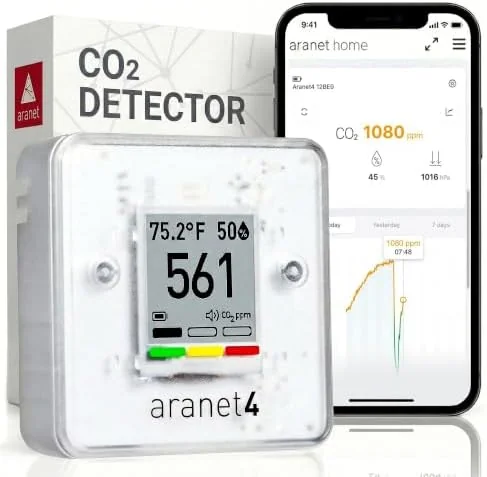
- The NDIR CO2 sensor is the technology behind the maker-stated +/-(30 ppm + 3% of reading) accuracy.
- The e-ink display shows a large, color-coded CO2 number, with an optional buzzer for high readings.
- Two included AA batteries power it without a cable, and the listing describes multi-year battery life.
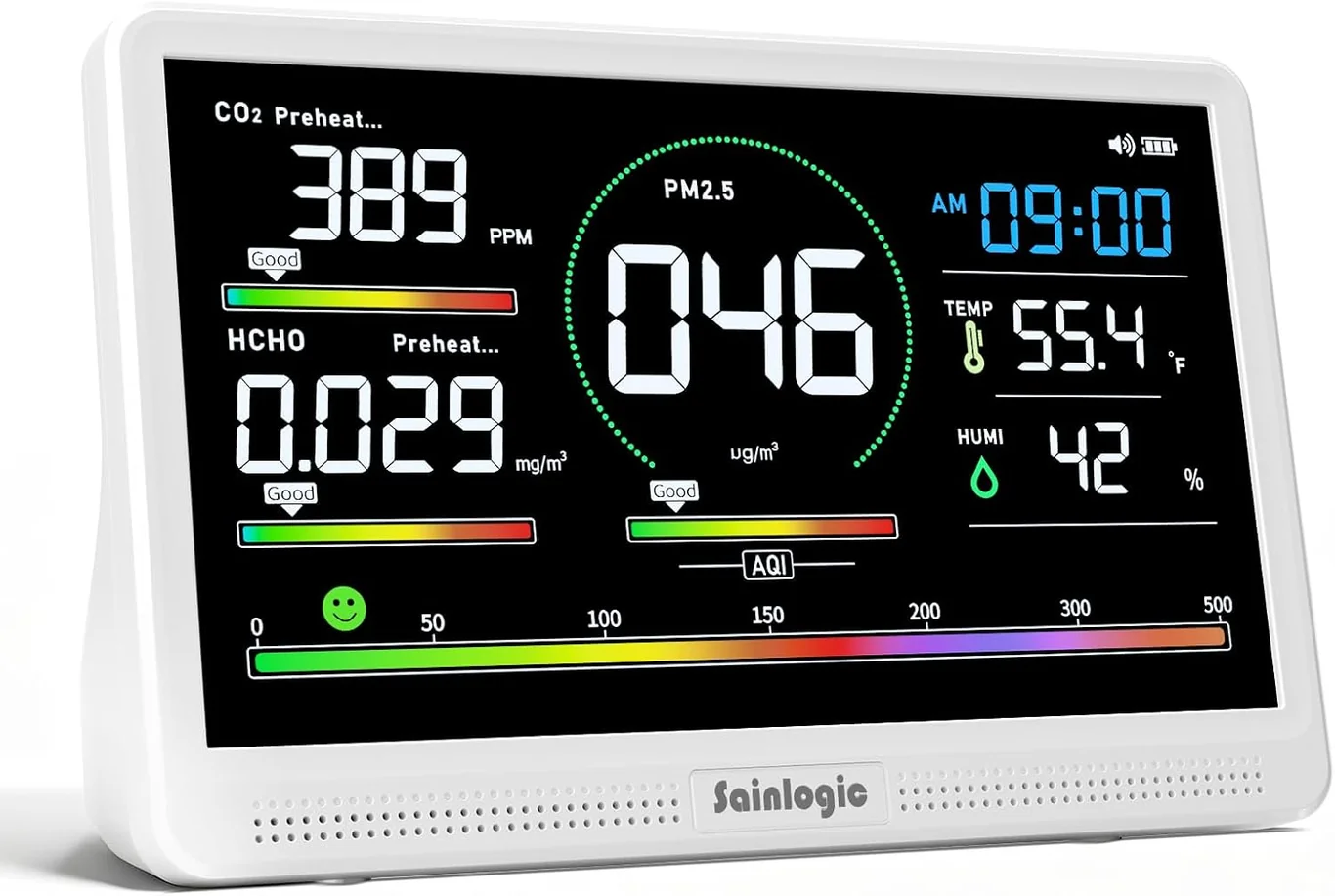
- The nine listed parameters cover CO2, particles, formaldehyde, TVOC, temperature and humidity.
- Seven user-defined alert thresholds set when the tri-color LED and display warn you.
- The 7-inch screen has three brightness levels and switches to the brightest when an alert triggers.
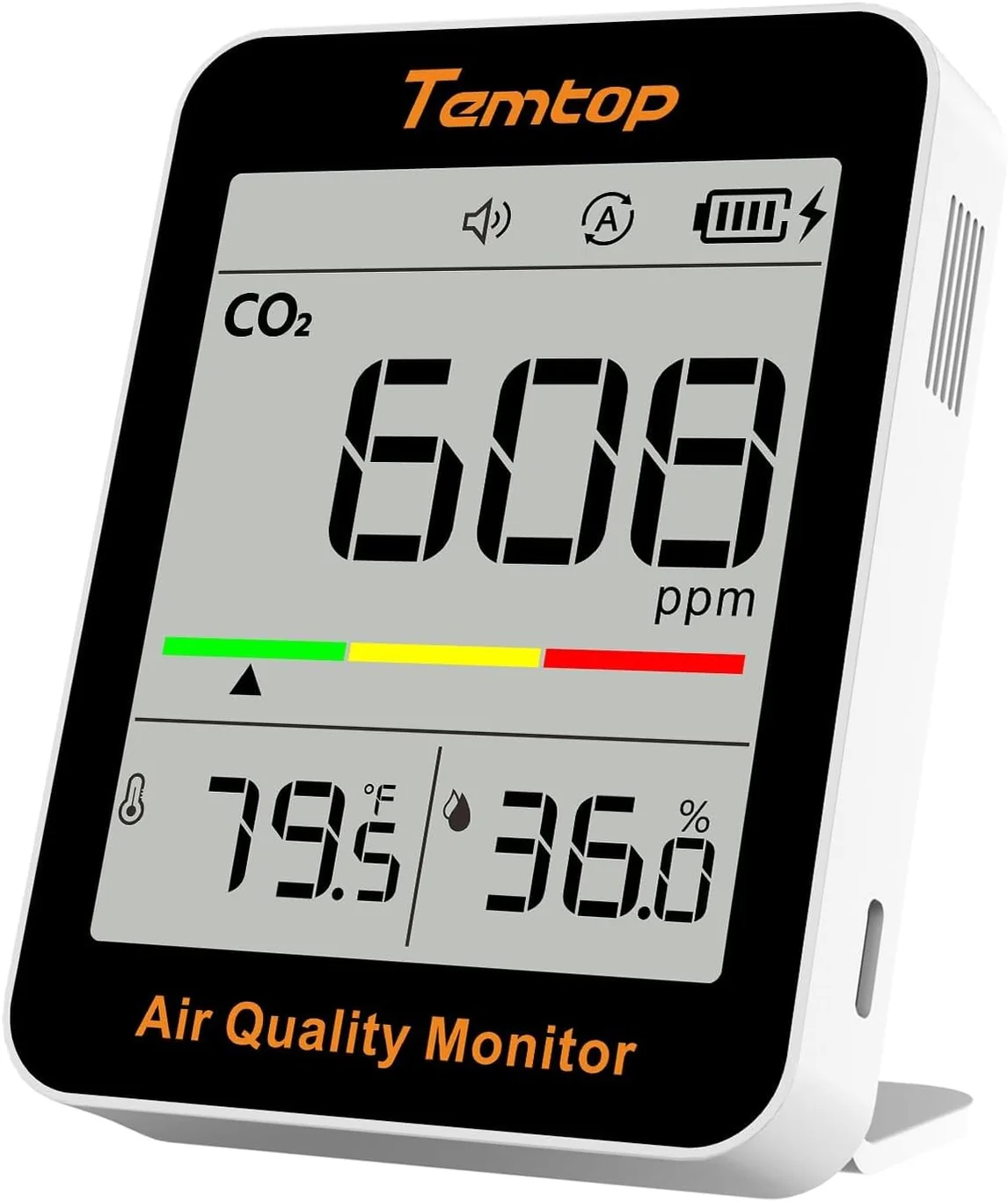
- A photoacoustic CO2 sensor (the Sensirion SCD41, per the listing) gives a stated +/-(40 ppm + 5% of reading) from 400 to 2500 ppm.
- It has 1 ppm resolution and refreshes every five seconds while charging; on battery, CO2 sampling occurs every minute in Performance mode or every ten minutes in power-saving mode.
- The alarm and display light can both be switched off for night use.
Best Air Quality Monitor Reviews 2026: 4 Top Models for Home and Office
The four are different jobs: a precise CO2 tracker, an all-in-one particle and gas unit, a portable meter and an app-connected display. Anyone setting up an office air quality monitor will find that the order below shows which job each unit does and where it falls short.
1. Aranet4 Indoor Air Quality Monitor
The Aranet4 earns the top spot because it does one job and states its limits: NDIR CO2 sensing with a maker-stated accuracy of +/-(30 ppm + 3% of reading). It also reads temperature, humidity and atmospheric pressure. It does not measure particles or VOCs, and we say so plainly.
Aranet4 Indoor Air Quality Monitor Specs
| Sensors | CO2, temperature, humidity, atmospheric pressure |
| CO2 Sensor Type | NDIR (nondispersive infrared) |
| Stated CO2 Accuracy | +/-(30 ppm + 3% of reading) (maker datasheet) |
| Power | 2 AA batteries (included) |
| Connectivity | Free smartphone app; no Wi-Fi listed |
| Display | E-ink, color-coded CO2 number |
| Alerts | Optional buzzer and color coding |
Key Features
- The NDIR CO2 sensor is the technology behind the maker-stated +/-(30 ppm + 3% of reading) accuracy.
- The e-ink display shows a large, color-coded CO2 number, with an optional buzzer for high readings.
- Two included AA batteries power it without a cable, and the listing describes multi-year battery life.
- The free app shows up to 90 days of history as graphs.
- Four readings cover CO2, temperature, relative humidity and atmospheric pressure.
Setup is simple: insert the batteries and the CO2 number appears on the display. Our read of the listing is that the color coding makes the reading easy to judge from across a room, which helps when you only want a yes or no on ventilating.
Our read of the maker datasheet is that the air quality monitor sensor is the real strength here: an NDIR cell with a stated range of 0 to 9999 ppm, calibrated from 0 to 5000 ppm. That is a better-documented claim than most listings in this group make.
Our one flag: no particle or VOC sensing, so smoke and dust are invisible to it.
Why We Chose This
It has the best-documented CO2 accuracy of the four, an e-ink display that needs no cable and an app with 90 days of history. Pick it when a trustworthy CO2 reading matters most.
The datasheet says long-term drift matters, so check it against a second reading now and then.
Battery claims need care. The listing claims up to four years of battery life. Actual runtime depends on the measurement interval and battery type.
Pros
- Maker-stated CO2 accuracy of +/-(30 ppm + 3%)
- NDIR CO2 sensing
- Cable-free e-ink display
- Color-coded CO2 reading
- Free app with 90 days of history
- Also reads pressure, temperature and humidity
- Made in the European Union
Cons
- No particle or VOC sensing
- Premium price tier
Next to the other units here, the Aranet4 asks you to pay for a documented, narrow-purpose CO2 reading instead of a longer list of sensors. In our view that trade is worth it when the goal is knowing when a bedroom or home office needs fresh air, because CO2 is the number that tracks ventilation.
Final Verdict
The Aranet4 is the most credible CO2 monitor in this group, with a clear accuracy statement and a display that needs no app. Choose it for ventilation, not for smoke or dust. It is the default recommendation for CO2 tracking.
2. Sainlogic All-in-1 Wireless Air Quality Monitor
Following the top pick, the Sainlogic is the affordable air quality monitor for anyone who wants nine readings in one unit: CO2, PM2.5, PM10, PM1.0, AQI, formaldehyde, TVOC, temperature and humidity. It is the only one of the four that reports particles and gases.
Sainlogic All-in-1 Wireless Air Quality Monitor Specs
| Sensors | CO2, PM2.5, PM10, PM1.0, AQI, HCHO, TVOC, temperature, humidity (listing) |
| CO2 Sensor Type | Not stated on the listing |
| Stated CO2 Accuracy | Not stated on the listing |
| Power | Built-in 2500 mAh battery, USB-C charging, up to 8 hours per charge |
| Connectivity | None needed; no app or Wi-Fi |
| Display | 7-inch screen, 3 brightness levels, tri-color LED |
| Alerts | 7 user-defined thresholds; audible alarm can be muted |
Key Features
- The nine listed parameters cover CO2, particles, formaldehyde, TVOC, temperature and humidity.
- Seven user-defined alert thresholds set when the tri-color LED and display warn you.
- The 7-inch screen has three brightness levels and switches to the brightest when an alert triggers.
- No app or Wi-Fi is needed, so the unit works as soon as it is powered on.
- The built-in 2500 mAh battery charges over USB-C and runs up to 8 hours per charge.
Operation is plain: power it on and it starts reading, with a one-touch reset for recalibration and an alarm you can mute. We read this as a monitor built to sit in one room and be glanced at, not one to carry around all day.
Particle readings are the reason to pick it. PM2.5 and PM10 are the figures that matter for smoke, and none of the other three monitors reports them. If you want an air quality monitor for wildfire smoke, this is the only unit of the four that can show a rise, though its particle accuracy is unverified.
Our one flag: no maker datasheet gives CO2, particle or gas accuracy.
Why We Chose This
It is the only unit in our group that reports particles, formaldehyde and TVOC alongside CO2, which makes it the best value for breadth of readings. Treat the numbers as indicative until you check them against a second device.
The listing quotes accuracy for temperature and humidity only, not for the gas or particle sensors.
Dust is a good use case. An air quality monitor for dust needs a particle sensor, and the PM10 and PM2.5 readings are what a dusty room needs. We would use it to compare rooms and watch trends, not to quote exact concentrations.
Pros
- Nine readings in one unit
- Only unit here that reports PM2.5 and PM10
- Reports formaldehyde and TVOC
- Seven user-set alert thresholds
- Large 7-inch screen
- No app or Wi-Fi setup
- USB-C rechargeable
Cons
- Gas and particle accuracy not stated
- About 8 hours of battery per charge
As the best budget air quality monitor in this group on breadth, it trades certainty for coverage. The listing is new, with a short track record behind it, so we would give it a second reading beside a trusted device before relying on it.
Final Verdict
The Sainlogic is the broadest sensor package here and the only one that sees particles. Use it plugged in, keep expectations modest on accuracy and verify it against a second reading. It is the broad but unproven all-in-one option.
3. Temtop Portable CO2 Monitor
Stepping down in size, the Temtop suits anyone who wants an air quality monitor portable enough to move between a nursery, an office and a classroom. It weighs 4.96 ounces and reads CO2, temperature and humidity.
Temtop Portable CO2 Monitor Specs
| Sensors | CO2, temperature, humidity |
| CO2 Sensor Type | Photoacoustic (Sensirion SCD41, per the listing) |
| Stated CO2 Accuracy | +/-(40 ppm + 5% of reading), 400 to 2500 ppm (listing) |
| Power | Battery; USB cable included; plugging in advised for real-time mode |
| Connectivity | No app or Wi-Fi mentioned |
| Display | Screen with illumination that can be turned off |
| Alerts | Buzzer alarm that can be turned off |
Key Features
- A photoacoustic CO2 sensor (the Sensirion SCD41, per the listing) gives a stated +/-(40 ppm + 5% of reading) from 400 to 2500 ppm.
- It has 1 ppm resolution and refreshes every five seconds while charging; on battery, CO2 sampling occurs every minute in Performance mode or every ten minutes in power-saving mode.
- The alarm and display light can both be switched off for night use.
- The slim body and bracket allow desk, shelf or wall placement.
- A USB cable is included, and the listing advises keeping the unit plugged in for real-time monitoring.
The listing describes a 70-day standby battery but also advises plugging the unit in for real-time mode. We read that as a monitor that can run on battery for portable checks and works best on a cable.
It is a compact air quality monitor, with a metal and plastic enclosure and a mounting bracket. The listing and the maker list different dimensions, so check the size before you buy. That makes it easy to park on a shelf or hang on a wall in a school or nursery.
Our one flag: it cannot detect carbon monoxide, as the listing itself says.
Why We Chose This
It is a low-cost portable CO2 meter with a clearly stated accuracy figure, a named sensor family and a night mode. Pick it when you want to carry a CO2 reading between rooms.
The listing names the sensor differently in two places, so confirm the sensor type before you buy.
For sleep use the fix is simple. Turn off the buzzer and the display light and the unit becomes a quiet bedroom check. The trade-off is that without the alarm you must look at the screen to catch a high reading.
Pros
- Stated CO2 accuracy figure
- Photoacoustic sensor named in the listing
- Light and easy to carry
- Mounting bracket included
- Alarm and display light can be turned off
- 5-second refresh while charging
- Metal and plastic enclosure
Cons
- Best used plugged in
- No app or Wi-Fi mentioned
The Temtop and the Aranet4 do the same job, but the Temtop states a wider error band of +/-(40 ppm + 5% of reading). In our view that is acceptable for room-level ventilation checks, as long as you treat the number as a guide.
Final Verdict
The Temtop is the easiest CO2 monitor to move between rooms, with a clear accuracy statement and a quiet mode. Keep it on a cable for steady readings. It is the portable pick for room-to-room CO2 checks.
4. GoveeLife Smart Air Quality Monitor H5140
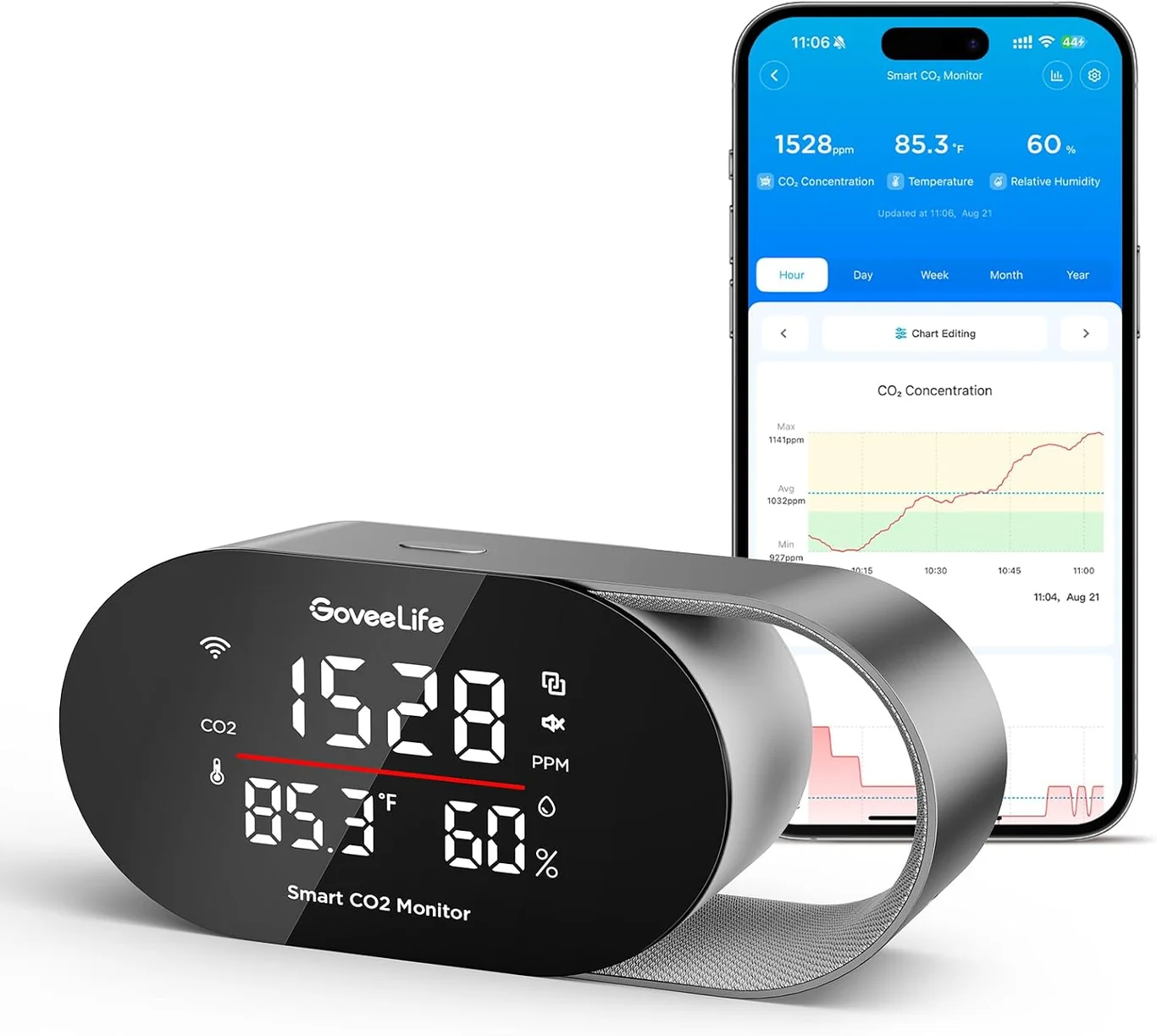
Last, the GoveeLife is a smart indoor air quality monitor for a household that already lives in an app. It shows CO2, temperature and humidity on a 4.82-inch display and sends alerts to your phone.
GoveeLife Smart Air Quality Monitor H5140 Specs
| Sensors | CO2, temperature, humidity; clock needs the app |
| CO2 Sensor Type | CO2 sensor (type not stated by the maker) |
| Stated CO2 Accuracy | +/-(40 ppm + 5% of reading) (manual-style source) |
| Power | AC power through a Type-C cable; no battery |
| Connectivity | App and cloud alerts; Alexa and Google Assistant queries |
| Display | 4.82-inch screen with tri-color light bar |
| Alerts | Buzzer, app notifications and email reports |
Key Features
- A 4.82-inch display shows CO2, temperature and humidity, with a clock that needs the app.
- Three alert types cover a buzzer, app notifications and email reports.
- Up to two years of history sit in the app, with CSV export.
- Alexa and Google Assistant can read out the CO2 level, and the Govee app links the monitor with humidifiers and tower fans.
- AC power through a Type-C cable allows 24/7 monitoring with no batteries.
The tri-color light bar follows a day and night brightness schedule set in the app, so it can dim for a bedroom. We read the schedule as the practical reason to choose it for a nursery or sleeping space.
The air quality monitor app is where this model differs most from the others. History up to two years with CSV export goes far beyond the 90 days on the Aranet4, and the email reports suit a shared household.
Our one flag: it needs mains power and reads CO2 only.
Why We Chose This
It is the one monitor here built around alerts and smart-home links, with long app history and voice queries. Choose it if you want a permanent, plugged-in unit in a room.
The listing says software update support is unknown, so do not count on future features.
Connectivity is app and cloud based, and the listing does not state the network band, so check your router setup before you buy. We would also not expect it to link to an air purifier, since the listing says purifiers cannot reduce CO2 and are not supported.
Pros
- Large 4.82-inch display
- Three alert types
- Two years of app history with CSV export
- Alexa and Google Assistant queries
- Links with humidifiers and tower fans
- Day and night brightness schedule
- Runs 24/7 with no batteries
Cons
- Needs mains power, no battery
- CO2, temperature and humidity only
The GoveeLife suits a fixed spot such as a desk or bedside table. A mains cable and an app account are the requirements for its alerts, so it is a poor fit for carrying between rooms.
Final Verdict
The GoveeLife is the best fit for a connected home that wants alerts and long history for CO2. Skip it if you need a battery unit or particle sensing. It is the plugged-in smart option.
How to Choose the Best Air Quality Monitor
A monitor is only useful if it measures the thing you worry about. Start with the pollutant, then check the sensor, the power source and the alerts. In our experience the spec sheet only tells half the story, so the sections below say what to look for and what each reading cannot tell you.
Which pollutants it measures
In our experience the first question is the pollutant, not the brand. Three of the four monitors here centre on CO2, with temperature and humidity (and pressure on the Aranet4), and CO2 is a ventilation signal, not a measure of pollution.
A small room with closed windows is where CO2 climbs fastest. If you are choosing an air quality monitor for apartment living, a CO2 reading tells you when to open a window, while particles and gases need a different sensor. For a dedicated CO2 reading, see our best CO2 monitor picks.
The list below matches each reading to the job it does:
- CO2: a ventilation signal that rises when people breathe in a closed room.
- PM2.5 and PM10: fine particles from smoke, dust and cooking.
- HCHO and TVOC: formaldehyde and volatile organic compounds, reported only by the Sainlogic.
- Temperature and humidity: context that affects comfort and the risk of damp.
CO2 sensor type and stated accuracy
NDIR and photoacoustic sensors both use infrared light to detect CO2, and both are common in this category. The Aranet4 states +/-(30 ppm + 3% of reading), while the Temtop states +/-(40 ppm + 5% of reading), and a manual-style source gives the same for the GoveeLife. The Sainlogic does not state a CO2 accuracy.
Our quality floor here is a stated accuracy figure: a monitor that quotes no CO2 error band gives you nothing to check it against. The Aranet4 datasheet also notes that long-term drift must be considered.
This ventilation guide shows commonly cited bands, not medical limits:
| CO2 reading | What it usually means |
| About 420 ppm | Typical outdoor air |
| 420 to 1,000 ppm | A normal indoor range with some ventilation |
| Above 1,000 ppm | Many guides suggest opening a window or adding fresh air |
Particle and VOC sensing
Only one of the four measures particles, so this factor decides more than any other whether a monitor can warn you about smoke or dust. PM2.5 means particles of 2.5 micrometers or smaller, the size class the US EPA sets air quality standards for.
Households that want an air quality monitor for allergies should look for PM2.5 and PM10 readings, but a particle reading does not identify the allergen. Pollen, pet dander and dust all register as particles.
VOC readings are indicative. The US EPA notes that volatile organic compounds come from a wide range of household products, so a TVOC number is a trend, not a diagnosis. In our experience a rising trend after cleaning or painting is the useful signal.
Power source and portability
Battery, rechargeable and mains units suit different rooms. The Aranet4 runs on two AA batteries, the Temtop runs on a battery but works best plugged in, the Sainlogic lasts up to 8 hours per charge, and the GoveeLife needs mains power.
Match the power source to where the unit will sit:
- Set and forget: the Aranet4, with replaceable AA batteries.
- Carry and charge: the Sainlogic and the Temtop, which move between rooms.
- Fixed spot: the GoveeLife, which needs an outlet.
We would pick power by how often you plan to move the unit, because a monitor you must recharge often is easy to forget.
App, Wi-Fi and alerts
Alerts are the point of a monitor, and they come in three forms: a display color, a buzzer and a phone message. Only the GoveeLife sends app notifications and email reports. The Aranet4 uses a Bluetooth app for history, and the Sainlogic needs no app at all.
If you want an air quality monitor wifi setup that sends alerts, be precise about what that means. The GoveeLife listing points to a cloud connection through its app but does not state the network band, so confirm your router supports it.
A smart indoor air quality monitor adds convenience, not accuracy. Voice queries and app history do not make the CO2 reading more exact, so judge the sensor first and the app second.
What an air quality monitor can and cannot tell you
A monitor shows a number for the air around it, and nothing more. It cannot clean the air, and it cannot find the source of a problem. In our experience the useful habit is to read the trend and then act, by opening a window or running a purifier.
None of these four detects mold, so there is no best air quality monitor for mold in this group. A humidity reading above about 60 percent is a risk indicator, not proof of mold.
Carbon monoxide needs its own safety device. If you are shopping for a carbon monoxide air quality monitor, note that CO2 and carbon monoxide are different gases, and none of these four detects carbon monoxide. Install a dedicated CO alarm.
Particle and VOC readings from low-cost units are indicative, and every sensor drifts over time. Compare your monitor with a second reading, such as an outdoor reading or another device, every few months. If CO2 stays high, look at ventilation and add outdoor air when conditions allow. For persistent particle pollution, reduce the source and consider suitable particle filtration, which is a separate buying decision.
My Overall Verdict
We ranked these four by what each measures, how well the maker documents it and how easy it is to live with. The Aranet4 leads on CO2 accuracy, the Sainlogic on breadth and the Temtop on portability.
- Aranet4 Indoor Air Quality Monitor [Best Overall] - an NDIR CO2 monitor with a maker-stated accuracy of +/-(30 ppm + 3% of reading) and an e-ink display
- Sainlogic All-in-1 Wireless Air Quality Monitor [Best Budget] - the only unit of the four that reports particles, formaldehyde and TVOC, though its accuracy is unverified
- Temtop Portable CO2 Monitor [Best Portable] - a slim CO2, temperature and humidity meter with a stated accuracy figure and a quiet night mode
The GoveeLife is our pick for a plugged-in, app-connected room, but it ranks fourth because it reads CO2 only and needs mains power. Match the monitor to the pollutant you want to watch, not to the longest feature list.
If you need particle readings, choose the Sainlogic and check it against a second device.
If you only need to know when to ventilate, the Aranet4 or the Temtop does that job, because the best air quality monitor is the one that measures what you are worried about.
Why Aranet4 Indoor Air Quality Monitor Might Be the Best Choice
The Aranet4 takes the top spot because it pairs NDIR CO2 sensing with a stated accuracy of +/-(30 ppm + 3% of reading). That is a clear, checkable claim, and it comes from the maker datasheet.
The trade-off is that it reads CO2, temperature, humidity and pressure only, so it cannot warn you about smoke, dust or formaldehyde. If particles matter more to you than ventilation, the Sainlogic is the better fit.
What stands out:
- NDIR CO2 sensing: the maker uses nondispersive infrared technology.
- Stated accuracy: +/-(30 ppm + 3% of reading) on the maker datasheet.
- Multi-year battery: two AA batteries are included, and the maker lists battery life in years.
- E-ink display: a color-coded CO2 number that needs no cable.
- App history: the free app shows up to 90 days of data.
SHOP ON AMAZONAvailability and current price shown on Amazon
FAQs
What is the best air quality monitor for a home?
The best air quality monitor for a home is the one that measures what you want to watch, and for most households that is CO2. The Aranet4 gives the clearest CO2 accuracy claim, while the Sainlogic adds particles and gases if you also want PM2.5 and VOC readings in the same unit.
Do you need a monitor with a PM2.5 sensor?
You need a monitor with a PM2.5 sensor only if smoke, dust or cooking fumes are your main concern in the rooms you want to check. Of the four here, only the Sainlogic reports PM2.5, while the Aranet4, Temtop and GoveeLife measure CO2, temperature and humidity and serve as ventilation checks.
Can an air quality monitor detect carbon monoxide or mold?
No, an air quality monitor of the type reviewed here cannot detect carbon monoxide or mold, and none of the four models we cover does either. Carbon monoxide needs a dedicated alarm, and a humidity reading only shows whether conditions favor mold, not whether mold is actually present in your home.
What CO2 level means a room needs fresh air?
A room needs fresh air when CO2 climbs well above the outdoor level of about 420 ppm, and many guides flag readings above 1,000 ppm. Treat that as a ventilation cue rather than a health limit, and see the CO2 sensor section of the buyer's guide for the bands we use.
How accurate are consumer air quality monitors?
Consumer air quality monitors state accuracy mainly for CO2, such as +/-(30 ppm + 3% of reading) for the Aranet4 and +/-(40 ppm + 5% of reading) for the Temtop. Treat particle and VOC readings as indicative only, and compare any unit with a second device or an outdoor reading whenever possible.
References:
- Aranet4 HOME datasheet (CO2 range 0-9999 ppm, accuracy +/-(30 ppm + 3% of reading), NDIR): https://pro.aranet.com/downloads/aranet4-datasheet
- Sensirion SCD4x datasheet (photoacoustic NDIR CO2 sensor family): https://sensirion.com/resource/datasheet/scd40/scd41
- US EPA, Particulate Matter (PM2.5) Air Quality Standards: https://www.epa.gov/naaqs/particulate-matter-pm-air-quality-standards
- US EPA, Volatile Organic Compounds' Impact on Indoor Air Quality: https://www.epa.gov/indoor-air-quality-iaq/volatile-organic-compounds-impact-indoor-air-quality
Medical Disclaimer: This content is for informational purposes only. It is not a substitute for professional medical advice, diagnosis, or treatment. If you have concerns about your water quality or air quality and their effects on your health, consult a qualified healthcare professional.
Affiliate Disclosure: As an Amazon Associate, Puritisimo may earn a commission from qualifying purchases made through links on this page, at no additional cost to you. Our recommendations are independent and editorial.